She Disguised Herself as Plain to Drive the Mountain Man Away — Then He Asked Her to Be His Wife

—
PART 1
Independence Creek didn’t smell like a town. It smelled like a wound — mud and manure, tobacco spit and the sour tang of twenty women’s fear, all of it pressed together under a sky the color of a bruise.
Aara Vance stood in the line with the others, arms wrapped around herself, and told her body to stop shaking. The wind coming down off the peaks had teeth in it. Winter was two weeks out, maybe less, and everyone in this territory understood what that meant for a woman without a husband, a home, or a trade.
It meant the auction.
They called it a *pairing ceremony*, because Mayor Jediah Cone liked the sound of decency even when he had none to spare. Underneath the churchy language, it was exactly what it looked like — men paying a fee to the town council for the right to take a wife up into the hills before the snow sealed the passes. Widows of the wagon trail. Daughters with no fathers left to protect them. Women whose only crime was surviving something that had killed everyone around them.
Aara had survived something too. Six weeks ago she’d been a school teacher’s daughter in Ohio, the kind of girl bankers’ sons wrote poems about. Now she was a name on a wanted poster, and the last thing on earth she needed was a man looking closely enough to recognize her.
So she’d made sure no one would.
An hour before the auction, in the shadows behind the livery, she’d mixed fireplace ash with axle grease and painted a false scar down the side of her face. She’d knotted straw and burrs into her golden hair until it looked like something living had died in it. She’d tied a rag tight around her calf, and practiced, again and again, the exact drag of a ruined leg.
*Keep your head down. Look sick. Look useless. Look like nothing worth taking.*
It worked beautifully. A young miner took one glance at her ash-blackened cheek and the way her shoulder sagged and nearly tripped over himself getting to the next woman in line. Aara let herself breathe. If this kept up, she’d be handed off to scullery work in the boarding house — brutal, unpaid, but *safe*. Invisible. Alive.
What she didn’t know was that a pair of eyes further down the boardwalk had already marked her for a different reason entirely — not her face, not her limp, but the fact that when the mayor’s men shoved the woman beside her, that woman had flinched and begged. Aara hadn’t begged. She’d gone very still instead, the way a rabbit goes still when a hawk’s shadow crosses the ground, calculating rather than pleading. It was a small thing. Most men wouldn’t have noticed it at all.
Elias Quincaid noticed everything.
The noise of the crowd died before she saw him. It didn’t fade — it *stopped*, all at once, like a held breath, and in the silence Aara heard something she would remember for the rest of her life — slow, heavy footfall on the boardwalk, thud by thud, each one landing like a verdict.
A woman two places down whispered the name before Aara even turned her head.
*Elias Quincaid.*
They called him the bear of Blackwood Ridge. The stories came fast and ugly — that he’d killed a man barehanded for kicking a dog, that he hadn’t spoken a civil word to another soul in ten years, that whatever wife he took wouldn’t be a wife at all, just a body to skin his kills and haul his firewood until the mountain finished what the isolation started.
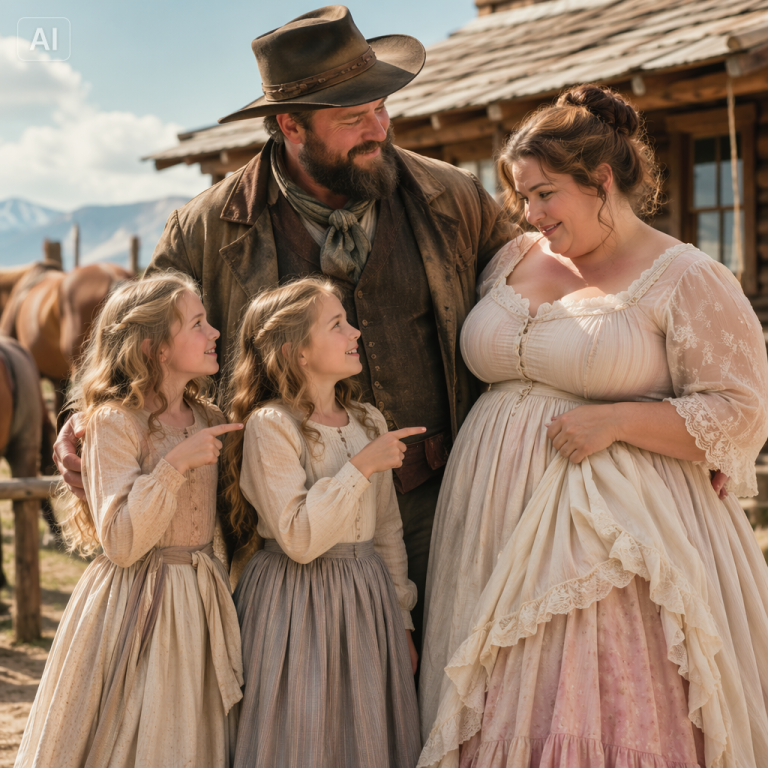
He came around the corner in a coat made from an actual grizzly hide, a rifle slung easy across one shoulder like it weighed nothing, and Aara understood, looking at him, why grown men in this town stepped into the mud to avoid his shadow.
He didn’t grab chins. He didn’t check teeth like the other men had. He simply walked the line, slow, his gaze moving over each woman — not appraising their bodies, she realized with a start, but watching how they *moved*. Who cringed. Who calculated. Who was performing something.
He stopped in front of Aara.
She let her body do everything she’d rehearsed — the sagging shoulder, the dragging foot, a low unintelligible sound in her throat. *Don’t look at me. See the sickness. See the ugliness. Walk away like all the others.*
He didn’t walk away. He tilted his head slightly, studying her the way a man studies a locked door he suspects isn’t actually locked.
The silence stretched so long that Mayor Cone finally stepped in, wringing his hands, pointing a gloved finger at her like she was something to be apologized for. *Surely not that one. Half-witted. Crippled. Likely carries a disease with a face like that.* He tried to steer the giant toward another woman — someone with *strong hips*, he said, like Aara wasn’t standing close enough to hear herself discussed like livestock.
Elias Quincaid turned his head toward the mayor. He didn’t say a word. He didn’t have to. Whatever the mayor saw in that look made him snap his mouth shut and take a step back like he’d been struck.
Then Elias turned back to her.
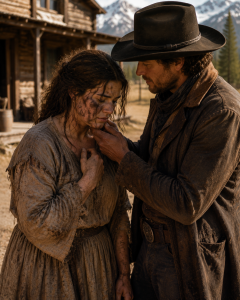
He reached out — a hand the size of a shovel blade, scarred and rough — and Aara flinched, certain, in the half-second before it landed, that this was where the blow finally came.
Instead his fingers closed gently under her chin. He tilted her face up into the gray light, studying the ash, the tangled hair, the vacant look she forced into her eyes.
She waited for disgust.
He leaned down instead, and when he spoke, his voice was pitched low enough that only she could hear it — not the rumble of a man announcing a purchase, but something quieter. Almost a question.
*”You weren’t afraid of being ugly,”* he said. *”You were afraid of being seen.”*
Aara’s breath caught. It wasn’t an accusation. It wasn’t even entirely certain. It was a man testing a theory out loud, watching her face for the flicker that would confirm it.
She gave him nothing. She was too well trained for that.
He straightened. *”Pack your things,”* he said, louder now, for the crowd.
The crowd gasped as one. Mayor Cone sputtered that she was broken, useless, a bad bargain — and Elias answered him not with words but with a leather pouch, dropped heavy into the mayor’s open palm, the unmistakable clink of gold coins silencing every objection in the square.
*”She’s mine,”* he said.
Aara felt the blood drain out of her face beneath the ash. He hadn’t looked through her disguise entirely. He’d looked through one small corner of it — enough to know she was hiding something, not enough, yet, to know what. And somehow that half-knowledge was worse than being fully caught, because now she’d be riding for hours into the mountains beside a man who intended to keep looking.
—
PART 2
He put her on the back of a black draft horse like she weighed nothing, wrapped his own bear-hide coat around her shivering shoulders without being asked, and told her, in a voice with no cruelty in it at all, *”Dead wives are bad luck.”*
Aara didn’t know if it was a joke. She didn’t know anything about this man except what the whole territory whispered in fear, and none of it matched the stranger riding ahead of her into the treeline, silent, watchful, giving up his own warmth to a woman he’d bought like a sack of grain at auction.
By the time they reached the cabin, dusk had eaten the last of the light off the peaks. Aara expected a hovel — something that matched the legend. What she found instead was a solid, well-kept structure with swept floorboards, shelves lined with preserved peaches and venison, a fire already laid, and an entire wall — an entire *wall* — of books. Shakespeare. Dickens. Philosophy she recognized from her father’s own shelves back in Ohio.
A savage didn’t read Plato.
He set a plate of bacon and cornbread in front of her and told her to eat. Aara, still committed to her act, reached for the food with a clumsy, childlike grab.
*”Use the fork, Aara,”* he said. Quiet. Certain.
The cornbread crumbled in her fingers. She hadn’t told a single soul in this territory her real name.
*”How—”* she started, before she caught herself.
*”Mayor’s ledger,”* he said simply, tapping a folded paper against the table before sliding it across. *”He records every woman’s name when the fee’s paid, in case a husband dies and he needs to know who’s left. I read it while you were being loaded onto the horse.”*
It was, she understood a half-second later, a small mercy — an honest answer instead of letting her believe he’d read her like scripture. But the paper he’d slid across wasn’t the ledger page. It was a wanted poster. Her own face, crudely sketched but recognizable, staring back up at her. *Grand larceny and arson. Reward: $500. Fled the estate of Judge Ambrose Thorne, St. Louis.*
*”That one I found nailed to the trading post door,”* he said. *”Before the auction. I wasn’t looking for you specifically. I was looking for anyone worth five hundred dollars who might be foolish enough to stand in that line.”*
The act was over. There was no point in keeping it up anymore — not with the truth sitting on the table between them like a loaded gun.
She stood, spine straight now, ash-smeared face blazing with something closer to fury than fear. *”You’re going to turn me in?”*
He didn’t answer the way she expected. He picked the poster back up, held it to the fire, and let it curl to ash in his hand — the only leverage he had over her, burned without a second thought.
*”Judge Thorne is my father,”* he said. *”And if you burned down his carriage house, you and I have something in common.”*
Aara stood frozen at the edge of the firelight, the warmth of the cabin fighting the cold still locked in her bones, staring at the broad back of a man who had just destroyed the one thing that could have bought her freedom back to St. Louis and traded it for nothing.
The monster wasn’t a monster. He was the exiled son of the man she’d fled — and that meant, somewhere behind them on the mountain trail, the real danger hadn’t even started climbing yet.
—
PART 3
The fire popped once, sharp as a gunshot, and neither of them moved.
Aara stood with the wanted poster’s ashes drifting toward the chimney, watching a man the whole territory called a beast turn his back to her and calmly stir a skillet, as if he hadn’t just burned five hundred dollars of leverage over her head without blinking.
“Wash your face,” he said, not turning around. “There’s warm water in the basin. You look ridiculous.”
She went. Not because he’d ordered it — because her hands were shaking too hard to argue, and scrubbing something clean felt like the only useful thing left to do with them. The cloth came away black with grease and ash, and beneath it, in the cracked little mirror propped against the wall, a face she barely recognized looked back. Pale. Frightened. Still, underneath all of it, alive.
“My leg isn’t crippled,” she said to his back, testing the words in her own voice for the first time in hours.
“I guessed as much on the ride up,” he said, without turning. “You didn’t favor it climbing off the horse. You only remembered to drag it once you thought I was watching.”
She didn’t sleep that first night so much as endure it, curled on the rug with a poker iron gripped in both fists, certain he’d come for her once the cabin went dark. He didn’t. He threw a quilt over her, grunted *suit yourself*, and climbed into the bed alone, snoring within minutes like a man with nothing on his conscience.
By the third night, the cold coming up through the floorboards had beaten her pride. She woke to find herself lifted — poker iron and all — and deposited unceremoniously on the far side of the mattress.
“Stay on your side,” he mumbled, already turning his back to her again. “You have cold feet.”
That was the arrangement, unspoken and absolute. They slept back to back, a wall of silence between two people who understood almost nothing about each other except that neither one intended to explain themselves first.
—
**A LIFE BUILT FROM WORK, SILENCE, AND SMALL LESSONS**
The days that followed taught Aara more about survival than four years of finishing school ever had, and they taught her slowly, in the way real skill is taught — not in a single dramatic burst, but stitched together out of a hundred ordinary mornings she wouldn’t understand the value of until much later.
Elias Quincaid did not believe in idle hands, hers least of all. He was up before the gray light touched the ridge, checking trap lines, splitting wood, patching the places winter would try hardest to break in. He didn’t want a servant warming his cabin. He made that clear the first morning he pressed a heavy Colt Dragoon into her palm.
“Can you shoot?”
“I was a school teacher,” she said, eyeing the revolver like it might go off on its own. “I taught Latin, not ballistics.”
“Latin won’t stop a cougar.” He adjusted her grip without asking permission, his hands rough and sure over hers. “Aim. Squeeze. Don’t jerk.”
It was in the second week, not the first, that she found herself standing over the cabin’s storeroom door one frost-bright morning, watching him work a stuck padlock with nothing but a bent nail and a patience she hadn’t credited him with.
“The hinge pins rusted before the lock did,” he said, not looking up. “Half the locks on this mountain are like this. Learn the shape of the mechanism, not the shape of the key.” He held the nail out to her. “Try it.”
She fumbled it for twenty minutes before the tumbler gave, and when it finally clicked open she felt an absurd, disproportionate pride that made him almost smile.
“Storeroom’s not exactly a bank vault,” he said.
“No,” she agreed. “But I’d like to know how, regardless.”
He didn’t ask why. She didn’t offer. But after that he left small locked things around the cabin without comment — a chest, a shed latch, an old strongbox with nothing inside it — and she picked at them in idle hours the way another woman might have taken up needlework, until her fingers stopped shaking over the work and started listening to it instead.
He taught her to skin a rabbit without puncturing the gut sack, to tell which mountain berries would break a fever and which would stop a heart in an hour, to read the woodsmoke on the wind for a stranger’s fire two ridges over before the stranger ever knew he’d been seen. In the evenings, while the wind climbed the ridge and threw itself against the log walls, he read — Dumas, mostly, a battered copy of *The Count of Monte Cristo* he clearly knew half by heart.
It was on one of those nights, the wind howling like something with a grudge, that Aara finally asked the question she’d been carrying since the wanted poster burned to nothing in his hand.
“Why did you leave St. Louis? If you’re a Thorne, you were rich.”
Elias didn’t look up right away. When he did, the firelight had found the gray in his beard, and his voice, when it came, had dropped an octave into something older and harder.
“I didn’t leave. I was exiled.” He turned a page he wasn’t reading. “My father has a particular view of the world. He believes the law is a tool for the strong to use against the weak. I disagreed with my fists. Broke his jaw.”
“You hit a federal judge.”
“He wasn’t a judge yet. Just a man who liked beating my mother.” His hand tightened on the book’s spine until his knuckles paled. “She died. He remarried inside a week. There was a foreman on the estate, a man named Purdy, who tried to speak up about what happened to her at the inquest. My father had him arrested inside a month on a manufactured theft charge and hanged him before spring. Just to prove no one else would try it.” His jaw worked. “That’s the kind of honest man my father is. I came up here, where the only law left is nature’s. A bear doesn’t kill you because it hates you, Aara. It kills you because it’s hungry. It’s honest. My father was never honest — he was thorough. Why did you run? The poster said arson.”
She stared into the flames instead of at him, the weight of what he’d just told her settling somewhere she’d think about long after this conversation ended.
“He tried to take the schoolhouse. Wanted the land for a new courthouse. Raised the rent until we couldn’t pay it, and when I protested, he made — other suggestions. About how the rent might get paid instead.” Her voice didn’t shake, but it came close. “I went to the carriage house to confront him. He laughed. Locked the door on me. I lit a lantern to find a way out and knocked it over. The hay caught.” A beat. “I didn’t mean to burn it down. But when I saw the flames catch, I didn’t try very hard to stop them either.”
Elias nodded once, slow, like a man weighing a verdict and finding it just.
“Good,” he said.
—
**WOLVES AT THE FENCE LINE**
The quiet between them had just begun to feel like something other than a truce when a sound outside shattered it — a high, thin whine, then a bark that rolled off the mountainside like thunder.
Elias was on his feet before Aara had finished flinching, the Winchester already in his hands. “Stay here,” he ordered, and was gone into the snow before she could argue.
She didn’t stay. She grabbed the Colt he’d given her and went to the window instead, and what she saw in the pale wash of moonlight stopped her heart — a wolf pack, gaunt and winter-starved, circling the horse corral where his two black draft animals screamed and kicked against the fence rails.
Elias strode into the open, a single huge shape against the white, and fired. The lead wolf dropped. But there were too many of them, and when they broke off the horses and came for the man instead, Aara understood, with a clarity that felt like falling, that she was not going to survive losing him.
She didn’t think. She didn’t plan. She kicked the door open and ran barefoot into the freezing dark, raised the Colt the way he’d taught her — *aim, squeeze, don’t jerk* — and fired at the animal tearing at his boot. It yelped and fell back. She fired again into the air, the report cracking off the canyon walls like cannon fire, and in the half-second of confusion that bought him, Elias surged up out of the snow with a roar that didn’t sound entirely human, cracked his rifle stock across a wolf’s jaw, and broke the pack.
They fled into the dark, leaving two of their own behind in the red-stained snow.
He carried her back inside without a word, wrapped her frozen feet in a rough towel, and rubbed the blood back into them with a violence that was somehow also tenderness.
“You foolish woman,” he growled, though there was no heat behind it. “You could have been killed.”
“You were going down,” she shot back, teeth chattering. “I saved you.”
He went still. Looked up at her, his face inches from hers, the adrenaline in the room curdling into something else entirely — something that had nothing to do with wolves.
“Yes,” he said quietly. “You did.”
He reached up and brushed a lock of hair from her face, his palm lingering against her cheek, and for one suspended second Aara was certain he meant to kiss her — and certain, with a jolt that frightened her more than the wolves had, that she wanted him to.
He pulled back instead. Crossed to the window. Stared out into a dark that had suddenly gotten more dangerous than any pack of animals.
“Pack your things, Aara.”
“What? Why?”
“That wasn’t just a wolf pack.” His jaw was tight. “Wolves don’t wear collars.”
She looked, and there it was — a leather band around the dead lead wolf’s throat, half-buried in the snow.
“Tracking hybrids,” Elias said grimly, crouching to look closer. “Someone’s been breeding wolf-hound crosses for man-hunting out of a kennel near Carson Pass — I’ve heard of it, never believed it. Bred specifically for scent work across terrain like this, where dogs alone can’t keep pace and horses can’t follow the trail at all. My father doesn’t do things by half measures. He’s sent Pinkertons, and they’ve found us. We don’t wait for dawn. To wait is to die.”
—
**THE DEVIL’S THROAT**
He moved through the cabin with a terrifying, practiced efficiency — dousing the fire, packing dried meat and ammunition and a small tin of medical supplies, saddling the horses in the dark while the animals stamped and shied, smelling the predator on the wind before their master said a word.
“Where are we going?” Aara asked, cinching a borrowed pair of his trousers around her waist, cut short with a hunting knife to fit her legs.
“Higher. Midnight can outlast their horses if we don’t lose our lead.” He swung up into the saddle. “The Pinkertons are city men. Most of them, anyway. But the one leading this, name of Garrett Voss — I’ve heard of him too. Used to track Apache scouts for the army before he went private. He won’t rely on roads and maps like the others. He’ll read the ground.”
“Then how do we lose a man like that?”
“We don’t lose him.” Elias’s face was grim in the dark. “We take him somewhere his methods stop working.”
“What’s the Devil’s Throat?”
“A pass near the summit. Narrow. Unstable. Suicide in a storm — for us and for him.” He looked back at her, and for once there was no reassurance in his face, only the truth. “It’s our only chance.”
They rode into the teeth of a blizzard that swallowed the trail behind them within minutes, the wind screaming through the pines loud enough to bury the sound of their own horses’ hooves. By midmorning the tracking dogs’ distant baying had found them again, relentless, unhurried, the sound of men who’d been paid enough not to quit — and once, through a gap in the whiteout, Aara caught sight of a lone rider far below on the switchback, moving with a deliberate, patient economy the others didn’t have. Voss, reading the mountain the way Elias read it, closing the gap an inch at a time.
“They’re gaining,” Aara shouted over the gale.
“Snow slows the horses. Not the dogs. Not him.” Elias pointed ahead through the white. “There. The cave.”
They found a fissure barely wide enough to squeeze the horses through, opening into a cavern that smelled of wet stone and something older than either of them. Elias posted himself at the mouth with the Winchester while Aara rubbed the horses down with dry straw until her arms burned, glancing at him every few strokes — a statue of concentration, scanning the whiteout for shapes that didn’t belong.
“Why didn’t you kill him?” she asked eventually, into the quiet. “Your father. When you broke his jaw. Why didn’t you finish it?”
He lowered the rifle, just slightly. His face, half in shadow, looked older than she’d ever seen it.
“Because I didn’t want to become him. He kills for pleasure. Power. I kill to survive. There’s a line.” He glanced at her. “If I cross it, I’m just another monster on this mountain.”
“You’re not a monster.” She crossed to him, ignoring the warning in his eyes, and laid a hand against an arm that felt like iron under the coat. “You’re the only decent man I’ve met since I left Ohio.”
Something in his expression cracked open. The hardness gave way to a heat that had nothing to do with the fire they didn’t dare light.
“You don’t know me, Aara. I’ve done things to stay alive up here.”
“I know enough.”
He dropped the rifle. It clattered against stone, and his hands came up to frame her face, and this time he didn’t pull away — he kissed her, hard and desperate and tasting of snow, a claim and a promise both at once. Aara melted into it, arms locking around his neck, anchoring herself against a storm that had, for one suspended heartbeat, stopped existing entirely.
Then a bullet sparked off the rock beside his head, and the moment shattered along with the stone.
“Get back!” Elias roared, shoving her behind a boulder as he snatched up the rifle and returned fire blind into the white.
“We have you pinned, Quincaid,” a voice called from the storm — calm, unhurried, without the swagger of the others. Voss. “Surrender the girl and this doesn’t have to cost more than it already has.”
“They flanked us,” Elias hissed, reloading with the speed of a man who’d done this before. “We can’t hold the cave. Give them time and Voss will figure the wind pattern and smoke us out, or worse, he’ll dynamite the entrance and let the mountain bury us.”
He looked toward the dark throat of the tunnel at the cave’s rear, where the mountain swallowed itself into old mine workings.
“There’s another way,” he said. “You’re not going to like it.”
“I’d prefer it to being buried.”
“It’s not just a pass. It’s a mine system. Old, unstable, full of methane. One spark and the whole mountain goes up.” He grabbed the horses’ reins. “Put the gun away. Iron on flint makes sparks. We walk in the dark — complete dark. You hold my coat and you do not let go. If you stumble, I can’t light a match to find you.”
She holstered the Colt and took a fistful of bear-hide coat in her fist.
“Lead the way.”
—
**SILVER CREEK**
They came out two days later on the western slope, coal-blackened and hollow-eyed but alive, Voss and the rest lost somewhere behind them in a darkness that had tested every nerve either of them had left. The storm had burned itself out, leaving a world so bright and so cold it felt like a different planet — and they were out of food, the horses gaunt, ribs showing through their winter coats.
“Silver Creek,” Elias rasped, his voice raw from two days of coal dust. “Mining outpost, ten miles south. Friend of mine runs the assay office. Caleb Black. Owes me his life.”
Aara studied him with a concern she didn’t try to hide. He was favoring his left side badly — a rotting support beam in the tunnels had glanced off his ribs during the escape, and though he hadn’t complained once, his breathing had gone shallow and hitched.
“Can we trust him?”
“Caleb’s family. Hates the law as much as I do.”
Silver Creek, when they reached it in the blue dusk, looked less like a town than a wound scraped into the mountainside — mud shacks, a saloon reeking of stale beer, and at its heart, the assay office, where Elias knocked in a pattern only someone expecting him would recognize.
Caleb Black opened the door with a face like a dried apple and one glass eye that didn’t quite track with the other. His good eye went wide and wet.
“Elias.” He pulled him inside before he’d even finished the name, hauling half the man’s weight over his own shoulder. “My God, man. Word came through last week you’d fallen into the Devil’s Throat and never come out. I sat up half the night thinking on it. Get him to the cot, girl — quick now.”
He worked over Elias’s ribs with a gentleness that belied the trembling in his old hands, binding them tight with strips of clean linen, muttering the whole time about foolish men who thought mountains owed them mercy. He poured coffee thick as tar and pressed a mug into Aara’s hands without being asked, calling her *Mrs. Quincaid* with an easy, delighted disbelief, as if the idea of Elias married at all was the best joke he’d heard in a decade.
“The bear finally got caught,” he said, shaking his head, and for a long while it felt exactly like what it looked like — an old friend overjoyed to find another one still breathing.
It was only later, well after the coffee had gone cold and Elias had drifted into an exhausted half-sleep, that Caleb rose to check the street through a gap in the curtain, and stood there a beat too long.
“Caleb?”
“It’s nothing.” He let the curtain fall, but his voice had lost some of its warmth. “Just — this town’s had a hard two years, is all. Mines dried up. Bank’s been circling like a buzzard.” He rubbed at his jaw, not quite meeting her eyes. “You’ll want fresh horses if you’re heading for the coast. I’ll see what I can arrange.”
Aara didn’t understand, then, why the words felt like a held breath. She understood it a great deal better an hour later, when Elias woke to a knock and Caleb answered his own door with a shotgun already in his hands.
“Supplies. Fresh horses — ours are spent. We’re heading for the coast,” Elias said, still groggy, missing what Aara had already begun to feel prickling up her spine.
“That’s a long ride,” Caleb said, and something had gone hollow behind his good eye now, some decision already made and simply waiting to be spoken. “And there’s a heavy price on your head these days. Five thousand. Another thousand for the girl.”
Aara went very still. The poster had said five hundred.
“Thorne raised it,” Elias said slowly, watching his old friend with new and sudden attention.
“He’s in town.” Caleb’s voice cracked on the words, grief and guilt tangled together so tightly she couldn’t tell where one ended. “Arrived yesterday. Twenty men. Took the whole top floor of the Grand Hotel.” He swallowed. “The mines dried up two years back, Elias. I owe the bank everything I have left and a little more besides. Thorne offered to wipe it clean. Plus the five thousand.” His hand was shaking on the shotgun now, and it was worse, somehow, for how much he clearly hated himself for it. “I’m sorry. I already signaled them, before you woke. God forgive me, I already signaled them.”
“You’d sell me out for debt?” Elias said, and there was less anger in it than raw disbelief — betrayal from a stranger would have been easier to carry than this.
“For survival,” Caleb whispered. “You of all people should understand survival.”
“Don’t do this,” Aara said, stepping between the barrel and the man on the cot.
“Move, girl. I don’t want to shoot you. Thorne wants you alive.”
The front door came off its hinges a half-second later, and the room filled with men in long duster coats.
—
**THE JUDGE**
Elias fought like something that had stopped being human, tackling Caleb aside and putting him down with a single punch before the others swarmed him — six against one, and one already broken-ribbed and coal-dust exhausted. He broke bones. He threw grown men through furniture. It wasn’t enough. A rifle butt found the back of his skull and dropped him to the floor in a heap that made Aara’s whole body go cold.
She lunged for the fallen shotgun and never reached it — a boot came down on her wrist hard enough to grind it into the floorboards, and she screamed as a hand fisted into her hair and hauled her head back.
Judge Ambrose Thorne walked into the room like a man inspecting property he already owned.
He was an older, sharper echo of his son — where Elias was wild and weathered, Thorne was manicured cruelty in a tailored suit that looked absurd against the mining town’s grime. He looked down at his unconscious son, then at Aara, with the flat, assessing contempt of a man who had never once in his life considered another person his equal.
“So,” he said, voice oily-smooth. “This is the siren who led my boy astray. You don’t look like much.”
Aara spat at him. Thorne only laughed, dry and hollow.
“You think I haven’t dealt with defiant women before? There was a foreman’s wife once, back in St. Louis, who thought she could testify against me at an inquest. I had her husband hanged inside a month, and she spent the rest of her life explaining to their children why their father was a thief. Nobody ever proved otherwise.” He crouched, close enough that Aara could smell the pomade in his hair. “The law is only ever what the man holding it decides to make of it. Remember that, in whatever time you have left.”
He straightened, and turned to his men.
“Take him to the jailhouse. Chain him tight. We hang him at noon tomorrow — an example for anyone else who thinks defying the law comes cheap.” He glanced back at Aara without warmth. “Lock her in the cellar. I’ll decide what to do with her after I’ve watched my son swing.”
—
**THE CELLAR**
The cellar was damp and dark and running with rats, and Aara sat curled in the corner nursing her crushed wrist while, overhead, boots thudded across the floorboards and Thorne’s men celebrated a victory they hadn’t actually earned.
They had taken her weapons. They had taken every ounce of leverage she’d walked into Silver Creek with.
They hadn’t taken her mind, and they hadn’t taken the weeks of quiet lessons that had reshaped her hands without her quite noticing.
She closed her eyes and saw Elias in the cave, lit by muzzle flash, telling her *I know enough* — and further back than that, the storeroom door on a frost-bright morning, his voice saying *learn the shape of the mechanism, not the shape of the key.* She understood, with a certainty that steadied her shaking hands, that she was not going to let him hang for the crime of refusing to become his father.
The cellar had been used for coal storage; a chute in the corner led up to the alley behind the hotel, barred at the top with a padlocked grate. She dragged a whiskey crate beneath it and climbed, the chute slick with cold grime, every movement sending fire through her ruined wrist. At the top, her fingers found a hairpin buried deep in the pocket of Elias’s borrowed trousers — a relic he’d tucked there weeks ago, back when the strongbox lessons had first begun, half in jest. *In case you’re ever locked somewhere you shouldn’t be.*
Her hands shook. *Steady,* she told herself, in his voice. *Learn the shape of the mechanism.* She found the tumbler the way her fingers had learned to find it on the storeroom door, the shed latch, the old strongbox with nothing inside it.
The lock gave with a click that sounded, in the silence, louder than a gunshot.
—
**THE GHOST OF THE STREET**
She hauled herself into the freezing alley and studied her own reflection in a trough of ice — soot-streaked, wild-haired, unrecognizable — and understood, all at once, exactly what she had to do next.
She didn’t wash the coal dust off. She rubbed more of it in.
She darkened her hairline with wet ash, tore her shoulder seam and smeared mud across it to fake a festering wound, twisted her posture back into the broken shape she’d worn at the auction three weeks and one lifetime ago. She wasn’t Aara Vance, the fugitive schoolteacher. She wasn’t Mrs. Quincaid, the mountain man’s wife. She was exactly what powerful men like Thorne had spent their whole lives training themselves not to see — a nothing. A ghost. A piece of refuse that stepped through their world unnoticed.
Two guards stood outside the jailhouse smoking cigars, rifles resting easy against their legs, entirely at peace with a threat they believed was already chained.
“Please, sirs,” Aara croaked, dragging her leg through the dirt, her voice a perfect, rasping imitation of a dying woman. “A penny? Just a penny for bread.”
“Get lost, hag,” one sneered, kicking dirt in her direction.
She stumbled closer, fell heavily against him, and in the half-second of contact before he shoved her away, lifted the ring of keys clean off his belt — the same slow, patient economy of motion Elias used to lift a fish from a stream without disturbing the water, practiced a hundred times on his own belt in the cabin without him ever once suspecting what she was rehearsing for.
She hit the mud wailing theatrics, scrambled off into the shadows on her hands and knees, and once out of sight, went instantly, perfectly still. In her coal-blackened palm sat a ring of iron keys.
Keys weren’t enough. Twenty armed men filled the hotel across the street. If she simply unlocked his cell, they’d be gunned down before they cleared the block.
She needed noise. She needed a diversion loud enough that God himself would look down and take notice.
The livery stable beside the jailhouse held the mercenaries’ horses — and, stacked carelessly by the grain bins, three crates marked HERCULES POWDER, freight bound for the played-out mines that Caleb had mentioned, left unguarded because every man Thorne had brought was either drinking in the saloon or standing watch on a jailhouse that seemed, to them, like the only thing in Silver Creek worth watching.
She’d burned a carriage house down by accident once, in another life, in another dress. This time she did it on purpose. She lit the fuse with a match from a workbench, opened the stall doors, drove the horses screaming into the street, and ran for the jailhouse wall as the world went white behind her.
The explosion took the stable apart entirely — a shockwave of heat and force that shattered windows up and down the street, sent flaming timber raining down like something biblical, and set the church bell tolling once, mournfully, on its own from the force of the blast. Men poured out of the saloon coughing and shouting, certain the ammunition was cooking off, no one sparing a glance for the small, hunched shadow slipping through the blown-out jailhouse door.
—
**THE ESCAPE**
She found him in the back cell, chained upright despite everything, his face a mask of bruised purple and dried blood, one eye swollen shut. When he saw her — soot-covered, bleeding, holding a ring of stolen keys — the eye that still worked went wide.
“Aara.” His voice was gravel dragged over stone.
“I told you,” she said, hands already flying at the lock. “I’m not the running kind.”
The shackles fell away with a clang. He didn’t ask how she’d done it. He simply grabbed her, checking her in one frantic, possessive sweep for broken bones.
“You crazy woman. You blew up half the town.”
“Just the stable.” She pressed the stolen Colt into his hand. “Let’s go.”
They burst into a street that looked like judgment day — smoke rolling in thick black clouds, fire glowing orange against the chaos. Midnight, Elias’s stallion, reared terrified but unbroken at a burning hitching post. Elias vaulted up, ribs and all, and hauled Aara onto the saddle behind him.
“Stop them!”
Judge Thorne stood on the hotel porch, untouched by the fire he hadn’t lifted a finger to fight, his face contorted with a fury that had nothing left of the smooth cruelty from before. “That’s them! Shoot them! Five thousand to the man who drops them!”
Three mercenaries raised their rifles. Elias didn’t turn for the mountains. He spurred Midnight straight at the hotel instead, raising the Colt and firing with the precision of a machine — two men dropped, the third dove for cover behind a water trough — and rode the warhorse straight up the porch steps, the boards groaning under the weight.
Thorne scrambled back, tripped over his own cane, and looked up to find his son’s stallion dancing inches from his skull.
—
**THE RECKONING**
Elias didn’t shoot him. He leaned down instead, grabbed a fistful of his father’s fine silk collar, and with a roar of raw effort, dragged the judge off his own porch and threw him into the mud of the street he’d thought he owned.
Thorne rolled onto his back, filthy, sputtering, staring up at his son silhouetted against the burning stable like something out of a nightmare he’d created himself.
“Do it,” Thorne whispered, and there was something almost eager in it. “Show them. Show them you’re the animal I always said you were. Kill your own father — the way you’ve wanted to since you were sixteen years old and I put your mother in the ground. Go on. Prove me right.”
Aara held her breath. She felt the tension coiled tight through Elias’s back — not the calm, controlled tension of a man deciding, but something rawer, closer to the surface than she’d ever seen in him.
“You had Purdy hanged for telling the truth,” Elias said, and his voice had gone somewhere dark and unfamiliar. “You’ll have this street believe I did all this. You’ll make it a story about the beast who finally showed his teeth. That’s the only ending you can imagine for me, isn’t it. It’s the only ending you ever wanted.”
He cocked the hammer. Aimed it between his father’s eyes. Thorne didn’t flinch — if anything, he smiled, the smile of a man who had already won something even in defeat, and Aara understood, with sudden horror, exactly what that smile was for. He wanted this. He wanted to die making his son into exactly the monster he’d always claimed him to be, a final cruelty delivered from flat on his back in the mud.
“Elias.” Her voice was quiet, but it cut through the noise of the burning street the way nothing else could have. She laid her hand over his on the pistol grip — not pulling it away, just resting there, warm against the cold iron. “Look at me. Not him. Me.”
His eyes flicked to hers. The wildness in them didn’t vanish, but it steadied, the way a compass needle steadies once it finds north.
“If you do this,” she said softly, “he wins. Not by dying. By making you into the story he’s been telling about you since you were sixteen. Don’t give him that. Give him nothing. Give him the rest of his life knowing he couldn’t make you.”
The tension in his back held for one long, unbearable second. Then his shoulders dropped. The fury bled out of him slowly, like a tide going out.
“No,” Elias said, and his voice carried over the dying roar of the fire to every man still standing in that street. “You aren’t worth the bullet. And you’re sure as hell not worth my soul.” He uncocked the hammer slowly. “You’re a small man, Ambrose. And you’re going to live the rest of your life knowing you couldn’t break me.” He spat into the mud beside his father’s face. “Take your men. Go back to St. Louis. If I ever see you or a single one of your hired guns on my mountain again, I won’t be this polite.”
He turned Midnight around. Behind him, Aara’s arms tightened at his waist — pride, relief, something that had no single name.
“Let’s go home, Aara,” he said, quiet now, the fire behind them and the mountain ahead.
—
**HOME**
They rode out of Silver Creek with the flames and the gold and every judgment men like Thorne had ever passed on either of them burning down to embers behind them, disappearing into the dark, welcoming line of the timber.
The ride back up to Blackwood Ridge took two days, slower this time, unhurried by dogs or dynamite or debt. Elias’s ribs needed the rest as much as the horses did. On the first night, camped in a wind-sheltered hollow, the quiet between them finally cracked open into something that had been building since the cave.
“You could have let him finish it,” Aara said, watching the fire. “Back there. If I hadn’t said anything.”
“I know.”
“That frightens me more than the wolves did.”
He was quiet a long moment. “It frightens me too,” he admitted, and it cost him something to say it. “I’ve spent ten years telling myself I left that line behind the day I rode out of St. Louis. Tonight I found out how close it still sits under my skin.” He looked at her, firelight catching the exhaustion and something rawer underneath it. “I don’t ever want you standing between me and that line again. Not for me.”
“Then don’t put yourself there,” she said. “Don’t ask me to just watch, next time, and trust that you’ll find your own way back.”
“It’s not that simple—”
“It is exactly that simple.” Her voice held steady, though her hands, in her lap, were not. “I didn’t survive an auction and a blizzard and a cellar to spend the rest of my life standing safely out of the way while you decide how much of yourself you’re willing to lose. If we’re in this, we’re in it the same way. Both of us, all the way, or not at all.”
He didn’t have an answer for that right away. When he finally reached for her hand across the fire, it wasn’t an argument won so much as a truce newly understood — one neither of them had needed to survive Independence Creek, but one they’d both need for whatever came after it.
The cabin, when they reached it, was exactly as they’d left it — fire long dead, shelves of preserves untouched, the wall of books waiting in the dark. Elias rebuilt the fire while Aara stood at the window, watching the last color drain out of the sky over the ridge that had nearly killed them both twice.
“What happens now?” she asked.
He came to stand behind her, close enough that she felt the warmth of him at her back before his arms came around her.
“Now,” he said, “nobody’s chasing us.”
“Thorne won’t stop hating you. Men like him don’t.”
“He might not. But he’s done chasing.” Elias turned her gently to face him, his battered face softened by firelight into something she’d never once expected to see on the man the whole territory called a monster. “Tonight, for the first time in his life, he looked me in the eye and understood I was never going to give him what he wanted. Not my hate. Not my violence. Not the satisfaction of watching me become him.” His thumb brushed the last smear of soot from her cheekbone. “That’s a harder thing for a man like Thorne to live with than a bullet would’ve been. You gave me that. Not the gun. You.”
Aara looked up at him — at the scars, the beard gone gray at the edges, the eyes that had first seen only a fraction of the truth in a muddy auction line and had spent three weeks patiently earning the rest.
“You didn’t know all of me that first day,” she said. “You told the truth about that, in the cabin. I’ve been thinking about it since.”
“No,” he agreed. “I knew you were hiding something. I knew you weren’t afraid of ugly — you were afraid of being found. That was all I had to go on.” His hand found hers, calloused palm against the wrist that was already healing. “Everything else, I had to earn the way anyone earns it. Watching how you held a gun. How you argued with a locked door instead of giving up on it. How you went still instead of begging, in a line full of women who’d stopped believing stillness could save them.” He tilted her chin up, the way he had that very first time, except now there was no ash to hide behind and nothing left for either of them to pretend. “I didn’t buy a mystery I already understood, Aara. I bought the chance to find out. That’s a different thing, and it’s the truer one.”
He kissed her then — slow this time, no storm at their backs, no gunfire waiting to interrupt it — and outside the cabin the snow began to fall again, soft and steady, burying the last of the tracks that led back down to Silver Creek, to St. Louis, to every version of the world that had ever tried to tell either of them who they were allowed to be.
Aara Vance had spent her whole life being looked at and unseen, or seen and unsafe. On Blackwood Ridge, for the first time, she was being learned — slowly, deliberately, one locked door at a time — and wanted for exactly what patience uncovered.
She closed her eyes against his chest and listened to his heartbeat, steady as the mountain itself, and understood that this — the fire, the books, the man who had burned his own leverage rather than use it against her — was not the ending to a story about running.
It was the beginning of one about finally being able to stop.
**THE END**