SHE SPENT HER LAST $12 ON A TRAIN TICKET TO MARRY A STRANGER — HE WASN’T THERE TO MEET HER, AND THE MAN HE SENT INSTEAD TOLD HER TO GO HOME

—
PART 1
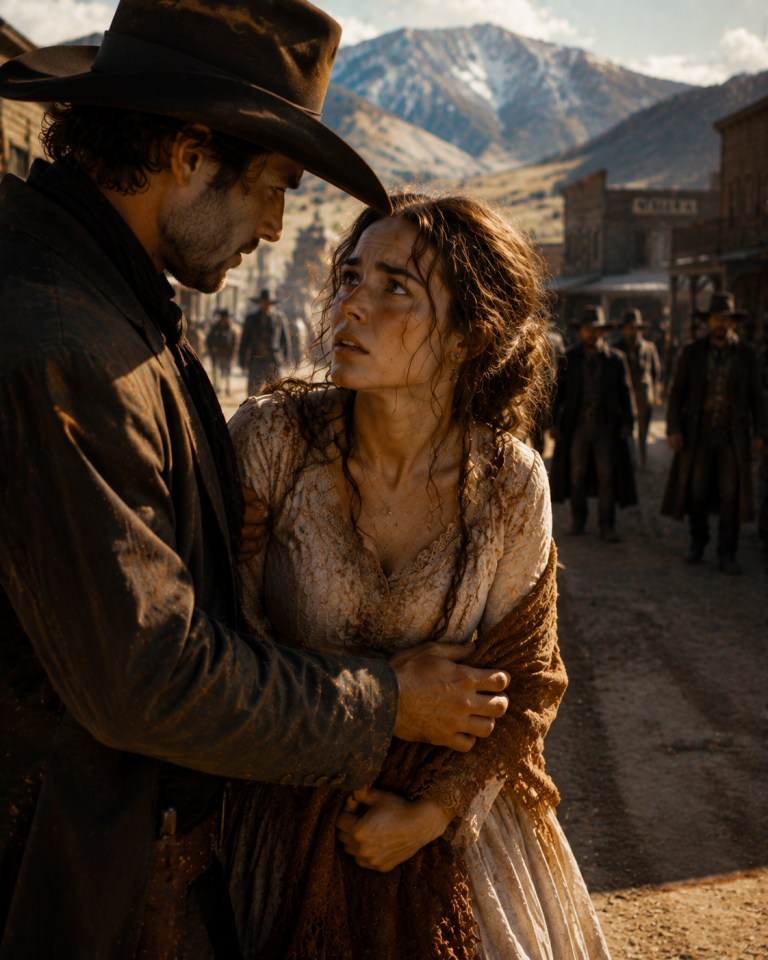
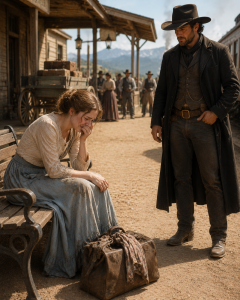
The July heat hit Adeline Mercer like a physical blow the moment she stepped off the rail car.
Not the wet, clinging heat of St. Louis summers. Something meaner. Dry and sharp, the kind that sucked the moisture out of your throat and cracked your lips before you’d taken ten steps.
She stood on the warped platform, one hand strangling the handle of her carpet bag, the other clutching a letter she’d read fifty times on the journey west, until the creases had gone soft as cloth.
*Dear Miss Mercer. I am a man of modest means but honest work. I have a homestead in the Montana territory with good land, timber, and water. I cannot promise luxury, but I can promise safety, respect, and a home where you will never want for the necessities. I will meet you at Ridgeway Station on July 12th, 1881. Yours in earnest hope, Caleb Granger.*
She’d convinced herself she could hear his voice in those words. Steady. Reliable. A man who kept his promises.
The platform was empty of him.
A station master with a face like sun-dried leather barely grunted at her question. A woman with a baby on her hip looked at her with the kind of pity that made a person want to hit something. Two men by the water pump looked her over like livestock at auction.
No fiancé. No Caleb. No future standing there waiting.
Adeline set her bag down carefully, though every instinct screamed to throw it in the dirt. Her mother — dead six years now, hollowed out from the inside by consumption — had taught her a lady never made a scene. Never let them see her bleed.
So she didn’t cry. She kept her spine straight and her chin level while the sun hammered down on her good dark-blue traveling dress, the one she’d altered herself because she couldn’t afford a seamstress.
“You waiting on someone, miss?”
The station master ambled over, thumbs in his suspenders.
“Caleb Granger. He was supposed to meet me here.”
Something flickered across his face. Not surprise. Worse — recognition.
“Granger’s place is fifteen miles north.” A pause. “He ain’t been to town in near six weeks, miss.”
The world tilted, just slightly. “Six weeks?”
“Last I heard he was laid up with fever. Bad one.” The man’s shrug told her everything his careful words wouldn’t.
She became aware of a particular quality of silence around her — the kind that meant people were listening without looking like they were. The woman with the baby had drifted closer. The men by the pump had stopped talking.
This was the moment she was supposed to break. Supposed to cry, to wail, to beg some stranger to fix her ruined plan.
Adeline had exactly seventeen cents in her reticule. No family in St. Louis worth the name — her father drunk to death three years back, her brother vanished into the California railroad camps. Nothing to return to, and apparently nothing waiting here either.
“Is there a hotel?” she asked.
“Mabel’s boarding house. Two blocks that way. But I should tell you, miss—”
“Thank you.”
She picked up her bag and walked before he could finish the sentence she didn’t want to hear.
She made it one block before a voice stopped her.
“You the mail order bride?”
The woman with the baby had positioned herself square in the street, hip cocked, expression somewhere between hostile and pitying.
“That’s not your concern,” Adeline said.
“Everybody’s concern when a woman shows up alone in a town this size.” The woman shifted the baby higher. “You know he’s probably dying, right? Fever took him over a month back. Rhett Callaway rode in saying Granger couldn’t stand without help. You ask me, you came two thousand miles for a dead man.”
“I didn’t ask you.”
“No. But you’re going to need someone to tell you how things work out here if you’re staying.” The woman’s eyes moved over her travel-stained dress, her worn bag, the desperation she couldn’t quite hide. “How much money you got?”
Silence was answer enough.
“Look — I ain’t trying to be cruel. I’m trying to keep you from a mistake that gets you killed or worse. No money, no husband, no claim to anything. Mabel charges fifty cents a night, and every man in this town’s going to figure you’re desperate enough to marry the first one who offers. Some of them won’t even wait for an offer.”
“I can take care of myself.”
“Sure you can.” The woman’s voice went dry. “That’s what the last one said. Found her three months later married to a man twice her age who beats her most days she’s drunk enough to deserve it in his mind. At least she’s got a roof.”
She turned to go, then paused. “Sarah Miller. My husband runs the dry goods store. You need work, you come find me tomorrow.”
Then she was gone, leaving Adeline alone in the middle of a dusty street with the sun beating down and the full weight of her situation pressing in from every side.
That night, in a boarding house room barely big enough for its narrow bed, a fist pounded on her door. Not polite. Determined.
The man who filled the doorway looked carved out of the mountains themselves — over six feet, shoulders that barely cleared the frame, a beard trimmed with what might’ve been a hunting knife, eyes the color of winter ice.
“You Adeline Mercer?” His voice was rough, like he didn’t use it often. “Need to talk to you about Granger.”
Something in his face told her the news wasn’t good. Something in her chest told her she wasn’t going home either way.
“How is he?” she asked.
The stranger’s jaw worked once before he answered.
“Bad. Could go either way. I rode down to tell you before you spent what little money you had waiting on a man who might never show.”
Adeline looked at the seventeen cents in her reticule, at the letter gone soft in her pocket, at a life two thousand miles behind her that had nothing left to offer.
“I’m not going back,” she said. “Take me to him.”
—
PART 2
The ride to Granger’s homestead took three brutal hours, and by the time Rhett Callaway pulled his horse up short on the ridge overlooking the valley, every muscle in Adeline’s body was screaming and she hadn’t complained once.
The cabin below looked worse than his description had prepared her for. Roof sagging in the middle. A window boarded up. The barn missing half its shingles, doors hanging crooked. Fencing broken in scattered lines around what had once been pasture.
“There it is,” Callaway said. “Paradise.”
Inside, the man in the bed wasn’t what she’d pictured on the long ride west. Younger than she’d expected — maybe thirty, though the fever had aged him twenty years. Dark hair plastered to his skull, skin gray in the lamplight, breathing wrong. Rattling. Wet. Like something had broken inside his chest.
He didn’t stir when Callaway said his name. Didn’t twitch.
“You know anything about nursing?” Callaway asked.
“Some. My mother was sick a long time before she died.”
He showed her the basics — willow bark for the fever, water when Granger would take it, broth if she could get it down him — and then he told her something that cracked something open in her chest that had nothing to do with romance and everything to do with recognition.
“Why are you doing this?” she’d asked him. “Riding up here every other day. Your own homestead needs you.”
“Out here,” he said, “you don’t let your neighbors die alone. Not if you can help it.”
By midnight, she’d scrubbed the cabin from floor to shelf, boiled water, gotten a few spoonfuls of tea past Caleb Granger’s cracked lips, and found the letters — not just the one he’d sent her, but drafts, fragments, all trying so hard to sound like a man who had his life together. Underneath every careful, practical sentence was something he’d never managed to write down.
*I’m alone out here, and it’s killing me.*
She understood that better than he could ever know.
At three in the morning, Caleb Granger started screaming.
Not words. Raw animal sounds of a man fighting something only he could see. His skin burned under her hands. She pressed cool cloths to his forehead, forced tea between his teeth, talked to him in a steady stream that meant nothing except *you’re not alone*, and fought the fever for two hours until it finally, barely, broke.
When he went still, Adeline sat down in the chair beside his bed and cried for the first time since stepping off that train. Not because she loved a man she’d never met. Because she’d come two thousand miles to marry a promise, and promises kept breaking apart in her hands the moment she tried to hold them.
Dawn came gray and cold, mist hanging in the valley like smoke. She was still in that chair, stiff and aching, when she made her decision.
She hadn’t come this far to run home to nothing.
But what she didn’t know yet — what nobody in that valley had told her, because nobody wanted to be the one to say it out loud — was that the fever wasn’t the only threat circling that homestead. A man named Silus Boon had already ridden through town three times that month, buying up land claims with cash and a smile that didn’t reach his eyes.
And he had his sights set on exactly the water and grazing rights that ran straight through Caleb Granger’s dying claim.
—
PART 3
The first week nearly killed her — not from any single blow, but from the sheer relentless volume of everything at once.
Fence posts rotting. A chicken coop half-collapsed with birds running wild through the scrub pine. A well pump seized on the third day that took four hours of cursing and bleeding knuckles to free. A stove that smoked so badly she had to prop the door open even in the cold morning air. And through all of it, Caleb Granger lay in that bed, sometimes conscious enough to swallow water, mostly lost to fever that had a rhythm all its own — breaking in the small hours, climbing again by afternoon, and starting the whole terrible cycle over by nightfall.
On the fourth day, he opened his eyes and actually saw her.
“You’re not supposed to be here yet,” he rasped.
“I came when you told me to. July twelfth.” She kept her voice even, afraid if she moved too fast he’d slip back into delirium.
“What day is it now?”
“July nineteenth.”
Something like horror crossed his face. He tried to sit up and fell back gasping. “I missed you. I should have sent word—”
“Should have predicted you’d get sick?” She pressed a cool cloth to his burning forehead. “It’s done. I’m here now. Lie still before you kill yourself.”
“You should go,” he whispered. “Back east. This was a mistake.”
“I don’t have money for a return ticket, and I’ve got no interest in becoming some widow’s charity case in town.” She held a cup to his lips. “So you’re stuck with me until you’re well enough to kick me out yourself.”
“I would never—”
“I know.” And she did, somehow. This man had written those lonely, careful letters, had tried to keep promises even half-dead with fever. “Now drink.”
He managed three swallows before his eyes rolled back and the fever took him again.
Rhett Callaway rode in on the sixth day with a pack mule trailing behind him, found her fighting the chicken coop’s wire fencing with hands blistered on top of blisters, and unloaded flour, salt, coffee, and a bundle of smoked venison without being asked.
“You didn’t need to do that,” she said, though her stomach was already growling.
“Can’t take care of a sick man if you’re starving yourself.” He looked at her — really looked — and she became aware of how she must appear. Hair falling loose, dress torn in three places, cloth wrapped around blistered hands.
“You need help,” he said.
“I’m managing.”
“You’re drowning.”
The bluntness stung because it was true. But when she told him she had no money to pay for it, he simply walked to the barn, pulled tools from his saddlebag, and started fixing the roof without asking permission.
“I didn’t ask you to.”
“Nope. But I’m doing it anyway.”
Pride was expensive, and Adeline couldn’t afford it. “Thank you,” she said instead, and he just nodded and got to work.
He was up on the barn roof past sundown, working by the last gray light rather than leave a job half finished, and when he finally climbed down he found her sitting on the porch steps, wrapping fresh cloth around hands that had split open again from the wire fencing.
He didn’t ask permission. Just knelt, took her hand in both of his — rough palms, careful fingers — and looked at the damage like it offended him personally.
“You favor the right one,” he said. “Held funny. Like you’re guarding it.”
“I didn’t say anything about my hand.”
“Didn’t have to.” He wrapped the cloth tighter than she would have, but it held. “People say plenty without talking, if you’re paying attention.”
He didn’t linger after that, just nodded once and rode off into the dark. But Adeline sat there a long moment after his hoofbeats faded, turning her bandaged hand over in the lamplight, aware that a man who barely spoke ten words a day had noticed something about her that she hadn’t said out loud to anyone.
**
Caleb’s fever broke for good on the fifteenth day. She woke to find him sitting up, weak but unmistakably conscious, looking around the cabin — the clean floors, the organized shelves, the mended clothes on their pegs.
“You did all this?”
“Most of it. Rhett’s been here every few days. He’s the reason you’re not lying in a collapsed barn right now.”
“I don’t understand why you stayed.”
“I stayed because I had nowhere else to go,” she said simply. “And because I’m tired of running from bad situations into worse ones.”
“I can’t marry you,” he said quietly. “Not like this. Not when I can barely take care of myself.”
Something tightened in her chest, but her voice stayed steady. “I wasn’t asking you to. I came for the promise of a home — land to build a life on. The marriage was just supposed to be the vehicle.”
“What kind of arrangement, then?”
“I don’t know yet. I’ve been too busy keeping us both alive to plan that far.”
He was quiet a long moment. “People are going to talk. A woman living on a man’s homestead, unmarried.”
“Let them talk.” She’d stopped being able to afford shame around the same time she’d stopped being able to afford anything else. “I’d rather be alive and gossiped about than dead and respectable.”
That earned her the first real smile she’d seen from him. “You’re not like anyone I’ve ever met.”
“I’ll take that as a compliment.”
“It was meant as one.”
**
The town noticed she wasn’t coming back. Sarah Miller rode up on the twentieth day with her husband Thomas and enough supplies to feed a small army — and news that turned Adeline’s stomach.
“There’s a man in town,” Thomas said. “Silus Boon. Buying up land claims, offering cash money — more than most of these homesteads are worth.”
“Let me guess the catch,” Adeline said.
“He’s not interested in the land itself. He wants water rights and the grazing route — one of the main paths to the northern pastures. Plans to consolidate the whole valley into one operation. Run cattle through here by the thousands come spring.”
“And anyone who doesn’t want to sell?”
Sarah and Thomas traded a look that told her everything. “He hasn’t turned violent yet,” Sarah said carefully. “But the men he’s brought with him aren’t farmers. They’ve got a look about them.”
“What kind of look?”
“The kind that says they’ve done worse than threaten homesteaders.”
Ice settled in Adeline’s stomach. “Has he approached Granger?”
“Not yet. But he will. And when he hears there’s a woman running the place while Granger’s laid up, he’ll think it’s easy pickings.”
Sarah pressed a folded letter into her hands — a note from Doc Chambers documenting Adeline’s role as Caleb’s caretaker, witnessed and dated. “Might help if Boon tries to claim the homestead’s abandoned.”
“Why are you helping me?” Adeline asked.
“Because you remind me of myself,” Sarah said simply. “I came out here ten years ago with nothing. People said I’d never make it. I’m still here.” Her smile went hard and sharp. “And I don’t like bullies. Boon’s a bully with money, which makes him worse.”
**
Silus Boon rode in three days later — three men, moving with the casual confidence of people who owned the world and everyone in it. Adeline was hauling water when she saw the dust cloud coming, and made herself stand up straight in a sweat-soaked dress with her hair falling out of its pins.
“Morning,” Boon called out, dismounting with practiced ease. Silver-haired, solidly built, clothes worth more than anything Adeline had ever owned. “I’m looking for Caleb Granger.”
“He’s not available. I’m managing the property.”
“The mail order bride.” His smile showed too many teeth. “I’m prepared to offer three hundred dollars for Granger’s claim. More than generous given the state of things.”
Three hundred dollars was more money than Adeline had ever seen in her life. It was also, by her own reading of Caleb’s survey papers, about a third of what the land was worth.
“Not interested,” she said.
“You should consult with Mr. Granger before deciding.”
“I’m deciding now. On his behalf and mine. We’re not selling.”
One of Boon’s men snorted. “You don’t own nothing, lady. You’re just some woman shacking up with a sick man.”
“What’s your name,” Adeline asked, “so I know what to call you when I tell people who tried to intimidate a woman on her own property?”
The smirk faltered. Boon raised a hand. “That’s enough, Curtis.” His eyes went cold. “You have no legal claim here, Miss Mercer. If Granger dies — or can’t work the land — this claim becomes abandoned. Abandoned claims can be filed on by anyone.”
“He’s not dying. And the land’s not abandoned.”
“We’ll see.” Boon’s voice hardened. “I’ll give you a week. After that, my offer decreases significantly.”
They rode out the way they’d come, and Adeline sat down hard on the edge of the well, hands finally shaking now that no one was watching to see it.
**
“You handled that better than I would have,” Caleb said from the cabin doorway, leaning heavily against the frame.
“You shouldn’t be out of bed.”
“I heard horses.” He made his slow way toward her. “You shouldn’t have refused him. You don’t know what he’s capable of.”
“I know exactly what he’s capable of. That’s why I refused. Men like Boon smell fear. Show them weakness and they take everything.”
“I can’t protect you. I can barely protect myself right now.”
“Then we figure out another way.” She looked at him. “How did I get so tough? The world didn’t give me a choice.”
He studied her for a long moment — not love, they barely knew each other, but something adjacent to it. Recognition. Respect.
“I’m sorry I brought you into this mess.”
“You didn’t. I walked into it with my eyes open. Mostly open.” A small, tired smile. “Besides — if I’d stayed in St. Louis, I’d probably be married to some factory worker who drinks too much and hits too hard. At least here I get to choose my own disasters.”
That startled a real laugh out of him. “You’re insane.”
“So you keep saying. And I’m starting to think that’s exactly what we need.”
**
Rhett taught her to shoot that afternoon — how to brace against the kick, how to breathe, how to aim without flinching. By sunset she could hit a fence post three times out of five.
“Boon’s men come back,” he told her, cleaning the rifle, “you don’t try to be a hero. Fire a warning shot, get inside, bar the door. They try to burn you out — that’s when you start shooting to kill.”
“Have you killed people before?”
“Yes.” No explanation offered. “Does it get easier?”
“No. But you learn to live with it.” He met her eyes directly. “You really want to do this? Once you commit, there’s no backing out.”
“I’m already committed,” she said. “I was committed the minute I stepped off that train.”
Before he left that evening, he handed her a tin cup of coffee without being asked — black, no sugar, strong enough to strip paint, exactly the way she’d made it for herself every morning since arriving and never once mentioned to him.
She looked at the cup, then at him. “How did you know?”
“Watched you make it three mornings running while Granger was still out of his head. Figured a woman who drinks her coffee that strong doesn’t want it fixed for her. Just made.” He swung up onto his horse before she could find an answer for that, and rode off without looking back, leaving her standing there with a cup of coffee that tasted, absurdly, like being seen.
**
The chicken coop burned nine days later, just after midnight — a warning, Rhett called it, not a real attack, because Boon wanted them scared, not dead yet. Adeline ran a rifle into the dark, put rounds into the dirt near the fleeing shapes, and watched three years of Caleb’s poultry stock go up in a shower of sparks and the sound of breaking bones.
“This doesn’t change anything,” she said afterward, covered in soot.
“They just burned down part of our home,” Caleb said. “They could have killed us.”
“Being scared keeps you alive,” Rhett said quietly.
“Being angry keeps me fighting.”
That week she and Rhett quietly reached out to the valley’s remaining homesteaders. Old man Peterson and his son signed on without hesitation. The Halversons offered help but couldn’t risk open fighting with three small children. James Coolie, a former Union soldier, looked at them with hard, tired eyes and said he’d think about it. Martha Chen — a widow running a small cattle operation, iron in her spine, a rifle she clearly knew how to use — didn’t hesitate at all.
“My husband built that ranch from nothing,” she said. “Died defending it from claim jumpers five years back. I’m not letting Boon take what he bled for.”
Seven of them gathered around Caleb’s table that Sunday and made a plan that wasn’t pretty and wasn’t perfect, but was a plan. Consolidate defensible positions. Pool resources. Sabotage Boon’s operation without giving him legal grounds to bring in territorial law.
Martha pulled Adeline aside as people left. “Boon’s asking specific questions about you. Whether you’ve got family. Whether anyone would come looking if something happened to you.”
Ice again, colder this time. “You think—”
“I think Boon sees you as the weak link. Remove you, Granger folds, Callaway’s got no reason left to fight.”
**
They made Boon’s life difficult for two weeks — diverted creeks, tore down new fence lines, fouled water sources. Nothing violent, nothing that gave him legal cover, just a campaign of exhausting sabotage that showed in the tired, frustrated faces of his men.
The Peterson fire changed everything.
James Coolie rode in with the news, his horse lathered from the run. Adeline reached Peterson’s homestead to find the cabin fully engulfed, Peterson and his son holding four of Boon’s riders at bay from a creek bed. She rode straight in, fired a warning shot between Curtis’s horse’s front legs, and made it clear: next round goes through somebody.
They backed off. But the cabin was a total loss.
“We can’t keep playing defense,” Coolie said that night. “We need to make Boon hurt.”
The escalation was inevitable after that. Silus Boon cornered Adeline in town himself, bought her a whiskey she didn’t touch, and offered her five hundred dollars to leave the territory for good.
“Everyone’s for sale,” he said. “It’s just a question of price.”
“Then you can’t afford me.”
Something flickered behind his eyes — not quite anger. Closer to recognition, the way one stubborn animal sometimes sees itself in another. He turned his glass slowly on the table.
“You think I’m just greedy,” he said. “Simple. A man who likes money more than people.” He didn’t wait for her to agree. “I started with four hundred acres of Kansas dirt my father lost to a bank in a single bad winter. Watched him die owning nothing, owing everyone, a joke in every saloon from here to Topeka. I swore I’d never again be the man other men laughed at for being small.” He looked around the saloon, at the whole dusty, half-built town beyond its windows. “This valley is going to be run by someone in ten years’ time, Miss Mercer. Cattle barons, railroad money, the territorial government itself — someone bigger than any of you scratching out a living on rented acres. I intend for it to be me, because the alternative is being the man who let it happen to somebody else and got nothing for the privilege.”
“That’s not vision,” Adeline said. “That’s just fear wearing a nicer coat.”
“Maybe.” He didn’t deny it. “But my fear builds towns. Yours just gets people killed defending mud and fence posts that won’t matter in twenty years.”
“Tell that to the people you’ve already buried.”
His jaw tightened — the first genuine crack she’d seen in him. “I don’t enjoy that part. I’m not going to pretend otherwise. But I decided a long time ago that I would rather be the man causing the damage than the man it happens to. You’ll understand that better than most, I think, given what you’ve survived to get here.”
“I understand it,” Adeline said, standing. “I just refuse to build anything on top of it.”
His smile came back, but it didn’t sit the same after that. “Last chance, Miss Mercer. When you’re watching everything you care about burn, remember I tried to be reasonable.”
**
Boon brought in twenty more men within the week. Rhett rode for the territorial capital with a signed letter documenting the burnings, the threats, the forced sales — five signatures, everything they had. He’d be gone ten days at minimum, and Boon wouldn’t wait that long to move.
The consolidation began immediately. Peterson’s livestock, Martha’s cattle, everyone’s resources pooled at the two most defensible homesteads. Adeline found herself directing the operation almost without meaning to — where to stack the water barrels, how to reinforce the barn walls, where to dig firing positions. Men who’d never taken orders from a woman found themselves following hers, because she was the one with answers.
“You’re good at this,” Martha said, working beside her in the root cellar.
“Never had a man to follow. Had to figure it out myself.”
“Boon’s going to come after you specifically. You’re the one holding this together.”
“I know. I’m terrified. It hasn’t killed me yet.”
“This is the kind where you might actually die.”
“Then I’ll die fighting for something that matters. That’s more than most people get.”
**
The attack came on the fifth day at sunset — men on foot moving through the treeline with practiced caution. Adeline rang the warning bell from the barn loft and the homestead scattered into positions they’d drilled a hundred times.
Curtis called out from the dark that Boon had one more offer. It was a lie wrapped around an ambush; the moment she refused, the first shot cracked the evening open and the fight that followed lasted ten brutal minutes. David, Peterson’s seventeen-year-old son, took a bullet through the shoulder — bad, but not fatal, if they could stop the bleeding fast enough.
They did. Barely.
“We can’t take another one like that,” Caleb said at dawn, surveying bullet-pocked walls and a punctured water trough.
“We have to,” Adeline said. “If we run now, everything we fought for becomes waste.”
The second attack came that same night — no warnings this time, just fire set to the barn in the darkest hour before dawn. Adeline ran into the burning structure wrapped in a wet blanket to free the trapped horses, got three out before the smoke drove her back, coughing so hard she thought her lungs would turn inside out.
In the firefight that followed, Martha Chen went down.
Adeline dragged her behind cover, pressed both hands to a wound already bleeding too fast to stop.
“You’re going to be fine,” she said.
“Liar.” Martha’s laugh dissolved into a cough. “Tell my kids I didn’t sell. Tell them I held.”
She died there in the dirt with her blood soaking Adeline’s hands and the barn collapsing behind them.
The rage that followed wasn’t hot. It was cold, clear, and absolute. Adeline picked up her rifle and, for the first time, started shooting to kill.
**
They buried Martha Chen at dawn in the plot behind Caleb’s cabin, a headstone carved simply: *She held her ground.*
Captain Marcus Shaw arrived from the territorial capital two days later with Rhett and six militia men — and turned out to be less rescue than obstacle. He listened to their account with polite disinterest, pointed out they had no bodies, no identifiable attackers, no evidence beyond accusation.
“According to the territorial land office,” he said, “Miss Mercer, you have no legal standing here. Neither did Martha Chen.” He recommended they sell to Boon and leave before more people died, then rode off with most of his men, leaving two behind to watch and report.
“He’s on Boon’s payroll,” Rhett said flatly. “Has to be.”
That night, Adeline made a decision the law wouldn’t make for her. She and Rhett slipped out toward Boon’s camp with a rifle, a knife sharpened to split hairs, and no illusions about the odds.
It was a trap. Boon had been waiting for exactly this kind of desperation. Six armed men poured from the shadows of his tent; Rhett went down under three of them before Adeline could reach him. Curtis hit her hard enough to taste blood.
“Lock them in the wagon,” Boon ordered. “We deal with them publicly, in the morning. I want the whole valley to see.”
**
In the dark, hands bound, Rhett asked her the question that mattered.
“You regret it? Coming west?”
Adeline thought about the alternative — a St. Louis tenement, a factory husband with mean fists, safety that felt like slow suffocation.
“No,” she said. “Even if I die tomorrow, at least I lived first.”
She spent the hours before dawn working her small hands free of rope built for larger wrists. When Curtis opened the wagon door at first light, she drove a pry bar into his stomach and then the back of his skull. Rhett, hands still bound, took down a second guard with his own body weight. Adeline broke a third man’s arm and then his consciousness.
They ran for the horses and nearly made it before gunfire pinned them behind a supply crate, out of options, out of time.
Then she heard hoofbeats. Dozens of them, coming fast from the north.
Caleb led the charge — rifle raised, Peterson beside him, followed by Coolie, the Halverson boys, Thomas Miller, and a dozen more men who’d found their courage somewhere between sunset and dawn. It wasn’t a cavalry charge so much as a controlled collision. Coolie, the only man among them with real soldiering behind him, had split the riders into two lines before they crested the ridge — half circling wide to cut off the horse lines and strand Boon’s men on foot, half driving straight through the camp’s center to break its shape before it could organize a defense. It cost them. One of the Halverson boys took a round through the leg and went down screaming before he’d fired a single shot of his own. Thomas Miller’s horse was shot out from under him, and he hit the ground hard enough that he didn’t get up again until the fighting had already moved past him. Peterson, sixty years old and grieving a burned home, put himself between two of Boon’s men and his own son and took a graze along the ribs that would leave him wincing every winter for the rest of his life.
Adeline fought through it half-deaf from gunfire, throat raw from smoke, legs shaking with an exhaustion that had nothing left to give and kept giving anyway. She saw Boon break for his horse in the chaos, and went after him not because she felt strong but because stopping meant someone else would have to, and she was closer.
She didn’t tackle him clean. She caught his coat, got dragged four feet through the dirt before her grip held, and they went down together in a tangle that had nothing graceful in it — elbows, gravel, his boot catching her hard enough across the shin that she’d carry the bruise for a month. She came up on top of him only because he was fifty-one years old and out of breath and she was twenty-six and furious, and even then it took both hands and the last of her strength to keep the rifle barrel steady against his throat while her arms shook.
“It’s over,” she said, and her voice came out rougher than she meant it to, worn thin by smoke and screaming and the effort of not letting go.
“You have no authority.”
“I have this rifle.” She had to breathe twice to get the rest out. “That’s all the authority I need left today.”
Around them, the fighting guttered out in pieces — not all at once, but man by man, as Boon’s hired guns realized their employer was face-down in the dirt with a woman’s knee in his back and decided, one after another, that the paycheck wasn’t worth what came next.
**
Captain Shaw arrived three hours later, conveniently after the violence had concluded, and tried to call it vigilante action until he looked around at a camp full of witnesses and a pile of confiscated weapons and reconsidered.
“Boon,” he said finally. “You’re under arrest for kidnapping, assault, and conspiracy to commit murder.”
The trial happened fast by territorial standards — the governor wanted the mess resolved before it became a scandal. Boon got fifteen years hard labor and his assets seized for restitution. It wasn’t enough. Nothing could bring Martha back. But it was something.
**
The homesteaders rebuilt together that autumn — barns raised, fences mended, winter stores laid in with a communal effort that hadn’t existed before Boon gave them a common enemy. They buried Martha properly, with half the valley in attendance, under a headstone that read *she held her ground.*
Caleb found Adeline on the porch one evening, and it took him a long time to say what he’d clearly ridden his own nerve up to say. He sat down beside her, started twice, stopped twice, and finally just stared out at the darkening valley like the words were written somewhere on the treeline.
“I’ve been trying to talk myself into loving you,” he admitted. “For weeks now. Tried hard. You saved my life. You bled for this land right alongside me. You stood in that yard and told Boon’s men no when I couldn’t even stand up straight.” His jaw worked. “Seems like the kind of woman a man should love without having to talk himself into it.”
“But you don’t,” Adeline said quietly. It wasn’t a question.
“I want to. That’s the honest truth of it. Some nights I look at you and I think, there it is, that’s what it’s supposed to feel like, and then morning comes and it’s just gone again, and I’m back to being grateful instead of in love, and those aren’t the same thing no matter how hard I wish they were.” He finally looked at her. “It isn’t fair to you, building a marriage out of gratitude. And it isn’t fair to me either, spending the rest of my life reaching for something that isn’t there and calling it enough.”
“I’ve been doing the same arithmetic,” Adeline admitted. “Came out the same answer.”
Something in his shoulders eased, like he’d been braced for her to argue. “I care about you, Adeline. More than I’ve cared about anyone since my mother died. But I don’t love you. Not the way a husband should.”
“I know.” She let out a breath she hadn’t realized she was holding. “I don’t love you either. I think I might have wanted to, for a while. It would have been simpler.”
“Simpler isn’t the same as right.” He managed a small, rueful smile. “Took me a long time and a lot of arguing with myself in that barn to get to something that simple.”
They sat with it a moment, the quiet between them easier now that the truth was finally out where they could both look at it.
“Half this land is yours,” he told her. “You bled for it. You earned it.” Then, with a knowing smile that had cost him something to arrive at: “And if you want to pursue whatever’s happening between you and Rhett — you should. I saw it before either of you let yourselves.”
Rhett came by the next day with a deer he’d shot for the winter stores. “Caleb talked to you?” he asked eventually.
“He asked if I had intentions.”
“I’m not an easy man,” Rhett said. “Got demons from the war that won’t leave me alone. Disappear for days when things get loud in my head.”
“I’m not exactly easy either. Stubborn. Angry. Don’t know how to ask for help.”
“Maybe damaged people understand each other better than whole ones do.”
He kissed her then — rough, uncertain, and nothing like the romance novels she’d once read by lamplight in St. Louis. It was better, because it was real.
**
Winter buried the valley under three feet of snow that December, but they were ready this time — new barn, adequate stores, a community that had learned survival required more than individual strength. It required people willing to fight for each other.
Spring came late and exploded into green so vivid it hurt to look at. More settlers arrived, drawn by stories of the valley where courage had beaten money. Sarah Miller told her people were calling it Callaway Ridge now.
Adeline and Rhett married under an oak tree that June, in a dress she could still work in, with a justice of the peace who’d ridden out from the capital. No fairy tale. Just real, which mattered more.
**
Two years later, the town at the old Ridgeway crossing had grown into a settlement of nearly three hundred people — a school, a store carrying goods from back east, a weekly newspaper. Martha’s land had become a cooperative farm feeding half the valley. Emma Pritchard’s husband, the man who’d spread poison rumors on Boon’s behalf, was arrested for embezzlement and bribery in the same scandal that had finally, belatedly, made the territorial government take homesteaders seriously.
Adeline gave birth to a daughter in early spring and named her Martha.
Rhett held his newborn with the careful terror of a man who’d spent years believing he was only good for violence, now confronted with something small and entirely dependent on him not to break it.
“I don’t know how to do this,” he admitted.
“Neither do I,” Adeline told him. “We’ll figure it out. Like everything else.”
Caleb came by with a cradle he’d built himself, remarried now to a quiet widow from town who understood his gentle nature. “You ever regret it?” he asked, looking down at the baby. “Coming west, the fighting, all of it, instead of an easier life?”
Adeline thought of the girl who’d stepped off that train with seventeen cents and a stranger’s promise, terrified and certain she’d made a catastrophic mistake.
“No,” she said. “Every scar, every loss — it all led here. To a life that’s mine. That’s all any of us can ask for.”
Little Martha grew up wild and strong across a valley that had been rebuilt from ash and stubbornness — a place where her mother’s word carried weight at town meetings, where women owned land and made decisions and didn’t apologize for taking up space. She grew up free in ways Adeline never had, and that, more than the land or the legend or the fight that had nearly killed them all, was the real inheritance.
Adeline Mercer had stepped off that train with nothing but a carpet bag and a stranger’s promise. She hadn’t found a home waiting for her.
She had built one, with her own bleeding hands, out of a valley that had tried its hardest to kill her — and she had won.
THE END