HIS SIX-YEAR-OLD SON TOLD A LONELY STRANGER “YOU LOOK LONELY” IN THE MIDDLE OF TOWN — THREE WEEKS LATER, A RANCHER RODE INTO A GUN OWNER’S SALOON AND STARTED A WAR HE COULDN’T WIN ALONE

—
PART 1
Forty-three days without rain. Wade Mercer knew because he marked each one in a ledger, right beside the columns tracking feed costs and cattle weights — numbers that proved his ranch still existed, even on the mornings he wasn’t entirely sure he did.
Three years since Margaret died, and Wade had survived them the only way he knew how. One task, then another, then another. Never stop long enough to feel anything.
His son was six years old and looked exactly like her. Same dark hair that never laid flat. Same serious gray eyes that watched everything twice as long as other children did. Every time Caleb smiled, which wasn’t often anymore, Wade saw his wife’s ghost standing in the boy’s face, and it made him want to pull his son close and also made him want to ride to the far pasture and not come back until dark.
“You ever going to talk again?” Caleb asked one morning, sitting on the fence rail, bare feet swinging.
“I talk.”
“Not really. You say stuff like *eat your breakfast*. You don’t actually talk.” A pause. “Mama used to talk.”
Wade opened his mouth. Closed it. Opened it again.
“I talk,” he repeated, and even to his own ears it sounded pathetic.
—
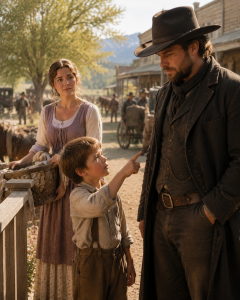
Friday, they needed supplies. Blackthorn Ridge wasn’t much — three hundred people counting the outlying ranches, one main street gone gray with sun and dust. Wade tied his horse outside the general store, told Caleb to stay close, and lost him inside of thirty seconds anyway.
He found the boy in front of the trading post, no longer looking at the pocket knives in the window.
He was staring at a woman sitting alone on the bench, half-hidden in the overhang’s shadow.
Faded green dress, carefully mended at the sleeves. Hair pinned in a style five years out of fashion. Hands resting in her lap the way people hold still when what they really want to do is disappear.
Most of Blackthorn Ridge was walking past her without looking. Blackthorn Ridge was good at not seeing things it didn’t want to see.
But Caleb was staring at her with that unblinking directness children use before the world teaches them which truths aren’t supposed to be spoken aloud.
“You look lonely.”
The woman’s head snapped up like she’d been slapped.
Wade moved fast, hand landing on his son’s shoulder harder than he meant to.
“Sorry,” he said, aiming the word somewhere between the woman and the middle distance. “He doesn’t mean—”
“It’s all right.” Her voice was quiet. Careful. The voice of someone trying very hard not to take up too much space. She looked at Caleb instead of Wade. “He’s honest. That’s not a bad thing.” A beat. “But she does look lonely.”
“Caleb. We need to go.”
The woman rose too fast, brushing at a skirt that had no dust on it.
“I didn’t mean to cause trouble.”
Two blocks out of town, Caleb finally spoke again.
“Why’d we leave so fast?”
“You can’t just say things like that to strangers.”
“Why not?”
“Because people don’t like it.”
“But it was true.” Caleb twisted in the saddle to look up at him. “She was lonely. I could tell.”
“That doesn’t mean you should say it.”
“Mama always said telling the truth was important.”
“Your mama—” Wade stopped himself hard. “Your mama was right about a lot of things. But sometimes the truth makes people uncomfortable, and you need to learn when to keep it to yourself.”
Caleb went quiet, and Wade hated himself for it. Hated that he was teaching his son to bury honesty under polite silence. Hated that he was turning the boy into another version of himself.
That night, Wade lay awake, staring at the ceiling, thinking about things he’d deliberately stopped thinking about three years ago.
*Margaret would have helped that woman.*
The thought arrived unwanted and completely true. Margaret would have sat down on that bench inside a minute, learned the woman’s name, probably invited her to Sunday dinner before the conversation was even over. That had been who she was — someone who saw suffering and moved *toward* it.
Wade had loved that about her.
He’d also, if he was honest, found it exhausting.
Now, lying in the dark three years after burying her, Wade wondered if his grief had become an excuse. Wondered if he’d used her death to get smaller. More isolated. More selfish.
He didn’t like any of the answers his mind offered.
Three days later, he went back to town — told himself it was for nails they didn’t urgently need. Told himself it had nothing to do with the woman on the bench.
He was lying to himself, and some part of him already knew it.
The bench outside the trading post was empty when they arrived. Relief and disappointment landed in his chest at the same time, and Wade felt stupid for feeling either.
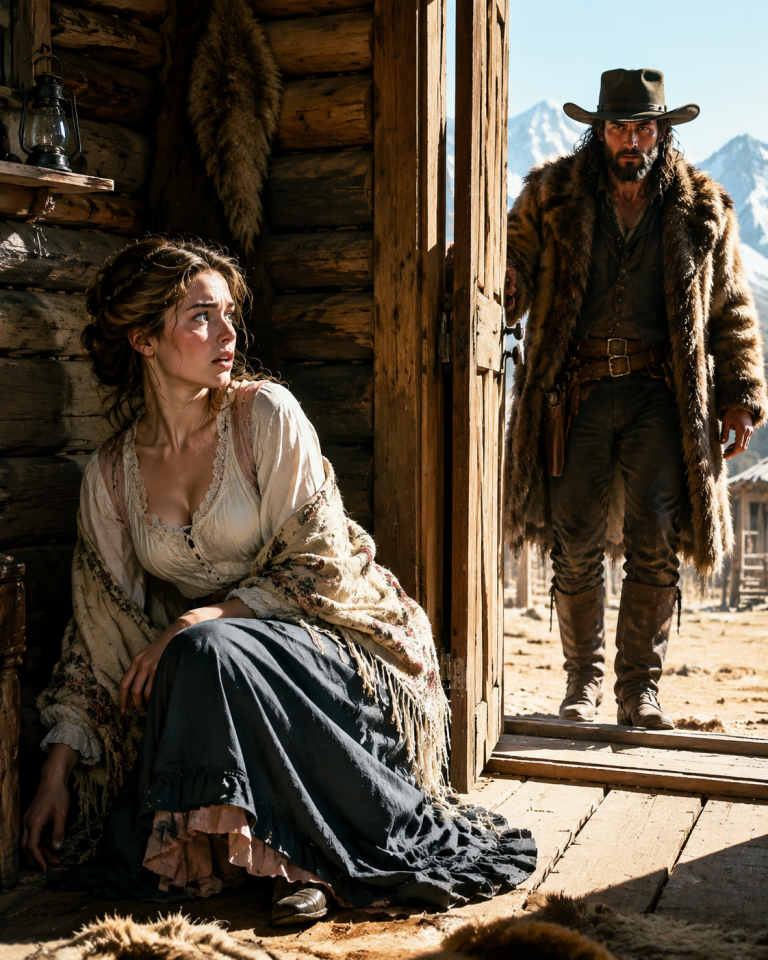
Then he heard raised voices from the saloon — two ranch hands, drunk despite the early hour, laughing loud and mean at someone walking past with her eyes fixed straight ahead.
The woman from the bench. Walking faster now, trying to outrun words Wade couldn’t quite hear but could guess the shape of.
His hands curled into fists.
This wasn’t his business. Getting involved meant exactly the kind of complication he’d spent three years avoiding. Those men worked for Vernon Pike, and Pike wasn’t someone you crossed lightly.
Wade knew all of that.
He started walking toward the saloon anyway.
—
PART 2
“Hey.” Wade’s voice came out flat. Cold. “Leave her alone.”
The taller one grinned slow, mean eyes, patchy beard.
“Well, hell. Wade Mercer. Didn’t know you cared about whores.”
Wade’s vision narrowed and went hot.
“Say that again.”
“I said—”
Wade hit him.
Not a good punch — he was out of practice, his knuckles connected wrong, pain flaring white through his hand — but it sent the kid stumbling backward into the doorway, blood streaming, shock replacing the grin. The second man reached for something, and then Tom Bellamy was there, shotgun raised, voice carrying across the street.
“That’s enough. All of you.”
They dragged themselves inside, muttering threats. Tom lowered the shotgun but didn’t put it away.
“Get out of here, Wade, before this gets worse.”
The woman stood a few feet off, arms wrapped around herself.
“You didn’t have to do that.”
“Yeah,” Wade said. “I did.”
“Now they’ll just be worse.”
She was probably right. By tomorrow half the town would believe she’d asked for his protection in exchange for something ungenerous, and the other half would just think Wade had lost his mind.
“Let them,” Wade said.
She stared at him like he’d spoken a foreign language.
“You don’t understand how this town works.”
“I’ve lived here fifteen years. I understand fine.”
His hand throbbed, knuckles swelling. He was exhausted and angry and his son had just watched him start a fight in the middle of the street, and this woman was right, and that somehow made everything worse.
“My name’s Wade Mercer,” he said abruptly. “Ranch eight miles north. I need help with housework, bookkeeping, cooking. Pays fair. Room and board included.”
Her eyes went wide. “*What?*”
“Think about it.” He was already moving toward his horse, toward escape from the entire mortifying situation. “If you’re interested, come by.”
He lifted Caleb into the saddle and rode out before his brain could catch up with what his mouth had just done.
A mile out, Caleb finally spoke.
“Are you going to marry her?”
Wade nearly fell off the horse.
“*What?* No.”
“But you invited her to live with us.”
“To work. That’s different.”
A pause. Then, quietly:
“Mama would have liked her.”
The comment hit harder than Rusty’s fist would have if it had landed.
—
Five days passed. Wade told himself she wouldn’t come.
Except on the fifth day, Caleb came sprinting across the south pasture, yelling something about a lady at the house — small bag, worn-out boots, asking very politely if Mr. Mercer was home.
She stood in front of the house like she couldn’t decide whether to knock or run.
“Mr. Mercer?”
“Wade. Just Wade.”
“Clara Whitmore.” She didn’t offer her hand. “I thought about your offer. If it’s still available, I’d like to accept.”
“You sure?”
“No.” The honesty surprised him. “But I don’t have better options. And you didn’t seem like—” She chose the word carefully. “You seem sincere.”
Caleb stepped forward before Wade could answer, undaunted by silence.
“I’m Caleb. I’m six. Do you like rocks? I found a really good one yesterday. It’s got sparkles in it.”
Something shifted in Clara’s face — softened into what might have been a smile before life taught her to be more careful with those.
“I do like rocks.”
Wade watched his son run for the house, watched Clara’s careful, guarded shoulders relax a fraction, and felt something in his own chest shift — not happiness, exactly. More like the absence of numbness.
“So,” he said finally, clearing his throat. “You know how to cook?”
“Yes.”
“Keep books?”
“I can learn.”
“Fifteen a month, room and board. Sundays off. You want to leave, give a week’s notice, I’ll pay you through the month regardless. Fair?”
“More than fair.”
He didn’t know it yet, but nothing at the Mercer ranch was going to stay the same.
—
PART 3
The first week felt like walking on ice that might crack any moment. Clara moved through the house like a ghost trying not to disturb the living — up before dawn, dishes cleaned so quietly Wade sometimes didn’t realize she’d finished until he found everything already put away. Door closed when she wasn’t working. Distance maintained like she understood exactly how precarious her situation was.
When Wade paid her at week’s end, she stared at the bills like they weren’t real.
“This is too much.”
“First week, plus a little extra. You needed a second dress.”
Her chin lifted, something flashing across her face. Pride, maybe. Or the shame of having her poverty acknowledged out loud.
“I don’t need charity.”
“It’s not charity. It’s practical.” He held her eyes. “You can’t work in the same dress every day.”
They stared at each other a beat too long. This was a test, Wade realized — Clara trying to determine what kind of man he was. Whether his help came with strings.
She folded the money carefully into her pocket.
“Thank you.”
Caleb, meanwhile, had decided Clara was the most interesting thing that had ever happened to him. He followed her everywhere, showing her every rock, every stick, every unremarkable patch of ground where something notable had once occurred. She listened to all of it. Asked questions that proved she was actually paying attention. Remembered details he’d mentioned days earlier and brought them back up.
Watching them together made Wade feel something close to shame. His son had been lonely — not just quiet, but lonely in a deep, patient way Wade had either missed or chosen not to see, because seeing it would have required doing something about it.
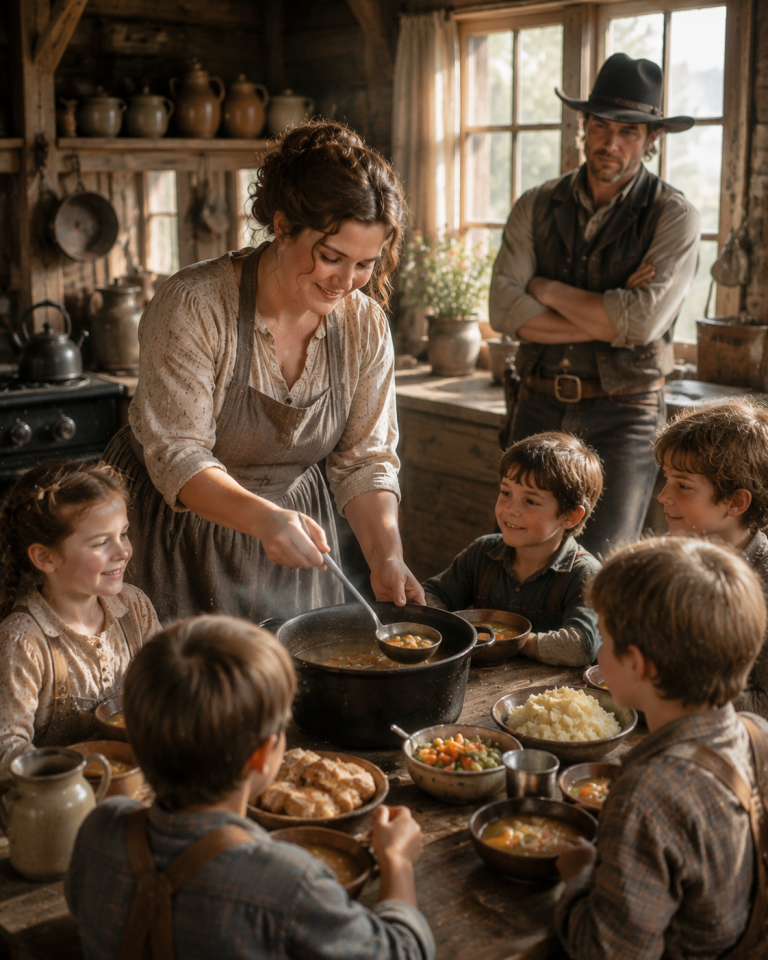
The second week, Clara started cooking real meals. Roasted chicken with herbs found wild near the creek. Biscuits that weren’t dense as stones.
“This is really good,” Caleb said, because children hadn’t yet learned to hide the truth. “Papa never cooks like this.”
“He makes everything too salty,” Caleb added, before Wade could stop him. “One time, I saw a chicken eat a nail.”
Clara laughed — quick, surprised, unguarded — and the sound of it did something strange to the air in the room. Made it feel less like three separate people sharing space, and more like something that resembled a household.
The third week, people in town noticed.
Tom Bellamy pulled Wade aside at the store.
“People are talking. Vernon Pike’s making noise about how you’re setting a bad example.”
“She’s an employee. I pay her wages. She has her own room.”
“You embarrassed one of his men in front of the whole town, Wade. He doesn’t forget that. And now he’s got a convenient excuse to make you pay for it.”
Wade rode home with tension sitting in his shoulders that hadn’t been there that morning. Clara took one look at his face and went still.
“What happened?”
“Nothing. Town gossip.”
“It’s about me, isn’t it?”
“You haven’t done anything wrong.” Wade set down the saddlebags harder than necessary. “Neither have I. If people want to believe something ugly about an honest arrangement, that’s their problem.”
“I can leave.”
“*No.*” The word came out harder than he’d intended. “You haven’t done anything wrong.”
“You have a son to raise. A life here. I’m nobody. I can find work somewhere else.”
“Where?” Wade demanded. “Every town within a hundred miles operates the same way this one does.”
Clara opened her mouth. Closed it. Wade watched her realize he was right — she had no better options, no family, no money, nowhere else that would treat her differently.
“I’m sorry,” she said quietly. “I should have known better than to accept.”
“Stop apologizing for existing.” The words came faster than he could organize them. “Everyone in this town acts like you’re the problem. Like you did something wrong by surviving when your husband didn’t. It’s cruel and it’s stupid, and I’m tired of watching people treat you like you’re shameful for having the nerve to keep breathing.”
Clara stared at him like he’d started speaking another language.
Her voice, when it came, was so quiet he almost missed it.
“Thank you.”
He didn’t trust himself to answer.
—
**PIKE**
Vernon Pike arrived the fourth week with two men flanking him, his face friendly in a way that didn’t reach his eyes.
“Wade Mercer.” He glanced at Clara on the porch, then back. “You’ve brought an unmarried woman into your home. I’m sure your intentions are good, but you have to understand how it looks.”
“How it looks to who?”
“To everyone who’s been your neighbor for years.” Pike’s voice dropped, false intimacy. “People are saying you’ve dishonored Margaret’s memory. That you’re not as stable as we all thought.”
“Get off my property.”
One of Pike’s men shifted his weight, hand drifting toward his belt.
“Wade.” Clara’s voice from the porch, steady despite the fear underneath it. “Don’t.”
Pike’s mouth twisted. “You’re letting her speak for you now? That’s even worse than I heard.”
Wade closed the distance before he could think it through, close enough to see the surprise flash across Pike’s face.
“You want to insult me, fine,” he said quietly. “But you speak about her with respect, or we’re going to have a problem that won’t be settled with words.”
Pike smiled, slow and cold, and turned back toward his horse.
“You’re making a mistake, Wade. A bad one. And when this falls apart — and it will — don’t come crying to the rest of us.”
They rode out. Wade stood in his yard, adrenaline making his hands shake.
“You shouldn’t have done that,” Clara said.
“Yeah. I know.”
“He’s going to make things worse now.”
“Probably.”
“I meant what I said before. I can leave. It would solve—”
“*No.*” Wade turned to look at her, really look, and saw the fear and the guilt and the bone-deep exhaustion of someone who’d spent too long believing she caused every problem in her vicinity. “You’re not leaving. Not because of Pike. Not because of anything.”
“Why are you doing this?”
It was the question Wade had been avoiding for four weeks.
“Because this place stopped feeling like a graveyard after you arrived,” he said finally, “and I’m not ready to go back to that.”
—
Things got worse fast after that. Tom stopped extending credit. Neighbors who’d always been friendly suddenly had no time to talk. A family canceled a cattle purchase without explanation.
Wade understood exactly what was happening. Quiet economic warfare — the way frontier communities dealt with someone who’d broken the unspoken rules.
That night, Wade heard Clara crying through the wall. Quiet, muffled, the sound of someone who’d learned to grieve privately because weakness was dangerous.
He lay there, hands clenched in the sheets, and hated Pike with an intensity that felt almost cleansing.
In the morning, he made a decision.
He was going to fight back.
—
**THE MEETING**
A rider appeared on the northern horizon that afternoon, young, riding hard.
“You Wade Mercer? Got a message from my boss. Group of smaller ranchers meeting tomorrow night at the old Miller homestead. Says maybe it’s time folks started doing something about Pike.”
“Who’s your boss?”
“Samuel Chen. Triple Bar spread.”
“Tell Chen I’ll be there.”
Twelve men waited in a collapsed barn the following evening, lantern light casting shadows on weathered faces. Chen — compact, sharp-eyed, hair going gray at the temples — cut straight to it.
“Pike’s been systematically destroying anyone who won’t fall in line. Quiet enough that nobody outside this valley would call it what it actually is. Extortion.”
Story after story followed — spooked herds, poisoned water rights, sudden refusals of credit. All of it careful. All of it deniable.
“Pike needs us divided,” Chen said. “Needs us thinking our problems are individual instead of collective. That’s how he keeps power.”
A younger man spoke up. “You’re talking about organizing against him. That could get people killed.”
“Staying divided is already killing us,” Chen said flatly. “Just slower.”
Wade stood.
“I’m in. Whatever Chen’s planning.”
“Even though you’re the one Pike’s targeting most directly?”
“Especially because of that.” Wade looked around the barn. “My wife used to help people. Brought strangers into our home. This town respected her for it, or pretended to. The minute I tried to do the same after she died, suddenly I’m the problem. That’s not about morality. That’s about control. And I’m done being controlled.”
Henry Larson stood next. Then another man. By the time the meeting ended, all twelve had committed.
—
**RETALIATION**
Three days later, one of Chen’s barns burned down — winter feed stores gone, message unmistakable.
Wade found Pike at the saloon and walked straight to his table, unarmed, every eye in the room tracking him.
“You burned Chen’s barn.”
“You got proof?”
“Don’t need proof. Everyone knows it was you.” Wade kept his voice level. “Twelve of us signed legal contracts yesterday. You come after one, you’re coming after all of us. And we will respond — with the territorial marshal, if it comes to that.”
Pike’s smile faded. “You’re making a mistake. Those twelve ranchers will blame you when this falls apart.”
“Maybe. At least we’ll have tried.”
He walked out before his own self-control could crack.
Two weeks of pressure followed — credit refused across the board, whispers turning to open hostility, a group of church women confronting Clara outside the trading post, telling her she was dishonoring Margaret’s memory and should leave the territory.
Wade found her that evening, face carefully neutral, eyes red-rimmed.
“Everything happening to you is my fault,” she said.
“And Caleb would still be growing up in a house that felt like a tomb,” Wade cut in. “Maybe things would be simpler. They sure as hell wouldn’t be better.” He moved closer, close enough to see the tears she was fighting. “Everything I actually care about is right here in this house, and I’m not letting Pike or the church ladies tell me caring about you is wrong.”
Clara’s lips parted. “Wade?”
Caleb burst through the door holding a dead snake before either of them could say more, and the moment shattered — but something had shifted, and they both knew it.
—
**THE RAVINE**
Caleb woke him before dawn, shaking his shoulder.
“Something’s wrong with the cattle.”
Wade ran outside to chaos — someone had cut the fence and driven the herd toward the ravine, not the safe creek but the dangerous one, where the water ran fast over rock. In the dark, he could already hear splashing, panicked bellowing. Three riders, bandannas over their faces, driving the animals deliberately toward the edge.
By the time Wade reached the creek, eight head had gone over. He could hear the ones still alive, screaming.
Something inside him snapped.
This wasn’t economic pressure anymore. This was war.
—
**THE PASS**
“There’s grazing land north of here,” Chen said the next morning, staring at mountains barely visible in the pre-dawn light. “Beyond the pass. Abandoned territory, but it has everything we need. Beyond Pike’s reach.”
“That pass is suicide in winter.”
“It’s early autumn. We’d have six weeks.”
Wade thought about eight dead cattle. About Clara crying through the wall. About Caleb growing up watching his father bow to bullies.
“How many of the others would come?”
“All of them, if we frame it right.”
They shook on it.
Clara’s face went white when Wade told her. “That’s—”
“I know. But Pike’s not stopping. If we stay, we’re finished. If the pass kills us, we’re also finished. At least we’ll have tried.”
She nodded slowly. “What do you need me to do?”
—
Thirteen families left at first light, cattle strung across the valley floor. On the last night before the mountains, Wade stood on the porch he was about to abandon forever, looking at land he’d built with Margaret — every board, every fence post.
Clara came to stand beside him and took his hand.
“You’re not losing her,” she said. “You’re carrying her forward. That’s not tied to this land.”
“When did you get so wise?”
“About the time I lost everything and realized places don’t matter as much as people do.”
They crossed five miles before Pike caught up with eight riders. Wade positioned himself between the caravan and the guns, jaw tight, rifle across his lap.
“Every acre from here to the mountains is under my grazing contracts,” Pike shouted. “You want to cross, you pay.”
“We’re not paying you a damn thing,” Chen said.
One of Pike’s own men broke ranks. “Boss, I didn’t sign up to shoot families.” Two more nodded agreement, and Wade watched Pike’s control crack in real time.
Pike wheeled his horse and rode off, cursing. Three of his men stayed behind — including Jim Cooper, who asked to bring his wife and two boys and join them heading north.
“You’re responsible for them,” Chen said. Cooper nodded, grateful, and rode for town.
—
**THE MOUNTAINS**
The pass took its toll in pieces. Wagons abandoned when the trail steepened. A girl named Sarah slipping over a ledge, Wade lowering himself down on rock that shifted and crumbled under his weight, passing her up just as the ledge gave way entirely — hands hauling him back over the edge as he scrambled for the cliff face.
“You could have died,” Clara said, hands on his face checking for injury.
“She would have.”
That night, sitting near the edge of camp wrapped in a blanket, Clara told him about Thomas — her husband, dead trying to protect their wagon from raiders, no plan, terrible odds.
“I was angry at him for being reckless,” she said. “But sitting here now, about to do something just as dangerous, I finally understand it. He was fighting for something worth fighting for.”
Wade took a breath.
“I’m scared,” he admitted. “Not for me. Caleb’s counting on me. And you—” He forced himself to say it. “You matter to me.”
Clara went still. Then she found his hand in the darkness.
“You matter, too. More than I probably should let you.”
—
They cleared the pass on the fifth day, single-file between sheer drops, cattle balking at the danger. At dawn on the far side, a scout woke Wade with urgency.
“Riders coming from behind.”
Pike, having waited until they cleared the trail before following, unencumbered by families or cattle. Wade understood immediately.
“He’s going to stampede the herd. Scatter us before winter.”
The firefight that followed was brief and ugly — Clara firing a warning shot that turned into real gunfire when one of Pike’s men tried to flank, the mountainside echoing, Larson taking a bullet to the shoulder and shooting anyway. Pike’s men broke and retreated once the odds turned against them, leaving Wade holding Clara while her hands shook from adrenaline she’d never felt before.
“I could have killed someone,” she whispered.
“But you didn’t. You just scared them off.”
—
**THE VALLEY**
It opened before them like a secret the mountains had been keeping — a creek, meadows still green, cliffs that would break the worst winter winds.
Chen gathered the group that first evening. “Eight weeks, maybe ten, before heavy snow. We build one structure. Everyone under one roof. Come spring, we spread out.”
They built with everything they had — timber, creek stone, clay from old homestead deposits. Clara transformed alongside the work, stopped apologizing for existing, started leading. Wade fell in love with her watching it happen, though he said nothing yet. There was too much survival requiring attention.
Three weeks in, more families arrived — refugees from a dying Blackthorn Ridge, fleeing Pike’s tightening grip.
The first snow hit a week early, catching them mid-construction. Forty-seven people crammed into a space built for thirty, chimney smoking wrong until Cooper fixed the draft, food running low, tempers fraying.
One evening, exhausted, Wade voiced his doubt to Clara by candlelight.
“I’m not qualified for this. I know cattle and fences. I don’t know how to run a community.”
“Nobody knows how to run a community until they do it,” Clara said, mending by candlelight. “People trust you because you don’t want the power. That makes you safer than someone who does.”
—
A group of survivors arrived from Blackthorn Ridge in January, half-frozen, Tom Bellamy among them.
“The town’s dying,” Tom said bluntly. “Without small ranchers, without any cooperation, everything collapsed.” A pause. “Pike’s planning to come here in spring. Take the valley by force.”
The room went silent.
“How many men?”
“Twenty, maybe more, if he hires guns.”
“We stay,” Wade said finally. “And we prepare.”
—
**THE PROPOSAL**
One evening in January, sitting near the central fire with Clara on one side and Caleb on the other, the building loud with fiddle music and children laughing, Wade felt something he hadn’t felt in three years.
“We should get married,” he said, before he’d planned to say anything at all.
Clara choked on her water. “*What?*”
“Eventually. When things are stable. If you want to.”
She kissed him quiet, then pulled back, smiling in a way he’d never seen before.
“Yes.”
Caleb looked up from his drawing. “Does this mean Clara’s going to be my new mama?”
“I can’t replace your mama,” Clara told him gently. “She was special, and you should never forget her. But I can love you and take care of you, if you’ll let me.”
Caleb considered this with total seriousness.
“Yeah. That’d be good.”
They married three weeks later, the entire community in attendance because there was nowhere else to be.
—
**PIKE’S LAST STAND**
The pass cleared in mid-April. Pike arrived three days later, twenty-three men in formation.
Wade positioned himself at the entrance with Clara behind him, reloading.
“You should be in the back with Caleb.”
“I should be here helping you.”
Pike rode forward alone, older, harder, worn down by a winter that had cost him his town.
“Surrender the valley peacefully and everyone leaves alive,” he called. “Fight, and I burn that building with your families inside.”
Clara’s hand landed steady on Wade’s back.
“No,” Wade said.
“You’re all going to die for a patch of dirt.”
“We’re going to fight for the right to build something without you controlling it.”
Three of Pike’s men dismounted and walked away before he could give the order. “This ain’t what we signed up for.” Five more followed. Pike, left with fifteen and his authority visibly crumbling, chose violence anyway.
The fight was brief, ugly, and decisive. Pike took a bullet to the shoulder from inside the building, fell from his horse, and his remaining men scattered.
He looked up at Wade from the dirt, furious, afraid.
“Finish it. You won. Finish it.”
Wade stood over him and felt nothing — no triumph, only exhaustion.
“No,” he said. “You’re going to live. You’re going to go back and tell everyone what happened here. That we didn’t surrender, and we didn’t run.”
They bandaged him and sent him home.
—
**AFTER**
Spring turned to summer. Individual homes rose where the communal building had stood. Seventy people, twenty-three households, called the valley home by the time news arrived that Blackthorn Ridge had effectively ceased to exist — Pike gone, some said dead of his wound, others said simply vanished, the town scattering without him.
Chen started calling it Mercer Valley. Wade tried to argue it was a terrible name.
“You started it,” Chen said, “when you hired Clara and refused to apologize for treating her with basic human dignity. One person refusing to accept cruelty as normal. That’s what began all this.”
One evening in late June, sitting on the porch of the new house, Clara settled beside him, one hand resting on a stomach just beginning to show. Caleb was in the yard, teaching younger children how to identify rocks.
“What are you thinking about?” she asked.
“How I almost didn’t speak to you outside the trading post. How I almost listened to everyone telling me it was foolish.”
“But you didn’t.”
“Caleb said you looked lonely, and I couldn’t pretend I didn’t see it, too.”
“Children are good at seeing truth,” Clara said, “before the world teaches them to look away.”
The sun dipped below the mountains they’d crossed, painting the valley gold. Someone started playing a badly-tuned fiddle, and instead of being annoying, it sounded like home. Lanterns glowed in windows across the settlement his son had helped build with his own small hands.
Wade Mercer had spent three years learning that strength meant enduring loss alone.
Sitting here now, with his wife’s head on his shoulder and his son’s laughter drifting across the yard, he understood, finally, that real strength was something else entirely.
It was letting yourself care about things despite knowing you could lose them.
It was one honest six-year-old, looking at a stranger on a bench, and refusing to look away.
THE END