His Family Handed Out Ballot Cards at Christmas to Vote On Whether I Deserved to Stay — They Didn’t Know Whose House They Were Standing In

—
PART 1
Bellemont House always looked most beautiful in December. The old Newport mansion sat above the black Atlantic like it had grown out of the cliff itself — pale stone, frost-glazed windows, wreaths large enough to shame a church door. By six, the ballroom smelled of pine, champagne, candle wax, and money old enough to stop introducing itself.
The Caldwells loved bringing people here because Bellemont made them feel richer than they were. That was the first truth nobody said aloud. The second was that the Caldwell family had been living off my side of the family for sixteen years while calling me lucky to have married in.
I was thirty-nine that Christmas, old enough to know humiliation has a temperature. It is cold at first. Then it burns.
I stood at the top of the marble staircase in a dark green silk dress my grandmother had once told me was the color of women who did not need to ask permission. My wedding ring was still on. Patrick had asked me to wear it “for appearances,” which is the kind of request a man makes when he has already decided appearances matter more than his vows.
He was waiting below, laughing with his cousins. Beside him stood Sloane Whitaker. Twenty-eight. Blonde. Wrapped in winter-white satin like a bride who had arrived too early and refused to leave. Her hand rested on Patrick’s forearm. Not resting. Claiming. Everyone saw it. No one corrected it. That was how wealthy families punished women — they did not scream, they rearranged the room until you understood where you no longer belonged.
Patrick looked up and saw me. His face tightened — not with guilt, with annoyance that I still looked like his wife. Then he climbed three steps to meet me. “Clara,” he said. “You look beautiful.”
He leaned in as if to kiss my cheek. I turned slightly so his mouth met air. “Let’s not make tonight difficult,” he murmured.
“I wasn’t planning to.”
His mother, Eleanor Caldwell, appeared beside him, carrying her little black velvet clutch like a weapon. “Clara, darling,” she said, kissing the air near my cheek. “You’re late.”
“I came downstairs at six.”
“The family was asking.”
“The family usually asks before judging.”
Eleanor smiled wider. That was when I knew something had been planned. Not guessed. Known. Because women like Eleanor do not smile before chaos unless they have ordered it from a caterer.
My grandmother, Virginia Hartley, had died eleven months earlier. Bellemont House had been hers — bought at thirty-two with no husband, no apology, and no desire to be accepted by Newport society. By the time she died at ninety-one, the same women who had once refused her tea were using her ballroom for charity galas. She left me her emerald ring, her private journals, and a sealed envelope with my name on it. She left my brother Daniel the family office in Boston and half the trusteeship. She left Bellemont exactly where she intended. Hidden in plain sight. The Caldwells did not know that. They had never asked. Assumption is the favorite drug of entitled people.
At eight-thirty, my marriage was placed on a silver tray.
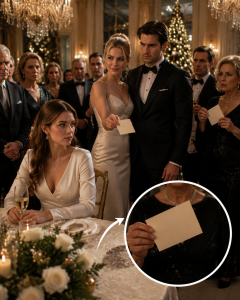
Sloane crossed the ballroom, chin lifted, tapped a champagne flute with a dessert spoon. The quartet lowered into something sweet and useless. A waiter behind her carried a tray stacked with ivory cards embossed in gold. I recognized the paper immediately. Hartley stationery. My grandmother’s stock.
“Good evening, everyone,” Sloane said, her voice warm enough to fool strangers. “First, I want to thank the Caldwell family for welcoming me tonight during what I know has been a complicated year.” A complicated year — that was one way to describe your husband coming home at three in the morning smelling like another woman’s perfume. “Eleanor reminded me that the Caldwell family has always believed in honesty, unity, and giving everyone a voice.”
The waiter began handing out ivory cards. My name was printed on them.
*CLARA CALDWELL SHOULD CONTINUE TO BE INVITED TO CALDWELL FAMILY HOLIDAY EVENTS. YES. NO.*
For a moment, the room did not move. Then it moved all at once. Small gasps. A chair leg scraping. Patrick finally looked at me — not with horror, with warning, as if my reaction would decide whether I was worthy of pity. He crossed the room slowly. “Clara,” he said under his breath. “You need to understand the context.”
“That is not an answer.”
Eleanor came forward, regal and poisonous. “This is not an attack. The family deserves democracy.”
“Democracy?”
“Yes. Everyone has suffered under this tension.”
Patrick added softly, “If you’ve treated people well, Clara, you have nothing to fear.”
That was when the last warm part of me toward him died. Not loudly. Not dramatically. It just went out, like a candle pinched between wet fingers.
I thought of the miscarriage I had endured alone because Patrick was “stuck in Chicago” — when he was actually in Miami with Sloane at a boutique hotel with a rooftop pool. I thought of every time I had swallowed my dignity because I was trying to protect a marriage he was already using as furniture.
Then I smiled. Not kindly. Not cruelly. Just enough.
“Then please,” I said, lifting my card. “Vote.”
—
PART 2
The first ballot dropped into a silver bowl at 8:42 p.m. I remember the time because the antique clock beside the library doors chimed once, as if Bellemont itself wanted the record kept.
People folded their cards with the solemnity of jurors and the excitement of children allowed to misbehave in church. Aunt Meredith, who had once borrowed my Nantucket house for three summers and left a wine stain on my grandmother’s rug, folded her card slowly and dropped it in. Patrick’s cousin Jill, who cried in my kitchen after her divorce while I held her and fed her soup, marked hers with a little frown of concentration. Uncle Graham didn’t bother folding his. I saw the black slash through YES.
My brother Daniel stood by the Christmas tree, fury held perfectly behind his teeth. My best friend Maya’s face had gone pale with rage. I gave them both a small shake of my head. Not yet. Daniel and I had learned silence from our grandmother — not the weak kind, the kind that let enemies finish writing the evidence in their own handwriting.
For three months, Eleanor had been pressuring me to sign a holiday “continuity agreement” — a document that would have allowed the Caldwell family to keep using Bellemont House for holidays regardless of any separation between Patrick and me, and would have allowed Sloane, unnamed, to attend “as a recognized partner of a Caldwell descendant.”
I had taken the document to Boston. Our attorneys took one look and asked a question that made the room go quiet. “Do they know who owns Bellemont?”
“They think they do,” I’d said.
My grandmother had taught us never to swing first. *Let them swing,* she used to say. *Then hand the judge the bat.* So I let them send emails. I let Eleanor write that Bellemont had become “a Caldwell family institution.” I let them make a record.
The vote took twelve minutes. Twelve minutes for people who had eaten my food, slept in my guest rooms, borrowed my contacts, used my name, and cashed checks from foundations my grandmother funded, to decide whether I had become inconvenient.
No. No. Yes. No. No. No. No. Brooke voted yes. Maya, though not family, wrote yes and signed it with a heart. Daniel wrote nothing — he drew a small key. I almost smiled.
By the time the bowl was empty, Sloane’s cheeks were pink with triumph. Eleanor took the tally sheet, then finally looked at me. “Clara,” she said, in a voice soft enough to pass for mercy, “the family has spoken.” *By a majority, the family feels it would be best if you stepped back from future Caldwell holiday gatherings.*
Stepped back. Not banished. Not discarded. Language is where cruel people hide their hands.
I nodded once. “Is that all? Is the vote complete? Have all cards been collected? Has the family spoken?”
“Yes, Clara. It has.”
I turned to the nearest waiter. “Would you please open the library doors?” He looked startled, then remembered who signed the event instructions. “Yes, Mrs. Caldwell.”
I removed my wedding ring. Slowly. Not angrily. The way one removes a splinter after it has finally surfaced. I placed it on the edge of the silver bowl. It made a small sound against the cards. Everyone heard it.
Then the library doors opened. And the truth walked in wearing a charcoal overcoat and carrying a red leather folder.
—
PART 3
Arthur Bell had been my grandmother’s attorney for thirty-seven years. He was eighty-two, silver-haired, and terrifying in the way only a polite old lawyer can be. He stepped into the ballroom with Daniel beside him and two younger attorneys behind them. The room shifted — not because everyone knew him, but because they knew what he represented. Paper. Authority. Consequences.
Eleanor’s face went white around the mouth. “Arthur. What is this?”
“Good evening, Eleanor,” he said. His voice was gentle. That made it worse.
Patrick looked from Arthur to me. “What did you do?”
I almost laughed. Men like Patrick can sleep with another woman for two years, humiliate their wife before eighty relatives, and still ask what *she* did when a lawyer enters the room.
“Mrs. Caldwell asked me to be present tonight in case the matter of Bellemont House became relevant,” Arthur said.
“This is a family event,” Eleanor snapped.
“It is an event held on Hartley property.”
The words landed softly. Then the room began to understand them. “That’s not right,” said Patrick’s brother Evan. “Bellemont is Caldwell.”
Daniel smiled without warmth. “No, Evan. Bellemont has never been Caldwell.”
“Virginia allowed us to use this house for decades,” Eleanor recovered.
“Yes,” Arthur said. “Virginia Hartley allowed many things. She was generous, not confused.”
Arthur opened the red leather folder. “For clarity, I will summarize only what is necessary tonight. Bellemont House, its grounds, furnishings, art, fixtures, and associated operating accounts are owned by the Hartley Bellemont Trust.” Eleanor gripped her clutch. “Mrs. Clara Hartley Caldwell is the current primary beneficiary and managing authority. Her brother, Daniel Hartley, is co-trustee for oversight. The Caldwell family has no ownership interest.”
He turned one page. “Furthermore, the Caldwell family’s use of Bellemont House for holiday events has always been by revocable invitation.”
*Revocable.* The word moved through the ballroom like black ice.
“This is absurd. Clara is Patrick’s wife,” Eleanor tried to laugh.
“For now,” I said.
Patrick flinched.
“Marriage did not transfer the property,” Arthur continued. “No prenuptial waiver transferred the property. No holiday tradition transferred the property. No number of photographs taken on the staircase transferred the property.”
Arthur’s eyes moved to the silver bowl. “I understand a vote was conducted tonight regarding Mrs. Caldwell’s continued invitation to future holidays.”
“It was symbolic,” Eleanor said, hardening.
“It was printed on Hartley stationery.”
Silence. Arthur removed a small plastic sleeve from the folder — the proof copy of the ivory card, with Sloane’s email attached, sent to the printer three weeks earlier. *Please use the thickest ivory stock available. Mrs. Eleanor Caldwell approved the language. This is for a private Caldwell family governance moment.* Governance moment. He didn’t need to read it aloud. He simply placed it on the table.
“I didn’t steal anything,” Sloane said.
“No one accused you of theft,” Arthur said.
“Yet,” Daniel added. I gave him a look. He shrugged.
“Daniel, enough,” Eleanor snapped.
“No, Eleanor. Enough was somewhere around the time you asked my sister to sign away our grandmother’s house so your son’s mistress could hang stockings here.”
The word nobody had wanted to say. *Mistress.* It did not echo. It stayed.
“I love Patrick,” Sloane said, tears filling her eyes immediately. That was her gift. Tears on command, like a faucet with excellent breeding.
Patrick finally moved toward her, then stopped. Because Arthur was still holding documents. Cowards can be romantic only when paperwork is not present.
“You planned this humiliation,” Eleanor accused me.
“No. I attended it.”
“You could have stopped the vote.”
“Yes.”
“Then why didn’t you?”
“Because I wanted to know who would mark the card.”
That quieted even the cruel ones. Especially the cruel ones. People who enjoy group punishment rarely enjoy individual accountability.
Arthur gave the younger attorney a nod. She stepped forward and handed me a cream envelope. I did not open it. I already knew what it contained. “Mrs. Caldwell has authorized me to notify all non-Hartley guests that tonight’s ball will conclude early.”
“You cannot throw out an entire family on Christmas,” Eleanor stared.
“It is December twenty-second,” Daniel said.
“Don’t be petty.”
“You held a vote to exile my sister from her own dining room.”
“Say something,” Eleanor told Patrick.
Patrick looked like a man trying to locate the version of himself who had believed this night would end cleanly. “Clara,” he said, voice low. “Can we talk privately?”
“No.”
His face tightened. That *no* had become familiar to him now. Still unwelcome. Still immovable.
Arthur produced another document. “Also relevant tonight is the matter of the Bellemont Preservation Fund.” Patrick’s mother stiffened. “In 2010, the Caldwell family holding company experienced a severe liquidity crisis. The Hartley family extended a private secured loan to prevent the forced sale of several Caldwell assets.”
Evan’s mouth fell open. “What?”
“That was business,” Eleanor said.
“Yes. And the debt was restructured twice. Once in 2014. Again in 2019.”
Patrick closed his eyes. He had known. Of course he had known. That was the worst of it. He had let his family call me provincial, lucky, dependent, all while my grandmother’s money had kept their name printed on donor walls.
“The Hartley family did not publicize this assistance out of respect for privacy,” Arthur said. “Mrs. Virginia Hartley specifically instructed that no Caldwell child should feel diminished by adult financial hardship.”
I felt my throat tighten. Not because of Patrick. Because of my grandmother. She had protected them better than they had protected me. And now they had used her ballroom to vote me out.
“Our grandmother kept your dignity intact,” Daniel said. “You used hers as a backdrop.”
No one spoke. Outside, the wind pressed snow against the windows.
“You vindictive girl,” Eleanor said to me. There was the real voice. Not democracy. Not family peace. Just rage that the servant had owned the house.
I smiled faintly. “Careful, Eleanor. You’re still standing on my floor.”
—
The staff moved like a quiet tide, instructed with precision. No one was rushed. No one was touched. Coats were brought from the cloakroom. Desserts were boxed for the children because my grandmother believed children should never be punished for adult foolishness. The music stopped at the end of the measure — even in disgrace, Bellemont did not interrupt the musicians.
Aunt Meredith approached me first, her lipstick faded at the corners. “Clara, I voted yes.”
“I know.”
“I always cared for you.”
“I know what you cared for.” I moved past her. “The Nantucket house will no longer be available in July.”
Jill came next, face red. “I’m so sorry.”
“No, Jill. You’re embarrassed.”
“There was pressure.”
“There always is. I didn’t think it would matter.” “That is exactly why it did.”
Patrick followed me toward the west corridor. “Clara, stop.” I stopped. He nearly collided with the suddenness of it. For sixteen years, he had mistaken my willingness to listen for an obligation. Now listening had ended.
“Do you remember our first Christmas here?” he asked. Memory as defense. “You wore a red dress. Your grandmother gave me Scotch in the library. She said I was family now.”
“She believed people could rise to an invitation.”
“That’s cruel.”
“No, Patrick. Cruel is handing your mistress a ballot.”
“I never wanted it to happen like this.”
“How did you want it to happen?”
“I don’t know. Cleaner.”
“Cleaner for whom?” He did not answer.
“I made mistakes,” he said.
“Mistakes are wrong exits and burnt toast. You made choices.”
“I loved you.”
“Not enough to be kind.”
That struck him. His eyes filled, but I did not soften. There had been years when his tears would have ruined me. Now they looked like weather behind glass.
“Please,” he whispered. “Don’t do this in front of everyone.”
“You did.”
I lowered my voice. “The divorce petition will be filed on December twenty-sixth. You will receive service at your office because I will not have anyone knock on your mother’s door during Christmas morning.”
Patrick stared. Even then, I gave him more grace than he deserved. For one second, his shame looked real.
Then Sloane stepped into the hallway. “Patrick?” Her voice was small. She did not look at me. Good. Patrick turned toward her reflexively. That was the answer. Not the whole answer. Just the last one I needed.
—
In the library, Daniel poured me water with hands still tight from anger. Maya shut the door behind us and let out a breath that sounded like a prayer and a curse. “I want to slap every single one of them.”
“Get in line,” Daniel muttered.
I sat in my grandmother’s leather chair. For the first time all night, I allowed my body to tremble. Only once.
Maya knelt in front of me. “Hey. Look at me. You were magnificent.”
“I was humiliated.”
“Yes. And you did not hand it back like trash. You turned it into evidence.”
That made me laugh. It broke halfway.
Arthur entered a minute later, his expression softening when he saw me. “Your grandmother would have been proud.”
That undid me more than the vote. For eleven months, I had not properly grieved Virginia Hartley. Now, in the library that still smelled faintly of her tobacco and lavender soap, grief found me. Not for the marriage. For the girl I had been when I thought being chosen meant being safe.
—
When I returned to the ballroom, most of the guests were in coats. The magic had drained from the evening. Without entitlement warming it, the room looked enormous and honest.
Eleanor stood beneath the chandelier with Patrick and Sloane. A fortress of three people pretending not to be stranded. On the table beside them lay the tally sheet. Fifty-six votes. Thirty-nine no. Fourteen yes. Three blank.
“You’ve made your point,” Eleanor said.
“No. You made yours.”
“You will regret turning this family against you.”
“This family was voting on whether I could eat pie near them.”
“I believe the turning happened earlier,” I told her.
“Mom, stop,” Patrick said.
She rounded on him. “No, Patrick. You stop. You allowed this girl to humiliate us.”
*This girl.* At thirty-nine. In my own house.
“Mother,” Patrick said, “you planned a vote.”
“For you.”
“For control.”
Eleanor went still. It was the first honest thing he had said all evening. Too late. But honest.
Arthur approached her. “Mrs. Caldwell, your car is ready.”
“I am not leaving.”
“Yes, you are,” I said.
“You think owning a house makes you powerful?”
“No. I think knowing when to close the doors does.”
The final guests filed out. Brooke stopped in front of me and took my hand. “I should have stopped it.”
“Yes.”
“I always cared for you.” She flinched. “Thank you for voting yes,” I said. “But next time, don’t be quietly decent. Be loudly decent.”
Then only four Caldwells remained. Eleanor. Patrick. Sloane. And Patrick’s father, William, silent all night in the way men of his generation call dignity.
He approached me slowly. “Clara. Virginia was a good woman.”
“She was.”
“She helped us when we needed it.”
“Yes.”
“I should have said so.”
“Yes.”
“I’m sorry.”
I nodded. He left without asking for absolution. That was the best thing he had ever given me.
Eleanor watched him go. For one instant, she looked abandoned. Then pride stitched her face back together. “You will be lonely,” she said.
I thought of my grandmother. My brother. Maya. The staff who had kept my favorite tea in the kitchen. The yes votes. The blank votes that told their own cowardly story. The years ahead, empty of Patrick’s lies.
“No,” I said. “I think I was lonely before.”
Patrick’s face broke. Eleanor looked away first. That was how I knew it was over.
—
By morning, three versions of the Christmas ball were circulating through private messages and one anonymous society account that loved rich people behaving badly. I did not respond. Arthur advised patience. I chose patience because it had teeth now.
On December twenty-sixth, Patrick was served at his office in downtown Providence. He called me nine times. I answered none. He texted once: *Can we please not become enemies?* I stared at the message for a long time, then typed back: *We became strangers first.* After that, I blocked him except through attorneys.
The divorce moved faster than people expected, because there was less to fight over than the Caldwells had assumed. Patrick kept the Boston condo in his name. I kept Bellemont, because it had never been his. His access to the Hartley charitable network ended quietly — three invitations disappeared from his January calendar and one board seat became “under review.” The Caldwell family holding company received a formal notice that the 2019 debt restructuring would not be extended again. That was not revenge. That was accounting.
Sloane lasted six weeks. Patrick’s assistant called my office by mistake in February and said, “Ms. Whitaker is here to see Mr. Caldwell, but he said he’s unavailable.” Then she gasped and hung up. Maya sent flowers to my office that day with a card that said, *For the unavailable man.* I laughed so hard I had to sit down.
The truth about women like Sloane is not that they always lose. Some win, for a while. But Sloane had wanted a stage. She had wanted to be chosen in the room where I was erased. When the room turned out to be mine, the romance lost its lighting.
Patrick came to Bellemont once in March. He did not get past the gate. I watched from the upstairs window as he stood beside his car, thinner than before, holding a paper coffee cup, looking up at the house like it might remember him kindly. For a moment I felt the old pull. Not love. Habit. The body remembers waiting for someone even after the heart has stopped.
He called from the gate phone. I answered because part of healing is proving the locked door works.
“Clara. I found your grandmother’s letter. The one she wrote me. Before the wedding.”
My hand tightened. “What did it say?”
“She said Bellemont was not a prize. She said you were not a bridge into a better life. She said if I ever forgot the difference between being welcomed and being entitled, I would lose both the house and the woman.”
“She knew you well.”
“No,” he said softly. “She knew people.”
For once, he did not ask to come inside. “I am sorry,” he said. I believed him. That surprised me. It did not change anything.
“I loved you badly.”
“Yes.”
“I should have protected you.”
“Yes.”
“I let my mother make our marriage into a family vote because I was too cowardly to make a decision myself.”
The honesty came too late to save us. But not too late to matter.
“You did,” I said.
“I hope you get everything peaceful.”
That almost made me cry. Not because I wanted him back. Because once, years ago, I had wanted only that sentence from him. Peace for me. Not access to me. Not forgiveness from me. Peace.
“Goodbye, Patrick.”
“Goodbye, Clara.”
I hung up. He stood there for another minute. Then he drove away.
—
Spring came slowly to Bellemont. Snow retreated from the hedges. The ocean changed color. I opened rooms that had been closed too long — not because I needed the space, but because houses, like women, become haunted when they are only used for other people’s ceremonies. I turned Eleanor’s favorite guest suite into a reading room for the girls from the scholarship program my grandmother founded. I had my grandmother’s portrait cleaned and rehung under better light. Now she looked not severe, but amused.
In May, I hosted my first dinner without the Caldwells. No orchestra. No ballot cards. No performance. Just a long table in the garden with candles in hurricane glass, blue hydrangeas, lemon chicken, warm bread, and people who knew how to be grateful without being instructed.
Maya came. Daniel came. Brooke came too, nervous and alone, no longer wearing her Caldwell pearls. She brought peach cobbler in a glass dish. “I know it doesn’t match the menu,” she said.
“It matches the table.”
She cried a little at that. I let her. Not every person who fails you must be exiled forever. But every person who returns must enter through the truth.
Daniel raised a glass. “To Grandma Virginia.”
“To doors that open,” I said.
“And doors that lock,” said Maya. Everyone laughed.
Later that night, after the guests left, I walked alone into the ballroom. The chandeliers were dimmed. The floor had been polished. For a moment I could see it again — Sloane in white, Eleanor with the bowl, Patrick by the fireplace, the cards passing from hand to hand, my name printed above two boxes.
I used to think betrayal was the loudest thing a person could survive. It is not. The loudest thing is the silence after you stop explaining yourself. That silence tells you who comes looking. That silence tells you who only loved the version of you that kept the peace. That silence tells you whether the room was ever yours.
I crossed to the north table, where the vote had been counted. A single ivory card sat there now. Not from that night. A new one. I had asked Daniel to print it as a joke, but when I saw it, I cried. On it, in gold lettering, were my grandmother’s words:
*A woman does not need permission to remain where she belongs.*
I framed it the next day.
People still talk about the Christmas ballot. They talk about the mistress. They talk about Eleanor being escorted out in mink. They talk about Patrick losing more than a wife because he forgot the difference between invitation and ownership.
But that is not the part I keep. I keep the moment after. The moment when the doors closed, the snow kept falling, and I was still standing.
Not chosen by them. Not approved by them. Not invited by them.
Home.
THE END