SHE ANSWERED HIS “COOK WANTED” NOTICE — HE MET HER WITH A RIFLE POINTED AT HER CHEST

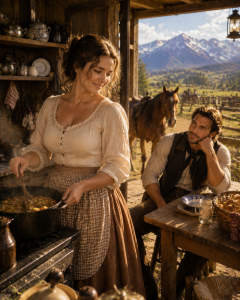
PART 1
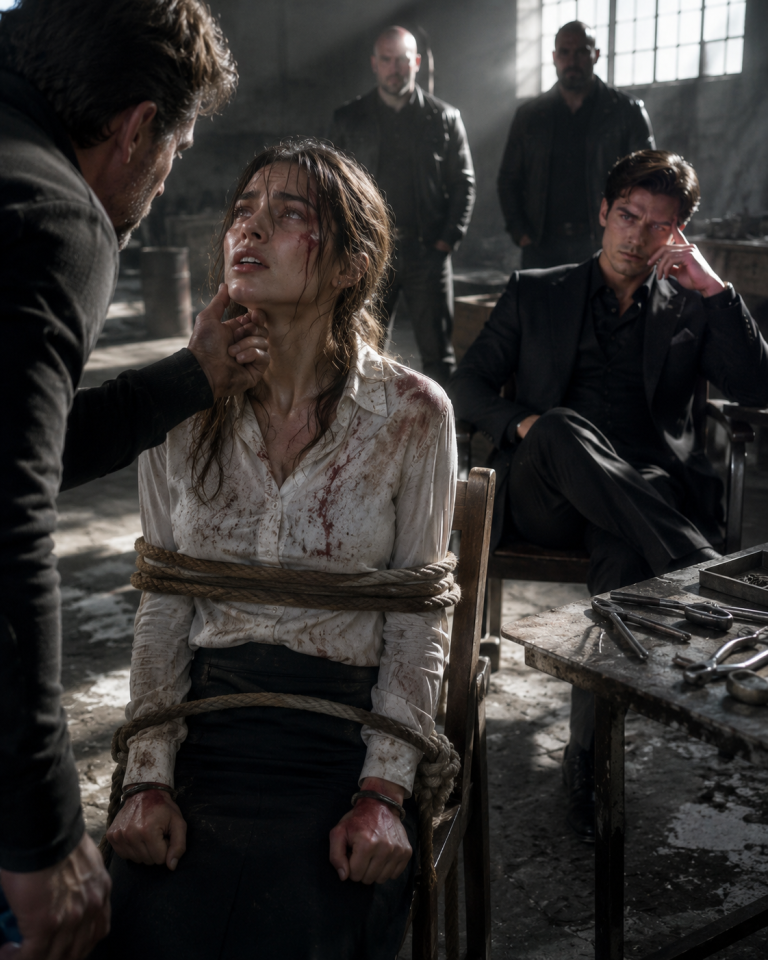
The rifle didn’t shake in Nathaniel Brooks’s hands. That was the thing Grace Sullivan noticed first, standing in a stranger’s yard with a battered suitcase at her feet and ten miles of dust on her hem. A man whose hands don’t shake around a gun pointed at a woman he’s never met is either dangerous or exhausted past the point of caring which. She’d learned, in the year since her whole life came apart, how to tell the two apart at a glance. This one was exhausted.
“I don’t know you,” he said.
“No, you don’t. And I don’t know you either, except that you’re rude, and you own a very large house that smells like dust from twenty feet away.” She wiped her forehead with the back of her wrist, unhurried, like the rifle was an inconvenience rather than a threat. “I’m Grace Sullivan. You posted a notice at the general store in Miles Crossing. *Cook wanted. Fair wages. No questions.* I’m here about the no-questions part, because Lord knows I’ve had enough of people asking them.”
He studied her the way a man studies a horse he isn’t sure he trusts. She wasn’t young in the way the town gossips meant when they clucked about widows — there was gray coming in at her temples, a hardness around her mouth that spoke of surviving things rather than being spared them. Her dress had been mended so many times the mending had its own mending. But she stood straight, and she didn’t look away from the barrel of that rifle, and that was the thing that made him hesitate.
“How’d you get out here? Nearest town’s ten miles.”
“I told you. I walked.”
“Nobody walks ten miles for a cooking job.”
“Then I suppose I’m nobody.” She picked the suitcase back up. “But if you’re not hiring, say so plain, and I’ll walk the ten miles back. I’ve done harder things than turn around.”
Nathaniel lowered the rifle. Not because he’d decided anything — because he was tired, and a tired man makes room for the first person in eight years who doesn’t tiptoe around him like he’s made of glass and grief.
“There’s coffee inside,” he said. “It’s bad coffee. I make it myself.”
“That,” Grace said, “is the most honest thing you’ve said since I got here.”
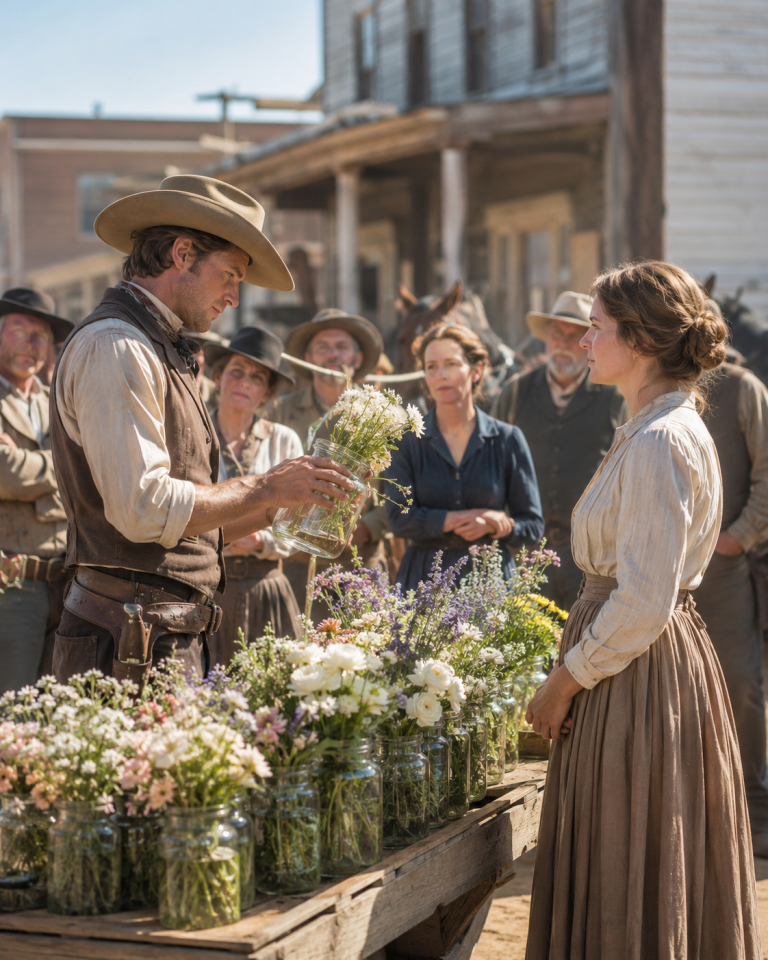
The kitchen had not been a kitchen in a long time. It had been a room where a man heated beans and ate them standing up, because sitting down at a table meant remembering who used to sit across from him. Grace stood in the doorway and looked at the cold stove, the empty shelves, the single chair pushed off to the side like it was ashamed of itself — and she did not say a single word about it. That was the second thing that made Nathaniel look at her twice. Most people said something. Most people made a face. She just set her suitcase against the wall and rolled up her sleeves.
“You keep flour anywhere in this house, or do your ranch hands eat air?”
“Cellar. Down the steps out back. There’s flour, salt. Some of it’s probably gone bad.”
“Everything’s gone bad in here,” Grace said. “But that’s fixable.” She looked at him directly. “What do I call you? Because I’m not calling a man ‘sir’ who pointed a gun at me before he offered me coffee.”
“Nathaniel.”
“Well, Nathaniel, you’ve got a house full of hungry men and a kitchen that’s been dead longer than my late husband, and I’ve got two hands and a recipe book. Do we have an arrangement or don’t we?”
He should have asked her a dozen things — where she came from, who she’d buried, why a woman of thirty-two was drifting the territory with nothing but a suitcase and a book. But he’d written *no questions* on that notice for a reason, and it wasn’t kindness. It was because he didn’t want anyone asking him any either.
“Two dollars a week,” he said. “Room in the back off the kitchen. You cook for me and the six hands. Start now, I’ll know by supper if you’re worth keeping.”
“Three,” Grace said, “because you’re going to need me a lot more than I need you, and we both already know it.”
The old ranch foreman, a leathery man named Silas, had wandered up to the doorway to see what the commotion was, and made a sound that might have been a laugh — the first laugh that had come out of Silas in months. Nathaniel heard it, and something in his chest turned over.
“Two-fifty,” he said. “Done.”
Grace was already opening cupboards. “Now get out of my kitchen, both of you, unless you know how to knead bread. And I can tell just by looking at your hands that you don’t.”
By supper she had the men, and she hadn’t tried to. That was what unsettled Nathaniel most, sitting at the head of a table he hadn’t sat at in years. She hadn’t performed for them. She’d simply put food in front of six men who’d been eating burnt beans and cold biscuits so long they’d forgotten food could be anything else, and she’d watched their faces change and said nothing about it. Let the food do the talking.
“Ma’am,” said the youngest hand, a boy of maybe seventeen named Tom, “I ain’t had cornbread like this since my mama passed.”
“Then your mama taught you what good cornbread was,” Grace said. “And you’ll know it the rest of your life. That’s a gift she left you. Don’t waste it by only eating mine.”
The boy’s ears went red. He ducked his head and ate three more pieces.
Nathaniel watched all of it from the end of the table and did not eat much, because he was busy with the strange, painful discovery that his own house had been silent for so long he’d stopped hearing the silence — and now that there was talking in it again, the silence he’d lived inside for eight years suddenly had a shape. And the shape was enormous, and it had been sitting on his chest the whole time.
“You’re not eating,” Grace said to him.
“I eat.”
“You’re pushing it around your plate like a man deciding whether to trust it. It’s cornbread, Nathaniel. It hasn’t got any opinions about you.”
Silas nearly choked on his coffee. One of the other hands laughed openly. And Nathaniel — who everyone in three counties treated like a wealthy, grieving shadow, who people spoke to too carefully — felt his mouth do something it hadn’t done in years. It almost smiled. He put it down fast, before anyone could see.
But Grace saw. Grace saw everything. She just didn’t say so.
She’d been at the ranch four days when the trouble started — and it started the way trouble in a small place always does, with a fine black wagon coming up a road that had no business carrying it.
—
PART 2
Grace saw it first from the kitchen window. A fine black wagon, two men in town clothes who’d never worked a day with their hands. “You expecting company?” she called through the house.
“I don’t get company.”
“You’re getting some.”
Nathaniel came out onto the porch, and Grace watched from the doorway as his whole body changed. Shoulders squared. Hands settled. In one breath he became the man who’d pointed a rifle at her — closed, hard, ready.
The man who climbed down was heavy and smiling, better dressed than anyone Grace had seen since leaving Chicago. Victor Callaway. He looked at the ranch like he was already deciding what he’d tear down.
“Nathaniel Brooks,” he said, warm as a summer afternoon. “You’re a hard man to sit down with.”
“Because I don’t want to sit down with you, Callaway.”
He wanted the north section — the low ground by the creek bed. The worst land on the whole ranch, cattle wouldn’t even graze it. He offered double what any man in the territory would call fair. Nathaniel refused, twice, and Callaway climbed back into his wagon with a smile that had turned into something colder. *”Country like that, a man never knows what might happen to it. Or to the people on it.”*
Grace didn’t wait for Nathaniel to explain it. “That man just threatened you,” she said. “What does he want with your creek bed? It’s the worst land you’ve got. He didn’t offer double the price of bad land because he likes you.”
“How do you know what land I’ve got?”
“Because I keep your kitchen, and Silas keeps talking, and I’m not deaf.” She crossed her arms. “There’s something under that creek bed he wants, and you don’t know about it. Either way, you’d best find out before he does.”
Nathaniel stared at her. Four days. She’d been in his house four days and already seen the shape of a thing that had taken him weeks of Callaway’s circling to even suspect.
“You always been this way? Seeing everything?”
“When you spend a year being seen as nothing,” Grace said, “you learn to do the seeing yourself. It’s safer.”
She was right about more than she knew. When the north fence came down three nights later — cut clean, not broken, cattle scattered to the creek — every man on the ranch understood what a cut fence in the dark meant, even if nobody would say the name out loud. And when Grace and Nathaniel finally took a shovel to the low ground by that creek at first light, two feet down, three feet, nothing but wet clay — the shovel struck something that wasn’t dirt and wasn’t rock at all.
It rang up the handle into his hands.
An iron pipe. Buried deep, buried deliberately, running in a long straight line toward the very land Victor Callaway had tried to buy. And where it seemed to end, the ground was wetter, greener, even in the dry season. A live spring, coming up through soil that had no business being wet.
“Do you understand what you’re standing on?” Grace asked quietly. “Not just water, Nathaniel. In a country where a bad drought can wipe out every ranch for fifty miles — this is the most valuable thing a man can own out here. And you didn’t even know you had it.”
Victor Callaway did know. That was why he’d offered double. That was why he’d cut the fence. He wasn’t after the cattle, or the grass, or the dirt.
He was after the water — and once he owned it, he could hold every rancher in the valley by the throat, one drought away from ruin.
What neither of them knew yet was that Callaway had already been onto the land once before, in the dark, with a man from town who owed him more than he could ever repay — a nervous surveyor with ink-stained fingers and a family to protect, who was about to become the first thread in the one thing Victor Callaway had spent fifteen years making sure never happened.
Eleven ranching families, each certain they were the only one who’d bent to him.
Each about to find out they were never alone at all.
—
PART 3
“Cover it back up,” Grace said, kneeling in the mud with the lantern beside her, mud to her elbows. “Both the pipe and the spring, exactly like it was. If Callaway comes back, I don’t want him to know we know.”
“You said to push back.”
“I did, and we will. But you don’t push back by showing your hand. You push back by knowing more than the other man thinks you know — and letting him keep believing you’re a grieving fool and I’m a nobody cook.” She picked up the lantern. “Cover it, Nathaniel. Then we ride into town. There’s a man in Miles Crossing who’s going to know exactly how that pipe got laid. And I’ve got a feeling I already know who he is.”
His name was Harlon Puit, and he ran the surveyor’s office in Miles Crossing — a thin, nervous man with ink-stained fingers who went pale the moment Nathaniel Brooks filled his doorway. Grace stepped in ahead of the trouble, gentle as anything.
“He’s not here to trouble you,” she said. “I’m Mrs. Sullivan. I keep house out at the Brooks ranch, and I’ll be honest with you, Mr. Puit, because you look like an honest man, and I’ve had my fill of dishonest ones. We’re worried. There’s been trouble at the ranch — cut fences. And Mr. Brooks here, well, he keeps things close. But a woman notices when a good man can’t sleep.” She let that sit. “We think somebody’s been surveying the north section without asking. And I thought to myself — if anybody in this town would know about a survey, it’d be the surveyor.”
Puit’s eyes went to Nathaniel, then to the window, then back to Grace, his hands twisting together. She knew before he said a word that she’d hit the vein clean.
“I can’t discuss my client’s business, ma’am.”
“So there was a client,” Grace said softly, “on Mr. Brooks’s land, that he didn’t hire.”
Puit went whiter still, and it took Nathaniel’s quiet, terrible calm — *”You came onto my land and surveyed it for another man, and never once thought to tell me”* — to crack the last of it loose.
“He told me it was routine,” Puit’s voice broke. “A boundary dispute. He paid well, and he said it was routine, and I’ve got a family, Mr. Brooks. I’ve got children. And a man like Callaway—” He stopped. His mouth clamped shut. He’d said the name.
The office went dead quiet.
It was Grace who crossed to him and put a hand on his arm, her voice kindness itself. “He won’t know a thing, Mr. Puit. Because you’re going to help us instead — and helping us is going to be the smartest thing you ever did. You’ve got children. Good. Then you understand what a man like Callaway does to a whole valley full of them when he owns the only water for fifty miles.” She held his gaze. “You made a mistake. I’m not here to punish you for it. But you can unmake it. Which one do you want your children to have as a father — the man who did the right thing when it counted, or the man who helped Victor Callaway put his boot on this whole county’s throat?”
Harlon Puit looked at her for a long moment, and something in his ink-stained face broke and reset into something firmer. “There’s a copy,” he said quietly. “Of the survey. I keep copies of everything. It shows the spring. It shows the pipe. It’s got his name on the work order.” His hand shook, pressing the folded paper into Nathaniel’s. “It won’t prove he cut your fence. But it’ll prove he surveyed your land for the water — and knew about the spring — and lied to me to do it.”
“You did that in ten minutes,” Nathaniel said once they were half a mile down the road. “I’ve been trying to get the better of Victor Callaway for two months.”
“I went at it like a woman offering a frightened man a way out,” Grace said. “People will give you almost anything if you let them keep their dignity while they do it. You cornered him. I opened a door and let him walk through it thinking it was his idea. It’s the only real thing a hard year taught me. When you’ve got no power, you learn to move people instead of pushing them. Pushing takes strength. Moving just takes seeing.”
Nathaniel rode beside her in silence a while. “Eleanor used to say something like that,” he said finally — the first time he’d spoken his wife’s name aloud since the night at the kitchen table. Grace went still and careful beside him, the way she did.
“She used to say I was the strongest man she knew and the worst at getting my own way, because I only knew how to push. She said it’d be the death of me one day.” He almost laughed. “I suppose it nearly was. Eight years of pushing everybody away, pushing so hard on the grief I couldn’t feel anything else. And now there’s a woman in my kitchen who outthinks a whole town before breakfast, and I don’t know what to do with that.”
He said it lightly. It landed heavy, and they both knew it.
“Don’t,” Grace said, her voice losing its steadiness at the edges. “Don’t make me into something I’m not, Nathaniel. I’m a cook. I’ll help you fight Callaway because it’s right, and because I hate men like him with everything I’ve got. But when it’s over, when it’s done, I’ll still be a widow with a suitcase, and you’ll still be the richest man in the territory. And there’s no story where those two things end up standing on the same porch. So please — whatever this is — don’t.” She looked straight ahead. “I’ve been nothing to everybody for a year. I can survive being nothing. What I can’t survive is being something to somebody for a little while, and then going back to nothing. That would break me clean in half, Nathaniel. And I’m already held together with mending on top of mending. So be kind. Let me stay the cook.”
Nathaniel opened his mouth to argue, and it was the real fear in her face — not fear of Callaway, but the older, deeper fear of a person who’d already lost everything once — that told him not to. So he said nothing. He let her have it. And that silence, given as a gift, said more than any argument could have.
Callaway came back four days later without the smile. Two big hired men behind him now, and iron in his voice instead of honey. He denied any survey, denied any client, watched Nathaniel’s hands for a reaction and found nothing — which visibly unsettled him. Then, when the bluff about the water didn’t crack Nathaniel’s calm, he turned it on Grace instead.
“I’ve got friends in Chicago, Mrs. Sullivan,” he said, smiling cold. “Did you know that I make it my business to know things about people? And a widow with a dead, bankrupt husband and no family — well, there’s always something a person like that would rather keep buried, isn’t there?”
Grace went very still. Whatever Callaway was reaching for, he’d reached toward something true.
“Get off my land,” Nathaniel said, and there was murder in it now, no bluff at all.
Callaway laughed and climbed back into his wagon. “Think about my offer, Brooks. And Mrs. Sullivan — you think about yours. Some secrets are worth a great deal of money. To keep, or to tell. Your choice.”
She didn’t speak until the wagon was gone. Then she went inside and stood at the counter with both hands flat on it, shaking.
“What did he mean?” Nathaniel asked. “What secret?”
“It’s nothing.” Her voice broke on the word.
“He threatened you on my porch over something in your past, and you went white as flour. Four days ago you told me the truth was the only thing a man like Callaway can’t buy. So don’t stand there and tell me it’s nothing — because whatever it is, *he* knows it. And if he knows it and I don’t, then he’s got a weapon, and I’ve got a blind spot. That’s exactly what you told me not to give him.”
Grace laughed, a terrible wet sound. “You listen too well. That’s the trouble with you.” She wiped her face hard. “Sit down, Nathaniel. If I’m going to tell you, I’d rather not watch your face fall from a standing position.”
He sat. She stayed standing, back to him, hands on the counter, and told the wall the truth.
“Daniel didn’t lose everything on bad investments. That’s the story I tell — it’s clean, it’s sad, people nod and look away. The truth is Daniel was in business with men like Callaway. And when it all came apart, when the money vanished, there were people who’d been cheated, ruined. He took their trust and their savings, and some of it he plain stole to cover the rest. I didn’t know, Nathaniel — I swear before God, I didn’t know until it was all over.” Her voice steadied the way voices do when they’ve committed to the fall. “When he died, they came for me. Not just the bank — the people he’d ruined. They said a wife always knows. A few of them said worse. That the grieving widow act was just an act. There was talk of charges. It never came to anything, because there was no proof, because I truly didn’t know. But a thing doesn’t have to be proven to follow you. It just has to be said, again and again, until it’s the first thing anyone learns about you.”
She turned around, eyes streaming. “That’s what Callaway’s got. That in Chicago there are people who believe Grace Sullivan helped her husband ruin honest families and walked away clean. It isn’t true. But it’s a story, and it’s an ugly one. And if he spreads it here, I’m finished. Not just here — everywhere. Because he’ll make sure it follows me to the next town, and the next. So now you know. Still glad I walked the ten miles?”
Nathaniel stood up slowly. “Come here,” he said, and when she did, he took both her hands the way he had that dawn by the fence, and said the truest thing he’d said in eight years.
“I pointed a rifle at you the first time I saw you. I’ve watched you every day since. I’ve watched you feed my men when you didn’t have to. I’ve watched you talk a terrified man out of the most dangerous secret in this county without once making him feel small. I don’t need Chicago to tell me who you are. I’ve seen who you are. A woman who helped her husband cheat honest families does not spend a hard year refusing charity out of pride. She takes it. She takes everything she can get. You never took a thing you didn’t earn. That’s not the character of a thief, Grace. That’s the exact opposite of one.”
“You can’t know that. You’ve known me two weeks.”
“I knew Eleanor was the one I’d marry the day I met her. Took me two hours.” He didn’t let go of her hands. “So let Callaway spread his story. Let the town whisper. I’ll stand on that porch and tell every soul in this county that Grace Sullivan is the most honest person I’ve ever known — and I’ve got the money and the land to make them listen. He thinks that secret’s a weapon. He’s wrong. The moment you tell a thing yourself, out loud, to the one person who matters, it stops being a weapon. It’s just a wound. And wounds heal. I’d know.”
For a long moment Grace couldn’t speak. When she did, it was small. “You weren’t supposed to say all that.”
“I know. But you spent a year with everybody looking away from you. I told you the first day — I’m not going to look away.”
She made him promise to wait — no confessions of love, no choosing, not until Callaway was finished, because she wouldn’t have him choosing her out of a fight. He agreed. But before the promise was even a day old, she looked at the survey in his hand and something changed in her face — the fear burning off like morning fog, something harder and brighter taking its place.
“He comes at every man alone,” she said. “That’s his whole game. One rancher, one widow, one frightened surveyor at a time, because a man alone is easy. He’s spent years making sure nobody in this valley talks to anybody else. But if he surveyed your land in the dark, he surveyed theirs too. Every family he’s cheated thinks they’re the only one — and they’re not. So we do the one thing he’s spent his whole life preventing. We put every lonely, frightened, cheated person in the same room. And we let them find out they were never alone.”
—
They rode at dawn, and by dusk they had their army — except an army, Grace learned that day, was not a thing you assembled so much as a wound you kept reopening in one kitchen after another. Ezra Coldwell, whose old boy’s trouble had been turned into a threat against his family’s name. The Hendersons, who’d lost two hundred head of cattle the same week they refused to sell. The widow Abbott, threatened over her late husband’s war record. The Garzas, over their citizenship papers. Harlon Puit’s own cousin, squeezed over a gambling debt Callaway had quietly bought up.
At every house it went the same way — the flinch, the shame, the certainty that they alone had folded. And at every house, hearing Nathaniel and Grace name the others, something straightened. A back. A head. The terrible loneliness of a private shame cracking open when a person learns their neighbor carries an identical one.
“It doesn’t cost Callaway a thing,” Grace said, watching it happen for the fifth time that day. “He finds the ugly true thing about a person, and he doesn’t even have to tell it. He just has to let them know he could. And then they lock their own selves up. They do the guarding for him.” She stared down the road. “That’s what he tried with me. And the only way out of that room is the door I already walked through with you. You say the thing out loud. You take the shame out and set it on the table and look at it in the light, and it turns out it was never as big as it was in the dark.”
By nightfall, eleven ranches had agreed to come quietly to the Brooks ranch in three days’ time.
But Callaway learned of it, of course — a valley couldn’t keep a secret that size — and he came the morning before the meeting, alone this time, which was worse, because a man who comes alone has decided he doesn’t need help handling you.
“Call off your meeting,” he said, no honey left in his voice at all. “Sign my option. Take the money. I’ll make it triple. Go live somewhere green with your kitchen widow. Because if that meeting happens tomorrow, I stop being polite.”
“Don’t you say her name,” Nathaniel said, ice in his voice, when Callaway invoked Eleanor as a lever.
“Everybody’s got a lever, Brooks. Yours used to be a dead wife. Now it’s a live cook.” His eyes went to the window, raising his voice so Grace could hear it clear through the glass. “I sent a letter to Chicago last week. Should hear back any day. And when I do, this whole valley is going to learn some very interesting things.”
Grace came out onto the porch, and this time Nathaniel let her stay, because she’d told him to let Callaway keep making the mistake of thinking she was nothing.
“Send your letter,” she said, chin lifted. “Send ten of them. I spent a year running from that story, letting it chase me because I was ashamed. And I was ashamed because I let myself believe a thing being said made it true. It doesn’t. And I’m done running from a lie just because a bad man might repeat it. You can only threaten a person with a secret while it’s still a secret. The moment they say it out loud themselves, you’ve got nothing. And I’ve already said mine — to him. So your letter is worth exactly as much as the paper it’s written on.”
“You’re bluffing,” Callaway said, and for the first time, he had no smooth answer ready.
“Try me. Ride into town and tell them. I’ll be right behind you, telling them the rest — that he did it without my knowing, and that the man trying so hard to spread the story is the very same man who’s been cutting fences and killing cattle and threatening children all up and down this valley.” She smiled, and it was not warm. “Which of us do you think they’ll believe, Mr. Callaway? The widow who cooks their neighbors’ suppers, or the outsider who’s been squeezing every family for a year?”
He wheeled his horse and rode out hard. That night, the barn burned.
Grace woke to Tom screaming for water and was out the kitchen door in her nightclothes before she was fully awake, the whole east side of the yard gone orange. They fought it till dawn — Nathaniel and the six hands, Grace hauling buckets, Silas beating at sparks with a wet blanket — and it was hopeless from the first minute, but they kept the fire from spreading. When the sun came up, there was nothing left but a black skeleton and a smell that would never fully leave the yard, and an empty kerosene tin by the fence.
Two horses had died in it. One Nathaniel had raised from a foal.
“This is because of us,” he said, his voice cracking. “Because we rode the valley.”
“No,” Grace said, grabbing his arm hard. “You don’t get to do that. Those horses died because a wicked man killed them, and the only thing you did wrong was own something he wanted. If you take this on yourself, you’re doing exactly what he wants — making yourself the guilty one so you’ll stop fighting. That’s shame again. Do not sit back down.”
He was still asking how he could ask eleven families to come stand against Callaway after this when the first wagon came up the road. Then a second. A third. The Coldwells, the Hendersons, the Garzas — one after another, hours before the meeting was even set.
“We saw the smoke,” Ezra Coldwell said, looking at the burned barn. “And I said to my wife — that’s Callaway. He’s done to Nathaniel what he’s been threatening to do to all of us. And I got up out of bed and hitched the wagon. If he’ll burn a barn to stop this meeting, then this meeting is the most important thing that’s ever going to happen in this valley.”
“He miscalculated,” Grace said softly, tears running unwiped down her face. “He spent a year keeping you all apart, all afraid, all alone. And then he burned a barn to scare you — and instead the fire’s the thing that finally showed you the smoke over each other’s houses. He gave you a signal, Nathaniel. He lit a fire everyone could see for miles.”
—
They held the meeting in the yard, in the shadow of the burned barn, because there was no better argument in the world than that black skeleton and the smell of it. Nathaniel wanted Grace to speak — she was the one who’d ridden to every house, told them they weren’t alone — so she stood on the porch step in soot-stained clothes she hadn’t had time to change, and she told them the truth.
“Every one of you signed something you’re ashamed of, or you’re about to, or he’s got a threat hanging over you that’s kept you up nights for months. And every one of you has believed you were the only one weak enough to bend.” She pointed at the barn. “That’s what his power actually looks like when you stop being afraid of it. A pile of ash. He can burn a barn. He can send a letter to Chicago about me. So I’ll save you the suspense, folks — he already has. And I’ll tell you exactly what it says right now, in front of everybody, so he can never use it against me again.”
And she did. Stood in that yard and told eleven families the ugly story of her husband’s fraud, plain and clean, all of it. When she finished, there was not a sound but the wind.
“That’s my secret. That’s the worst thing anyone could say about me, and now you all know it. So it’s not a secret anymore. So it’s not a weapon anymore. That’s how you take his power away — not with guns, not with money. You just stop being ashamed of the things he’d use to shame you.”
Ezra Coldwell stood first, and confessed his signed option. Then the widow Abbott. Then the eldest Garza son. One after another, they set their secrets down in the light, and Grace watched shame die in a whole valley at once, curling up like smoke.
Nathaniel stepped up beside her. “I’ve got money. I’ve been too much of a coward to use it for anything but hiding these eight years. Not anymore. I’ll pay for the lawyer, the best one in the territory. I’ll pay for every one of you to travel to court. If Callaway comes at any of your families while this is going, you send word, and I’ll house you and feed you here till it’s done. He spent a year making you each stand alone. None of you stands alone again. Not while I’ve got a dollar left.”
Ezra Coldwell put out his hand. Nathaniel took it. One by one, every head of every family shook the hand of the richest man in the territory, who three weeks ago couldn’t have named a single one of their troubles.
—
They rode for the lawyer that same afternoon — Thaddius Finch, the one man in four hundred miles no amount of money could buy. It was on that long ride that Nathaniel finally broke his own promise.
“You told them about Daniel, about Chicago, in front of the whole valley,” he said. “Why? You didn’t have to.”
“Because you were right,” Grace said, watching the road. “You said the moment I tell a thing out loud to the person who matters, it stops being a weapon and becomes a wound, and wounds heal. Telling one person in a dark kitchen — that’s safe. Telling eleven families in a yard, in daylight — that’s the real thing. And I did it. It healed the second I said it out loud to all of them. The whole year of running just stopped, like a fever breaking. He can send a hundred letters to Chicago now. I don’t care. I’m not ashamed anymore. And a person who isn’t ashamed can’t be threatened with shame.”
Nathaniel reined his horse to a gentle stop.
“I love you, Grace Sullivan,” he said. “I didn’t want to. I buried the last woman I loved and swore off it. And then you walked ten miles into my yard and looked down the barrel of my rifle and told me you didn’t need charity, and I’ve been slowly, helplessly, gladly falling every day since. That’s not a fight talking. That’s just the truth, on a plain road, in plain daylight.”
“That’s not fair,” Grace said, her voice breaking. “You said we’d wait. You said *ordinary.*”
“It’s the most ordinary thing in the world. A man telling a woman the truth on a road. People have been doing it since there were roads.” He almost smiled. “You wanted boring and safe and sunlit. Look around, Grace. It’s sunlit.”
And Grace Sullivan, who had spent a year with the whole world looking away from her, looked at the one man who never had, and felt the last of the old fear go out of her — not the fear of Callaway, but the fear of being something to someone and then losing it and breaking in half.
“If you make me a widow twice,” she said, crying and laughing at once, “I will never forgive you, Nathaniel Brooks. I mean it. So whatever we do to Callaway, you do it careful. You come home to me every single night. Is that a yes?”
“It’s a yes, you impossible man. It’s been a yes since you offered me bad coffee instead of shooting me.”
—
Thaddius Finch listened for two hours without a word, then set down his pen. “No one’s ever beaten Victor Callaway,” he said, “because he only ever fights one person at a time. You’re telling me you’ve got eleven families, a surveyor’s own copy of the work order, a widow willing to testify to attempted extortion, and a physical spring under land he tried to buy at triple its worth.” A thin, dry smile. “That’s not one person’s word. That’s a pattern. And a pattern is the one thing a rich man’s lawyers can’t argue away. Sit down. We’ve got work to do, and we’ll only get one shot.”
The work took six weeks — the hardest of Grace’s life, harder in some ways than the year of running, because now she had something to lose. She rode the valley a dozen times over, coaxing frightened people through the exact words a monster had said to them, writing it all down in her careful hand. It turned out the quiet competence that had kept her alive that terrible year was exactly what this fight needed.
Callaway tried money next — real cash to three families to withdraw their testimony. The Hendersons nearly took it, six children and a mortgage weighing heavy. Grace rode out that night and sat at their table.
“Take it if you want it,” she said. “I mean that. But that money is not a gift. It’s a purchase. He’s buying your silence because your silence is the only thing that can save him. Which means your voice is worth more than that cash. I just want you choosing with your eyes open.”
The Hendersons kept their testimony. So did the others. Then Callaway tried fear again — but it didn’t work anymore, because that was the miracle of the burned yard. When you’ve already said your worst secret out loud to your neighbors, a threat to reveal it is just a man shouting a thing everyone already knows.
“He doesn’t understand it,” Grace told Nathaniel one night. “He spent fifteen years with shame as his whole arsenal, and he can’t grasp that we just stopped being ashamed.”
Three weeks before trial, a woman arrived alone in a hired buggy, dressed in mourning black. Margaret Vance, from Chicago — the widow of one of the men Daniel had ruined.
“I have hated your name for two years, Mrs. Sullivan,” she said, weeping. “A man came to me six weeks ago wanting me to sign a letter swearing you’d known about the fraud. And I almost did — because I wanted someone to blame who was still alive. But I started asking myself how a man from out west cared so much about a widow in Montana. And the more I looked at him, the more I saw my own husband’s killer looking back. Not the man himself. The kind.” She drew out a paper. “So I made him think I’d sign, and I got him talking, and I wrote down everything. It’s all here. His own words. About a spring. About eleven families he means to crush.”
Grace read it, hand to her mouth. Callaway had confessed the entire plan to a woman he was certain hated Grace too much to ever warn her — the one weapon he’d never guarded, his own certainty that everyone shared his contempt.
Grace crossed the room and took Margaret’s trembling hands in both of hers. “You lost your husband to a man like Callaway. So did I, in a way. We’re not enemies, Margaret. We never were. We’re two widows who got handed the same grief from two ends of it.”
—
The trial opened on a gray morning, and Victor Callaway walked in with three lawyers and the confidence of a man who had never lost. He lost that confidence one degree at a time over four days. Harlon Puit, hands shaking, voice holding, testifying that the survey clearly marked the spring Callaway had known about all along — *”You can make me look small, sir. You can’t make the paper say something it doesn’t.”* Then eleven ranching families, one after another, the same threats, the same tactics, a rhythm building that no lawyer could argue away. Then Margaret Vance, reading Callaway’s own confessed words back to him in open court.
Then Grace.
“Isn’t it true that your late husband defrauded numerous families in Chicago?” the lawyer sneered.
“Yes,” Grace said, steady and clear, and the courtroom stirred, because she wasn’t supposed to answer that way. “I didn’t know what Daniel had done until it was over. I’ve spent a year paying for a crime I didn’t commit, and I’m done paying for it, sir. So you can ask me anything you like, and I’ll answer plain — because a thing you’re not ashamed of anymore can’t be used to shake you.”
He tried every angle and found nothing to grip. Finally, desperate, he reached for the cruelest one: *”Isn’t the truth that you saw a wealthy, grieving, vulnerable man, and—”*
“Let him finish,” Grace said, holding up a hand before Finch could object. “I want to answer it.”
She turned to the jury. “You want to know what I saw when I walked ten miles to that ranch? I saw a man who pointed a rifle at me. I saw a house that had been dead for eight years. I saw somebody so buried in grief he’d forgotten how to sit at his own table. And you’re right that I fell in love with him, sir — slowly, against my own better judgment, because I’d buried one husband and swore I’d never risk another. I’m not ashamed of that either. There’s not a soul in this room who’s ever loved someone and believed for one second that love is a crime.” She looked at him plain and open. “I’m testifying because Victor Callaway burned a barn with two horses in it to frighten a valley into silence, and I have run from frightened silence my whole life, and I am done running. That’s the whole truth. Make of it what you can. I’ve got nothing left to hide from you, which I understand is a great inconvenience to your case.”
The gallery went silent, and then someone began to clap, and the judge gaveled it down, but everyone in the room had already heard it.
The verdict came on the fifth day. Victor Callaway, liable on every count of fraudulent land acquisition, with federal charges of extortion, arson, and conspiracy fraud stretching back fifteen years and across three territories filed before he’d even left the building. Every coerced sale in the valley opened for review. The spring, ruled free and clear, Nathaniel’s.
As they led him out, Callaway stopped close to Grace, and for a moment his face wasn’t rage but honest bewilderment. “How?” he said, low. “One rancher, one widow. I’ve beaten a hundred of them.”
“Because you fight people one at a time,” Grace said quietly, “and you win by making sure they’re ashamed and alone. But shame only works in the dark, Mr. Callaway. You put a lonely, frightened person in a room with eleven others carrying the same fear, and let them say the ugly thing out loud together, and it just evaporates. That’s all we did. You spent fifteen years keeping people apart. You never once imagined what would happen if they stood together. You just couldn’t see it, because you’ve never in your life stood beside anybody.”
—
The town’s people came in ones and twos to the kitchen door in the weeks that followed, hats in hand, to apologize for the whispers. Grace let every one of them in, gave them coffee and bread, and accepted it without a shred of triumph.
“I don’t know how you can even look at me,” one woman said, ashamed — the same woman who’d once crossed the street to avoid her.
“I can look at you fine,” Grace said, setting down the bread. “You were frightened of a thing you didn’t understand. I know that better than most. If I held your fear against you, I’d have to hold my own against myself, and I’m tired of carrying that. Kindness that only goes to people who’ve earned it isn’t kindness. It’s payment. I’m not in the payment business. I’m in the bread business. Sit down.”
“You could make them grovel,” Nathaniel said to her one evening. “Nobody would blame you.”
“I know,” Grace said. “That’s exactly why I won’t. Victor Callaway spent fifteen years making people pay for their fear, their weakness, their secrets. I watched what it turned him into — a man so busy collecting debts he never once stood beside another human being. I’d sooner die poor and kind than live rich and keeping ledgers on people’s worst moments.”
He found his ordinary morning three weeks later — no ring in a velvet box, no speech, just leaning in the kitchen doorway watching her work the dough.
“Marry me, Grace.”
“That’s it? That’s the whole thing?”
“You wanted boring. Safe. Sunlit. It doesn’t get more ordinary than a man asking a woman to marry him while she’s making bread on a Tuesday, flour on her face, coffee going cold.” His voice softened. “You’ve had enough drama for three lifetimes. I wanted to give you the one thing you said you never got.”
Grace turned around, laughing and crying and not wiping the flour off her face. “Yes, you impossible, wonderful, ordinary man. Yes.”
Silas walked in exactly then, took one look, and said, “Oh, for God’s sake, it’s about time,” and went to go tell the other hands. By noon, the whole valley knew.
They married in the spring, in the yard where the barn had burned. Grace wouldn’t let Nathaniel rebuild it first. *”Let the place where the worst thing happened become the place where the best thing happens.”* Every one of the eleven families came. Margaret Vance came too, in color this time, and stood up front where family stands.
The years were good to them. When the great drought came four summers later and ranches failed for a hundred miles in every direction, the Brooks land held — and Nathaniel didn’t do what Callaway would have done. He opened the water to every family that had once stood in his yard, free of charge. What Victor Callaway had built to make a valley his tenants became, in Nathaniel’s hands, the one thing that made it free.
The kitchen became the heart of the whole county. Grace’s mother’s recipe book, carried in a single suitcase through the worst year of her life, grew fat with new pages in a dozen different hands.
Many years on, an old man and an old woman stood together on the same porch where it had all begun.
“I’d point the rifle at you again,” Nathaniel said quietly, “if it meant getting all of it. Every bit. The whole thing over — grief, and Callaway, and the barn, and all of it — just to end up right here.”
Grace laughed, the real laugh, the one she’d once turned away so he couldn’t catch it, and now gave him freely every day. “You impossible man. You’d point a rifle at me again.”
“I would.”
She took his hand the way she had that first dawn, when neither of them had let go as fast as they could have. “Well. This time — don’t let go.”
“I never did,” Nathaniel said. “Not once. Not from the first morning. You just couldn’t see it yet.”
And they stood there together as the light went down, two broken people who had learned, slowly and against all their own hard wisdom, the one truth that outlasts every grief and every threat and every burned and buried thing: the strongest homes are never built by wealth, and never held by fear, and never kept by keeping ledgers on who has wronged you. They are built by two people who choose — and keep choosing — to stand in the burned places, and refuse to let them stay burned.
**THE END**