SHE STEPPED OFF THE STAGE LIKE A WOMAN CALCULATING HOW FAST SHE COULD RUN — THEN THE RANCHER WHO SENT FOR HER SAID THE ONE THING NO ONE HAD EVER OFFERED HER: A WAY OUT

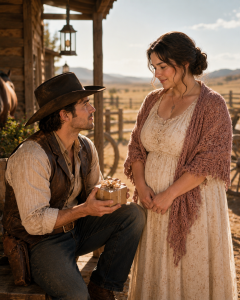
—
PART 1
The dust hadn’t even settled around the stagecoach wheels when Wyatt Granger saw it — the thing nobody else in that whole crowded street in Silver Creek, Colorado seemed to notice.
A woman stepping down from a coach in July, buttoned to the throat in a heavy gray wool coat, sweat-soaked and unnecessary in the heat, both arms wrapped around a small brown-paper package like it was the only thing keeping her upright.
Her eyes didn’t search for him. They searched for the exits.
Wyatt had spent thirty-one years reading frightened animals — cattle that flinched before a storm, horses that startled at nothing anyone else could see. He knew what he was looking at now wasn’t a mail-order bride arriving with hope in her chest. It was a woman who had learned, somewhere, the hard way, that safety was a lie people told you right before they hurt you.
He hadn’t sent for a wife because he was lonely. Men like Wyatt didn’t admit to loneliness any more than they admitted to fear — they just carried it so deep it stopped feeling like anything at all. He’d sent the letter east after a winter two years back nearly killed him, three days of fever with nobody to bring him water, staring at the ceiling of an empty ranch house thinking: *this is no kind of life.*
Clara Whitmore’s letters had been different from what the agency samples suggested. No talk of cooking, no talk of pleasant dispositions. Just: *I am not looking for rescue. I am looking for fair ground.*
Six months of careful, factual letters later, here she was. Twenty-six years old. Twenty-six years old and looking, in this one unguarded second before she caught herself, like a woman deciding exactly how far she’d have to run if she needed to.
Wyatt stepped forward before he’d made any conscious decision to move.
“Miss Whitmore?”
Her expression locked into something composed so fast it was almost frightening.
“Mr. Granger.”
He noticed the trunk that wasn’t there. Just a small, battered carpet bag.
“This is everything,” she said, when he asked.
He didn’t ask why. He’d learned that with horses — pushing too early was how you lost an animal for good.
Two miles out of town, on the wagon bench, he asked her the only question that mattered.
*”Do you want to be here?”*
Not a test. Not politeness. A real question.
She went quiet a long time before she answered honestly that she didn’t know yet — but she thought she wanted to find out.
“That’s fair enough,” he said. And he meant it enough that when she later admitted she wasn’t sure this wasn’t just the best option she had left, he told her plainly:
*”I’d drive you back to town. Put you up for the night. Wire you money for a ticket wherever you want to go.”*
She stared at him like the offer itself was dangerous.
“Why?” she asked.
“Because that doesn’t seem like much of a life for either one of us.”
They married the next morning in a fifteen-minute ceremony with no flowers, witnessed by his foreman Pete Hadley and the pastor’s wife. Clara signed the papers in careful, margin-filling handwriting, the same precision she’d used in every letter she’d ever sent him — like she was afraid of wasting even a quarter inch of paper, or of taking up more space than she’d been allowed.
In the two weeks that followed, Wyatt learned the geography of his new wife the way you learn unfamiliar land — slowly, by what you find where you don’t expect it.
She was awake before him every morning, a woman who had clearly spent years learning to move through kitchens that weren’t hers without asking where anything was kept. She repaired two broken chairs with nothing but twine and scrap wood and didn’t mention it until he sat in one and looked surprised.
She apologized for things that weren’t her fault. For asking questions. For the weather.
She flinched — small, controlled, nearly invisible — at raised voices.
She ate half of what she served herself, and Wyatt didn’t understand why until the night he asked her plainly when she’d last eaten a full meal, and she told him her parents had died when she was fourteen, and after that whether there was food depended on whether she’d worked enough that day to earn it.
*Old habits,* she said.
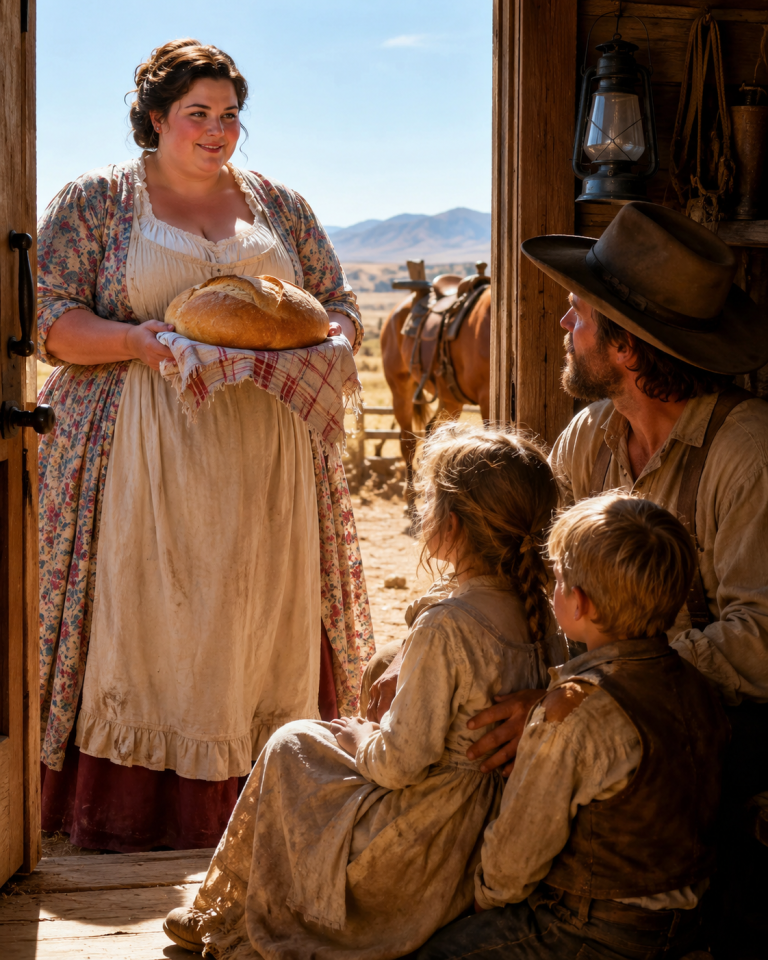
He went to the pantry that night and set half a loaf of bread, salt pork, boiled eggs, and a jar of preserved peaches on the table in front of her.
“That’s tomorrow’s breakfast,” she said.
“Tomorrow, I’ll make more.”
She ate an egg without apologizing once.
And the brown-paper package stayed exactly where she’d first set it — on the shelf above her dresser, untouched, unopened, tied with the same kitchen twine it had traveled a thousand miles under. Wyatt noticed it every single day. He never asked what was inside.
He didn’t know yet that it had been sitting there, unopened, for twelve years.
He didn’t know yet what she could do with a horse that had put three grown men in the hospital.
And he had no idea — none at all — that three weeks later, a letter would arrive addressed not to Mrs. Granger, but to a name she’d left behind in New York. A name that belonged to a man who had spent three years methodically destroying her life, one employer, one lie, one whispered accusation at a time.
A man who was already making plans to come to Colorado himself.
The letter was still folded in her apron pocket by the time supper went cold that night, and Clara Granger sat across from her husband of three weeks with her eyes on the window instead of her food, waiting to find out if the one safe thing she’d finally found was already about to be taken from her.
—
PART 2
She slid the letter across the table before he could ask twice.
Wyatt read it in silence. A man named Edgar Callaway, traveling west on business, planning to stop in Silver Creek, hoping Miss Whitmore had “settled her current situation satisfactorily” — because he intended, at his earliest convenience, to discuss it with her personally.
“Who is he?” Wyatt asked, keeping his voice level.
A railroad investor. A man with money who’d decided, three years ago, that Clara was something he was owed. When she refused him, he’d found other ways to make her agree — telling her employers she was unstable, that she’d been caught stealing, that the way she worked with horses was “suspicious.” She’d lost three positions in eight months. Each time she found new work, a letter arrived ahead of her.
“He was patient about it,” she said. “He thought eventually I’d have no choice.”
Wyatt didn’t ask her to handle it alone. He didn’t offer to send her back to town, either. He set his coffee down and said the thing that would end up meaning more to her than anything else anyone had ever told her:
*”Whatever walks onto my land is my problem, too. I don’t say that to take this from you. I say it because you shouldn’t have to stand in front of that man alone.”*
She touched the chain at her throat — a small, unconscious gesture — and asked him one more question, quiet, almost afraid of the answer.
*”What’s in the package, Clara?”*
She told him. A journal. From her mother. Given to her the week before she died, with instructions to open it only when she found somewhere safe.
*”I’ve been carrying it for twelve years,”* she said. *”I haven’t found anywhere safe yet.”*
He walked to the door and, without turning around, told her the ranch wasn’t perfect, that the winters would try to kill her every year, but that nobody would reach her here without going through him first.
That night, alone in the kitchen, she opened it.
Inside was her mother’s handwriting, faded to pale brown ink: *You have always heard what others cannot. It is your inheritance, and no one can take it unless you let them.*
Because that was the truth about Clara Whitmore that Edgar Callaway had never understood, and that Wyatt Granger was only beginning to. She wasn’t just good with frightened horses. She could hear what they were feeling — not words, but the shape of their fear, the weight of it — a gift passed down through generations of women in her family who’d learned to hide it, because the world had never been ready for a woman who knew things men couldn’t explain and therefore couldn’t control.
A gift Edgar Callaway had tried to put on display for his wealthy friends like a parlor trick. A gift he’d tried to own — and when she said no, he’d decided that if he couldn’t have it, nobody would.
Three days later, a black stallion that had broken two men’s arms and thrown a third fifteen feet into a creek walked calmly across a pen and put his nose into Clara’s open hands.
Wyatt Granger watched his new wife do something he had never seen in his life, and thought two things at once, standing at that gate with his hand still on the latch.
*Who did this to you?*
And then, colder, quieter:
*Who is going to try to take it back?*
He didn’t know yet that Edgar Callaway was already on his way to Silver Creek. He didn’t know the man had a contact in the county land office, or that he’d rather burn the whole ranch to the ground than let another man have what he’d decided, three years ago, belonged to him.
—
PART 3
The stallion’s name, Wyatt realized later, had never mattered to anyone. Not to Harrison Webb, who’d inherited him from a buyer who’d given up entirely. Not to the three handlers who’d tried and failed to break him. The animal had simply become *the black one*, seventeen hands of solid, spectacular danger that nobody wanted and nobody could put down, because he was too valuable to waste and too dangerous to keep.
Clara had given him back something that had nothing to do with a name. She’d given him the thing he’d stopped believing existed — a hand that wouldn’t hurt him.
“You know horses,” Wyatt had said, that first afternoon at the barn door.
“I know that one,” she’d answered, and there had been nothing careful in her voice at all. No apology. No second coat of caution laid over the words. Just certainty.
He should have told her no. Every sensible instinct in him said no — the horse was unpredictable, she was small, they’d been married three weeks, and he had no idea what kind of funeral he’d have to explain to Pastor Hollis if this went wrong.
He’d said, *”I’ll be right behind you,”* instead.
And he’d watched her stand at that gate with her hands loose at her sides, patient in a way that was almost unbearable to witness, like watching something private that wasn’t meant for him — and the stallion had crossed the pen in a straight line and pressed his nose into her palms and let out an exhale Wyatt had never heard from that animal before.
*”There you are,”* she’d murmured. *”Nobody’s going to be rough with you anymore.”*
Wyatt hadn’t asked what she’d done. He’d asked what it *was*.
“I don’t know exactly,” she’d said. “I just — I hear them. What they’re feeling. I always have.” A pause, her expression going careful again, the way it always did when something felt too exposed. “Most people think it’s strange.”
“Most people,” Wyatt had said, “have never seen what I just saw.”
He’d thought about that conversation for days afterward, turning it over the way he turned over a fence post to check it for rot. A woman who ate half a meal and apologized for asking questions and flinched at raised voices — and who still had enough left inside her to walk straight at something terrifying and call it by its true name.
The letter from Edgar Callaway arrived three days later, and everything Wyatt had suspected about the shape of Clara’s fear finally had an outline.
—
**A NAME FROM NEW YORK**
She told him all of it that night, plainly, without the careful omissions she’d spent years using to make the story survivable. Her parents dying when she was fourteen. Learning horses because it was the only thing that had ever made her feel like she had some say over what happened to her. Edgar Callaway, a railroad investor with money and a smooth, rehearsed way of talking, deciding she was something he was entitled to.
When she’d refused him, he hadn’t raised his voice or made a scene. He’d simply started making her disappear — one lie at a time, one employer at a time, until three former bosses were willing to put their names to letters calling her unstable and dangerous.
“And the correspondence agency,” Wyatt said. “He doesn’t know you used one.”
“He does now, apparently.”
Wyatt had carried his coffee to the window and asked how long they had before Callaway reached Silver Creek. When she’d finally admitted, in a voice barely above a whisper, that she’d expected him to tell her to handle it herself — that it was her problem — he’d turned around with an expression she hadn’t yet learned how to read.
“Why would I do that?”
“Because it’s my problem.”
“You’re my wife,” he said. “That doesn’t make everything my concern *yours* alone.” He paused. “Whatever walks onto my land is my problem, too.”
She’d looked at him across that kitchen with something fighting itself behind her eyes — uncertain, fragile at the edges, the look of a person encountering kindness for the first time in so long she’d half-forgotten how to recognize it.
*”I’ve been standing in front of him alone for three years,”* she said.
*”I know,”* Wyatt answered. *”And you survived it. You’re stronger than most people I’ve ever met.”* He held her gaze. *”But you don’t have to anymore.”*
That was the night she’d finally taken the package down from the shelf. The one wrapped in brown paper, tied with kitchen twine, that had traveled with her from New York and sat untouched in his ranch house for weeks. Her mother’s journal. A note in faded ink: *You have always heard what others cannot. Do not let the world convince you that what you hear is wrong. It is your inheritance.*
Clara had sat with it a long time, not crying — she’d cried for her mother years ago, and there was nothing left of that particular grief but a hollow quiet that lived in her chest. What she felt now was something without a clean name. Something that had been waiting twelve years for a place safe enough to exist in.
*”My mother called it listening,”* she told Wyatt when he came back inside and found her there. *”Every woman in our family had it. The world wasn’t ready for it.”*
*”No,”* Wyatt agreed. *”It wasn’t.”*
*”Men like Edgar Callaway aren’t afraid of it because it’s dangerous,”* Clara said, running her thumb along the journal’s worn cover. *”They’re afraid of it because they can’t own it. He wanted to put me in his house, show me off to his wealthy friends like a trick. And when I said no—”* Her voice stayed level, controlled, the way it always did when she was describing something that still had teeth. *”He decided if he couldn’t have it, nobody would.”*
Wyatt had said only one thing before he went to bed that night. *”That journal belongs on your shelf, Clara. Not in your pocket. Not under your mattress. On your shelf. This is your home. Act like it.”*
She sat alone in the kitchen a long while after he left, and thought that she had been wrong about Wyatt Granger the way you’re wrong about terrain when someone else’s map doesn’t match the ground beneath your own feet. Not wrong about the shape of him. Wrong about the feel of him.
She had expected a transaction. She had not expected a man who noticed how much she ate.
—
**WHAT THE TOWN SAW WITH ITS OWN EYES**
Word moved through Silver Creek the way it always did — a comment at the feed store, a question after Sunday service. Within three weeks, ranchers were bringing damaged and dangerous horses to Wyatt’s property, men who arrived talking about fencing and cattle prices and then let their eyes drift toward where Clara worked, and stayed there.
She charged fairly. She told men honestly when an animal’s fear was too old to fully reach, and honestly when it wasn’t — and nobody argued with the difference after they’d watched her work.
What Wyatt noticed more than the money that started coming in was what the work did to his wife. She straightened. She asked questions without apologizing first. She laughed once, clearly, at something Pete Hadley said, and looked briefly startled by the sound of it, as though she’d forgotten she was capable of that.
He hadn’t married her for love. He’d married her for partnership, for practicality, for the steadiness her letters had suggested. What he felt now was something he hadn’t planned for at all — something that had shown up quietly and taken up residence without announcing itself, the way the best things usually do.
He didn’t say anything about it. Not yet.
The afternoon everything changed started with a child. Margaret Hollis, nine years old, the pastor’s daughter, fearless in the specific way of children who haven’t yet connected their actions to consequences, had climbed into the far pen to pet the black stallion.
Wyatt heard the commotion before he understood it — a child’s voice, high and indignant, then a crash, then Clara’s voice, sharp and immediate: *”Don’t run. Stand still, Margaret. Stand still.”*
He came around the barn to find the girl backed against the fence, the stallion rearing above her — not in killing fury, but in the wild, cornered panic of an animal reacting from somewhere old and scared. Clara was already inside the pen, already between the child and the horse, both arms out, her voice dropping from sharp to low to something barely above a murmur.
*”Hey. It’s me. Nobody’s hurting you.”*
Wyatt’s hand found the gate latch. Clara looked back at him for one second.
*”Don’t. Stay there.”*
He stayed. It took four minutes — four minutes that felt longer than most days he could remember — before the stallion settled and Clara backed herself and Margaret slowly to the gate. The girl burst into tears from delayed terror. Clara crouched to her level, held her by both shoulders.
*”You’re all right. You scared him. And you are never to go in that pen alone again. Do you understand me?”*
When Wyatt asked if she was all right, she said yes without hesitation — which meant it was mostly true, except for the trembling in her hands that she was controlling by sheer will, the aftermath of adrenaline waiting until it was safe to shake.
Pastor Hollis, hearing the story later with his face going progressively paler, told Clara she had a remarkable gift. And walking back to the wagon afterward, in the copper light of late afternoon, Clara said something quiet that told Wyatt more about her whole life than any of her letters ever had.
*”Nobody’s ever put it that way before. Like it was worth something.”*
*”They were wrong,”* Wyatt said.
—
**THE MAN WHO CAME TO TAKE IT BACK**
Pete Hadley brought the first real warning at supper, dropping it into the conversation the same flat way he’d report a broken fence. A well-dressed stranger asking questions at the feed store — how long the Grangers had been married, whether there’d been a woman here before, what the wife looked like.
Clara’s fork went still. *”Describe him.”*
Pete described him. The silence that followed wasn’t surprise. It was the silence of a woman who’d been expecting something and had hoped, uselessly, that she was wrong.
*”He’s early,”* she said.
Wyatt didn’t tell her to hide. He told her to do the opposite. *”He’s going to come in from outside with a story. You’re already on the inside with a life. Let him see what he’s walking into.”*
It was the most direct thing he’d said to her yet, and she’d sat with it, turning a biscuit over in her hands, before admitting quietly that she’d never told anyone the full truth of what Callaway had done — because people didn’t always believe women when they tried.
*”They don’t always,”* Wyatt agreed. *”But you have something he doesn’t. You’re already here. Already working. Already someone people have watched do something with their own eyes.”*
She’d spent the following week doing exactly that — driving out alone to tell Harrison Webb, Pastor Hollis, Dorothy Fenwick at the mercantile, the town lawyer Tom Greer, and eighty-one-year-old Mabel Hutchkins, who had lived in Silver Creek longer than the railroad and who, upon hearing the whole story, delivered a verdict that would end up traveling faster through town than anything Callaway could plant: *”A man who tries to silence a woman because she won’t belong to him is just a coward in expensive clothes.”*
Edgar Callaway arrived on a Friday morning with the comfortable confidence of a man who had never once had a door closed in his face. He was exactly what his letter suggested — impeccably dressed, handsome in a careful, maintained way, with a handshake calibrated to communicate: *I am a man you should take seriously.*
He told Wyatt, with rehearsed concern, that his wife had a temperament that was “frankly unpredictable,” that there had been “serious incidents” in New York.
*”Employers who will attest,”* Callaway said.
*”Those employers,”* Wyatt answered, voice flat, *”signed letters you paid for.”*
The smile went very still. Callaway recalibrated — he’d expected nervous, uncertain, a man who could be managed. He’d gotten something else entirely. When he reached into his coat, presumably to name a number, Wyatt told him to put it away.
*”There is no proposal. This conversation is over.”*
*”You’ll regret this,”* Callaway said, plainly, the way people say true threats.
*”Maybe,”* Wyatt answered. *”But not today.”*
—
**THE PRESSURE CAMPAIGN**
Callaway left, but he didn’t leave Silver Creek. He worked at the edges — drinks at the saloon, careful conversation with mine investors who’d recently arrived in town with money and opinions, a word here, a word there, nothing anyone could directly quote or confront. The Hendersons quietly stopped bringing their horses to Clara. At the mercantile, two women went silent mid-conversation the moment Clara walked in.
Worse news came from Pete: a railroad surveyor had overheard Callaway offering the mine investors ranchland at a low price, mentioning a contact in the county land office who could “facilitate a review of certain property boundaries.” Wyatt’s property boundaries.
It wasn’t just Clara he was after now. It was the ranch.
Tom Greer laid it out plainly at the kitchen table that night, papers spread in front of him. Callaway didn’t need to win in court — he just needed to create enough confusion about the title that lenders and buyers got nervous and the ranch became untenable to run. He’d done it before. Two similar cases in Denver. Land made too expensive to keep, sold at a loss to one of Callaway’s own associates.
Clara, sitting at the end of the table with a coffee cup she wasn’t drinking, said the thing neither man had said aloud yet.
*”The land isn’t the real goal. It’s leverage. If the ranch is threatened, Wyatt has to choose between fighting for the land and fighting for me. He’s trying to create a situation where I become the problem — where the simplest solution is to remove me.”*
Greer looked at her for a long moment. *”That’s a very clear-eyed read of the situation.”*
*”I’ve had three years to learn how he thinks.”*
They needed one thing — proof the boundary review had been initiated by Callaway, not the county. Greer needed time. Callaway was betting they didn’t have any.
That night, after Greer left, Clara told Wyatt she knew what he was about to say — that it wasn’t her fault, that she shouldn’t feel responsible for what Callaway was doing to his land.
*”You’d be right, factually,”* she said. *”But he followed me here. He chose this ranch because I’m in it. I can know it’s not my fault and still feel the weight of it. Both of those things are true.”*
*”All right,”* Wyatt said. *”Then feel the weight of it. And then help me stop him. Because feeling it and being stopped by it are two different things. And you know the difference.”*
*”I do know the difference,”* she said quietly.
—
**THE AUCTION**
Harrison Webb’s annual horse auction brought every rancher in three counties, buyers from Denver and Kansas City, half the businessmen in Silver Creek — and, inevitably, Edgar Callaway, standing with two mine investors and a man in an expensive coat, smiling slowly at Clara across the crowd. *I see you. I’m still here. This isn’t over.*
What he hadn’t planned for was a gray gelding that Webb had pulled from the sale list the week before — a three-year-old, deteriorating since a bad transport, that Clara had spent four honest, incomplete sessions with. She’d told Webb plainly the horse wasn’t ready to sell.
Webb brought him to the auction anyway, and quietly arranged for half the town to be standing nearby when he did.
*”He’s not ready,”* Clara said, looking at the animal shaking at the far end of the pen.
*”You’ll make him ready,”* Webb said. It wasn’t a request.
She went in. The crowd went silent in stages, the way large groups do when something demands attention. The gelding was shaking hard enough to see from twelve feet away. She stopped. She let him have the distance. She waited with her hands at her sides while, somewhere behind her, Callaway said something low and dismissive to the investor beside him.
None of it mattered. Only the frightened animal in front of her mattered.
The horse came to her one testing step at a time, until he was close enough for both her hands to find the sides of his face, and the shaking moved through her palms and gradually, impossibly, began to still.
*”There you are. Right there. Nobody’s going to hurt you anymore.”*
The horse exhaled, long and shuddering, like releasing something he’d carried since before he’d met her. Somewhere in the crowd, someone made a sound that wasn’t words — the sound people make when they see something they weren’t prepared for.
Webb, loud enough for everyone to hear: *”That horse has not let a human being touch him in six weeks. Three experienced handlers tried. This is the first time he’s stood still in this county. Clara Granger has been working with him for a month.”*
Silence. Then Mabel Hutchkins, in the carrying voice of an old woman who has decided something needs saying: *”Well, I don’t know what that man from New York has been telling people, but I know what I just saw with my own eyes — and I know which one of those things I trust.”*
The laughter that followed was warm, and very much not what Edgar Callaway had spent weeks building toward.
He left the pen immediately, cutting through the crowd toward the investor he’d courted all morning, and spent eight minutes trying to convince the man the whole thing was a trick — a sedated horse, a performance. The investor’s ranch hand overheard every word, including the investor’s answer: *”That animal was not sedated. I’ll be damned if I’m going to call a thing fraudulent just because I can’t explain it. I don’t think we have any further business.”*
Meanwhile, Tom Greer had been watching a land office clerk named Sutter arrive at a horse auction with no reason to be there — a man who went directly to Callaway upon arrival. Greer followed him afterward and found what he needed: a frightened man who’d made one bad decision for money and woken up inside something much larger than he’d bargained for. Greer offered him a way out — come forward voluntarily before Callaway could control the narrative.
Sutter asked for two hours to think about it. Greer gave him one.
—
**FIRE**
It came at two in the morning, three days later, with the smell of kerosene.
Clara woke first — she always woke first, a habit from years of sleeping in places where danger arrived without announcement. Through the window: three men with lanterns at the barn door, one holding a can, and beyond them at the fence line, standing apart with the patient stillness of a man overseeing rather than doing — Callaway.
She didn’t waste time on fear. She stepped past it the same way she stepped past a frightened horse’s panic — acknowledging it, not becoming it. She went through the barn’s side door and moved through the dark with the certainty of someone who’d learned every inch of that space in daylight. The horses were already sensing wrong in the air; they trusted her enough to move fast. *Come on. This way. Keep moving.* All eight, out through the far door into the north pasture, loose in the open dark.
Then she ran for the house.
*”Callaway. Three men. Barn. Kerosene. The horses are out. Get your rifle.”*
Wyatt was off the bed in four seconds. He looked at her once — just long enough. *”You got the horses out.”* Something moved across his face. Then he was past her, and she was right behind him.
The fire was three feet wide and growing when Wyatt came around the barn corner. Pete Hadley — awake at the first sound of moving horses, built like a fence post — put the man carrying the kerosene can flat on his back. One man ran. One man stood with his hands up, face white. And Edgar Callaway, at the fence line, found Wyatt standing between him and the road.
The fire was out in minutes, water bucket and wet blanket and two days of rain-soaked ground. The barn door was scorched but standing. The horses were safe in the north pasture, unsettled but unharmed.
Tom Greer arrived with the sheriff twenty minutes later, carrying what Sutter had signed before midnight — documentation, letters, payment records, and a statement naming three witnesses in New York who’d been waiting years for exactly this chance to say, under legal protection, what Edgar Callaway had done to a woman’s reputation and livelihood.
Wyatt’s face went through several things in thirty seconds as Greer laid it out. Clara stepped directly between him and where Callaway stood with the sheriff.
*”Look at me,”* she said. *”He is not worth it. Not your hands. Not your name. Not one more thing he gets to take from either of us. He’s done. Greer has it. The sheriff has it. It’s finished.”*
Wyatt’s hands were shaking — not from fear, from the effort of deciding.
*”Do you know what he did to you? All of it?”*
*”I know what he did to me,”* she said. *”I lived it. And I am still here. I am standing in front of you, on my land, in my home, with my horses in that pasture. And none of that happened because I let him make me into something destroyed.”* She stepped closer. *”Don’t let him do it to you. Not now. Not when it’s over.”*
The shaking in his hands slowed, then stopped. He looked past her at Callaway one last time — the look of a man who has decided someone isn’t worth any more of his attention — and then back at her.
*”It’s over,”* he said.
*”It’s over,”* she agreed.
The sheriff put the handcuffs on Edgar Callaway at 3:40 in the morning. He said nothing. There were no angles left to work.
—
**WHAT WAS LEFT AFTER**
They stood together in the yard in the smoke-thinned dark, two in the morning, the fire smell fading into pine and cold mountain air. Clara was in her night clothes and work boots she’d put on without lacing, soot on one hand, and something in her face Wyatt had never seen before — not the careful composure, not the armor. Something open. Entirely real.
*”That thing I said I’d tell you later,”* Wyatt said. *”I think I should tell you now.”*
She waited.
*”I am grateful every single day that you stepped off that stage.”*
Clara looked at him a long time. When she spoke, her voice wasn’t steady.
*”I wasn’t looking for rescue. I meant that. I was looking for ground that was fair. I didn’t expect you. I didn’t expect someone who noticed how much I ate. Someone who stood at a gate and trusted me to know what I was doing.”* She held his gaze in the dark. *”I love you, Wyatt. I don’t know exactly when it happened. I wanted you to know — not because of tonight, not because I’m frightened. Just because it’s true, and you deserve to hear true things.”*
*”I’ve known since the black stallion,”* Wyatt said quietly. *”Watching you stand there with both hands out and not one ounce of fear on your face. I just didn’t have the right to say it yet.”*
*”You have the right now.”*
*”I love you, Clara. Every part of what you are.”*
She crossed the space between something half-laugh and half-relief, entirely unmanaged, and let herself be held — the thing she hadn’t done in all her years of surviving. Not in years. Maybe not ever, not like this.
—
**THE TRIAL, AND WHAT GREW AFTER**
Edgar Callaway was convicted on four of five counts in a Denver courtroom four months later. Clara testified in a clean gray dress Dorothy Fenwick had helped her choose, plain sentences, without flinching once. Wyatt sat in the second row and said nothing all day. He didn’t need to.
When the verdict was read, Clara felt something simpler and stranger than triumph. She felt *finished* — the way a sentence feels when you put the period on it and move to the next one.
*”Can we go home?”* she asked.
Silver Creek decided its opinion of Clara Granger the way small towns decide most things — not in one clean moment, but in an accumulation of gestures that became unstoppable once they started. Materials for a bigger training facility. Labor on Saturdays. Pete Hadley telling the feed store owner, without being asked, that Mrs. Granger was the finest person he’d encountered in thirty years of ranch work.
By the following spring, the ranch had proper stalls, a covered working area, and a waiting list stretching into next year. Clara hired two young helpers Mabel Hutchkins sent her way — one orphaned by a mining accident, one who’d grown up in a hard home and had a gift with animals that reminded Clara sharply of herself at that age. She didn’t lecture them about what they’d find there. She just put them to work and let the work teach what work teaches: that trust is built slowly and lost fast, that a frightened thing needs time, space, and nothing that resembles force.
A letter came, eventually, from Mary Gaines — the woman whose short note about clean air and nobody watching her anymore had once given Clara the courage to use a correspondence agency in the first place. *I heard about what you built out there,* Mary wrote. *I think our mothers would have found each other if the world had let them. I think we were supposed to.*
Clara read it twice, then went and stood with the black stallion — not the wild, broken thing he’d once been, but something that had learned to carry its fire without terror — and said nothing at all for a long time.
That was the night Wyatt suggested making the sanctuary official. Not just horses. People too. Boys who needed somewhere to work and learn.
*”My mother used to say the best homes aren’t built for beauty,”* Clara told him. *”They’re built for refuge. Something comes in broken and leaves healed. That’s what this place already is.”*
*”You want to make it what it already is,”* Wyatt said. *”On purpose.”*
*”Let’s do it on purpose.”*
—
**THE INHERITANCE**
Years folded into each other the way good things build — quietly, incrementally, through small true choices too ordinary to feel important until you turned around and saw what they’d made. Clara stopped counting exits in her sleep. She stopped calculating the weight of leaning into someone before she leaned. At thirty-four, lying awake before dawn listening to Wyatt’s breathing and the horses moving below, she cried a little, quietly, and meant it down to the floor of herself when she told him she was all right.
They had two children — Daniel, with his father’s stillness and his mother’s gift; Ruth, small and fierce and entirely without negotiable conclusions about the world. Clara taught them both the difference between fear and danger, what trust costs, and why the only way to earn it is to be exactly who you say you are, consistently, without exception, over time.
The winter Daniel turned twelve, he found her in the barn with a question.
*”That new horse, the gray one — she’s not mean.”*
*”No,”* Clara said. *”She’s scared.”*
*”How do you know the difference?”*
*”Mean wants to hurt you. Scared just doesn’t want to be hurt anymore. Most things that look mean are scared.” *
She watched her son walk to the mare’s fence afterward and stand there, hands loose at his sides, patient as a Sunday morning — inheriting something without knowing that’s what was happening.
Years later still, an elderly Wyatt Granger sat on the porch with his wife, hands interlocked the way they’d been interlocking for decades, watching their granddaughter run fearless across the yard below. He thought about a telegram on a kitchen table, about a woman who had arrived like a warning and turned out to be the answer to a question he hadn’t known how to ask.
*”You thought your gift was calming horses,”* he told her. *”Your real gift was teaching broken things they could feel safe again. Every person on this land. Every animal that came here frightened. Every child Mabel sent us that didn’t know where else to go.” * He tightened his hand around hers. *”You built that. That’s what you are.”*
*”We,”* Clara said. *”That’s what we made.”*
*”We,”* he agreed.
The light moved across the Colorado mountains the way it had moved across them for thirty years of sunsets. The woman who had once stepped off a stagecoach clutching a locked package she hadn’t yet earned the safety to open had opened it finally, at the edge of these mountains — not just her mother’s journal, but everything it had promised. Every generation of women who’d carried a quiet gift in a world too small to hold it. Every inheritance of patience and the fierce, unshakable belief that broken things were worth the time it took to heal them.
What grew from it — the ranch, the family, the generations of people and animals who found their way through that gate and left less frightened than they’d arrived — did not belong to one woman’s gift or one man’s steadiness or any single choice made in any single year.
It belonged to what they had chosen, every day, together.
That was the whole of it.
That was enough.
THE END