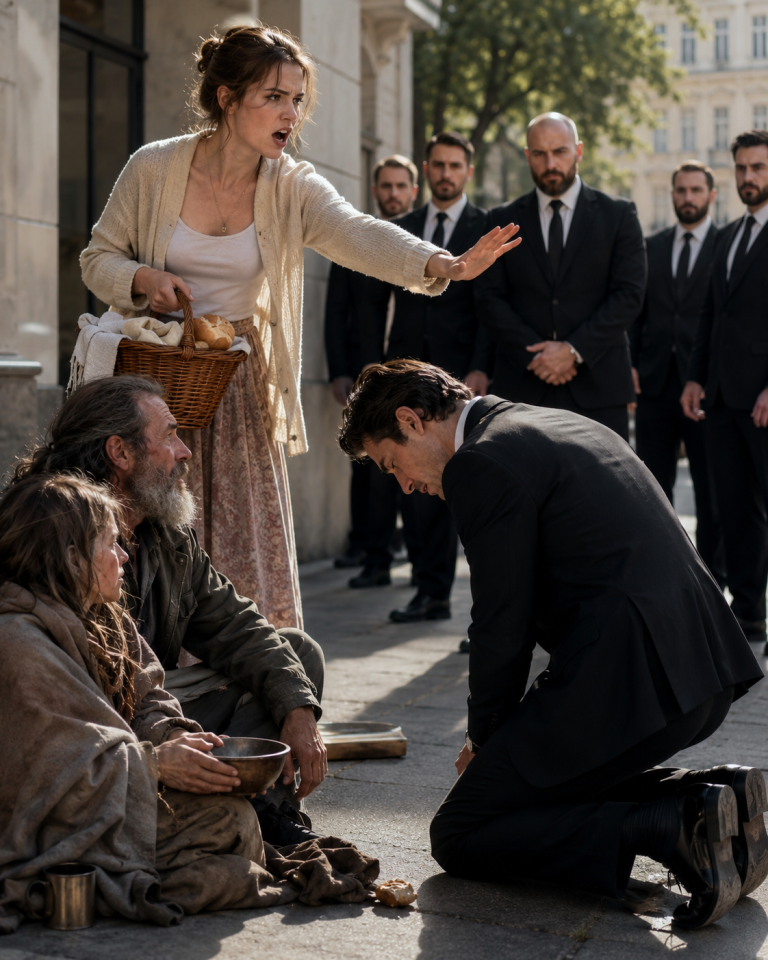
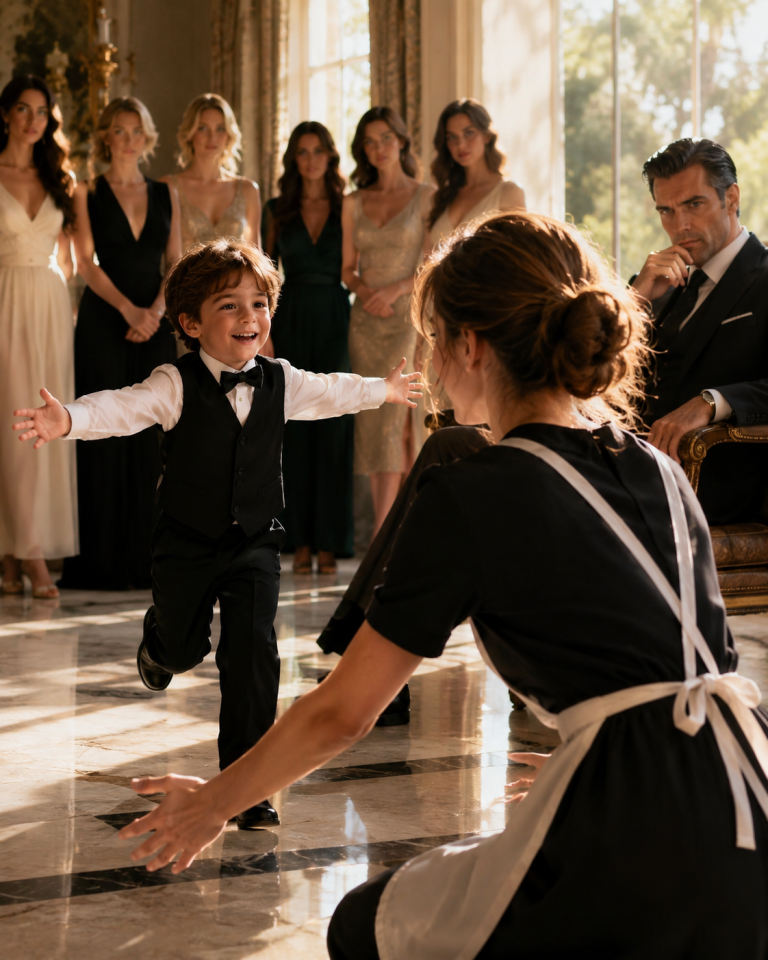
A Waitress Dropped Her Tray And Stepped Between A Yakuza Boss And A Bullet — Then Spoke Words No One Expected Her To Know

PART 1
Lydia Monroe had exactly one rule at the Wellington, and she had followed it perfectly for three years: be invisible.
Pour the vintage without a sound. Clear the plate before anyone notices your hand. Never, under any circumstance, let your face register anything you overhear in a private room. It was the golden law of the most exclusive restaurant in Chicago, and tonight, inside the suite known as the Obsidian Room, it was also the only thing standing between her and getting killed by accident.
The reservation had come in under a shell name. When the manager, Gregory, saw the black Escalades pull up outside, every drop of color left his face.
“Nobody looks at the head of the table,” he’d hissed at the staff, ten minutes before service. “You do not speak unless spoken to. You do not hover.”
The man at the head of that table was Vincent Hayes — to the Tribune, a shipping and real-estate billionaire with a taste for privacy. To the handful of people who understood what actually moved through the ports of this city, Vincent Hayes was something else entirely: the oyabun of the Kanai syndicate’s Western division, raised in the underworld of Osaka, and answering to no law written in English.
Across from him sat Dominic Rossi, capo of the local outfit, here to hammer out a shipping treaty worth more than either man was willing to say out loud. Between them, sweating through a silk tie, sat Bradley — a freelance interpreter hired for the night, because Vincent Hayes refused, on principle, to negotiate business in English. It was a power move. It forced every enemy in the room to play by his rules.
Lydia kept her eyes on the tablecloth as she refilled the water glasses. But she was listening. She had a secret nobody at the Wellington knew, not even Gregory. Before this restaurant, before her father died of a sudden heart attack in a cramped Osaka apartment, she had spent ten years growing up in the wards of Japan — not the postcard version, the real one. She didn’t just speak the language. She knew the dialect, the honorifics, the difference between a phrase that showed respect and one that could get a man killed.
Vincent leaned forward, laid out his terms in low, clipped Japanese — the south docks were his, his men would oversee the cargo, any deviation would be treated as an act of war.
Lydia understood every word. There was no room in it for negotiation.
“What did he say?” Dominic asked Bradley, chewing his cigar.
Bradley wiped his forehead and mangled it completely — turned an ultimatum into a generous offer to *share* oversight. Worse, in his nerves, he dropped every honorific required when addressing a man like Vincent Hayes, and spoke to him the way you’d speak to a subordinate.
The room went cold in a way Lydia felt in her spine.
She saw Gideon’s hand drift toward his jacket. She saw Felix’s eyes lock onto Bradley with the flat, patient look of a man who had done this before. Vincent didn’t blink. He simply looked at the interpreter the way you’d look at something already finished.
“You dare speak to me with the tongue of a peasant,” Vincent said quietly, in Japanese. “You twist my terms and insult my house.”
Bradley — utterly oblivious to the sentence that had just been passed on him — asked him to repeat it.
Vincent gave the smallest possible nod. Gideon stood.
Lydia didn’t decide to move. Her body decided for her. The silver pitcher hit the table with a crack loud enough to freeze the room, and she stepped directly into the space between the gun and the interpreter.
Every weapon in the room turned toward her.
She didn’t look at any of them. She looked at Vincent Hayes, bowed exactly forty-five degrees, and when she straightened, she spoke — not in the rough Japanese she’d grown up shouting on street corners, but in the elevated, aristocratic register reserved for the highest rooms in the country he’d been raised in.
“Forgive this intrusion, Hayes-sama,” she said. “The translator is incompetent, not disloyal. He has insulted your honor through ignorance — and mistranslated your terms to Mr. Rossi. If blood is spilled tonight, it will be over a hired tongue’s mistake. Not a true breach.”
Vincent’s eyes widened by a fraction of a millimeter. It was the only sign, anywhere on his face, that his entire understanding of the room had just been rebuilt from nothing.
“Who,” he asked slowly, in Japanese, “are you?”
—
PART 2
“I am nobody, Hayes-sama,” Lydia said. “Merely a servant of this house. But I know what you said. Your men oversee the cargo. Absolute control. No deviations.”
Vincent raised one hand. Gideon lowered his weapon. Felix sheathed his blade. The whole room seemed to exhale at once.
What followed was the strangest hour of Lydia’s life — Vincent Hayes rising to his feet, dismissing the interpreter with a single sentence in flawless English that carried a Midwestern chill Dominic clearly hadn’t expected, and then turning to the manager with a command that wasn’t a request.
“Miss Monroe is no longer serving food tonight. She is sitting at this table. She is my interpreter for the remainder of these negotiations. Whatever she’s being paid — add three zeros. Bill it to my account.”
Lydia untied her apron. She knew, sitting down in that chair, that she was stepping back into the exact world her father had spent the last ten years of his life running from. But the alternative — refusing the man who had just watched her disarm a room with nothing but grammar — wasn’t really an alternative at all.
For the next hour, she sat at Vincent Hayes’s right hand and did something she’d never expected to do again: she translated for the Kanai syndicate. She softened Dominic’s blunt demands into something survivable. She warned Vincent, quietly, in his own dialect, that killing a hot-headed capo over pride would only buy him a war on Interstate 90 he didn’t need. She negotiated a treaty between a Japanese crime syndicate and the Chicago outfit without a single shot fired — and felt, for the first time in years, the strange, sick thrill of being *seen* by someone dangerous enough to matter.
Then she caught the reflection in the floor-to-ceiling window. A van, parked at an angle that made no sense for parking. A rifle barrel sliding out of the side window, aimed at the center of the room.
Dominic hadn’t come to negotiate. He’d come to stall Vincent in one fixed seat until his hit squad arrived.
Lydia didn’t think. She screamed a warning in Japanese and threw her whole body against a mafia boss twice her size, and the world exploded into gunfire, shattering glass, and a war that had been thirty seconds from erupting into something no one in that room would have walked away from.
When the smoke cleared, Dominic Rossi was dead on the carpet, two of Vincent’s men were bleeding but standing, and Vincent Hayes was kneeling in the wreckage in front of her, holding her face in both hands like she was something he’d just discovered he couldn’t afford to lose.
“You saved my life twice tonight,” he told her, in Japanese. “Once with your mind. Once with your body.”
And then he told her the truth she couldn’t unhear: the moment she’d opened her mouth and spoken his language like she’d been born to it, her old life — the invisible one, the safe one — was already gone.
—
PART 3
**Chapter One: The Golden Rule**
The Wellington sat off Rush Street like something carved out of old money — floor-to-ceiling windows fogged silver with Chicago rain, a dining room lit low enough that the Michelin star practically hummed off the walls. Lydia Monroe had worked there for three years, long enough to learn its one unbreakable law by heart.
*You pour the vintage. You serve the Wagyu. And you do not exist.*
Tonight, the rule felt less like professional discipline and more like the only thing standing between her and disaster.
She was twenty-four, dark hair pulled into a bun severe enough to ache by the end of a shift, her white uniform pressed and spotless and, tonight, feeling less like a uniform and more like a straitjacket. She’d seen the black Escalades roll up outside through the kitchen window, watched Gregory’s face lose every drop of color as he came to brief the staff.
“Nobody looks directly at the head of the table,” Gregory had said, his voice pitched low, urgent, nothing like the smooth hospitality-school cadence he used on ordinary guests. “You do not speak unless spoken to. You do not hover.”
Lydia hadn’t asked who was coming. She already had a guess, the same guess everyone on staff quietly shared and never said aloud: Vincent Hayes.
To the Tribune, to the zoning board, to anyone who Googled him, Vincent Hayes was a venture capitalist with interests in shipping and real estate — a phantom who never gave interviews and never smiled for cameras. To the small, dangerous world underneath that world, Vincent Hayes was the oyabun of the Kanai syndicate’s Western division: born to American diplomats, orphaned young, and raised inside the strict, unforgiving codes of the Osaka underworld. He had a jawline like something drawn by an aristocrat and eyes the pale, merciless blue of lake ice in January, and he wore a bespoke charcoal suit the way other men wore armor.
He sat now at the head of the long oak table in the private suite called the Obsidian Room, flanked by six armed men, two of whom — Gideon and Felix — Lydia had learned by name only because they came in often enough that avoiding eye contact with them had become a kind of survival skill.
Across from Vincent sat Dominic Rossi, capo of the local Italian outfit, chewing an unlit cigar like it owed him money. Between them, sweating through a silk tie he clearly couldn’t afford, sat Bradley — a freelance corporate interpreter Dominic had hired for the night, because Vincent Hayes did not negotiate syndicate business in English. Not out of necessity. Out of principle. It was a power move, and everyone at that table understood it as one.
Lydia approached with a silver water pitcher, kept her eyes fixed on the tablecloth, and listened.
She had a secret none of them — not Gregory, not the other servers, not a single soul at the Wellington — knew. Before Chicago, before her father’s heart gave out in a cramped, run-down apartment in one of Osaka’s neon-lit wards, Lydia had spent ten years of her childhood growing up in the middle of that city. Her father, William Monroe, had been a disgraced accountant running from debts and worse, and Lydia had grown up fluent not in textbook Japanese but in the real thing — slang, honorifics, the particular clipped cadence of Kanai dialect, the difference between a phrase that showed deference and one that could get a man killed in a room like this one.
Vincent leaned forward, steepled his fingers, and spoke.
“The docks on the south side belong to us,” he said, in low, rhythmic Japanese. “You may use them for transit. My men oversee the cargo. Any deviation from this arrangement will be considered an act of war.”
Lydia’s hand trembled slightly as she poured sparkling water into Gideon’s glass. She understood every syllable. There was no negotiation hiding anywhere in that sentence.
“Well?” Dominic said, glancing at Bradley. “What’d the suit say?”
Bradley wiped his forehead. He’d learned polished, sterile boardroom Japanese — the kind used in international contracts, not the kind spoken in rooms like this one.
“He, uh—” Bradley stammered. “He says they want the south docks, but they’re willing to share the oversight with your men. To keep the peace.”
Lydia froze mid-pour. *That is not what he said. Not even close.*
Dominic smiled, leaned back in his chair. “Share oversight. Now that’s what I’m talking about. Tell Hayes we have a deal — but my boys hold the keys to the storage units.”
Bradley turned back to Vincent to relay the counteroffer, and in his rush, dropped the keigo — the strict formal honorifics required when addressing a syndicate boss — entirely. He spoke to Vincent Hayes in the casual, almost dismissive register a person might use with a subordinate.
The temperature in the Obsidian Room dropped to somewhere below freezing.
Lydia saw Gideon’s hand drift beneath his jacket. Felix’s weight shifted, his eyes fixing on Bradley with the flat patience of a man who’d done this exact thing before and knew precisely how it ended.
Vincent did not blink.
“You,” he said, in Japanese, the word dripping with something colder than anger. “You dare speak to me with the tongue of a peasant. You twist my terms. You insult my house.”
Bradley — entirely, catastrophically oblivious — blinked and asked him to repeat it.
Vincent gave the smallest possible nod. Gideon rose.
**Chapter Two: The Bow**
What happened next took less than three seconds, though it would feel, later, like it had stretched across an hour.
Gideon drew a suppressed pistol from his shoulder holster with terrifying, practiced speed. Gregory, standing frozen by the door, made a sound like something breaking. Dominic’s men shot to their feet, hands going for their own weapons, and the entire private dining room of Chicago’s most exclusive restaurant tipped, in that instant, toward a massacre.
Lydia didn’t decide to move. Her body decided for her, the way it had once decided things for her on the streets of Osaka, back when hesitation meant something worse than embarrassment. The silver pitcher hit the mahogany table with a crack loud enough to still every other sound in the room, and she stepped directly into the space between the gun and the interpreter.
Every weapon in the room turned toward her.
Gideon’s suppressed barrel found the center of her chest. Felix had a blade out, catching the chandelier light. Somewhere behind her, Dominic’s men were shouting, but it reached her like sound underwater — distant, muffled, unimportant.
She looked at none of them. She looked directly into Vincent Hayes’s ice-blue eyes, and she bowed — a precise, unhurried forty-five degrees, the kind of bow that meant something specific in a language most of the room in that moment couldn’t speak.
When she straightened, her voice came out steady.
“Forgive this intrusion, Hayes-sama.”
The words left her in flawless, aristocratic keigo — not the rough dialect she’d shouted across street corners as a teenager, but the elevated register reserved for the very top of a hierarchy most Americans didn’t know existed. Her pronunciation carried the specific, unmistakable melody of the Kanai region.
Vincent’s eyes widened by a fraction of a millimeter. It was the only visible sign that the floor of his entire understanding of the room had just shifted under him.
Gideon hesitated, his finger pausing on the trigger. Felix’s blade lowered a few degrees. Six armed men who, moments before, had been fully prepared to redecorate a Michelin-starred dining room in blood were now frozen by the sheer impossibility of what they were watching: an American waitress speaking to their oyabun in language most of them had spent years learning to use correctly.
Lydia kept going, because stopping meant dying.
“The translator is incompetent,” she continued, keeping her tone smooth, deferential, carrying just enough quiet authority to be heard over the ringing silence. “He has gravely insulted your honor through ignorance, not malice. More importantly, he has mistranslated your terms to Mr. Rossi. If blood is spilled tonight, it will be over the mistake of a hired tongue — not a true breach of business.”
Vincent studied her for ten long seconds that felt, to Lydia, like standing at the edge of something with no bottom. He took in her pale skin, her dark eyes, the barely controlled tremble in her hands.
“Who are you?” he asked, in Japanese, his voice a low, dangerous velvet.
“I am nobody, Hayes-sama. Merely a servant of this house.” She didn’t break eye contact. “But I know what you said. Your men oversee the cargo. Absolute control. No deviations.”
Vincent raised one hand. Gideon lowered his weapon and stepped back. Felix sheathed his blade. The suffocating pressure in the room dialed back just enough to let air return to it.
Vincent turned to Dominic, whose face had gone from cigar-smug to genuinely bewildered.
“Your interpreter is a dead man walking,” Vincent said, switching to English now — smooth, carrying a cold Midwestern edge that unsettled Dominic even more than the Japanese had. “He disrespected me. And he lied to you. I did not offer shared oversight, Rossi. I offered you permission to exist on my docks. Nothing more.”
Dominic’s face flushed dark red. He rounded on Bradley, who was currently hyperventilating against the wall. “Get out,” he snarled. “Get out before I kill you myself.”
Bradley scrambled for the door, shoving past Gregory, who was still frozen mid-collapse.
Vincent rose. He crossed the wreckage of the moment slowly, deliberately, until he stood inches from Lydia — close enough that she caught the scent of cedarwood and rain and something colder underneath it, something like metal.
“You saved a man’s life tonight,” he said, back in English, his tone impossible to read. “And you risked your own to do it. Why?”
“I don’t like messes in my dining room, sir.” Lydia’s voice came out steadier than she felt. “Blood is terribly hard to get out of the carpets.”
A beat of silence. Then a low, genuine sound rumbled up out of Vincent’s chest — a real laugh, dark and unguarded, the kind Gideon and Felix exchanged a stunned look over, because their boss did not laugh. Not during business. Not ever, as far as either of them had seen.
He leaned in, close enough that his next words landed in the specific Kanai dialect she’d grown up hearing in the back alleys of Osaka.
“A gaijin waitress in Chicago with the tongue of an Osaka ghost,” he murmured. “You have my attention, little bird. What is your name?”
“Lydia,” she answered, softly, in Japanese. “Lydia Monroe.”
Vincent turned his head toward the door. “Gregory.”
The manager flinched forward like a man walking to his own execution. “Y-yes, Mr. Hayes?”
“Miss Monroe is no longer serving food tonight. She is sitting at this table. She is my interpreter for the remainder of these negotiations. Whatever she’s being paid for this shift — add three zeros. Bill it to my account.”
Gregory’s mouth opened and closed. “Sir — company policy—”
Vincent’s look could have frozen the river outside. “Do I look like a man who cares about your policies?”
“No, sir. Right away, sir.” Gregory practically bowed on his way out of the room.
Vincent turned back and gestured, with a strange kind of grace, to the empty chair at his right hand.
“Sit, Lydia Monroe.”
Lydia looked at that chair the way a person looks at a door they’d sworn, years ago, never to walk back through. Sitting down meant stepping into the exact world her father had spent ten years of his life dying slowly to escape. But standing in front of Vincent Hayes with his eyes on her, she understood there wasn’t really a second option left.
She untied her apron, draped it over the service station, and walked to the table.
**Chapter Three: The Voice at His Right Hand**
The heavy, electric tension of an almost-execution had settled into something quieter and, in its own way, more dangerous — a room full of powerful men recalculating everything they thought they understood about the woman now sitting at Vincent Hayes’s right hand.
Dominic snapped his fingers, impatient, cologne thick enough to cut through the smell of rain. “Tell him the Chicago O’Hare Logistics Union won’t process his shipments unless my family gets forty percent of the Southport tariff, and we want unmonitored access to Warehouse 4B. Rocco Cavallaro insists on it. We are not tourists in our own city.”
Lydia turned the sentence over in her mind before translating it. She recognized the demand for what it was — blunt, nearly suicidal disrespect, the kind of language you did not use with a man like Vincent Hayes, no matter who your boss was back at the social club.
She glanced at Vincent. He wasn’t watching the men across the table. He was watching her — tracking every small shift in her expression like he was reading something more interesting than the negotiation itself.
“The Italian side states their union connections at O’Hare are necessary for your land transit,” Lydia said in Japanese, her voice calm, deliberately smoother than Dominic’s barked demand had been. “He requests forty percent of the tariff, and access to Warehouse 4B. He invokes his superior, Rocco Cavallaro, as guarantee of local authority.”
Vincent’s mouth curved, dark and faintly amused. He leaned closer, close enough that the cedarwood and rain settled over her again.
“He did not ask politely, did he?”
“No, Hayes-sama,” Lydia said. “He phrased it as a demand. I softened it.”
“To protect him.”
“To protect your carpets,” she said, refusing to look away. “If you kill him now, Cavallaro retaliates against your transport trucks on I-90. It’s a messy, unnecessary war over pride. You are a businessman, Hayes-sama. There is no profit in a blood feud over a warehouse.”
Behind Vincent’s shoulder, Gideon inhaled sharply. No one corrected the oyabun’s instincts. No one analyzed his strategy out loud, in front of an enemy, without consequences. Felix’s hand drifted to his holster, waiting for a signal that didn’t come.
Instead, something sparked in Vincent’s eyes — pure, unguarded fascination. He reached out, brushing his fingers lightly over her trembling knuckles where they rested on the table, and the touch sent something electric straight up her arm.
“Tell the barking dog,” Vincent said, never breaking eye contact with her, “that he will accept twenty percent. He will never set foot near Warehouse 4B. If he or his men attempt to bypass my security, I will send Rocco Cavallaro their hands in a silk-lined box.”
Lydia turned back to Dominic, sliding effortlessly into English, her tone professional, hiding a confidence she didn’t fully feel.
“Mr. Hayes is offering a generous twenty percent tariff. Warehouse 4B is off limits to all external personnel — proprietary syndicate assets. Total compliance on port security is expected. Any unauthorized access will be treated as a hostile breach.”
Dominic’s face darkened, a vein rising at his temple. “Twenty percent’s an insult. Rocco will never sign off.”
“It is not an offer, Mr. Rossi,” Lydia said, leaning forward slightly. She wasn’t just translating anymore. She was negotiating, drawing on instincts she’d learned surviving a different city’s underworld a lifetime ago. “It is the final parameter. Twenty percent of Mr. Hayes’s volume is worth triple what you currently make on the east docks. You walk out of here wealthy, or you walk out with nothing. The choice belongs to you.”
Dominic stared at her for a long moment, visibly recalculating. He glanced at his men, Carmine and Angelo, who gave the smallest of nods. The math worked. Even at twenty percent, the sheer scale of the syndicate’s operation dwarfed anything the outfit currently pulled from the east docks.
“Fine,” Dominic spat. “Twenty percent. No access to 4B. But I want it in writing. My lawyer sees the transit documents by tomorrow morning.”
Lydia translated the surrender. Vincent nodded, drew a silver Montblanc from his breast pocket, and slid a leather portfolio across the table.
“The treaty is concluded,” he said, in Japanese, though the finality in his voice needed no translation at all.
As Dominic uncapped his own pen, Lydia let out a slow, silent breath. She had done it — navigated a mafia negotiation without a single shot fired. She closed her eyes for a fraction of a second, the adrenaline just beginning to loosen its grip.
Then she opened them, and her gaze caught something reflected in the rain-streaked floor-to-ceiling window behind Vincent’s head.
A black, unmarked cargo van, parked at an angle that made no sense for parking, headlights off, its side window sliding down just enough to let the barrel of an assault rifle emerge.
Aimed directly at the center of the room. Directly at Vincent Hayes.
**Chapter Four: The Setup**
Time slowed to something Lydia would later describe, if she’d ever described it to anyone, as unbearable.
The van sat at precisely the angle that bypassed the restaurant’s reinforced architecture. The glass behind Vincent was thick, but it wasn’t bulletproof. And the negotiation — the whole slow, grinding argument over warehouse access and tariff percentages — hadn’t been a negotiation at all. It had been a delay. A way to keep Vincent Hayes sitting in one fixed position long enough for a hit squad to arrive.
Lydia didn’t think. Whatever muscle memory her childhood had carved into her nervous system took over completely.
“Get down!” she screamed, in Japanese, the words shattering the room’s fragile quiet.
She threw her entire body weight against Vincent’s chest. The surprise of it knocked him clean out of his chair, and they hit the floor together just as the world exploded.
High-caliber automatic fire tore through the windows in a deafening roar. Rain and shredded curtains and flying crystal mixed together in the air. The mahogany table splintered into wreckage. Above them, chaos took the room completely — Dominic flipping the remains of the table for cover, shouting commands in Italian, his men turning their weapons not toward the window but toward Gideon and Felix, the true target of the ambush revealing itself in real time.
Gideon took a bullet to the shoulder and returned fire without breaking stride, dropping Angelo where he stood. Felix vaulted the service station, blade out, meeting Carmine in a brutal, close-quarters fight that ended with Carmine on the carpet and Felix wiping the blade on his own slacks.
Underneath the wreckage of the table, Lydia was pinned beneath the crushing weight of Vincent Hayes, who had rolled instantly, deliberately, placing his own body between her and the storm of bullets tearing through the room. His face was inches from hers. His eyes were wide, but there was no panic in them — only a cold, total calculation. This was, she understood in that moment, exactly the version of himself he’d been raised to become.
“You saw the van,” he said. It wasn’t a question.
“Sniper. South alley.” Lydia coughed as plaster dust rained down over both of them. “Rossi stalled you. It was a setup.”
Vincent’s jaw locked. He drew a matte black pistol from his waistband.
“Stay exactly here, little bird. Do not move.”
Before she could argue, he surged upward — not cowering behind cover, but stepping directly into the crossfire with the unhurried, predatory grace of a man who had done this before and never once lost.
Dominic, scrambling to reload behind the ruined table, looked up just in time to see Vincent standing over him.
“Rocco sends his regards,” Dominic sneered, raising his weapon.
“I will deliver them personally,” Vincent said, in flawless, chilling English, and fired twice.
Dominic’s eyes rolled back. He collapsed, lifeless, onto the ruined carpet.
The gunfire from the alley stopped abruptly. Tires screamed against wet pavement as the van realized the ambush had failed and vanished into the rain. In the distance, sirens began their approach — a low, rising howl that meant the isolation of the last twenty minutes was about to end.
**Chapter Five: Two Doors**
The Obsidian Room was unrecognizable. Shattered chandeliers. Bordeaux bleeding into white carpet. Gunpowder hanging thick in the air where cedar and vintage wine had lingered an hour before. Gideon, bleeding but upright, kicked a dead man’s weapon out of reach. Felix stood over Carmine’s body, cleaning his blade with mechanical calm.
“Secure the exits,” Vincent ordered, his voice cutting clean through the ringing in everyone’s ears. “We vanish in two minutes. Bribe the captain. I want this block scrubbed of our presence by morning.”
He crossed the wreckage, boots crunching over broken glass, until he reached Lydia, who was pushing herself up from the floor with hands cut from the debris, her once-pristine uniform ruined with soot and rainwater. She was shaking now, the adrenaline crash hitting her all at once.
Vincent knelt in front of her and ignored the sirens, the destruction, and his own bleeding lieutenants entirely. He reached out, gently gripping her face, tilting it up until she had no choice but to meet his eyes.
“You saved my life tonight,” he said, in Japanese, quiet and startlingly intimate. “Twice. Once with your mind. Once with your body.”
“I just reacted.” Her breath came shallow. “I couldn’t let them kill you.”
“No,” he agreed softly, his thumb brushing a streak of dirt from her cheek. “You couldn’t. Because you belong to my world, Lydia Monroe. You tried to hide in plain sight, pouring water for ghosts. But your blood runs with the same fire as mine.”
He stood, pulling her up with him, and didn’t let go of her hand.
“Gideon.” His voice snapped back into English, hard and final. “The girl comes with us.”
“What?” Lydia’s eyes went wide. “No — I have a life here. An apartment. A job.”
“You *had* a job,” Vincent said, glancing around the ruined restaurant. “Now you’re an accomplice to a mafia shootout. The Rossi family will pull the security footage. They’ll see you saved me. Rocco Cavallaro will send his best men to find you, and they will not be gentle about it.”
Lydia went cold. The truth of it landed with a weight she couldn’t argue against. The invisible, careful life she’d spent three years building — the one rule she’d never broken — had ended the second she opened her mouth and spoken a language she’d promised herself she’d left behind.
Vincent stepped closer, until she could feel the heat coming off his chest through the ruin of her uniform.
“You have two choices, Lydia.” His voice was low, almost hypnotic, carrying the specific gravity of a man who had never once had to raise it to be obeyed. “Walk out the front door and take your chances with the Italians. Or walk out the back door with me. Step into my world. Stand at my side. I will protect you with every gun, every dollar, and every drop of blood I have.”
Lydia looked into his eyes and saw exactly what he was — a dark, consuming thing that could swallow her whole. But underneath the danger, she saw something else too: a fierce, deliberate possession, the kind that came with its own brutal, absolute form of safety.
Outside, the sirens grew louder, red and blue light bleeding through the rain-streaked glass.
She looked once more at the wreckage of the restaurant that had been her invisible, careful life for three years. Then she looked at the man holding her hand — the one who had knelt in broken glass to check that she was still breathing before he’d said a single word about his own bleeding men.
“Let’s go,” Lydia whispered.
**Chapter Six: The World Underneath the World**
They didn’t speak again until the car — matte black, windows tinted dark enough to swallow the streetlights — pulled away from the alley behind the Wellington, sirens fading into the wet Chicago night behind them.
Gideon sat up front, jaw tight around the pain in his shoulder, muttering directions to a driver Lydia had never seen before. Felix rode in a separate vehicle somewhere ahead of them, running silent security on the route. Vincent sat beside her in the back seat, his hand still loosely wrapped around hers, like he’d forgotten to let go, or had decided not to.
“You’ll want questions answered,” he said finally, watching the city blur past the window. “Ask them now. I don’t repeat myself twice in one night.”
“Where are we going?”
“Somewhere safe. Tonight, and for as long as it takes to make sure Cavallaro understands that killing you would cost him considerably more than he’d gain.”
“And after tonight?”
Vincent turned to look at her properly for the first time since the car had pulled away. “After tonight is a longer conversation. One I’d rather have when you’re not still shaking and bleeding from broken glass.”
Lydia looked down at her own hands, cut and trembling in her lap, and found she didn’t have the energy left to argue with him about it.
They arrived, eventually, at a townhouse on the north side that gave away nothing about its owner from the street — narrow, dark brick, unremarkable among its neighbors, the kind of understatement that only money with something to hide could afford. Inside, it was warmer than Lydia expected, all soft lamp light and quiet, expensive restraint, nothing like the cold marble opulence she’d half-imagined belonged to a man like Vincent Hayes.
A woman appeared almost instantly — mid-fifties, silver-streaked hair pulled back, moving with the brisk efficiency of someone who had clearly done this exact thing before, tending to Vincent’s people after a bad night.
“This is Michiko,” Vincent said. “She’ll see to your hands. Don’t argue with her. Nobody wins that fight.”
Michiko didn’t ask Lydia a single question — not about the blood on her uniform, not about the restaurant, not about who she was or why the oyabun had brought her home himself instead of sending a driver. She simply set to work cleaning the cuts across Lydia’s palms with brisk, gentle hands, murmuring softly in Japanese the whole time, the kind of casual, unguarded dialect that made something in Lydia’s chest ache with an old, complicated homesickness she hadn’t expected to feel again.
“You understand her,” Vincent said, watching from the doorway. It wasn’t a question.
“I told you already. I grew up there.”
“You told me you knew the language. That’s not the same as growing up in Osaka.” He crossed the room slowly, taking the chair across from her once Michiko had finished and retreated with a small, respectful bow. “Tell me the rest of it. All of it. I don’t bring strangers into my house, Lydia Monroe, and I especially don’t bring strangers who somehow speak my mother tongue like they were raised inside it.”
So she told him.
She told him about her father, William Monroe — a corporate accountant back in the States who’d made the mistake of skimming from the wrong company and fleeing the country with his ten-year-old daughter rather than face what came next. She told him about ten years spent in cramped apartments in Osaka’s outer wards, moving every year or two whenever her father’s nerves got the better of him, about learning the language not in a classroom but on the street, the way children learn anything — by necessity, by immersion, by not having any other option. She told him about the year her father’s heart finally gave out in a run-down apartment with peeling wallpaper, about coming back to America at nineteen with nothing but a suitcase and a language most people in Chicago would never guess she carried.
“I built a quiet life,” she said. “I wanted invisible. I wanted safe. Waitressing at the Wellington was the safest, most boring thing I could find — good money, good hours, absolutely nothing that could ever follow me home.” She looked up at him. “And then a man walked into my restaurant tonight and got translated into a war.”
Something that might have been the ghost of guilt passed over Vincent’s face — there and gone so fast she almost missed it.
“I didn’t choose the interpreter,” he said. “Rossi did. His incompetence isn’t mine to apologize for. But I understand what tonight cost you, Lydia. I’m not going to pretend otherwise.”
“Then tell me honestly,” she said. “What happens to me now?”
Vincent studied her for a long moment, the same unreadable calculation she’d first seen in his eyes across the negotiation table.
“Cavallaro will want you dead by the end of the week,” he said. “Not out of personal malice. Out of necessity. You’re a loose thread — a witness who can place his family at the scene of an assassination attempt on a syndicate boss. That’s not a grudge. That’s cleanup.”
“And you’re offering to stop that from happening.”
“I’m offering you a place at my side,” Vincent said. “Not out of charity. I don’t deal in charity. I’m offering it because you are, without question, the single most valuable asset that has fallen into my lap in a decade — a translator who understands not just my language but my world, who thinks three moves ahead in a room full of armed men, who had the nerve to step between a bullet and a target on nothing but instinct. Men like that are rare, Lydia. Women like that, in my experience, are rarer still.”
“That’s not the same as safety.”
“No,” Vincent agreed. “It’s better than safety. Safety is passive. What I’m offering is protection with teeth.”
Lydia sat with that for a long moment, turning it over, weighing the terrifying calculus of it against everything else she’d lost in the space of a single evening — her apartment, her job, the invisible life she’d spent three careful years constructing.
“And if I say no? If I walk out that door tomorrow and take my chances alone?”
“Then I won’t stop you,” Vincent said, quiet and entirely without threat. “I don’t keep people who don’t want to be kept. But I’ll tell you plainly — you won’t survive the week without me, and some small part of you already knows that, or you wouldn’t still be sitting in my house asking me questions instead of walking out the front door.”
She had no answer for that, because he was right, and they both knew it.
**Chapter Seven: The Price of Being Seen**
The following days unfolded in a strange, suspended rhythm — half safehouse, half education. Gideon’s shoulder healed under Michiko’s care while he taught Lydia, almost reluctantly at first, the specific etiquette of moving through Vincent’s world: which lieutenants could be trusted to speak freely in front of her, which ones still eyed her like an unresolved threat, how to read the particular silence that meant a room was about to turn dangerous.
Felix, for his part, remained wary longer than anyone. He tested her twice in the first week — once with a deliberately mistranslated phrase slipped into a phone call to see if she’d catch it, once with a blunt, half-serious question about whether she’d run to the police the moment she got the chance.
“I watched Rossi die two feet from where I was standing,” Lydia told him, flat and unflinching. “If I wanted to talk to the police, I’d have done it that night, covered in glass, with sirens already outside the door. I didn’t. Ask yourself why.”
Felix didn’t test her again after that.
Vincent, meanwhile, kept her close in a way that felt less like possession and more, disconcertingly, like consultation. He brought her into meetings that had nothing to do with translation at all — sat her at his side while he negotiated port schedules with legitimate shipping contacts who had no idea what else moved through those same containers, watched her read the room the way she’d read Dominic Rossi’s table, and began, gradually, to ask her opinion before he gave an order rather than after.
“You disagree with something,” he said one evening, watching her across his study after a call with one of his Osaka contacts. “You’ve had that same look on your face since the meeting started.”
“It’s not my place to disagree with you.”
“It became your place the moment you stepped between a gun and a man who wasn’t yours to protect,” Vincent said. “Say it.”
“You’re moving too much volume through the same three parcels of warehouse space,” Lydia said. “Rossi’s people knew about your Southport arrangement before the negotiation even started — which means someone inside your own operation is talking, or someone’s watching your patterns closely enough to predict them. Either way, concentrating that much cargo in one predictable place is what got you shot at last week. I’d diversify the routes, even if it costs you efficiency, because efficiency didn’t save you last Tuesday. I did.”
Vincent was quiet for a long moment, studying her with something that had shifted, subtly, from fascination into something closer to respect.
“You should have been running a syndicate of your own,” he said finally.
“I should have been serving wine and going home to an apartment nobody was watching,” Lydia said. “But here we are.”
It was during the third week that the first real threat arrived — not from Cavallaro directly, but from one of his lieutenants, a cold, careful man named Salvatore who’d apparently taken the death of Dominic Rossi personally enough to make it his business. A car followed Lydia’s driver two blocks too long on a routine supply run. A man loitered outside Michiko’s usual grocery store for three consecutive mornings, watching the townhouse with the kind of patience that wasn’t casual.
Vincent didn’t wait for a fourth morning. He met Salvatore’s people at a neutral location Gideon arranged, alone except for two guards at the door, and came back two hours later with his knuckles bruised and no explanation beyond a single flat statement.
“Cavallaro understands, now, that touching you costs him considerably more than he stands to gain,” Vincent said, setting his jacket over the back of a chair like the whole evening had been a minor inconvenience. “He won’t send anyone else.”
“You’re certain.”
“I made very certain.” He looked at her, something unguarded flickering across his face for just a moment before the composure settled back into place. “You’re safe, Lydia. That’s not a promise I make lightly, and it’s not one I intend to break.”
She believed him — not because his tone left room for doubt, but because she’d watched, over three strange weeks, exactly how far Vincent Hayes was willing to go to keep the people inside his circle breathing.
**Chapter Eight: What She Chose**
Six months after the night the Obsidian Room came apart around them, Lydia stood in the same townhouse study, translating a contract for a legitimate shipping deal — one of the growing handful Vincent had begun steering toward, slowly, quietly, the syndicate’s more violent edges dulling by degrees as his trust in her judgment deepened.
“You could leave,” Vincent said, watching her from the doorway the way he sometimes did now, without announcing himself first. “Cavallaro’s dead. Has been for two months. The threat that pulled you into this world in the first place is gone. You could walk out that door today and build the invisible life back, somewhere else. Nobody would stop you.”
Lydia set down her pen and looked at him for a long moment — the sharp, careful man who’d knelt in broken glass to make sure she was breathing before he checked on his own bleeding lieutenants, who’d asked her opinion on shipping routes like it mattered as much as his own instincts, who’d never once, in six months, made her feel like the price of her safety was her silence.
“I know I could leave,” she said. “I’m choosing not to.”
“Why?”
“Because for three years I built a life around being invisible, and it turns out invisible wasn’t safety. It was just waiting,” Lydia said. “Waiting for the wrong table to need water at the wrong moment. I’d rather be seen and dangerous than invisible and lucky, Vincent. I found that out the night I stepped between you and a bullet, and I haven’t been able to unlearn it since.”
Vincent crossed the room slowly and stopped in front of her, close enough that the old, familiar scent of cedarwood settled over her again.
“Then stay,” he said, quiet, without a trace of the command that usually lived in his voice when he spoke to anyone else in his world. “Not as my interpreter. Not as an asset. Stay because I am asking you to, and because I have not, in longer than I can remember, wanted anything the way I want that.”
Lydia reached up and rested her hand against his jaw, feeling the same tension there she’d first noticed across a table full of armed men on the worst night of her life.
“Then I’m staying,” she said.
Outside, the Chicago rain had finally cleared, the city’s neon reflected clean and sharp against wet pavement instead of smeared and distorted the way it had been the night everything started. Vincent Hayes — oyabun of the Kanai syndicate’s Western division, a phantom to the Tribune and a legend to the underworld that actually ran beneath it — kissed the woman who had once been invisible on purpose, and understood, with the same absolute certainty he brought to everything else in his life, that some things found you exactly once, and a wise man did not let them slip back into the crowd a second time.
THE END