HE ORDERED A “PLAIN, QUIET WIFE” FROM A MAIL-ORDER AGENCY — WHAT STEPPED OFF THE STAGE INSTEAD MADE HIM SAY THE CRUELEST THING HE’D EVER SAID OUT LOUD IN FRONT OF THE WHOLE TOWN

PART 1
Eli Tanner had filled out the marriage agency form on a Tuesday evening in March, alone at his kitchen table, with a glass of water he never drank and a lamp that needed a new wick.
He’d written plainly. He always wrote plainly. *Seeking a woman of practical disposition. Must be capable of hard work and comfortable with rural isolation. Appearance is of no concern. Personality should be quiet and agreeable.* He’d underlined *quiet* twice — not out of cruelty, but because he’d spent four years learning, the hard way, that silence was the only thing that didn’t hurt.
He was not a man looking for love. He was a man taking on a business partner: clear expectations, clean paperwork, no emotional entanglement whatsoever.
The agency wrote back six weeks later. *We have found a suitable match. Miss Josie Callaway, age 26, of Ohio. Experienced in farm labor, literate, of good health and character. Arrives Bitterroot Station, April 14th.*
Eli rode into town that morning, tied up outside the station, and told himself firmly that he was not nervous. He was simply present.
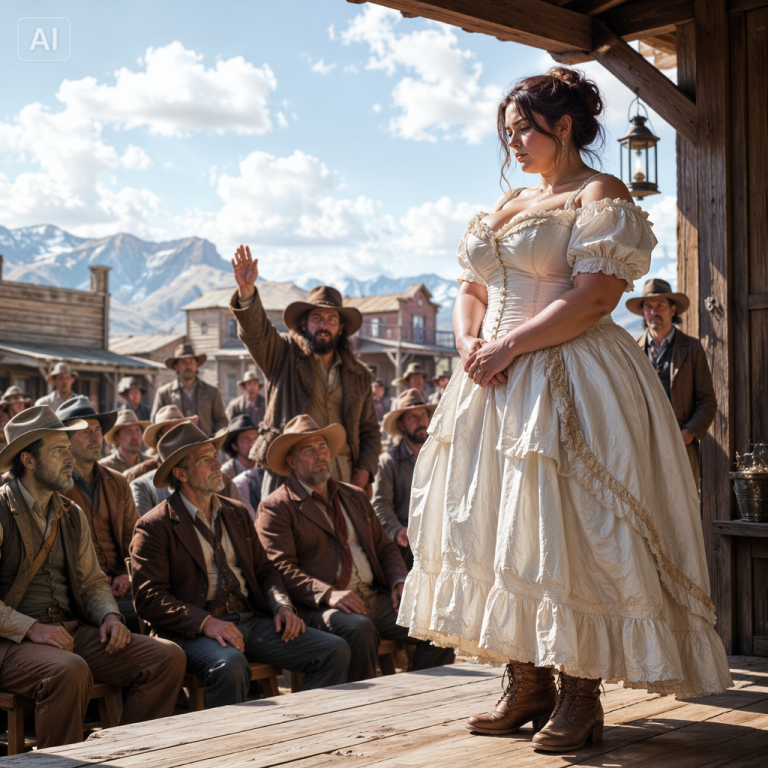
The stagecoach door swung open, and the first thing Eli registered — before his brain could organize a single coherent thought — was that the street had gone quiet. Not literally. Horses still shuffled. A dog still barked down by the livery. But the particular stillness that arrives before a storm settled over Bitterroot’s main road, and every living thing in it seemed to hold its breath.
She was tall, and she moved like a woman who had never once in her life waited for permission to enter a room. Dark honey hair, loose at the edges from three days of travel. A face that made the word *plain* feel laughable the instant Eli’s mind reached for it and found nothing to attach it to. She was the kind of beautiful men wrote bad poetry about and women distrusted on sight — and God, apparently, had thought it very funny indeed to send her to a man who had specifically, in writing, requested the opposite.
She scanned the station with calm, assessing eyes. Then those eyes found his.
He said it before he could stop himself.
“You are not what I ordered.”
Loud enough that men by the feed store turned to look. Loud enough that it carried the length of the street.
Josie Callaway looked at him for three full seconds. Then she picked up her traveling bag, walked directly toward him, and stopped two feet away.
“Eli Tanner,” she said.
“Yes.”
“Josie Callaway.” She extended her hand. It was a firm handshake — the handshake of someone who was not going to pretend she hadn’t heard exactly what he’d just said in front of half the town. “I heard what you just said.”
“I apologize. That was—”
“Honest,” she finished. “Which I respect, even if it wasn’t kind.” She tilted her head, studying him the way a person studies a piece of farm equipment they’re considering buying. “You’re not what I pictured either.”
“What did you picture?”
“Older,” she said simply. “And less angry looking.”
“I’m not angry.”
“You’re holding your hat brim hard enough to crush it, Mr. Tanner.”
He looked down. She was right. He loosened his grip.
“It’s been a long morning,” he said.
“I’ve had a long three days,” she replied. “Can we get moving? I’d like to see the place before dark.”
That was it. No tears, no wounded expression, no dramatic scene. She simply picked up her bag and walked toward his horse — and Eli stood there half a second longer than he should have before following, because something in him, something buried under four years of deliberate, iron-willed numbness, had just cracked. Not shattered. Cracked. The first hairline fracture in a wall before the whole thing comes down.
He did not like that feeling at all.
The ride to the ranch took an hour and a half, and they spoke maybe four sentences the entire way. Josie watched the valley pass without comment, which he appreciated, and Eli found himself, against his own will, mildly curious what she was thinking. He didn’t ask.
“It’s not fancy,” he said, when they finally pulled up in front of the two-story timber house.
She climbed down herself before he could offer a hand — not rudely, just efficiently, the way someone does who’s spent her whole life getting herself in and out of things.
“It’s a good ranch,” she said, taking in the barn, the pasture, the cattle moving in the distance.
“It is,” he agreed.
“You built it yourself.”
“Most of it.”
She nodded once, filing that away, and asked where she’d sleep. He showed her the room at the end of the hall — clean sheets, a small window, a dresser with a wonky leg. She set her bag down and said only, “Thank you.” No complaint about the size, or the faint rectangular shadow on the floor where a storage crate had clearly sat until very recently.
“Supper’s at six,” Eli said from the doorway. “I cook my own. You’re welcome to eat with me, or I can leave something out.”
Josie turned and looked at him with that same calm, reading expression.
“We’re married, Mr. Tanner. Or close enough to it. Once we see the preacher, we can eat together.”
“Right,” he said. “Six.”
Then he left before the conversation could become anything more than what it already was — because downstairs, alone at the kitchen counter, Eli Tanner stood with his hands flat on the wood and stared at the wall for a long moment, understanding, with a dread he couldn’t quite name, that a woman upstairs in his house had just shaken his entire careful understanding of himself in ninety minutes flat, without raising her voice, without demanding a single thing.
If she’d been difficult, he’d have known exactly what to do.
He had absolutely no idea what to do with calm.
—
PART 2
She came downstairs at quarter to six, changed into a plain work dress, hair pulled back, and took one look at what Eli was doing at the stove.
“You’re going to burn that,” she said. “The heat’s too high for salt pork. It’ll go tough.”
“I’ve been cooking my own supper for four years.”
“And eating tough salt pork for four years, probably.” She said it without malice, moved beside him, and turned the heat down herself. Her arm brushed his for half a second. Neither of them acknowledged it.
“You don’t have to cook,” Eli said. “That wasn’t part of the arrangement.”
“I know it wasn’t. But I like to cook, I’m hungry, and your supper was going to be terrible.” She glanced up. “That’s not a criticism. Just a fact.”
“You say a lot of things that are just facts.”
“Is that a problem?”
He thought about it, honestly. “No. Actually, no, it’s not.”
They ate at the table — Eli couldn’t remember the last time he’d sat down for a meal — and the food was better than anything he’d cooked in four years. She asked three questions, all business: how many head of cattle, whether the east fence ran to the creek, what his arrangement was with the neighboring ranches. He answered fully. She asked nothing personal. He asked nothing of hers.
By day three, she’d already found the failing fence posts along the north pasture, already checked the grey mare’s leg before anyone asked, already begun leaving his coffee at exactly the right temperature without being told. Something small and structural had started shifting between them — the kind of shift that seems like nothing at first, the way a single stone moving at the base of a wall seems like nothing, until you understand that stones like that, once they move, have a way of changing everything built above them.
“The agency said you wanted someone plain,” Josie said, out on the fence line one morning, conversational, like she was reading an invoice.
Eli drove a post anchor into the ground and answered without looking at her. “Because pretty women make men do stupid things, and I’m not in the business of being stupid anymore.”
“That’s a strange thing to say. It’s a little insulting, actually — to both of us. To me, because you’re suggesting my face makes me less manageable. And to you, because you’re suggesting you have no control over your own reactions.”
“I didn’t say I had no control.”
“Then what’s the problem?”
He had no answer for that, and he was uncomfortably aware that she had just won an argument without raising her voice even once.
Three days later, the town’s opinions arrived in the shape of Helen Marsh, the postmaster’s wife, cornering Eli outside the general store with the particular delicacy of a woman handling explosives she’d very much like to see go off. “She’s very beautiful, Eli,” Helen said, leaning in. “Some are saying it seems suspicious — a woman that beautiful, coming out here willingly, to a man she’s never met. There are questions.”
“She’s my wife,” Eli said. “That’s the end of it.”
But riding home, the question Helen had only hinted at sat uneasy in him — because it was the very same question he hadn’t let himself look at directly yet, either: *why would a woman like that choose this?*
That night he found her at the kitchen table with his ranch ledger open, her neat pencil annotations already filling the margins, a pasture rotation sketched out that solved a cash-flow problem he hadn’t even fully diagnosed himself.
“I’m not used to this,” he admitted finally. “To someone helping. To someone just — taking hold, without being asked.”
“Eli,” she said — the first time she’d used his first name so plainly, so directly — “I didn’t come out here to sit in a room and look decorative. I came because I needed a life I could build something in. Everything —” she gestured at the ledger, the house, the land, “— is that life. I’m not going to half-do it. Unless that’s not what you want.”
He looked at his hands on the table. Then he looked at her.
“East pasture rotation,” he said. “Show me what you’re thinking.”
They stayed bent over the numbers for an hour, and outside the valley held its breath, and inside, very quietly, something had started that was not going to stop — though neither of them, that first week, understood yet how far Roy Decker, the neighboring rancher who had wanted a strip of Eli’s creek-boundary land for two years without ever giving a reason that made sense, was about to make them pay for building it.
—
PART 3
### I. The Shape of the Land
The shift between them showed up in small ways at first — the barn lantern Eli moved to a hook Josie could reach without stretching, the coffee left at exactly the temperature he liked, the fact that neither of them mentioned any of it, though both of them noticed everything.
On the sixth day, Roy Decker rode up to the gate with the easy, proprietary posture of a man who had never once questioned whether he was welcome somewhere. He owned the bordering ranch to the north — more land, more cattle, more money, and a way of reminding people of all three without ever saying it outright.
“Heard you took yourself a wife,” he said pleasantly. “Actually came to talk about that strip of creek land on the south boundary. Wanted to see if you’d reconsidered.”
“I haven’t.”
Roy had been trying to buy that narrow strip for two years, his interest wildly disproportionate to its size — which was exactly why Eli had never sold. A man who wants something that badly without a clean reason why is a man worth watching closely.
Josie stepped out onto the porch just then, and Roy’s smile changed — didn’t disappear, but became something calculated, something Eli noticed immediately and did not like at all.
“Mrs. Tanner,” Roy said, with an ease that was too easy — the ease of a man who had already decided something about a woman without asking her permission to. “A pleasure.”
Josie came and stood beside Eli. Not behind him. Beside him.
“My husband said the land isn’t for sale,” she said evenly. “Was there something else?”
“Sharp woman,” Roy said to Eli, as if she weren’t standing right there.
“She’s also standing right here,” Josie said.
Roy laughed, genuinely this time, and rode out, and Eli watched him go until the gate cleared. “You should find out why he actually wants that land,” Josie said, already turning back toward the house. “I’ve been wondering that for two years.” “Wonder faster.”
That evening, Tom Griggs from the livery arrived with his hat in his hands and a message he clearly hated carrying: Helen Marsh was telling anyone who’d listen that Josie had left Ohio under complicated circumstances, that she’d misrepresented herself to the agency. “Roy Decker’s been having coffee with the Marsh family three mornings this week,” Tom added on his way out. “Watch yourself.”
Eli found Josie in the kitchen and told her plainly what was being said. Her face didn’t crumble. It didn’t flush with denial. It simply stilled, like water before a stone hits it.
“There was a man in Ohio,” she said finally, factually, the way she said all true things. “Franklin Holt. My employer. He told me he intended to marry me. He was very convincing.” A pause. “He was already married. I found out when his wife came home from visiting family. I left the next day. I went to the agency two weeks later.” She met his eyes. “I was not involved with a married man knowingly, Eli. The moment I knew, I left. That’s all there is.” A beat. “Do you believe me?”
He thought about her handshake on Main Street, the mare’s leg she’d checked before anyone asked, the way she’d stood beside him — not behind him — when Decker came calling.
“Yes,” he said. “I believe you.”
Something in her face moved, so briefly he almost missed it — something that had been braced for a different answer.
“Roy Decker has been having breakfast with the Marsh family,” Eli said. “Three mornings this week.”
Josie’s hands stilled on her cup. “He’s using her to run the story. To discredit me, or pressure you. Both, probably.” She thought it through out loud, methodical, unhurried. “He wants the ranch. Not just the creek boundary — control of the water access from it. If he controls the water, he dictates your grazing rotation. Makes your whole operation dependent on his goodwill. And eventually you sell.”
Eli looked at her, sitting at his kitchen table, seeing the shape of a threat he’d been too close to see clearly for four years alone.
“File a formal property survey,” she said. “Get the boundary legally documented through the county office — not the local justice, Roy has friends in Bitterroot. This week.” She tapped the table once. “My father’s farm. We had a neighbor like Roy Decker. We lost twenty acres before we understood what was happening.”
He stood, looked at her, and felt something move through him he almost didn’t recognize — not quite gratitude, not quite admiration, something more foundational than either: the specific relief of a man who has carried something heavy alone for a very long time and has just, without asking for it, been offered a hand.
“I’ll ride to the county seat Thursday,” he said.
### II. The Stake in the Ground
Arthur Peele, the county clerk, filed the survey request within the hour and set the appointment for the following Monday — the earliest date available. Riding home, Eli passed Roy’s foreman, Gus Platt, watching him from the far side of the road with no particular reason to be standing there. Neither man waved. Both understood something had just been set in motion.
He arrived home to find Helen Marsh in his front room delivering a basket of preserves and a great deal of thinly veiled interrogation, which Josie handled with a composure that left the woman with the distinct impression she’d come to deliver a message and received one instead.
“How did the filing go?” Josie asked once Helen was gone.
“Peele witnessed it personally. Decker’s foreman saw me leaving. He’ll know by tonight.”
“How long before Decker does something about it?”
“That’s the question.”
“He won’t come at you directly,” Josie said. “Not yet. He’ll try something indirect first — dispute the original boundary markers.” She looked at him. “Is there anyone who set those original markers who might be persuadable?”
Eli went still. “The original surveyor passed two years ago. His assistant works in Peele’s office now.”
They looked at each other. “Make sure Peele personally oversees the request,” Josie said. “Don’t let it get passed down.”
The next morning Eli rode back to the county seat before dawn and found Peele already at the door. “You think someone might interfere?” Peele asked, and when Eli didn’t answer, added, “You didn’t have to say it. I’ve been county clerk eleven years. I know who’s been trying to consolidate water access in this valley for three.” He agreed to personally witness the survey and note in the record that the filing was in response to a potential dispute — legal protection against any competing claim filed during the survey window. “Just make sure your original stakes are still physically in the ground when the surveyor gets there Monday,” he added. “Sometimes stakes go missing over a weekend.”
Eli rode home fast, cold dread building the whole way. He found Josie in the north pasture with a notebook, walking the fence line, building knowledge of the land the same patient way she was learning him — slowly, with full attention.
“Stakes,” he said, breathless. “I need to check the boundary.”
They found the first four intact. The fifth was gone — not knocked, not pulled violently, simply removed, the ground around the hole disturbed in a way soil doesn’t disturb itself: packed on one side, loosened on the other. Josie crouched, pressed her fingers into the earth.
“Last night,” she said. “Or very early this morning. The ground’s still damp in the disruption zone. While you were at the county seat.” She stood, jaw set, eyes doing something complicated. “He had someone watching. When you rode out, they moved.”
They reset the stake together, measured precisely from the original markers, Josie holding the survey plat steady and calling out numbers with calm precision — the kind of coordination that usually takes years to build between two people.
“He’s not going to stop,” she said quietly, when it was done.
“No,” Eli agreed. “He’s going to escalate. The gossip, the stake — those were testing moves. He’s checking how I respond.” He looked at her. “I’m going to be standing here Monday with every document, every measurement, every witness I need. And that boundary is going to be legally unassailable by the time Roy Decker wakes up Tuesday morning.”
Something moved in Josie’s face — warm and decided. “Good,” she said.
### III. Clara
The lady’s social that Friday sent Josie home two hours later, coat still on, carrying something she hadn’t set down yet. Most of the room had been either kind or coldly indifferent — but Clara Decker, Roy’s quiet wife, had sat by the window all evening watching Josie with careful, troubled attention, and pulled her aside at the very end.
*”Be careful of what he has on paper,”* Clara had said. *”Roy never goes after something he doesn’t already have a claim to.”*
Then she’d walked away before Josie could respond.
“He has a document,” Eli said slowly, working through it. “Something that claims the boundary belongs where he wants it.”
“Something a county clerk might have to weigh,” Josie said, “if it’s presented alongside the survey.”
They traced the danger together — a possible forged addendum from the original surveyor’s now-deceased assistant’s replacement, a man named Ben Carver, who now worked, conveniently, in Peele’s own office. “If Roy paid Carver’s debts,” Eli said grimly, “then Carver is Roy’s man.”
“I need to call in a favor,” Eli said. “Walter Briggs. Territorial land office, retired. He’d know altered field notes when he saw them.” It was after nine already.
“You’d be riding in the dark,” Josie said.
“I’ve done it before.”
She looked at him steadily, then went to the hook by the door and brought back his coat, held it out. Their hands touched — actually touched, not almost — and neither of them moved for a full two seconds.
“Come back safe,” she said. It wasn’t dramatic. It was the thing you say to someone whose safety has, without your full permission, become something that matters to you.
“Lock the door,” he said. “Both bolts.”
He rode twelve miles through the Montana dark, and Walter Briggs — sharp-eyed, meticulous, retired twenty-two years from the territorial land office — listened to the whole story without interrupting, then pulled a leather-bound folder of 1871 regional benchmark data off a shelf that looked chaotic to anyone but him.
“If Carver altered your field notes,” Walter said, “he’d have had to adjust the margin bearings. And those adjustments won’t match the fixed 1871 benchmarks, because Carver never learned to cross-reference them. Nobody taught him that part before he left.” He looked up. “I can demonstrate that any adjusted bearings don’t conform to the established record. That invalidates them.”
He’d also had a visit from Roy Decker three weeks earlier, fishing for old survey notes. “I told him my memory wasn’t what it used to be,” Walter said dryly. “My memory is excellent. You hadn’t asked me for help yet. Now you have. I’ll be there Monday.”
Eli got home past two in the morning to find the kitchen lamp still burning and Josie asleep in the chair, his old wool blanket over her lap. She’d tried not to fall asleep, and lost the argument with exhaustion, and waited up anyway.
He stood in the doorway and looked at her — not the careful, deliberate avoidance he’d been practicing since she stepped off the stage, but really looked, the way you look at something real that has settled into your life and made it unrecognizable in ways you’re no longer certain you’d undo.
“Josie,” he said quietly, and she woke instantly, fully, the way people wake who’ve trained themselves to be ready.
“Did he help?” she asked.
“Walter will be there Monday. He can prove the alteration.”
“Good.” Just that. She folded the blanket, stood, paused at the stairs, her back to him. “Eli. I’m glad you’re back.”
She went upstairs, and Eli stood a long time in the dark kitchen, listening to the fire, to the full, weighted silence of a house that finally knew the difference between empty and occupied.
### IV. The Offer
Saturday brought Gus Platt to the barn door before breakfast — a deliberate breach of courtesy — with a folded purchase offer signed by Roy Decker: a fair market price for the *entire* Tanner ranch, open until Sunday evening. The day before the survey.
“Tell Roy I said no,” Eli said, holding the paper back out.
“Sure you don’t want to sleep on it?”
“Slept fine last night.”
Gus glanced toward the porch, where Josie stood watching. “New wife have an opinion?”
“My wife and I are of the same mind,” Eli said. “You can tell Roy that, too.”
“Then he should stop creating them,” Josie called clearly from the porch, when Gus muttered something about Decker not liking complications. Something shifted in Gus’s expression — not quite respect, but its shadow — and he rode out.
“He’ll report back within the hour,” Josie said. “Roy knows we’re not selling, and not frightened. Which means he moves the document before Monday.” She was quiet a moment. “There’s one more thing. Clara Decker. Women like her don’t warn a stranger without calculation. I think she’s been watching what Roy does for a long time. And I think she’s tired.” She looked at Eli directly. “I want to go to her. Today, while Gus is reporting back and Roy’s deciding his next move. It’s a small window.”
“It’s dangerous, Josie.”
“Every move we’ve made has had a risk,” she said, using his name the way she’d been saying it for a week now — easy, direct, like it had always been hers to say. “This one has the highest potential payoff.”
“Be back before dark,” Eli said, and she was already walking toward the barn to saddle the mare.
Clara Decker answered her own door — staff conveniently absent, a window Clara had likely made herself — and let Josie in without surprise.
“He has a letter,” Clara said without preamble, voice barely above a whisper. “From Carver. Dated eighteen months ago. Claims the original boundary stake placement was wrong by fifteen feet, in Roy’s favor. Notarized by his cousin’s husband.” Her jaw tightened. “I found it in his desk eight months ago. I’ve known what it was since then.”
“Why tell me?” Josie asked, genuinely, not accusatory.
“Because I’ve watched my husband take things from people for fifteen years,” Clara said. “Because I’ve been quiet for fifteen years. Because you walked into that social alone, knowing what people were saying, and held your head level the whole time, and I thought — *that’s a woman who’s going to fight for what’s hers.*” She met Josie’s eyes. “I wanted you to win.”
The detail that made it airtight came next: Carver hadn’t moved to Bitterroot until fourteen months ago — four months *after* the letter’s supposed date. He hadn’t even been in the county when it was written.
“Can you sign a statement saying you saw the letter in Roy’s possession?” Josie asked.
Fear crossed Clara’s face, then something stronger than fear. “Yes,” she said. “If it means this ends.”
### V. What Was Chosen
Eli read the signed statement at the kitchen table that evening, the fire cracking, and when he finished, his face did something it rarely did.
“She knows what this costs her,” he said.
“She’s been building herself up to it for eight months,” Josie said. “I think she needed someone to come to the door.”
Eli set the papers down and looked at her — really looked, the way he’d looked at the land, the ledger, the reset boundary stake — without the careful deflection he’d been practicing since the moment she stepped off the stagecoach.
“When I filled out that form,” he said, “I asked for someone I couldn’t feel anything for. I thought if I don’t feel anything, I can’t lose anything.” He looked at the table. “I didn’t account for a woman who’d walk in here and run straight at every problem I had. Fix fence posts. Read ledgers. Ride to a dangerous woman’s house on her own because she saw the move and decided to make it.” He looked up. “I didn’t account for you. I don’t want to keep treating this like a business arrangement I’m maintaining a safe distance from. I want this to be real. I want us to be real.”
“I know it’s soon,” he added quickly. “We’ve known each other three weeks.”
“I know, Eli.” Her voice was quiet, certain. “I told myself I came out here because I had nothing left in Ohio and needed a life I could build. That’s what I told myself the first three days. And then you drove fence posts with me at dawn and believed me without proof and rode twelve miles in the dark to protect something you’d built with your own hands. And I stopped telling myself that.” She held his gaze. “I’m not going anywhere. I haven’t been planning to.”
Something in him — long defended, tightly locked — came loose. Not violently. Just the way ice goes in early spring: quietly, because the conditions have finally changed and there’s no longer any reason to hold.
“All right,” he said, rough at the edges.
“All right,” she agreed.
### VI. Monday
They spent Sunday in focused, deliberate preparation — Clara’s statement, the benchmark evidence, the original plat, everything laid out clean and certain on the kitchen table.
“Whatever happens tomorrow,” Josie said, looking at it all, “we did this right.”
“We did,” Eli said. “Together.”
Monday arrived without ceremony — just the ordinary sounds of a ranch morning and the particular weight of knowing something would be decided before the day was out. At the creek boundary, Roy Decker arrived at five-nine with Gus and a thin man in a town coat carrying a leather satchel like something precious. His eyes found Walter Briggs first, then Eli, then lingered one beat too long on Josie, trying and failing to read what she knew.
“I need to enter a document into the county record,” Roy announced. “A letter from Ben Carver—”
“All documents are entered after primary survey testimony,” Peele said without looking up. “That is the standard procedure.”
Walter Briggs opened his folder and laid it out with unhurried precision: the fixed 1871 territorial benchmarks, the original Tanner survey bearings, and the impossible eleven-degree deviation the Carver letter’s claimed correction would require. “That is not a field measurement error,” Walter said. “Field errors run to one or two degrees at most. Eleven degrees is not an accident.” He added the final piece — Carver hadn’t even lived in the county when the letter was supposedly written — and handed Peele Clara’s signed statement.
“I’d like to know who signed that,” Roy said, his pleasant professionalism thinning into something harder.
Josie’s voice cut cleanly through the silence. “It doesn’t matter who signed it, Mr. Decker. What matters is whether it’s true.” She held his gaze. “And we both know it is.”
The room went still in the particular way a room goes still when a hand is turned face up on the table and everyone can finally see what it is. Roy’s man with the satchel took a quiet step back. Gus watched his employer with the look of a man recalculating his own position.
“The survey will proceed using the original plat coordinates,” Peele said. “The Carver document will not be entered pending formal review of its authenticity.”
It took forty minutes to finish. Peele signed the record himself, county seal and all, and handed Eli a copy. Eight years of work, four years alone, three impossible weeks of something new — all of it protected, documented, sealed.
“No hard feelings,” Roy said afterward, professional pleasantness restored.
“You pulled a boundary stake on my property,” Eli said evenly. “You paid a man to falsify a document. You used a woman in this town to spread lies about my wife. Those aren’t things I can have no feelings about. But I’ll let the legal process handle what it handles, keep to my side of the line, and expect you to keep to yours. That’s the most either of us gets from today.”
Roy nodded once — the precise nod of a man accepting a result he hadn’t wanted without giving up the pretense of dignity — and rode north with Gus and his satchel man behind him.
“He’ll be careful for a while,” Walter said, watching them go. “Then he’ll try something else. That’s how men like that work.”
“We’ll keep the documentation current,” Eli said. He heard the *we* come out of himself without hesitation — no fraction of a pause that would have been there three weeks before. Walter heard it too, and glanced at Josie with something in his dry expression that warmed by exactly one degree.
“Good wife,” he said quietly.
“Yeah,” Eli said. “She is.”
### VII. What They Built
Clara Decker left the Decker ranch that Wednesday morning with two bags and a letter of introduction to a respectable, discreet boarding house in Helena — before Roy came home, no note, because she’d decided she’d spent fifteen years explaining herself to a man who wasn’t listening and saw no reason to spend her last fifteen minutes there the same way. Josie helped her pack the evening before while Eli waited outside with the horses.
“You did this yourself,” Josie told her, when Clara tried to thank her. “You made the decision. You signed the statement. You opened the door when I knocked. I just knocked.”
“He’s going to be smaller after this,” Clara said, from the wagon seat. “Men like him get small when they lose. Small men are meaner than large ones.”
“We’ll watch for it,” Josie said.
“You built something real,” Clara told them both, looking at the two of them standing there, naturally close, naturally aligned, as though it had simply always been the correct configuration. “Take care of it.”
They watched the wagon until it was out of sight.
The weeks that followed had a different quality than the ones before — not easier, exactly, since running a ranch never gets easier, but different, the way a room is different once the furniture finally sits where it should have been all along. Eli noticed himself changing: he stopped eating standing at the counter, started talking through decisions out loud instead of chewing on them alone, woke each morning without the careful, hollow numbness that had been his entire climate for four years.
Three weeks after the survey, over supper, he told her about Margaret — the fiancée who’d left two months before their wedding, back east, for someone from a better situation, without telling him until she was already leaving. “I’m not telling you to explain myself,” he said. “I just thought you should know. Since we’re—”
“Since we’re real,” Josie said quietly.
“Yeah. Since we’re real.”
“I know what it does to a person,” she said, “when someone you trusted decides you’re not worth the thing they promised. It makes you very careful about what you promise next time.”
“It made me try not to promise anything.”
“I know.” A small, unguarded smile. “And then you ordered a plain, quiet wife who wouldn’t ask you for anything. How’s that working out?”
Despite himself, despite everything, Eli laughed — rough and real, a muscle he hadn’t used in a long time proving it still worked. And Josie’s answering smile, the full one, not the almost-smiles she rationed so carefully, was the most devastating thing he had ever seen in his entire life, and he was done pretending otherwise.
“I love you,” he said. “I didn’t go looking for it. I specifically tried to prevent it. But I love you, and this ranch is yours as much as it’s mine, and I want the rest of my life to be whatever you and I build it into.”
“I loved you before the fence posts,” Josie said simply, the way she said all true things. “I think I loved you when you shook my hand on Main Street and looked embarrassed about what you’d said — because a man who feels embarrassed about hurting someone is a man worth staying for.” She reached across the table, covered his hand with hers. “This has been mine for weeks, Eli. The ranch, the ledger, the kitchen.” She met his eyes. “You.”
Roy Decker, exactly as Clara had predicted, became smaller after that. He never approached the boundary again; Carver requested a transfer within the month once Peele opened his own inquiry; Helen Marsh’s gossip dried up the instant there was nothing scandalous left to feed it — just a man and a woman building something solid in Bitterroot Valley, which was, in the end, not scandalous at all. The east pasture rotation produced exactly what the recalculated numbers had promised. The grey mare’s leg healed clean. The north fence held through the whole winter without a single post going down.
On a Thursday evening in November, fire going, the year’s ledger finally showing numbers better than the three before it, Josie looked up from putting away the stock report.
“I wrote to my sister in Ohio,” she said. “I told her that if she ever needed a place to land, Bitterroot Valley wasn’t the worst option available.” She tilted her head. “Is that all right?”
Eli looked at his wife — his actual, real, entirely unanticipated wife, standing in the lamplight of the kitchen where he’d eaten alone every night for four straight years — and thought about the form he’d filled out on a Tuesday in March with careful words designed to prevent exactly this. He thought about a stagecoach rolling in and the air changing, about *you are not what I ordered* said out loud on Main Street, and her answer — *I heard what you just said* — without a single flinch. He thought about fence posts and ledger columns and a midnight ride through Montana dark, about a boundary stake reset in solid ground, and a signed statement that ended fifteen years of a man taking what wasn’t his.
“Tell her the valley’s a good place to build something,” Eli said. “If she’s willing to work for it.”
Josie smiled the real one.
“I’ll tell her exactly that.”
Outside, the Montana night held the ranch in its cold, familiar dark. Inside, the lamp burned steady, the fire ran warm, and Eli Tanner sat in his own kitchen and understood, with the particular certainty of a man who has finally stopped fighting something true, that the best thing that had ever happened to him had stepped off a stagecoach on a dusty April afternoon in answer to a request he hadn’t known how to make — and had built a home here the way she built everything: with clear eyes, capable hands, and a certainty that never once asked his permission to take hold.
**THE END**