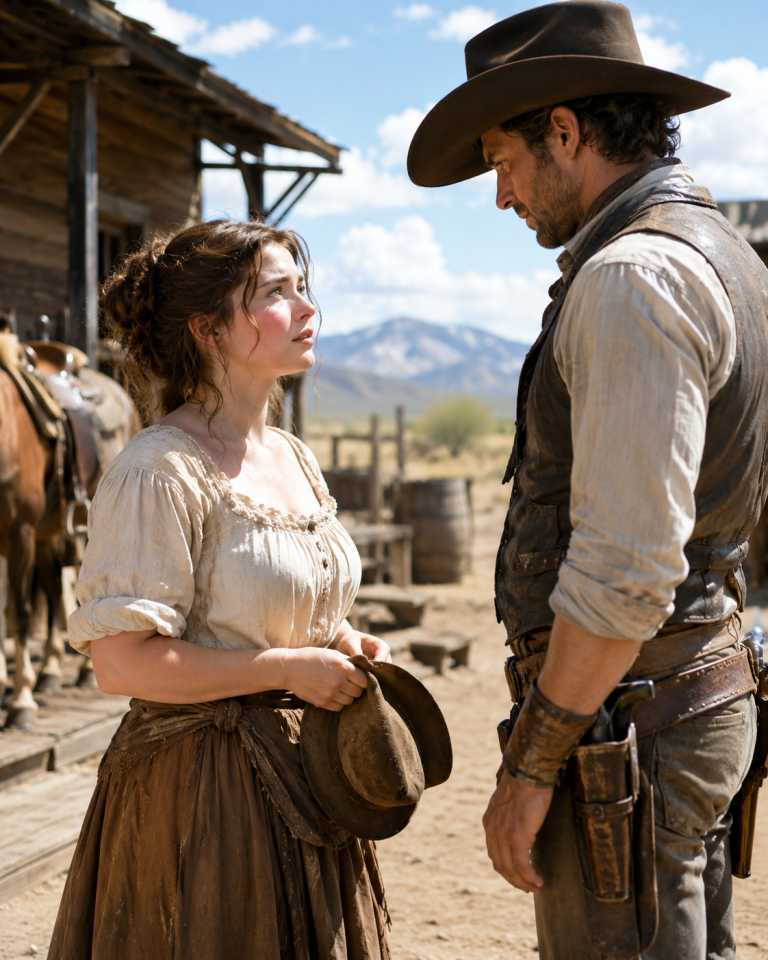
TITLE My Sisters Submitted Me To A Widower’s Mail-Order Ad As A Joke — Then I Became His Empire’s Cornerstone

PART 1
The scratch of Eliza Mercer’s steel pen against the ledger was the only honest sound in a house built on comfortable lies.
Outside, the Missouri soil was turning stubborn, yielding less with every passing season. Inside, the Mercer family was surviving on the quiet, relentless arithmetic Eliza performed at the kitchen table. She was twenty-one, the middle sister, and possessed the kind of plain, gray-eyed stillness that allowed her to move through rooms like a piece of well-placed furniture. She noticed the milk cow’s limp three days before the hired hand. She knew exactly where every rusted tool lived. She kept them out of the bank’s grasp.
No one thanked her. They simply expected it.
“It’s practically a prison sentence,” Josephine’s voice drifted down the hallway, light and venomous.
Eliza didn’t look up from the feed store debt. Josephine, nineteen and sharp as broken glass, was whispering to Arabella. Arabella was twenty-three, copper-haired, and currently examining her reflection in a silver hand mirror.
“A widower in Wyoming,” Josephine continued, the rustle of newsprint accompanying her words. “Cattle ranch. One child. He wants a capable woman of good character. I thought we might help Eliza expand her horizons.”
Arabella’s laugh was a soft, musical thing that didn’t reach her eyes. “You want to submit her name? To a stranger?”
“I want to give her an adventure.”
Eliza’s pen paused. A single drop of black ink bled into the page, ruining the month’s profit margin. She closed the ledger, the leather cover soft from years of her grip, and said nothing. Silence was easier to live in than the noise of wanting things she couldn’t have.
Three weeks later, the punchline arrived in the mail.
Eliza was the one who collected the letters. She sorted the bills and the seed catalogs on the kitchen table before her fingers brushed against thick, expensive parchment. The return address read: S. Hale, Laramie County, Wyoming Territory.
She stood in the quiet kitchen, the afternoon sun cutting through the dust motes, and broke the seal.
Dear Miss Mercer, the handwriting was plain, devoid of flourish. I am not a man who uses many words when fewer will do. I am 32. I own a cattle ranch. My wife passed three years ago. I have a son, Eli, who is seven. I am not looking for romance. I am looking for a capable woman who understands work and will treat my son with decency. I am reliable, honest, and I do not raise my hand to women or children. If this holds interest, write back with your genuine assessment. Respectfully, Colton Hale.
Eliza read it three times. The words didn’t offer pity. They offered a credential. Capable.
When Josephine walked into the kitchen for a glass of water, Eliza didn’t shout. She simply held up the parchment.
“Why does a man in Wyoming territory have my address?”
The color drained from Josephine’s face, leaving her looking suddenly very young and very cruel. “It was a joke, Eliza. I didn’t think anyone would actually respond. Not like… not like him.”
Eliza folded the letter. The paper felt like a door left slightly ajar. “You were hoping for a desperate man,” she said, her voice terrifyingly calm. “So you could watch me humiliate myself.”
She didn’t wait for an apology that wouldn’t mean anything. She walked upstairs to the narrow room at the back of the house. She packed one trunk. Two work dresses. Her boots. Her sewing kit. The leather journal she kept her accounts in. And her mother’s second-best brooch, which she pinned to her collar.
She left a note for her father on his workbench, thanking him for telling her she had a good mind when she was nine years old.
She walked to the train station in the early morning mist. The station master, a heavy-set man who had known her family for years, looked at her single trunk.
“You going far?”
“Wyoming,” Eliza said.
“Alone?”
“Yes.”
She boarded the train without looking back. It wasn’t a nostalgic glance. It was the act of checking that a door was finally, permanently closed.
The journey took three days. In Kansas City, she stood on a street corner and let the sheer, terrifying weight of her choice settle over her. She had fourteen dollars and the name of a man she had never met. But beneath the fear, she felt a strange, uncomfortable exhilaration. Possibility.
When the train finally hissed into the Laramie County station, the light was thinner, colder, making the distant mountains look like they had been carved from ice.
She waited twelve minutes. Then, a buckboard wagon pulled by two dark horses rounded the corner. The man driving it sat with a straight, unhurried posture.
Colton Hale was not what she had pictured. He was rough, his face weathered by high plains wind, his jaw cut from something hard and unyielding. But his eyes, when they found hers, were the pale, serious gray of a winter sky.
He climbed down, lifted her trunk with two clean, efficient motions, and set it in the bed.
“Long trip,” he said. His voice was a low rumble that vibrated in the wooden platform.
“Yes.”
“Hungry?”
“Somewhat.” He looked at her, his gaze assessing without being unkind. “You’re smaller than I expected.”
“Most people are,” Eliza said, “when you only know them from letters.”
The corner of his mouth moved—a shadow of a smile. “Fair enough.”
She climbed into the wagon before he could offer his hand. She wasn’t starting this by being lifted. He noticed, but said nothing.
They drove out of town in silence. It wasn’t the heavy, suffocating silence of her childhood home. It was the quiet of two people deciding independently to reserve judgment.
As the sun dipped below the horizon, the ranch appeared. It was sprawling, functional, and entirely devoid of sentiment. And standing on the porch of the main house, silhouetted against the lamplight, was a small figure.
Eli. Seven years old, with his father’s dark hair and a weariness around his mouth that belonged to a much older man.
Eliza climbed down from the wagon and looked up at him. “You must be Eli.”
He stared at her. “Papa said you were coming to stay. He said it wasn’t definite.”
Eliza glanced at Colton, who was watching them with his arms crossed. “That’s true,” she said, returning her attention to the boy. “Not definite yet.”
“Why not?”
“We haven’t decided if we suit each other yet, your father and I.”
Eli absorbed this with the grave seriousness of a child who had learned early that adults rarely told the whole truth. “What if you don’t?”
“Then I’ll go home,” Eliza said honestly. “But I don’t think that’s going to happen.”
“How do you know?”
“I’m not in the habit of coming all this way for nothing.”
Something shifted in the boy’s face. Not trust. But the recognition that she hadn’t spoken down to him. “Supper’s been keeping warm,” he said, and turned to go inside.
PART 2
The first month at the Hale ranch was a masterclass in quiet observation. Eliza didn’t try to mother Eli, and she didn’t try to charm Colton. She simply worked.
She learned the rhythm of the ranch. She learned that the kitchen garden’s soil was too acidic, and she spent an afternoon digging lime from the equipment shed to balance it. She found the household account ledger on Colton’s desk and spent two hours reorganizing his chronological mess into categorical columns.
Colton noticed. He didn’t say thank you, but the next morning, he left the ledger open on the desk with a blank page waiting for her shorthand.
They were married on a Friday by a circuit minister who didn’t pry. Colton slipped a plain gold band onto her finger. “My mother’s,” he murmured. “If you’d rather have something new, I’ll get it.”
“This is right,” Eliza said.
But peace on the frontier was an illusion. The territory was shifting, and men who built empires made enemies.
It happened on a Tuesday in November, while Colton was out checking a compromised fence line in the far pasture. Eliza was in the front room, reviewing the winter feed inventory, when a shadow fell across the window.
A knock echoed through the house. Firm. Entitled.
Eliza opened the door to find a man in a good coat and clean boots. He possessed the kind of practiced, manufactured warmth that Eliza recognized instantly. Her father had owed money to a man with that exact smile.
“Mrs. Hale,” the man said. “I’m Silas Crowe. I have some business with your husband regarding the creek boundary parcels.”
“He’s not in,” Eliza said, her hand resting on the doorframe.
“I don’t mind waiting.”
Eliza knew Crowe’s reputation. The postmaster in town had mentioned him with careful neutrality. He was a land acquirer. A man who circled struggling ranches and bought them up for pennies. He hadn’t come by accident. He knew Colton was in the far pasture. He had come to test the perimeter.
“Come in,” Eliza said. “I’ll get coffee.”
She left him in the parlor and walked to the kitchen. Her heart beat a steady, rhythmic tattoo against her ribs. Crowe wasn’t here to buy land. The creek parcels controlled the summer water rights for the entire valley. He was here to see if the new wife was soft enough to be intimidated.
Eliza poured the coffee, her hands perfectly steady, and walked back into the room to face the wolf.
PART 3
Silas Crowe accepted the coffee with a smile that showed entirely too many teeth. He spent the first ten minutes talking about the territory, the cattle market, and the harshness of the coming winter. He was smooth, painting a picture of a changing frontier where large, unfenced ranges were becoming liabilities.
“A man in Colton’s position might want to think carefully about the future,” Crowe said, leaning back in the armchair. “There are parties interested in the creek boundary. A fair price. Nothing that would compromise the core operation.”
Eliza sat across from him, her hands folded in her lap. “What exactly are you suggesting, Mr. Crowe?”
“Just a conversation. Investment interests from back east.”
“What are their names?”
A micro-expression of annoyance flickered across Crowe’s face before the pleasant mask reassembled. “I’d want to discuss the specifics with Mr. Hale directly.”
“Of course,” Eliza said pleasantly. “When he’s available.” She picked up her teacup. “Can I ask how long you’ve been looking at this particular property?”
“I’ve had a general interest for some time.”
“How specific is your general interest?” Eliza’s voice remained light, conversational. “For instance, have you spoken with anyone at the land office about the Hale creek boundary parcels?”
Crowe went still. The silence in the room stretched, thick and suffocating. He looked at her, really looked at her, recalculating the math of the woman sitting across from him.
“You’re well informed,” he said, the warmth dropping from his tone.
“I keep the accounts,” Eliza said. “Careful is the requirement.”
Crowe set his cup down. “You’re a careful woman, Mrs. Hale.”
“When my husband returns, I’ll tell him you called.”
Crowe stood, buttoning his coat. “I’ll be back when he’s here. Tell him not to let the winter freeze his assets.”
When the sound of his horse’s hooves faded down the trail, Eliza let out a long, slow breath. Her hands were shaking. She gripped the edge of the table until her knuckles turned white, waiting for the adrenaline to recede.
Colton returned an hour later, bringing the smell of cold air and horse sweat into the kitchen. Eliza told him everything. She didn’t editorialize. She just gave him the facts, the questions she asked, and the silence that followed.
Colton listened, his hands flat on the table. When she finished, he stared at the wood grain for a long time.
“He’s been circling for two years,” Colton said finally.
“What does he actually want?”
“The creek parcels. But they aren’t valuable by themselves. They’re the leverage point on the water rights. You control that section, you control where the main herd can water in summer.” He looked up, his gray eyes dark. “He knows that.”
“He came when you were out to see what he was dealing with,” Eliza said. “He wasn’t expecting me.”
Something shifted in Colton’s face. A muscle feathered in his jaw. “No. He wasn’t expecting you.”
Eliza tapped her leather journal. “I want to pull the land records on those boundary parcels. I want to know exactly what the legal ground looks like before he comes back.”
“He’ll come back when I’m here.”
“He’ll come back when you’re here,” she agreed. “But I want to know the numbers before that conversation happens.”
Colton looked at her for a long moment. Then he stood, walked to his desk, and pulled a heavy iron key from his pocket. “The land records are in the locked box. I’ll get you the key.”
For three days, Eliza lived in the territorial archives and the county clerk’s office in Garnet Creek. She cross-referenced deeds, surveyed maps, and water rights filings. She found the crack in the armor.
When Crowe returned on a Saturday, Colton was sitting at the head of the table. Eliza sat at the far end, a leather folder resting quietly in front of her.
Crowe made his offer. It was generous on the surface, designed to look like a lifeline.
Colton didn’t blink. “I’d want to look at the survey records before I considered any part of the creek boundary.”
Crowe’s smile tightened. “Standard surveys. Nothing complicated.”
“The 1871 survey on the north parcel has a chain discrepancy,” Eliza said, not looking up from her tea. “About forty feet along the eastern edge. It’s in the original filing, never corrected.”
The silence in the room was absolute.
Crowe turned to look at her. The pleasantness took a full second to reassemble. “Mrs. Hale. You’ve done your research.”
“I keep the accounts,” she said again.
It wasn’t the same work, and they all knew it. But she said it pleasantly enough that Crowe had no clean way to challenge it without looking foolish.
The meeting ended without an agreement. When Crowe’s horse was finally out of earshot, Colton turned to Eliza. The expression on his face was something close to wonder.
“Where did you learn to do that?” he asked.
“Four years of keeping accounts for people who didn’t pay attention,” Eliza said, closing her folder. “You learn to know the numbers better than everyone in the room. It’s the only power that’s actually yours.”
Colton was quiet. Then he said, “Thank you.”
Eliza nodded, picked up her tea, and walked to the kitchen to start supper. If her hands were slightly unsteady as she reached for the iron pot, it was because the adrenaline had somewhere to go. She gripped the handle and let the steadiness come back.
The blizzard arrived in the second week of December.
It didn’t announce itself with grace. It came in the night, a sustained, battering roar that made the timber walls of the main house flex. By morning, the drifts were up to the first window sills. The barn was invisible. The world had been reduced to a howling, gray-white void.
Eli treated it as an adventure, pressing his face to the glass and asking questions about ropes and visibility. Eliza answered him honestly, teaching him the mechanics of survival without indulging in panic.
But Colton was not all right.
Eliza noticed it the first evening. His stillness was too tight, his shoulders drawn up as if bracing for a physical blow. He checked the windows more than was necessary. He was navigating some internal terrain she couldn’t see.
She said nothing that first night. She just sat by the fire with her mending, letting the silence be what it was.
The second day, the storm did not let up. By afternoon, the pressure inside Colton was visibly cracking the walls he kept so carefully maintained.
Eliza made coffee. She brought a cup to where he stood at the window, staring out at the blinding white.
“Tell me,” she said.
“Nothing to tell.”
“Colton.”
He was quiet for a long time. The fire ticked in the grate. The wind screamed against the glass.
“Clara died in a storm,” he said, his voice flat, stripped of all its usual timber. “Not like this one. A March storm. She went out to check on a nervous mare. She went the wrong way in the dark. In the cold.”
He didn’t turn around. “They found her the next morning. Forty feet from the barn door.”
Eliza stood with her own cup, looking at the side of his face. She thought about forty feet. She thought about a woman she had never known, whose gold ring was currently on Eliza’s finger, who had walked forty feet in the wrong direction and never came back. She thought about a man who had built this house and was standing at a window three years later, still carrying those forty feet everywhere he went.
“You couldn’t have stopped it,” she said.
“I should have checked the horse myself.”
“Maybe. But you didn’t know.”
“I should have known.” His voice cracked on the last word, a microscopic fracture that revealed the crushing weight underneath. “I knew that horse was nervous. I knew the weather was turning.”
Eliza set her cup down. She crossed the room and put her hand on his arm. Not softly. Firmly. The way you touch something you need to hold steady.
“Colton.”
He turned to look at her. His eyes were bright, the sealed door finally blowing off its hinges.
“You have been carrying a verdict against yourself for three years for something you didn’t choose,” Eliza said, her voice steady and clear. “That is not guilt. That is punishment.”
“There’s a difference?”
“Guilt is about what happened. Punishment is what you do to yourself after.” She held his gaze, refusing to let him look away. “She would not have wanted this. You didn’t know her.”
“No,” Eliza said. “But I know you. And I know you are a man who, if you made a genuine mistake, would find a way to carry it and move forward. What you are doing is holding yourself responsible for weather, and bad luck, and the terrible randomness of how things go wrong. And it is eating you alive.”
Colton stared at her. The fire popped, sending a shower of sparks up the chimney.
“You’ve thought about this,” he said.
“I’ve been thinking about it for three months.”
“Why didn’t you say anything?”
“Because it wasn’t time.”
He made a sound that was half-laugh, half-sob. He turned back to the window, but his shoulders had dropped. The tension had broken. Eliza stayed where she was, her hand on his arm, while the storm pressed on and the house held.
They sat by the fire long after Eli went to bed. Colton talked. He spoke about Clara, about the year after she died, about trying to explain the concept of ‘forever’ to a four-year-old boy. Eliza listened. She didn’t offer empty platitudes. She didn’t tell him the grief would pass. She just sat in the dark with him and bore witness.
When the fire burned down to embers, she looked at this man with his sealed-up grief and his careful hands.
“I’m not going anywhere,” she said quietly.
Colton looked at her. Really looked at her, without the careful distance he had maintained since the day she stepped off the train.
“I know,” he said. “I think I knew that before you did.”
He reached across the space between them and took her hand. His palm was rough, warm, and entirely steady. They sat like that while the storm finished its business with the world outside. The house was quiet in a way it had never been quiet before. It was the quiet of two people who had finally stopped pretending the distance was what either of them wanted.
The morning after the blizzard broke, the ranchyard had been remade into a sculpture of blinding white. The sky was a hard, scoured blue.
Colton came downstairs and found Eliza at the kitchen window. He walked up behind her, put his hand briefly on her shoulder, and then they both went about the business of digging out.
That was the difference, Eliza thought, as she loaded wood onto the porch. This life did not wait for you to be ready.
Spring came late, but it came with purpose. The garden Eliza had amended with lime pushed green shoots through the dark soil.
She found Eli crouched at the garden edge one morning, watching a row of crooked sprouts with intense suspicion.
“Are they doing it right?” she asked, crouching beside him.
“They’re crooked,” he said.
“They’ll straighten when they have more sun. They’re reaching for it.”
Eli looked at the shoots, then at the sky. “That’s what you do when something’s hard to get. You just keep going toward it.”
Eliza looked at the side of his face. The weariness that had shadowed his eyes when she first arrived was gone. “Yes,” she said. “That’s exactly what you do.”
The land deal with Silas Crowe was finalized in March. Eliza’s strategy held. They negotiated a fifteen-year water access lease that gave Crowe’s grazing operations what he needed, while retaining absolute ownership of the parcels and securing a steady income stream for the Hale ranch.
When Crowe signed the final documents, he looked at Eliza with a mixture of resentment and grudging respect. He had underestimated the accounting. He had underestimated her.
The news of the agreement spread through Garnet Creek. When Eliza went to the general store, Vera Callaway, the woman who had spent months evaluating Eliza’s worth, stopped her in the aisle.
“I hear you held Silas Crowe off the creek parcels,” Vera said, her voice stripped of its usual condescending tilt.
“We came to an agreement that worked for the ranch,” Eliza replied.
Vera looked at her for a long moment. “Silas Crowe has been trying to acquire pieces of this county for ten years. Most people can’t negotiate with him.”
“He’s exactly what he looks like,” Eliza said. “If you’re looking at his hands instead of his face.”
Vera considered this. “I misjudged you when you came.”
Eliza set her list on the counter. “People usually do. I’ve mostly stopped minding.”
It wasn’t a friendship. But in a small community built on the currency of opinion, an acknowledgment from Vera Callaway was a shifting of the tectonic plates. Eliza had arrived.
By June, the ranch was running with a synchronized efficiency that felt like music. Eliza was seven months pregnant, a fact she had told Colton on a quiet April evening in the kitchen.
He had been terrified. The fear of losing something that mattered was a ghost that haunted him. But Eliza had taken his hands, looked him in the eye, and told him she was not Clara, and she was not going to be taken from him the same way. She demanded he hold the fear alongside the happiness, rather than letting it consume the room.
He was doing it. It cost him, she could see the effort it took, but he was doing it.
The letter from Missouri arrived on a Tuesday in mid-June.
Eliza recognized Arabella’s elegant, looping handwriting. She stood at the mail table in the post office, holding the envelope, and considered throwing it in the stove.
She didn’t.
She opened it. Arabella wrote that their mother had been unwell. She wrote, in careful, constructed sentences, that they had heard things about Eliza’s life in the territory. She wrote that they would like to visit in September, if such a visit was welcome. There was no direct apology, only a sentence that started, I know that what Josephine and I did was… and ended with not what it should have been.
Eliza read it three times. She wrote back that same evening. She said a visit was acceptable. She said they were welcome in her home. She did not write more than that. The visit would be the conversation.
When Arabella and Josephine stepped down from the wagon in September, the air was crisp, edged with the promise of autumn.
Arabella looked exactly as she always did: beautiful, poised, and entirely out of place against the backdrop of the Wyoming mountains. Josephine was thinner, the sharp quickness of her youth quieted into something more guarded.
Eliza stood on the porch, holding her daughter, Ruth, who had been born in the hard, bright heat of August.
“Eliza,” Arabella said, looking at the ranch house, the yard, the mountains, and finally, her sister. For a moment, her composure slipped. “This is… really something.”
“It needed work when I arrived,” Eliza said. “Most things do.”
She did not hug them. Not yet. She brought them inside and showed them her home. The clean kitchen, the organized shelves, the fiddle resting on its shelf in the sitting room, the account ledgers on the desk. She let the visible evidence of her life speak for itself.
Colton came in from the range that evening. He met them with the contained directness that was simply how he was. He shook Josephine’s hand with the specific expression of a man who was being civil solely because his wife had asked it of him.
Dinner was a study in unspoken histories. Eli, now eight, asked Arabella where she got her hair from, treating it as a purely scientific inquiry. Arabella answered with surprising grace.
Later, when Colton had taken Eli upstairs and Arabella had retired to the guest room with a traveling headache, Eliza and Josephine were left alone at the kitchen table.
The silence between them was heavy, loaded with years of casual cruelty and deliberate dismissal.
Josephine went first. “I owe you an apology. A real one. What I did was cruel. I knew it was cruel when I did it, and I did it anyway because I wanted to feel like I had power over something. It was wrong. You didn’t deserve it.”
Eliza held her teacup in both hands. She had constructed a speech over the past year. It was precise, cutting, and heavy with everything she was owed.
She looked at her sister, and she let the speech go.
“I know,” Eliza said. “And I know you know. That’s enough.”
Josephine blinked. “That’s it?”
“What else do you want? I’m not going to punish you. And you’re not going to punish yourself forever, because that’s its own kind of self-indulgence.” Eliza set her cup down. “You did a cruel thing. And it sent me somewhere I belonged. I’ve spent a year deciding what to do with that. I’ve decided I’m not carrying it. You can carry your part of it however you need to, but I’m not adding mine.”
Josephine was very still. Her eyes were bright in the lamplight. “You’ve changed.”
“I haven’t changed, Joe,” Eliza said softly. “I’ve always been exactly this. You just weren’t looking.”
Josephine wiped her eye with the back of her wrist in a quick, private motion. “She would have loved this place,” she whispered. “Mama. She would have hated the dirt, but she would have loved what you built.”
“You should tell her that,” Eliza said. “Write her a letter. Tell her what you see. She never saw me. But that’s not entirely her fault. She was looking somewhere else her whole life. You can tell her to look.”
They stayed at the table until the fire burned down. It wasn’t a perfect reconciliation. It was something more honest. Two complicated women starting the slow work of building something new on top of the old ground, without pretending the old ground wasn’t there.
Before they left, Arabella held Ruth in the sitting room. She looked down at the niece she hadn’t known existed, her face unguarded.
“She has your eyes,” Arabella said.
“She has her father’s stubborn chin,” Eliza replied.
Arabella looked up. “I didn’t see you, Eliza. I see you now.”
“I know,” Eliza said. “Come back next spring. Eli will have taught Ruth to point at the horses by then.”
Arabella laughed, a genuine sound that filled the room, and handed the baby back.
When the wagon finally disappeared around the bend in the road, Eliza stood on the porch, Colton’s arm wrapped around her shoulders. The ranch was quiet. The horses moved in the corral. The mountains sat against the horizon, ancient and indifferent.
Inside, Eli was feeding Ruth her morning bottle with the focused seriousness of a general commanding a vital operation. He talked to her in a low, steady murmur, explaining the mechanics of the milk and the proper way to hold the wood.
Eliza watched from the doorway. The weariness that had defined the boy when she first arrived was entirely gone. He was just a boy, teaching his sister about the world.
She had been in Wyoming for two years. She had arrived with one trunk, fourteen dollars, and the assumption that she was the kind of person things could be done to without consequence. The kind of person whose name could be written down as a joke.
What she knew now, standing in her kitchen in the fall light, was that the people who underestimate you are not seeing you clearly. They are seeing a story they told themselves. The verdict says nothing about you. It says everything about the limits of what they were willing to see.
She had not been transformed by the frontier into someone new. She had simply been given the room to be exactly who she already was. And it had been enough.
She looked at the plain gold band on her finger. She thought about the train pulling out of Missouri, the blizzard that broke the sealed doors, the bird’s nest on the windowsill, and the ledger that held the empire together.
The forgotten daughter had become the cornerstone. Not because the world had finally decided to see her, but because she had never stopped being worth seeing.
Colton squeezed her shoulder, pulling her back to the present. “Josephine?” he asked, his voice a low rumble.
“She’s working on it,” Eliza said.
“Is that enough?”
Eliza looked at the man who had handed her his ledger, the boy who was feeding her daughter, and the land that had demanded everything and given her a life in return.
“For now,” she said. “People work on things at their own pace.”
She turned away from the window and walked back into her kitchen, into the ordinary morning that was her life. It was honest. It was hard. It was entirely hers.
And it was, in every way that counted, exactly enough.
THE END