HE FOUND HER ALONE IN A BLIZZARD — ABANDONED BY THE MAN WHO ORDERED HER LIKE FREIGHT — BUT THE DEED SHE CARRIED IN HER TRUNK WAS WORTH ENOUGH TO GET THEM BOTH KILLED

PART 1
Sheamus Ali’s Trading Post — Montana-Idaho Border — Late November 1883
Stefan Caldwell pushed open the heavy oak door with his shoulder and let the warmth of the trading post close around him like a fist.
The smell was familiar. Cured tobacco, cheap whiskey, and wet wool. He’d been making this trip twice a year for six years — down from the Bitterroot high country for salt, gunpowder, coffee, and lead — and the trading post had never changed. It smelled like a man’s world. Practical and dim and slightly sour.
The woman in the corner was not part of the inventory.
She sat rigidly on a leather-bound steamer trunk near the potbelly stove, her navy traveling dress entirely inadequate for where she was, a veiled hat clutched in white-knuckled hands. Her lips were tinged blue. Her jaw was set with a pride that was clearly costing her something to maintain. She looked like a porcelain figurine that had been carried across the country in a mail sack and expected to land without breaking.
Stefan dropped his heavy sack of pelts on the counter and grunted at Ali. His chin moved toward the corner.
Ali leaned in, his voice low.
“Miss Joselyn Albright. Mail-order bride, all the way from Boston. Northern Pacific to the end of the line, stagecoach the rest of the way.” He paused. “Been sitting on that trunk three days.”
Stefan frowned. “Where’s the groom?”
Ali spat the name like something he’d found in his coffee. “Arthur Pendleton. Came by yesterday. Looked at her through the window — saw she hadn’t brought the dowry he was expecting — and rode straight for Virginia City. Left a note saying the arrangement was terminated.” He wiped the counter with a rag that made it worse. “Stage won’t be back until spring thaw, Stefan. I ain’t got the provisions to board her, and I ain’t running a house for abandoned women.”
Stefan turned and looked at her again.
She was staring at the flames behind the cast iron grate. Not with self-pity — he’d seen plenty of self-pity in his years at altitude and he knew what it looked like. She was staring with the particular focus of a person who is calculating their options and discovering there aren’t any.
He crossed the room.
“Miss Albright.”
She flinched. Turned her head. Her eyes were a clear, striking gray, and beneath the exhaustion pooling beneath them was something sharp and watchful.
“If you have come to offer pity, sir, I assure you I have no use for it.” Her chin lifted. “I am simply waiting for the next coach.”
“There ain’t a next coach.” Stefan kept his voice level. “Not until April. The pass is freezing over as we speak. By midnight, there’ll be four feet of snow outside that door. By tomorrow, eight.”
A muscle moved in her jaw. “Then what do you suggest?”
“I have a cabin. Ten miles up the ridge.” He heard himself saying it and immediately wanted to take it back — every reasonable instinct he’d cultivated over six years of deliberate solitude screaming at him to turn around. But he didn’t turn around. He hadn’t been able to turn around yet, and he suspected he wasn’t going to. “It ain’t pretty. It’s small. Smells like smoke and cured meat. I ain’t much for conversation. But it’s got a solid roof and firewood enough to last the winter. You can ride out the storm there. Come spring, I’ll bring you back down.”
She looked at him the way a woman looks at a door she’s not sure leads somewhere worse than where she already is. He was aware of what he looked like — the wolf fur, the Winchester slung over one shoulder, the hunting knife, the beard that had never been properly groomed — and he didn’t try to soften any of it. What he was, she’d have to take or leave.
Outside, the wind found the walls of the trading post and the window panes shook in their frames.
“I will not be a burden,” she said finally.
“Stefan Caldwell. And up there, everybody carries their weight. Grab your things.”
—
The blizzard came for them within twenty minutes of leaving Ali’s.
It didn’t build. It arrived — a wall of white that reduced the world to three feet of visibility and a screaming wind that tore at exposed skin like something with intent. The temperature dropped to thirty below with a speed that felt personal. Stefan tied a hemp rope around his waist and secured the other end around hers, terrified she’d wander off the trail and disappear into one of the ravines that waited on either side like patient things.
For four hours they moved through drifts that came to her thighs. Her city boots — the boots of a woman who had crossed two thousand miles to start a new life — were worse than useless up here. She lost feeling in her toes first, then her feet, then her calves. The snow was soft and the cold was gentle and there was a part of her mind, she would tell him much later, that kept suggesting she could just lie down for a moment.
She didn’t lie down. She kept walking until she couldn’t.
When her legs finally gave out, Stefan didn’t scold her. He didn’t pause to evaluate the situation. He simply waded back through the drifts, hoisted her over his shoulder the way you’d hoist a deer, and carried her the last two miles.
She regained consciousness on a pallet of soft bear skins with a tin cup of venison broth in her hands and a fire roaring six feet away.
Stefan sat at the hearth with his back to her, cleaning his rifle.
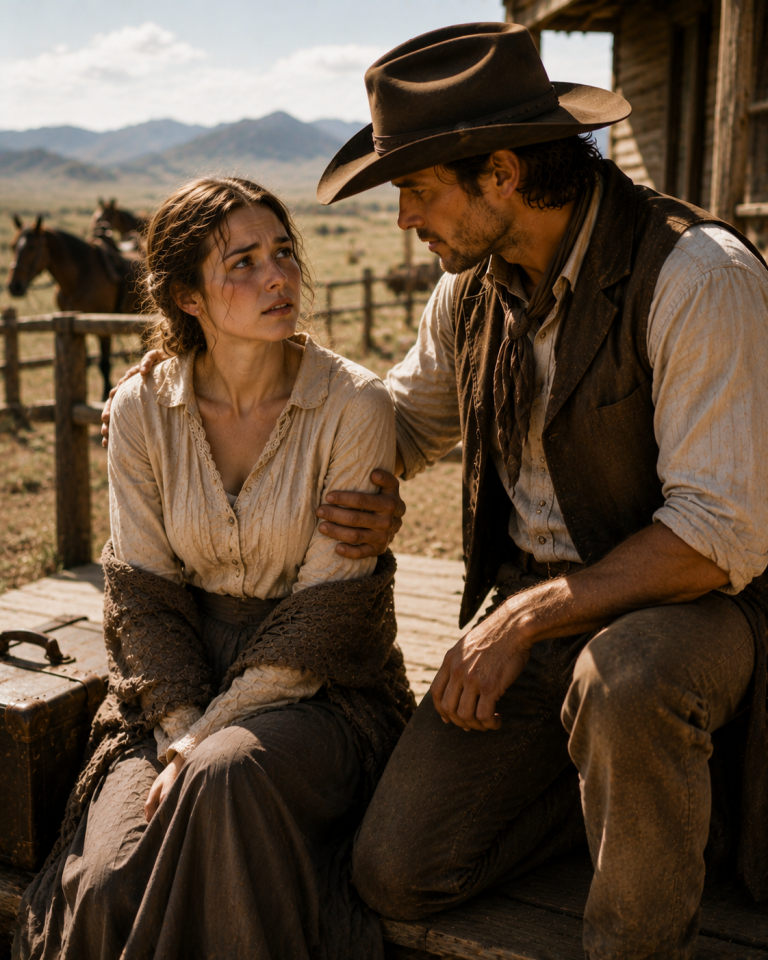
“Your toes are frostnipped,” he said, without turning around. “But you’ll keep them. You were lucky.”
She looked around the cabin. Spartan, dim, hung with dried herbs and stretched hides. No pictures. No soft edges. A place built entirely for survival, by a man who had decided that survival was the only honest promise the world still made.
She took a sip of the broth. It was the best thing she had ever tasted in her life.
“Thank you, Mr. Caldwell,” she whispered.
He grunted.
The fire cracked and settled. Outside, the blizzard threw itself against the cabin walls.
The mountain man and the abandoned bride looked at the same fire from opposite sides of a silence neither of them knew yet how to cross.
—
—
PART 2
*Posted by J.Albright — 10:54 PM*
People have been asking me to write down what happened that winter. What really happened. Not the version the Helena paper printed in July, with the silver claim and the burned cabin and the two men tied to the pine tree. The real version — starting from the beginning, starting from what I found under the false bottom of my father’s trunk.
I want to explain something first. My father was a quiet man. An assayer. He spent his life measuring the value of things other people found in the earth, writing numbers in ledgers, and watching those numbers make other men rich. When he died, I inherited his debts, his Bible, his trunk, and a deed to a piece of scrub land in the Dakota Territory that his solicitor described as “essentially worthless.”
I never opened the deed. I threw it in the trunk with his letters and I crossed a continent to marry a man I’d never met because there was nothing left in Boston but the outline of a life I couldn’t afford to keep living.
I didn’t know about the silver. I didn’t know about Elias Dalton. I didn’t know that Arthur Pendleton hadn’t found me through a mail-order catalogue by accident — that he had been paid to find me specifically, to marry me and claim the Dakota land through spousal rights. I didn’t know that my father had been killed over a piece of paper sewn under a false bottom in a steamer trunk that I had been sitting on for three days in a Montana trading post.
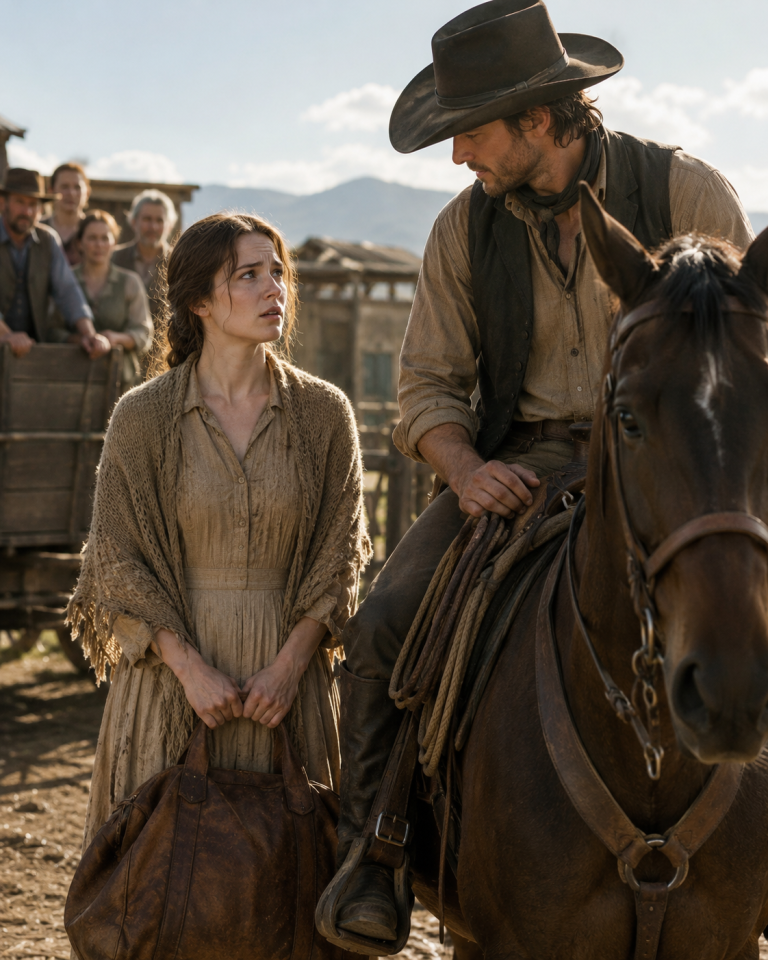
I found out in April. When Stefan and I rode down from the Bitterroot, into the muddy yard of Ali’s trading post, and a sheriff from Virginia City was standing on the porch with two deputies.
And behind him, Sheamus Ali was pointing at me.
“That’s the Pendleton bride,” Ali said.
Stefan moved his mule in front of mine before the sheriff finished dismounting. His hand drifted to his Winchester. Slow. Casual. The way a man reaches for something he’s already decided he’s going to use.
Then the sheriff said a name.
Elias Dalton.
And I watched all the color leave Stefan Caldwell’s face.
—
PART 3
# “THE PAST CLIMBED THE MOUNTAIN TO FIND HIM”: THE FULL STORY OF STEFAN CALDWELL, JOSELYN ALBRIGHT, AND THE DEED THAT STARTED A WAR
*The complete account — of a winter that healed a man, a spring that nearly killed them both, and what was buried under the false bottom of a dead man’s trunk*
—
### PART ONE: THE THAW INSIDE THE CABIN
The first month was a war of silences.
The blizzard raged for two solid weeks without apology, burying the cabin to its eaves and reducing the world to a permanent gray twilight broken only by the orange pulse of the hearth. Stefan Caldwell lived by a routine so rigid it had become a kind of armor — up before dawn, stoke the fire, check the snare lines on snowshoes, return, split wood until his arms gave out. He had built the routine over six years specifically to leave no space for anything that might require him to feel something.
Joselyn Albright dismantled it quietly and without ceremony.
She started the morning he returned from the snare lines to find the cabin swept clean, the copper pot scoured with ash until it gleamed, and a pot of something that smelled improbably like civilization simmering over the fire. She had used the dried herbs from the rafters, the remains of the last rabbit, and what appeared to be creative determination to produce a stew that bore no resemblance to anything Stefan had eaten in six years of subsistence living.
He sat down and ate two bowls without speaking.
She didn’t ask for thanks. She sat across the table and ate her own bowl and looked at the fire, and the silence between them shifted almost imperceptibly — from the silence of two people waiting for the other to become a problem, to the silence of two people existing in the same space without catastrophe.
A rhythm formed in the weeks that followed, tentative as ice beginning to re-form on a stream.
Stefan would return from the trap lines and leave a skinned rabbit on the rough-hewn table. Joselyn would turn it into something that made the cabin smell like purpose. He tracked mud across her swept floorboards. She swept it clean again without comment. He brought in wood. She stacked it with a precision that suggested she had decided, somewhere along the way, to become excellent at everything this place required of her.
Her hands paid the price. They had been seamstress’s hands when she arrived — soft, fine-boned, accustomed to delicate work. By late December, they were calloused and reddened and occasionally bled where the cold cracked the skin at her knuckles. She wrapped them in cloth strips and kept working. Stefan saw it and said nothing. He put a small crock of bear grease on the shelf near the basin. She found it the next morning and used it without comment and put it back.
Neither of them acknowledged it. It was a transaction conducted entirely in the language of people who have decided, without saying so, to take care of each other.
—
The night of the journal changed everything.
It was late December, the wind screaming in the pines outside with a sound like a living thing in extremis. Joselyn was sweeping with her broom of pine boughs when the bristles caught on something — a raised edge beneath the floorboard near the eastern wall. She pried it up without thinking. Found the leather journal.
Opened it.
The handwriting was beautiful. She hadn’t expected that — hadn’t expected the precise, careful cursive, the detailed sketches of the Eastern seaboard coastline, the poems about winter light and river ice. She hadn’t expected the letters. Addressed to a woman named Clara, dated from Virginia, from Antietam, from the long march through the mud of the Georgia campaign.
She was still reading when the door opened.
“Put that down.”
She dropped the book.
Stefan stood in the doorway — not filling it so much as *being* it, a mass of cold air and fury and something else, something raw that she hadn’t seen in him before. He crossed the room in two strides, retrieved the journal, pressed it back into the hiding place with a flatness of motion that told her he had done this before — reached for the book and put it away, reached and put it away, as if the physical act of concealment could contain whatever lived inside it.
Then he stopped.
She waited for the eruption. Braced for it — the raised voice, the order to leave a room she couldn’t leave because there was nowhere to go.
What happened instead was that his shoulders dropped. One degree. Then another. The anger ran out of him slowly, like heat leaving a stone. He walked to the rocking chair by the fire and sat down in it heavily, an old man all at once, staring into the flames.
“She was my wife.”
His voice came out like something dredged from a very deep place.
“Died of cholera while I was fighting in Virginia. I came back to an empty house and a headstone.” A long silence. The fire cracked. “The world down there — it’s just a graveyard to me, Miss Albright. The mountain is the only place that makes sense. The rules are simple. You survive, or you don’t.”
Joselyn set her broom against the wall. She crossed the room and knelt beside his chair — not touching him, just close, in the way you stay close to something that is in pain.
“I know about empty houses,” she said softly. “I know about promises that don’t arrive.” She looked at his profile, the firelight moving across the hard planes of his face. “But hiding up here doesn’t bring the dead back, Stefan. It just makes you a ghost among the living.”
The fire settled in the hearth.
He didn’t respond. But he didn’t ask her to move.
—
After that night, the cabin changed its temperature by some degree that had nothing to do with the woodstove.
Stefan began to talk. Sparingly at first — a word here, an observation there, the verbal equivalent of a man testing ice before committing his weight. Then, as January deepened, with increasing ease. He taught her how to read tracks in the snow — the difference between a wolf moving with hunger and an elk moving with fear. He placed the heavy Sharps buffalo rifle in her hands, adjusted her feet, her elbows, the angle of her chin, speaking in low precise sentences about elevation and wind drift and the patience required to wait for the right moment.
She was a fast learner. She suspected this pleased him in some wordless way, though he never said so.
In return, she brought things back into the spaces of him that had been vacated.
She told him about Boston — the smell of the harbor in July, the noise of the market on Tremont Street, the way snow fell differently there, soft and civilian, nothing like the mountain’s assault. She told him about her father, the assayer, a quiet methodical man who had loved her in the only language he knew — provision, preparation, the silent construction of things that would outlast him.
She made him laugh once, in early February, telling him about her disastrous attempt to cook her first rabbit. It was a short laugh, reluctant and rusty from disuse. He looked almost surprised to hear it come from himself.
She watched it happen — the slow return of a man to himself. Like ice retreating from a shoreline in late winter. She understood, watching it, that this was the most extraordinary thing she had ever witnessed. Not dramatic. Not sudden. Just the patient work of warmth against something that had been frozen a very long time.
She also understood, with a clarity that arrived one morning while she was watching him move through the clearing on snowshoes, that she was not going back to Boston. She had known it for weeks. She simply hadn’t said it yet.
—
### PART TWO: THE NAME IN THE SHERIFF’S MOUTH
April arrived on the mountain with violence and color — the snowmelt torrential, the valleys erupting green overnight, the river in the ravine below the cabin roaring with six months of collected winter.
The ride down to Ali’s trading post was agonizingly quiet.
Stefan rode ahead on his mule, staring at the treeline. Joselyn rode behind him, watching his back, trying to find the words. She had been rehearsing them for two weeks. *What if I don’t want to go back east?* She had the line ready. She was waiting for the moment.
They rode into Ali’s yard and the moment disappeared.
Three horses at the hitching post. Heavy Mexican saddles. A man with a silver star on his chest standing on the porch with a thin cigar and two deputies who looked like they hadn’t slept. Sheamus Ali beside them, his face tight with the expression of a man who has been waiting for someone else to deal with a problem that has been sitting in his yard for several hours.
The sheriff looked at Joselyn.
Ali pointed.
“That’s the Pendleton bride.”
Stefan moved his mule forward before the sheriff finished dismounting. His hand drifted to the Winchester with the casual precision of a man taking hold of something he’s already decided he’s going to need.
“Easy, Caldwell.” The sheriff raised one hand. “Nobody’s looking for a fight. I’m Sheriff Holden, Virginia City. I’m here for the woman.”
“She hasn’t done anything.”
“No, sir. But her intended sure did.” Holden flicked his cigar into the mud. “Arthur Pendleton turned up dead two weeks ago in a gulch outside town. Shot in the back of the head. But before he died, he sent a telegraph to a man named Elias Dalton.”
The name landed.
Joselyn watched it land. Watched something leave Stefan’s face — not just color, but the particular steadiness she had come to think of as his natural state. What replaced it was older and colder than anything the mountain had put there.
Holden kept talking, his eyes moving between them. Pendleton hadn’t been looking for a wife, he explained. He’d been working for Dalton — a land baron, a former Confederate raider, a man who had spent the post-war decades accumulating territory through means the law had been unable to quite pin down. Joselyn’s father, the quiet Boston assayer, had purchased a piece of scrub land in the Dakota Territory five years ago. The land sat on top of the richest undiscovered silver vein in the territory. Dalton had found out about it. He’d hired Pendleton to locate the heir through the mail-order catalogues, marry her, and claim the property through spousal rights.
Pendleton had tried to double-cross Dalton. Sell the information to a rival mining company. Dalton had found out and put a bullet in him.
“Dalton’s riders were spotted crossing the river this morning,” Holden said. He glanced at the ridge above them. “We came to take the woman into protective custody. But I’m afraid we might be too late.”
Stefan wheeled his mule around. Grabbed the reins of Joselyn’s mount with one hand.
“You’re not putting her in any jail cell.”
“Stefan,” Holden started.
“She’d be a sitting duck with a badge on the door.” He looked at Joselyn, and what was in his eyes now was the cold, calculated attention of someone who has spent a decade learning to be the most dangerous thing in any terrain. “We’re going back up the mountain. Let them try and take her from my territory.”
—
### PART THREE: THE SIEGE AT BITTERROOT RIDGE
The ascent was a race.
Spring had turned the switchbacks into treacherous mud slides, and Stefan pushed the mules at a pace that left no room for conversation or second thoughts. He rode with his eyes on the treeline below, scanning for the telltale movement of horses against new-growth green. Joselyn rode beside him with a rigidity that had nothing to do with fear — or rather, with fear accepted and converted into something useful.
The terrified woman in the navy traveling dress was not here anymore.
She had left her behind sometime around January, somewhere between the first shot she fired and the morning she realized she had stopped flinching at sudden sounds. The mountain had done that. The cold and the work and the slow, difficult return of a man to himself had done that. She wasn’t sure what she was now, exactly, but she knew she wasn’t going to die in the spring mud if she could avoid it.
They broke through the tree line into the cabin clearing and Stefan moved with the efficiency of a man executing a plan he’d been building in his head for the last two miles of trail.
“Inside,” he said. “Bar the door. Don’t light the hearth.”
“Smoke,” she said, understanding immediately.
“Gives away the position before they clear the ridge.”
She took the mule’s reins and moved. He was already pulling hidden ammunition caches from beneath the wood pile — he had stores she hadn’t known about, wrapped in oilcloth against the damp. She watched him drag logs to reinforce the cabin’s weak points, position them at angles she recognized from descriptions of fortifications. He moved like a soldier. She hadn’t seen him move like that before. She understood now what he had been, before the Bitterroot. Before Clara. Before he had decided the mountain’s simple rules were the only honest ones left.
Inside, the afternoon light filtered through the gaps in the heavy shutters he’d bolted over the windows. The cabin that had been her world for five months felt different in that dim light — smaller, the walls thinner, the spaces between the logs suddenly meaningful.
Joselyn knelt beside her steamer trunk.
The trunk. The thing she had sat on in Ali’s trading post while the Montana winter assembled itself outside. She’d carried it two thousand miles and five months and never once thought to question what was in it beyond dresses and letters and a family Bible.
She thought about what the sheriff had said. *Your father bought a piece of scrub land.* A man who spent his life measuring the value of things other people found in the earth.
She emptied the trunk. Woolen skirts, faded daguerreotypes, the Bible.
She took Stefan’s hunting knife from the table.
Pried at the brass tacks lining the bottom.
The false bottom her father had crafted with the patience of a man who had always prepared for contingencies he hoped would never arrive cracked upward with a sharp sound that seemed very loud in the shuttered cabin.
Oil cloth. A folded parchment, heavy and crisp.
*The Silver Star Claim — Dakota Territory.*
An assayer’s report attached in her father’s precise handwriting. Core samples. Measurements. A vein of pure silver described in the dry language of geological assessment in terms that even she, with no knowledge of mining, understood to mean *enormous.*
Stefan came through the root cellar trap door, his face darkened with soot and dirt. Saw the parchment in her hands.
“So it’s real,” he said.
“It’s a king’s ransom.” She looked up at him. “This piece of paper is why my father is dead. It’s why I was brought out here. It’s why Pendleton looked through Ali’s window and saw me and decided I wasn’t worth the complications.”
Stefan walked to the table. His massive hand covered hers — lowered the deed gently to the rough-hewn wood.
“Elias Dalton is a ghost from a war that should have ended twenty years ago.” His voice had dropped to something very quiet. “He rode with the bushwhackers in Missouri. Men who didn’t fight armies. They burned farms. Slaughtered innocents.” He paused, and in the pause she heard what was coming before he said it. “When the cholera hit my county — Dalton’s men held the supply roads. They shot the physician trying to bring quinine and clean water through. Clara died because Dalton wanted to make a point about Yankee sympathizers.”
The fire that was not lit sat cold in the hearth.
Joselyn understood then the full shape of the haunted look she had been living beside all winter. It wasn’t only grief. It was the specific, corrosive agony of a man who knows exactly who is responsible for what he lost and has spent six years unable to do anything about it.
“He took my past,” Stefan said. He stepped back. Lifted his rifle. Chambered a round with a sound like a door closing. “I will be damned to hell before I let him take my future.”
—
Dusk came over the Bitterroot Range in violent orange and bruised purple.
The mountain went quiet in a way it didn’t usually go quiet — not the comfortable silence of altitude and emptiness, but the listening silence of a place that knows something is about to happen. The elk stopped. The birds stopped. Even the wind dropped to a murmur.
Then a twig snapped.
Stefan pressed his eye to the narrow gap he’d carved in the log chinking. Joselyn pressed herself against the wall beside a second gap, the Sharps buffalo rifle across her knees, its weight familiar now in a way it hadn’t been five months ago.
Six riders emerged from the tree line.
Elias Dalton rode at the center. He wore broadcloth and a heavy duster, a wealthy man’s clothes over a killer’s face — angular, scarred, built by decades of decisions made without reference to mercy. He carried himself with the particular ease of a man who has rarely been told no.
“Caldwell.” His voice carried across the clearing with the practiced projection of a man accustomed to commanding spaces. “It’s been a long time since Missouri. I hear you’ve taken up nursing stray women.” A pause weighted with false warmth. “Send the Boston girl out with the paper. I’ll let you go back to skinning your rodents in peace.”
Stefan aimed through the murder hole. Accounted for the wind through the pines — twenty degrees from the northwest, moderate — and squeezed the trigger.
The bullet struck the dirt an inch from the hoof of Dalton’s Andalusian stallion.
The horse reared. Dalton scrambled.
“Take the cabin,” Dalton roared.
—
What followed was not a battle in any clean sense. It was a siege — lead eating through pine logs, the interior filling with woodsmoke and the acrid sulfur bite of black powder, Joselyn sliding the loaded Sharps across the floorboards to Stefan the moment his Winchester ran dry, reaching for the next round before he’d finished firing.
He moved through the cabin’s interior with a terrible economy — two steps, fire through a murder hole, shift, fire again. She tracked his position by the sound of his boots. She loaded without looking at the door.
Outside, a scream tore through the exchange of gunfire. One of Dalton’s men had moved wide on the left flank — too wide, into the deep spring ferns where Stefan had positioned the bear traps in the final minutes before they’d come inside. The sound of it reached them through the logs like something that had happened in another world, and it demoralized Dalton’s men in the way that unexpected consequences always do.
They pulled back to the tree line.
“They won’t rush us again,” Stefan said, his back against the wall, one sleeve dark with blood from a splinter wound. He didn’t look at it. “Dalton is a coward at heart. He’ll wait for dark. He’ll try to burn us out.”
He was right.
Around two in the morning, the smell of kerosene reached them through the log chinking. Then the heavy beat of boots sprinting from the tree line, and the orange bloom of flame catching the dry pine roof before Stefan could drop the second man.
“Root cellar,” Stefan said. Already moving. “There’s a tunnel. Leads to the dry creek bed in the ravine.”
They went down the wooden ladder into the damp dark and pushed through the narrow dirt passage as the cabin’s roof began to give way above them — the sound of it enormous and final, like something collapsing that had been standing for years. They came up through the ravine embankment into cold night air smelling of smoke and pine resin, and took cover behind a massive granite boulder overlooking the ruin.
Below, the cabin burned.
Five months of her new life, burning.
Joselyn watched the flames for a moment. Then she turned away. She had not built her life there — she had built it in the conversations and the silences and the morning light through the gaps in the shutters and the tin cup of broth and the sound of a man laughing for the first time in years. The logs could burn. None of that could burn.
Elias Dalton stepped into the firelight with three remaining men, his face orange-lit and satisfied.
“Search the ashes,” he ordered. “The deed’s in a lockbox. Find it.”
Then a rifle shot cracked from the high ridge above, and one of Dalton’s men dropped into the snow.
Joselyn turned.
A figure limped from the shadows at the ridge line — thin, hollow-eyed, one arm bound in a blood-darkened sling. His clothes were in ruins. But his eyes were burning with the particular fever of a man who has survived something he shouldn’t have in order to reach something he wants.
Arthur Pendleton.
Her breath left her.
“You thought a grazing shot would keep me down, Dalton?” Pendleton’s voice came down the ridge with the cracked intensity of a man who has been rehearsing this for two weeks. “I tracked you from Virginia City. You do the heavy work and I take the Dakota silver.”
Dalton laughed — a sound like something breaking. “You’re a fool, Pendleton.”
Two pistols rose.
Two men, both of whom had used her as a piece in a game she hadn’t known she was playing, pointed their weapons at each other in the firelight of the home she had almost made.
Stefan’s hand closed on her arm.
“Stay here.” He pressed the Sharps into her hands. “If anyone but me comes up this ridge, pull the trigger.”
Then he stepped off the boulder and into the smoke.
—
### PART FOUR: THE CHOICE AT THE BARREL’S EDGE
She lost sight of him almost immediately.
He moved through the shadows below with the silence and direction of something that belonged to this terrain in a way no one born east of the Mississippi ever could. She tracked Dalton’s men by their voices and the firelight reflected in their eyes. She tracked Stefan by an absence — the way the darkness moved around him, rearranging itself.
Below, the firefight between Dalton and Pendleton erupted with the stupid violence of two men who have been double-crossing each other for so long that they’ve forgotten what honesty looks like. Pendleton fired wildly — desperation more than aim. Dalton’s return fire caught him in the thigh and Pendleton went down into the mud, his rifle spinning from his hands.
Dalton walked toward him.
Raised his revolver.
Stefan came out of the smoke like he’d been assembled from it.
He took Dalton with the force of a man twice his size and the trajectory of something that had been building across twenty years of mountain winters and one name spoken too many times in a dark cabin. They went down together into the mud and ash, Dalton’s revolver going off into the open sky above them, harmless.
It was not a long struggle. Stefan’s weight alone made it brief. Within seconds he had Dalton pinned — one knee on the man’s chest, the hunting knife at the base of his throat, the blade steady.
Dalton stared up into the face of the man whose wife he had killed by holding a supply road and looked, for the first time Joselyn had ever seen, like a man who understood what was about to happen to him.
“This is for Clara,” Stefan said. Very quiet. “And for my mountain.”
Dalton tried to speak. Stopped. His eyes moved between the knife and Stefan’s face, calculating, finding nothing there to negotiate with.
“I’ll give you gold,” he said finally. “Land. Anything.”
Stefan didn’t move.
She watched him from the ridge above. Watched the choice happening in the set of his jaw and the stillness of his knife hand. She understood that the soldier in him — the man who had fought through Antietam and come back to an empty house and a ghost — that man wanted the blood. Had wanted it for a decade. Had come to the mountain partly to get far enough away from the world that the wanting didn’t consume him.
But he looked up. Through the falling ash and the smoke of the burning cabin. He looked up at the ridge.
At her.
She was still there. The Sharps across her knees. Her gray eyes steady.
He looked at her for a long moment. Something in him settled — not the exhaustion of defeat, but the quieter, more difficult thing. The decision to put something down.
He lowered the knife. Turned the hilt in his hand. And brought it across the side of Dalton’s skull with a sound like a branch breaking.
Dalton went still.
Stefan stood up.
And from somewhere in the mud behind him, a rifle clicked.
She heard it from the ridge. The distinct metallic sound of a hammer being cocked. She was already raising the Sharps before her mind had fully assembled the picture — Pendleton, bleeding heavily, one arm useless, the other dragging himself upright with a revolver aimed at Stefan’s back.
“I’ll be taking that deed now,” Pendleton wheezed.
Joselyn found him in the Sharps’ sights.
She thought of Stefan’s hand on her elbow, adjusting her stance. *Account for the wind. Breathe out. Wait for the moment.*
She breathed out.
Pulled the trigger.
The crack of the Sharps tore through the clearing. Pendleton’s revolver flew from his shattered hand and he collapsed backward into the mud with a cry that faded almost immediately into the sound of the fire.
The clearing went quiet.
Stefan turned slowly to look at the ridge.
She lowered the smoking barrel. Her hands were completely steady. She had accounted for the wind exactly as he’d taught her.
—
### PART FIVE: WHAT THEY BUILT
By sunrise, Sheriff Holden and a posse from Virginia City rode into the clearing, drawn by the smoke that could be seen from the valley floor.
They found Elias Dalton and Arthur Pendleton tied back-to-back against a ponderosa pine at the edge of the clearing, conscious and thoroughly finished. The cabin was ash and standing stone. Stefan and Joselyn sat on a fallen cedar at the clearing’s edge, wrapped in a single bear skin, watching the fire finish the last of the logs.
Holden took in the scene. Looked at the two men tied to the tree. Looked at the man and woman on the cedar.
He didn’t ask many questions.
Three weeks later, in Helena, Stefan Caldwell and Joselyn Albright stood before a federal registrar and legally filed the Silver Star Claim in the Dakota Territory. The assayer’s report was everything her father’s notes had promised. The silver vein beneath that piece of scrub land was extraordinary — enough to make them, in the language of the territory’s newspapers, “two of the wealthiest individuals in the Montana Territory.”
The papers made much of the silver. They always make much of the silver.
What they didn’t write about was what happened after the filing, when Stefan and Joselyn stood outside the registrar’s office in Helena with the afternoon light coming down pale and cold through the clouds, and Stefan handed her a train schedule — eastbound, first class, Boston in nine days — and she took it from him and looked at it for a long time.
“The deed’s filed in both our names,” he said. He was looking at the street. “The lawyers can handle the rest. You don’t need to go back to the mountain.”
“What if I want to?”
He looked at her.
“It’s a hard life, Joselyn.”
“I know what kind of life it is.” She folded the train schedule once. Twice. Set it on the bench beside her. “I learned to read tracks in the snow. I can shoot a revolver out of a man’s hand at two hundred yards.” She looked at him steadily. “I built a broom out of pine branches. I think I can manage.”
Something moved through his face. The beginning of a smile, suppressed out of habit, then released because he was apparently too tired to stop it.
“I suppose,” Stefan said, “I should find you better boots.”
—
They bought ten thousand acres of valley land at the foot of the Bitterroot Mountains that spring. The ranch they built there was nothing like the burned cabin on the ridge — it had massive windows that let the light in from every direction, and a deep porch facing the morning mountains, and eventually the sound of children’s voices moving through the rooms like weather.
Stefan never went back to the high ridge. There was no reason to. The thing he had been hiding from had been resolved, not by blood — though there had been blood — but by the decision, made in an ash-lit clearing with a knife in his hand, to put something down and look up.
Clara’s journal went into a cedar box in the bedroom. Not hidden. Kept.
Joselyn Albright became Joselyn Caldwell in a simple ceremony in the Helena courthouse the following August, the same week that the Helena paper reported Elias Dalton had been sentenced to hang. She wore a dress she had made herself, with the careful stitches of a woman who had spent a winter relearning her own hands.
She kept the false-bottomed trunk in the corner of the bedroom. Not as a reminder of what had been hidden in it. As a reminder of what her father had built in secret, with patience, for a contingency he hoped would never arrive.
She understood that now. She understood it the way she understood the mountain — not easily, not quickly, but through the long experience of living close to something until its nature becomes familiar.
Her father had prepared for the worst and hidden the best of himself in the same act.
She thought that was the most honest thing she had ever known a person to do.
—
The Bitterroot Mountains change their color with the light — gold at dawn, blue in the afternoon, deep violet at the hour before dark. Stefan Caldwell sat on the porch of the timber ranch on an evening in late October, his coffee cooling in his hands, watching that last color move through the peaks.
Inside the house, the sounds of his children argued cheerfully over something that didn’t matter. Joselyn’s voice cut through it — warm, decisive, the voice of a woman who had survived a continental winter in a one-room cabin and emerged from it absolutely certain of her own authority.
The argument subsided.
Boots on the floorboards. The creak of the porch door.
She sat down beside him in the other chair and pulled a blanket over her shoulders and looked at the mountains the same way he was looking at them — not with the longing of someone who wants to be somewhere else, but with the quiet satisfaction of someone who is exactly where they chose to be.
“Clara would have loved it here,” Joselyn said. She had never said Clara’s name to him before. She said it the way you say the name of someone who deserves to be spoken aloud.
Stefan looked at the mountains for a long time.
“Yes,” he said. “She would have.”
The last light moved through the peaks and vanished, and the stars came out over the Bitterroot Range — cold and uncountable and indifferent to everything except their own burning.
Stefan Caldwell and Joselyn Albright had not tamed the frontier. The frontier does not get tamed. But they had learned its language — the language of survival and endurance and the specific, difficult work of choosing to remain in the world. They had built something in the valley beneath the mountains that bore the marks of both of them: her careful stitches and his rough-hewn timber, her laughter in the rooms and his silence on the porch, the children who had her gray eyes and his willingness to go out into whatever the weather was and come back.
The mountains whispered nothing.
They didn’t need to.
—
**THE END**