Her Aunt Sold Her Into Marriage to a Broken Mountain Man — What He Said on Their Wedding Night Changed Everything

PART 1
Iris Doyle heard the wagon before she saw it, and something in her chest folded in on itself the way paper does before it tears.
Snow lay thick against the cabin walls that morning, and inside, her mother’s cough tore through the thin blankets like something alive and hungry. Iris had walked four miles into the settlement and back that day, three coins earned from mending a stranger’s coat pressed cold in her palm the whole way home. It wasn’t enough. It had never once been enough, not since her father died on the logging trail two winters back and left them to the mercy of a mountain that didn’t know how to be merciful.
“You’re late,” her mother whispered when Iris pushed through the door, snow melting off her shoulders.
“I stayed as long as the light held,” Iris said, kneeling by the bed. “We needed the money.”
Her mother’s smile was thin and sad in a way that made Iris’s stomach drop before she understood why. Before she could ask, her younger brother Sam appeared at the window, eyes wide.
“Iris. Someone’s coming.”
No one climbed this high into the Bitterroot range uninvited. Not in winter. Not unless something had already been decided without her.
Iris stepped outside as the wagon rolled to a stop in the yard, pulled by two heavy horses, and a woman climbed down wrapped in a coat too fine for the cold to have any real claim on her. Louisa Kane. Iris knew the name the way everyone in three valleys knew it — the Kanes owned half the timber rights on this side of the mountain, and Louisa’s late husband had once hired Iris’s father to guide surveying parties through passes no map had bothered naming.
“Hello, Iris,” Louisa said, gentle in a way that felt, somehow, like the opening line of bad news. “It’s been a long time.”
“Why are you here?” Iris’s voice came out sharper than she meant it to.
Louisa didn’t answer. She looked instead at the cabin, at the smoke barely lifting from its chimney, and something crossed her face that Iris couldn’t name yet and would spend the rest of that terrible day learning the shape of.
Inside, her mother struggled upright against the pillows, and the guilt already sitting plain on her face frightened Iris more than the fever ever had.
“Margaret,” Louisa said softly. “Thank you for writing.”
“You knew,” Iris said, turning on her mother. “You knew she was coming.”
Her mother could only nod, tears already gathering.
“Three weeks ago,” Louisa said. “Your mother wrote to me about the debt at the trading post. About her illness. About what happens to you and Sam when she’s gone.”
“We don’t need charity,” Iris said, chin lifting.
“This isn’t charity,” Louisa said. “It’s an arrangement. One your mother has already agreed to.”
The floor seemed to tilt beneath Iris’s feet. “What arrangement?”
Her mother covered her mouth, shoulders shaking. “I did it to save you. To save Sam. I could not die knowing you’d both starve on this mountain.”
“Ma. What did you do?”
Louisa unfolded a paper with the calm of a woman who had done this kind of talking before. “My nephew, Nathaniel, needs a wife,” she said plainly.
Iris felt the words land like a physical blow. “A wife.”
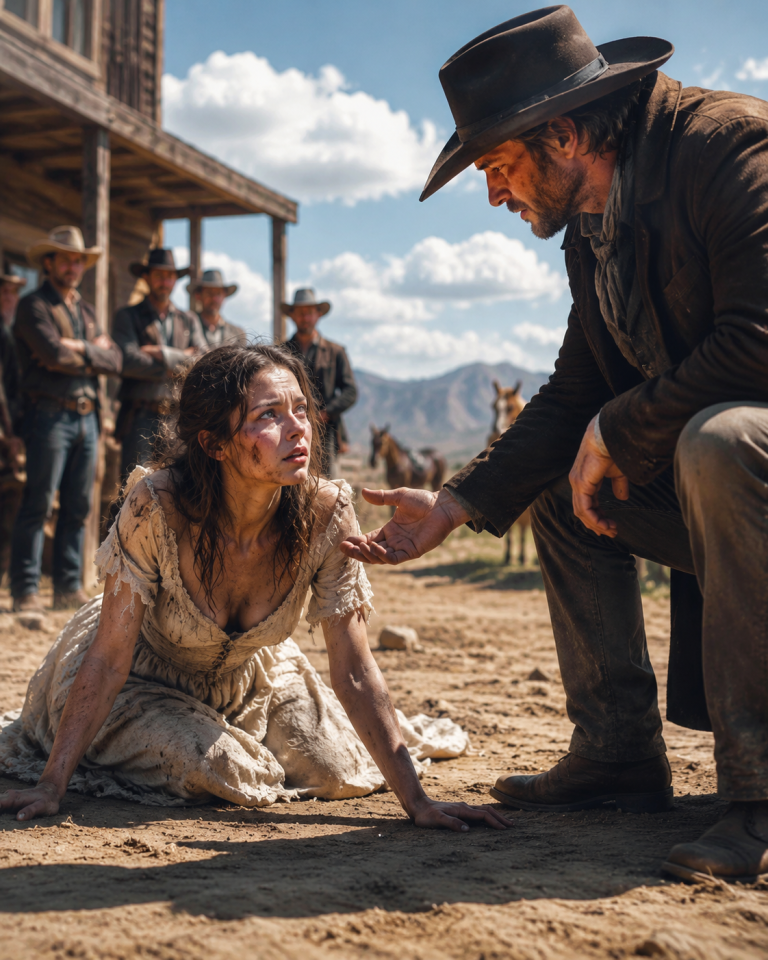
“There was an accident at the Ashwood silver claim two years back,” Louisa said. “A rockslide. His leg was crushed, his arm and shoulder burned badly enough that he can’t work the mine anymore, can barely work the ranch some days. He’s shut himself away since. Bitter. Angry. Refuses visitors.”
“What does that have to do with me?”
“He needs someone steady,” Louisa said. “Someone who won’t flinch from what he’s become. In exchange, I’ll pay for your mother’s treatment immediately. Sam will be sent to proper schooling in the valley. Your family will never go hungry again.”
“No.” Iris’s voice cracked down the middle. “You’re selling me.”
“I’m saving you,” her mother wept. “Iris, I’m dying. When I’m gone, what happens to you? To Sam? You needed a way out of this mountain, and he needs someone to bring him back to the world. It isn’t cruelty. It’s the only mercy either of us has left to give.”
It was true. It was a cruel, unbearable, undeniable truth.
“You leave in one week,” Louisa said quietly. “The wedding will be held at Ashwood Ridge. Nathaniel has agreed.”
“And if I refuse?”
Louisa met her eyes without flinching. “Then your mother dies without medicine, your brother grows up in this cabin alone, and the mountain takes whatever’s left of this family by spring.”
That night, Iris lay awake in the loft, staring at rafters gone soft with shadow. Sam climbed up beside her, small and warm and frightened.
“Are you really leaving us?” he whispered.
“I don’t want to,” Iris said. “But I have to. For you. For Ma.”
He clung to her, and she held him back just as tightly, wishing desperately she could feel even a fraction of the strength she was pretending to have.
Seven days later, the wagon returned. Iris held her mother and brother one last time on the cabin steps, and she did not let herself cry until the trees had swallowed the only home she’d ever known behind her.
Hours into the climb, with the peaks rising sharper and colder around them, Louisa studied her from the wagon seat.
“You’re afraid,” she said.
“I’m going to marry a man I’ve never met,” Iris said. “A man who doesn’t want a wife any more than I want a husband.”
“He was a good man once,” Louisa said quietly. “Before the mountain took most of him. Whether it took all of him — that part, I think, is still waiting to be decided.”
When Ashwood Ridge finally came into view against the darkening sky — a great log house set hard against the rock, smoke rising thin from its chimney — Iris’s heart pounded so loud she was certain the horses could hear it.
She did not yet know that the broken man waiting inside would do something, on the very night they married, that neither of them would ever forget.
—
PART 2
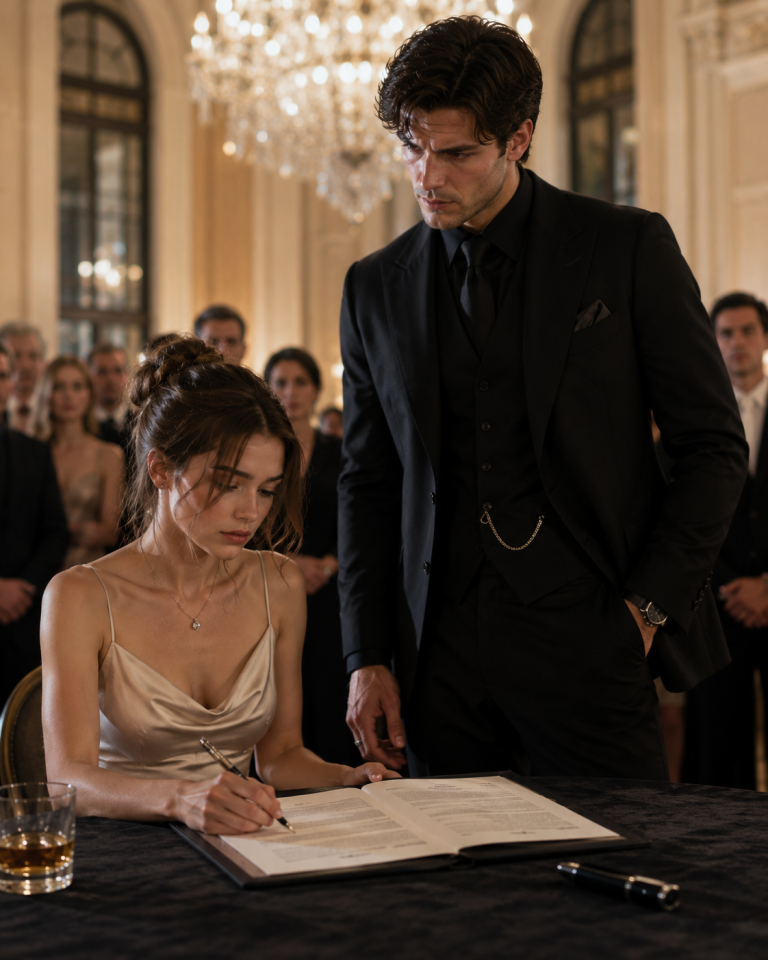
The wedding took place two mornings later, quick and quiet, a circuit preacher and four ranch hands the only witnesses. Nathaniel Kane stood at the altar rail on a cane, weight braced hard against his good leg, his jaw locked tight the entire ceremony. When the preacher said the final words, he did not lean in. He simply nodded once, stiff and distant, and let the moment pass without touching her at all.
It was not a wedding. It felt like the closing of a ledger.
That night, Iris sat alone at the long dining table, the fire burning low, waiting for a husband who did not come down from his study. Hannah, the ranch cook, set a plate in front of her with a sympathetic look that said more than words would have.
“He eats alone most nights,” Hannah said. “Has for two years now. Don’t take it personal, child.”
Iris was halfway through a silent, tasteless supper when the uneven tap of a cane sounded in the hallway, slower than she expected, hesitant in a way that didn’t match the hard, closed-off man from the altar.
Nathaniel appeared in the doorway. He didn’t sit.
“You’re still awake,” he said. Not a question.
“I didn’t know if I was meant to wait for you.”
Something flickered across his face — not quite guilt, not quite apology. He lowered himself into the chair across from her with visible effort, setting the cane against the table’s edge like a thing he resented needing.
“I owe you an explanation,” he said finally. “For the ceremony. For tonight.”
Iris said nothing, waiting.
“I didn’t ask for this marriage,” he said. “My aunt arranged it the way she arranges everything — because she decided it was necessary, and necessary, to Louisa, has never required anyone’s permission.” His gray eyes lifted to hers, and for the first time she saw something underneath the anger — something closer to shame. “But I want you to hear this plainly, tonight, before either of us pretends otherwise for a single day longer: I will not touch you as a husband touches a wife until you choose it. Not out of duty. Not out of the arrangement. Only if you choose it, freely, and only when you do.”
Iris stared at him, caught entirely off guard by the steadiness of it.
“Why tell me this now?”
“Because my aunt sold you a husband,” Nathaniel said, “and I intend, God help me, to be something better than the thing she paid for. You’ll have your own room, a lock on the inside of the door, and my word — which is the only currency I have left worth spending — that no one in this house will ever make you feel owned again.”
Something in Iris’s chest, wound tight since the wagon first rolled into her mother’s yard, loosened just slightly for the first time in a week.
“And if I never choose it?” she asked quietly. “What happens then?”
“Then we build whatever kind of marriage two honest strangers can build without it,” Nathaniel said. “A roof. A truce. Maybe, in time, something like friendship. I won’t pretend that’s a small thing, Iris. I’ve had two years of nothing at all. A truce would be more than I’ve had since the mountain came down on me.”
He pushed back from the table then, reaching for his cane, and paused at the doorway without turning around.
“For what it’s worth,” he said, “I am sorry my aunt turned your desperation into a transaction. You didn’t deserve to be anyone’s arrangement.”
He left her sitting there in the firelight, the words settling over her strange and unfamiliar, like warmth from a stove she hadn’t yet trusted enough to stand near.
It would be weeks before she understood that the man who’d made that promise on their wedding night had also, quietly, begun keeping a far more dangerous one — a promise to himself that he would not let her leave this marriage unchanged, whatever it cost him to become someone worth staying for.
PART 3
The days that followed settled into a careful, uneasy rhythm, the kind two strangers build when neither one trusts the ground yet but both have run out of anywhere else to stand.
Iris rose early out of habit, long before the ranch hands stirred, and found herself drawn to the kitchen where Hannah kneaded dough with flour to her elbows and an easy, unbothered warmth that made the enormous log house feel briefly smaller and kinder than it looked from the outside.
“He’s not cruel,” Hannah told her, on the third morning, without being asked. “Just drowning. Been drowning two years now. Man used to move through these mountains like he was born half-goat, tracking silver veins nobody else could find, climbing ridges that’d break a younger man’s neck. Then the slide took his leg and half his arm’s use, and it took something else besides, something none of us have found the word for yet.”
“What happened?” Iris asked. “Truly. Not the version people say at church.”
Hannah’s hands stilled on the dough. “The Ashwood claim collapsed on three men. Nathaniel got two of them out alive before the second slide came down and buried him under it. Took the crew four hours to dig him free. Doctor said he shouldn’t have lived, the way that leg was crushed, the way the rock had opened his shoulder near to the bone.” She shook her head slowly. “He lived. But I think some nights he still argues with himself about whether that was mercy or just the mountain being slow about finishing the job.”
Iris carried that with her all morning, turning it over like a stone worn smooth by a creek.
She saw him properly for the first time at midday, moving across the yard toward the barn, cane striking uneven rhythm against packed snow, his burned arm held slightly stiff against his side in a way he’d clearly learned to hide well enough that a stranger might miss it entirely. She didn’t miss it. She had spent two years watching her mother hide pain behind small, careful movements, and she recognized the same practiced concealment now in a man twice her mother’s size.
“You’re staring,” Nathaniel said, without turning around.
“I wasn’t trying to.”
He stopped, faced her fully for the first time since the wedding night. “Most people stare at the leg first. You were looking at the shoulder.”
“The leg’s obvious,” Iris said. “The shoulder, you’ve clearly practiced hiding.”
Something almost like surprise crossed his face. “Nobody’s noticed that before.”
“Nobody’s watched their mother do the same thing for two winters,” Iris said quietly.
He studied her a long moment, gray eyes unreadable, and then, unexpectedly, the corner of his mouth moved — not quite a smile, but its distant cousin.
“You’re more observant than my aunt gave you credit for,” he said.
“Your aunt didn’t ask what I was,” Iris said. “Only what I could be used for.”
The words came out sharper than she’d intended, and she braced for anger. Instead, Nathaniel’s jaw tightened — not at her, she realized, but at the truth of it.
“That’s a fair thing to be furious about,” he said. “I won’t defend her for it.”
—
They began sharing supper within the week, an arrangement neither of them named aloud but both, somehow, simply arrived at — Iris waiting until his uneven step sounded in the hallway before sitting, Nathaniel appearing more nights than not, plate settling across from hers with the same careful effort he brought to every motion his body no longer performed easily.
Conversation came slow, in small, deliberate portions, the way you’d feed something that had gone a long time without trusting food.
“How is your mother?” he asked, the fourth night, catching her by surprise.
“Better,” Iris said. “The medicine your aunt sent reached her before the fever turned. I got word through the mail rider yesterday.”
Nathaniel nodded, eyes on his plate. “I’m glad.”
The fifth night, he asked about her brother. The sixth, he mentioned, almost offhand, that the weather would turn hard by week’s end, the kind of small, unnecessary information a man offers when he’s trying, clumsily, to fill a silence with something other than distance.
It was nearly three weeks in when Iris found him on the porch after dark, staring out at the black shape of the mountains against a sky gone thick with stars, and something in the set of his shoulders looked less like a man resting and more like a man grieving.
“You miss it,” she said, settling beside him without asking permission. “Being up there.”
“Every day,” he said, so quietly she almost missed it. “Every single day.”
“Will you tell me what it was like?” she asked. “Before.”
He was silent long enough that she thought he wouldn’t answer at all. Then, slowly, haltingly, he began — tracking elk through fresh snow at dawn, reading weather in the shape of clouds over the western ridge, the particular silence of standing on a peak before sunrise with the whole valley still asleep below. His voice changed as he spoke, filling with a life she hadn’t yet heard from him, grief and pride tangled together so tightly she couldn’t tell where one ended and the other began.
Iris listened, and somewhere in the telling, she understood she wasn’t sitting beside a broken man at all. She was sitting beside someone the mountain had buried alive, still breathing under all that rock, waiting for someone patient enough to start digging.
—
The turning point came on a gray morning in late January, when Iris found him standing at the paddock fence, watching the horses with an expression so raw and hungry it startled her.
“You could ride,” she said. “I’ve seen you in the barn, working the tack one-handed better than most men manage with two.”
“Riding and working tack in a barn aren’t the same thing, Iris.” His voice went hard, defensive in a way she recognized now as fear wearing anger’s coat. “I can barely cross this yard some mornings.”
“Then we go slow,” she said. “Not far. Just far enough to remember what the mountains feel like instead of just missing them from a porch.”
“And if I can’t manage it?”
“Then we turn back,” she said simply. “There’s no shame in trying and stopping. There’s only shame in never letting yourself try at all.”
He stood there a long moment, jaw working, pride and longing warring plainly across his face. Then, slowly, he nodded.
They saddled the horses together the next clear morning, one of the ranch hands helping him mount using a low wooden block built specially for the purpose — something, Iris realized with a quiet ache, that had clearly sat unused in the barn for longer than she wanted to think about.
The first stretch was tense, Nathaniel’s grip too tight on the reins, his shoulders locked. But as the horses moved beneath the tree line and the cold mountain air hit their faces, something in him began, visibly, to loosen.
“There,” he said suddenly, pointing with his good arm. “Fresh fox tracks. See how they cut sideways there, then double back? Something spooked it.”
He kept talking as they rode, pointing out the bend of branches under old snow, the particular blue shadow that meant ice beneath the surface crust, a hundred small signs Iris had never learned to read in her life on this mountain. His voice gained strength with every mile, until, cresting a low ridge overlooking the whole white valley, he pulled his horse to a stop and simply breathed.
“This is where I used to come,” he said, voice thick, “when everything else felt like too much.”
Iris watched him quietly, this man who had spent two years convincing himself the mountain had taken everything worth keeping, sitting here now with color in his face and something close to wonder in his eyes.
“Thank you,” he said finally. “You have no idea what this means.”
“We can come again,” Iris said. “Whenever you want.”
They rode back slower, in a silence that felt, for the first time since the wagon had carried her up this trail, like peace instead of dread.
—
Spring crept in reluctant and gray at first, then all at once, grass pushing green through thawed ground, the creek behind the house running loud with meltwater. Iris’s mother and Sam came to visit in early April, Margaret still thin but steady on her feet, color returned to her cheeks in a way Iris hadn’t seen in over a year.
Nathaniel welcomed them with a warmth that surprised even Hannah, walking Sam around the ranch despite the effort it clearly cost him, answering the boy’s endless questions about mine shafts and mountain lions and how a man learned to read snow like a book.
That evening, Iris sat with her mother on the porch, watching Nathaniel and Sam near the barn, the boy laughing at something Nathaniel had said.
“Are you happy here?” Margaret asked quietly. “Truly, Iris. Not the answer you think I need to hear.”
Iris looked out at the ranch, at the mountains holding the last gold light of evening, at the man who had promised her a truce and somehow, without either of them quite noticing the moment it happened, given her something closer to a home.
“Yes,” she said. “I am. Truly.”
Margaret’s eyes filled, and Iris took her mother’s hand, forgiveness settling between them the way it does when it finally has room enough to breathe.
—
It was nearly a year to the day since the wagon had first rolled into her mother’s yard when Nathaniel found her by the creek, the water running high and bright with the last of the snowmelt, and sat down beside her without his cane, leaning instead on a smooth boulder worn flat by decades of current.
“I never asked you properly,” he said. “That first night, I only ever promised you a truce. I think it’s past time I asked for something more honest than that.”
Iris’s heart went still and loud all at once.
“I know how this began,” Nathaniel said. “I know my aunt turned your desperation into a bargain, and mine into an excuse to stop hiding. But if I could go back now, knowing everything I know, and choose freely, without any of it — the debt, the arrangement, any of it — I would still choose you, Iris. Every single time.”
A tear slipped free before she could stop it.
“I think,” she said, voice unsteady, “I would choose you too.”
He reached for her hand then, slow and careful, the same way he’d reached for it a hundred small times over the past year, and this time she laced her fingers through his without hesitation.
Their first real kiss was quiet, unhurried, tasting faintly of creek water and mountain air, and it changed something between them so completely that neither of them tried, afterward, to pretend they were still simply honoring a truce.
—
Years gathered gently after that, the way seasons do when you stop counting them against loss and start counting them toward something instead. Nathaniel returned to the mountain trails in slow, careful stages, never quite the man he’d been before the slide, but no longer the man the slide had tried to convince him he’d become. He taught Sam to track elk the way his own father had taught him. He rebuilt, one season at a time, a version of himself the mountain had never actually managed to bury.
One summer afternoon, riding the same ridge where he’d first felt the mountains again, Iris leaned against his shoulder, the horses standing quiet beneath them.
“Do you ever regret how we started?” she asked.
“No,” he said, without hesitation. “Because it brought me you.”
She smiled against his good shoulder. “And you gave me back everything I thought that mountain had already taken from me. Family. Safety. A place that finally felt like it wanted me in it.”
They sat together as the light went gold over the valley, two people who had once been bound only by desperation and debt, now bound instead by a choice they kept making, quietly, every single day.
No one in three valleys had expected the broken mountain man to love so fiercely once someone finally reached him. No one had expected the girl sold into marriage to find, at the end of that terrible bargain, the truest home she’d ever known.
But it happened anyway — because sometimes the life you never wanted turns out, against every fear you carried into it, to be exactly the one you were meant to build.
THE END