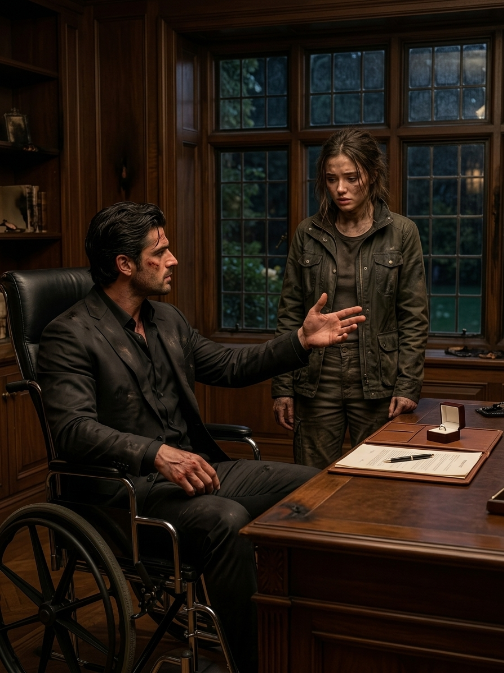
HE BROUGHT ANOTHER WOMAN TO THE MAFIA GALA — EVERY DON IN THE ROOM REFUSED TO SIT UNTIL HIS WIFE WALKED IN

**PART 1**
The moment Julian Ashcroft walked into Belmont Hall with another woman on his arm, the entire room stopped breathing.
Not because the woman was beautiful, though she was. Selena Vaughn knew how to enter a room like she’d been born under a spotlight. Her silver dress caught the chandelier light with every step. Her hair fell over one shoulder in perfect waves. The diamond bracelet on her wrist glittered brightly enough to make wives look twice and mistresses look away.
But beauty wasn’t why forty-three of the most dangerous people in America went silent.
They went silent because Julian had come to the annual council gala without his wife.
Not just any wife. He had come without Margot Ashcroft.
At the top of the marble staircase, Julian paused as if he expected applause. Below him, the ballroom of Belmont Hall spread out in gold and ivory, a historic Manhattan building owned through three shell companies and rented only to people with enough power to never ask who’d signed the lease. Waiters in white jackets moved between tables. Champagne had been poured. The long table at the center waited for the heads of seven families.
But no one sat. No one lifted a glass. No one smiled.
Julian mistook the silence for awe. That had always been his greatest flaw.
He was thirty-nine, handsome in the hard, polished way of men who’d never been told no often enough. His father had built the Ashcroft organization from the waterfront up, moving from trucking contracts to private security to the kind of influence that made mayors answer private calls at midnight. Julian had inherited not just money, but fear. He’d confused the two so completely he thought every quiet room belonged to him.
Selena’s fingers tightened on his sleeve. “Jules,” she whispered, smile fixed, “why is everyone staring?”
“Because they’re old. And I just reminded them the future is here.”
He guided her down the stairs. A lesser woman would have hesitated. Selena did not — she’d worked too hard to reach this moment. For eighteen months she’d listened to Julian complain about Margot. Margot was too quiet. Too cold. Cared too much about old loyalties and private phone calls and rituals Julian found suffocating. Margot knew how to stand beside him at galas, but not how to make him feel like a king.
Selena had made him feel like one.
So tonight, Julian had made a statement. He’d told Margot not to come — actually, worse than that, he’d sent the message through his assistant. *Mrs. Ashcroft will not be needed at tonight’s event.*
Then he’d brought Selena.
At the foot of the staircase, the first man to approach him wasn’t one of his own people. It was Enzo Bellini, a broad-shouldered don from New Jersey with a face like weathered stone and eyes that had watched men lie for forty years.
“Julian.”
“Enzo. Good to see you.”
Bellini’s gaze flicked once toward Selena. It didn’t linger. That was somehow more insulting than if he’d stared. “Where is Margot?”
Julian’s smile held. “At home.”
Bellini waited.
“I’ve made some changes in how the Ashcroft family will be represented,” Julian added.
Selena lifted her chin slightly. Bellini looked at Julian a long moment. “I see.” He turned and walked away.
Julian’s jaw tightened. “That was rude,” Selena whispered.
“That was Enzo being dramatic.”
But then Rafael Alvarez asked the same question. Then Patrick Doyle. Then a quiet woman from Chicago named Ruth Sinclair, who hadn’t spoken more than six words to Julian in three years, looked up from her untouched wine and said, “Mrs. Ashcroft is not attending?”
“Correct,” Julian said, more sharply than he meant to.
Ruth closed her folder. “Then I’ll wait.”
“For what?”
“For her.”
The word spread without anyone raising their voice. *Wait.* The orchestra played softly from the balcony. Waiters kept moving because no one had told them to stop. But every principal table remained empty, seven chairs pulled out at perfect angles, white napkins folded like birds on the plates.
At 8:52 the gala was supposed to begin. At 9:17, no one had sat down.
Julian found the event coordinator near the service doors, pale and sweating. “What’s the delay?”
Martin Voss looked like he wanted to crawl into a flower arrangement and die there. “The principals are waiting, Mr. Ashcroft.”
“Waiting for what?”
“For Mrs. Ashcroft.”
Julian stared at him. “That’s absurd.”
“I’m only telling you what they said.”
He walked away before he did something embarrassing. Across the room Selena stood near the bar, still beautiful, still composed, but the confidence had begun to drain from her posture. She had expected whispers, resentment, maybe a few icy looks. She had not expected a work stoppage.
Julian crossed to the oldest man in the room, Samuel Conti, who’d run his Boston family since before Julian was born. Conti stood by a window with a glass of water, watching taxis crawl through traffic below.
“Samuel. We need to start.”
“Yes. We do.”
“Then why is everyone standing around?”
Conti turned — small, silver-haired, almost gentle in the way a locked door can seem gentle until you try to force it open. “Where is Margot?”
Julian exhaled through his nose. “I have answered that question five times tonight.”
“Then answer it once more for me.”
“She is not coming.”
“Did she choose not to come?”
“That’s none of your concern.”
“Tonight, it is.”
Julian stepped closer. “This is my gala. My family called this council.”
“Yes,” Conti said calmly. “Your family called it. Margot made it possible.”
The words landed wrong. Julian felt them but didn’t understand them yet.
“Margot is my wife,” he said. “She is not a principal.”
“No. She is something rarer.”
Julian almost laughed. “You cannot be serious.”
“I have been serious since 1978. It has served me well.” Behind him, men who’d once ordered cities into silence stood waiting. Julian looked across the room at the empty chairs, the untouched plates, the stillness that refused to break around him.
“You’re telling me nobody will sit down until my wife arrives?”
“I am telling you nobody will sign a single page in this building without Margot Ashcroft in the room.”
For the first time that night, Julian felt a thin blade of fear slide between his ribs. He covered it with anger. “She has no authority over these agreements.”
Conti’s face didn’t change. “That is what makes this evening so painful to watch, son. You truly believe that.”
The next half hour humiliated Julian in slow motion. Bellini refused to sit. Alvarez refused to sit. The Chicago delegation refused to open their folders. Even families who owed the Ashcrofts money, protection, favors, and silence chose to stand in polite, immovable patience.
Julian finally cornered Bellini near the bar. “Tell me what she did.”
Bellini raised an eyebrow.
“My wife,” Julian snapped. “Tell me what all of you think she did that makes her so necessary.”
Bellini looked at his glass of water like the answer might be floating in it. “Eight years ago, my people and Alvarez’s people were three days from war. Trucks had been burned. Two men had disappeared. Everyone knew what was coming. Your father was sick by then. You were busy proving you weren’t afraid of anyone.”
Julian said nothing.
“Margot called me. Not as your wife. Not as Ashcroft property. She called as Margot. She knew the numbers, the insult on both sides, where pride ended and business began. She arranged a meeting in a church basement in Newark. By sunrise, nobody was going to war.”
Julian stared at him. “She never told me.”
Bellini’s expression sharpened. “Did you ask?”
**PART 2**
Julian opened his mouth. Closed it.
“She did that again the following year with the Irish and the Albanians,” Bellini went on. “Then Chicago and Baltimore. Then a shipping dispute you signed off on without knowing three families had nearly walked away until she rewrote the terms in language everybody could swallow.”
“She managed conversations,” Julian said, hating how small it sounded.
“She maintained trust. You inherited fear. Your wife built confidence. Those are not the same currency.”
Julian looked toward Selena, standing alone now, hand around an untouched glass. Her eyes met his, and for the first time since he’d known her, she looked less like a prize and more like a witness.
“You need to call her,” she said when he returned.
“No.”
“Julian.”
“I said no.” Then, quieter: “I didn’t know.”
“Know what?”
“What she was.”
“Neither did I,” he admitted, and the honesty surprised them both.
At 9:46, the front doors opened. No announcement first. Four black SUVs pulled up outside, and the men at the entrance stepped aside like some instinct older than loyalty had told them to move.
Margot Ashcroft walked in.
She wasn’t dressed for a gala — charcoal suit, low heels, cream blouse, dark blond hair pulled back, pearl earrings, no necklace, no glitter, no performance. And still the entire room turned toward her.
Julian had spent eleven years looking at that same restraint and calling it plainness. Calm, he’d called boring. Discretion, weakness. Intelligence, a talent for household management.
Now he watched Enzo Bellini cross the room to her like a man approaching a judge. Then Conti. Then Sinclair. Then Alvarez. One by one, the powerful people in the room moved toward the woman Julian had left at home.
Margot listened more than she spoke, asked one question, then another, her eyes reading alliances and temperature and danger. When her gaze reached Julian, she held it two seconds. No heartbreak in her face. That was worse — heartbreak would have meant something was still breaking.
She looked at Selena once, not cruelly, only with the brief assessment one gives an object placed in the wrong room, then turned away.
Julian stepped forward, but before he could speak, Ruth Sinclair approached Margot and said something too quiet to hear. Margot’s face changed — barely, but Bellini saw it, Conti saw it, Sinclair saw it. And now Julian saw it too.
Something was wrong. Something much bigger than his marriage.
Margot turned to Bellini. “Who else received the revised packet?”
**PART 3**
Bellini’s face hardened. “Revised?”
“What packet?” Julian asked.
Margot didn’t look at him. “The one someone wanted signed tonight.”
Within minutes the gala stopped being a humiliation and became an emergency. Margot moved the principals into a private room behind the ballroom. Julian followed, though no one invited him — a small fact that struck him harder than expected. All his life, rooms had opened because his last name was Ashcroft. Tonight, doors still opened, but the room beyond no longer rearranged itself around him. It rearranged itself around Margot.
Ruth Sinclair placed a folder on the table. “The courier was intercepted an hour ago. My people recovered copies from Baltimore. These are not the terms we negotiated.”
Margot opened the folder and read with the calm precision of a surgeon counting instruments before cutting into a body. “These clauses were altered. The tonnage split. The port access windows. The penalty language.”
“Altered how?” Alvarez leaned forward.
“Carefully. Not enough to alarm anyone tonight. Enough to create a breach within thirty days.”
Bellini swore under his breath. Conti looked at Julian. “Who handled the final documents?”
Julian’s answer came too late. “My office.”
Margot looked at him then — not angrily, just directly. “Your office has been compromised.”
The sentence emptied the room. “No,” Julian said.
“Yes.”
A man from Baltimore, Calvin Ford, slid a second envelope across the table, looking sick. “A representative came to me. Said he was acting under Ashcroft authorization. Told me the packet was final and substantially unchanged.”
“What representative?” Julian demanded.
Ford opened the envelope and removed a letter. “Yours.” Julian snatched it. His own signature stared back — not a rough imitation, every line and pressure mark and sharp angle of the *A* looking like his own hand had made it.
“I didn’t sign this.”
“I know,” Margot said, and the two quiet words frightened him more than if she’d shouted.
“You know?”
“I suspected a false channel. I did not know they had moved to full signature forgery.”
“They?”
But already his mind assembled the awful shape of the answer. His assistant, Marcus Dale, had access to his calendar, correspondence, draft agreements, signature plates, courier routes, guest lists, private domestic schedules. Marcus had been with the organization eight years — so familiar that Julian no longer thought of him as a person with choices. Furniture. Infrastructure. And like most men, Julian had never inspected the foundation until the building started falling.
Margot watched his face. “Don’t.”
“Don’t what?”
“Do not look at me because you need the problem to become a shape your pride can survive.”
“I’m looking at facts.”
“No. You’re looking at the woman you ignored for eleven years and wondering how she knew more than you. That is not suspicion. That is panic wearing a suit.”
No one laughed. No one rescued him. Margot turned back to the table. “Someone intended these documents to be signed tonight. If they were, three families would accuse two others of bad faith within a month. Retaliation would follow. The alliance would fracture.”
“Who benefits?” Bellini asked.
“Someone outside the table.”
Sinclair’s expression sharpened. “Harlan Vance.”
The name made several people shift. Julian knew Vance as a Midwestern financier with dirty money, clean lawyers, and ambitions bigger than his territory — fifteen years hovering at the edges of the national underworld, rich enough to be useful, never trusted enough to be included.
“He was never invited,” Julian said.
“That is his grievance,” Margot replied. “And his motive.”
“How long have you known?”
“About Vance? Four years.”
“And Dale?”
“Five months.”
“You knew my assistant was compromised for five months and left him in my office?”
“I controlled what he saw.”
“He had access to everything.”
“No,” Margot said, something edged into her voice now, pressure beneath it rather than anger. “He had access to what I allowed him to believe was everything.”
“You should have told me.”
“I tried. Eighteen months ago. I came into your study during a meeting and told you there was an external pressure campaign forming around the council structure.”
Julian remembered — not clearly at first, then with nauseating detail. Margot entering quietly with a file, Marcus in the room, Julian irritated before she’d finished her first sentence, telling her in front of three men that external assessments weren’t her concern, to let the professionals handle professional matters. He’d seen Marcus hide a smile.
Julian closed his eyes briefly. Margot saw that too. “I continued without your approval,” she said. “As I have done many times.”
Ford unfolded another paper with trembling fingers. “There’s more.” Margot took it. This time even she went still.
“What is it?” Conti asked.
“A schedule.” Names in code, addresses around Belmont Hall, times beginning at 10:15.
Bellini stood. “Those aren’t delivery windows.”
“No. They’re positions.”
The room hardened. “Men outside?” Julian asked, understanding half a second behind the others.
“At minimum. But this is not just surveillance. If the document plan failed, Vance had a second option.”
“Violence,” Conti said, low.
“Not violence,” Margot said, folding the paper. “Removal.”
“Removal of who?”
“Everyone important enough to matter.”
No one moved. The distant music continued two absurd measures before stopping.
Margot began issuing instructions — not suggestions, instructions. Bellini’s people secured the service corridors. Sinclair’s team checked the east exit. Conti made two calls and shut down every vehicle route on the surrounding blocks through people who owed him favors in city departments. Alvarez sent men to the roof.
Julian watched his wife coordinate the survival of forty-three people while wearing the suit she’d likely put on after receiving an insult through his assistant.
At 10:03, one of Sinclair’s analysts confirmed the first device in a service corridor. Margot didn’t flinch. “At least three more. Maybe five.”
“How do you know?”
“Because Vance is arrogant, not sloppy. One device is a message. Multiple devices are an outcome.”
She turned to him. “I need the room cleared.”
“Then clear it.”
“They will debate if I give the order. They will obey if you do.” It was the first time all night she had needed him — not as a husband, not as a leader, as a name. That distinction humbled him more than any insult could have.
Julian walked back into the ballroom, climbed the small stage, gripped the podium. “We have a security threat in the building. Principals and immediate staff move through the east corridor now. Do not collect coats. Do not argue. Move.”
For one beat, nothing happened. Then Conti stood. “Go.”
The room moved — not in panic, these were not people who panicked easily. Chairs scraped. Men with guns under tailored jackets guided older men, younger wives, lawyers, accountants through the east corridor with controlled urgency.
Selena remained near the bar. Julian found her as the room emptied. “You need to leave with Alvarez’s people.”
“Is this because of me?”
“No.” But that wasn’t entirely true, and they both knew it. She hadn’t planted the documents, hadn’t forged the letter, hadn’t built the trap. But she’d been useful to it. Julian had made her useful.
“I thought this was just about us,” she said quietly.
Julian looked toward the private room where Margot was still working. “So did I.”
“I’m sorry,” Selena said, and for the first time he believed she meant it.
“Go.” She did.
At 10:11, Margot’s people disabled the first device. At 10:13, a second. At 10:14, Sinclair found the third. At 10:16, the threat window passed, but Margot didn’t relax.
“Where is Dale?”
No one answered. Julian’s chest tightened. “He left my office at seven. He was supposed to deliver the signed ceremonial copies.”
Margot’s gaze sharpened. “What ceremonial copies?”
Julian realized his mistake as the words left his mouth. Those copies hadn’t been part of the official courier route. Only four people knew about them: Julian, Margot — because she knew everything — Marcus Dale, and Selena.
Julian turned toward the corridor Selena had disappeared through. Margot moved before he did.
They found her in the east stairwell, not outside, pressed against the wall, hands shaking, staring at a phone that wasn’t hers.
“I didn’t know,” she said the second she saw Julian, tears cutting through her makeup. “I swear to God, I didn’t know what he was doing.”
Margot took the phone. On the screen: *Tell Ashcroft’s girl to stay put. Dale is coming to collect the last file.*
Julian’s voice went deadly quiet. “Who gave you this phone?”
Selena looked at Margot, not him. “Marcus. Weeks ago. He said Julian’s world had rules — said if anyone ever contacted me through it, I should listen. I thought he meant reporters. Security. I thought—” She broke off, horrified at her own foolishness. “I thought it made me important.”
Margot’s face softened by one degree. “That is how men like Vance recruit people who don’t think they’re being recruited.”
Julian looked at Selena, whatever romance had existed between them burned away, leaving only consequence. “Did you tell Dale I wasn’t bringing Margot tonight?”
Selena covered her mouth. “I told him you were nervous. That you were finally ready to put me beside you. I thought he was helping.”
Julian stepped back like he’d been struck. Margot handed the phone to Sinclair’s analyst. “Trace the last signal.”
“West reception room. Second floor.”
Margot turned and walked. This time she didn’t tell him to stay back.
The west reception room was used for storage during galas, but tonight someone had cleared the center and arranged three floor lamps like a theater set. Harlan Vance stood in the light — older than Julian expected, broad, silver-haired, dressed in navy that cost more than most people’s cars. Two armed men behind him. He didn’t look trapped. He looked inconvenienced.
“Margot,” he said.
Julian hated the familiarity in his voice.
“Harlan.”
“You were faster than I planned.”
“You gave me too much time.”
“Apparently.” His gaze slid to Julian. “And you brought your husband. That surprises me.”
“The feeling is mutual,” Julian said.
Vance chuckled. “Still proud. Even now. Fascinating.” Then, to Julian directly, smile sharpening: “Do you understand what your wife is? Truly? I’ve watched her prevent wars with phone calls. Watched her turn enemies into reluctant partners. Watched men twice your age change their plans because she asked the right question at the right time. And you brought a girlfriend to replace her like she was a chair at dinner.”
The words should have made Julian angry. Instead he felt them settle into the place where truth had been collecting all night.
“I know,” he said.
Vance blinked. He’d expected denial — the ego, the explosion, the predictable pride of an Ashcroft man defending the fantasy of his own greatness. Julian gave him none of it.
“You used Dale to access documents,” Margot said, steady. “You used Selena to confirm my absence. You altered the council terms to provoke a fracture. When that failed, you activated men around the building.”
“You make it sound crude.”
“It was crude.”
His face changed, just slightly, but enough. “You spent a decade being invisible,” Vance said. “I would have made you visible.”
“You wanted to own what you could not defeat.”
“I wanted to pay you what you’re worth.”
“No. You wanted to decide my worth. Men like you always confuse those things.”
His guards shifted. The door opened behind Julian — Enzo Bellini, with eight men. Vance’s expression finally cracked.
Margot didn’t look away from him. “I told you I would come in. I did not tell you I would come in alone.”
One of Vance’s men lowered his weapon first. Then the other. Vance looked at her with something close to admiration and much closer to hatred.
“You needed me here,” he said.
“Yes. In person. With your network deployed. With your channels exposed. With your contingency activated and failed. Not wounded, Harlan. Ended.”
For the first time that night, Julian saw exhaustion touch her face. Not weakness. Cost.
Vance straightened his jacket as Bellini’s men moved in. Before they took him, he looked once more at Julian. “Everything you kept tonight, she saved.”
Julian held his gaze. “Yes. She did.”
Vance was led out. For one quiet second, the room held nothing but lamp light and aftermath.
Then three gunshots cracked from below.
Margot ran. Julian ran after her. The ballroom, when they burst in, wasn’t chaos — it was worse. Controlled violence already finished. Marcus Dale stood near the center of the marble floor, a gun hanging from his hand, face gray with shock. A woman from Margot’s security team, Jenna Hale, lay unconscious ten feet away, blood at her temple.
Margot slowed. “Marcus.”
Dale looked at her like a drowning man seeing shore and knowing he’d already drifted too far. “I was supposed to be gone. Nobody was supposed to be here.”
Julian stepped forward, rage rising so fast he nearly choked. Margot lifted one hand without looking at him. He stopped.
She walked toward Dale. “Put it down.”
“He had my family. Vance had pictures. Addresses. My sister’s kids. My mother’s building. I didn’t have a choice.”
“You had choices,” Margot said. “Every day for eight years, you had choices. Some were terrible. That does not mean they were not choices.”
Dale began to cry — an ugly, silent crying that made no claim to innocence. “I didn’t know he would try to kill everyone.”
“I believe you.” Julian stared at her. “But you helped him build the door.”
Dale’s hand shook. Margot came close enough now that one wrong movement could end her. Every instinct in Julian’s body screamed to pull her back. But the room had gone still around her — forty people watching the woman Julian had thought needed his protection do what no one else could.
“Put it down, Marcus,” Margot said again. “Not for forgiveness. For the one decent decision you still get to make tonight.”
The gun hit the marble. Bellini’s men moved in. Margot went to Jenna first, knelt, touched two fingers to her neck, closed her eyes for one second at finding a pulse. “Medical.”
The next ninety minutes passed in fragments. Jenna survived with a concussion and stitches. Dale was taken somewhere private, where his cooperation mattered more than revenge. Vance disappeared into a legal and financial reckoning large enough to destroy the empire he’d built on shadows. Every family in the room had proof of his betrayal before dawn.
At 12:08, the principals returned to the long table. The dinner was gone, candles burned low, the flowers too delicate for the room they sat in. Margot stood at the head of the table. Julian stood against the wall — for the first time in his life, not trying to claim a chair no one had offered him.
Margot explained everything, cleanly, without exaggerating her role or humiliating Julian, leaving no place for lies to hide. When she finished, Conti picked up a pen. “The corrected agreements.”
She placed the documents before him. One by one, the dons signed — not because Julian demanded it, not because the Ashcroft name required it, but because Margot had made the truth solid enough to stand on.
At 1:06, the alliance held. By 1:40, Julian found her by the windows overlooking Park Avenue, the city entering the strange quiet hour when even Manhattan lowers its voice.
“I need to say something,” he said.
“Then say it.”
He looked at her reflection in the glass. “I told myself a story about you. That you were quiet because you had nothing to say. Careful because you were afraid. That you stayed beside me because my world was bigger than yours.” His throat tightened. “I was wrong about everything. Not a little. Completely.”
“I know.”
“I brought Selena here to replace you publicly.”
“Yes.”
“I gave Vance the opening he needed.”
“Yes.” He deserved every word.
“I am sorry,” Julian said. “Not because I got embarrassed. Because you spent years holding together a world I thought I owned, and I never asked what it cost you.”
Margot said nothing for a moment, then turned — tired now, human in a way he’d rarely let himself see, not because she’d hidden it but because he’d never looked carefully enough.
“I waited a long time for you to understand that,” she said. “Not because I needed your permission to be real. Because living beside someone who cannot see the truth is exhausting.”
“I know.”
“No. You’re beginning to know.” He accepted that too. An hour earlier he would have argued the correction. That man felt very far away.
She folded her arms. “I’m leaving the marriage.”
He’d known. It still hurt. “Okay.”
Something shifted in her eyes — she’d expected resistance, maybe anger, maybe another performance of ownership dressed as love. He gave her none.
“The diplomatic structure I built will continue,” she said. “Not through the Ashcroft household. The council is creating an independent seat for conflict review and interfamily mediation. I’ll hold it twelve months. After that, I’ll decide what I want.”
“What do you want?” The question surprised her, maybe because he should have asked it years ago.
She looked back toward the emptying ballroom, the men who still turned to her, the women who’d watched her survive one kind of betrayal while preventing another kind of war. “I want a house where no one sends messages through assistants. I want sleep. I want my phone to ring less. I want to know who I am when I’m not solving problems for men who call themselves powerful.”
“You deserve that.”
“I know.” No cruelty in it. Only certainty.
Across the room, Selena waited near the exit with Alvarez’s people. Her eyes met Julian’s once — no future there, only a lesson neither had wanted and both had earned. Later he’d speak to her honestly and end it without blaming her for what wasn’t only hers to carry. Not tonight, though. Tonight belonged to Margot.
Enzo Bellini approached slowly. “Mrs. Ashcroft.” Margot gave him a look. “Margot,” he corrected. She nodded. “The council will need you in the morning.”
“The council can wait until noon.”
He almost smiled. “Noon, then.” He walked away.
Julian stood beside her in silence. For eleven years he had mistaken silence for emptiness. Now he understood it could be discipline. Mercy. Grief. Judgment. Freedom.
Margot gathered her coat from a chair near the window. Julian didn’t offer to help her put it on. That, too, was something he was learning.
At the front doors, the first pale edge of dawn touched the city. Margot’s car waited at the curb. She paused on the sidewalk and looked back at Belmont Hall, the building where Julian had tried to replace her and instead revealed her to everyone.
Then she looked at him — not warmly, not coldly. Clearly.
“I hope you become better than the man who walked in tonight,” she said.
“So do I,” Julian said, voice rough.
She got into the car. It pulled away into the blue-gray morning.
Julian stood alone on the sidewalk long after the taillights vanished. Behind him, Belmont Hall was being cleaned — tables cleared, glasses collected, flowers thrown away. By noon the room would look untouched. Rich people were very skilled at making wreckage disappear.
But Julian knew some wreckage should remain visible. Inside him, something had collapsed. Not his empire. Not his name. Something more dangerous.
His certainty.
For the first time in his adult life, Julian Ashcroft did not know who he was without power arranging the room around him.
So he stood in the cold until the sun rose between the buildings. Then he put his hands in his pockets and started walking.
Not toward forgiveness. Not yet. Maybe not ever.
But toward the long, necessary work of becoming a man who could finally recognize the woman he had lost — not as an extension of himself, not as a title, not as a wife at his table, but as Margot.
And that was the first honest step he had taken all night.