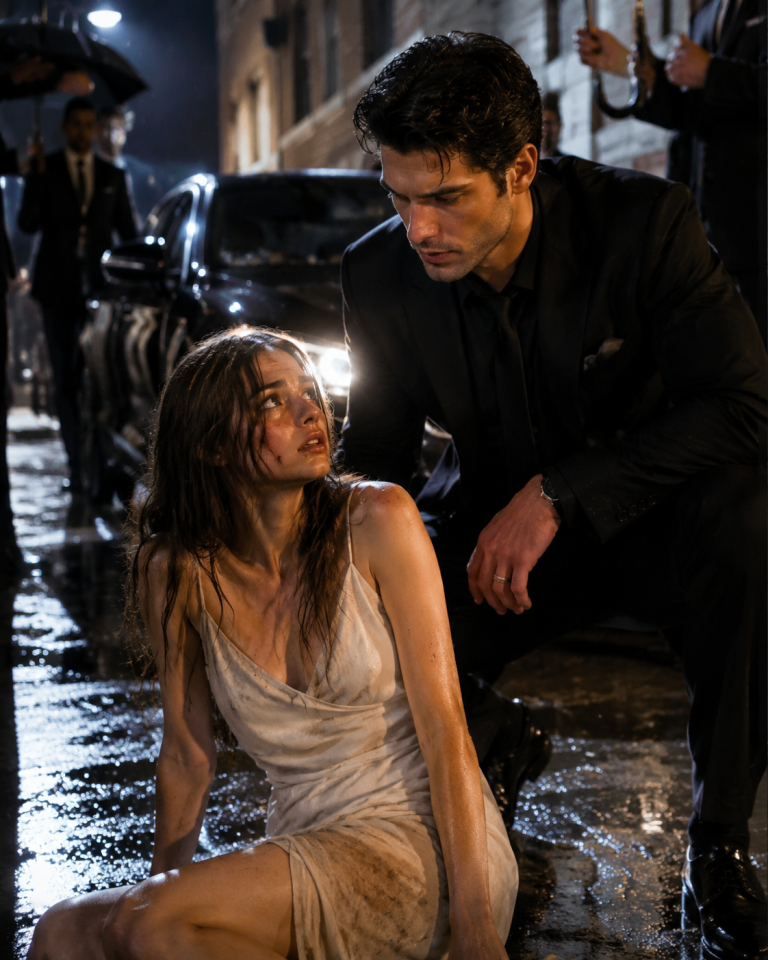
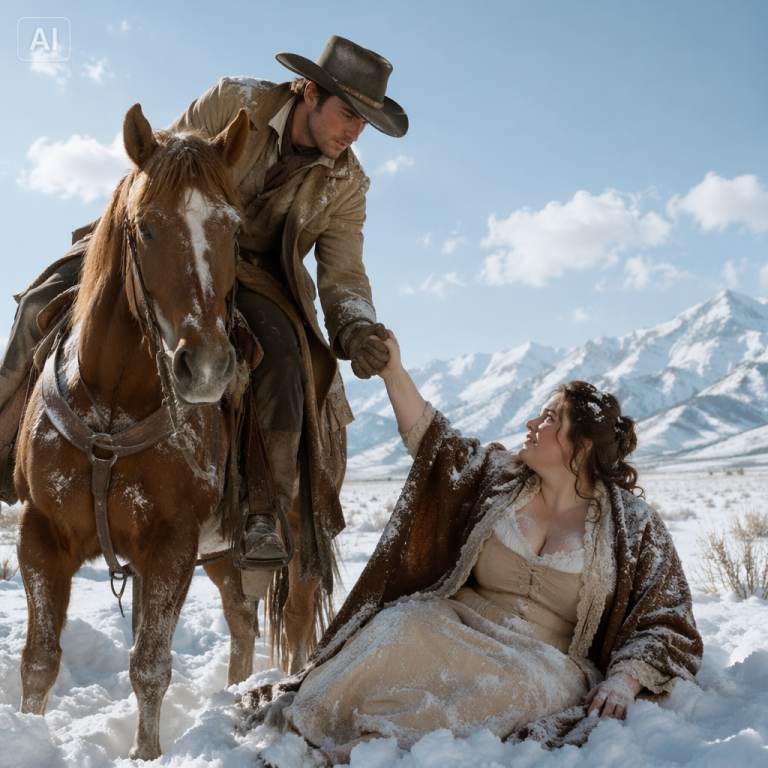
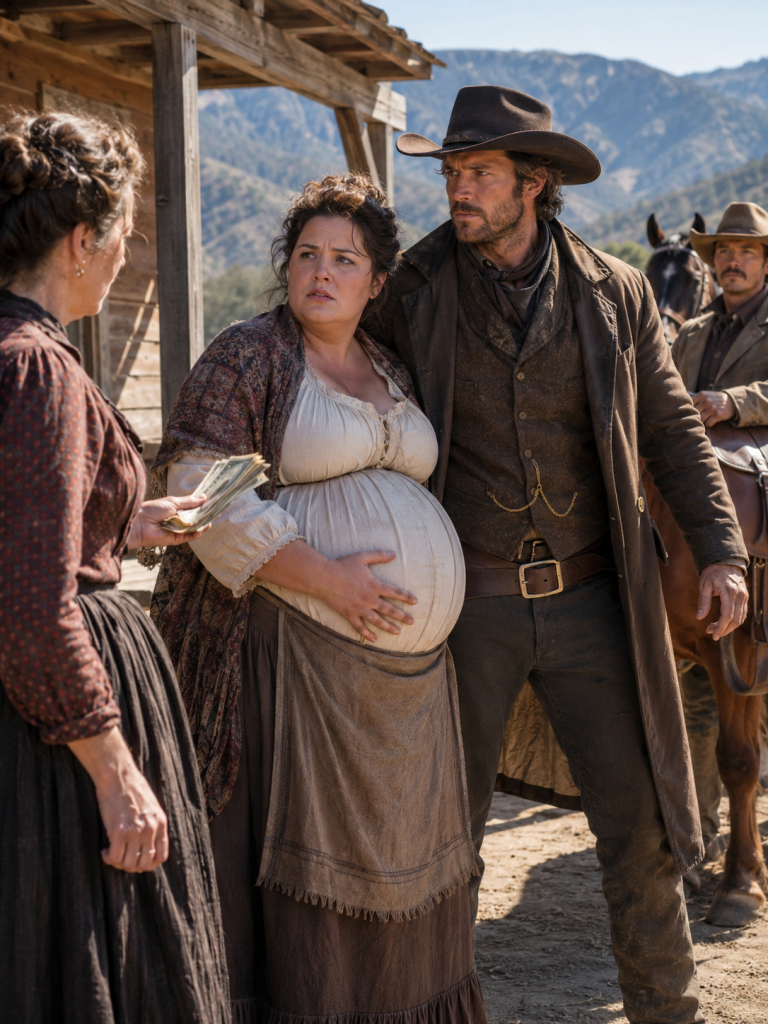
SHE WAS STRUNG UP BY HER ANKLES EVERY AFTERNOON FOR A WEEK UNTIL SHE SIGNED — THEN A STRANGER FROM THE HIGH COUNTRY CUT THE ROPE WITH ONE STROKE

PART 1
By the seventh day, Charlotte Dunmore no longer screamed.
On the first day, she had. She’d cursed Barnabas Kane with every scrap of breath her body could produce, her voice ringing off the weather-beaten storefronts of Redstone Gulch while blood rushed into her skull and the world dissolved into a red, pulsing haze. She’d shouted that he was a murderer, a thief, a liar hiding behind a badge and a ledger. She’d screamed until her throat felt flayed raw, because pain that size demands a witness, and because some stubborn corner of the human spirit still believes that truth spoken loud enough in public will shame somebody into action.
No one came.
By the fourth day, she’d learned better. By the seventh, she conserved every last shred of strength just to stay conscious.
The year was 1874, and Redstone Gulch, deep in the Colorado Territory, was never a place where justice grew naturally. It had been built the way too many frontier towns were — fast, dirty, under the rule of men who understood that where the law ran thin, wealth could pin on a sheriff’s badge and call itself authority. The town sat in a valley ringed by dense pine and jagged mountain shoulders, half mining camp, half timber settlement, the sort of place where mud never fully dried and every building looked thrown up in a hurry by men who expected either fortune or death to claim them before winter came. Even at midday, a dimness seemed to cling to the place, as though the heavy forest crowding its edges kept some portion of God’s own light for itself.
And no man embodied the rot of Redstone Gulch more completely than Barnabas Kane.
He owned the saloon, the bank, and — through a pliable county appointment and enough bribes passed under enough tables — the sheriff’s badge besides. He dressed in tailored Eastern suits that made him look more civilized than the town around him, which was exactly the point. Men like Kane survived by wrapping violence in polish. They turned theft into debt collection, murder into accident, extortion into legal process. They favored signatures and witnesses and the performance of legitimacy, because it made brutality so much harder to fight in the open.
Charlotte had learned that lesson too late.
She was twenty-four, hands toughened by ranch work, storm-gray eyes that had always made people remark she looked too serious for a girl her age. Her father, Nathaniel Dunmore, had built Meadowlark Ranch with his own hands and a handful of hired men over fifteen punishing years. The land sat in the best part of the valley, broad and fertile, threaded through with clean water, and for most of Charlotte’s life that alone had seemed reason enough to make it valuable. Then silver turned up beneath the northern ridge of the property, and overnight what had been a ranch became an empire waiting on someone bold enough to steal it.
Nathaniel Dunmore was found dead at the bottom of a ravine before the month was out.
The town called it a riding accident. Barnabas Kane called it a tragedy. The sheriff’s office wrote it down as misfortune and closed the book on it.
Charlotte knew it for murder. Her father had been the finest horseman in three counties — could’ve ridden blind through sleet and kept his seat the whole way. He hadn’t simply fallen. He’d been taken off that horse and thrown somewhere no man with power intended to look too closely.
Within a week of the burial, before the earth over Nathaniel Dunmore’s grave had even properly settled, Barnabas Kane produced a deed. It claimed Nathaniel had signed Meadowlark Ranch over to cover a gambling debt.
The forgery was so obvious Charlotte nearly laughed the first time she saw it — except nothing about the room where Kane presented it invited laughter. Judge Pemberton nodded over the document like its authority was self-evident. The sheriff allowed the signature looked valid enough to him. Thaddeus Prentice, the storekeeper, studied the floorboards. No one in that room would meet her eyes.
That was when Charlotte learned the most important truth about power in Redstone Gulch. Proof didn’t matter one bit, once the right man had already bought everyone’s agreement.
She did not collapse. Did not beg. She fought.
In the dead of night, running on grief and fury and the certainty that one more day of stillness would see her father’s land vanish under a lie made legal, Charlotte broke into Kane’s office above the saloon, meaning to steal the forged deed and ride to Denver, to put the whole matter in front of a federal marshal or any badge Kane hadn’t already bought outright.
Kane’s men were waiting.
That was the second time in two weeks she learned exactly what planning looked like in the hands of a man like Barnabas Kane. He anticipated resistance not because he understood courage, but because he understood ownership — he believed every living thing in Redstone Gulch belonged either to him or to fear of him.
They caught her before she ever reached the desk. She fought them too — scratched, kicked, bit, drew blood down one man’s cheek with her nails, nearly got her hand around a knife tucked in another’s boot. They beat her for it. Not badly enough to cripple her outright, not in ways that would leave marks Kane couldn’t still put to use in public. Just enough to soften her. Just enough to drag her into the street half-dazed, muddy, and furious.
Kane could have shot her. Could have had her buried in some shallow grave past the northern ridge and told the town she’d fled in shame. Simpler, by far.
But simplicity never satisfied a man like him. He wanted theater. He wanted Redstone Gulch to see exactly what happened to anyone who defied him in the open. More than that, he needed Charlotte alive long enough to sign a confession of theft and a formal transfer of ownership, in front of Judge Pemberton, sealing Meadowlark beyond challenge for good. The land, the silver, the whole valley’s future — all of it made law the instant the right trembling hand touched the right paper.
“Break the spirit,” he told Dutch Hollis, his lead enforcer, “and the hand’ll sign.”
So began the ritual that would scar Redstone Gulch more deeply than any gunfight ever could.
Every afternoon at exactly four o’clock, Dutch Hollis and two other men dragged Charlotte to the dead sycamore at the edge of town. It stood alone, stripped of bark and life long before the town had ever grown up around it — a gray, skeletal thing looming against the mountain light like a warning from God nobody had bothered to translate. They bound her ankles with thick hemp rope, rough and unforgiving, threw the line over a heavy branch, hauled her upside down until she hung four feet above the dirt, and left her there until dusk swallowed the valley whole.
The physical agony went past naming. Within minutes the blood pooled in her skull with such force her eyes throbbed in time with her own heartbeat. The whole town inverted around her — street, storefronts, the faces of everyone watching and doing nothing — all of it dangling above her in a blurred, red-tinted nightmare. The rope cut through her stockings into the flesh beneath, burning first, then grinding deeper with every small involuntary movement. Her lungs fought the unnatural angle, each breath shallower than the last. By the time the sun dropped, mountain cold came rushing in, seizing her sweat-soaked clothes and turning them into a second torment layered over the first.
And every day, Redstone Gulch watched.
Not all of them looked at her directly. Most couldn’t bear it, or told themselves they couldn’t. But their avoidance was its own kind of attendance. Doc Ellery, the town physician, stood in his clinic window with a bottle shaking in one hand and never once stepped outside. Mrs. Callender, who baked bread for half the valley, hurried her children indoors and bolted the door each afternoon at a quarter to four. Men coming off shift at the mine crossed the street rather than pass anywhere near the sycamore. Fear had settled over that town long before Charlotte ever hung there, and Kane had trained every last one of them to wear it like a second skin.
By the fourth day, the evenings turned worst of all. That was when the coyotes came — first at the edge of the brush, feet soft in the dead grass, breath sharp in the cooling dark, then nearer, eyes catching the last light, circling below her, drawn by the blood at her ankles and whatever animal instinct in them recognized weakness suspended and unable to run. Charlotte had to swing her arms wildly, use what voice she had left to keep them off, sending fresh spikes of pain through her battered body with every desperate motion.
On the seventh day, a Friday, something inside her finally began to fray.
Her face was swollen past recognition. Her lips split. The whites of her eyes had gone entirely red. When Dutch Hollis lowered her at sunset, she hit the mud and couldn’t feel her legs at all. He crouched beside her, tobacco on his breath, cruelty as casual as weather.
“Just sign the paper,” he sneered. “Mr. Kane’s patience is about run out. Tomorrow we might just leave you up there till the wolves come down off the ridge.”
Charlotte looked at the mud beneath her cheek and said nothing.
She wasn’t afraid of dying anymore. That fear had come and gone somewhere around the third day. What frightened her now was failing before death came for her — signing what Kane wanted because her body had finally overruled her pride. She was afraid she might survive only to become the instrument of her own ruin.
That night, dumped in a cell behind the jailhouse with barely enough water to keep her alive, Charlotte closed her eyes and prayed for either an end or a miracle.
She didn’t know that both had already ridden into the valley.
Roan Sutter came into Redstone Gulch smelling of pine sap, woodsmoke, and high ridges.
He didn’t belong to towns. He belonged to the severe country above them, where winter came early and mercy mostly meant knowing the land well enough not to die in it. For ten years he’d lived alone in the high country, trapping, hunting, moving through the mountains like something half man, half weather. Six foot three, broad through the shoulders, scarred in ways that told their own stories without needing words, he looked carved from the same hard elements that shaped the land around him. His coat was cured buffalo hide, his trousers fringed buckskin, a jagged pale scar running from his left temple to his jaw — a relic of a grizzly that hadn’t survived its final mistake. He spoke rarely, trusted almost no one, and came down to the settlements twice a year at most, trading pelts for flour, coffee, salt, ammunition, and whatever else a man couldn’t produce on mountain soil alone.
He rode a huge draft-cross gelding named Cinder.
Late that afternoon he tied the horse outside Thaddeus Prentice’s mercantile and hauled a bundle of winter beaver pelts up onto one shoulder. He’d think later that if he’d arrived twenty minutes earlier or twenty minutes later, he might have missed the whole thing entirely.
But he arrived when he arrived.
Just as three men were dragging a woman toward the dead sycamore. Just as the crowd began forming its familiar, distant ring. Just as Charlotte Dunmore was being bound by the ankles and hoisted into the bitter mountain air like a lesson.
Roan stopped dead in the middle of the street and watched.
It struck him not as surprise but as offense — the sheer deliberate unnaturalness of it. He’d seen brutality plenty of times before, lived his whole life in hard country among hard men, understood the frontier’s appetite for cruelty better than most. But this wasn’t killing born of rage or desperate survival. This was ceremony. Humiliation staged and repeated on schedule. Cruelty turned into civic entertainment.
He carried his pelts into the mercantile and dropped them on Prentice’s counter with a heavy thud.
“What’s the going rate on prime winter beaver?” he asked.
Thaddeus, who’d been peering through the dirty glass toward the tree with all the furtive misery of a coward well aware he was one, jumped at the sound. “Two dollars a pelt, Mr. Sutter. Same as last spring.”
Roan tilted his head toward the window. “Who’s the woman?”
Thaddeus went pale, busying his hands with a rag that only pushed the dust from one end of the counter to the other. “You don’t want to involve yourself in that, Roan. That’s Charlotte Dunmore. Crossed Barnabas Kane. Stole from him, so the sheriff says.”
“Looks like she’s dying.”
“She will, she don’t sign over her daddy’s ranch,” Thaddeus whispered, leaning in despite himself. “Kane hangs her there every single day. It’s — it’s a terrible thing. But Kane owns this whole town. Cross him, you end up in a pine box. Best take your flour and beans and head on back to the mountains. Ain’t your fight.”
Roan looked through the window again.
PART 2
Roan looked through the mercantile window one last time.
Charlotte hung beneath the dead sycamore, swaying gently in the bitter wind while Barnabas Kane stood several yards off with Judge Pemberton and Sheriff Garrow, discussing her in the same calm tones men use for cattle prices.
He picked up the sack of flour Thaddeus had finally finished weighing. “How much?”
Thaddeus blinked. “You’re… buying it?”
“For now.”
“Four dollars.”
Roan counted the coins onto the counter, slung the flour over one shoulder, took his coffee, salt, and ammunition in the other hand, and walked calmly back out into the street. Nobody noticed him until he reached the tree.
Dutch Hollis looked up first. “Move along, mountain man.”
Roan didn’t answer. He set the flour sack down carefully in the snow, drew the heavy hunting knife from his belt.
Dutch laughed. “You planning to cut firewood?”
The knife flashed once. The hemp rope snapped. Charlotte dropped, and Roan caught her before she struck the frozen ground.
The whole street froze along with them.
PART 3
For one full heartbeat, nobody moved. Then Barnabas Kane smiled. “A stranger interferes with lawful punishment.”
Roan lowered Charlotte gently onto his own coat before he finally looked up at Kane. “She weighs less than a sack of grain.”
“So?”
“You’ve had her hanging upside down a week.”
“She stole from me.”
Roan’s gray eyes narrowed. “No.” One word. Nothing more. “You stole from her.”
Silence rippled through the gathered crowd. Kane’s smile faded. Sheriff Garrow’s hand drifted to his revolver. “You’re making a mistake, friend.”
Roan nodded once. “I know.” His gaze never left Kane’s face. “My mistake was believing this town still had decent men left in it.”
Charlotte struggled to sit up, blood rushing painfully back into her legs. Roan steadied her without a word. She looked at him through swollen eyes. “You shouldn’t have—”
“Yes.”
“They’ll kill you.”
“Not today.”
Something in the way he said it made her believe him.
Kane raised one hand. “Arrest him.”
No deputy moved. Not from refusal — none of them wanted to be the first. Roan Sutter stood squarely between them and the woman they’d spent a week torturing, and even half-broken, Charlotte saw something in Redstone Gulch she hadn’t witnessed in seven terrible days.
Fear. Not hers. Theirs.
Kane drew his revolver. “So be it.”
The shot never came. A rifle cracked from the edge of town, and the revolver exploded clean out of Kane’s hand. Every head turned. Five riders came into the street, at their front a broad-shouldered United States Marshal in a dust-covered coat.
Marshal Owen Barrett.
He held a second rifle steady across his saddle. “Afternoon, Barnabas.”
Kane stared. “What are you doing here?”
Barrett smiled without a trace of warmth. “Following Mr. Sutter.”
The town looked between the mountain man and the marshal, thoroughly confused. Roan only shrugged. “Sent him a letter three weeks back.”
Charlotte frowned. “A letter?”
“I’d heard rumors.” His eyes stayed fixed on Kane. “Don’t much care for rumors. So I asked the government to look into it.”
Judge Pemberton recovered first. “You’ve no jurisdiction here.”
Barrett calmly reached into his saddlebag and unfolded several papers. “Believe I do.” He read them off one by one. “One federal warrant for suspected forgery of territorial land deeds.” Another sheet. “One warrant for conspiracy to commit murder.” Another. “One search order for every document inside the Redstone Gulch bank.”
Kane’s face drained of every last drop of color.
The search ran until sunset. Inside the bank vault, deputies found ledgers hidden behind a false wall — bribes, forged signatures, false debts, dozens of stolen ranches documented in Kane’s own careful hand. Then Thaddeus Prentice quietly stepped forward, carrying a small wooden box.
“I’ve had this for years,” he said, and everyone turned to look at him. “Belonged to Nathaniel Dunmore.” He set it in front of the marshal. “My conscience has been heavier than my fear a long while now.”
Inside lay Nathaniel Dunmore’s real ranch records, and alongside them an unfinished letter written only two days before his death. It named Barnabas Kane outright. It described the silver discovery. It warned that Kane had demanded the ranch for next to nothing and threatened worse if refused. The final page carried Nathaniel’s true, unmistakable signature.
Marshal Barrett laid it beside the forged deed. Even across the room the difference showed plain.
Judge Pemberton lowered his head. “It… wasn’t the same hand.”
“No,” Barrett said quietly. “Never was.”
The arrests began immediately. Sheriff Garrow surrendered his badge without a fight. Judge Pemberton confessed to taking money before the week was out. Dutch Hollis admitted under oath that Nathaniel Dunmore had been beaten before ever going into that ravine. Barnabas Kane said nothing at all. When the irons closed around his wrists, he looked once toward Charlotte.
“You’ve ruined yourself.”
She met his eyes steadily. “No.” She glanced toward Roan. “You just failed to finish the job.”
Meadowlark Ranch was returned to its rightful owner before the first spring thaw. The silver beneath the northern ridge stayed untouched — Charlotte sold only enough mining rights to rebuild what had been damaged, refusing every offer that came with a demand for ownership of the land itself. “My father loved the grass,” she told the surveyors who came asking. “He never once wanted a mountain full of greed.”
Recovery came slow. Some days she could barely stand on her own. Roan stayed. He repaired the broken fences, cleared fallen timber, mended the roof, never once asked for payment. One evening she found him on the porch, quietly carving something out of a piece of pine.
“What are you making?”
He turned the small carving toward her. A sycamore tree — but alive, branches thick with carved leaves.
She stared at it. “You changed it.”
“Figured it deserved another ending.”
She smiled — the first real smile since her father’s funeral. “So did I.”
Summer returned to Redstone Gulch. Children laughed again beneath where the old sycamore had stood; the dead tree had been cut down that spring, and in its place Charlotte planted a young cottonwood. When people asked her why, she gave the same answer every time. “No child should have to grow up looking at a monument to fear.”
On the first anniversary of her father’s death, the whole valley gathered at Meadowlark Ranch. Marshal Barrett attended. Even Thaddeus Prentice came. Roan stood quietly at the edge of the crowd, uncomfortable with the attention the way he’d always been, and once everyone had finally gone, Charlotte walked over to him carrying two cups of coffee.
“You’re leaving tomorrow.”
“Yes.”
“Back to the mountains.”
He nodded. “They’ve always been home.”
She looked out across the ranch, then back at him. “Home can change.”
Roan didn’t answer right away. She reached into her pocket and drew out the old hunting knife he’d used to cut her free that first day.
“I believe this belongs to you.”
He closed her fingers gently back around the handle. “No.”
She frowned. “It belongs here now.”
“With me?”
“With the woman who reminded a whole town what courage looks like.” Tears gathered in her eyes. “And what if I asked you to stay?”
He looked out at the ranch. At the fields Nathaniel Dunmore had loved enough to build with his own two hands. At the woman standing in front of him who had survived seven days no human being should ever have had to endure.
Then he smiled — small, quiet, and it changed his whole weathered face. “Suppose even mountain men get tired of eating alone eventually.”
Charlotte laughed through her tears. “So you’ll stay?”
“For as many seasons as you’ll have me.”
She slipped her hand into his, and neither one of them said another word for a long while after that. The valley didn’t need any more words from them.
It had waited long enough already for justice to finally arrive.
Years later, travelers passing through Redstone Gulch no longer spoke of the dead sycamore, or the woman who’d once hung beneath it. They spoke instead of Meadowlark Ranch — of the rancher’s daughter who’d refused to surrender her father’s legacy, and of the mountain man who’d ridden down out of the high country, cut a single rope with one clean stroke, and reminded an entire town that courage is contagious, once somebody finally proves willing to go first.
THE END