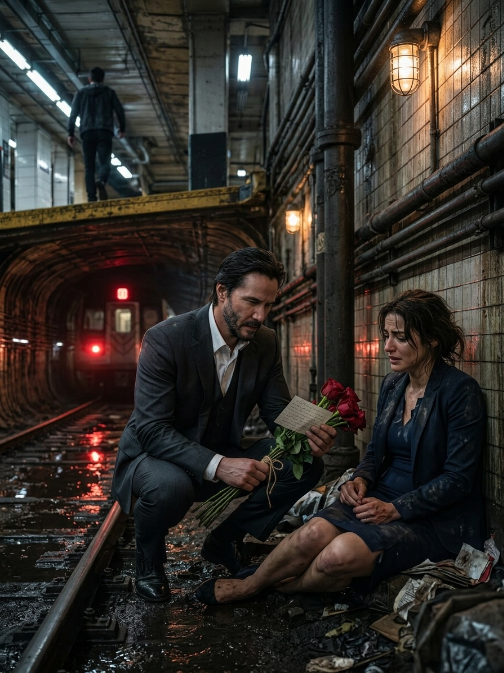
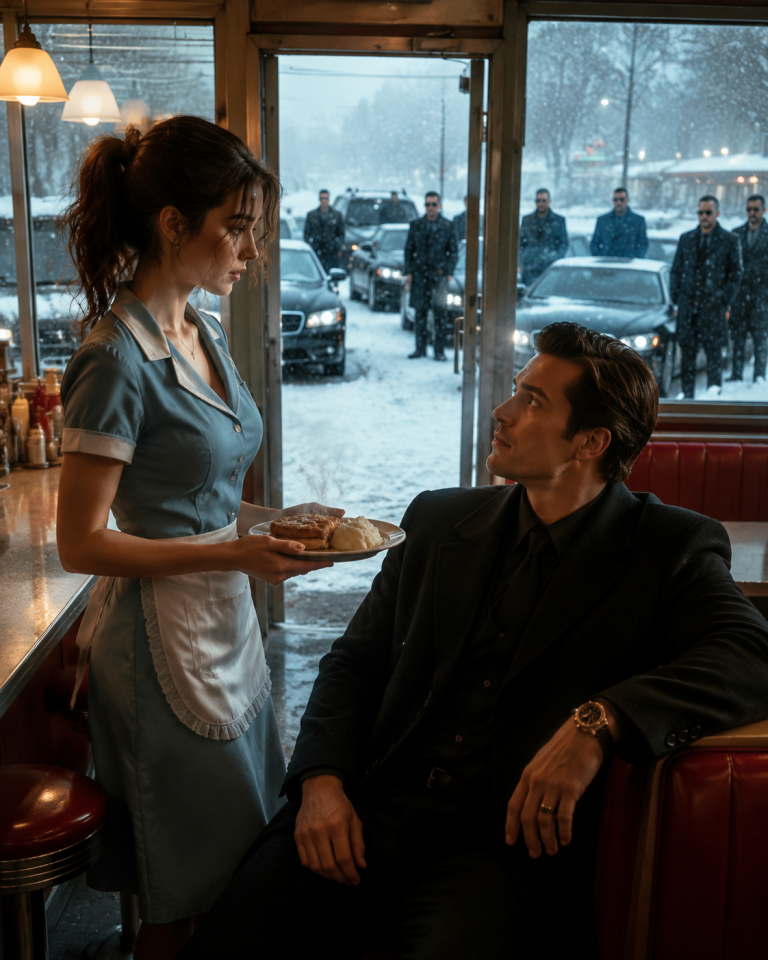
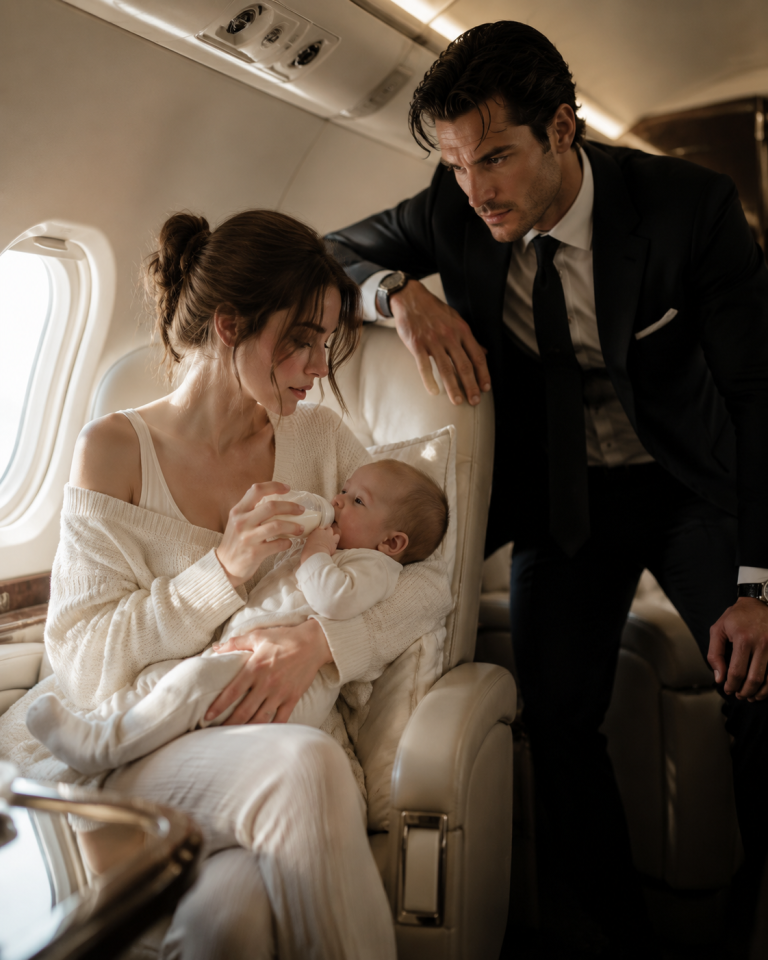
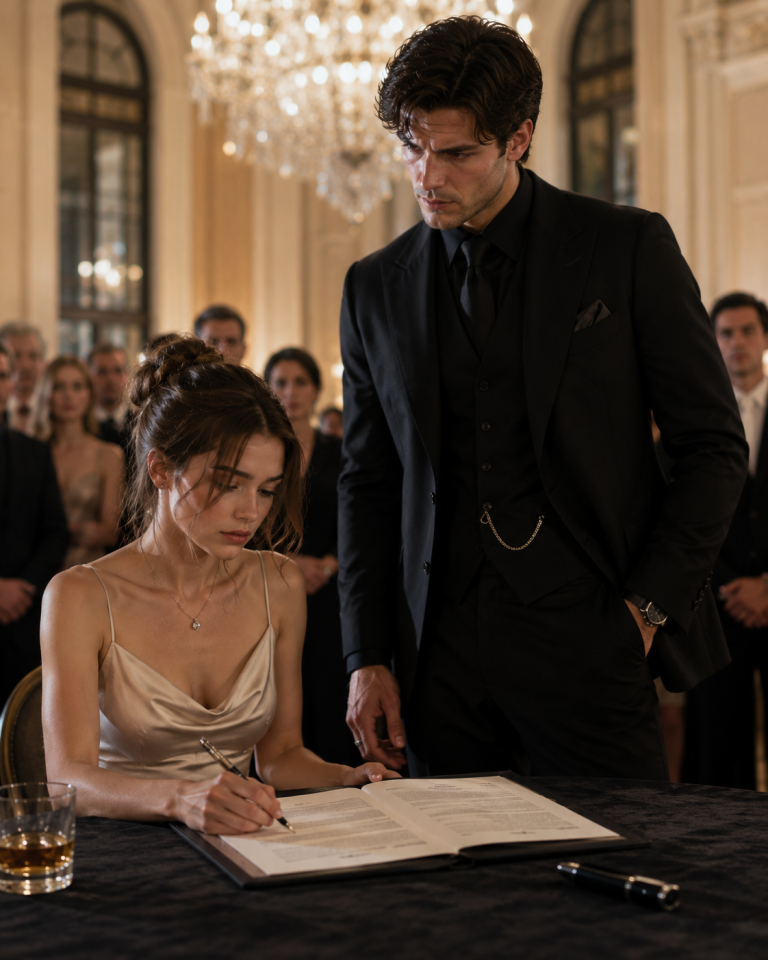
At the moment he told her love was a luxury he would never pay for, she disappeared into the rain—leaving behind only a goodbye letter hidden inside a bookstore… and by midnight, Manhattan’s most feared mafia billionaire was begging for her back.

PART 1
The broken champagne glass on the marble floor was the first thing Caspian Vale noticed when he stepped into his penthouse. The second was blood — not much, just a thin red smear near the balcony door, glistening under low gold chandelier light while rain lashed the windows thirty stories above Manhattan.
For three seconds, he didn’t breathe.
Men who owed him money had vanished for less than touching what belonged to him. Men who whispered his name in back rooms lowered their voices instinctively, as if sound itself might carry consequences. Caspian controlled docks, unions, politicians, judges, restaurants, warehouses, and half the secrets in New York.
But in that moment, inside his own home, with the city flashing cold and white beyond the glass, Caspian Vale was not a boss. He was a man staring at blood where Mireille Sutton should have been.
“Mireille,” he called. His voice didn’t echo the way it usually did — the penthouse swallowed it.
He crossed the living room slowly, hand already moving beneath his coat for the gun he hadn’t needed in years. One pillow had fallen from the sofa. Her blue sweater was gone from the chair. The candle she burned every Sunday morning had been blown out, smoke still curling faintly above the blackened wick.
Someone had been here recently.
He moved toward the hallway. “Mireille.” Nothing. His phone vibrated in his pocket — Dario, his underboss. He ignored it.
He pushed open the bedroom door. The bed was made. Her side of the closet half-empty — not ransacked, not torn apart, carefully emptied. Her suitcase gone. The framed photo from their weekend in Maine had disappeared from the shelf.
Then he saw the envelope, sitting on his pillow, white and still, his name written across the front in Mireille’s graceful hand.
Caspian stared at it. The smear near the balcony was not blood, he understood now — wine from the broken glass, darkened by rainwater that had blown in when she opened the doors.
There had been no kidnapping. No rival. No enemy bold enough to breach his fortress. Only a woman who had finally walked away.
He picked up the envelope with fingers that had once stayed steady while signing death warrants. The paper felt soft, expensive, familiar — Mireille always bought stationery from a small shop in the Village because she said some words deserved better than a phone screen.
He opened it. The first line was so gentle it almost killed him.
*If you are reading this, Caspian, it means I finally chose myself over the man I would have destroyed myself loving.*
Thunder rolled beyond the windows. He read the sentence again, mind refusing to accept it. Mireille had left. Not to cool down after an argument. Not to punish him for another missed dinner. Not to force him into chasing her with diamonds and promises he’d never learned to keep.
She was gone.
He lowered himself onto the edge of the bed, the letter shaking slightly in his hand.
*You once told me that a mafia boss can’t afford love. I smiled when you said it because I thought you were warning me about your world. Later, I understood you were warning me about you.*
His jaw tightened. He remembered the night she meant — three weeks earlier, a private dinner at Vale’s, the restaurant his mother had loved before cancer made her too tired to leave the house. Mireille had worn a green silk dress and the pearl earrings he’d bought her in Paris, looking softer than the room deserved, sitting among men who measured affection as weakness and loyalty as currency.
A senator’s aide had laughed after too much bourbon and said, “Vale, you ever think about settling down? A woman like that could make an honest man out of you.”
Everyone had laughed. Mireille had looked at Caspian, waiting. Maybe waiting for him to take her hand. Maybe waiting for him to say she already had.
PART 2
Instead, Caspian had leaned back and said with no emotion at all, “A mafia boss can’t afford love.”
The table went quiet for half a second before the men laughed again. Mireille had smiled too. That was what destroyed him now. She’d smiled because she knew how to bleed politely.
He forced himself to keep reading. *I kept waiting for you to look at me the way people in love do. But you looked at me like someone you were terrified to lose, and somehow that hurt worse. Being protected is not the same as being loved. A cage can be made of gold and still be a cage.*
Caspian stood and walked to the window. Manhattan glittered beneath him, hard and bright, the city he’d spent his life conquering. He’d been fourteen when his mother died, had watched his father turn from a dangerous man into a grieving ghost, drinking himself through ten years of regret for loving his wife too late and too quietly. Caspian had learned the lesson clearly. Love made men beg. Love made men careless. Love gave life a weapon and showed it exactly where to strike.
PART 3
So Caspian built himself into something unbreakable, inherited his father’s empire, cleaned half of it, buried the other half behind legitimate businesses, became the kind of man who never needed anyone enough to be ruined by losing them.
Then Mireille came into his life with rain in her hair, paint on her hands, and a laugh that made his penthouse feel less like a monument to survival and more like a home.
He’d given her everything money could buy. A driver. Security. A private floor above Central Park. Clothes she rarely wore. Jewelry she accepted with a sadness he’d mistaken for modesty. A black card she almost never used. Protection from landlords, medical bills, predatory clients, anyone foolish enough to disrespect her.
But Mireille had never wanted expensive things. She’d wanted dinner without his phone on the table. She’d wanted him to come to bed before dawn. She’d wanted him to say something honest when nightmares woke him and she touched his wrist in the dark. She’d wanted a man. He’d given her a fortress.
His eyes dropped to the final paragraph. *I loved you quietly for three years. I defended your silence. I translated your coldness into fear because loving you made me generous. But I cannot disappear inside someone who refuses to love me out loud. Please do not look for me as Caspian Vale. If there is anything left in you that ever cared for me, let me go as Mireille.*
The last sentence blurred. He didn’t realize he’d crushed the paper until he heard it wrinkle.
His phone vibrated again. He answered without looking.
“Where the hell are you?” Dario Castellano demanded. “The Delgados have been sitting downtown for twenty minutes, and Beckman says the senator is panicking about tomorrow’s vote.”
“Handle it.”
A pause. Dario had known him since they were nineteen, when both had learned that loyalty in their world was less about brotherhood and more about knowing where the bodies were buried.
“Caspian,” Dario said carefully. “What happened?”
He stared at the empty side of the closet. “Mireille left.”
Silence. Then Dario swore under his breath. “You want me to find her?”
The answer should have come instantly. Caspian had men who could track an unlicensed gun across three boroughs in forty minutes. A woman traveling alone should have been easy.
But Mireille’s words were still burning in his hand. *Please do not look for me as Caspian Vale.*
“No,” he said.
“You sure?”
“No.”
Another silence. Dario exhaled. “Then what do you want?”
Caspian looked at the bed where Mireille used to fall asleep reading, one hand on his pillow as if reaching for him even when he wasn’t there.
“I don’t know.”
It was the first honest answer he’d given in years.
—
By morning, the penthouse felt less like a home and more like a crime scene where the victim had survived by leaving. The staff moved quietly, frightened by his stillness. Caspian walked from room to room finding evidence of Mireille everywhere — her coffee mug beside the sink, a hair tie around the faucet, a half-finished novel on the nightstand turned facedown to save the page, lavender lotion on the bathroom counter, a grocery list in her handwriting stuck to the refrigerator.
*Eggs. Basil. Lemons. Caspian’s coffee.*
His name on that list hit him harder than it should have. He opened the pantry and found three boxes of the tea she drank when she couldn’t sleep. He remembered teasing her once, saying tea didn’t solve problems. She’d smiled and said, “No, but it gives your hands something warm to hold while your heart catches up.” He hadn’t understood her then. He was beginning to.
Near noon, his house manager, Mrs. Fenwick, approached him in the kitchen. “Mr. Vale?”
He looked up. She held a small black box wrapped with silver ribbon. “Miss Sutton left this in the upstairs closet. The tag says it was for your birthday next week.”
Something inside him sank. “Leave it.”
She hesitated. She’d worked for his family before his mother died, one of the few people alive who remembered him as a boy instead of a name. “Sir, she bought it two months ago. She asked me three different times if you preferred vintage silver or brushed steel.”
He stared at the box. Then he took it.
He sat alone in the bedroom before opening it. Inside was a watch — vintage silver, understated, elegant, nothing like the aggressive pieces his associates wore to announce money from across a room. Quiet. Thoughtful. Beneath the velvet cushion, a note.
*You give so much of your time to people who fear you. I wanted you to have something that reminded you time belongs to you, too. Maybe one day you’ll spend some of it on yourself. Maybe, if I am lucky, on us.*
Caspian closed his eyes.
For years, Mireille had noticed everything — the way his driver liked old Motown during late-night rides, the way Dario took his coffee black but only before noon, the fact that Mrs. Fenwick pretended not to like wine but kept a bottle of Oregon pinot hidden for holidays. Mireille remembered birthdays, favorite songs, old wounds, small preferences, quiet griefs.
Caspian could remember every debt owed to him in Manhattan. He could not remember the last time he’d asked Mireille if she was happy. That realization felt like a blade sliding slowly between his ribs.
He placed the watch on the bed and opened the vanity drawer, unable to stop searching for anything else she’d left behind. There, beneath a silk scarf, was a bundle of letters tied with pale blue ribbon. His name on every envelope, some dated two years earlier, some only months ago. None opened.
The first letter was from the previous winter. *Today you smiled at me during breakfast. It lasted maybe three seconds, but I carried it around all day like sunlight.*
He swallowed hard. The second, from their anniversary. *You sent roses after cancelling dinner. They were beautiful. I wish I did not hate them. I wish flowers did not feel like proof that your assistant remembered what you forgot.*
His hand tightened. The third, dated only six weeks ago. *Sometimes I think you love me in every way except the one that reaches me. You protect my body. You pay my bills. You destroy my enemies before I know they exist. But when I sit beside you, I feel like I am starving outside a locked door, and you keep telling me the house is safe.*
He read until the city turned dark, then read until dawn.
—
By the fourth night, Dario found him sitting in the living room with a letter in one hand and Mireille’s watch in the other.
“This has to stop.”
Caspian didn’t look up. “What exactly?”
“You are falling apart.”
A bitter laugh left his throat. “Good. Maybe something in me should have fallen apart sooner.”
Dario crossed the room and sat opposite him. For once, he didn’t look like an underboss — he looked like a tired friend who’d seen too much damage done by men too proud to apologize before funerals.
“I knew your mother,” he said quietly. “I knew your father before grief turned him into a warning sign. Do not become him.”
Caspian’s eyes lifted. “Choose your next words carefully.”
“No. You need someone to stop choosing careful words around you. Your father loved your mother like a secret and mourned her like a punishment. He spent ten years drinking to conversations he was too proud to have while she was alive. You hated him for it. Now you’re sitting in the dark doing the same thing with paper ghosts.”
Caspian stood so fast the letter fell from his hand. “I am not my father.”
“Then prove it.”
The room went silent. Rain ticked against the windows. Far below, sirens cut through Midtown traffic. He looked at the letter on the floor, Mireille’s handwriting staring back, calm and devastating.
“What if she doesn’t want me?” he asked, the question sounding strange in his voice. Small.
Dario’s expression softened. “Then you let her say it to your face. Not to your fear. Not to your pride. To you.”
Caspian rubbed both hands over his face. “I don’t know how to be what she needs.”
“Then start with not pretending you do.”
—
That night, Caspian made three decisions that changed the shape of his life. First, he cancelled every meeting for the next week. Second, he placed Dario in control of all operations with written authority, something no Vale had ever done for anyone outside blood. Third, he asked for Mireille to be found — not tracked like property, not dragged back, not cornered by security teams. Found gently. Quietly. Only enough to know she was safe.
It took six days. Mireille had left New York with cash, taken a bus to Boston, then another north, used her middle name, Grace, to rent a small cottage in Cape Elizabeth, Maine. She worked three afternoons a week at a bookstore near the water.
Dario brought Caspian a photograph — grainy, taken from across a street in light rain. Mireille stood outside the bookstore in a cream sweater and jeans, hair loose in the ocean wind, holding a paper cup of coffee, smiling at an elderly woman beside her. A real smile. Not the careful one Caspian had seen during her last months in Manhattan. A real one.
It hurt worse than seeing her cry.
“She looks peaceful,” Dario said.
Caspian nodded because he couldn’t speak.
“No security on her. No one followed her except our man, and he kept distance.”
“Pull him back.”
Dario blinked. “You sure?”
“Yes.”
He touched the edge of the photograph. The woman in it looked softer, lighter, as if the sea air had carried away the invisible weight she’d lived under beside him. For the first time, Caspian understood something that had nothing to do with power. If he truly loved her, he had to risk finding out whether her peace required his absence.
—
He drove himself to Maine in a rented gray sedan. No convoy, no black SUVs, no armed men stepping out before him, no Vale name opening doors. Just Caspian, a coat, Mireille’s letters in a leather folder, and the velvet ring box he’d bought six months earlier but had been too afraid to give.
The drive from Portland to Cape Elizabeth took less than twenty minutes, but his pulse never steadied. The Atlantic appeared under a low gray sky, restless and cold. Houses sat tucked between pines and rocky cliffs. Everything looked ordinary in a way his life never had.
The bookstore stood on a corner near the harbor, yellow light in the windows, a hand-painted sign above the door. *Blue Lantern Books.*
Caspian stood across the street for almost ten minutes. A man had once offered him two million dollars in cash to walk away from a dock contract. He hadn’t blinked. Now he couldn’t make himself cross a wet street.
Finally, the bell above the bookstore door chimed as he entered. Warmth wrapped around him — coffee, paper, old wood, a small jazz record playing somewhere behind the counter. And there she was.
Mireille looked up from a stack of hardcovers. The color drained from her face. Caspian stopped near the door, rain darkening his coat. For a moment, neither of them moved. Then she said his name.
“Caspian.”
It nearly broke him.
“Hi,” he said.
After three years, after a goodbye letter that had gutted him, after six days of not sleeping and hundreds of miles of fear, the most dangerous man in Manhattan could only manage one ordinary word.
She set the book down carefully. “How did you find me?”
“I asked enough to know you were safe.”
“That is not an answer.”
“No,” he said. “But it is the honest version that does not dress itself up.”
Her eyes shifted slightly, as if honesty from him had become unfamiliar enough to be suspicious. “You shouldn’t be here.”
“I know.”
“Then why are you?”
*Because I love you.* The words rose in him, but he didn’t say them yet. He’d used silence as armor for too long. He wouldn’t use confession as a weapon now.
“I came to ask if you would let me talk,” he said. “Not as Vale. Not as the man who thinks every door should open because he wants it to. Just as me.”
Mireille’s face tightened. A customer in the back glanced over, sensed the emotional weather, and disappeared behind a shelf of mysteries.
She folded her arms. “You do not get to arrive here and make this harder because you finally feel lonely.”
“I know.”
“You don’t know,” she said, voice still soft but sharper now. “That was always the problem. You thought knowing where I was meant knowing me. You thought paying for my safety meant understanding my fear. You thought giving me a life no one could touch meant I should stop wanting the parts of you that were real.”
Every sentence landed cleanly. Caspian accepted them because he deserved worse.
“You’re right,” he said.
She looked away. He stepped no closer.
“I read the letters.”
Her eyes closed briefly. “You were never supposed to find those.”
“I know.”
“They were not written to punish you.”
“I know that too.”
“No, Caspian.” Her eyes opened, bright with tears she refused to let fall. “You don’t. I wrote them because if I said those things out loud, you would get quiet. Or tired. Or you would touch my face like I was a problem you could soothe without solving. So I wrote them down and put them away because at least paper did not make me feel foolish for needing more.”
His throat tightened. “I made you lonely while standing beside you.”
“Yes,” she whispered.
There it was. The truth. No gunshot had ever sounded louder.
The bookstore owner, a woman in her sixties named Iris, appeared from the back office and looked between them. “Mira, honey, I’m going to take inventory upstairs for a while.”
Mireille wiped beneath one eye quickly. “Thank you.”
Iris gave Caspian a look that suggested she’d survived enough men to recognize one arriving late with regret in his coat. Then she disappeared.
Rain slid down the windows. Caspian reached into his coat and removed the leather folder. “I brought these because I wanted you to know I read every word.”
Mireille stared at the folder like it might burn her.
“I did not read them to build an argument,” he said. “I read them because it was the first time in three years I heard you without interrupting you with my fear.”
Her mouth trembled.
“I do love you,” he said.
She flinched — not because the words were unwanted, but because they were late. Caspian felt that flinch in his bones.
“I know saying it now does not repair what I broke,” he continued. “I know it may even be selfish to say it here. But I need you to hear it once from the man who should have said it every day. I love you, Mireille. Not quietly. Not safely. Not in ways only I can understand. I love you in the way that has made every room in my life unbearable since you left it.”
She turned toward the window. For a moment he thought she’d ask him to go. Instead, she said, “Do you remember the night I came to your office with soup?”
The change in subject struck him, but he nodded. “You said I looked sick.”
“You had a fever.”
“I was working.”
“You were destroying yourself.”
He had no defense for that.
“I sat in the hallway for forty minutes because your men would not let me interrupt a meeting. I heard you inside. Someone asked if I was becoming a distraction.” She looked back at him. “Do you remember what you said?”
Caspian did not. The shame of that was immediate.
She remembered for him. “You said, ‘She knows her place.'”
The floor seemed to tilt. “Mireille—”
“I know what you meant,” she said quickly, as if she’d defended him even to herself for so long the instinct remained. “You meant I knew not to walk into dangerous rooms. You meant I was not part of business. You probably even meant it as protection. But I stood outside that door holding soup like an idiot and heard the man I loved describe me like furniture.”
Caspian’s face went cold with self-disgust. “I am sorry.”
“You always were,” she said. “Quietly. Later. With jewelry.”
He closed his eyes. She moved from behind the counter then, not toward him but toward the front window, where rain blurred the harbor lights into soft gold. He watched her gather herself piece by piece.
“I did not leave because I stopped loving you,” she said. “I left because loving you was teaching me to stop loving myself.”
That was the sentence that finally made a tear slide down her cheek. Caspian had seen men plead for their lives without mercy rising in him. Seeing Mireille cry because of him made him want to cut every cruel part of himself out by hand.
“I cannot ask you to come back,” he said.
Her eyes searched his. “I want to,” he admitted. “God help me, Mireille, I want to ask. I want to beg. I want to say anything that makes you pack a bag and come home tonight. But if I do that, I become every reason you left.”
“So what are you asking?”
He took a breath. “For one hour. Dinner. Coffee. A walk. Anything you can give without betraying yourself. And if, after that, you tell me to go, I will go.”
She studied him for a long time. Then the bell above the door chimed.
Both of them turned. A man in a navy raincoat stepped inside. Caspian recognized him before Mireille did.
Nathaniel Crowe. A polished Boston attorney with old money, clean hands, and eyes Caspian had last seen across a negotiation table involving union pensions and stolen records. Crowe was not mafia. He was worse in some ways. He was respectable. Respectable men could steal with signatures instead of guns.
Crowe paused when he saw Caspian. Then he smiled. “Vale,” he said. “That is unexpected.”
Mireille’s spine straightened, the soft grief in her face folding away behind something more guarded, and Caspian felt the floor of the conversation shift under him for the second time in ten minutes — not toward an old enemy this time, but toward the question of exactly how long Nathaniel Crowe had known where to find Mireille Sutton when Caspian himself had needed six days and a small army of quiet men just to learn her middle name.