The Stranger Claimed Her in Front of Everyone—So the Billionaire Mafia Called His Assistant His Fiancée… But the Ring She Hid Proved She’d Been Protecting Him for Three Years

PART 1
Three years of dark coffee and one raw sugar, and Vincent Carrara had never once said the words that mattered. He’d memorized the way Isla Bennett laughed at bad jokes she pretended not to find funny, the exact pressure of her hand when she steadied his temper before a meeting went sideways, the particular silence she left in a room when she walked out of it. None of that had stopped him from watching her smile at someone else tonight and feeling something inside his chest come apart at the seams.
“Take your hand off my fiancée.”
The words cut through the restaurant hard enough that even the violinist near the bar lost his place.
Isla froze, her fingers still resting inside another man’s hand across the candlelit table. Her date — a soft-spoken history teacher named Owen Wren — blinked first at her, then at the tall man filling the doorway, rain still clinging to his black overcoat, something close to murder behind his eyes.
“Your… what?” Owen asked.
Isla rose slowly from her chair. “Vince,” she said, and the way she said it landed worse than any scream could have. Quiet. Shaking. Furious. “What did you just call me?”
He should have corrected himself right then. Should have said he had no right, that three years of pretending not to love her had finally cracked open in the worst possible room in the city. Instead, his eyes dropped to Owen’s hand, still resting over hers.
The man was still touching her.
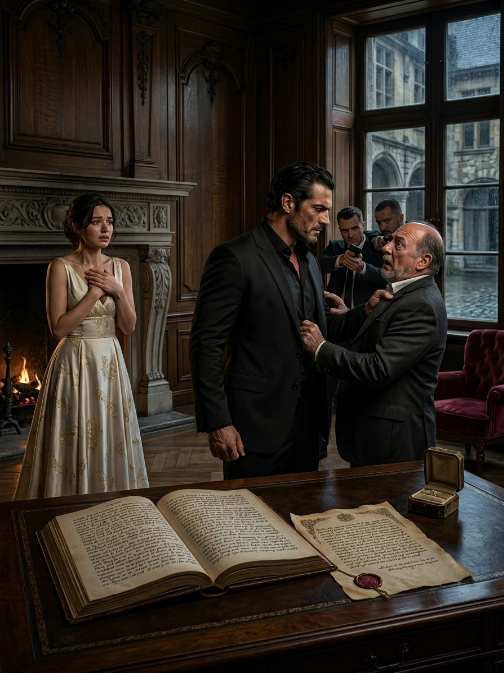
Vincent moved before thought could stop him. His arm swept a waiter’s tray sideways, and a bottle of red wine shattered against the wall beside Owen’s head. Glass sprayed across white linen, wine bleeding down it like something violent had happened there.
The restaurant went dead silent. Owen jerked backward so hard his chair nearly toppled.
Isla’s face drained white. “Have you lost your mind?”
“Maybe,” Vincent said, breathing hard. “But he’s still touching you.”
Owen rose with both palms lifted. “I don’t know who you are, but this is a date. A normal date. She said yes to being here.”
Vincent laughed once, with no humor in it at all. “That was your first mistake.”
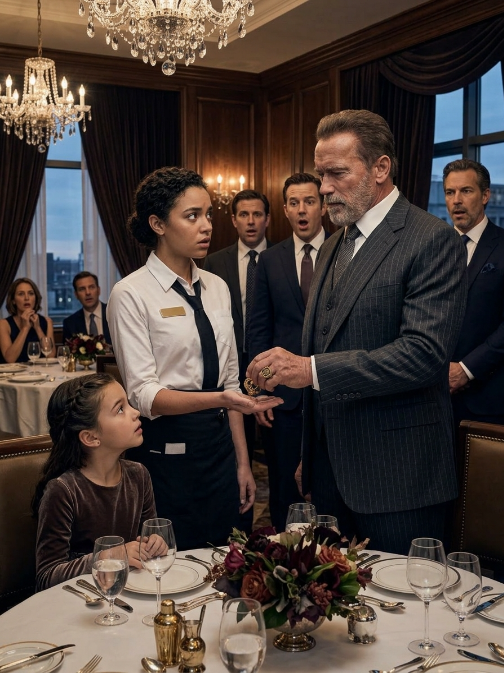
Isla planted herself between the two men before Vincent’s people could close the distance — three dark-suited shadows who’d materialized from the corners of the dining room as if grown there, men who looked carved from nothing but bad decisions.
“No,” she snapped, palm flat against Vincent’s chest. “Call them off.”
It was a simple touch. Almost professional. It nearly destroyed him anyway.
For three years, Isla Bennett had run his calendar, corrected his temper before it cost him an alliance, lied smoothly to his mother on his behalf, stalled his enemies in the lobby long enough for him to disappear out the back, and made his coffee dark with exactly one raw sugar without ever once being asked twice. For three years, Vincent had convinced himself she was safer as an employee than as the one thing in his life he actually wanted.
Then tonight — after three warehouses had burned to the ground and six of his men had turned up dead in the rail yards south of the city — he’d followed her across town to make sure she got home safe.
That was the lie he’d told himself walking out the door.
The truth was simpler and far uglier. He’d seen her smile at another man, and something inside him had simply broken.
“Outside,” Isla said.
“Isla—”
“Now.”
She walked past him without waiting to see if he’d follow. The whole restaurant watched her go. Vincent followed because he would have followed her into a fire, into a courtroom, into the bottom of whatever hell came next.
Rain hung cold and fine in the night air outside. Traffic hissed along the wet curb. Black cars idled at the kerb, his men already fanning out to cover every angle of the street without being told to.
Isla turned on him beneath the awning. “Fiancée? That’s what you decided to say?”
“I needed him to understand.”
“Understand *what*? That my employer’s lost his mind?”
“That you’re not his.”
“I’m not yours either.”
The words hit harder than the wine bottle ever had.
PART 2
Vincent’s jaw tightened. “Don’t say that.”
“Why? Because it’s true?”
“Because it isn’t.”
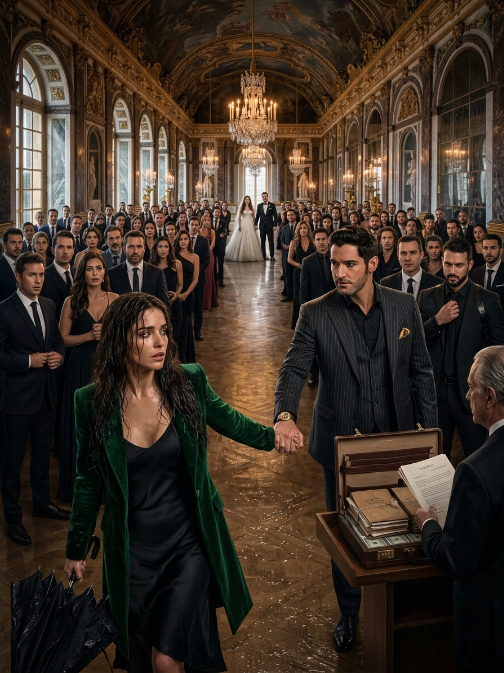
Isla stared at him, rain misting in her hair, her dark green dress — the one that had stopped him mid-breath through the restaurant window an hour earlier — clinging like it had been designed specifically to torment him.
“You don’t get to do this,” she said, voice trembling. “You don’t get to ignore me for three years, send me to order flowers for other women, schedule your fake dates around my real life, and then crash into my actual date like some jealous king out of a bad story.”
“They were never real.”
“What?”
“The women,” he said. “Cover. Distractions. Names for newspapers, faces for charity galas. None of them mattered.”
“And I did?”
He stepped closer. “You were the only thing that ever mattered.”
Her eyes shone, but she didn’t soften. “Then why did you make me feel invisible?”
“Because everyone I love becomes a target.”
“That isn’t an answer. That’s an excuse.”
He looked away, and in that flash she saw something she had never once seen on Vincent Carrara’s face in three years.
Fear.
Not anger dressed in fear’s clothes. Real fear.
PART 3
“My father loved my mother,” Vincent said. “Loved her so much that everyone knew it — and his enemies used her to get to him. I was fifteen. I watched men drag him out of our house because he ran toward her voice instead of running from danger. They killed him in front of me on the porch steps.”
Isla’s anger faltered.
“I learned the lesson early,” he went on, looking back at her. “Love is a map. If your enemies can read it, they know exactly where to stand and wait.”
“And you thought hiding it would protect me?”
“I thought it did.”
“For three years I thought I wasn’t enough.”
He flinched like she’d struck him.
“Do you know what it’s like,” Isla said, voice cracking but steady, “to love someone who looks straight through you every single day? To know his moods, his scars, his silences, and still get treated like part of the furniture?”
“You were never furniture.”
“No. I was worse. I was *convenient.* Loyal. Close enough to keep, never close enough to claim.”
He reached for her, then stopped his own hand halfway. “Isla, I’ve wanted you since the day you walked into my office and told me my filing system looked like it had been designed by a raccoon with a grudge.”
A tearful laugh escaped her despite herself. “It did.”
“I know. And you fixed it. Then my calendar. Then my meetings. Then my temper. Then every room you ever walked into.” His voice dropped lower. “Eventually I realized you were fixing parts of me I’d stopped believing could be fixed at all.”
She looked at him like she wanted to believe it and hated herself a little for wanting to.
“That doesn’t erase tonight,” she whispered. “You humiliated me. You terrified a history teacher. You threw a bottle of wine at a man whose biggest crime was holding my hand.”
Vincent glanced toward the restaurant door. Owen hadn’t followed them out. Smart man.
“I’ll apologize to him.”
She raised one eyebrow.
“I’ll pay for the suit.”
“That’s not the same thing.”
“It’s a start.”
For a moment the city kept moving around them — taxis, rain, the distant wail of a siren two blocks over — while neither of them moved at all. Then Vincent’s phone rang, and he almost let it go unanswered.
Isla noticed. “Answer it.”
“It can wait.”
“If your face is any indication, it can’t.”
He answered. “Carrara.”
Tony Marsh, his consigliere and oldest friend in the world, spoke fast and low. “Boss, we have a problem. The Delaneys know about her.”
Vincent went very still. Isla caught the shift instantly. “What happened?”
“They’ve had eyes on the restaurant for the last hour,” Tony said. “Somebody tipped them you’d be there tonight, and somebody else tipped them about who you’d be with. Cole Delaney’s people pulled photos of her getting into the town car outside her apartment. They’re already circulating.”
Vincent’s grip tightened on the phone hard enough that the plastic creaked. “Pull the cars around. We’re moving her now.”
“Boss—”
“Now, Tony.”
He ended the call and turned to Isla, all the softness from a moment ago gone, replaced by the cold calculation she’d watched run his entire empire for three years.
“What is it?” she asked, though some part of her already understood the answer would change everything.
“The Delaneys know who you are to me,” he said. “They’ve had you photographed leaving your building tonight. That photo is already moving through channels I can’t stop fast enough.”
The blood left her face slower than it had inside the restaurant, but it left all the same. “Why does that matter? I’m your assistant. Half the city’s already seen me running your errands for three years.”
“Because tonight I called you my fiancée in front of witnesses, in a restaurant owned by a man who reports everything he sees to three different families for the right price.” Vincent’s jaw worked. “By morning, the Delaneys won’t see an assistant. They’ll see exactly what my father’s enemies saw thirty years ago. A map.”
Isla’s mouth went dry. “Vincent, what are you saying?”
“I’m saying I just did the one thing I swore I’d never do.” His voice had gone rough, stripped of its usual control. “I made you a target the second that bottle hit the wall, and I can’t undo it by apologizing to a schoolteacher.”
The first car pulled to the curb before she could answer, doors already opening, his men moving with the practiced economy of people who’d rehearsed exactly this kind of night more times than anyone should have to.
“Get in,” Vincent said.
“I haven’t agreed to anything.”
“You don’t have to agree. You have to be alive long enough to be angry with me about it tomorrow.”
It was, infuriatingly, the most honest thing he’d said to her in three years, and it worked exactly because of that honesty. Isla got in the car.
They didn’t go to her apartment. They didn’t go to his penthouse either, the one place every rival family in the city already had mapped down to the elevator code. Instead the convoy threaded through wet streets toward a brownstone in a quiet, unremarkable neighborhood Isla had never once heard him mention in three years of managing his entire life.
“Whose house is this?” she asked as the car slowed.
“Mine. The one nobody knows about. My mother bought it under a name that doesn’t exist anymore, the year after my father died. I kept it the same way.” Vincent helped her out of the car, scanning the street out of old habit before he let the door shut behind them. “I never brought anyone here. Not once.”
“Why bring me now?”
“Because it’s the only place left where the Delaneys don’t already know to look.”
Inside, the house was nothing like the cold precision of his office or the curated luxury of his penthouse. Worn floorboards, a kitchen that looked genuinely used, framed photographs on the mantel of people Isla had never seen — a woman with Vincent’s same sharp eyes, a man with his same set jaw, a boy of fifteen standing between them in a backyard that didn’t exist in any part of the city he currently ruled.
“That’s the last photo of all three of us,” Vincent said quietly, following her gaze. “Six weeks before he died.”
Isla turned to look at him properly, really look, the way she hadn’t allowed herself to in three years of professional distance. “You’ve been carrying this alone the whole time.”
“I didn’t have a choice.”
“You always have a choice, Vincent. You told Nathan — Owen — that there’s always a choice. You should listen to yourself sometimes.”
He almost smiled at that, despite everything. “Funny how that sounds different coming back at me.”
Tony arrived twenty minutes later with two more men and a laptop, the same calm urgency he’d carried into a hundred crises before this one. “The photo’s been confirmed by three separate sources inside the Delaney organization,” he reported. “Cole’s already moving pieces. He knows exactly what hitting her would cost you, and that’s exactly why he’s considering it.”
“Options,” Vincent said.
“Limited. We pull her out of the city entirely, which buys time but doesn’t end anything. Or—” Tony hesitated, glancing at Isla like he wasn’t sure she should hear the second half.
“Say it,” Isla said.
“Or you make it impossible for Cole to use her against you by removing the leverage entirely. Marry her for real, publicly, with enough security and enough noise that hitting her becomes an act of war against the entire Marino-Bennett alliance instead of a quiet message to one man. Cole doesn’t want a war. He wants pressure he can apply quietly. Take the quiet option away from him.”
Vincent’s jaw tightened. “Marriage isn’t a negotiating tactic.”
“Tonight it might be the only thing that keeps her alive,” Tony said, not unkindly. “You already called her your fiancée in front of half of Manhattan’s worst people. Cole already believes it. The only question left is whether you make it true before he decides to test how true it is.”
Isla sat very still through this entire exchange, watching the two men discuss her safety like a chess problem, and felt something hot and clarifying cut through the fear. “I’m in the room,” she said. “Both of you can stop talking about me like I’m a line item.”
Tony had the decency to look chastened. Vincent simply turned to her, all of his usual armor visibly missing.
“What do you want to do?” he asked.
“That’s the first time in three years you’ve asked me that instead of telling me,” Isla said.
“I’m asking now.”
She crossed her arms, rain still drying in her hair, three years of swallowed feeling finally given somewhere to go. “I’m not marrying you to solve a security problem, Vincent. If I ever marry you, it’s going to be because you actually choose me out loud, in a normal room, with no bottle of wine involved and no consigliere drawing up tactical advantages on a laptop.”
“That’s fair.”
“But,” she said, and watched his eyes lift, “I’m also not running from this. I’ve spent three years learning every weak point in your organization because you trusted me with it. I know exactly how the Delaneys think, because I’ve read every file you’ve ever had on Cole personally. If you’re going to protect me, you’re going to do it as a partner, not as a problem you’re managing.”
Vincent studied her for a long moment, something shifting behind his eyes that looked almost like relief. “All right.”
“All right what?”
“All right, partner.” He held out a hand — not a romantic gesture, something steadier, an offer of equal footing she hadn’t expected from him in three years of watching him offer that kind of respect to no one but himself. “Tony, get the Delaney file. All of it. She’s seeing everything.”
What followed wasn’t the quiet retreat Tony had first proposed. Isla spent the next four days in the brownstone going through years of intercepted communications, shipping manifests, and financial records with the same precision she’d once used to fix Vincent’s filing system, except this time the stakes were considerably higher than a missed meeting. She found what three years of professional men with guns had missed — a pattern in Cole Delaney’s own financial records that showed he’d been quietly skimming from a joint operation with the Bellandi family for the better part of a year, money that was supposed to be split three ways and wasn’t.
“He’s not trying to start a war with you,” Isla said, sliding the printout across the kitchen table at two in the morning, Vincent and Tony both leaning over it like men twice their actual age. “He’s trying to manufacture a distraction big enough that nobody looks too closely at his own books before the Bellandis notice what’s missing. The photo, the leverage, all of it — it’s noise. He needs you angry and reckless so the Bellandis are watching you instead of him.”
Vincent read the numbers twice, then looked up at her with something that wasn’t quite admiration and wasn’t quite disbelief — something that looked, more than anything, like a man finally seeing clearly what he’d had standing beside him the entire time. “You found this in four days. My entire financial team missed it for a year.”
“Your entire financial team wasn’t motivated by staying alive,” Isla said. “I was.”
They didn’t go after Cole Delaney with bullets. Vincent had learned that lesson on his father’s porch steps thirty years earlier, and it had taken Isla’s calm insistence to remind him that the smartest move wasn’t always the loudest one. Instead, the discrepancy in Cole’s books found its way, through channels no one could trace back to either of them, directly into the hands of the Bellandi family’s own accountant — the same family Cole had been quietly stealing from for a year while using Vincent as cover.
The Bellandis didn’t need Vincent’s help to handle their own house. Within a week, Cole Delaney’s leverage evaporated entirely, replaced by a far more immediate problem of his own making, and the photograph of Isla leaving her apartment that had threatened to start a war simply stopped mattering to anyone but the two people it had been taken of.
—
Six months later, Vincent Carrara married Isla Bennett in the backyard of the brownstone nobody was supposed to know about, under the same maple tree visible in the photograph on the mantel, with Tony standing as best man and a guest list small enough to fit comfortably around two folding tables instead of the ballroom his mother’s old society friends had assumed he’d choose.
There was no bottle of wine thrown that day. No shadows in dark suits guarding every angle of the lawn, though two discreetly remained near the gate out of habit nobody felt the need to break entirely. Vincent said his vows looking directly at her, no map for anyone to read in it but the one she’d already memorized over three years of dark coffee and one raw sugar — the only kind of love, he’d finally learned, that didn’t have to be hidden to survive.
“I spent half my life believing love was the thing that got people killed,” he told her, voice steady in front of the small, quiet crowd. “It took you three years of fixing everything I broke, and one terrible night at a restaurant, to teach me it’s also the only thing worth being alive for in the first place.”
Isla didn’t cry until afterward, alone with him under the same tree once the small crowd had gone inside for cake, his forehead resting against hers, rain threatening again somewhere far off over the water.
“No more pretending,” she said.
“No more pretending,” he agreed. “Just you. Out loud, in a normal room, exactly the way you asked for.”
And for the first time in either of their lives, that turned out to be enough.