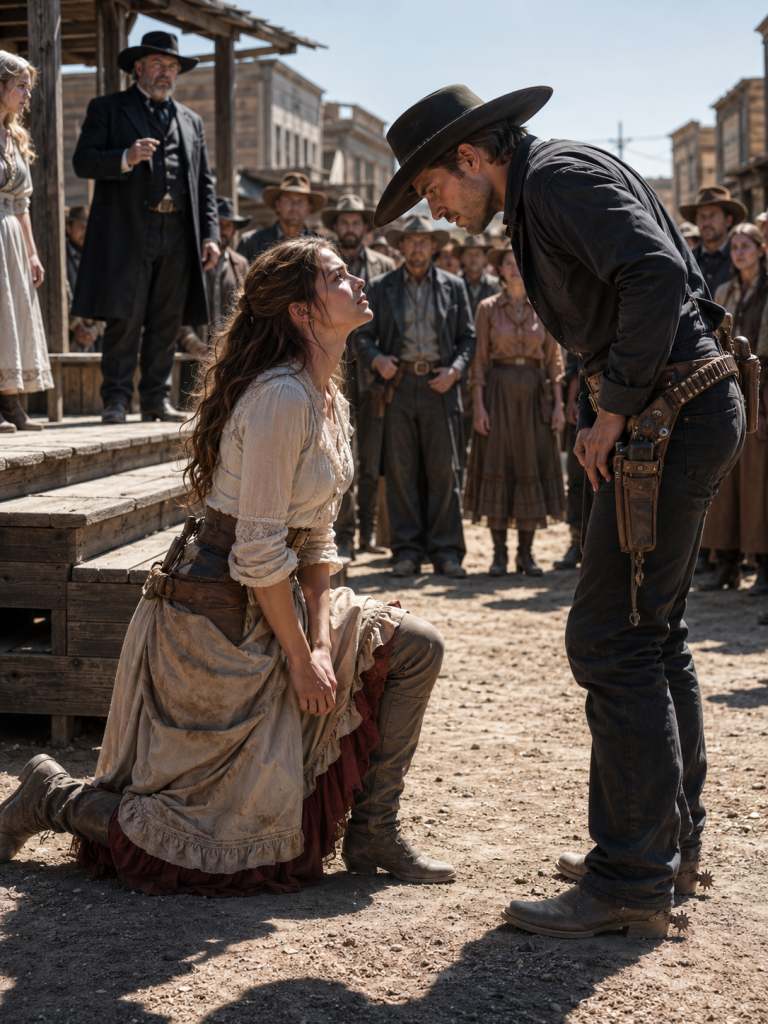
With the noose already hanging above her, she whispered, “They’ll hang me.” Then the cowboy saw the sheriff’s bloody badge—and his reply made the entire town forget how to breathe.

# PART 1
Victoria Lane once thought a gunshot inside the Riverstone General Store would end her life.
She had been wrong about a great many things before that moment.
She was not wrong about this.
The shot had ended something. But not her life. It had ended the possibility of silence. It had ended the narrative that powerful men had been carefully building. It had ended the version of the truth that had no room for a poor shop girl’s voice.
Now, weeks later, in a cabin deep in the mountains while snow erased every trail behind them, she understood what the shot had truly ended: her old life. Everything before the storeroom was smoke.
“They are hunting me,” she said to Daniel Merrick, the cowboy who had pulled her onto his horse and ridden into the dark before the first torch could be lit.
“I know,” he replied.
“They will not stop.”
“No.”
“My father—”
“Your father is dead and cannot protect you,” Daniel said, not unkindly. “But I can stand between you and everyone who wants to hurt you. That is not protection. That is just refusing to move.”
Each night, he sat near the cabin door with his rifle across his knees while Victoria lay by the fire, listening to the wind scrape through the logs, trying not to shake whenever she remembered Sheriff Calloway shouting through the town square: “Five hundred dollars for the man who brings her in! Dead or alive!”
Dead or alive.
The words lived inside her now, a constant companion.
She tried not to think about the moment in the storeroom.
She failed.
Marcus Price had followed her there—followed her deliberately, she understood now, because he had been waiting for an opportunity. His father Nathaniel owned everything in Riverstone: the store, the bank, the sheriff, and by extension, the truth.
“You have been putting on airs,” Marcus had said, blocking the door. “Working in my father’s store like you belong there. Like you are not just a poor girl my father hired out of charity.”
She had backed away.
“I am leaving.”
He had caught her arm.
Not gently.
“You are not going anywhere.”
The rest had happened very quickly. His hand on her dress. Her hand finding the small pistol her father had pressed into her palm years earlier, saying, “Keep this hidden. Some men do not respect words.” The gun appearing in her grip. The shot.
Marcus falling.
And then the world breaking into noise: people running, doors opening, voices shouting her name like an accusation.
Now, in the cabin, while Daniel slept in short intervals and Victoria lay awake remembering, she understood what Nathaniel Price was doing in the town below.
He was not simply hunting her.
He was erasing her.
The news came on a late winter afternoon when Daniel’s old friend, a man named Samuel Garrett, rode up through the trees with coffee, letters, and a face that suggested he carried terrible information.
“Price is pushing the doctor to change the report,” Samuel said, sitting at the rough wooden table. “The bruises on your arms—he wants them erased from the medical record. Calloway has witnesses ready to swear you went to the storeroom of your own accord. That you shot Marcus without cause. That you are a woman scorned, not a woman defending herself.”
Victoria’s hands went cold around her coffee cup.
Her heart beat so hard it hurt.
Daniel slammed his palm against the wood with a force that made the cabin shake.
“They are not just hunting her,” he said. “They are rewriting that night. They are making her a murderer out of convenience.”
Samuel nodded grimly.
“Price is powerful. He has money. He has the sheriff in his pocket. What he does not have is a good story if people see the truth. So he is erasing the truth before it can be seen.”
After Samuel left with promises to gather more information, Victoria sat by the fire and made a decision that felt like stepping off a cliff.
She opened the old cloth bag she had carried from Riverstone—the bag Daniel had not questioned, had not searched, had simply allowed her to keep as part of her survival.
Inside were the things she had grabbed in the chaos after the shot.
A torn piece of her sleeve, still dusted with material from the storeroom floor.
The broken hairpin Marcus had snapped when he grabbed at her hair, trying to control her movements.
A small note the hotel washerwoman had slipped into her hand weeks earlier: “I heard Marcus say he would make Victoria stay quiet. He said his father could make any trouble disappear.”
She pulled needle and thread from her sewing kit.
Then, carefully, methodically, she stitched all of it into the lining of her blue shawl. The evidence that would prove what had happened in that storeroom. The proof that would destroy the narrative Nathaniel Price had spent weeks constructing.
She did not tell Daniel.
Not because she did not trust him, but because what she was about to do was dangerous, and she would not let him carry the weight of knowing.
All winter, while they waited for the mountain passes to open, she wore that shawl. Slept with it folded near her pillow. Felt the small hard edges of evidence against her ribs like a secret heartbeat.
When spring came and the snow began its retreat and the mountain paths opened to the lower valleys, Daniel asked, “Are you ready to go back?”
“No,” Victoria said.
“But you want to?”
“Yes.”
He understood without needing her to explain.
They rode down from the mountains on a clear morning when the sky was the color of truth—bright, unambiguous, impossible to mistake for anything else.
Riverstone had changed and not changed.
The store was still there. The bank still stood. The sheriff’s office still waited at the corner like a dog expecting to be fed. But there was something different in how people looked at them. Not all pity. Not all fear. Some confusion. Some calculation.
The hearing was set for the following afternoon.
Victoria wore the blue shawl.
She said nothing to anyone about what it contained.
—
# PART 2
The town hall filled to capacity by midday.
Oil lamps burned along the walls, though the sun was still bright outside. The smell of damp wood, old tobacco, and nervous sweat filled the room. Riverstone packed every available bench. People who had once shouted Victoria’s name in the streets now stared at her as if a ghost had walked through the door.
Nathaniel Price sat in the front row in a black coat, his silver-handled cane resting across his knee.
He smiled when he saw her, the way a man smiles when he is certain of his advantage.
Victoria felt Daniel’s presence beside her like a physical thing—solid, steady, unwavering.
The territorial marshal opened proceedings with a review of the incident. The version that had been officially recorded. The version that made no room for truth.
Marcus Price had been shot in the storeroom of the family business.
The weapon belonged to Victoria Lane.
The question was intent.
Was this self-defense or murder?
Nathaniel Price rose to speak first.
He was old money speaking to old money’s rules. He was silver hair and expensive clothing and the particular confidence of a man who had never been told no in any way that mattered.
“Miss Lane,” he said, not unkindly, “came to work in our family business because her circumstances required charity. For months, she performed adequately. Then, as sometimes happens with women of uncertain background, she developed an attachment to my son.”
A murmur moved through the room.
“When Marcus made clear he could not possibly return such an attachment, Miss Lane became… erratic. She began leaving notes. Appearing unexpectedly. On the day in question, she followed my son to the storeroom with apparent intent to… persuade him of her worth.”
He paused for effect.
“My son, being a gentleman, attempted to refuse her advances with kindness. She, being rejected, produced a weapon and fired.”
The room exhaled with the relief of a story that made sense, that fit the proper order of things, that required nothing more from them than to believe a powerful man.
Victoria stood before the marshal’s table could call for testimony.
“That is a lie,” she said. Her voice was steady. “And I can prove it.”
Nathaniel’s smile did not falter, but something behind his eyes went very still.
Victoria unwound her blue shawl and placed it on the table.
“I came here not to speak words that can be questioned,” she said. “I came to return the things your son left behind.”
She began to carefully unpick the stitching.
The torn sleeve piece fell first, white cloth against the dark wood.
The broken hairpin followed.
Then the washerwoman’s note, carefully folded and preserved.
And finally, a medical report with the doctor’s signature attesting to bruising on Victoria’s arms consistent with defensive gripping—bruising that Nathaniel had been attempting to have erased from the official record.
The room went very still.
The marshal picked up the note and read each line slowly.
Every word landed like a hammer in that room.
Nathaniel Price’s face went the color of old ash.
Calloway stood so quickly his chair fell backward.
But Victoria did not wait for the crowd to turn into a storm.
She turned and walked out of the hall, hearing chairs scrape, voices raise, and for the first time in his life, Nathaniel Price lose his careful composure.
Daniel followed her into the street.
—
# PART 3
That night, in a small boardinghouse at the edge of town, the telephone rang sharp through the darkness.
Victoria lifted the receiver.
Nathaniel Price’s voice came through the wire, no longer smooth, no longer controlled, transformed into something raw by the loss of his narrative.
“What did you leave in that shawl, Victoria?”
She looked at Daniel standing by the window, silhouetted against the lamplight, and answered softly: “Not much, Mr. Price. Only the things you thought a poor woman would be too frightened to keep. The proof that your son attacked me. The evidence that you tried to bury the truth. The understanding that sometimes people fight back.”
She hung up before he could respond.
The territorial marshal’s ruling came the next morning.
Self-defense.
Clear and unambiguous.
The bruises on Victoria’s arms were consistent with defensive posturing. The torn sleeve and broken hairpin corroborated struggle that was not consensual. The washerwoman’s testimony, when formally given, provided motive beyond rejection—Marcus had been attempting coercion, likely with the knowledge and approval of his father.
Nathaniel Price would face charges for conspiracy to obstruct justice, falsifying medical records, and attempting to manipulate testimony.
Sheriff Calloway resigned before he could be arrested.
But the real victory was smaller than legal proceedings.
It was the way people looked at Victoria now.
Not with pity for what she had endured, but with a particular kind of respect for having endured it and then refused to be silent about the cost.
The hotel washerwoman brought her flour for bread, left on the boardinghouse step without comment.
A woman who owned a small dressmaking shop offered her work, apprenticeship, and partnership.
Another woman, barely more than a girl, approached her privately and asked, “How did you know they would believe you? How did you know carrying the evidence would be enough?”
Victoria considered the question.
“I did not know,” she said finally. “I only knew that silence would definitely lose. So I chose to make noise.”
The girl nodded and walked away, visibly changed by the permission Victoria had given her—the permission to believe that her own voice, her own evidence, her own resistance could matter.
Three weeks after the hearing, Daniel took Victoria to the small church at the edge of Riverstone.
She wore a simple white dress and the blue shawl—now properly hemmed, no longer carrying hidden evidence, but forever marked by what it had held.
They married without fanfare.
The territorial marshal came. Samuel Garrett attended. The dressmaker who had offered partnership brought flowers. The washerwoman cried quietly in the back row.
But mostly it was Daniel and Victoria making promises to each other in a language that required no audience.
“I will stand beside you,” Daniel said.
“I will not ask you to,” Victoria replied. “But I will be grateful if you do.”
“I will do more than stand beside you. I will let you stand. I will not take up space that is yours to claim.”
“That is all I need,” Victoria said. “Permission to remain myself.”
After the ceremony, Nathaniel Price left Riverstone.
He attempted to rebuild his life in another territory, but news traveled. The truth traveled. His name became synonymous with the man who had tried to bury a woman’s defense of her own body.
Some men never recovered from that kind of exposure.
Nathaniel Price was one of them.
He died five years later, alone, remembered by no one who mattered.
The store that had been his passed into other hands. Victoria and Daniel took the small ranch land that was part of her settlement—the money forced from the Price estate as restitution for damages.
They built a quiet life there, away from town but not from purpose.
Other women came to them.
Women fleeing violence.
Women carrying evidence of what had been done to them.
Women needing space to heal and the understanding that speaking the truth would not destroy them, even if it destroyed powerful men.
Victoria became known in the territory not as the woman who had shot Marcus Price, but as the woman who had stood up, carried her evidence, and refused to let a powerful man’s narrative override her own.
She taught young women to document injuries, to preserve evidence, to write down what had happened in clear language, to speak clearly about assault and resistance and self-defense.
She taught them that silence served the perpetrator, not the victim.
She taught them that a shawl could carry revolution if you stitched it carefully enough.
Daniel built the ranch into something substantial. Not from ambition, but from quiet intention. The work was honest. The earnings were fair. The land was treated with respect.
When they had children—two daughters, one son—Victoria told them the truth of how their parents had met.
Not as a romantic story of escape and rescue.
But as a story of conspiracy, evidence, and the particular kind of courage it took to return to a place where people wanted you dead and demand to be heard.
The son grew up to study law. He became a prosecutor who specialized in cases where powerful men had attempted to silence vulnerable women. He used his mother’s case as foundational precedent for how evidence should be preserved and presented.
The daughters grew up to understand that their mother’s victory was not special or exceptional.
It was simply what happened when a woman refused to let someone else write the ending of her story.
Years later, when Victoria was old, a woman from the capital came to interview her.
This woman was writing a book about historical justice, about cases where the powerful had been exposed, about moments when evidence had mattered more than status.
“Why did you keep those things?” the woman asked. “The sleeve, the hairpin, the note? You could have left the mountains and started over somewhere else. No one would have found you.”
Victoria looked at the blue shawl, hanging now in a place of honor in her home.
“Because,” she said, “if I had left that evidence in a storeroom in Riverstone, it would have been destroyed. Nathaniel Price would have cleaned up his son’s mess and gone on. He would have told his story again and again until everyone believed it. And I would have carried the weight of his version of my life forever.”
She turned to face the woman directly.
“I kept those things because they were truth in material form. Not words that could be denied. Not accounts that could be questioned. But the actual physical evidence that I had been attacked, that I had defended myself, that I had not fired that shot out of rejection or madness or spite.”
“And if no one had believed you?”
“Then I would still have known,” Victoria said. “And I would still have been alive to tell anyone who would listen. That is more than many women get.”
The book, when it was published, became standard reading in schools. Victoria’s case was taught alongside historical moments of injustice corrected. Young people learned that sometimes the truth required evidence. Sometimes evidence required courage. Sometimes courage meant returning to a place that wanted you dead.
By the time Victoria died at eighty-four, surrounded by her children and grandchildren, she had lived longer than Nathaniel Price had dreamed possible.
She had lived not only to tell her story.
She had lived to teach others how to carry their own stories forward with evidence, with clarity, and with the unwavering belief that truth, when properly presented, could not be buried.
The blue shawl was donated to a museum in the capital city.
It sat behind glass with a placard that read: “Evidence of Survival: The blue shawl worn by Victoria Lane Merrick contained the physical proof that demonstrated self-defense in a case where powerful men attempted to rewrite history. The torn sleeve, broken hairpin, and preserved note inside this shawl’s lining led to the conviction of Nathaniel Price for conspiracy to obstruct justice. This shawl represents not only one woman’s courage, but the power of evidence to overturn narratives built by those who assume their power is absolute.”
Daniel lived into his eighties, tending the quiet ranch, watching the women who came to Victoria with stories of violence find strength through speaking and being believed.
When he died, the funeral was large.
Not because he had been famous or powerful.
But because he had stood beside his wife while she changed everything, and he had done it without ever trying to take up space that was hers to claim.
The son who became a prosecutor wrote his mother’s story in legal journals. The daughters became teachers, activists, women who taught girls how to speak clearly about violence done to them.
And the shawl behind glass became something more than evidence.
It became a symbol.
A symbol that sometimes the most powerful thing you could do was refuse to disappear.
Refuse to let someone else write your ending.
Refuse to accept that a powerful man’s version was the only version that mattered.
And sometimes, if you were very brave and very careful and very determined, you could stitch your evidence into cloth and carry it back into the place that had tried to bury you.
And you could place it on a table in front of witnesses and say: “This is what happened. This is what was done to me. This is why I fired that shot.”
And the world would have to listen.
Not because you were special.
But because truth, when properly stitched together, was harder to dismiss than lies.
And sometimes, that was enough to change everything.