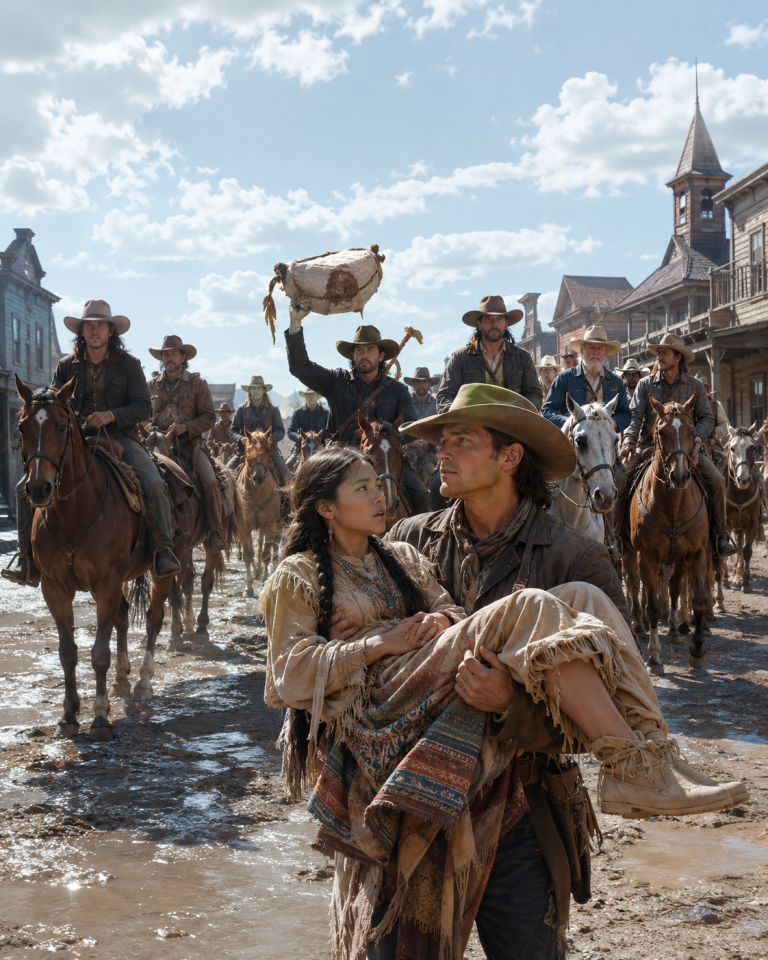
She Woke Among the Dead With No One Left to Save Her — Until a Lone Cowboy Noticed the Strange Mark on Her Hand

## PART 1
The courtroom was crowded in the way that Wyoming courthouses fill when something has already been decided in private and everyone comes to watch the official performance of that decision.
Jack Mccree sat with Alice pressed against his side, her small frame rigid with the kind of terror that does not announce itself loudly. She wore a blue dress that had cost Agnes Vera three hours of sewing and had been chosen, Alice had understood without being told, because looking the right way in front of judges mattered more than any truth spoken under oath.
On the other side of the room sat Henry Voss.
He looked like a man who had never wanted anything in his life that he had not eventually obtained. His suit was expensive. His hands were uncalloused. His lawyer, Harlon Quaid, sat beside him with the careful efficiency of a man being paid to transform simple cruelty into legal procedure.
Alice’s fingers found the blue handkerchief in her pocket and gripped it hard.
Quaid stood and began with an argument about blood relation.
Jack barely listened. He had spent enough time in court during the war, testifying about things he had done and things he had been ordered to do, that he understood the real decisions happened before anyone spoke a word. What mattered was the story people had already decided to believe.
But Alice was 4 years old, and she believed that words had power.
She had been that age when he found her in a broken wagon with her mother three weeks dead in the shade beside it.
Jack had not been looking for redemption that day.
He had been riding north, tracking a horse thief without much enthusiasm, when Dusty—the gray mare that was the most honest thing in his possession—had refused to move. Dusty never refused without reason. She had planted her feet and flattened her ears and made clear through the only language she had that something below the ridge required investigation.
He had found the wagon tilted hard to one side with a collapsed canvas top, the kind of broken thing the frontier produced and forgot about within the same season. Then he smelled it. Death. The particular smell that lived in the chest cavity and clung to a man’s clothes afterward, the smell Jack had known intimately since 1861.
He came around the wagon and stopped.
The woman lay in the narrow shade beside the broken wheel. Her hair was dark red. Her dress was blue calico with small white flowers, though dust and blood had dulled it. A knife wound in her side. Narrow. Clean. Deliberate.
Then he heard it.
A thin, cracked humming from inside the wagon. Not a tune. Just sound. The audible evidence that something small was still working at staying alive.
He used his rifle to push the canvas flap aside.
A little girl sat among the wreckage, small enough that Jack’s first thought was that she might have been left there by mistake. She held a blue handkerchief pressed hard against her cheek, the way children cling to the last thing they recognize. When she saw him, she stopped humming.
They stared at each other.
Her eyes were dark. Her lips were cracked and bleeding. Her face was burned raw by sun and exposure. But there was something in her expression that made Jack’s chest tighten. Not crying. Not hope. She had gone past both.
“My name is Jack,” he said, his voice rough from disuse. “I’m not going to hurt you.”
“Is your mama outside?” he asked, knowing the answer.
“She’s sleeping,” the girl said.
The words hit him hard enough to force him still.
“How long has she been sleeping?”
“A long time.”
“Will she wake up?”
The girl looked at him with the blank exhaustion of someone explaining something obvious to a slower person.
“I tried.”
Jack removed his rifle from the wagon floor and placed his canteen instead. She lunged for it with both hands and drank like someone trying to swallow the whole sky. When she finally lowered it, her hands were trembling.
“What’s your name?”
“Alice,” she said.
He knelt beside her mother—Catherine Voss, he would learn later from the papers—and wrapped her body in canvas. Then he and Alice buried Catherine on a rise above the hollow where the grass was thick and the mountains could be seen in both directions.
Alice gathered stones one by one and carried them to the grave. When there was no wood for a cross, Jack carved the name into the flattest stone he could find.
Catherine Voss.
Alice ran one finger over the letters.
“Will she be lonely down there?” she asked.
Jack had not believed in much for four years. But some people are too important to answer with nothing.
“Your mama ran a thousand miles for you,” he said. “I think she’s still running, even now. Still protecting you.”
Alice dropped a wildflower into the grave.
“I’ll be good,” she whispered. “I promise.”
They rode to his ranch in the last of the light.
The cabin was small because Jack had built it to be impossible to love. Small places were easier to abandon when abandonment became necessary. Small places required less from a man, gave back less when he failed.
Alice studied it from the saddle.
“Is this your house?” she asked.
“It is.”
“It is small.”
“Yes.”
“That’s all right,” she said. “Mama said small things are harder to find.”
Inside the cabin, Jack found Catherine’s journal tucked beneath an overturned trunk. The final entry was dated June 14, 1876. The handwriting was firm but hurried.
Catherine wrote that they were close. Forty miles north of Elk Creek stood a ranch belonging to a man named Jack Mccree. Her husband Warren had served with him during the war. He had said Jack was the most decent man he ever knew and the most destroyed. He had said if the worst happened, bring Alice to him, because a man carrying that much guilt would do anything to set one thing right.
God forgive me for using him this way, she wrote. But Alice must survive.
Beneath the journal was a land claim with an official seal. Mining rights to a silver deposit in Colorado Territory, registered to Catherine Voss. The sort of paper men killed for without firing a shot.
Alice appeared silently beside him.
“Did you find something?” she asked.
“Some papers.”
“Are they important?”
“Yes.”
Alice nodded.
“Mama said papers were how people stole things without using guns.”
Jack looked at her then. This little girl had been alone for three days with her dead mother, had rationed her water, had not wandered, had not screamed herself into collapse. She had simply stayed.
Something long frozen inside him shifted.
“Did your mama ever talk about someone following you? Someone she was afraid of?”
Alice’s fingers tightened on the handkerchief.
“She called him the shadow.”
Jack understood then.
Catherine Voss had been killed for the mining claim. The shadow was her brother-in-law, Henry Voss. And Henry Voss had come to Elk Creek with a story, a lawyer, and a plan to take Alice and make the problem disappear.
—
## PART 2
The first sign came three days later, when Agnes Vera rode into the ranch yard with news.
“There’s a man in town,” Agnes said without preamble. “Name of William Hart. Says he’s a detective from Kansas City. Says he’s looking for a missing child. Says her uncle is worried.”
Jack felt Alice go still beside him.
Alice had already told him the only truth that mattered when he asked: “Does the law care what I want?”
By then Jack already knew what Catherine’s journal implied. As long as Alice lived, she stood between someone and a great deal of money. William Hart was only the hired hand. The real threat was Henry Voss.
Jack also knew something else.
He knew what broken men were capable of when given reason to fight. Catherine had sent her daughter to a man carrying guilt because she understood that guilt made men dangerous. Men with nothing left to lose, nothing left to hide, nothing left to fear—those men fought hardest.
Jack began putting pieces together the way he had during the war, gathering intelligence, establishing position, understanding the terrain before engagement.
Louise Marsh—Catherine’s sister—arrived with letters written by their father before his death. The letters told a story Henry had spent years hiding. Catherine’s husband Warren had been given the Colorado claim by their father, not Henry, because Henry had spent a lifetime taking what belonged to others.
Henry contested the will and lost.
Then he waited.
Henry supplied Warren with expensive whiskey, patient and purposeful, and Warren drank himself to death. Then Henry waited for Catherine to fail under the weight of raising a child alone, to make mistakes, to become vulnerable.
Instead, Catherine had run.
And that made her a problem that required solving.
Louise testified to the same fear Alice had voiced plainly: Henry did not love the child. He wanted the papers.
“I am not asking this court to convict him,” Louise said during the hearing preparation. “I am asking this court not to hand him a 4-year-old girl and a silver mine.”
But the law did not always listen to what it was being asked.
Judge Cameron called the hearing for a Thursday morning. Jack sat with Alice at the table the night before and told her something he had learned during the war.
“Tomorrow, we tell the truth,” he said. “All of it. Even the hard parts.”
Alice looked at him seriously.
“And then?”
“And then we see if the world is big enough for both of us.”
—
## PART 3
Judge Cameron read the testimony in silence for what felt like a very long time.
Harlon Quaid had presented his case with the confidence of a man being paid to perform a role. Blood relation. Territorial law. Henry Voss as the rightful guardian. Jack Mccree as a stranger with no legal claim, a burned history, years of isolation, no wife, no household stability, no standing at all.
He was good.
But Agnes had done what Agnes always did. She had turned private fear into public action. Fourteen people came to the courthouse that morning. Ranchers. Townsfolk. Dr. Crawford. Marshal Briggs. People Jack had barely spoken to in five years of living alone. They had decided, in the quiet accumulation of three weeks, that some things required standing up to be counted for.
Agnes testified first. She described Alice’s condition when Jack brought her into town—sunburned, dehydrated, blank-eyed with shock. Then she described Jack over the weeks that followed: the steadiness, the patience, the rifle across his knees every night because he had decided the child would be safe.
“He is the best thing that has happened to that child since her mother died,” Agnes said.
Dr. Crawford testified to Alice’s physical state. The ranchers testified to Jack’s character. Marshal Briggs testified about William Hart approaching Louise with money to change her testimony. At that, Hart stopped writing in his notebook and Quaid’s jaw tightened visibly.
Then Louise Marsh took the stand.
She told the truth about Warren and Henry, about jealousy and competition and a brother slowly poisoned with convenient whiskey. She read the letters aloud. She described the three dead women whose estates had all benefited Henry in one way or another.
“I am not asking this court to convict him,” she said, echoing her earlier words. “I am asking this court not to hand him a 4-year-old girl and a silver mine.”
When it came time for Jack to testify, he sat in the chair and spoke plainly about his own failures. About the fire that took his wife and daughter four years ago. About the drinking that followed. About the isolation. About the man he had become when he thought there was nothing left worth saving.
Quaid used all of it. Jack did not fight the facts. He answered yes when yes was true.
Then he said what mattered.
“Catherine Voss knew all of that,” he told the judge. “She knew exactly what I was and brought her daughter to me anyway. She wrote that a man carrying enough guilt would do anything to set one thing right. She used me. And she was right to do it.”
The room went still.
“I cannot promise Alice a perfect life,” he continued. “I cannot promise I won’t make mistakes. But I can promise her one thing. I will be there every day. When she wakes from nightmares, I’ll be there because I know those nightmares. I will tell her the truth, even when it’s hard. I am not what she deserves. I am what she has. And I would rather be an imperfect man who stays than a capable man who sees her as a transaction.”
Quaid tried to recover with cross-examination, but Jack’s truth had already changed the room.
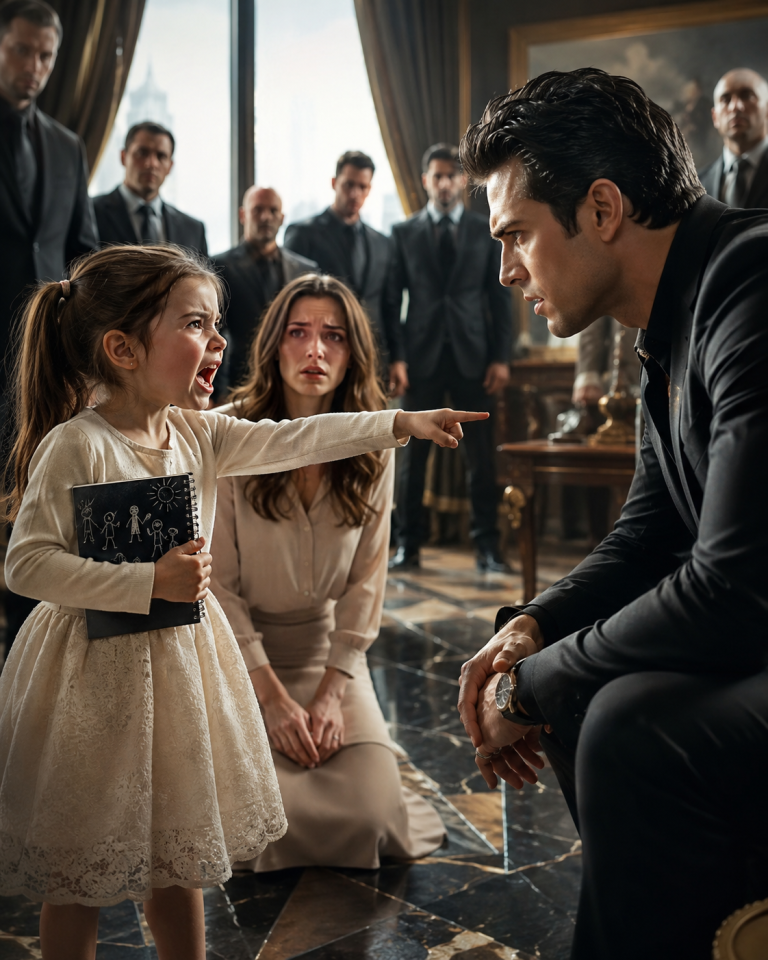
Then, before the judge could adjourn, Alice stood.
She had been watching from the front pew, the blue handkerchief in both hands. She walked to the front of the room before anyone could stop her and stood beneath the judge’s bench, small and straight-backed in her blue dress.
“You want to say something?” Judge Cameron asked.
“Yes, sir,” Alice said.
She turned first toward Henry Voss.
She held his eyes until he broke.
Then she faced the judge.
“My mama ran a thousand miles,” she said in a small, clear voice. “She ran because Uncle Henry wanted the papers and because she knew if he got me too, he would never stop. She brought me to Jack because she said broken people protect broken things because they know how easy things break.”
The room might as well have stopped breathing.
Alice swallowed.
“He got off his horse,” she said. “He stayed all night. He says when he is scared. He tells me the truth even if it is bad. Uncle Henry just wants the papers. Jack wants me.”
Silence followed her back to the pew.
Judge Cameron adjourned for deliberation.
An hour later, the bell rang and they went back inside.
Cameron read for what felt like a very long time.
“I have considered the testimony,” he finally said. “I have read the letters submitted by Miss Marsh. I have heard from the child. I have considered the law.”
He paused.
“Section 14 of the Custody and Guardianship Act provides exception when this court determines that the blood claimant’s interest is not the welfare of the child. The evidence before me is consistent with a man whose interest is financial.”
He looked directly at Henry Voss.
“Mr. Henry Voss, your petition for guardianship is denied.”
The room erupted.
Cameron brought the gavel down twice.
“I am not finished.”
The noise died instantly.
“Mr. Mccree, please stand.”
Jack stood. So did Alice, because she was 4 and was not about to let go of his hand now.
“This court grants you temporary legal guardianship of Alice Voss effective immediately,” Cameron said. “You will file formal adoption papers within 60 days through the territorial court in Casper. The Colorado mining claim registered to Catherine Voss will be held in trust for the child until her 18th birthday, administered by this court.”
“Yes, sir,” Jack said.
“Mr. Voss, you will leave Elk Creek today. If I learn you have contacted this child or her guardian, or made any attempt to interfere with this ruling, I will issue a warrant.”
The gavel came down once more.
Final.
Alice made a sound Jack had never heard from her before. Half sob, half laugh, something sharp and involuntary and impossibly young. She threw both arms around his waist and held on with everything in her, and he picked her up and she wrapped her legs around him and cried the way she had not been able to cry in weeks.
“It’s all right,” he murmured into her hair. “It’s all right. We won.”
“For real?” she managed.
“For real.”
“Forever?”
He held her tighter.
“Forever.”
When Alice finally lifted her face, she looked younger than she had since the wagon. The fear had loosened. Relief, even brief relief, gives childhood back to a face astonishingly fast.
She looked at Jack and said one word.
“Papa.”
That was all.
No hesitation. No explanation. Just the word, placed between them so plainly it made the whole room seem to recede for a second.
“Right here,” Jack said. “Right here.”
Henry Voss passed close enough on his way out that Jack could have touched him. For one instant Henry looked at Alice, then at Jack, and something crossed his face that was not quite remorse and not quite recognition. Then he walked on and out of the courthouse and out of Elk Creek and, in every way that mattered, out of their lives.
They rode home in the golden light of late afternoon.
Alice sat in front of Jack the way she had on the first day, but this time she leaned back against his chest without thinking about it, without holding her body tight and careful. She simply rested there and let him carry her.
For a long while neither of them spoke.
Then Alice said, very seriously, “Can we get a dog now?”
A laugh broke out of Jack before he could stop it.
A real laugh. Deep and surprised and alive enough that he almost did not recognize it as his own.
“Yes,” he said. “We can get a dog.”
“I already know her name,” Alice said.
“Do you.”
“It has to be a girl,” she said. “For Mama. I’m going to call her Catherine.”
Jack felt his throat tighten but kept his voice even.
“That’s a good name.”
When the ranch came into sight, Alice sat up straighter the way she always did when she saw the cabin and barn. The habit had started in the first week and Jack had noticed it without understanding. Now he did. Her body knew before her words had caught up. The place meant stopping. It meant no more running. It meant the road had finally ended.
He helped her down from the saddle.
She stood in the yard and looked at the cabin for a long moment.
“Home,” she said.
“Yes,” Jack answered. “Home.”
Agnes and Louise arrived not long after with more food than Jack’s kitchen had seen in years. Agnes brought preserves. Louise brought a cake because, as she explained when Jack raised an eyebrow, she had no intention of wasting a perfectly good cake on a bad outcome.
Alice ate two slices and then fell asleep at the table, cheek on folded arms, blue handkerchief tucked in her dress pocket. Jack carried her to bed and stood for a long moment watching her breathe in the lamplight.
He had stood over another sleeping child once.
That old grief still came. It always would. But that night it did not come alone. Something else sat beside it now. Something living. Something ongoing. Something that meant he no longer had to be the man who had nothing left to lose.
He could be the man who had something to keep.
At the table, Agnes watched him.
“You look different,” she said.
“I feel different.”
“Good different?”
He thought about that carefully.
“Painful,” he said. “But yes.”
Agnes nodded as if that was the only answer she would have respected.
Time moved after that the way life moves once catastrophe stops dictating every hour.
Louise remained in Elk Creek. Adoption papers were filed in Casper. The federal marshal in Cheyenne opened an inquiry into Henry Voss and the pattern of the three dead women. William Hart vanished back into whatever work men like him found once clients stopped paying. Agnes continued knowing everything before anyone else and acting on it as if that were simply her civic obligation. Alice acquired a dog named Catherine, large and foolish and female, who followed her everywhere with the solemn devotion of creatures lucky enough to be loved by children.
At supper each evening, Alice set the table with grave precision: two plates, two cups, two forks, parallel and exact. Jack had taught her that the table was how you showed people they were expected, that a place had been made for them. Alice watched that ritual deepen into habit and understood something about home that she carried forward without needing it explained.
Weeks later, on a quiet evening with the horses in the corral and the last blue of the Wyoming sky settling outside the window, Alice looked up from her beans and said, “Papa?”
“Yes.”
“Thank you for getting off your horse.”
The words struck him harder than any praise an adult had ever offered.
She did not mean only that first day in the hollow. She meant the burial. The courtroom. The nights he stayed awake while she slept. The mornings he told the truth. The cornbread and the dog and the fact of remaining.
She meant all of it.
Jack thought of Catherine’s journal. A broken man. Catherine had sent her daughter to a broken man because she believed broken men would fight hardest to keep one thing from breaking too.
He looked at Alice sitting across from him with charcoal already in hand, ready to draw the dog and the house and the two figures she always drew holding hands in front of it.
“Thank you for letting me,” he said.
Alice nodded as if that made complete sense.
Then she bent over the paper again. First the dog. Then the cabin. Then two people in front of it, one tall and one small, fingers linked the way she always drew them now, permanent.
Jack sat across from his daughter and watched her draw.
Outside, the Wyoming night breathed itself into place. The land held still in that patient, hard, beautiful way it always had. Inside, the lamp burned warm. Alice hummed a tuneless little melody over the paper. The handkerchief remained tucked safely in her pocket, not as a desperate tether now, but as something carried forward. A reminder that love sometimes arrives in the form of a woman running a thousand miles, and that sometimes the smallest person in the room holds the largest truth.
For a man who had once believed he had nothing left to lose, for a man who had built his entire life around that belief, it turned out that Catherine Voss had known something he had not.
It turned out that wasn’t the end of his story at all.
It was the first true home he had ever made.