They Left Her Bleeding in the Snow While the Whole Town Watched — Then a Silent Mountain Man Stepped Forward and Said, “Enough.”

## PART 1
Margaret Prescott’s hands had stopped shaking three days ago, which meant the fear had calcified into something worse: certainty. She sat in the small room above the general store, the foreclosure notice folded and refolded on her lap until the creases had worn through the paper itself. Outside, Bitter Creek’s autumn wind rattled the boards like bones in a box. Inside, she had begun to understand that she was going to die, and no one would call it murder.
The signature on the document was perfect. Too perfect.
She had watched her father sign things his entire life—contracts for supplies, receipts for the land taxes, letters to distant relatives. William Prescott had a particular way of forming the final *i* in his surname, a slight lift and flourish that looked almost defiant. On this paper, supposedly signed four months ago when they had been discussing drought conditions and nothing else, the handwriting was flawless. Someone had spent time learning the shape of her father’s name. Someone had prepared for this.
The loan officer at Colton’s Bank, a nervous man named Pettigrew, had refused to meet her eyes when she came demanding answers.
“Your father came to Mr. Colton himself,” Pettigrew had said, shuffling papers that all looked identical. “There are witnesses.”
“Who?” Margaret had asked.
Pettigrew had not answered.
James Prescott was dead three weeks. She had held his broken hand in the mortuary while Doctor Samuel Hart measured the contusions on his skull, each one a dark flower of violence that had nothing to do with any fall from a horse. The ravine where they’d found him was rocky, yes, but the wounds didn’t match stone. They matched fists. Or something heavier.
Hart had signed the death certificate as *accidental injury* and had looked at Margaret with an apology he would never voice aloud.
She had known then that her father had been executed. What she did not know was why they felt bold enough to continue the execution as a legal process.
The knock came at sunset.
Sheriff Jacob Pierce stood in her doorway, his jaw working on nothing, his eyes fixed somewhere behind her head. He had worked with her father. They had gone riding together. At the funeral, Pierce had wept.
“Margaret,” he began, and the sound of her first name in his mouth was an insult. “I’ve come with an order. From Mr. Colton. You have three hours to—”
“To what?” She stood. She was tall for a woman, and she knew how to use height as a weapon, how to make a man feel the weight of judgment. “To leave? Or to disappear?”
“The property is being seized. The note is legal. I checked with the territorial court myself.” His voice had developed a whine. “You can’t stay here. He’s sending men to help you vacate.”
*Help you vacate.* As if she had chosen to leave the only home she had ever known.
Margaret had dressed carefully that afternoon. A wool dress, dark and severe. Her mother’s silver brooch, the only thing of value she still owned. She braided her hair tight against her skull because she understood, at some primitive level, that what was coming would not be gentle, and loose hair gave a man something easy to grab.
By the time she walked down to the main street, maybe fifty people had gathered. The saloon was emptying. The dry goods store had gone quiet. She saw Sarah Jenkins, who had brought soup when Margaret’s mother died, pull her children back inside and bar the door as if disease walked in Margaret’s shadow.
The men arrived on horseback.
There were four of them. But it was the tall one with the scarred face who made the other townspeople take a small step back. His name was Mercer Voss, and he had the particular confidence of a man who had discovered that violence was simpler than talking. He sat very still in his saddle, watching Margaret with the eyes of something that had decided to hunt.
Behind them came Ezra Colton himself, dressed like he was attending an opera. His suit was perfectly pressed. His boots gleamed like dark water. He looked at Margaret with the kind of expression a merchant might use when inspecting damaged goods he had already paid for.
“Ms. Prescott,” he called out, not bothering to dismount. “You have exactly three hours to remove yourself from the property. You may take what you can carry. Nothing of value. Nothing that could be construed as part of the estate.”
Margaret stepped into the street. The mud was frozen hard, cracked in places where the moisture had turned to crystal. She could see the whole town arranged like an audience in a theater—in windows, on porches, behind the café counter. All of them watching. None of them moving.
“The note is a forgery,” Margaret said. Her voice was steady, which was its own kind of courage. “My father never signed anything with you. He never took a loan. You murdered him and now you’re stealing his land.”
For a moment, Colton didn’t respond. His expression didn’t change. He simply looked at her the way one might look at an insect that had become irritating. Then he made a small gesture with one gloved hand.
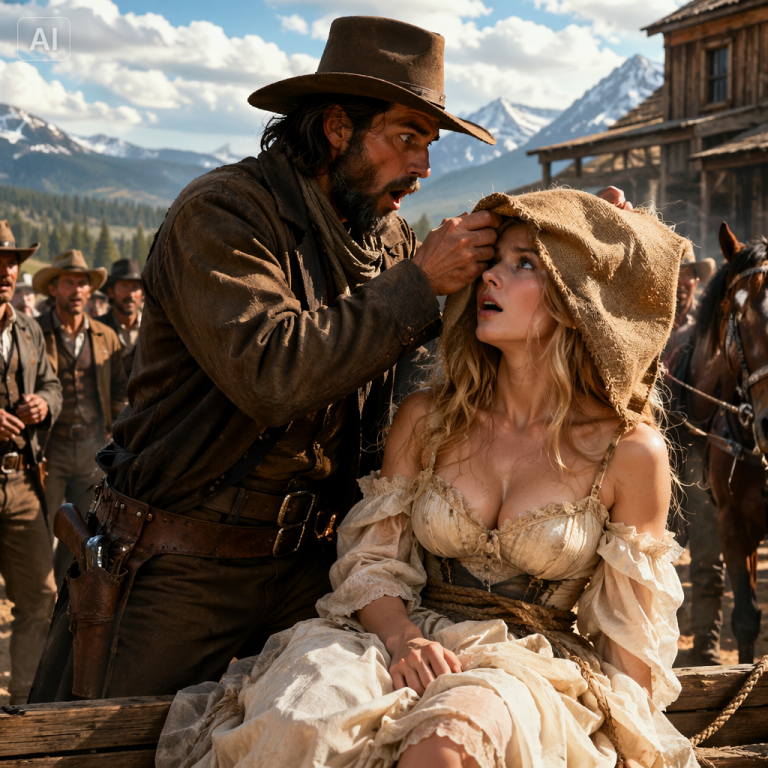
Mercer Voss moved with the kind of speed that suggested he had been waiting for permission. He dropped from his horse and crossed the frozen mud in four strides. When he grabbed her arm, his fingers bit into the bone. She didn’t resist—resistance would have accomplished nothing but additional pain—but as he pulled her, she turned and looked into the faces of the watching townspeople.
She saw Mrs. Jenkins. Deputy Benjamin Cross. Father Matthias from the church, his collar white against his dark coat. She saw them all choose, in that moment, to become invisible.
Voss threw her.
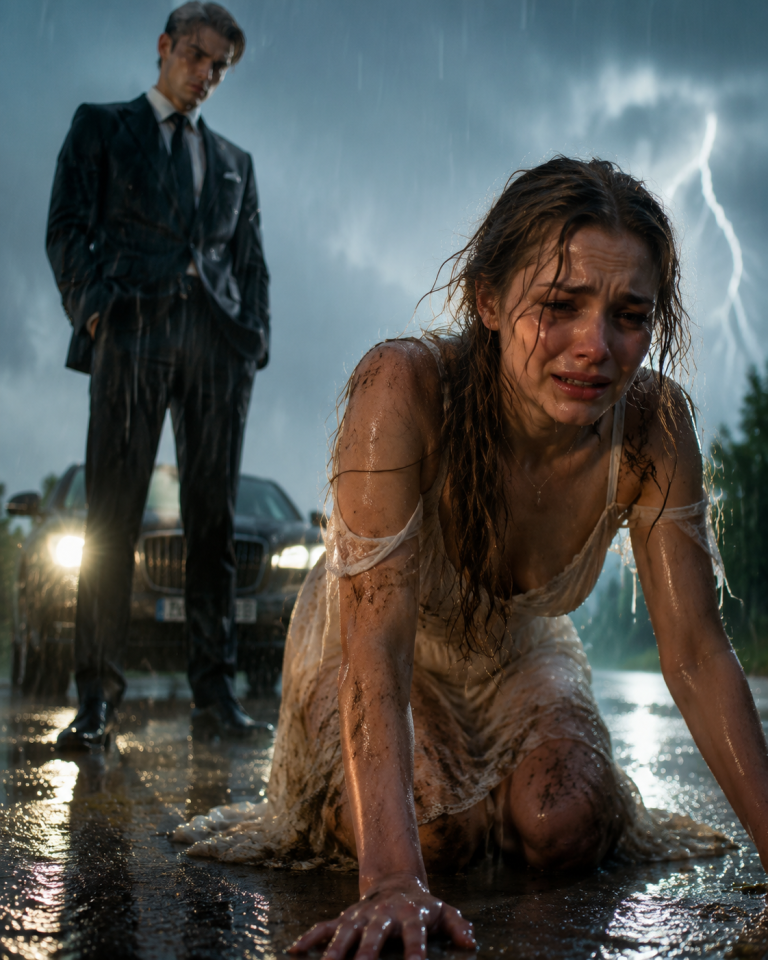
The impact was absolute. All the air left her body at once. Her back hit the ground and then her head, and for a moment the sky detached itself and went spinning. When her vision resolved, she was flat against the frozen earth, her wool dress torn, her left temple bleeding.
She tried to sit up.
Voss kicked her back down.
The pain arrived then, arriving late like a train—it started in her ribs and radiated outward. She could taste blood. Colton’s voice came from somewhere above her, distorted by the roaring in her ears.
“Perhaps this will help you remember. You are a woman with no family, no protection, and no legal claim to anything. The world is going to be very unkind to you, Margaret. I suggest you accept that.”
Voss reached down and grabbed the front of her dress. Margaret had a moment to think—*this is how it ends*—and then another thought that was colder and clearer: *not yet*.
She drove her heel upward with everything she had left.
For a moment—just a moment—his grip loosened. She rolled backward, her fingers scraping at the mud, trying to find purchase, trying to find distance. The watching faces blurred. She could hear him laughing behind her, the sound of someone who had never been denied anything and did not believe he could be.
His footsteps came closer. She scrambled backward on her hands, gasping, and lifted her head to see his fist descending toward her face like something falling from the sky.
It never landed.
The sound was like thunder in a closed room—the impact of his arm being caught mid-swing by something that had entered the scene with the absolute certainty of inevitability. Voss made a strangled noise. Margaret saw the massive hand wrapped around his wrist, the fingers disappearing into his sleeve. The hand connected to an arm that was impossibly thick. The arm connected to a body that seemed to fill the entire street.
The man was enormous. That was the first fact. The second fact was that he moved with the kind of power that came from spending years in places where power was the only currency that mattered. He wore a wolf pelt coat. Buckskin. A knife the size of a short sword hung at his hip. His face was half-hidden by a beard that had never seen a razor, but his eyes—his eyes were the color of winter stone and carried in them something that had lived too long in high places.
Mercer Voss understood very quickly that he was going to die if he did not break his wrist free.
He tried.
The stranger simply held him.
“Move along,” Voss managed, his voice high and strained. “This ain’t your concern.”
The stranger did not blink. He did not respond. He simply began to squeeze, and Voss’s face started to turn the color of spoiled meat.
Colton’s composure fractured like thin ice.
“Release him,” Colton commanded. “Release him this instant. You are committing a crime. The law—”
“The law,” the stranger said, and his voice was like rocks grinding together, “left when it watched a woman bleed without raising a hand.”
He turned—a slow, deliberate movement that brought his full attention to bear on Colton. Voss hung from his grip like a child’s toy, his legs kicking uselessly. The other three hired guns had their hands on their revolvers, but none of them drew. Something in the stranger’s bearing had convinced them that drawing would be a matter of choosing between one death and another.
The stranger tilted his wrist.
Voss flew. He traveled backward through the air in an arc that seemed impossible, his body moving faster than anything that large should be able to move, and crashed directly into the wooden water trough with enough force to splinter it. Water exploded across the frozen street. Voss lay among the broken boards, gasping, his arm hanging at an angle that suggested it would never work the same way again.
The stranger turned back to Margaret.
She was still on her back in the mud, still bleeding, her mind moving through shock toward something sharper. She looked up at his face and understood that she was looking at rescue or death, and she had no way to distinguish between the two.
He extended his hand.
It was enormous. The palm was scored with old scars from rope and work. The fingers were thick as branches. But when she took it, he pulled her up with surprising gentleness, and then—without asking—he scooped her into his arms and carried her to a horse that was waiting with the kind of patient confidence that suggested it had done this before.
He set her into the saddle and swung up behind her.
Colton’s voice cracked across the street.
“If you ride out with her, you’re an outlaw. I will send every man I have up that mountain. I will find you. I will burn whatever pathetic claim you have to nothing. Do you understand me?”
The stranger turned to look at him. He took his time. Margaret could feel his heartbeat against her back—steady, unhurried, completely unafraid.
“Send them,” he said. His voice carried the weight of something that had nothing left to lose. “Send all of them. But I’d start buying coffins first.”
Then he spurred the horse forward.
The crowd parted in confused panic. Margaret saw the faces blur past—Sarah Jenkins looking away, Father Matthias making the sign of the cross, Sheriff Pierce studying the ground with intense interest. All of them watching her escape with a stranger, and none of them moving to stop it.
Behind them, Bitter Creek receded into distance.
Ahead of them, the Wind River Range rose like the edge of another world entirely.
“Where?” Margaret managed, her voice torn. “Where are you taking me?”
The stranger did not answer immediately. He simply kept the horse moving, steady and certain, toward the mountains.
“Somewhere they can’t follow,” he said finally. “Somewhere men like that don’t survive.”
Margaret realized then that she was trembling—not from fear, but from something else. Relief. Rage. The strange, terrible gratitude of someone who had been marked for death and had been pulled back from the edge by a hand that asked nothing in return.
She closed her eyes against the wind.
And in the growing darkness behind them, Bitter Creek’s lights grew smaller and smaller, until they were nothing but a fading memory of a place where murder had been called law.
—
## PART 2
The cabin was six hours into the mountains, high enough that the autumn wind came down with teeth. It was built from logs that had turned gray with age, and it smelled like smoke and leather and something else—something like survival. The stranger—his name was Wyatt Mccord, though he didn’t offer it until after he’d started a fire and tended to her injuries—worked with the same economical silence that had defined everything about him.
He had a kit of supplies: whiskey, bandages, something that smelled like pine tar and worse. He examined her temple, her ribs, the places where Voss had gripped her arm and left bruises that were already turning the color of decay.
“You’ve been hit before,” he said. It wasn’t a question.
“Once,” Margaret replied. “A man in Denver. I was working at a restaurant. He decided his wages weren’t enough to purchase my company.”
Wyatt looked at her with something that might have been respect.
“And?”
“I broke a plate over his head and kept moving.”
He nodded. He didn’t ask where she’d come from after that, or what had driven her back to Bitter Creek, back to her father’s ranch. Some men had the decency to understand that people carried their stories close, and that asking too many questions was a form of violence.
He bound her ribs with the kind of efficiency that suggested he’d done it many times before. Then he went to the cabin’s small shelf and produced a tin of something that smelled like salt and smoke.
“Eat,” he said. “Your body needs to remember it’s alive.”
She didn’t think she could eat. Then she did. The food was simple—jerked meat, hard bread, something that might have been preserved fruit—but it was food, and her body understood that survival sometimes required consumption.
Wyatt sat across from her, his scarred hands wrapped around a cup of coffee, and told her something of what had brought him to Bitter Creek that particular day.
He had been coming down from his claim in the high country, heading to the assayer’s office to trade his autumn haul for supplies. He had seen the gathering crowd. He had understood, by the way the street had gone quiet, that something worse than normal was about to occur.
“I’ve spent seven years running from civilization,” he said, and his voice was steady, matter-of-fact. “From people. From consequences. But watching that happen, watching that whole town choose comfort over right—” He stopped. He didn’t finish. He didn’t need to.
Margaret understood then that she had been saved not by luck, but by someone who had reached a limit. Who had looked at a choice and had finally chosen differently.
The wind outside grew louder.
“They’ll send men,” Margaret said.
“They will.” Wyatt nodded. “Colton will commission a posse. Probably ten or twelve men. Sheriff Pierce might be among them, or he might find a reason to be unavailable. Voss, if his arm doesn’t kill him from infection, will want to be there. Revenge is a drug, and he’s tasted it now.”
“Will they find us?”
“Eventually.” Wyatt’s eyes reflected the firelight. “But I’ve lived in these mountains long enough to know them better than any man born at sea level. There are places they can’t reach before winter comes. And winter comes early here.”
He stood and moved to the window. Outside, the sky was turning the color of a bruise.
“There’s a hunter’s cabin, three days north. Built by a man named Richardson. He died ten years ago, but the structure stands. It’s defensible. Remote. We can wait out the first snow there, and by then—”
“By then what?” Margaret asked.
Wyatt turned back to her, and in his face she saw something that might have been the beginning of a plan. Or the beginning of something else entirely.
“By then,” he said, “Colton will overreach. Men like that, when you take something from them, they don’t just hunt. They burn. They destroy. And when they do that in front of witnesses—when they do it to try and punish me—some of those witnesses might finally decide that watching isn’t enough.”
Margaret understood then that Wyatt Mccord was not running.
He was fighting. He was just doing it on a battlefield he understood, in ways that civilians like Colton could never anticipate.
Behind them, the cabin door closed against the gathering darkness.
And in Bitter Creek, a different kind of darkness was beginning to unfold—one that started with Mercer Voss’s fevered screaming as infection claimed his arm, and continued with Ezra Colton’s rage as he realized that his mountain man had not simply escaped, but had taken something far more valuable than a woman.
He had taken Colton’s invulnerability. And every man in town who saw it happen—every man who had chosen to look away in the street—now understood that they had all made a choice, and that choice had consequences.
The posse would ride out in three days.
But they would not return the same men who left.
—
## PART 3
The first snow came before Colton’s posse cleared the foothills, which was the first time any of them understood that they had fundamentally misunderstood the game they were playing. Wyatt Mccord had not run into the mountains looking for a place to hide. He had run into a place where snow did what walls and guns could never do: it changed the rules.
The cabin Richardson had built stood on a plateau that was invisible from below, accessible by a single trail that curved around granite outcropping in a way that made any approach a mathematical nightmare. By the time the posse reached it, three of their horses had gone lame, one man had broken a leg falling from the ridge, and they had lost two days to weather that turned the world into something abstract and murderous.
Mercer Voss was not among them. His arm had begun to blacken three days into the journey, and when the fever took him fully, he’d begged—actually begged—to be left behind. Colton had ordered him left. Voss had died two hours later, his screaming carrying down the mountain in a way that seemed to suggest that pain had its own voice.
Colton himself led the posse. He had brought eight men, a judge he’d somehow convinced to ride with them, and papers that supposedly authorized him to shoot on sight and call it justice.
Wyatt let them come.
He and Margaret had spent the days before the snow fortifying the cabin in ways that were almost invisible. The snow had a habit of drifting in specific patterns around the structure, and Wyatt had worked with the snow rather than against it. He had positioned supplies, weapons, and his own considerable knowledge of siege mathematics into a configuration that made the cabin into something much more formidable than it appeared.
“They think they’re coming to rescue you,” Wyatt had told Margaret the night before the snow hit. “They think they’re justice enforcing itself. But all they’re doing is validating the very thing they claimed was necessary.”
“What do you mean?”
“I mean,” he said, “that Colton came out here to prove his authority. He came because no man—no one—had ever refused him before. But now he’s spent a week riding into country that’s trying to kill him. He’s lost men. He’s lost control of the narrative. By the time he reaches this cabin, everyone in Bitter Creek who watches him arrive is going to understand a very simple truth: he was never powerful. He was just never challenged.”
When the posse finally reached the cabin clearing, they were exhausted, angry, and—though they didn’t know it yet—already defeated.
Wyatt didn’t come out shooting. He came out alone, hands empty, walking across the snow toward them with the kind of deliberate movement that made horses shy away.
“You’re trespassing,” he called out. “This is private property. You need to turn around.”
Colton actually laughed. His face was wind-burned, his lips cracked. The judge beside him—a territorial official named Brennan who Colton had somehow blackmailed or convinced—read from a document with the tone of a man executing a legal procedure that was going to make him very uncomfortable.
“You are accused of harboring a fugitive, interference with a legal proceeding, assault on officers of the law, and theft of property belonging to the Colton Estate. You are required to surrender yourself and the woman into our custody.”
Wyatt looked at the document like it was written in a language he’d never quite learned.
“No,” he said.
It was such a small word. But it seemed to contain in it the entirety of the last week—the journey, the snow, the men who had died or been broken by it.
Colton’s patience shattered.
“Shoot him,” he ordered.
Three guns came up. But in the moment before they could fire, something happened that the posse had not anticipated, because they were men of small towns and legal procedures, and they had not built their understanding of the world on the foundation of actual, physical consequence.
A gunshot came from the cabin.
Not aimed at the posse. Aimed at the snow ten feet to their left. The shot was perfectly calculated. It triggered an avalanche—a small one, but one that came down the slope with the absolute certainty of physics, sweeping two of the mounted men off their horses and carrying them down the mountain in a tumbling chaos of white.
They weren’t dead. Probably. But they were gone.
Judge Brennan’s horse bolted. He barely kept his seat.
“Jesus Christ,” one of the other men whispered.
Wyatt stood in the snow like he was waiting for something.
“I know these mountains in ways you can’t understand,” he called out. “I know where the ice is thin. Where the snow holds death. I know every passage and every deadly stone. I brought a woman here because her home was taken from her and her father was murdered. And I’ll be damned if I’m going to hand her over to the man who did it, no matter what papers he carries.”
He turned his back on them. Deliberately. Slowly. Like he was giving them an explicit invitation to shoot him.
Colton raised his pistol.
But before he could fire, another voice cut across the snow. It came from the edge of the clearing. And when the posse turned to look, they saw movement—seven figures emerging from the trees, moving with the careful purpose of men who had ridden hard and deliberately chosen to come here instead of allowing themselves to be led.
One of them was Sheriff Jacob Pierce.
Behind him came Dr. Samuel Hart. Then Father Matthias. Then Sarah Jenkins’s husband, who owned the dry goods store. And behind them, a deputy. A blacksmith. A freight driver.
They had come from Bitter Creek.
“What is the meaning of this?” Colton demanded, his voice cracking.
Sheriff Pierce rode forward until he was level with the posse’s front line. He was carrying a rifle. So were the men behind him.
“I’ve been thinking about a lot of things,” he said. “About what I saw in the street. About the way I looked away. About the foreclosure on that land, and the fact that Mercer Voss—a man I’ve arrested before for assault—was doing your bidding while I did nothing.”
He turned his horse to face Colton directly.
“So I asked some questions. I asked the territorial court about that loan note. And the territorial court, it turns out, never received any such document. So I asked Dr. Hart what he really saw when he examined James Prescott’s body. And he told me the truth about those injuries. And then—”
Pierce gestured toward the other men.
“—these gentlemen decided that some things couldn’t be overlooked anymore. That a town that lets one of its own be murdered, that watches a woman be beaten in the street because some banker decides the law belongs to him—that town deserves everything that comes to it.”
Colton’s hand moved toward his pistol.
“I wouldn’t do that,” Hart said quietly. “We’re here to bring you back to Bitter Creek. In chains. You’re going to answer for William Prescott’s murder. And you’re going to answer for fraud, theft, attempted assault, and everything else we’ve figured out in the last three days.”
For a moment, Colton seemed like he might try something. Might push all the way into violence. But then something in him recognized that he had, finally, lost. That the architecture of fear he’d built had been demolished not by one man, but by many—by the ordinary citizens of his own town deciding that they couldn’t pretend anymore.
He lowered his hand.
The ride back to Bitter Creek took two days. By the time they arrived, the snow had stopped, and the light had turned the kind of clean, clear white that made everything look like it was being seen for the first time.
Margaret didn’t go back to Bitter Creek itself. Wyatt helped her to the territorial capital, where she gave her testimony about her father’s death, about the forged documents, about everything that had been done to strip her of her inheritance. The territorial judge—an actual one, not Colton’s pet—listened carefully. And when she was done, he ruled that the land was hers. That the foreclosure was void. That she was entitled to damages and compensation for the emotional trauma of the proceeding.
But Margaret didn’t go back to the ranch either.
Instead, she and Wyatt opened a way station—a small establishment where people could rest and resupply while crossing the Wind River Range. It became known as honest, clean, and run by a woman who knew how to read ledgers and a man who knew how to survive.
Colton hanged three months later, after a trial that was so public and so damning that it reached even into the territorial newspapers. Mercer Voss’s death from infection and gangrene was ruled just—the natural consequence of his own choices. Sheriff Pierce was reelected, and he spent the rest of his career making sure that men like Colton never took root in Bitter Creek again.
And years later, when people asked Margaret Prescott Mccord why she had chosen to build her life in the mountains instead of in town, she would tell them the simple truth: she had learned that salvation didn’t come from the places that seemed safe. It came from the places that were willing to see clearly, and from the people who had finally decided that looking away was a form of complicity they couldn’t afford anymore.
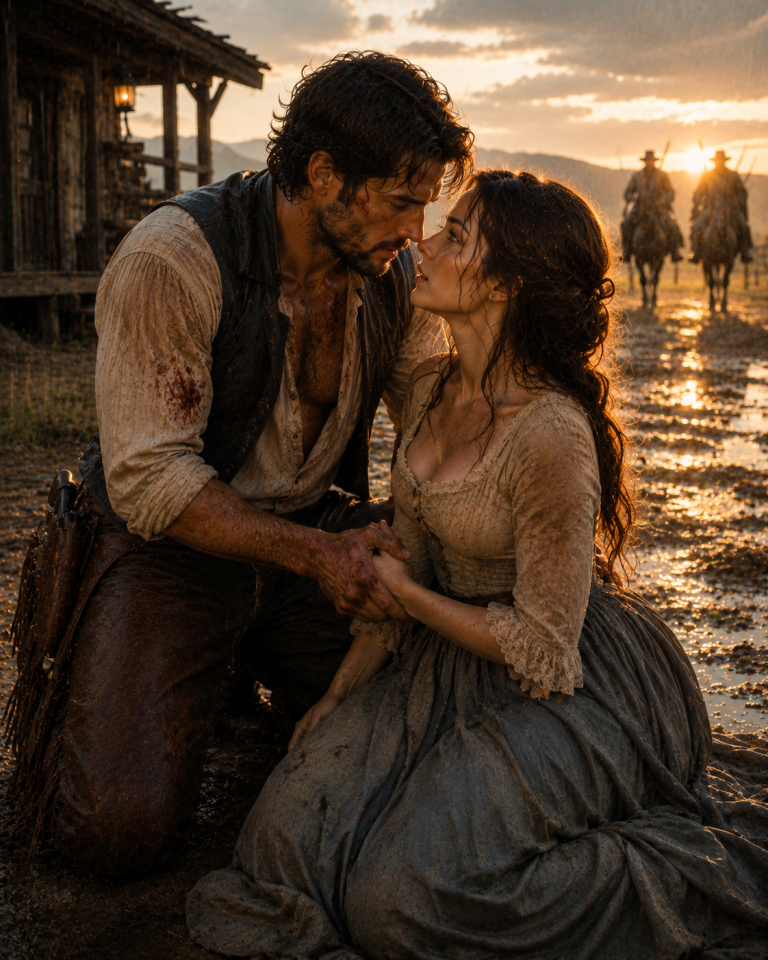
On the day of their wedding—a small affair in the mountain cabin, witnessed by Dr. Hart and Father Matthias and the other men who had ridden out to bring justice—Wyatt had held her hand and said something that she would remember for the rest of her life.
“I spent seven years running from the world,” he said. “I thought peace was something you found in distance. But I was wrong. Peace is something you build with the people who show you that it’s worth fighting for.”
The snow fell that night, clean and absolute. And somewhere down the mountain, in Bitter Creek, the town adjusted to its new reality. It would take time for trust to be rebuilt. For the scars to fade. For people to understand that they had been given a second chance to be the kind of community that deserved to survive.
But the foundation had been laid. One man had stood up. Others had followed. And a woman who had every reason to despair had instead walked into the mountains with her head high, knowing that some debts could only be paid in blood, and some salvation came not from the law, but from the people brave enough to enforce the kind of justice that the law could never reach.