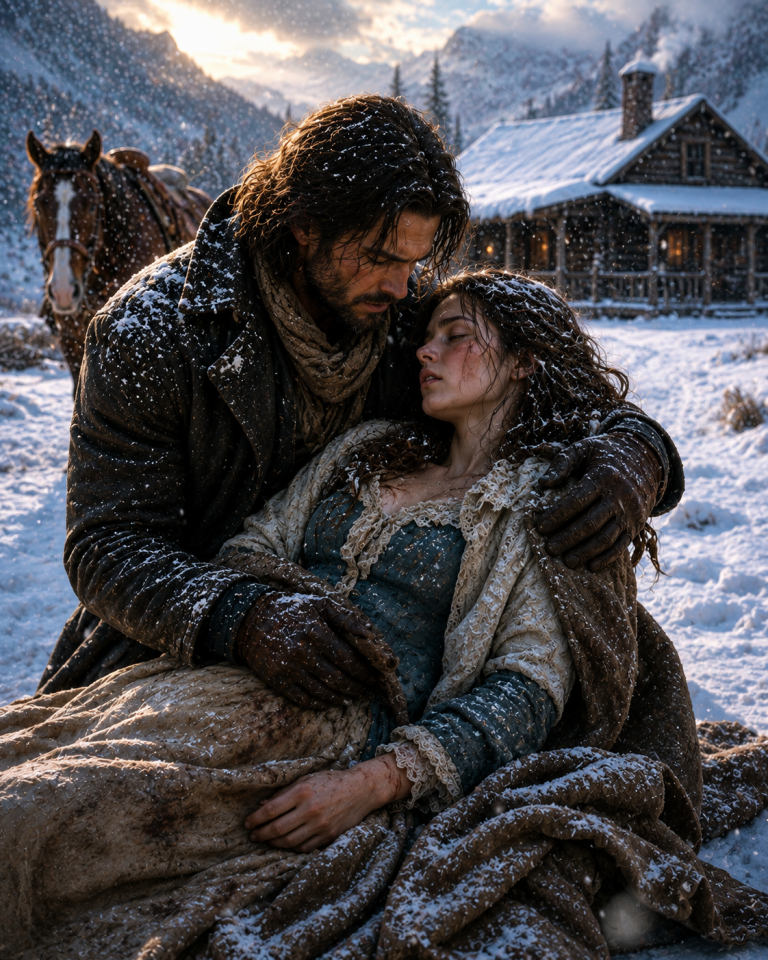
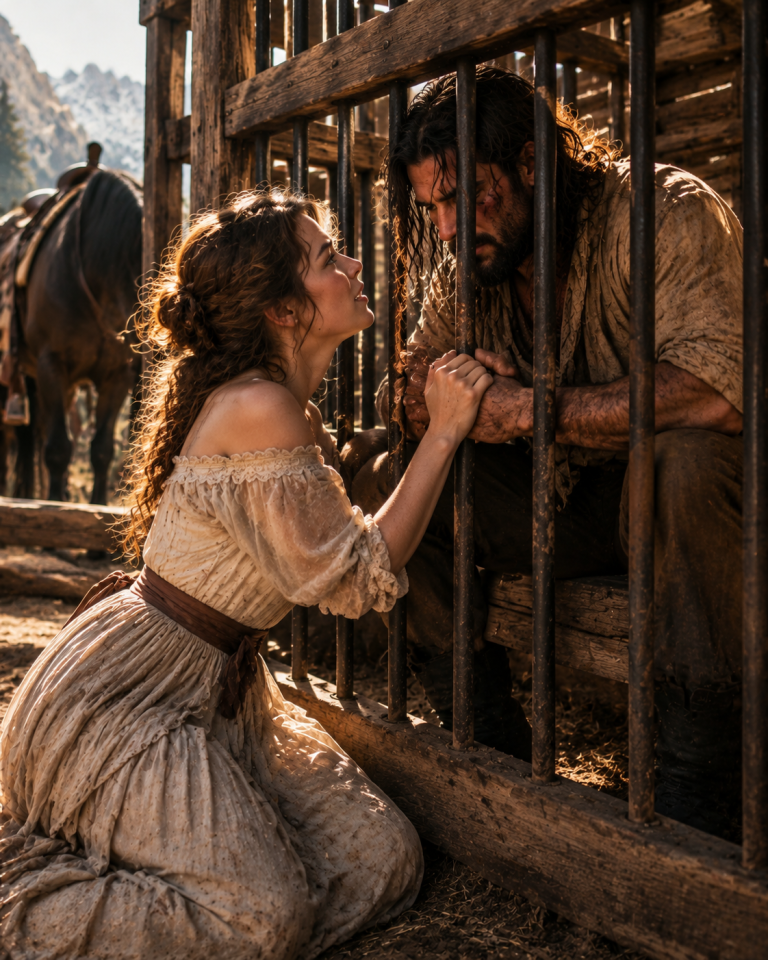
After her in-laws cut off her hair and left her standing in shame, she thought no one would dare look at her—until a silent rancher stepped from the dust and said, “You’re coming with me.”

## PART 1
The first stroke of the shears sounded like bone breaking.
Catherine would remember that sound longer than the pain itself. Pain fades into the body’s larger memory of survival, becomes one sensation among many. But the sound — cold iron closing on a fistful of hair, the metallic bite, the sick little weight of something falling away — that remained sharp.
Thomas Morton had been in the ground for three days when the Harlan family came through the gate.
She was standing on the porch because sitting felt impossible, because the black dress she was wearing still smelled of dye and grief and the particular chemical bitterness of mourning ordered in haste. Thomas’s pneumonia had taken him after two weeks of fever and the sound of drowning in his own lungs. Catherine had nursed him through all of it — every labored breath, every night sweat, every fever dream — and had held his hand when the end came.
The Harlans arrived like a weather system: Margaret Harlan leading, the five brothers spreading behind her in a rough half-circle of muscle and old malice. Samuel, the eldest, broad and dead-eyed. The twins Matthew and Mark, indistinguishable in their hunger for cruelty. Luke with the nervous laugh that always arrived before violence. Benjamin, youngest and somehow the worst because he still had the energy to enjoy it.
Catherine had known they hated her. She had known since Thomas brought her home seven years earlier, an orphan from the city with books and proper speech and a face the family had immediately treated as deception. They wanted Thomas to marry local. They wanted bloodlines, connections, obedience. They had not wanted a woman with nothing to trade except her own labor and her careful literacy.
But knowing the hatred and understanding its shape were not the same thing.
“You lying witch,” Margaret called from the yard. “Couldn’t even wait for him to settle in the ground.”
Catherine gripped the porch rail. “I have done nothing wrong.”
Samuel stepped closer. “Jack Brennan was at the fence yesterday. Talking to you.”
Jack Brennan was a ranch hand from the Turner place next door. He had asked, politely and from a proper distance, whether she wanted help mending a section of fence that had given way. They had spoken perhaps a dozen words.
In the mouths of the Harlans, that had become evidence of betrayal.
They came for her all at once.
One twin seized her wrist. The other took her other arm. Samuel forced her to her knees in the packed earth while Margaret advanced with sheep shears pulled from beneath her skirts, her face made radiant by the righteousness of punishment. The men held her hard enough to bruise. Dust rose with each struggle. She saw Herman Weber driving past in his wagon and deliberately looking away, because no one in the county interfered with Harlan business if they wanted peace to remain possible in their own homes.
The first cut took a curl of auburn hair Catherine had pinned carefully for Thomas’s funeral three days earlier.
The second cut took more.
Margaret worked with ugly concentration — grabbing, hacking, shearing, sometimes catching scalp so that Catherine felt tiny sharp flares followed by warmth. Chunks of hair fell around her like something torn from a different person’s life. Catherine bit the inside of her cheek until she tasted blood because she would not scream for them if she could help it. Tears came anyway, but they were not for the Harlans. They were for the shock of understanding that this was not punishment for false flirtation. This was a declaration. A stripping. A public remaking of her into something they could point at and call ruined.
When Margaret finished, she stepped back breathing hard.
“There,” she said. “Now everyone can see what you are.”
Samuel yanked Catherine to her feet and spun her toward the house.
“Sundown. Everything you can carry.”
“The house—”
“Harlan land,” he said. “Thomas was fool enough to marry you, but this place belongs to the family.”
Catherine heard herself say, “I have nowhere to go,” and hated that the truth had escaped in front of them.
Margaret smiled. “Should have thought of that before deciding to play the whore.”
By noon they had gathered on the porch with bottles and friends, watching her pack. She looked in the mirror Thomas had given her on their wedding day and did not recognize the woman looking back. Her scalp was shorn close and uneven, with little red nicks visible where the shears had bitten too deep. Her eyes looked too large. Her mouth was white with shock.
Still, she moved.
She packed methodically: clothes, her mother’s Bible, the wedding photograph, coins she had hidden, Thomas’s journal from the desk drawer. On its last page, written before fever took his strength, he had written that Catherine had tended him faithfully, that he had chosen well, and that he prayed if something happened to him she would find better than what he had given her.
She cried then — hard and ugly and entirely alone.
Then she dried her face and went on packing.
Luke came into the kitchen under the excuse of watching for theft and stood too close, smelling of whiskey, suggesting other arrangements if she wanted lenience. Catherine took the kitchen knife off the counter and held it between them with a hand that no longer shook.
“Get out.”
Something in her face made him retreat.
By sundown there was nothing left but to go.
At the gate, Samuel caught her wrist.
“If you spread lies about this family, if you claim anything that belongs to us, if you show your face in this county again, I’ll finish what my sister started.”
Catherine met his eyes and saw nothing human there to appeal to.
“I understand,” she said.
She walked.
Behind her they resumed their drinking and their laughter, which continued until she was beyond sight but not beyond sound.
A quarter mile down the road, Mrs. Patterson from the general store rode up and, without dismounting, threw down a blanket and wrapped bread. She would not take Catherine in — the Harlans would burn out anyone who sheltered her — but there was a trapper’s shack three miles north by Bone Creek.
Catherine reached it after dark with blistered heels and the last thread of her strength beginning to fray.
It was barely more than a square of boards and stubbornness. Dirt floor. One bunk. But someone had left dry wood stacked beside an old stove, and the roof still kept most of the weather out.
She lay wrapped in the donated blanket and listened to the desert come alive. Coyotes. Wind. The specific sounds of a land that did not care whether she lived or died. Somewhere around midnight, she thought about ending things — not with drama, but simply. The pain was not acute enough to justify the effort, but the thought sat with her anyway until dawn.
She was still alive when she heard a horse.
One rider. Steady. Deliberate.
He came around the junipers at a walk and stopped about twenty feet from the shack. He was a large man — broad through the chest and shoulders, his face weathered by sun and years of work. Dark hair with strands of silver. Eyes the color of sage honey, watchful and clear.
He took in everything — the shaved scalp, the carpet bag, the shack, the way she had risen with her hand near a knife — with one long, unflinching look.
Then he said, in a voice deep and calm as distant thunder: “You’re Catherine Morton.”
Not a question.
“Daniel Marcus. Double H Ranch.”
She knew the name. Everyone in the county did. Marcus owned one of the largest and most respected ranches west of town. A widower. A man with solid standing. Not a man prone to entangling himself in family ugliness.
“Jack Brennan works for me now,” Daniel said. “He told me what passed between you at that fence. Fixing a fence. Nothing more.”
Relief moved through her so strongly she nearly swayed.
“Why would you involve yourself?”
“My wife died two years ago,” he said. “Before the end, she made me promise something. Said if I had strength and standing, I’d better use both to help people when protection was needed. Said otherwise all that strength meant nothing.”
He gestured to the horse behind him.
“I’m not offering charity. I need help at the ranch. My housekeeper can’t manage alone. Honest work. Fair wages. A room of your own. Protection.”
“And in return?”
“You work,” he said. “Nothing else.”
No hidden smile. No implication. No pressure.
“I can’t pay you back.”
“I didn’t ask you to.”
He paused.
“I’m offering you a choice. Stay here, or come with me. What you decide is yours.”
Catherine looked at the shack, the road, the open country that would gladly finish what the Harlans had started. Then she looked at this man who had come not because he wanted anything from her, but because he had heard a wrong thing happened and decided it mattered.
“On what terms?” she asked.
“Honest work for fair wages,” he said. “Equal standing in the household. Protection. No obligations beyond that.”
She had spent seven years learning that agreements made under duress become chains. She had learned to read the small lies people told. She looked at Marcus and saw no lie.
“I’m coming with you,” she said.
He handed her a wide-brimmed hat. It smelled faintly of leather and clean sweat. It had likely been his wife’s. She settled it carefully over her tender scalp and, for the first time since the shears closed around her hair, felt something like the first outline of dignity being returned.
They rode west.
Halfway there, Jack Brennan intercepted them with news that Samuel Harlan was in town promising to burn out anyone who took her in.
Daniel listened, then sent Jack ahead to tell Esperanza to prepare the blue room and Miguel and the boys to be ready for visitors.
—
## PART 2
The Harlan brothers arrived at noon the next day like a force that believed momentum itself would carry them to victory.
Samuel led them, with Matthew, Mark, Luke, and Benjamin close behind, their horses coming fast enough to throw a hard drumming across the packed ground. Daniel stepped out from the house with a second gun belt on and the settled stillness of a man who had already decided how far he was willing to let things proceed. Miguel, his foreman, came with four ranch hands and spread them along the porch in a loose line that looked casual until you noticed how many rifles lay ready in practiced hands.
“Stay behind me,” Daniel told Catherine. “But don’t hide. They need to see you’re under my protection.”
Samuel found her immediately. “Well,” he called. “She found herself a man. What’s she paying you with, Marcus?”
“Samuel Harlan,” Daniel said, “you’re on my land. State your business or move along.”
What followed was not conversation. It was the systematic dismantling of a lie. Jack Brennan’s name. The truth of the fence work. The property theft. Daniel called them thieves and cowards in front of their own men. Esperanza stepped onto the porch and testified in her dry commanding voice that she had sent medicines during William’s illness and knew exactly how faithfully Catherine had nursed him. Miguel held the ground with his men. Sheriff Dawson arrived at the exact moment before violence became unavoidable and informed Samuel that harassment of a widow who had broken no law was a crime.
The Harlans rode away that day, but only because the math had changed against them.
They did not consider the matter finished.
At the Double H, Esperanza showed Catherine into a bright room with clean linens and a proper bed. She put Catherine to work only after she had eaten and slept — a mercy that felt like the first true kindness given without condition. Work steadied her: sorting linens, chopping vegetables, helping in the kitchen. The kind of work that proved there were still useful things her hands could do.
Daniel sent Miguel and two hands to the Morton place that same afternoon. By nightfall, Catherine’s belongings were returned. The rocking chair Thomas had built for a nursery they never used. Her mother’s teapot. The quilt from her first married winter. Thomas’s books and journal. Every object felt both painful and precious, and their return mattered because it declared what the Harlans wanted buried: that she had belonged to a life they had no right to erase.
Dinner at the Double H that first night felt miraculous.
Everyone ate at the same table — Daniel at one end, Esperanza at the other, ranch hands filling the sides, and Catherine seated at Daniel’s right not as spectacle but as simple fact. No one stared at her bare scalp. No one asked the wrong questions. They spoke about cattle prices, weather, a busted wagon wheel, cards. There was more dignity in that ordinary conversation than in all the polished hypocrisy of Thomas’s family gatherings.
Later, while drying dishes beside Esperanza, Catherine asked the question beneath all the others.
“Why did he really take me in?”
Esperanza did not answer immediately.
“His first wife, Sarah, made him promise he’d use his strength to protect people when protection was needed,” she said. “But there’s more. Daniel had a sister once. Married young to a man who was not kind. She died — ‘accident,’ they said. Daniel was too young and too poor then to help her. Some men live the rest of their lives pretending those things aren’t part of them. Daniel built a ranch instead.”
When Daniel came later to check whether Catherine had settled in, she asked him directly.
“What use is strength if it never stands between cruelty and someone smaller?” he said. “My wife Sarah taught me that. If I’m not going to use what I have to help, then what do I have it for?”
—
## PART 3
For a little while, it seemed the Harlans might settle into distant hatred and do no worse than whisper.
Then the town women came.
Margaret led them to the gate like a general bringing social artillery to finish what brute force had not. Mrs. Peton, the banker’s wife, came with them, along with several of the county’s respectable wives. They did not accuse Catherine of anything direct this time. They draped their venom in concern, propriety, appearances. A single man housing a woman of questionable reputation. Better perhaps if she relocated quietly to California or somewhere she did not embarrass decent society.
Catherine stepped onto the porch with the scarf over her healing scalp and let them see what had been done to her.
“You shaved my head like I was a criminal,” she said to Margaret. “You stole my home. You spread lies about me. And now you come to the one place that has shown me kindness and try to drive me out again.”
Daniel stood beside her and said simply, “She’s wanted here.”
Esperanza’s contribution was even deadlier. She told the women she would begin recounting the shearing in detailed testimony to every church circle and ladies’ society from Carson City to the valley, and would ensure no one forgot exactly who had done it. That threat changed the room faster than any sermon. Cruelty travels easily when its details remain vague. Once made specific, it begins to smell worse.
Mrs. Peton looked directly at Catherine before leaving and said what had been done to her was not Christian.
Margaret retreated, furious.
That night Catherine could not sleep. She found Daniel in the kitchen with coffee and ledgers and confessed what had been gnawing at her.
“I’m bringing trouble to your door.”
He looked up.
“Is that what you want to do? Leave?”
She thought honestly for the first time, and the answer was not merely fear.
“No.”
“Then don’t let them choose for you,” he said. “This place was 160 acres of scrub no one wanted when I started. The world is full of people ready to tell you what can’t be done, who doesn’t deserve help, what kind of shame ought to stick forever. I built this ranch by refusing most of them.”
He spoke then of Sarah and the thing she used to say: that people are all just walking each other home, and strength matters only if it helps someone else stand. In the soft lamplight of that kitchen, with danger still circling, Eliza felt the first deep shift from gratitude into trust.
Jack Brennan came to the ranch the next morning bruised and bloodied. Samuel and his brothers had jumped him in town for helping her. Next time, they had said, it wouldn’t be just fists.
A week later came the fire.
The alarm came from one of the night hands. By the time Daniel, Catherine, Miguel, and the others reached the yard, flames were running the barn beams and pushing sparks hard against the dark. Horses screamed inside. Men cursed. Buckets formed a line from the trough and well. Catherine worked until her hands blistered and her lungs burned, throwing water, cutting halters, hauling frightened animals into the cold. They saved the other buildings only because the wind changed and because every person on the ranch fought like the place itself had blood in it.
By dawn, the barn was a blackened skeleton.
Sheriff Dawson arrived and found oil-soaked rags at three points along the foundation.
It would have ended in another shrug from the law if not for Jimmy, a neighboring boy who had been camping by the creek and saw the Harlan brothers ride up, spread the oil, and light it. He swore to it. His father stood beside him and told him to tell the truth.
That truth carried them to town.
Samuel and his brothers barricaded themselves in the saloon and called everyone liars from the upper windows. The standoff became the talk of the county before it was half over. Daniel arrived with Miguel and the ranch hands, and Catherine, despite his objections, came too. She stood with Esperanza near the general store, watching Samuel rage behind glass while townspeople gathered in numbers large enough to change the shape of courage.
Men like Samuel thrive on isolation. They weaken once a crowd smells their weakness.
Eventually, the saloon owner himself turned on them rather than let his business be shot to splinters over their pride. The brothers surrendered, cursing, filthy, and more frightened than they had ever looked when they had her on her knees in the yard with the shears above her head.
At trial, the judge heard about the shearing, the theft, the assault on Jack, the arson, the campaign of lies. This time the law did not move slowly enough for them to hide inside it. Samuel and his brothers were convicted. Catherine’s property was restored by court order, along with damages paid out of the Harlan estate. It should have felt like triumph. Instead it felt like exhaustion finally given permission to sit down.
On the ride back to the Double H, Daniel asked how she felt.
“Empty,” she admitted. “I thought justice would feel better.”
“It doesn’t make things unhappen,” he said. “It just means you can stop looking over your shoulder.”
That was enough.
She sold the Morton place. There were too many ghosts. With the money, she bought an investment stake in the Double H instead of remaining merely an employee. Daniel tried to object. She told him she did not need rescuing anymore. She wanted partnership.
He held out his hand.
“Partners, then.”
—
The months that followed brought a gentler sort of labor.
Her hair grew back, darker than before and threaded unexpectedly with silver where the scalp had healed badly. She learned to ride properly, to rope, to read weather, to manage accounts for the ranch and a growing school they established on land set aside for valley children. The Double H became known, not loudly but steadily, as a place where broken people might come and not be broken further.
Six months after the fire, sitting beside Daniel on the porch at sunset, she asked him to tell her about Sarah.
He did.
The dead woman who had shaped his life still lived in him honestly, not as a rival but as history. Catherine understood then that love given once does not become counterfeit when given again. It becomes evidence that the heart survived the first wound.
A year later, Daniel rode her into the foothills to a meadow ringed by wildflowers and centered by an old oak.
“This is where I proposed to Sarah,” he said.
Catherine’s heart began to pound.
“I thought I’d never bring anyone else here. Thought it would mean I’d forgotten. But Sarah said love isn’t diminished by being given again. It multiplies.”
Then he went down on one knee in the grass and asked her to marry him.
She said yes through tears and laughter and the unsteady wonder of it.
They married a month later at the ranch with the whole valley in attendance. Even Mrs. Peton came. Esperanza stood witness for Catherine. The vows were spoken under the wide Nevada sky, and for the first time since Thomas died and his family came for her with shears and accusation, Catherine stood in a crowd and felt wholly herself.
Margaret Harlan came to the wedding after the dancing had begun.
Time and disgrace had worn her thinner. She stood at the gate alone and said she had come to apologize. Not because she expected forgiveness. Because the thing she had done was wrong, cruel, and unchristian.
Catherine listened. Then she said, “I forgive you. Not for you. For me. Carrying hatred is too heavy.”
Margaret wept quietly and left.
Later that night, Daniel gave Catherine a deed as a wedding gift: legal half ownership of the Double H. True equality. When she protested, he told her she was not simply his wife but his partner in everything that flourished there.
Then she gave him her own news.
A child, in seven months.
After all those barren years with Thomas, she had thought motherhood closed to her. Esperanza, who confirmed it, only smiled and said sometimes the body waits for the right season, the right safety, the right love.
—
The ranch thrived.
So did they.
For a while.
Then, three years after Samuel had gone to prison, a letter arrived.
He had been released early.
And he was coming for what he considered his.
—
Samuel Coldwell had learned patience in prison and come out more dangerous for it.
He did not return with obvious force. He attacked the life instead of the body. Ranch hands quit after being threatened or bribed. Supply orders vanished between town and ranch. Rumors spread that Daniel Marcus was failing, overextended, on the verge of selling out. Contracts wavered. Credit tightened. Respectable people who had once done business freely with the Double H began weighing the cost of being seen on the wrong side of the Harlan feud.
“He’s trying to isolate us,” Daniel said over the ledgers one evening.
“It’s working,” Catherine admitted.
Young William, three years old and solemn-eyed in the way some thoughtful children are, played at their feet with wooden blocks while his parents counted losses.
When she said perhaps she should leave with the child and go to California, Daniel cut her off at once.
“We don’t run,” he said. “And Samuel Harlan doesn’t get to drive you away again. Never again.”
The first direct strike came at the schoolhouse.
Catherine was teaching when the children screamed. She ran outside and found Samuel on horseback in the yard, thinner than before, harder, the old swagger replaced by something colder and more diseased. He smiled at her and mentioned young William by name.
Jack Brennan and two armed hands appeared quickly and drove him off, but the message had landed. He could reach into the middle of the ordinary day. He could poison even the places she had built for safety.
Weeks later came the final attack.
It began after dark with hired men riding hard toward the ranch under cover of wind and moonless sky. They meant to take the place by speed and terror. Daniel and Miguel met them in the yard with the ranch hands while Catherine, roused from sleep with young William in her arms, understood at once that the house was no safer than the open ground.
She fled upward with the child, across the roofline toward the rebuilt barn loft while gunfire split the night below.
Samuel came after her.
He crashed through the bedroom and followed her roof to roof with a knife in hand and all the old hatred alive in him. When Catherine slipped through the loft window and dropped into the hay with William clutched to her chest, she heard Samuel behind her and knew with a terrible calm that the whole shape of her life had narrowed again to one question: whether she would kneel or not.
She would not.
“Running again?” he called from the window. “Just like that day at your house.”
She raised the rifle she had taken, though she held William with her other arm and knew the position put her at a ruinous disadvantage.
He climbed through anyway.
He said her hair had grown back pretty enough to cut again. He said she had only ever been a frightened nobody who should have vanished when the family ordered it. He called everything she had built a costume, a pretense, a theft.
Catherine set William down in the hay and stood.
“I’m not scared anymore,” she told him. “I’m angry.”
That was the entire truth.
He lunged. She fired and missed because he knocked the barrel aside at the last instant. They crashed together into the hay, fighting at close quarters. For one brutal moment he had the advantage by weight and force, just as the Harlans always had. Then Catherine did the thing he never imagined from the woman he had once held down in the dirt while Margaret cut her hair.
She fought to win.
Not to survive. Not to endure. To win.
She drove her knee up hard, twisted the knife hand, and slammed a loft hook into his face when he tried to overpower her again. He reeled. She seized the dropped rifle by the barrel and drove the stock into his throat. He went down choking just as Daniel reached the loft from below.
The look in Samuel’s eyes then was not rage.
It was the first full recognition of defeat.
“You won,” he rasped.
Catherine, breathing hard, hair loose around her face and child crying behind her in the hay, answered with the clearest truth she had ever spoken to him.
“No. I survived. There’s a difference.”
That ended him.
The hired men broke once Daniel and the others gained the upper hand below. Those who lived testified later in exchange for lighter sentences. The whole attack was laid bare in court: the years of vengeance, the intimidation, the attempt to murder Catherine and threaten her son. This time no one in authority pretended there was room for lenience. Samuel Harlan was sentenced to spend the rest of his life in prison.
Afterward, Margaret approached Catherine in the courthouse and asked for mercy, not for herself but for Samuel’s children, who were now hungry, ostracized, and paying for a father’s crimes.
It would have been easy to refuse.
Instead Catherine thought of Daniel’s words about strength and what it is for, and of the woman she had once been when no one stepped between her and the cruelty. She told Margaret to send the children to the school and the ranch. They would not go hungry. The county heard of it. It became part of the story told about her afterward: not the shaved widow driven into the road, but the woman who chose grace when vengeance was cheaper.
—
Years passed.
The Double H became more than a ranch. It became a place of work, study, shelter, and second chances. Young William grew into a young man with Daniel’s steadiness and Catherine’s clear compassion. More children came after him — Sarah, named for Daniel’s first wife, and James with Catherine’s auburn hair and stubbornness. The school expanded into a proper academy drawing families from three counties. Esperanza and Miguel found their own quiet happiness. Jack Brennan married a local girl and never again let anyone call him weak for kindness.
And Catherine, who had once walked down a road shorn and cast out with a carpet bag and a donated blanket, became the woman the whole valley turned toward when things fell apart.
On the fifth anniversary of Samuel’s final attack, Daniel found her standing in the barn loft where she had made her stand.
“Regrets?” he asked.
She leaned into him and looked over the land they had made.
“No. Only remembering that woman you found in the shack. Sometimes I can barely remember being her.”
“She’s still in there,” he said softly. “She’s just not alone anymore.”
That was true.
Time worked more changes.
The town that grew up around the ranch began calling itself, half-jokingly at first and then more seriously, a place of second chances. Women came in whispers, then in wagons, then openly. Widows. Wives who had run. Girls with children. Families broken by drought or drink or some quieter brutality no one respectable wanted to name in public. The Double H did not become a sanctuary all at once. It simply never stopped saying yes when people arrived needing more than a sermon.
Many years later, when Catherine’s hair had gone silver and her children had children of their own, she visited Samuel in prison.
He was dying.
The old bitterness had worn thin into something smaller and uglier, a life wasted and at last visible as waste. He asked her why she had helped his children. Why she had not let the Harlan name die in shame. Catherine told him that shame is not inherited, that cruelty does not have to echo forever, and that someone once showed her kindness when she deserved it least and she learned then that was when kindness mattered most.
He asked whether she forgave him.
She said she forgave the pain because carrying it longer would only keep injuring her. But forgiveness did not erase consequence. He was still dying in prison because of choices he made. That was justice, not vengeance.
When he asked her to tell his children he was sorry, she told him to write them himself.
Then she left.
On the ride home, she felt lighter. As if one final chain had finally dropped from her body without her knowing she still wore it.
By then the Sunday dinners at the ranch had become tradition. One long extended table in the great room, stretching farther each year as hired hands married, children grew, teachers came and stayed, and the place filled itself with lives it had once only sheltered temporarily. On one such evening, after supper had been cleared and the grandchildren had begun clustering around her chair with the relentless appetite of the very young for old stories, they begged again for the tale they loved most.
“Tell us about when Papa found you.”
“Tell us about the bad men.”
“Tell us about being brave.”
So Catherine did tell it, but differently than she once had.
She no longer told it as a story of shame or even survival alone. She told it as a story about what happens when ordinary people choose not to step aside. When a rancher on horseback says, “You’re coming with me,” and means not possession, but refuge. When a woman in a kitchen opens a door. When a foreman shoulders a rifle. When a boy tells the truth about a fire. When a widow keeps going long enough to become the person other wounded people one day run toward.
“The rancher who said that to me didn’t just save one life,” she told the grandchildren. “He started something that saved hundreds. Every child taught here, every woman sheltered here, every person who learned they were worth protecting — they all came from that moment when someone chose compassion over indifference.”
That night, after the children were sent to bed and Daniel sat beside her in the darkness beyond the porch lamps, another rider came.
A young woman this time. Frightened. Children clinging to her skirts. The old look in the eyes. The look Catherine could recognize now across any distance because she had once worn it herself.
The woman said they had heard this was a place where second chances begin.
Catherine rose without hesitation and went to meet her.
“You’re safe here,” she said.
The woman began to cry.
Inside, Esperanza — or one of the younger women who had long since learned her trade and her spirit — was already setting food to warm. Rooms would be found. Blankets laid out. Work, if wanted, would come later. Dignity first. That was always the order of things.
As Catherine led the newcomers inside, she caught herself in the hallway mirror.
Silver hair gleaming. Face lined by weather, love, grief, and time. A woman very far from the stripped, shorn creature who had once lain awake in a trapper’s shack wondering whether survival by itself was enough to justify morning.
She was the same woman.
Only now made whole by what had happened after.
In bed later, Daniel curled a strand of her silver hair around his finger and asked what she was thinking.
“About circles and straight lines,” she said.
The Harlans had imagined a straight line for her. Shame to exile. Exile to disappearance. A widow erased. A life reduced to a warning. But life had refused the line they drew. It had bent and widened and returned her to herself by way of work, justice, love, children, land, forgiveness, and the slow astonishing mathematics of one human act of decency echoing forward through years.
They had tried to make her into nothing.
Instead, they had driven her toward the place where she would become impossible to erase.
And in the end, that was the deepest justice of all.
*THE END*