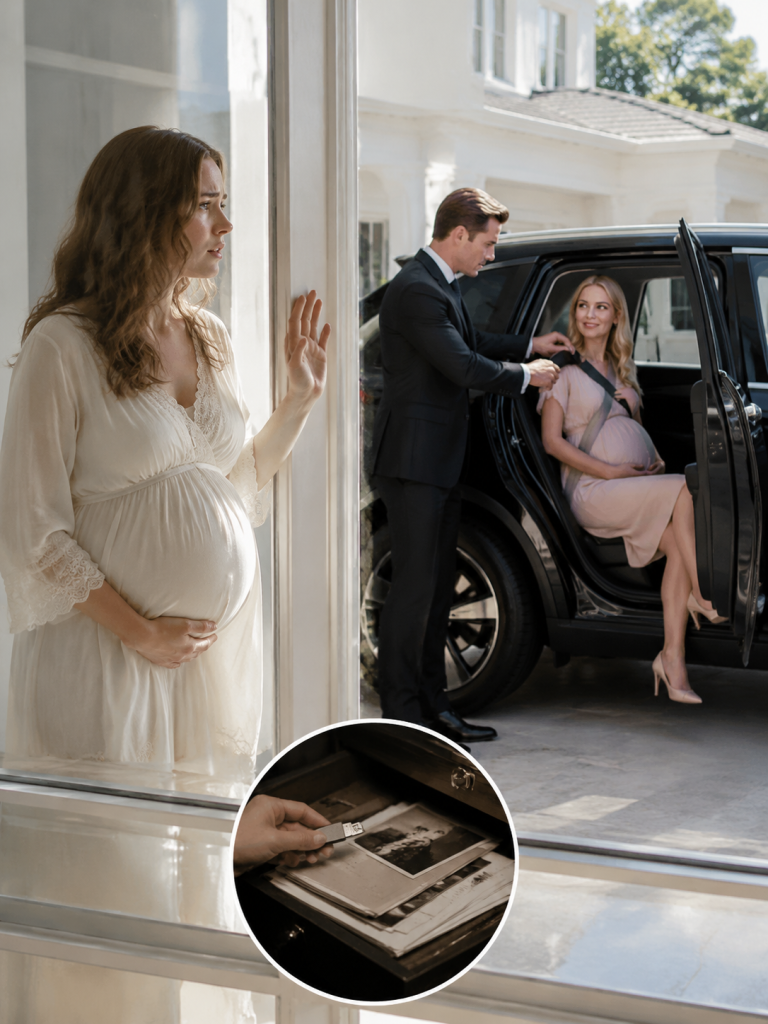
The night she saved a dying mafia boss beneath her floor, she thought fear was the worst price she’d pay—until five years later, he returned with her name on his lips and a promise that sounded more like a threat.

## PART 1
The SUV door shut with a heavy, airtight sound.
Through the tinted glass, the diner became a muted orange glow — her whole working life burning at the edges — and then disappeared as the vehicle pulled smoothly away. No squealing tires. No panic. Nothing cinematic about it except the total, clean efficiency of a man who had decided something and arranged accordingly.
Norah pressed herself against the far door.
Her purse in both hands. Her jacket smelling of fryer grease and a fear she had not finished processing.
The driver was thick-necked and silent.
Renko sat beside her.
Too close.
Too calm.
“You are breathing too fast,” he said without looking at her. “You’ll pass out.”
“You burned down my job.”
“Yes.”
“You bought my apartment building.”
“Yes.”
“I have nowhere to go.”
“You have where I put you.”
“I am not luggage.”
He turned his head.
Streetlights cut his face into pieces — jaw, scar, mouth, shadow — and then rebuilt him before the next one cut him apart again.
“What do you want from me?” Norah demanded. “You said I paid the debt. Five years of nightmares, why not just let Antonov finish it?”
His answer came without hesitation.
“Because I do not let people touch what falls under my protection.”
“I don’t fall under anything of yours.”
“No,” he said. “But your survival belongs to the debt I owe.”
That was not better.
“Grigori Antonov is not a man running a business,” Renko continued. “He is grief wearing a coat. He lost brothers, territory, money, standing. To him, you are not a woman who made a decision under pressure. You are the reason I survived long enough to ruin him.”
Norah stared.
“If he finds you, he will not kill you quickly. He will take everything first. Work. Friends. Your home. Your name. Then he will send me whatever is left.”
He said it without decoration.
That made it worse.
Norah looked out at the blurring city.
She had traded a graveyard for a cage.
The drive was an hour. Neon gave way to highway, highway to dark road, dark road to a private drive through old trees. Rain against the roof. Gravel under tires. Security lights appearing through the forest like cold white eyes.
The estate looked less like a home than a fortress that had taken lessons in architecture.
Dark stone. Steel beams. No warm porch light. Cameras tracked their arrival with small mechanical sounds.
Norah stepped out and shivered.
The air smelled of wet leaves and money.
Renko walked past her.
“Inside.”
The foyer was vast, slate-gray marble, their footsteps echoing. Abstract paintings on the walls. No photographs. No clutter. No evidence that anyone inside had ever laughed by accident.
A woman appeared from a side hallway. Simple black dress. Silver hair. Face unreadable.
“Sofia,” Renko said. “East wing.”
The woman nodded.
“Lock exterior doors.”
“Am I a prisoner?” Norah asked. Her voice echoed back before she finished.
Renko stopped at the base of the glass staircase and turned.
For the first time, he seemed to actually consider the question.
“You are a guest who requires protection.”
“Guests can leave.”
“You can walk out the front door whenever you like. The gate is five miles down the private road. The woods are monitored. The highway beyond has no lights.” He paused. “If Grigori’s people do not reach you before dawn, the exposure will.”
His voice dropped.
“You are not a prisoner, Norah. You are out of better options.”
He walked upstairs.
Sofia led her down a corridor lined with arched windows looking into black forest. At the end of the hall, an oak door opened into a room larger than Norah’s entire apartment.
King bed. Dark duvet. Sitting area. A bathroom of white marble and glass. A closet large enough to hide a family in. Beautiful, sterile, and impersonal.
“Clothes are in the closet,” Sofia said. “Bathroom is stocked.”
She nodded once and left.
The door clicked.
Norah crossed the room and twisted the handle.
Locked from the outside.
A hysterical laugh rose in her throat and died there.
Not a prisoner.
She dropped her purse. It tipped, spilling chapstick, keys to an apartment she no longer owned, and crumpled tip money across a rug probably worth more than everything she had accumulated in twenty-eight years.
She sat on the floor.
She did not cry.
Crying required some faith that things would be different afterward. She had no such faith left.
She stayed on the floor until the cold came through her clothes. Then she stood, went to the bathroom, turned the shower as hot as it would go, and stepped under it in her diner clothes.
She scrubbed her arms and hands and face until her skin hurt.
It did not work.
In the closet she found new clothes with tags removed. Charcoal sweatpants. A cashmere sweater. Sneakers in her size. Underwear.
All her size.
He had prepared for her.
The precision was more frightening than the lock.
She put on the sweater. It was impossibly soft. The kind of soft that made poverty feel like a skin condition.
She climbed into the enormous bed and stared at the ceiling until dawn.
—
## PART 2
Morning arrived without garbage trucks or shouting neighbors.
It came as gray light through the window and, at exactly eight o’clock, the electronic click of her door unlocking.
No one entered.
Norah sat up, heart hammering.
A controlled kindness.
She hated it.
Her stomach growled. She had not eaten since yesterday afternoon. Survival meant eating, even in cages.
She found the kitchen by following the smell of coffee and butter. It looked like a magazine spread built for people who had staff to clean it. Renko sat at a glass table near a bay window, no suit jacket, dark fitted shirt, looking larger without layers — all controlled muscle and old violence under skin.
A younger man with a broken nose stood near the counter.
He saw Norah first.
His hand moved toward his waistband.
Renko did not look up from his tablet.
“Norah is a guest.”
“Guest?” the man repeated.
Renko swiped the screen. “Damir. Tell me why the Port Three shipment was delayed four hours.”
Damir swallowed.
“Customs changed the inspection rotation. We waited them out.”
“I pay the supervisor twenty-five thousand a month to ensure surprises do not surprise me.”
“He said internal affairs is watching.”
Renko set the tablet down.
The soft tap sounded like a decision.
“If internal affairs is near Port Three, someone on the dock is talking. Find who. Remove the ability to talk again.”
Norah’s breath caught.
Both men looked at her.
Vincent watched her face.
“Damir. Out.”
Damir left quickly, giving Norah a wide berth.
She stood in the doorway.
“You just ordered a mutilation over coffee.”
“I ordered protection of my business.”
“Is that what you call it?”
He gestured to the chair across from him.
“Sit. There is food.”
Her body obeyed before pride could intervene.
That frightened her.
She sat, keeping her hands in her lap, nails digging into her palms.
“You are terrified of me,” Renko observed.
“You burned my diner down and ordered someone’s tongue removed before breakfast. Should I compliment the kitchen instead?”
Something in his eyes shifted.
“You knew what I was that night.”
“I knew you were bleeding and the police were outside.”
“A man with a bullet in his shoulder who cannot go to a hospital is not usually innocent.”
“I didn’t care if you were innocent,” she said. “I cared whether I got arrested.”
“Pragmatic.”
“Poor.”
“That too.”
He lifted the lid from the platter between them.
Eggs. Thick bacon. Toast. Fruit. Butter in a dish.
Her stomach cramped.
“Eat.”
She hated the command.
She hated more that she needed it.
The eggs were soft and buttery. She swallowed around the tightness in her throat.
“You need to understand something,” Renko said. “I am not a good man. I will not insult you by pretending otherwise. But while you are inside these walls, nothing touches you without going through me.”
“You say that like a promise.”
“It is.”
“It sounds like a threat.”
“It is also that.”
At least he did not lie.
That was the first terrible thing she respected about him.
Three days passed like slow poison.
Norah counted steps. She memorized corridors. She learned that Sofia appeared without sound and served meals with the expression of a woman who had seen bodies moved through expensive rooms and had folded her opinions neatly years ago.
Luxury felt like a bribe.
Egyptian cotton. Perfect pressure in the shower. Coffee that did not taste burned. Clothes that fit as if someone had taken her measurements from a distance.
None of it belonged to her.
By the fourth night, inactivity turned toxic.
At ten o’clock she left her room and walked barefoot toward the west wing, following the smell of old paper and gun oil.
She found an open library door.
A single desk lamp cast warm light over a mahogany desk. Renko sat in the pool of it with a disassembled handgun spread on black cloth. Sleeves rolled to his elbows. Scars silvered his forearms. He cleaned the gun with mechanical precision, each movement silent.
“You walk heavy on your left heel,” he said without looking up.
Norah stepped into the room.
“Old injury.”
“Rains make it worse.”
“That was not a question.”
“No.”
“Do you catalog everyone like this or am I special because I stitched your shoulder badly?”
“You stitched it adequately.”
“That is not an answer.”
“No.”
She crossed her arms.
“I am going insane in this house.”
“There are books.”
“I need work.”
The gun clicked.
“You are a target, not staff.”
“I need to do something with my hands.”
“You need to stay unseen while I dismantle Antonov.”
“I am not made of porcelain.”
He looked up.
“No,” he said. “Porcelain breaks more quietly.”
The sentence landed strangely.
Not an insult.
An observation.
Norah uncrossed her arms.
“I survived the South Side. I survived clinic shifts, a diner, two landlords who considered heat a luxury, and five years of waking up every time rain hit a window wrong. I can handle inventory. Cooking. Organizing. Something.”
“You want to earn your keep.”
“I don’t take charity.”
“This is not charity. It is quarantine.”
“I don’t care what you call it.”
Renko studied her for a long moment. The dark circles. The rigid shoulders. The hands that never fully relaxed. The anger keeping her upright.
He opened a drawer and tossed a thick folder to the edge of the desk.
“You were a clinic aide.”
“I organized supplies and covered nurses who did not show.”
“You stitched a bullet wound under police pressure with stolen materials.”
“That is not a résumé.”
“It is more useful than most.”
Norah looked at the folder.
“I have men on port rotation,” Renko said. “They get cut, bruised, burned. Hospitals create questions. Sofia will show you the basement medical room tomorrow. Inventory everything. Make a list. When one of my men bleeds, you patch them.”
Norah stared.
By accepting, she would become function inside his machinery.
Not prisoner. Not guest.
Useful.
That should have frightened her more than it did.
Purpose moved through her like warmth through a room that had been cold too long.
“Why give me something real instead of locking me in the east wing until the war ends?”
Renko stood.
He was a foot taller, and the room seemed to remember it.
He leaned over the desk, not touching her, but close enough that cedar overpowered gun oil.
“Because a caged animal with nothing to occupy it eventually occupies itself destructively,” he said. “And I need you whole.”
He turned off the desk lamp.
Darkness swallowed the library.
“Inventory starts at eight. Do not be late.”
She was not late.
The basement medical room was not what she expected.
She expected a box of gauze and expired painkillers.
Instead, Sofia unlocked a steel door and revealed a clinical space cleaner than the walk-in clinic where Norah had once worked. Stainless cabinets. A refrigerator for temperature-controlled medications. An exam table. Surgical lights. Abundant supplies arranged with the organizational logic of someone who did not think about organization.
“This is an illegal urgent care,” Norah said.
Sofia’s face remained blank.
“Mr. Renko dislikes unnecessary hospital visits.”
“I imagine hospitals dislike him too.”
“Mutual.”
Norah almost smiled.
She worked eight hours.
She found expired antibiotics, mislabeled sutures, unlogged medications, cheap gloves beside sterile ones, and enough organizational stupidity to push fear aside for entire stretches of time. She made lists. She rearranged. She labeled. She built intake forms on paper because men who moved shipping containers across oceans had apparently never considered writing down who was allergic to penicillin.
By evening, Renko appeared at the door.
Norah was on a step stool organizing IV tubing.
“This is unacceptable,” she said without turning.
A pause.
“The room?”
“The system. There is no system. There are expensive supplies arranged by memory.”
“Sofia knows where everything is.”
“Sofia is not a protocol.”
Renko looked at Sofia, who stood in the corner with the expression of a woman who had been waiting years for someone to say this.
Norah climbed down.
“I need a locked medication log, a sharps disposal schedule, a sterilization checklist, and if any of your men lie to me about allergies, I will let them itch.”
For the first time, Renko smiled.
Small. Visible.
It changed his face enough that Norah looked away.
“Approved,” he said.
Two days later, Damir was carried in with a knife wound along his ribs.
Norah froze for one second at the blood.
Real.
Hot.
Fresh.
The copper smell hit her and she was back in the closet, back in the rain, back in the apartment where a stranger’s blood had mapped itself across her floor.
Then Damir groaned, “I’m fine.”
Her body snapped into work.
“No, you’re dramatic. Sit down.”
Renko watched from the doorway as she cleaned, checked depth, snapped at Damir for moving, and taped the bandage with hands that steadied the more necessary they became.
When she finished, Damir muttered, “Thanks.”
Norah threw the bloody gauze in the disposal bin.
“Duck faster next time.”
Damir looked at Renko.
“Can she talk to me like that?”
Renko’s eyes stayed on Norah.
“Yes.”
—
The illusion of safety shattered at 2:14 a.m.
Norah was awake, watching the clock. Rain slammed against bulletproof glass with the particular sound it had when she had learned to be afraid of it. Her ankle ached. The room smelled of cedar soap and insomnia.
The door burst open.
Renko stood in the frame wearing black tactical gear, Kevlar vest, rifle across his chest.
The calm was gone.
“Shoes. Now.”
“What—”
“*Now.*”
She scrambled out of bed. Her hands shook so badly she could barely push her feet into sneakers. Renko grabbed a wool coat from the closet and threw it at her.
“They breached the lower gate. The mole at Port Three gave them access codes. We are leaving.”
The house had become chaos.
Boots on stairs. Men shouting in the corridors. Emergency lights washing the walls red.
Renko grabbed her arm and pulled her through a back stairwell. They emerged in an underground garage where two armored SUVs idled in red-washed exhaust.
Arthur was behind the wheel of the lead vehicle.
“Back floorboards,” Renko ordered.
Norah stumbled climbing in. Her untied lace caught the running board. Her knees hit metal hard enough to send pain up her thighs.
She curled between the seats.
Renko slid above her and slammed the door.
“Go.”
The SUV launched forward.
Norah pressed her cheek to the floor mat. It smelled of rubber and old rain. Then she clamped her hands over her ears as the vehicle hit the road.
“They’re on us,” Arthur called.
The rear window flashed white.
Then sound arrived.
Not movie gunfire.
Real gunfire.
Concussive. Battering the reinforced glass above Renko’s head until it spiderwebbed into milky starbursts.
“Down,” Renko snarled.
He cracked his window and fired. The blasts inside the cabin were agony. Gunpowder filled the air.
Then Arthur screamed, “RPG—”
The world turned white.
The blast did not hit directly, but close enough. The SUV lifted for one impossible second. Then gravity brought them down. Metal screamed. Tires shredded. The vehicle spun across wet asphalt and crashed into a pine.
Airbags exploded.
Silence.
Impact silence.
The kind filled with ringing ears and smoke and bodies deciding whether they still belonged to the living.
Norah lay pinned beneath Renko’s weight.
She could not breathe.
His vest crushed her ribs. Dust filled her mouth. Something warm dripped onto the back of her neck.
Blood.
Real.
Not memory.
“Renko,” she rasped.
He did not move.
Outside, boots on wet gravel.
A flashlight swept through the fractured glass.
A voice with a heavy accent: “Check the cabin.”
Her fear should have frozen her.
It almost did.
Then her hand found his wrist.
Pulse.
Weak.
Present.
Five years of trying to forget collapsed into one clear truth.
She had saved him once by reflex.
This time she would have to do it on purpose.
—
## PART 3
Norah forced herself to breathe shallowly beneath Renko’s weight.
The SUV smelled of airbag chemicals, blood, wet rubber, and spent gunpowder. Rain hissed against the crushed hood. Somewhere under the dashboard, a warning chime rang in a stupid, persistent rhythm.
Boots crunched closer.
A flashlight swept the windshield.
“Driver first.”
Arthur groaned in the front seat.
Alive.
Good.
Norah reached carefully toward Renko’s vest. Her fingers found a sidearm clipped near his hip. She had never fired a gun. She hated guns. She hated what they did to bodies and to rooms and to the people who survived what happened in them.
But she knew tools.
And fear, when focused, became instruction.
She drew the pistol slowly.
Renko’s hand closed over her wrist.
Norah nearly cried out.
His eyes opened a fraction. Dark. Unfocused. Furious at being alive inconveniently.
“No,” he breathed.
“Then move.”
He could not.
The rear door handle jerked.
Locked.
A shot cracked the window.
The glass fractured but held.
Norah’s mind moved.
Rear passenger door warped. Front blocked by the tree. Arthur conscious but bleeding from his scalp. Renko wounded somewhere beneath the armor. Antonov’s men expecting helpless survivors.
She grabbed the emergency flare from the door pocket.
Shoved the pistol into Renko’s hand.
“If you can shoot, shoot. If you can’t, make a scary face.”
His mouth twitched despite the blood on his lip.
The rear door was forced open from outside.
Rain exploded into the cabin.
A masked man leaned in.
Norah struck the flare against the striker.
Red light burst into the dark.
She drove it into his face.
He screamed, stumbling backward, hands flying to his eyes.
Renko fired once.
The sound punched the cabin.
The man dropped.
Arthur slammed the car into reverse. The engine screamed. The vehicle barely moved, pinned against the tree, but the jolt threw the second attacker off balance. Renko fired again through the open door. The second flashlight vanished.
“Out,” Renko rasped.
“You are on top of me.”
“Complaining means alive.”
“I will haunt you if you bleed out.”
“That sounds like motivation.”
He rolled with a sound that came from somewhere deep in bone.
Norah crawled out through the open rear door into rain and mud. Her knees hit gravel. Pain shot through her bad ankle. She ignored it and turned back.
Renko tried to stand.
Failed.
Blood darkened his side beneath the vest.
Not his shoulder this time.
Lower.
Worse.
“Where?” she demanded.
“Not now.”
“Where?”
“Left side.”
She pressed her hand to the wound.
Blood soaked her palm fast.
“Through and through?”
“No.”
“Bullet still in?”
“Yes.”
“Wonderful. You collect terrible hobbies.”
Arthur emerged from the front, one hand pressed to his head, pistol in the other.
More headlights appeared in the rain.
Norah looked at the road. The ditch. The tree line. A drainage culvert running under the private road.
“There,” she said.
Renko followed her gaze.
“No.”
“Yes.”
“That culvert floods.”
“So does dying.”
Arthur fired two shots into the rain to buy seconds.
Norah grabbed Renko under his uninjured arm.
“Help me.”
“I can walk,” he growled.
She looked at his side.
“You can lie to me later.”
Arthur half-carried, half-dragged Renko toward the culvert while Norah pressed both hands to the wound. Rain washed blood down her wrists. The copper smell was everywhere, as close as breathing.
But something had changed.
It did not own her.
It informed her.
Bleeding rate.
Pressure.
Temperature.
Shock signs.
The culvert was narrow and cold and echoing, water rushing around their ankles. Arthur covered the entrance. Norah shoved Renko against the curved concrete wall and tore open his vest straps.
“Stay with me.”
“I am here.”
“You sound bored. It is rude.”
“I am in pain.”
“Good. That means something is still functioning.”
She ripped his shirt with a folding knife Arthur handed her.
The wound was deep and ugly. Not spurting. Deep enough to kill him slowly.
“Pressure,” she told Arthur.
He dropped beside them and pressed a folded cloth to Renko’s side.
Renko hissed.
Norah pulled off her wool coat and sweater, leaving herself in a thin tank top in freezing rainwater. She used the sweater to reinforce pressure. Her hands moved faster than thought. Five years of trying to forget collapsed under training she had never truly lost.
“He needs antibiotics, fluids, surgical extraction, and a real doctor,” she told Arthur. “How far is the safe house?”
“Twenty minutes if roads are clear.”
“They’re not clear.”
Gunfire cracked outside.
She looked at Renko.
His face had gone gray.
“Who knew the route tonight?” she asked.
His eyes sharpened despite the pain.
“What?”
“The lower gate codes were leaked. The route was hit. Who knew we would use that garage?”
“Inner crew.”
“Name them.”
“Arthur. Damir. Sofia. Two security leads.”
“Damir was in the kitchen when you mentioned Port Three.”
Renko’s jaw tightened.
“He is young.”
“And scared.”
Arthur swore quietly.
Norah pressed harder.
“You said someone on the dock was talking. What if Damir is not the only leak? What if the house was not breached because Antonov found me, but because someone wanted you moving through that route specifically?”
Renko looked at her.
“Tonight they fired an RPG at your SUV,” she said. “They did not try to take me. They tried to kill you.”
Arthur’s eyes widened.
Renko’s breathing slowed.
Not from weakness.
From calculation.
“The leak is not about her,” Arthur said. “It is about you.”
Renko closed his eyes once.
When he opened them: “Sofia.”
Norah blinked.
“She has been with the estate twelve years,” Arthur said.
“Exactly.” Renko’s voice was quiet. “Only Sofia knew the backup route out through that garage. Only Sofia controlled the east wing door locks. Only Sofia knew Norah had been given basement access.”
Gunfire outside stopped.
That was worse.
A voice called from the road.
“Renko. Send the woman out. You get a quick death instead of a slow one.”
Norah went still.
Renko’s hand closed around her wrist.
“No.”
She looked at him.
“They think I am leverage.”
“They are right.”
“No,” she said. “They are wrong.”
Before he could stop her, she pulled free, took the pistol Arthur had set on the ground, and crawled toward the culvert entrance.
“Norah.”
She ignored him.
Rain blurred the road. Two men moved near the crashed SUV. A third at the tree line. Farther back, a pale figure in a long coat held a phone to his ear.
Damir.
Not Sofia.
Damir — face young, pale in the headlights, smiling.
Young. Scared. Ambitious. Useful.
A pawn, not a planner.
She raised the pistol with both hands.
Too far. Too dark. Too shaky.
She did not aim at Damir.
She fired at the SUV’s leaking fuel trail.
Once.
Twice.
The sparks did nothing.
She saw the flare still burning near the rear door.
She fired at the flare casing.
It jumped, rolled through the fuel-slicked puddle, and the ground bloomed orange.
The blast was smaller than movies promised.
Large enough.
Antonov’s men dove for cover.
Arthur surged out behind her and fired cleanly.
One man dropped his weapon.
Another ran.
Renko’s security team, drawn by the explosion, arrived from the tree line. The ambush collapsed. Men who expected injured prey found an armed crew, a burning vehicle, and Norah Vale standing barefoot in mud, shaking, holding a gun she did not know how to lower.
Damir tried to run.
Arthur caught him.
By dawn, they reached the safe house.
A reinforced barn behind a ridge road. A doctor arrived with a surgical kit and the expression of a man accustomed to removing bullets at inconvenient hours.
Norah refused to leave the room.
Renko, pale and sweating on the table, looked at her.
“You can go.”
“No.”
“That is not a request.”
“Good. I’m ignoring it.”
The doctor glanced at Renko.
Renko closed his eyes.
“She stays.”
Norah stood near his head through the procedure. She handed instruments. Checked gauze. Counted sponges. When his blood pressure dropped, she caught it first.
“Fluids faster,” she told the doctor.
He looked up.
“Now.”
He obeyed.
Two hours later, Renko was alive.
Norah walked outside into the gray morning and threw up behind the barn.
Then she sat on wet grass and laughed until the sound became something dangerously close to crying.
Arthur found her there and held out a blanket.
“You saved him twice,” he said.
She wrapped the blanket around her shoulders.
“I’m beginning to think he is careless.”
Arthur smiled faintly.
“Only around you.”
—
That afternoon, Renko woke.
Norah was in a chair beside the bed. Hair damp. Borrowed clothes muddy. Hands bandaged from small cuts she did not remember getting.
His eyes opened.
“You look terrible.”
She stared at him.
“You’re welcome.”
His mouth curved faintly.
Then the curve disappeared.
“You should have stayed in the culvert.”
“You should stop needing emergency care in the rain.”
“Fair.”
She leaned back.
“I found your leak.”
“Yes.”
“You almost died.”
“Yes.”
“You burned my life down for protection, then your own house handed us to Antonov.”
The room went quiet.
Norah stood.
“I am done being cargo moved between dangerous men.”
His jaw tightened.
“That is not what you are.”
“Then prove it.”
He said nothing.
She stepped closer.
“You said I was a guest, then locked my door. You said you were protecting me, then burned my job. You said you owed me, but you paid that debt by removing every choice I had.”
His eyes held hers.
She expected anger.
She got silence.
“I saved you because I chose to,” she said. “Twice. Not because I belong to you. Not because your debt gives you rights over my life. If I stay in this, it is because I decide. If I leave, you do not burn my options, buy my building, or send men to find me.”
Renko breathed carefully.
Painfully.
“If you leave unprotected, Antonov will take you.”
“Then offer protection without ownership.”
The room seemed to stop.
Arthur, near the door, looked at the floor.
Renko was quiet for a long moment.
“Terms,” he said at last.
Norah blinked.
“What?”
“You want choice. We make terms.”
Not romantic.
Better.
A beginning that did not pretend teeth were flowers.
“My room locks from the inside.”
“Yes.”
“I work in the medical room because I choose to, and I am paid.”
“Yes.”
“I leave the estate with security when I ask. Not when you decide I have earned sunlight.”
His mouth tightened.
“Yes.”
“No one touches my medical supplies without my permission.”
“Yes.”
“You do not call me yours.”
He went very still.
“Protection is not possession,” she said.
The monitor beeped.
Then Renko said, quietly: “Agreed.”
Arthur exhaled as if he had been holding his breath for years.
Norah nodded.
“Good. Sleep. You look awful.”
Renko’s eyes closed.
“You are very rude for someone under my protection.”
“Under contract.”
His mouth curved faintly.
“Under contract.”
—
The war did not end in one night.
Wars like his rarely did.
Sofia disappeared into the city with stolen codes and route maps. Damir broke under questioning and admitted he had been paid, threatened, and promised a position if Renko fell.
Norah did not ask what happened to Damir afterward.
She asked once whether he was alive.
Renko looked at her for a long moment.
“Yes.”
That was enough.
For now.
The estate changed after the attack in ways no outsider would see.
Norah’s door locked from the inside. She was given a phone with numbers she had chosen. The medical room became hers in practice before anyone said so aloud.
She built a real system.
Intake records under coded names.
Allergy charts.
Inventory logs.
Rotating emergency kits.
Burn response cards taped inside cabinet doors.
She forced men twice her size to wash their hands before sitting on her exam table. She threw out a new guard for dripping blood across her floor without pressure on the wound. She made Arthur hold an ice pack over his eyebrow for twenty minutes while he muttered about worse injuries.
“I do not care what you survived,” she told him. “I care what you infect.”
Word spread.
Not publicly.
Quietly.
The Renko estate had a woman in the basement who could stitch skin, challenge men, and make Renko himself wait outside if he was disturbing the patient.
The first time it happened, the room went silent.
Renko looked at the man on the table.
Then at Norah.
“Excuse me?”
“You heard me.”
“This is my house.”
“This is my room.”
Arthur coughed into his fist.
Renko’s eyes narrowed.
Norah held the look.
After ten seconds, Renko walked out.
The patient whispered, “Are you insane?”
Norah snapped on gloves.
“Probably. Hold still.”
Outside, Renko leaned against the wall and smiled where no one could see.
—
They found Sofia through an allergy.
A specific antibiotic had gone missing from the emergency kit — not valuable, not common. Norah checked inventory and remembered Sofia mentioning a grandchild once.
“You said she had no family,” Norah told Renko.
“She claimed none.”
“People lie about family when family is the weakness.”
They traced a prescription network through the allergy. Sofia had a grandchild in debt to Antonov.
Grigori had not bought her loyalty.
He had bought her fear.
When Renko’s men located Sofia in a motel outside Albany, Renko prepared to go himself.
Norah appeared in his office doorway.
“Do not kill her.”
He looked up.
“She handed us to Antonov.”
“She was protecting her grandchild.”
“She betrayed this house.”
“Yes.”
Norah stepped inside.
“And if you kill every frightened person who was forced into betrayal, you teach the next one to stay quiet until more people die.”
Renko stared at her.
“She nearly got you killed.”
“She nearly got *you* killed,” Norah corrected. “I’m harder to finish.”
Arthur made a sound near the wall.
Possibly a laugh.
Renko looked at him.
Arthur became stone.
Norah continued.
“Bring her in. Use what she knows. Give the grandchild protection if they cooperate. Make fear expensive for Antonov. Not for the people he cornered.”
Renko leaned back.
“You are advising me on how to run my organization.”
“I am preventing infection.”
“In my organization?”
“In your judgment.”
He should have been angry.
Instead, he listened.
Sofia came back alive.
Ashamed.
Older than Norah remembered.
She sat in the medical room while Norah taped a cut on her cheek. Renko stood in the corner, silent as a held decision.
Sofia did not ask forgiveness.
That made Norah respect her more.
“He said he would hurt her if I didn’t help,” Sofia whispered. “My granddaughter.”
Norah finished the tape.
“I believe you.”
Sofia looked at Renko.
“The man inside the customs chain is named Harpur. He plans to hit the clinic shipment next Thursday. He knew—” She stopped. “He knows that she will come if people are hurt.”
The room chilled.
Grigori had finally understood Norah.
Not as a phantom.
Not as collateral.
As a pattern.
She did not run from bleeding people.
That was the trap he would set.
—
On Thursday night, the trap was ready on Renko’s terms.
A medical supply shipment moved through Port Three. Publicly, it belonged to a nonprofit clinic network. Quietly, it was bait.
Norah sat in an armored van with her medical bag between her boots, her hair tied back, her hands steady.
Renko sat across from her.
“You should not be here.”
“We discussed this.”
“I hated it then too.”
“They will not believe the bait if I am not close enough to bite.”
He exhaled.
“You enjoy saying things that make me want to lock doors.”
Norah looked at him.
“And you don’t.”
He said nothing.
“Good,” she said.
The ambush came near a warehouse by the river.
A truck overturned across the road. A man lay on the pavement, screaming about his leg, blood pooling too brightly. Norah recognized theatrical blood. She had cleaned enough real blood to know the difference.
But one of Renko’s younger guards stepped forward anyway.
A shot cracked.
He dropped.
That blood was real.
Norah moved before Renko could grab her.
She slid from the van, keeping low, medical bag in hand. Gunfire shattered the night. Renko cursed and returned fire from behind the van door. Arthur moved the team into cover.
The wounded guard was twenty feet away.
Young.
Bleeding from the thigh.
Arterial.
“Norah!”
Renko’s voice cracked across the road.
She ignored it.
She crawled through broken glass and rainwater until she reached the guard. His eyes were wide with panic.
“I don’t want to die,” he gasped.
“Then stop wasting breath arguing.”
She tied the tourniquet high and tight. He screamed. Good. She packed gauze, pressed hard, and dragged him inch by inch behind a concrete barrier while bullets struck sparks from the pavement around her.
Then the warehouse lights came on.
Grigori Antonov stepped into view on the second-floor catwalk.
Tall. Thin. Gray hair. A face like old paper stretched over wire. A pistol in one hand.
“Norah Vale,” he called. “The little aide who ruined my family.”
Renko raised his rifle.
Grigori stepped behind a pillar.
“You come with me, and the boy lives,” Grigori said. “You stay with Renko, everyone bleeds.”
Norah looked at the guard.
Tourniquet holding.
Pulse rapid but present.
She looked at Renko.
His eyes said no.
Every line of his body said no.
She stood anyway.
Slowly.
Hands visible.
“Renko,” he said.
She looked at him.
“Trust me.”
The words struck them both.
He had demanded this without earning it.
She was asking for it with open eyes.
Renko lowered his rifle a fraction.
Norah stepped into the open.
Rain soaked her hair and ran down her face. Her heart hammered. Every survival instinct screamed to get small, hide, disappear. Five years of making herself invisible rose in her throat like old water.
But hiding had brought Grigori to every door she ever had.
She lifted her chin.
“You want to know why your brothers died?” she called.
Grigori’s face hardened.
“Because you protected him.”
“No,” Norah said. “Because they missed.”
The men around Grigori shifted.
Renko went completely still.
“They had police in the streets, guns in the alley, and a city on their side,” Norah continued, voice rising through the rain. “And then a twenty-two-year-old clinic aide with stolen gauze put your operation in a closet with a bottle of vodka and a locked door.”
Grigori raised his pistol.
“You think that is bravery?”
“No. I think it is humiliating.”
The silence spread.
Norah took one step closer.
“You spent five years hunting a ghost because you could not survive the idea that your empire fell apart after a broke woman made a practical decision in a bad apartment.”
Grigori’s finger moved.
Renko moved.
Norah shouted: “Now.”
The young guard she had dragged behind cover fired the emergency flare she had pressed into his hand.
Red light arced upward and burst against the warehouse window.
Not a weapon.
A signal.
Renko’s people hidden along the river wall opened fire on Grigori’s exposed positions. Arthur’s team cut off the rear exits. A federal task force, tipped through channels Norah did not ask about, stormed the far side.
Grigori understood too late.
Norah had not stepped into the open as bait.
She had stepped out as the clock.
The operation lasted eleven minutes.
When it ended, Grigori Antonov lay wounded on the catwalk — alive enough to face charges, ruined enough to understand he had lost to the woman he thought was a loose end.
Renko reached Norah first.
He grabbed her shoulders, then stopped himself so abruptly that his hands hovered.
“Are you hit?”
“No.”
“Are you sure?”
“Yes.”
“You walked into open fire.”
“I walked into a plan.”
“You could have died.”
“So could your guard.”
His face twisted with something that could not decide whether it was fury or relief.
“You are not expendable.”
Norah looked up at him in the rain.
“Neither am I yours.”
He closed his eyes for one second.
When he opened them, the rage had shifted into something more accurate.
“No,” he said. “You are not.”
—
Three months later, the city believed a simplified story.
Grigori Antonov had been arrested in a multi-agency operation connected to port corruption. Several officials resigned. The Renko organization was, publicly, not involved. The diner fire was electrical. Norah Vale had moved.
That last part was true.
She moved out of the life that had been built entirely around surviving fear.
Not into Renko’s bedroom.
Not into his name.
Into a renovated brick building two miles from the port, where the first floor became a discreet night clinic for people who could not go to hospitals without risking arrest, deportation, debt, or worse.
The sign on the door said Vale After-Hours Care.
Sofia worked the front desk three nights a week after her granddaughter entered a protection arrangement Norah personally reviewed. Arthur handled security. A new supply clerk stocked shelves exactly according to Norah’s labels because she had made her expectations clear on his first day and he had not tested them since.
Renko funded the clinic.
Norah owned it.
The paperwork was very clear.
She made sure of that.
The first night it opened, rain fell softly.
Norah stood in the exam room arranging sutures, gauze, tape, antiseptic, gloves, and a stack of intake forms. The smell of disinfectant rose clean and sharp. Not like bleach covering something terrible. Like preparation.
Renko appeared in the doorway.
Dark coat.
No gloves.
He almost never wore them anymore in rooms that were hers.
“You built a system,” he said.
“I always do.”
“Better than mine.”
“Yes.”
His mouth curved.
She looked at him.
“You can come in if you are not bleeding.”
He stepped inside.
They stood in the room where her past had become purpose.
Renko looked at the supplies.
Then at her.
“I owe you a life,” he said.
“You keep saying that.”
“It remains true.”
Norah placed a roll of gauze in a drawer.
“Then spend yours better.”
“How?”
“Stop collecting people like debts. Start paying attention before they betray you. Fear is not loyalty. It is rot with a timer.”
He absorbed that.
Slowly.
Like a man learning something in a language he had resisted.
“And you?” he asked.
“What about me?”
“What do you want?”
The question should have been simple.
Norah thought of the South Side apartment. The closet. The diner. The burning neon. The locked room. The culvert. The warehouse. The first time she told Renko no and watched him choose to hear it.
“I want my door to lock from my side,” she said.
“It does.”
“I want my work.”
“You have it.”
“I want to stop smelling copper every time it rains.”
Renko’s face softened in the smallest possible way.
“I cannot give you that.”
“No,” she said. “But you can stop being the reason it comes back.”
He took that without defense.
The quiet stretched between them.
“I am trying,” he said finally.
Norah nodded.
“I know.”
Months passed.
The clinic became known in whispers. A dockworker with a crushed hand. A young woman with a split lip who would not say who caused it. A teenager with a fever and no insurance. A Renko man who apologized before bleeding on Norah’s floor because Arthur had warned him.
Norah worked until exhaustion became familiar again.
But this time it did not feel like hiding.
It felt like choosing.
Renko came often.
Sometimes with blood on his cuff.
Sometimes with files she had not asked for but could use.
Sometimes with coffee that was too expensive and, occasionally, badly made.
He learned to knock before entering any room that belonged to her. He learned not to use possessive language unless he was prepared to have it corrected. When he failed, she told him. When she told him, he listened.
That was not a miracle.
But it was enough to build on.
One night, a storm rolled over the city and rain battered the clinic windows hard enough to rattle the frames.
Norah stood in the supply room with her hands braced on a shelf and her eyes closed. The copper smell had returned. Not as strong as before. But there.
She heard footsteps stop at the doorway.
Renko.
She knew his silences.
“Norah.”
“I’m fine.”
“No.”
She almost argued.
Then did not.
“I hate rain,” she said quietly.
“I know.”
“I hate that it still finds me.”
He did not enter until she looked at him.
“May I?”
She nodded.
He came in slowly.
No grabbing. No command.
Just presence.
Norah turned and pressed her forehead against his chest because she chose to, because the door was open, because she could leave and did not want to.
His arms came around her carefully.
Cedar was there.
This time it did not erase the copper.
It stood beside it.
A second scent.
A present one.
A reminder that not all nights with rain ended the same way.
“I never thanked you properly,” Renko said quietly.
“You burned down my job. That was your version of a thank-you.”
His chest moved with a quiet sound.
“I am serious.”
“So am I.”
He pulled back enough to see her face.
“Thank you for opening the door five years ago.”
Norah looked at him.
“I almost didn’t.”
“I know.”
“I hid you because I was afraid.”
“You still saved me.”
“I did a terrible stitch.”
“It held.”
She smiled faintly.
“That is basically my entire life philosophy.”
His thumb brushed her cheek.
“Mine used to be simpler.”
“Kill first, think later?”
“Something like that.”
“And now?”
He looked around the supply room. The labeled shelves. The clean gauze. The locked cabinet with her name on the log. The woman who had taken his debt and turned it into a place where blood did not automatically mean death.
“Now,” he said, “I ask who is bleeding before I decide who deserves the bandage.”
Nadia stared at him.
“That might be the least terrifying thing you have ever said.”
“I am improving.”
“Don’t get arrogant.”
“Too late.”
She kissed him first.
Not because danger had made him romantic.
Not because power had cornered her choices.
Because the man who had dragged her into his world by force had finally learned to stand still and let her cross the distance herself.
—
Years later, people still told the story wrong.
They said Norah Vale saved a mafia boss and he claimed her in return.
They said Renko burned her diner to protect her.
They said the woman in the clinic belonged to a dangerous man because dangerous men had always been good at turning women into legends they could own.
They were wrong.
Norah did not belong to Renko.
She did not belong to the South Side, or the diner, or the fear that had made her sleep with a knife in her nightstand. She did not belong to the night a bleeding man fell through her doorway and changed the shape of her life.
Norah belonged to herself.
That was why Renko loved her.
Not because she hid him.
Not because she saved him.
Because after years of being dragged, locked away, hunted, and used as leverage, she still stepped into the rain and decided what happened next.
The first time she saved him, she did it with stolen gauze and bad sutures.
The second time, she did it under a wrecked vehicle with gunfire in the trees.
The third time, she did it more slowly.
She taught him that protection without choice was only another kind of violence.
And in return, he gave her the one thing no man had managed to give her without turning it into a debt.
A door that opened from her side.
Rain still came.
It always would.
But now, when it struck the clinic windows at 2:14 a.m., Norah no longer heard only the night the world decided to bleed on her floor.
She heard footsteps in the hall.
A knock before the door opened.
A city full of people who might survive because she had stopped hiding.
And sometimes, if Renko was there, she heard his voice behind her, low and no longer a command.
“Tell me where you need me.”
Norah would look at the rain.
Then at the supplies ready on the shelf.
And she would answer like a woman who had finally learned the difference between a cage and a home.
“Wash your hands first.”
—
*THE END*