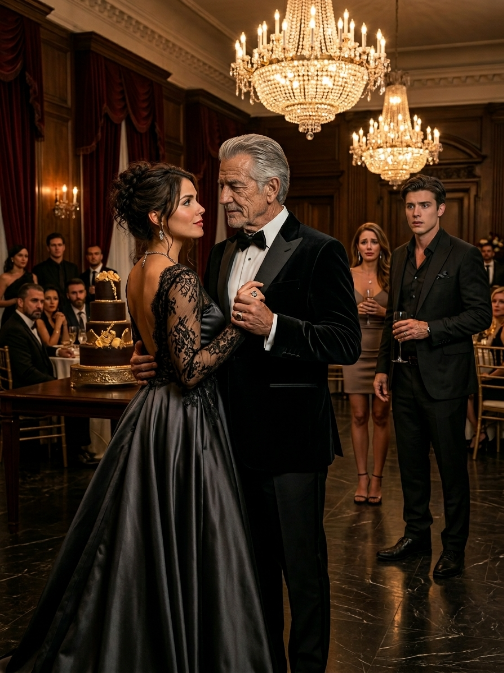
Just as the woman thought her darkest secret was buried forever, the Mafia Boss ordered everyone out—then froze when her perfume hit the air, and said five words that turned her blood cold.

PART 1
She had spilled nothing.
She had said nothing.
She had simply walked to the corner booth with a tray of wine and done what she had done a hundred times before — leaned slightly, set the glass, prepared to disappear.
That was when the man looked up.
Not at the wine.
Not at her face.
At the air just above her wrist.
The change was so small she almost missed it.
One breath.
A stillness that traveled from his body outward like a dropped stone traveling across still water.
And then, quietly enough that only she could hear:
“Where did you get that scent?”
Nina Castillo — six years at Castello’s, best tips on Thursday nights, three double shifts a week since her mother’s diagnosis — had received stranger questions from men at corner tables.
She had learned to answer them pleasantly and move on.
“I’m sorry?”
The man’s eyes found hers.
Dark.
Not unkind.
Not kind either.
Just — precise.
“The perfume,” he said. “On your wrist.”
Behind her, the restaurant continued its elegant performance.
Silver clicked against porcelain.
Someone laughed at the bar.
The pianist modulated into something melancholy.
“It was my grandmother’s,” Nina said, because there was nothing threatening in the question and she had learned to pick her fears carefully when she needed the income.
The man set down his glass.
He did not look away from her.
He lifted two fingers.
The manager appeared with the terrified speed of a man who had practiced terrified speed.
“Mr. Amorelli.”
“Clear the room.”
The manager’s smile died behind his teeth.
“Sir, we have—”
“Clear it.”
Nina stood very still.
The restaurant took less than four minutes to empty.
She watched Miami’s most expensively dressed people gather their coats and their dignity and file through the front door without argument, without protest, without a single raised voice.
Some of them had not finished their appetizers.
A woman in a red silk dress paused at the exit and looked back at Nina with an expression that might have been pity.
Then the doors closed.
Then the lock turned.
Nina heard it.
Marco Amorelli rose from the booth.
He was taller standing than she had expected.
He crossed the distance between them slowly, the way men who never needed to rush moved through space — like the room was already his and always had been.
“I’m not going to hurt you,” he said, stopping a few feet away.
Nina looked at the locked doors.
“Men who mean that don’t usually lock exits.”
Something shifted in his expression.
Not amusement, exactly.
More like recognition.
“You sound like someone I used to know.”
“Most people sound like someone you used to know. That’s not a reason to clear a restaurant.”
“No,” he agreed. “This is.”
He closed his eyes.
Breathed in once, deliberately, the way a person breathes near something they thought was gone forever.
When he opened them again, he looked like a man standing over a grave that had just opened.
“That perfume,” he said, “was made once. For one family. By a woman who understood that certain things should outlast the people who carried them.”
Nina’s palm went cold around her serving tray.
She thought of her grandmother, Valentina, who had lived like a woman running from something she never named.
Who had changed phone numbers annually.
Who had flinched at black cars idling too long outside their building.
Who had clipped coupons and hidden savings in a coffee tin and pressed a small crystal bottle into Nina’s hand from a hospital bed and whispered: this will find the right person before you do.
“What family?” Nina asked.
Marco’s eyes stayed on her.
“Mine.”
—
His name was Marco Amorelli, and he was the kind of man about whom Miami whispered rather than spoke.
Nina learned this from the manager, Fabian, who reappeared once the dining room had been cleared and stood near the kitchen door with the nervous energy of a man who desperately wanted to be somewhere else.
She learned little else from Fabian.
He disappeared within minutes.
So did the bartender.
So did the two servers who had been on shift with her.
Which meant that Nina stood alone in a room of abandoned wine glasses and guttering candles with a mafia boss who believed her grandmother’s perfume was connected to his family.
She set the tray down on the nearest table.
If her hands were shaking, the tray was steadier than she was.
“My grandmother’s name was Valentina Moreau,” she said. “Before she married my grandfather she was Valentina Castillo. She was a nurse. She raised me and my mother in an apartment on the west side of this city, and she died three weeks ago in a hospice on Brickell Avenue with nothing more expensive than a library card in her wallet.”
Marco watched her the whole time she spoke.
“You know her name,” Nina said. “I can see that you do.”
“Yes.”
“How?”
He crossed to the booth he’d been sitting in, not sitting down but resting one hand on the table, like a man needing anchor.
“Because Valentina Castillo left this city thirty-two years ago with my brother’s child and a promise that she would vanish completely. And for thirty-two years, she kept it.”
The room went very quiet.
Nina heard her own breathing.
“Your brother.”
“Rodrigo.”
“And the child.”
Marco held her gaze.
“Your mother, Nina. Your mother is Rodrigo’s daughter. Which makes you—”
“Don’t,” she said.
He stopped.
“Don’t finish that sentence until I’ve had time to—”
Her voice broke on the last word.
She pressed her lips together.
Breathed through her nose.
Did what she had done every time bad news arrived with her mother’s name attached — put the air in, put the air out, stay vertical.
Then a package appeared.
It arrived the way things arrived in rooms like this — not through the front door, not through the back, just suddenly present in the hands of a man Nina hadn’t seen enter, set quietly on the table near Marco without ceremony.
No return address.
No postage.
Marco opened it.
Inside was a photograph.
Nina, tonight, outside Castello’s service entrance, taken close enough to read the name tag on her uniform.
And written in black marker across the bottom:
SHE DOESN’T KNOW YET. DOES SHE?
Nina stared at it.
“Who took that?”
Marco’s face had gone still in a way that was different from his usual stillness.
More internal.
More dangerous.
He turned the photograph over.
Ran his thumb along the backing.
Pressed at one corner.
A sim card fell out onto the table.
He inserted it into a device his man produced.
A video file opened.
Valentina.
Not old.
Not sick.
Maybe fifty.
Filmed in a kitchen Nina didn’t recognize, the blinds drawn, speaking directly at the camera the way people speak when they don’t know if the recording will survive them.
“If Nina is watching this, then the perfume found its way home. That’s good.”
Nina’s legs stopped working correctly.
She gripped the edge of the booth.
“The perfume is not the evidence,” Valentina said, voice steady and very tired. “It’s only a key. What they’ll need is what I hid before I left. Inside the drawing. The one Nina has had since she was twelve.”
Nina made a sound she didn’t recognize.
On screen, Valentina pressed her lips together the way Nina pressed her lips together.
“Rodrigo didn’t just create a trust for your mother. He documented everything Enzo Gardoni did with it afterward. The full transfer chain. Everything Enzo buried. It’s all encoded in the bottom layer of the painting I gave Nina for her birthday.”
The video ended.
Nina stood in a room that had rearranged itself around her without moving at all.
Marco looked at her with the expression of a man recalibrating everything he thought he understood.
“What drawing?” he asked.
Nina’s voice came from somewhere far away.
“It’s in my apartment.”
He looked toward the locked front doors.
Then at his phone.
His expression shifted in a way she had learned, in the last forty minutes, to read as concern rather than calculation.
“We need to get there first,” he said.
“First?”
He turned the photograph over again.
The timestamp on the image was forty minutes ago.
Forty minutes.
The same moment she had set down his wine glass.
“Someone already knows you’re here,” Marco said. “And they know why.”
Nina looked at the locked doors.
At the empty restaurant.
At her own reflection fractured in the abandoned crystal glasses across the tables.
And she realized that whatever her grandmother had spent thirty-two years hiding from, it had known where to find Nina long before tonight.
PART 2
The drive took eleven minutes.
Nina sat in the back of Marco’s car with her hands flat on her thighs and the city moving past the window in long amber smears and said nothing because there was nothing that fit inside a sentence yet.
Marco sat beside her, phone to his ear, speaking in short clipped phrases she wasn’t meant to parse.
When they reached her building, she saw it before he pointed it out.
The service entrance door.
Slightly ajar.
She always locked it when she left.
Always.
Marco’s hand came down gently on her arm.
“Stay.”
She did not stay.
She went first because it was her home and she knew where every shadow sat.
The apartment had been entered carefully.
Neatly, almost.
Someone who wanted her to believe nothing had been disturbed.
But the painting on the bedroom wall was one inch too far to the left.
Nina crossed the room and lifted it off its hook.
The canvas felt normal.
Looked normal.
A watercolor landscape, blues and grays, a farmhouse in rain.
Valentina had given it to her wrapped in brown paper on the morning of Nina’s twelfth birthday and said: keep this where you can see it.
Nina turned it over.
On the backing board, faint, almost invisible beneath a secondary layer of paper that had been sealed and painted over: numbers.
Account strings.
Names in her grandmother’s precise small handwriting.
Transfer dates running four years in sequence.
And at the bottom of the column, two words underlined twice.
GARDONI. PROOF.
Marco stood in the doorway.
He looked at the backing board.
He said nothing for a long time.
Then: “She had this the entire time.”
“She gave it to a twelve-year-old,” Nina said. “Because she knew nobody would look.”
Marco’s jaw tightened.
Then his phone rang.
He answered.
His expression changed immediately — something entering it that Nina had not seen yet.
Not anger.
Not strategy.
Something rawer.
He lowered the phone.
Looked at Nina with the face of a man who has just been handed one impossible truth too many.
“Enzo Gardoni is downstairs.”
Nina looked at the painting in her hands.
At the numbers written by a woman who had spent thirty-two years being careful.
And she felt something cold and exact move through her chest.
Not fear.
Clarity.
“Then he already knows what’s up here,” she said.
“Yes.”
Nina looked at the door.
Then at Marco.
“How long has he known about me?”
Marco’s silence was its own answer.
And in the second before the lobby buzzer sounded, Nina understood that tonight was never about the perfume finding the right person.
Tonight was about Enzo Gardoni deciding that thirty-two years was long enough to wait.
PART 3
The lobby buzzer went off twice.
Short, deliberate.
The kind of ring that wasn’t asking permission.
Marco’s man, Dante, appeared in the doorway and spoke quickly.
Marco answered in kind.
Then the apartment went into a particular kind of stillness that Nina recognized — not silence, but the held breath before a decision.
“How many?” Marco asked.
“Three cars,” Dante said. “Enzo plus six.”
Marco looked at Nina.
“There’s a back stairwell.”
“I know,” she said. “I’ve used it during three separate fire alarms.”
She set the painting down on the bed, pulled the backing board free with both hands, folded it twice along its natural seam, and tucked it inside her server’s apron still tied at her waist.
Marco watched her.
“You’re not going to panic,” he said. It was not a question.
“I panic in the shower,” Nina answered. “Not in front of people who need me functional.”
Something moved in his face that wasn’t quite a smile.
Too tired to be a smile.
Too real.
“Valentina would have said exactly that,” he said.
They went out through the back.
—
The Gardoni name meant something specific in this city.
Not what the Amorelli name meant — which was power, structure, a force that organized itself along functional lines even when those lines ran dark.
The Gardoni name meant something older.
Meaner.
The kind of family that had built its holdings not by being more capable than others but by ensuring others couldn’t become capable at all.
Nina learned this in fragments across the next six hours, sitting across from Marco in a private room above a restaurant that he owned three blocks from the waterfront, the painting backing spread on the table between them, a forensic accountant named Dora — sixty, silver-haired, reading glasses on a chain — moving a magnifying glass slowly across Valentina’s handwriting.
“This is a full transfer record,” Dora said, with the calm of someone whose emotions had been replaced by professional satisfaction. “Origin account. Destination. Shell intermediaries. Three layers of obfuscation, but your grandmother numbered them in sequence.” She looked up. “She understood how audits work.”
“She was a nurse,” Nina said.
Dora set the magnifying glass down.
“She was also apparently a forensic accountant.”
Marco stood near the window.
“Rodrigo put that money into trust for your mother the year before he died,” he said. “Separated from family holdings. Clean assets. Property, investments, a structured account. Enough that your mother would have been—”
“Comfortable,” Nina said.
“Yes.”
“Instead she lives in a care facility in Kendall that smells like industrial cleaner and I work doubles to cover the gap between her Medicare and the real cost.”
Marco didn’t look away.
“Yes.”
“And Enzo Gardoni stole it.”
“Enzo Gardoni’s father orchestrated the original disappearance of the trust. Enzo inherited both the money and the maintenance of the lie.”
“How long have you known?”
The question sat in the air.
Marco turned from the window.
“I suspected. I didn’t have proof. What your grandmother compiled—” he gestured toward the backing board — “this is what I couldn’t find. She had the original transaction records. She must have had someone inside the bank before she left.”
“She had a childhood friend,” Nina said slowly. “A woman named Greta. She worked in finance. Grandma never talked about her except to say she owed her more than she could repay.”
Greta.
A woman Nina had never met, who might have handed her grandmother a photocopied ledger thirty-two years ago and been the actual turning point of this entire night.
“Did Enzo follow us?” Nina asked.
“No,” Marco said. “He went to Castello’s first. He thought the restaurant would be easier.”
“He’s been watching me.”
“For some time, yes.”
“How long?”
Marco hesitated.
That hesitation told Nina everything.
“How long,” she said again, flat.
“We believe since the hospice contacted him about Valentina’s admission. The Gardoni family has contacts in several South Florida medical systems. Standard practice for them — tracking family lines they have reason to monitor.”
Nina pressed her palms flat on the table.
Took the air in.
Put the air out.
“He knew she was dying,” she said. “He waited until she was gone and then started watching me.”
“Yes.”
“Because a grieving woman clearing out her grandmother’s things is a better opportunity than a living woman with someone watching her back.”
“Yes.”
Nina looked at the folded backing board.
At the handwriting that had survived three decades of fear and poverty and calculated silence.
“She knew he’d wait her out,” Nina said. “She told me. She said men like that have all the time in the world and they use every second of it.”
“Valentina was correct about most things,” Marco said quietly.
“Not about this. She thought hiding was the answer. She thought keeping me ignorant kept me safe.” Nina’s voice didn’t break, but it thinned. “Meanwhile Enzo was building a file on me. He knew where I worked. He knew about my mother. He knew I wore the perfume.” She looked up. “How long have you known the perfume existed?”
“My grandmother created it. I knew it existed in theory. I didn’t know Valentina still had it. I didn’t know she gave it to you. I went to Castello’s tonight because I was meeting a contact — your perfume was not something I anticipated.”
Nina studied him.
“You’re telling the truth.”
“I try to, when it costs me nothing more than embarrassment.”
“What does it cost you when it costs something more?”
Marco looked at his hands on the windowsill.
“That depends on the night.”
—
Dora finished her analysis at two in the morning.
She removed her reading glasses and set them on the table with the specific finality of a woman who had found exactly what she expected.
“This is actionable,” she said. “The transfer sequence is complete. The shell identifiers are numbered and matchable. With the right forensic financial team and a lawyer willing to file without getting bought off, you could freeze every clean asset the Gardoni family holds before they knew what was coming.”
“Define ‘right lawyer,'” Nina said.
“I have one,” Marco said.
Nina looked at him.
“Not a family lawyer.”
“No. A federal one.”
“You have a federal lawyer.”
“I have a woman who used to work for the DOJ and now operates independently for clients she personally approves. She does not approve of men like Enzo Gardoni.” He paused. “She does not particularly approve of men like me either, which is useful — it means she handles both sides without favoritism.”
Nina thought about that.
“What do you get out of this?”
Marco’s expression was careful.
“The Gardoni family has operated in competition with mine for twenty years. They have always had a layer of legitimate holdings that insulated them from consequences. Your mother’s trust is woven through the foundation of those holdings. If it unravels—”
“They lose the insulation.”
“Yes.”
Nina was quiet for a moment.
“So I’m useful to you.”
Marco didn’t deny it.
That, more than anything he had said in the last four hours, made her believe him.
“Your grandmother left me a message too,” he said. “Not on the video. Earlier. Years ago.”
Nina looked up.
“She had someone deliver a letter after Rodrigo died. I was twenty-six. It said that she was keeping what Rodrigo had given her — not the money, not the trust, but the document that proved where the money went. She said she would not use it while she and your mother and you were alive and findable. She said that if she died before the situation resolved, the perfume would do what she couldn’t.”
“She sent you a letter?”
“A very short one.”
“What did it say at the end?”
Marco looked at the window.
“It said: protect the girls, and I’ll protect the proof. Fail to do one and the other becomes irrelevant.”
Nina stared at him.
“She never told me about you.”
“No. She told you about the perfume. She let it do the introduction.”
The city hummed beyond the glass.
Somewhere below, cars moved through streets that didn’t know any of this was happening, which was the strange thing about nights like this — the world continued its ordinary business while inside specific rooms, the weight of thirty years shifted all at once.
“I want to meet the lawyer,” Nina said.
“Tomorrow morning.”
“I want copies of everything Dora photographed.”
“Already made.”
“I want to be present for every conversation.”
“I would not conduct them otherwise.”
Nina looked at him steadily.
“And I want you to understand something, Mr. Amorelli. My grandmother spent thirty-two years poor so that I would survive long enough to be sitting in this room. She counted pills at the kitchen table and cried in the pantry where she thought I couldn’t hear and said no to every small pleasure because the margin was too thin. My mother is lying in a care facility right now wondering if the insurance is going to cover the next round of treatment.”
Marco said nothing.
“Whatever alignment of interests brought us to the same table tonight, I am not a move in your game. I am the person this actually belongs to.”
Marco’s gaze was steady.
“Yes,” he said. “You are.”
Nina nodded once.
“Good. Then let’s start.”
—
The lawyer’s name was Helena Voss.
She came to them the next morning in a spare office above a printing shop in Wynwood — not her own office, not Marco’s, a neutral space that smelled like toner and coffee and indifference.
She was sixty, compact, with close-cropped gray hair and reading glasses she put on and took off repeatedly as she moved through the documents.
She made no sound while reading.
No reactions.
Not a raised eyebrow or a pursed lip.
Just motion — page, next page, photograph, next photograph.
When she finished, she looked at Nina.
“Your grandmother compiled this over how many years?”
“I don’t know exactly. At least the last decade. Probably more.”
“She had forensic training?”
“She was a nurse.”
Helena considered that.
“Some nurses become extraordinarily precise under pressure. They learn to document because documentation is the difference between a patient living and dying.” She set the pages down. “This reads like someone who understood that the same principle applied to everything else.”
Nina thought of Valentina’s hands.
Always moving.
Writing lists, keeping receipts, numbering envelopes.
“She was precise,” Nina said.
“Yes,” Helena agreed. “And it’s going to help enormously.”
She looked at Marco.
“You stay out of the filings.”
Marco’s mouth opened.
“Completely,” Helena said. “I mean it. Your name on any document near this case turns it from a trust dispute into an organized crime matter. We have enough organized crime in the background already without importing more through the front door.”
Marco sat back.
“Understood.”
Helena looked at Nina again.
“This will take time. Not as much time as they expect, because they expect you to be afraid. But time.”
“How much?”
“Two months for the initial freeze petition. Potentially six months for full recovery. Litigation could extend that.” She removed her glasses. “Are you prepared for six months of Enzo Gardoni knowing what you’ve filed?”
Nina thought about that honestly.
“Is my mother safe?”
Helena looked at Marco.
Marco said: “Yes.”
“Then yes,” Nina said.
Helena put her glasses back on.
“Good. I have questions.”
—
The freeze petition was filed on a Tuesday.
By Wednesday morning, three shell companies had begun dissolving.
By Wednesday afternoon, two of them had received emergency preservation orders.
Nina was at Clear View Memory Care when Marco called with the update.
She stepped into the hallway outside her mother’s room, phone pressed to her ear, watching through the small window as a nurse straightened Sofia’s blanket.
Sofia had a good day that week.
Confused about the year, but clear about faces.
When Nina had walked in that morning, Sofia had said: “You look like your grandmother when she was fighting about something.”
Nina had laughed.
More than the situation required.
Because it was true.
“The Gardoni attorneys have filed a response,” Marco said. “As expected. They’re calling the documents forgeries.”
“Of course they are.”
“Helena anticipated this. She’s prepared a chain of custody argument using the original storage records and the provenance of the crystal bottle — apparently the bottle itself has a maker’s mark that traces to a specific craftsman my grandmother commissioned in 1987. Impossible to replicate.”
“Grandma kept the bottle for thirty-two years,” Nina said.
“She kept everything for thirty-two years,” Marco said. “That is the point.”
Nina watched her mother through the window.
Sofia was holding the photograph Nina had brought last week — Valentina at maybe forty, standing outside the apartment building, squinting in the sun with the specific expression of a woman who has no patience for being photographed.
“She recognized her,” Nina said.
“Sorry?”
“My mother. She recognized the photo. She said: she always looked like that, like she was about to argue with the sun.”
A silence came through the phone.
Then Marco said: “My brother said something similar about her. That she was the only person he’d ever met who made you feel like you were being corrected and cared for at the same time.”
Nina pressed her forehead briefly against the cool of the window frame.
“Why didn’t he protect her better?” she asked. Not angry. Genuinely asking.
“Because he underestimated Enzo,” Marco said. “And because men who grow up with power often make the mistake of believing it will extend to cover the people they love.”
“Do you make that mistake?”
A pause.
“I have,” he said. “I’m trying not to make it now.”
—
Enzo came to the restaurant three weeks later.
Not Marco’s restaurant — Castello’s.
Nina’s restaurant.
The place she had returned to because she needed income while the case progressed and Helena had been firm about optics: a waitress filing for recovery of stolen assets needed to look like a waitress, not like someone already spending money that hadn’t been recovered yet.
She was carrying a tray to a four-top near the windows when she saw him sit down in her section.
Enzo Gardoni was seventy-three and looked like money that had been left in the sun — dried out, slightly yellowed, still valuable but no longer soft.
He sat with the particular ease of a man who had never once doubted his welcome.
Nina finished delivering the tray.
She straightened.
She walked to his table.
“Good evening,” she said. “Can I start you with something to drink?”
Enzo looked up at her.
“Sit down, Nina.”
“I’m working.”
“I know.” He glanced around the restaurant. “I also know that the woman at the bar in the green dress is not a restaurant customer, and the man near the emergency exit nursing water is not thirsty. So the theater we’re doing for their benefit can probably skip the opening act.”
Nina kept her server’s expression — pleasant, neutral, nothing.
“I don’t know what you mean. Can I bring you something?”
Enzo smiled.
It was the smile of a man who had been doing this for fifty years and found it more tedious than threatening.
“Your lawyer is very good,” he said. “The freeze petition was tight. Helena Voss — I remember her from the DOJ. Difficult woman. Principled, which is its own kind of difficult.”
“I’ll let someone know you’re ready to order.”
“The documents your grandmother kept,” Enzo continued, as if she hadn’t spoken, “are compelling. Not insurmountable — we have our own documentation, our own accountants, our own timeline. But compelling. It will be a long process.”
Nina set her notepad on the table.
“Would you like to hear today’s specials?”
Enzo’s eyes met hers.
“How much?” he said. “That’s really all this is. Name a number. One that covers your mother’s care, covers your own trouble, and lets both families close a file that has been open too long.”
Nina looked at him for a moment.
“My grandmother chose thirty-two years of poverty over accepting something like that from you.”
“Your grandmother was proud.”
“She was principled,” Nina said. “You just said that was its own kind of difficult.”
Enzo’s smile faded.
“Don’t make the mistake of thinking this will be clean because you have paperwork.”
Nina picked up her notepad.
“I think,” she said, “that what you should order is water. You look like you could use it.”
Then she walked away.
—
She texted Marco from the server station: He’s here. Already handled.
The response came back in forty seconds: I know. You were calm?
She looked across the restaurant at Enzo Gardoni, who was now actually reading the menu with the expression of a man who had decided that dinner was at least reliable.
She typed: I was professional.
Marco: That’s worse, for him.
She set the phone down and picked up her tray.
—
The hearing was on a Thursday, four months after the night at Castello’s.
A federal courtroom in downtown Miami, wood-paneled and airless, the kind of room that absorbed drama by refusing to respond to it.
Nina sat beside Helena at the plaintiff’s table.
Her mother’s medical authorization sat in the folder in front of her.
Valentina’s documentation — photographed, digitized, filed in triplicate — sat in the court record.
Across the room, Enzo Gardoni sat between two attorneys who had collectively billed more hours than Nina had worked in six years.
Marco was not in the courtroom.
Helena had been firm.
He had been firm about complying.
He sat outside in the hallway, which was both the right thing and, from what Dante reported, the most difficult thing he had done in several years.
The judge was a woman named Reyes who had the particular manner of someone who had read everything in advance and had questions nobody was going to enjoy answering.
She asked them.
She asked the Gardoni attorneys about the transfer timeline.
She asked about the shell company incorporations.
She asked why three entities had initiated dissolution procedures within forty-eight hours of the freeze petition.
She asked, slowly and with visible interest, about the provenance of a handwritten ledger compiled across multiple decades by a woman who had died three weeks before the filing — a woman whose documentation, Judge Reyes noted, was “unusually precise for someone with no legal training.”
The Gardoni attorneys called it forgery.
Helena presented the craftsman’s mark on the crystal bottle.
The chain of custody from the storage unit.
The timestamp data from the film footage Valentina had referenced in her video message.
The Gardoni attorneys called it circumstantial.
Helena presented the original trust registration documents, found inside the storage unit trunk.
Catherine Ravalini Mitchell.
Beneficiary.
Signed by Rodrigo Amorelli.
Notarized by a firm that still existed, with records that still existed, with a notary who had since retired to Sarasota and remembered the name clearly because Rodrigo Amorelli had cried while signing.
The Gardoni attorneys went quiet.
Not silent.
Quiet in the specific way of people recalibrating.
Judge Reyes looked at them over her glasses.
“I’m going to need a recess,” she said.
—
The recess lasted two hours.
Nina sat in the hallway beside Marco.
Neither of them spoke much.
Dante brought coffee from somewhere.
Helena paced.
At one point, Marco said: “Your grandmother would have found this room tolerable.”
“She liked institutional settings,” Nina said. “She said they were honest. No one pretends to be comfortable.”
“She was correct.”
“She usually was.”
Marco wrapped both hands around his coffee cup.
“I owe her an apology,” he said. “That’s not useful — you can’t apologize to the dead. But I want to say it.”
“Why?”
“Because I told myself, for years, that staying out of her life was protecting her. That distance was the right form of loyalty.” He looked at the courtroom doors. “But distance is also a very comfortable way to feel principled without paying the cost.”
Nina considered that.
“She knew,” she said. “She didn’t hold it against you. She sent you that letter. She let the perfume do the rest.”
“That’s generous of her.”
“She was generous,” Nina said. “Strategically. She gave generosity to the people she’d decided were worth it and made them feel it rather than tell them.”
Marco looked at her.
“You’re like her,” he said. “Not in a sentimental way. In the structural sense. The way you reason.”
“Is that a compliment?”
“Yes.”
Nina looked at the ceiling.
“She would have liked you to say it while she was alive.”
“I know.”
The courtroom doors opened.
—
Judge Reyes spoke for twenty minutes.
The preliminary findings were not a final ruling.
Helena had explained this.
Nothing in law was a final ruling the first time — it was a beginning, a direction, a signal.
But the direction was clear.
The Gardoni family’s assertion of legitimate ownership of the transferred assets was, in Judge Reyes’s words, “inadequately substantiated given the documentary record presented by the plaintiff.”
A full forensic accounting of the relevant entities was ordered.
The freeze on Gardoni Holdings assets was extended pending that review.
A separate evidentiary hearing was scheduled for the film footage and camera hardware recovered from Marello’s employee lockers.
The Gardoni attorneys requested a continuance.
Judge Reyes denied it.
She looked at both tables with the expression of a woman who had been doing this for thirty years and found no reason to be theatrical about truth.
“We’ll proceed,” she said.
—
Nina called Clear View from the courthouse steps.
The nurse who answered said Sofia was awake and had eaten lunch and was asking whether Nina was coming by because she had something she wanted to show her.
“What is it?” Nina asked.
The nurse put the phone down.
Nina heard shuffling.
Then Sofia’s voice, thin and wavering but clear:
“Niña. I found my mother’s photograph. The one where she’s young.”
Nina gripped the phone.
“I know that one,” she said. “It’s the one where she’s outside the building squinting.”
“Yes,” Sofia said. “She looks—” a pause, the disease shifting slightly, Sofia reaching through it — “she looks like she’s already won.”
Nina looked at the courthouse behind her.
The white stone.
The flags.
Marco standing a few feet away, giving her space.
Helena on the phone with her office.
The city going about its business in the afternoon heat.
“Tell her I said hi,” Nina said softly.
Sofia laughed — a thin, surprised sound, like someone finding a coin in an old coat.
“She can’t hear you.”
“I know,” Nina said. “Tell her anyway.”
—
It took seven months in total.
Not clean months.
Not easy ones.
Months of filings and counterfilings, of depositions and document requests, of one Gardoni attorney being replaced by another, of Enzo himself cycling through expressions from dismissive to hostile to something Nina could only describe as diminished.
Months of Nina working her shifts at Castello’s, not because she had to but because she had decided to finish the job she’d started.
Months of Marco staying, mostly, out of the way — calling when Helena needed information, meeting Nina for coffee on Sunday mornings that became a rhythm she didn’t examine too carefully.
Months of visiting Sofia, who had worse weeks and better ones, who asked about the case with more clarity than Nina expected and less patience than anyone had earned.
“Is it done yet?” Sofia asked, on a bad Tuesday in the fourth month.
“Not yet.”
“Your grandmother would have been impatient.”
“Grandma was the most patient woman I ever knew.”
“About everything except injustice,” Sofia said. “That, she had no patience for.”
Nina sat with that for a while.
“She hid for thirty-two years,” she finally said.
Sofia shook her head.
“She waited,” she said. “There’s a difference. Hiding is fear. Waiting is timing.”
Nina looked at her mother.
“When did you get so wise?”
Sofia patted her hand.
“I’ve always been wise. The disease just interrupts the delivery.”
—
The final order came on a Thursday.
Helena called at 8:14 in the morning.
Nina was standing at her kitchen counter drinking coffee she hadn’t tasted yet, still in the clothes she’d slept in because she hadn’t actually slept, just moved through darkness until the sky changed color.
“It’s done,” Helena said.
Nina set the cup down.
“All of it?”
“The trust assets, the associated investment accounts, the property holdings — everything traceable to the original transfer. It’s been assigned to Catherine Mitchell by court order. A structured distribution account is being established. The first quarterly disbursement will be processed within sixty days.”
Nina pressed her hand flat on the countertop.
“Is it enough?”
Helena paused.
“For Clear View? Yes. Considerably enough.”
Nina looked at the kitchen.
The coffee tin on the shelf — the old one, moved here from Valentina’s apartment, still dented on one side where it had been dropped decades ago.
Empty now.
The savings were long spent.
But Nina had kept the tin because getting rid of it felt like getting rid of something she hadn’t yet understood.
“What about Enzo?” she asked.
“Three subsidiaries are under federal review. The film footage created significant complications for his attorneys. That process will take its own time and has its own outcomes. But that is separate from what belongs to your family.”
“Thank you,” Nina said.
“Thank your grandmother,” Helena said. “She was the lawyer in this case. I just filed her work.”
—
Nina told Sofia that afternoon.
She sat beside the bed and explained it the way she explained things to Sofia on good days — clearly, with detail, without rushing to the emotional part.
Sofia listened.
When Nina finished, Sofia was quiet for a moment.
Then she said: “She did it.”
“Yes.”
“She said she would and she did.”
“Yes.”
Sofia closed her eyes.
Her face did something complicated — joy and grief arriving at the same time the way they sometimes did, inseparable now after a life spent in the same neighborhood.
“I remember,” Sofia said quietly, “when I was small. We moved three times in one year. I didn’t understand why. She told me we were adventuring.”
Nina’s throat tightened.
“You were safe,” she said. “That was the adventure.”
Sofia opened her eyes.
“She was always keeping me safe.”
“She was.”
“Even from knowing.”
“Especially from knowing.”
Sofia looked toward the window.
The afternoon light came in at a low angle, catching the dust in the air.
“I want to thank her,” Sofia said.
“I know.”
“I can’t.”
“No.”
A silence.
Then Sofia reached over and touched Nina’s hand — lightly, the way she touched things now when she wanted to say more than she had words for.
“Then you’ll have to be enough,” Sofia said.
Nina turned her hand over and held her mother’s.
“I’m working on it,” she said.
—
That evening, Nina went back to Castello’s one last time.
Not to work.
She had resigned that morning with two weeks’ notice and a handshake from Fabian, who had the grace to look ashamed and the cowardice not to explain why.
She went back because she had left a scarf in locker nineteen and because she wanted to walk out through the front entrance rather than the service door.
Small things.
But she had learned from Valentina that small things were how you marked the turning of large ones.
Marco was outside when she came through the front door.
She had not told him she was going.
She suspected Dante had mentioned it anyway.
He was standing a few feet from the entrance in the same posture she had first seen him in — hands in his jacket pockets, watching the street with the expression of a man who was always thinking about something else while appearing to do nothing.
“Done?” he asked.
“Done.”
She stood beside him.
The street was busy — Friday evening, the restaurants filling up, music coming from somewhere down the block, headlights moving through warm air.
“Sofia sends her regards,” Nina said.
“Tell her I accept them.”
“She asked about you again. She said you look like someone who needs to be told inconvenient things more often.”
“That’s accurate.”
“I know.”
Marco looked at her.
“What happens now?”
Nina thought about it.
“I get my mother into a better facility. I take about two weeks where I don’t have to count anything. I figure out what comes next that isn’t surviving.”
“And?”
“That’s not a small list.”
“No,” he agreed. “But it’s a different kind of list than the one you had six months ago.”
Nina looked at the entrance of Castello’s.
The same door she had walked through three nights a week for six years.
The same awning.
The same faint smell of garlic and warm bread drifting from the kitchen vent.
Different now.
Not because the building had changed.
Because she had come out the front.
“My grandmother said something to me once,” Nina said. “I was maybe sixteen. I was angry about something — money, probably, it was usually money — and I said it wasn’t fair that we had to manage everything so carefully while other people didn’t.”
Marco waited.
“She said: Nina, women in this family have always had to be smarter than the men who wronged them. That is not justice. But it is ours.”
The street moved around them.
Laughter from a passing group.
A car horn somewhere.
The city entirely indifferent to the specific weight of the last seven months.
“She wasn’t wrong,” Marco said.
“No. But I think the addendum is—” Nina paused, finding the right shape for it — “you don’t have to stay in that position. Being smarter than the people who wronged you is a starting point. Not a life sentence.”
Marco was quiet for a moment.
“What is it, then? After the starting point?”
Nina smiled.
Not for him.
For herself.
For Valentina at the kitchen sink.
For Sofia adventuring through one more apartment.
For the ledger folded inside an apron.
For the perfume still warm on her wrist.
“Something ordinary,” she said. “That’s all I want. Something boring and ordinary that I chose instead of survived.”
Marco looked at her with the expression she had come to recognize as the one he used when he had more to say and was deciding whether the moment was right.
She had learned to leave space for it.
“Coffee,” he said. “Tomorrow. Not a meeting. Not a debrief. Coffee.”
Nina considered.
“Nine o’clock,” she said. “Not before.”
“Agreed.”
She stepped off the curb.
“Good night, Mr. Amorelli.”
“Good night, Nina.”
She walked to her car.
She did not look back.
But she was smiling — privately, to herself, the way Valentina had smiled in the pantry when she thought no one was watching.
Not at a man.
Not at a victory.
At the specific satisfaction of a woman who had carried something enormous for the exact right amount of time and had now, at last, set it down.
The perfume caught the night air as she walked.
Amber.
Cedar.
Old books.
Flowers with no name.
Still alive.
Still exactly what it had always been.
A signal between women who understood that some truths were too important to say out loud — so they learned to write them down, fold them away, hide them in the places powerful men forgot to look, and trust that someone worth finding would eventually smell them in the air and know.