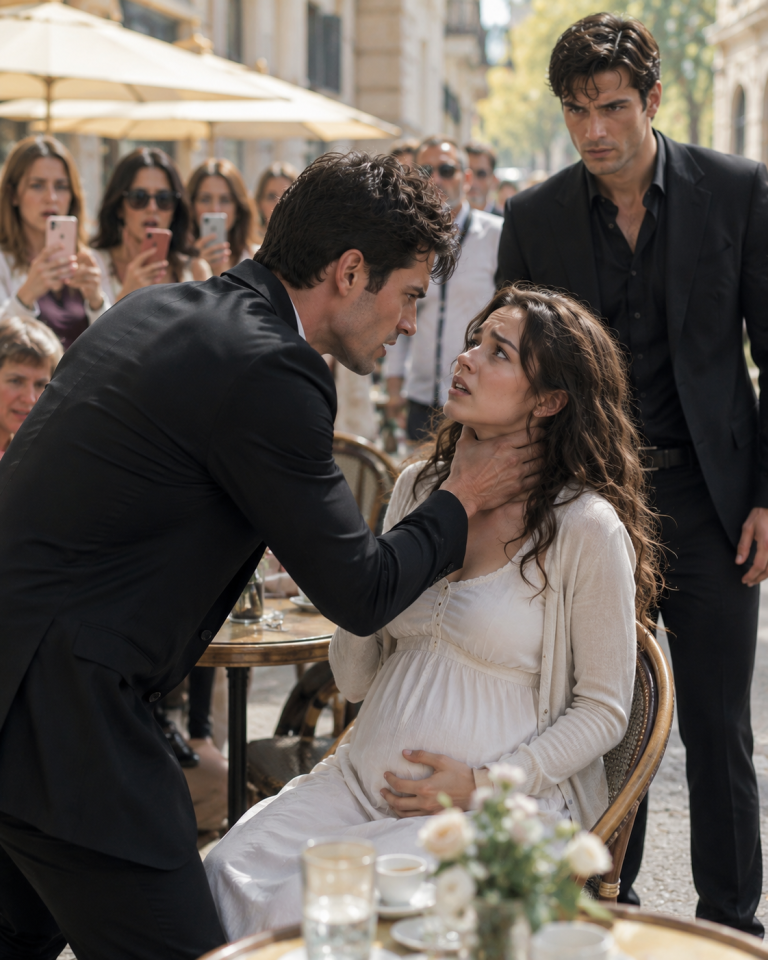
The Mafia Boss Could Handle Enemies, Bullets, and Betrayal — But Not His Silent Daughter… Until She Called a Poor Delivery Woman “Mommy.”

PART 1
The hundred-dollar tip made the decision for her.
Petra Voss looked at the notification on her phone for a full five seconds, which was the amount of time it took her to calculate that a hundred dollars was three days of groceries or half her phone bill or the electric payment that was already ten days late. Then she accepted the delivery order and started her car, which took two tries because the engine had its own opinion about cold weather.
The address was in Barrington Hills.
She had driven there twice before, both times for premium orders from restaurants that cost more than her weekly income, both times tipping acceptably if you considered acceptable to be something that acknowledged her existence rather than her inconvenience. One hundred dollars was a different statement. It meant someone needed something delivered badly enough to make it worth her while, which she understood better than most people thought.
It was almost midnight and raining with the specific violence of a storm that had been building for three days and had finally decided to deliver on its threat. The expressway had two lanes down. Her windshield wipers ran continuously and still couldn’t quite keep up. The bags in her back seat smelled of garlic and reduced wine and something involving pastry that she identified without looking because she had been doing this long enough to know food by its ambient presence.
Her father’s medical debt was forty-seven thousand dollars.
She had known the number for six months, since the Tuesday morning she sat across from a woman at a hospital billing office who delivered it with the practiced gentleness of someone who had been trained to present impossible numbers as manageable challenges. Petra had written it down. She had a notebook where she wrote these things, the accounting of a life that was currently costing more than it produced, and she filled pages in it with numbers that changed slowly and in the wrong direction.
She also had three jobs, none of them sufficient individually, all of them sufficient together if sufficient was understood to mean survivable.
The food delivery was the third job.
She pulled off the interstate onto a narrowing road that curved between old trees. The private lane that appeared after half a mile was not marked. She nearly missed it. Her GPS had stopped confidently directing her three turns ago and had shifted to the particular hesitation of a mapping system encountering an address it couldn’t fully resolve.
Iron gates appeared through the rain.
She slowed, looking for an intercom.
The gates were already open.
She noted this as unusual and drove through.
—
The house was enormous in the specific way that said the point of it was being enormous — not the elegant compression of a house that knew what it was, but the expansive assertion of a structure that wanted to be unmistakable from a distance. Limestone. Multiple wings. Lights in the upper windows.
She parked near what appeared to be an entrance and got out into the rain, immediately soaked despite the jacket she had shrugged on over her uniform.
The front door wasn’t where she expected it. She followed a covered walkway that led into a garden maze, which in better light and better weather would probably be beautiful, but in a rainstorm at midnight was simply confusing. She went left when she should have gone right and came out of the hedge maze facing a structure at the garden’s edge.
A greenhouse.
Victorian glass and iron, lit from within, enormous. It glowed like something that had no business being attached to reality.
She reasoned that it might connect to the house.
She ran for it.
Inside was warmth and the smell of wet soil and citrus and orchids, and the quiet sound of rain on glass that transformed the storm into something bearable. She shook water from her hair and lowered her hood and said into the warm air: “Hello? Delivery?”
A sound came from the far corner.
She turned.
Under the broad leaves of a monstera plant that had been allowed to grow to an unreasonable size, a child was sitting on the stone floor.
The child was small — five, maybe six. White nightgown. Hair tangled. Bare feet. Eyes the color of pale winter light, and those eyes were fixed on Petra with the particular quality of a child who had learned to evaluate adults before they got close.
Thunder moved through the greenhouse from the outside, a full-chest vibration in the glass walls.
The child flinched and pressed her hands to her ears.
Petra set the delivery bags on a potting table.
She went down to the floor — not crouching, fully sitting, cross-legged, reducing herself to a size that was not threatening.
“Hey,” she said quietly.
The child kept her hands over her ears, but her eyes stayed on Petra.
“That’s loud,” Petra said. “I know. It got me too when I came in.”
The child’s hands lowered a fraction.
“My dad used to say thunder was clouds arguing,” Petra said. “He had a theory about it. The clouds would line up on opposite sides and then someone would say something that the other cloud had definitely said first, and the whole argument would explode.”
The child blinked.
“He’d do the different voices.” Petra heard herself and knew she sounded slightly unhinged, and also understood that slightly unhinged was sometimes what a frightened child needed from a stranger in a greenhouse at midnight. “He had this voice for the cloud that always started it. Very confident. Very wrong about things.”
Lightning moved through the glass.
The child flinched again, but this time she looked at Petra immediately after, checking.
Petra stayed where she was.
“You can come closer if you want,” she said. “You don’t have to.”
The child stayed under the leaves.
“That’s okay too,” Petra said.
Another thunder roll.
This one was closer. The child pressed her hands over her ears again and her face went tight with a fear that Petra recognized as older than this storm — the kind of fear that a present thing activates but didn’t originally create.
Petra held out her hand, palm up, at a distance.
The child stared at it.
For a long time.
Then, with the specific caution of someone who has been burned by trust and is trying it again anyway, she reached out and put her cold fingers in Petra’s hand.
“There you are,” Petra said.
She wrapped both hands around the child’s fingers and held them gently, rubbing warmth back into skin that had been cold for a while.
The child looked at her.
“You’re safe,” Petra said. “I’ve got you.”
The greenhouse doors blew open.
—
The men came in fast.
A tall man first, and behind him three more with flashlights and the coordinated movement of people who had trained for the specific purpose of entering spaces and establishing control of them. The man in front had dark eyes and the expression of someone who had expected to find something wrong and had found it.
His gaze located the child immediately.
Then it located Petra.
She was still sitting on the floor with the child’s hands in hers.
She raised both her hands — let go of the child to raise them — and said, “I’m a delivery driver. I got lost. I’m not— I just found her—”
The man’s voice was controlled in the specific way that had nothing to do with calm and everything to do with someone who had learned that volume was a waste of energy.
“Step away from my daughter.”
The child did not step toward her father.
She stepped in front of Petra.
Small as she was, she put herself between Petra and the gun with the seriousness of someone executing a decision they had made clearly.
The greenhouse went silent except for rain.
Petra’s heart was doing something complicated that she didn’t have time to examine.
The man — the father — was looking at his daughter with an expression that had nothing to do with the gun anymore. His face had broken open in the specific way of a person encountering something they had stopped expecting.
The child’s throat moved.
The word came out barely above a whisper, shaped by a voice that seemed to be remembering how it worked.
“Mommy.”
Petra didn’t move.
She couldn’t.
The gun in the man’s hand lowered until it was pointing at the floor.
Then it dropped.
He didn’t appear to notice it fall.
—
PART 2
He was in front of her in three strides, and he dropped to his knees and put both hands on the child’s face with a tenderness so absolute that for a moment nothing else existed in the room.
“Giada,” he said.
The child leaned toward him.
Then she turned and pressed her face against Petra’s wet jacket.
The man looked up.
Petra looked back.
He was maybe thirty-five, dark-haired, built with the efficiency of someone who had never had the luxury of being imprecise, and there was grief in his face beneath everything else — the grief of a person who has been carrying something that doesn’t get lighter.
“Sir,” one of the other men said.
He came back to himself.
“Inside,” he said.
“I need to go,” Petra said. “I have a delivery—”
“You’re inside my property in the middle of a storm after my security system was somehow bypassed, and my daughter—” His voice stopped. “My daughter spoke.” He looked at Giada, then at Petra. “You come inside.”
“I don’t—”
“Please.”
The word came out like something rarely used.
Giada’s hand tightened in Petra’s jacket.
Petra looked at the child.
She knew what it felt like to want someone to stay. She had felt it in hospital rooms and in the specific silence of an apartment where someone had recently not been present. She recognized it.
“Fine,” she said. “But I’m calling my emergency contact first.”
The man nodded.
She texted her neighbor Rosa: *Barrington Hills delivery ran long. I’m fine. If you don’t hear from me by 3am call the number on my fridge.* She wasn’t sure whether she was being dramatic. She sent it anyway.
They went inside.
—
The study was the room of a man who used rooms as statements. Dark wood, expensive books that had been read (she checked — the spines were cracked), a fireplace burning low, and the smell of a person who worked late and had strong opinions about the quality of their scotch.
Petra sat across from a desk the size of her kitchen and tried to stop shivering.
Giada stayed beside her, close but not touching, watching the man behind the desk with the careful attention of a child who had learned to read weather in faces.
The man — she still didn’t know his name — had changed into a dry shirt and looked considerably more composed than the man who had dropped a gun in a greenhouse, which she wasn’t sure was comforting.
“Your name,” he said.
“You already know it. You had someone run me in the time it took to walk from the garden.”
Something shifted in his expression. “Petra Voss. Twenty-six. North Humboldt address. Three jobs. Father deceased six months ago. Medical debt that will take approximately—”
“Fifteen years,” she said. “I know. I have a notebook.”
He looked at her.
“I wanted to see if you’d lie about something we could verify.”
“And?”
“You didn’t.”
“I usually don’t lie when I’m not sure what the other person already knows,” she said. “It’s a waste of everyone’s time.”
Giada made a sound — not quite a laugh, but adjacent to one.
The man looked at his daughter with the expression of someone watching something they’d almost stopped believing in.
“She hasn’t made that sound in two years,” he said.
Petra was quiet.
“She hasn’t spoken in two years,” he said. “Since her mother died. The best specialists I’ve found have been — careful. Professional. Expensive.” He said the last word with a quality that made clear it was meant as a category rather than a compliment. “You talked to her for eleven minutes in a greenhouse in the dark and she spoke twice.”
“She was scared. I was there. That’s the whole thing.”
“It is not the whole thing.”
“I’m a delivery driver, Mr.—”
“Andrei,” he said.
“Mr. Andrei. Andrei. I don’t know the whole situation, I don’t know what she’s been through, I just—” She looked at Giada, who was looking at the low fire in the fireplace. “She needed someone to sit down and be with her. So I sat down.”
Andrei looked at his daughter.
Then he looked back at Petra.
“I want to offer you a position,” he said.
“No.”
“You haven’t heard—”
“You’re going to offer me money to stay near your daughter. I can tell from the setup.” Petra gestured vaguely at the desk, the study, the general architecture of the conversation. “It’s very organized.”
“Yes,” he said.
“I have jobs.”
“They don’t pay enough.”
“No one’s jobs pay enough. That’s not a reason to take a job from someone who pulled a gun on me twenty minutes ago.”
Andrei absorbed this.
“I apologize for the gun.”
Petra stared at him.
“I’m serious,” he said. “The situation was unclear. You were crouched on the floor next to my daughter at midnight. I apologize for the gun. I do not apologize for the guards.”
“That’s a very specific apology.”
“I try to be precise.”
Petra looked at Giada. The child had moved closer to Petra’s knee during this exchange and was now leaning very slightly against it, which was the specific weight of a child deciding someone is safe without announcing the decision.
“Thirty days,” Petra said. “I’ll try thirty days. And I mean try. I’m not a specialist, I’m not a therapist, I’m not a nanny. I’m someone who sat on a floor during a storm.”
“Yes,” Andrei said. “That’s what I’m asking for.”
“Debt,” Petra said. “The medical debt is the debt my father left. It gets resolved separately from whatever you pay me. Not as salary. As— what you owe someone who sat with your daughter when no one else was there.”
The large man near the door — who she would learn was named Lev — made the faintest possible sound.
Andrei looked at her for a long time.
“Agreed,” he said.
“And if I feel unsafe, I leave. No argument.”
“Agreed.”
“And Giada makes her own choices about how close she gets to people. I’m not a lure.”
“Agreed.”
Petra looked at him.
“You agreed to everything very fast.”
“You said nothing I could reasonably refuse.”
Giada looked up at Petra.
She didn’t say anything.
But she took Petra’s hand.
—
PART 3
The east wing suite was the size of an apartment.
Petra stood in it the first morning and felt the specific disorientation of a person whose circumstances have changed faster than their nervous system can process. The closet was full. She hadn’t asked for that. She found Andrei in his study after breakfast and held up a sweater she had not owned before going to sleep.
“I didn’t ask for this.”
“You arrived in a wet jacket and three delivery uniforms.”
“I can buy my own clothes.”
“With what?”
“That’s not—” She stopped. “You can’t purchase my life incrementally and call it consideration.”
Andrei looked at her for a moment.
“Noted,” he said.
“I want to mean that you’re actually noting it. Not that you’re waiting for me to accept the premise.”
“I’m actually noting it,” he said.
She looked at him.
She went back to the wing and kept the sweater, which she acknowledged to herself was not a principled victory. But she also texted Rosa about her job hours, started paying her own groceries out of the salary she negotiated, and maintained the account in her name that Andrei had established without telling her, which she found out about from Lev accidentally and then addressed with Andrei directly.
“That was meant as a safety net,” he said.
“Tell me about it before you create it.”
“Yes,” he said.
And he did, after that.
—
With Giada she had no script.
She had never worked with children in any professional capacity. She had no training in trauma therapy, no certification in pediatric psychology, no particular expertise beyond the fact that she had once been a small person who was scared of things and had needed someone to sit down and be ordinary with her about it.
She was ordinary with Giada.
They made pasta in the kitchen because Petra had asked the chef to let them, and the chef had looked to Andrei, and Andrei had said yes. The pasta was uneven and the sauce was over-seasoned and Giada had gotten flour in her hair and laughed about it, which made Petra understand why people made pasta together.
They built a fort in the library using cushions from furniture that Petra suspected cost more than her car, and they read inside it by flashlight, which was Giada’s idea and which produced the specific satisfaction of a space that was yours and small and safe.
They named the koi in the garden pond. Giada’s naming conventions were unusual. She named one Mr. Big after some preliminary research she conducted into whether fish had personalities. She named another Sixteen after the number of times he circled the same rock on their first observation day. She named the largest one Andrei, and when Petra tried to redirect this, Giada looked at her with complete seriousness and said: “He’s the biggest one and he swims alone.”
Petra looked at the fish.
She could not argue with the taxonomy.
Words came back to Giada gradually, and then less gradually. Not because Petra was doing anything clinical. She was doing the opposite of clinical — she was treating the absence of words as unremarkable and the presence of them as ordinary, which was the approach of someone who had learned not to make big moments out of small ones because small ones were where the actual things happened.
The first full sentence: “Can we go outside?”
It was a Tuesday. Overcast. Petra said yes and put on her coat.
The second: “Papa doesn’t sleep.”
Petra learned this was true. She occasionally saw lights in Andrei’s study at two, three in the morning. She didn’t comment on it to him. She did start leaving coffee outside his door on the mornings after.
He noticed. He didn’t mention it. He started making sure there was something for her breakfast before she came down.
They didn’t discuss the exchange. It became a fact about the household.
—
Andrei’s world came through the edges.
Not directly — he was careful about what was visible, and she understood he was careful specifically because of Giada. But people came to the house at odd hours. Conversations paused when she entered rooms. Lev stood near certain doors in ways that communicated the doors mattered.
She wasn’t naive about what she was in. She had accepted a position in a household that operated with the infrastructure of something she didn’t have to name to recognize.
What she found, watching carefully, was that this specific man was operating in contradiction to himself — or was trying to. He was meticulous about separation. He was genuinely, observably trying to build a wall between the life Giada could see and the life she couldn’t. Whether the wall was working was a different question.
She thought about it once, directly, and then said to him: “The wall you’re building around her. It’s made of the same things you’re trying to keep out.”
He looked at her.
“Fear,” she said. “Control. Surveillance. She knows when you’re worried even when you don’t tell her. She reads you the same way she reads rooms.”
“I know,” he said.
“She needs the wall to come down eventually.”
“I know that too.”
He did. That was the complicated thing. He knew it and was doing it anyway, which was either the honest answer or the only answer available to someone who was still figuring out what the alternative looked like.
The greenhouse, she discovered, was where he went to be without the performance of everything else. She found him there the night three weeks in when Giada had a nightmare and woke calling for her mother, and Petra had gone and held her until she fell back asleep and then had not gone back to bed herself.
She went to the greenhouse.
He was there.
“She’s asleep,” Petra said.
“I know. I heard her. I—” He stopped.
“You didn’t come in,” Petra said.
“She calls for Sophia.” His voice was even. “I have learned that when she calls for Sophia, I am not what she needs. If I come in, she sees me and it makes it worse. I have tried it the other way and it makes it worse.”
Petra stood with that.
“That’s a hard thing to have learned,” she said.
“Yes.”
She sat on the bench near the monstera plant where she had found Giada.
After a moment, Andrei sat on the other end.
“Sophia designed this,” he said. “The whole greenhouse.”
“I know. Giada told me. She said her mother could make anything grow.”
He looked at the orchids along the eastern wall. “She was right.”
“Did you know the monstera was Giada’s favorite place before I found her there?”
“I knew she came here. I didn’t know she had a specific spot.” He paused. “I didn’t know a lot of things about her hiding places.”
“She makes them because she needs them,” Petra said. “She’s not hiding from you. She’s building places where she can be small enough to feel held.”
Andrei turned to look at her.
“She hides under the monstera because the leaves are big enough to make her feel covered,” Petra said. “I did the same thing as a kid. I used to get under the kitchen table and pull the chairs in. Same principle.”
He watched her.
“You talk about your own experience with her,” he said. “Rather than clinical language.”
“I’m not a clinician.”
“No. But you’re the first person she’s spoken to in two years, so I’m interested in your method regardless of its credentials.”
Petra looked at the rain on the glass roof.
“I just tell her the truth,” she said. “When she asks if I’m scared, I tell her yes. When she asks if something hurts, I tell her whether it does. I’m not performing stability. I’m just trying to actually be okay, and she can tell the difference.”
Andrei was quiet.
“She can tell the difference,” he said.
“Always could,” Petra said. “Even before she stopped speaking. She watches everything.”
“Like her mother.”
Petra looked at him.
“She has your decisiveness,” she said. “She walked in front of that gun without hesitating.”
He flinched.
“She walked in front of a gun because I brought a gun into a room she was in,” he said.
“She walked in front of it to protect someone,” Petra said. “That’s the part I’d hold onto.”
He looked at her for a long moment in the greenhouse quiet, with rain on the glass and orchids on the wall, and something in the air between them shifted in the way things shifted when two people understood that the conversation they were having was also about something else.
She went back inside before she thought too hard about what that meant.
—
The threat came six weeks in.
She found out about it the same way she found out about most things in the household — not directly, but from the accumulation of signals. Lev’s posture changed. Andrei’s schedule shifted. People she hadn’t seen before appeared at the perimeter.
She asked Andrei.
“A business problem,” he said.
“Involving us?”
He didn’t answer immediately, which was its own answer.
“The people you’re in conflict with,” she said carefully. “Do they know about Giada?”
“They have always known about Giada.”
“Do they know about me?”
A pause.
“We should assume yes.”
She sat with that.
“What does that mean?”
“It means I’m adjusting the protocols.”
“Which means?”
“Which means for the next several weeks, you don’t leave the property without an escort. It means Giada’s appointment schedule changes. It means I’m going to ask you to accept some constraints that I wish I weren’t asking for.”
Petra looked at her hands.
“You’re going to tell me this is temporary.”
“Yes.”
“Is it?”
Another pause.
“The situation is temporary. The underlying reality is—” He stopped.
“More permanent,” she said.
“I’m working on that.”
She looked at him.
“Are you actually working on it or is that what you say.”
He didn’t look away.
“I am actually working on it,” he said. “It is the slowest and most expensive thing I’ve ever done, and there are people who will never forgive me for it, and I do not know how long it will take.”
“But you’re doing it.”
“Yes.”
She believed him. She wasn’t sure whether believing him was sensible. She also wasn’t sure sensible was the right standard.
“Okay,” she said. “Temporary constraints. But I want to know what’s happening. Not the details — I’m not asking for the details. But the shape of it. Whether we’re safe.”
“Yes,” he said. “That’s a reasonable ask. I’ll tell you the shape.”
She nodded.
“And Giada doesn’t know any of this.”
“No.”
“Good,” she said. “She has enough that’s heavy.”
—
The convoy ambush was in the third month.
She wasn’t supposed to be in it. Andrei had wanted to reschedule Giada’s quarterly psychological evaluation, but the therapist — a small woman named Dr. Ling who wore cardigans and had the specific patience of someone who had chosen her work deliberately — had been firm that the continuity mattered more than the timing.
Andrei had relented.
He had made the escort arrangements himself and reviewed them twice and hadn’t liked them and had run them a third time. He had stood at the door of the estate and watched Petra help Giada into her coat and had a quality about him that she was learning to read as the expression of a man managing something he couldn’t fully control.
Giada had handed him a small folded paper on the way out.
He opened it after the car left.
It was a drawing: a fish circling a rock. Underneath it, in uneven letters: *He’s not alone.*
Petra found out later he had held it for a long time.
The car was bulletproof, which she had known in the abstract and which became concrete when the truck blocked the tunnel and the sound of gunfire arrived as something entirely different from any representation of it she’d encountered. It was physical. It moved through the chassis, through the seat, through her.
She had Giada on the floor under her before she’d finished processing the sound.
“Don’t look up,” she said. “Look at my face. Just look at my face.”
Giada looked at her face.
“Clouds arguing,” Petra said. Her voice was shaking. She heard it. “Big dramatic argument. Someone got the last word.”
Giada’s eyes were enormous.
“I’ve got you,” Petra said. “I’m right here. I’m not going anywhere.”
The window gave and something caught her shoulder and she heard herself make a sound she hadn’t planned.
Giada looked at the blood.
“Mommy,” she said.
“I’m okay,” Petra said. “I’m right here. Look at my face.”
She stayed over Giada.
She stayed there.
The gunfire stopped when Andrei’s vehicle came down the access ramp. She heard the impact, heard voices, heard the situation changing.
She stayed over Giada.
When the door opened and Andrei said her name, she tried to push herself up and found the shoulder wasn’t cooperating and she was already very tired.
“I didn’t let them touch her,” she said.
And then she stopped making decisions for a while.
—
She woke to the sound of Giada breathing beside her.
The room she was in was not a hospital — the ceiling was wrong for a hospital, too textured, and the light was different, and she could smell cedar instead of antiseptic. She had a line in her arm and a bandage on her shoulder that had been done by someone who knew what they were doing.
Giada was asleep curled against her side with one hand on Petra’s forearm.
Andrei was in the chair.
He looked like a man who had not slept.
“Giada?” Petra said.
“Not a scratch,” he said.
She felt her eyes sting.
“The shoulder?”
“Fragment. It’s out. You’ll heal fully.”
She nodded.
“The convoy,” she said. “The person who gave the route.”
“Handled,” he said. “Not the way I would have handled it two years ago. The way I’m trying to learn to handle things.”
She looked at him.
“What does that mean?”
“It means evidence went to federal investigators. It means the organization responsible is currently losing every external relationship it has, in daylight, because daylight is harder to survive than darkness for certain kinds of structure.” He paused. “It means I stayed in this room instead of leaving to make other arrangements.”
“That was hard.”
“Yes.”
She held his gaze.
“Thank you,” she said.
He looked at Giada, then at Petra.
“I need to tell you something,” he said.
She waited.
“The thirty days ended last week,” he said. “I didn’t say anything because the situation was—” He paused. “I didn’t want the reason you stayed to be the situation.”
Petra looked at her hands.
“The debt is cleared,” he said. “Your apartment is paid through the year. There’s money in an account for the work you did. If you want to leave, I will not stop you. I will make sure you’re safe regardless of what you decide.”
Giada stirred in her sleep and tightened her hand on Petra’s arm without waking.
“What do you want?” Petra said.
He looked at her directly.
“I want you to stay,” he said. “Not as an arrangement. Not as something I’ve purchased. I want you to stay because you’re the first person in two years who has made this house feel like something is actually happening in it. I want you to stay because Giada laughs now. Because someone leaves coffee outside my door when they notice I’ve been up late, which no one has ever done for me.” He paused. “I want you to stay because when I look at you I see someone who is making difficult things work through the force of being honest about what they cost, and I am trying to become that kind of person, and it is easier to try when you’re nearby.”
She looked at him.
“That was very precise,” she said.
“I try to be.”
“You said that before. That first night.”
“It was true then too.”
She looked at Giada.
“She called me mommy because I was there and she was scared,” Petra said. “I don’t want her to need me to be her mother because the alternative is absence.”
“I know.”
“She needs to be able to want me because I’m good for her. Not because she has no other option.”
“I know that too.” He leaned forward. “She has options now. Dr. Ling is back on schedule. She has the therapist she likes, and the school enrollment I should have done six months ago, and a world that’s slower now and has more light in it.” He paused. “She still runs to you. That’s not trauma. That’s preference.”
Petra felt her throat tighten.
“I’m not Sophia,” she said.
“No,” he said. “And I’m not asking you to be.”
“She loved this house.”
“She loved the greenhouse,” he said. “She thought the house was too big. She was right.”
Petra almost smiled.
He saw it.
“Stay,” he said quietly. “Not for her. For all of it. For you, if that’s a reason. Because you’re good here and you know it.”
She looked at him.
She thought about the forty-seven thousand dollars in her notebook and what it had felt like to carry that, and the cold apartment, and the three jobs, and also the specific way Giada had taken her hand in the greenhouse with the weight of a decision made carefully.
She thought about coffee left outside a door and someone making sure breakfast was ready before she came down.
“Yes,” she said.
Andrei exhaled.
It was not a dramatic exhale. It was the exhale of a person who has been holding something and can set it down now.
Giada, in her sleep, turned toward Petra and said something incomprehensible that might have been the fish’s name.
Petra put her hand over Giada’s.
“One condition,” she said.
“Yes.”
“The house stays loud. No going back to how it was.”
He looked at her steadily.
“The house stays loud,” he said.
—
It took another year to dismantle the infrastructure.
Not quickly, and not cleanly, and not without cost — she was in the household for the cost, and she watched it happen with the specific attention of someone who had been asked to witness something and understood that witnessing it meant not looking away. Money went. Alliances went. Men who had been present for years departed in various states of agreement and displeasure. There were legal proceedings that Andrei cooperated with and which produced depositions she didn’t read but could tell from his face had been thorough.
He came home to dinner every evening that it was possible.
He sat with Giada through the parts of the therapy that Dr. Ling invited him to. He cried once, during one of those sessions, and then he sat with having cried in front of his daughter and didn’t perform anything about it afterward.
Giada’s words came back fully sometime in the fifth month.
She announced this to no one specifically. One Tuesday she was simply speaking in complete sentences without the pauses and the checking and the economy of a person who wasn’t sure words were safe. She talked constantly after that. She narrated her thoughts about the koi fish with the sustained intensity of a zoologist presenting findings. She had opinions about the greenhouse temperature and the placement of certain plants and whether the chef was doing adequate justice to pasta as a form.
She had opinions about Andrei’s coffee consumption.
“You drink too much,” she told him.
“The amount I drink is appropriate to the work I do,” he said.
“Petra says four cups is a lot.”
Andrei looked at Petra.
“You’re filing reports,” he said.
“I mentioned it once,” Petra said.
“Giada remembered it.”
“She remembers everything.”
Giada nodded seriously.
Andrei reduced to three cups.
Petra did not say anything about this.
She did leave slightly better coffee outside his door.
—
The greenhouse in May was different from the greenhouse in October.
Everything Sophia had planted had grown through the winter into itself. The orchids bloomed in the east corner. The citrus trees had fruit that was actually fruit now rather than promise. The monstera had reached a size that Petra had started to document photographically because she found its ambition moving.
Giada had started tending the plants herself.
She had a specific routine, which she had developed without instruction and defended with the patience of a person who had determined the correct approach and found questioning unnecessary. Andrei had learned not to suggest adjustments.
Petra stood at the door of the greenhouse one Saturday morning watching Giada talk to a fern.
Andrei came to stand beside her.
“The fern has a name,” she said.
“Grigoriy,” Andrei confirmed. “She named it after my grandfather.”
“Your grandfather was a fern?”
“She determined he had a similar disposition. I didn’t argue.”
Petra looked at him.
He was watching Giada the way he always watched her now — with the open face of a person who had stopped performing anything in this particular room.
“The business,” Petra said. “The final pieces.”
“March,” he said. “The final cooperative agreement with the federal office completes in March. After that, what remains is the logistics company, which is legitimately the logistics company.”
“How does that feel?”
He thought about it.
“Like being very cold for a long time and then being less cold,” he said. “Not warm. Not yet. But less cold.”
She turned to face him.
“Do you regret it?”
“The business or the people it cost?”
“Either.”
He looked at Giada.
“Not the business,” he said. “Not once, since the night you stayed.” He paused. “The people — there’s no answer to that. You don’t not regret things that cost other people. But I don’t regret the direction.”
“Good,” she said.
He turned to her.
“I want to ask you something,” he said.
“You’re doing the thing where you’re very precise about your word order,” she said. “You always do that when something matters.”
“I know.” He looked at her steadily. “I want to ask you to marry me. Not because of what we’ve built and not because of Giada and not because it makes structural sense given the household. Because you’re the person I’ve become less cold near, and I want to keep being near you in a way that’s honest about what it is.”
Giada appeared beside them from among the plants.
“Did he ask yet?” she said.
Andrei looked at his daughter.
“You knew about this.”
“I helped him plan it,” Giada said. “He kept getting the words wrong.”
“Did I get them right this time?” he said.
Giada considered.
“Better,” she said. “Petra, he means it. He practiced.”
Petra looked at Andrei.
He looked back at her.
She thought about October and a greenhouse and a child under a monstera plant. She thought about thirty days that became longer. She thought about coffee outside a door and honest answers to hard questions and a man learning to come home at dinner and the specific miracle of a child who had stopped speaking finding her way back to words.
She thought: this is not the life she planned. It is stranger and more expensive and has required more negotiation and more direct confrontation than anything she would have chosen deliberately.
She thought: it is also real.
“Yes,” she said.
Giada pumped her fist.
Andrei looked at his daughter.
“Thank you for the vote of confidence,” he said.
“You needed it,” Giada said. “You were going to do the thing where you say too many words.”
“I didn’t say too many words.”
“Petra, did he say too many words?”
Petra considered the question seriously.
“He said the right amount,” she said. “For him.”
Andrei looked at her.
She looked back.
Outside, the rain came again, as it did in May in this part of the country, and Giada turned her face up to the sound on the glass with the expression of a person who had reclassified something that used to be threatening as something that was simply weather.
“Clouds arguing,” she said.
“Big dramatic argument,” Petra agreed.
“Papa,” Giada said. “You explain it.”
Andrei looked at the glass roof and the rain and his daughter and Petra.
He had spent decades being precise and competent and controlled and unavoidable.
He had never, until recently, been asked to explain why clouds argued.
“There’s one cloud,” he said. “Very confident. Usually wrong.”
Giada grinned.
“And then?”
“And then it meets a cloud that’s better at the argument.”
Giada looked at Petra.
“That’s you,” she said.
Petra laughed.
The rain ran down the glass and the monstera stood in the corner growing unreasonably and outside the spring world continued in its ordinary directions, unaware of what had been built in here, in this strange and specific light, by two people and a child who had found each other in a storm.