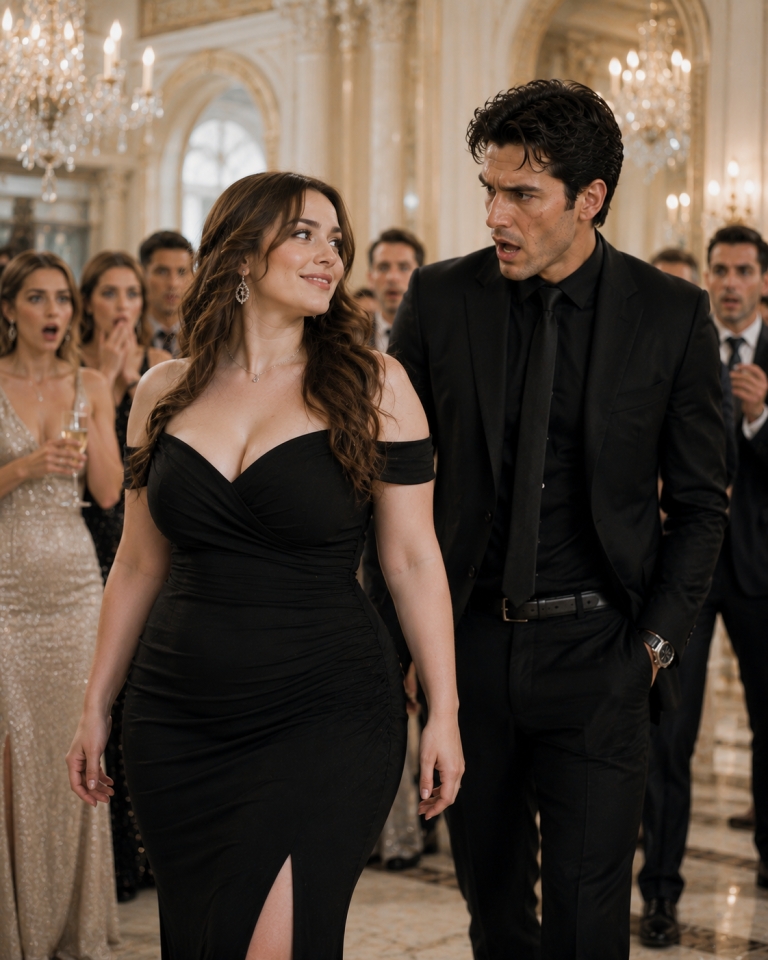
She Kissed the Mafia Boss by Accident—And He Refused to Let Her Go After That

## PART 1
The bar stool was cold beneath my fingers when I spun it around.
I didn’t hesitate. That was the mistake. Hesitation would have saved me — from everything that came after, from the gray eyes that caught mine in the half-second before I closed the distance, from the mouth that tasted like whiskey and something darker I couldn’t name. I kissed him because Adrienne had told me to be bold, because I’d spent six months watching my life pass in amber-lit windows while I stayed safely inside, and because the man in the dark suit holding a thick novel was exactly where she’d said he’d be.
Except he wasn’t. He wasn’t Nicholas. He wasn’t anyone I was supposed to want.
I didn’t know that yet.
For ten seconds — maybe fifteen — there was only warmth, and the firm press of a stranger’s lips, and the inexplicable sensation that the floor had dissolved beneath my heels. His hand came up to the back of my head as if he’d been expecting me. As if I’d come home to a place I’d never been.
When I pulled back, my glasses had fogged. I wiped them with the edge of my sleeve, looked at him properly, and understood.
Dark hair. Sharp jaw. Eyes the color of the sky thirty seconds before a storm breaks.
Not blond. Not blue-eyed. Not Nicholas.
“I’m so sorry,” I said. “I thought you were someone else.”
He still had one hand resting at my hip. He hadn’t moved it.
“Did you.” It wasn’t a question. His accent turned the words into something continental, something that felt like it belonged in old cities I’d only read about.
“I was meeting someone. A date. He was supposed to be at the bar — dark suit, a book — and you—”
“Were at the bar. In a dark suit. With a book.” The corner of his mouth moved. Just barely. “Your logic was sound.”
“It wasn’t, though. Because you’re—” I gestured vaguely. “Not him.”
“He left.” The man nodded toward the entrance without looking away from me. “Blond. Anxious. He waited eight minutes and walked out with a woman who’d been watching him since seven-thirty.”
My heart dropped. “You watched all of that?”
“I was sitting right here.”
“And you let me—”
“You didn’t exactly give me time to intervene.”
I stared at him. The humiliation arrived in waves, hot and thorough. I pressed my palms to my cheeks and tried to remember if I’d ever wanted to dissolve through a barstool before. I hadn’t. This was new.
“I should go,” I said.
“You could.” He reached for his drink, unhurried. “Or you could sit down. Tell me what book he was supposed to be holding.”
“War and Peace.”
“That would explain mine.” He tilted the cover toward me. It was in Russian — dense, dark-jacketed, clearly not Tolstoy. “Close enough for a dim bar, I suppose.”
“Close enough for a catastrophically near-sighted woman who left her contacts at home,” I admitted.
Something shifted in his expression. Not quite a smile. A precursor to one.
“Sit,” he said. “I’ll buy you a drink. You’ve earned it.”
I should have left. I am, in my regular life, a careful person. I read contracts before signing them. I research restaurants before booking. I did not, as a rule, accept drinks from beautiful strangers whose names I didn’t know, in bars where I’d already made a fool of myself once.
I sat.
“Maren,” I said. “Maren Calloway.”
“Alexei Vasin.” He said it the way people said names that were supposed to mean something. I filed that away and didn’t ask.
Two hours. Two drinks. A conversation that moved through books, cities, the particular loneliness of being surrounded by people who never quite saw you.
He asked about my work. I told him I edited fiction — literary, mostly, the kind that didn’t sell well but mattered enormously to the twelve people who read it. He told me almost nothing about himself. He was a specialist in redirection: every question I aimed at him curved back toward me like a boomerang, and I didn’t notice until I’d already answered four of them in a row.
“You’re very good at this,” I said finally.
“At what?”
“Knowing everything about me while telling me nothing about yourself.”
He was quiet for a moment. Then: “What would you like to know?”
“What do you do?”
“Business. Trade, mostly. Import and export.”
“That pause before ‘mostly’ is doing a lot of work.”
His eyes sharpened. “You’re perceptive.”
“It’s my job. I notice when things don’t add up.” I turned my glass slowly between my palms. “The way the bartender watches you. The table that cleared when you walked past it. The fact that you’ve been sitting alone in this particular bar on a Friday night, reading, and nobody has bothered you once.”
“Perhaps I’m simply unapproachable.”
“You’re not. You’re very approachable. A total stranger kissed you twenty minutes ago.”
He laughed. It broke across his face like something rare — like he’d forgotten he was capable of it. The sharpness went out of his jaw. He looked, for one unguarded second, almost young.
“Come home with me,” he said.
The words landed before I was ready for them.
“I don’t do that.”
“You kissed a stranger in a bar.”
“That was an accident.”
“And this?” He held my gaze. “Is this an accident?”
I didn’t answer. But I didn’t leave either.
What I didn’t know — what I couldn’t have known, sitting on that barstool with his eyes on mine and the city humming outside — was that Alexei Vasin’s name appeared in federal surveillance files in four countries. That the table clearing when he passed wasn’t coincidence. That the man I’d kissed by mistake was someone powerful men were afraid of.
I didn’t know any of that.
I only knew that when he looked at me, I felt like the most interesting thing in the room.
I said yes.
—
## PART 2
I stayed the weekend.
I told myself it was because the conversation was extraordinary — and it was. We talked about Bulgakov and Nabokov and the particular cruelty of stories that don’t end cleanly. We talked about loneliness and the way it calcifies into something almost comfortable if you leave it long enough. He cooked badly and refused to admit it. I made toast and pretended it was a skill.
By Sunday evening I knew four things about Alexei Vasin: he had a younger sister he called Sonya and spoke about with a gentleness that altered his entire face; he hadn’t slept well in years; he owned more books than furniture; and he was in love with the idea that someone could choose a dangerous life and still be good inside it.
Sunday night, he told me the truth.
Not all of it. I understand that now. But enough.
“My family controls certain operations in this city,” he said. “Not all of them legal.”
I looked at the tattoos I’d traced in the dark the night before. The Orthodox crosses. The eight-pointed stars at his collarbones. The Russian scripture across his ribs that I’d asked about and he’d called a prayer.
“You’re telling me now,” I said. “Why?”
“Because I don’t want you to leave without knowing who you stayed with.”
“And if I leave anyway?”
“Then I’ll understand.” His voice was very quiet. “But I won’t stop thinking about you.”
I should have left. Every sensible architecture of my life — the careful contracts, the researched restaurants, the six-year habit of choosing safe over sorry — pointed toward the door.
Instead I said: “I’m an editor, Alexei. I’ve read every version of this story. The dangerous man. The woman who stays anyway. I know how it usually ends.”
“How does it end?”
“In my experience?” I looked at him. “Depends entirely on whether he’s honest with her.”
Something crossed his face — relief, or the shadow of it.
“I’ll be honest,” he said. “Whatever you ask.”
“Then tell me one true thing. Right now.”
He didn’t hesitate. “I’ve been alone for three years. Not because I had to be. Because I stopped believing I deserved anything else.” His eyes found mine. “You walked in here and kissed me before you even knew my name. And something — something I’d locked up a long time ago — came loose.”
The silence between us was not empty. It was the fullest silence I’d ever sat inside.
“One weekend,” I said finally. “And then we’ll see.”
He nodded. But the way he looked at me suggested he already knew how the story went.
I didn’t. Not yet.
I wouldn’t find out until the morning a manila envelope appeared on my desk at work — photographs of me and Alexei, taken over two weeks, with a typed note at the bottom that made my hands go cold.
*You don’t know what you’ve gotten yourself into, Miss Calloway. Walk away now, while you still can. The next envelope won’t come to you.*
At the bottom of the note, a name.
Not Sokolov. Not any of the rivals Alexei had mentioned in passing, the names that moved through his world like weather systems.
The name at the bottom was one I recognized.
Nicholas Harte.
My blind date.
—
## PART 3
I stared at Nicholas Harte’s name for a long time.
My office felt suddenly too small, the manuscript on my screen meaningless. Adrienne appeared in my doorway with coffee and stopped when she saw my face.
“What’s wrong?”
“Nothing.” I folded the note and slid it beneath my keyboard. “Just tired.”
She didn’t believe me. Adrienne never believed me when I lied, which is why I rarely tried. But she left, and I sat with the photographs spread across my desk — me and Alexei at the Thai restaurant on 54th, me and Alexei in the park, me and Alexei in the back of his car outside my apartment building — and tried to understand what Nicholas Harte had to do with any of this.
We had never met. Not properly. He’d been a name in a text from Adrienne, a photo she’d shown me on her phone, a man who’d left a bar eight minutes after I was supposed to arrive and gone home with someone named Tiffany. He was a finance professional with excellent cheekbones and apparently zero interest in waiting for a woman who was fifteen minutes late.
So why did his name appear on a threatening note in a manila envelope delivered to my place of work?
I called Alexei from the stairwell.
He answered on the second ring. “Maren.”
“Someone sent me photographs.” I kept my voice low and even. “And a note. Signed with the name Nicholas Harte.”
Three seconds of silence. Then: “Don’t go home alone tonight. I’m sending Gregor.”
“I don’t need—”
“Maren.” His voice dropped into something without warmth, without the register I’d come to know over four weeks. Command-voice. The version of him I’d only heard turned outward, on other people. “Please.”
Gregor arrived at my office at six. He was built like a commercial refrigerator and communicated primarily through eyebrow movements, but he got me to Alexei’s penthouse without incident, and that was what mattered.
Alexei was standing at his desk when I arrived. Spread across it were photographs of his own — surveillance images, printed on plain paper, sorted into groups. Beside them, a file I recognized from the way he touched it: something he’d had for a while. Something he’d been sitting with.
“You know who he is,” I said. “Nicholas.”
“I know who his family is.” He looked up. “Nicholas Harte’s father is Peter Harte. He runs a logistics operation out of Staten Island. For the last eight months, he’s been moving product through a supply chain that overlaps with territory my family controls.” His jaw was tight. “Peter Harte wants that territory. He’s been looking for leverage against me.”
“And Nicholas—”
“Nicholas was placed on a dating app and introduced to Adrienne through a contact she trusted. He was never interested in a blind date. He was interested in who you might be seeing.” His eyes met mine. “When you didn’t show up, he assumed you were a dead end. When you left with me—”
“He started watching us.”
“He started reporting to his father.”
I sat down heavily in the nearest chair.
“They used me as a way to find your vulnerabilities.”
“Yes.”
“And now that they’ve found one—”
“They’ll try to use it.” He crossed the room and crouched in front of me, bringing his eyes level with mine. “Maren. I need you to understand what I’m about to tell you.”
“Tell me.”
“This is the moment where most people would leave. Where the rational calculation becomes clear: the danger outweighs whatever this is.” He held my gaze without flinching. “I’m not going to ask you to stay. I’m going to ask you to choose.”
“I already chose,” I said. “I chose four weeks ago when you told me the truth on a Sunday night and I stayed anyway.”
“This is different. This is real threat. Real people who will hurt you if it serves them.”
“I know.”
“And?”
“And I’m angry.” I surprised myself with how much I meant it. “I’m angry that Nicholas Harte sat in a bar watching me walk in, watched me kiss you, and thought I was just a tool. I’m angry that his father looked at someone’s relationship and saw a transaction.” I looked at Alexei. “I’m not leaving. But I need you to handle this.”
“I intend to.”
“Without anyone dying.”
A pause. “That’s a significant constraint.”
“It’s a non-negotiable one.”
He studied me for a long moment. “You’re remarkable,” he said, very quietly.
“I’m furious. There’s a difference.”
He almost smiled. “Not always.”
—
What happened next took eleven days. I know because I counted.
Alexei moved me to a property in Brooklyn — not a safe house in any grim Hollywood sense, but a brownstone two blocks from his mother’s home, staffed with people who regarded me with polite watchfulness and brought me very good food. Vera Vasin came every morning. She was exactly what Alexei had described: terrifying, wonderful, the kind of woman who had outlasted things that would have ended most people.
“He told you about his father,” she said on the third morning, setting a cup of tea in front of me at the kitchen table.
“He told me his father died protecting him. When he was nineteen.”
Vera was quiet for a moment. She looked out the window at the garden, at the February-stripped branches and the gray sky above them.
“He believes that,” she said carefully.
Something cold moved through me. “But?”
“But belief and truth are not always the same thing.” She turned to face me. “There are things about Alexei’s past that he hasn’t told you yet. Not because he’s dishonest. Because he doesn’t know them himself.”
“Vera.”
“I’m telling you this because you’re going to find out.” Her voice was very even. “And I want you to hear it from someone who loves him before you hear it from someone who doesn’t.”
She told me about Dmitri Vasin. Alexei’s father.
He had been powerful. Ruthless in business, devoted in private — the man who’d built what Alexei now ran, who’d kissed Vera’s forehead every morning for twenty-two years and told her she was the only thing worth protecting. The man who had, in Alexei’s telling, been killed by rivals when Alexei was nineteen, just before he was supposed to take over the family operation. The death that had shaped everything. The guilt Alexei carried like weather.
Vera set down her tea. “He didn’t die.”
The kitchen was very quiet.
“He staged it,” she said. “I didn’t know until four years ago. He came to me. He thought — he had reasons I won’t defend. He believed that stepping back would protect the children. That Alexei would run things differently if he thought he was running them from grief, not inheritance.” Her mouth tightened. “He was wrong. He simply ran. And what he built when he ran — a separate operation, competitors, rivals — has been pressing against Alexei’s territory for three years.”
“Peter Harte,” I said slowly. “The logistics operation.”
Vera looked at me.
“Dmitri isn’t running it directly. But he’s connected to it. The Hartes work with him.” She set her hands flat on the table. “The photographs. Nicholas. The envelope. This was never just about territory, Maren. This was Dmitri forcing a confrontation he couldn’t have any other way. Using you to bring Alexei to the table.”
I sat with that for a long time.
A dead man who wasn’t dead. A father engineering his own son’s unraveling from a distance. A blind date that was never a date.
I thought about Alexei standing in his kitchen the morning after I stayed, burning eggs and refusing to admit he’d mistranslated the recipe. I thought about the way he’d said *hope* — quietly, like the word cost something.
He didn’t know. He thought he was grieving a man who’d been watching him for years.
“Does he need to know before this is over?” I asked.
“Yes.” Vera’s voice didn’t waver. “He does.”
—
I was the one who told him.
I asked Gregor to bring Alexei to the brownstone that evening, and I told him everything his mother had told me. I watched his face change in ways I had no adequate vocabulary for — the controlled surface fracturing, something raw and seismic moving underneath. He didn’t speak for a long time. He stood at the window with his back to me, and I let him.
When he turned around, his eyes were very bright.
“She’s certain.”
“Yes.”
“He’s been—” He stopped. Started again. “All this time.”
“Yes.”
“And he sent Nicholas Harte after you. After us.”
“To force a meeting. According to your mother.”
He crossed the room in four steps and put his arms around me without saying anything. I felt him breathe. In, out. Slowly, deliberately, the way people breathe when they’re choosing not to break.
“I’m sorry,” he said into my hair.
“You didn’t do anything.”
“I brought you into this.”
“I kissed you in a bar. That part was entirely my fault.” I held on tighter. “Alexei. What do you want to do?”
“Meet him.”
“Okay.”
“That’s all. I don’t want — I’m not going to—” He pulled back to look at me. “I want to look at him. I want to understand why.” His voice was very steady. “And then I want to come home.”
I touched his face. “Then that’s what we’ll do.”
—
The meeting took place in a private room at a restaurant in Red Hook. Alexei’s people, the Hartes’ people, and at the center of it, a man I hadn’t known to imagine until three days ago: Dmitri Vasin, sixty-one years old, silver at his temples, with his son’s jaw and something in his eyes that was either guilt or a very good facsimile of it.
I waited outside in the car. Alexei had asked me to, and I had agreed, because this was not my story to walk through — it was his.
He was inside for forty-seven minutes.
When he came out, he looked older and younger at the same time. He got into the back seat beside me and sat for a moment with his hands loose in his lap.
“Well?” I said.
“He apologized.” Alexei’s voice was neutral, reporting facts. “He gave me documentation — everything the Hartes have been building, what they planned to do with it. He said he wanted me to have it. To use however I chose.” A pause. “He said he’s been watching me run the operation for six years. That I’d done it better than he ever did.”
“Do you believe him?”
“I don’t know yet.” He turned to look at me. “I told him about you.”
“What did you say?”
“That a woman had walked into a bar and kissed me by mistake. That I’d held on because something in me recognized something in her.” He reached over and took my hand. “That whatever he’d intended by sending Nicholas Harte — whatever leverage he thought he’d built — he’d accidentally introduced me to the only person I’d wanted to keep in twenty years.”
My throat tightened.
“How did he take that?”
“He said—” Alexei paused. Something moved across his face that I couldn’t read. “He said my mother used to do that. Walk into rooms and rearrange them just by being there.”
We were quiet for a moment. The city moved past the windows.
“What happens now?” I asked.
“The Hartes stand down. Dmitri will see to it — it’s what he offered, in exchange for the meeting.” He exhaled slowly. “And then I don’t know. He’s alive. That’s—” He stopped. “I have to learn to hold that.”
“You don’t have to do it alone.”
He looked at me. “No. I don’t.”
—
Six months later, Adrienne stood beside me in Vera’s garden and cried through the entire ceremony, which was gratifying since it had been her terrible planning that started all of this.
“I didn’t put you two together on purpose,” she kept insisting, even with mascara tracking down her face. “The different times were an accident.”
“I know,” I told her.
“But it worked out.”
“It worked out.”
She looked at Alexei, who was across the garden talking to his mother and a man I had met exactly once — Dmitri Vasin, standing slightly apart from the group in the careful way of someone who knows he hasn’t yet earned the right to be central. He’d been there when we arrived. He and Alexei hadn’t embraced. But they’d shaken hands, and Alexei had introduced him to me, and that was something. That was a start.
Vera had cried. Quietly, to herself, where she thought no one could see.
I had seen.
“You okay?” Alexei said when he found me by the roses, twenty minutes before the ceremony.
“I’m exactly okay.” I straightened his collar, which didn’t need straightening. “You?”
“Terrified.” He caught my hand and held it. “I keep waiting for the part where I realize I don’t deserve this.”
“You can stop waiting. That part isn’t coming.”
“You sound very certain.”
“I edit stories for a living, Alexei. I know when a character’s earned their ending.”
He raised my hand and pressed his lips to my knuckles. Old-world gesture. Very him.
“I love you,” he said.
“I know. I love you too.” I tugged him toward the garden where everyone was gathering, where his mother was already directing people to their seats with cheerful authority. “Now come on. We’re getting married before your mother reorganizes the entire seating chart again.”
His laugh was the same as the first time I’d heard it — rich and sudden and slightly disbelieving, like a man rediscovering something he’d given up on.
I’d kissed a stranger by mistake in a dim bar on a February night, looking for someone ordinary, someone safe, someone who read Tolstoy and would never complicate my life.
What I’d found was Alexei Vasin: complicated and extraordinary and not safe at all.
And standing in the middle of Vera’s garden, with his hand in mine and the city spread out beyond the brownstone walls, I understood something I’d spent six months trying to articulate.
The best stories were never the safe ones. They were the ones that changed you — that walked you into a room you hadn’t planned to enter and showed you who you were capable of becoming.
I’d walked into that bar to meet the right man.
I’d kissed the wrong one instead.
And somewhere in the middle of that mistake, I’d found the truest thing I’d ever edited: that love doesn’t announce itself. It just reaches up and cups the back of your head, and pulls you closer, and holds on.
The officiant called us forward.
We went.