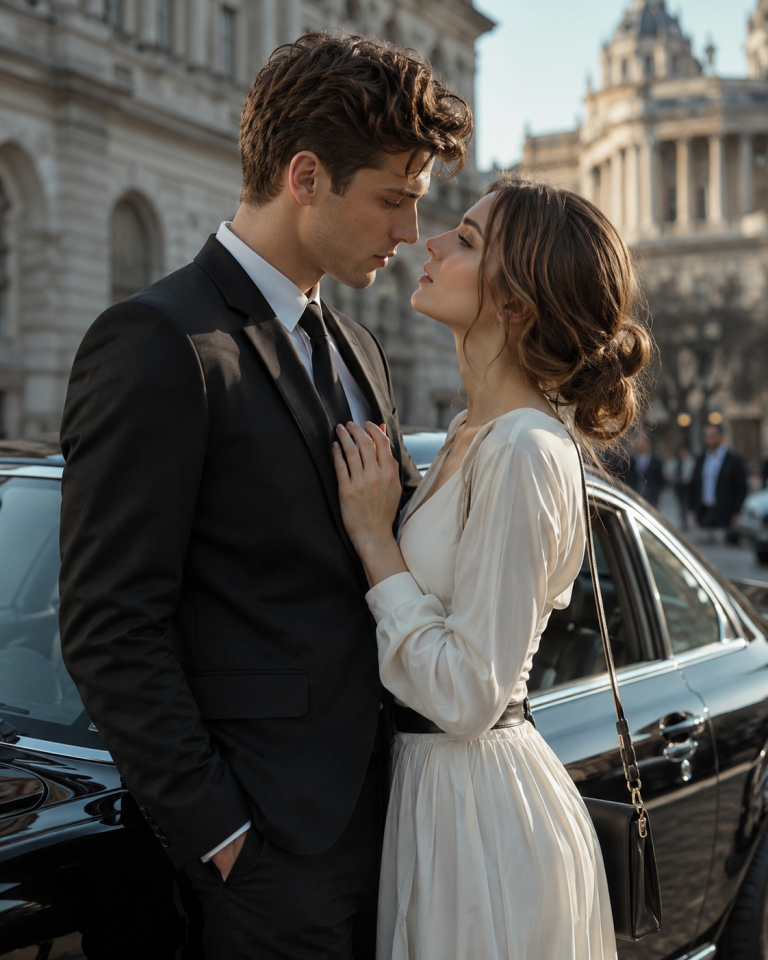
The Mafia Boss Pulled Her Close—Then Whispered Words That Made Her Cry

## PART 1
She had her father’s blood on her hands and nowhere left to run.
That was the only thought Mara Conti could hold as she moved through the back streets of Chicago at midnight, rain driving into her face, her lungs burning with every step. She hadn’t stopped running since she’d heard the shots. Since she’d crawled to where her father lay on the restaurant floor and held his face between her palms and watched the light in his eyes flatten and go still.
*Find Luca,* he’d said. Just that. A name whispered through blood. *Luca Ferretti. He’ll keep you safe.*
She didn’t know a Luca Ferretti. She was twenty-three years old, a graduate student in art history who spent her evenings waiting tables at her father’s small trattoria in Logan Square. She didn’t know the name, didn’t know why her father had said it with such certainty in what she only understood afterward were his final seconds, didn’t know what world she’d just been pulled into.
She knew two things: men were following her, and she couldn’t stop moving.
The alley she turned into was a mistake—she felt it immediately, the way the walls closed in, the way the rain made the bricks slick and black. She pressed herself flat against the wall, forcing her breathing down, listening to the voices that carried from the street behind her. Two men. Patient voices. The kind that didn’t need to hurry because they knew you had nowhere to go.
Then headlights swept the mouth of the alley.
A car. Black, long, expensive—the kind that didn’t belong in this part of the city at this hour. It pulled to a slow stop. The back door opened, and a man stepped out.
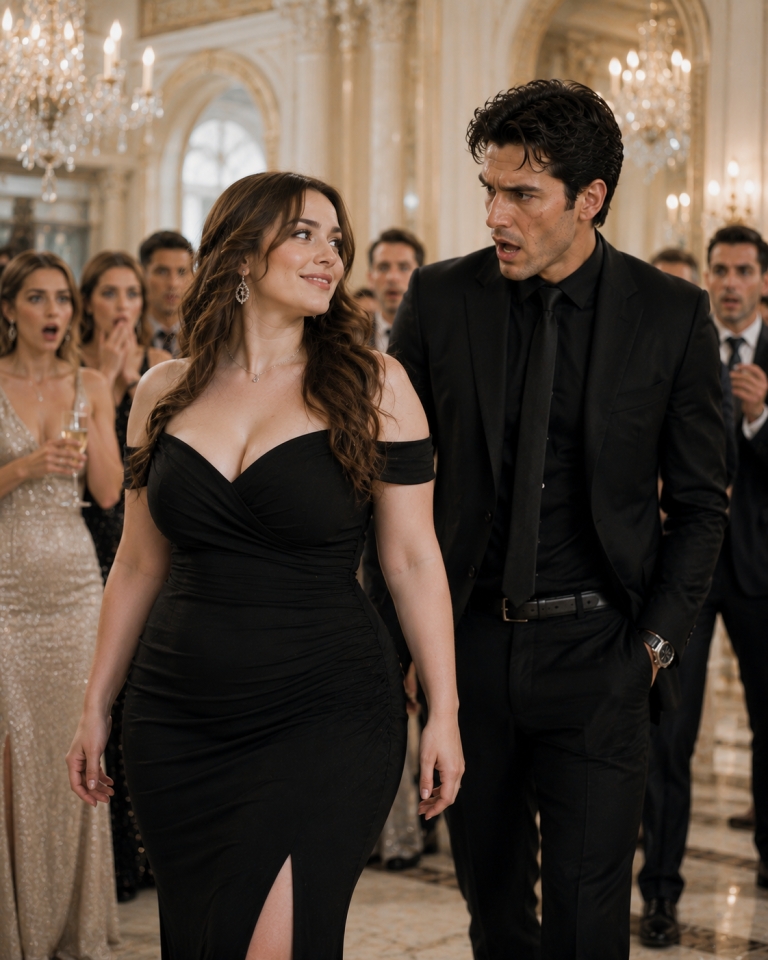
Even half-blind with rain and terror, Mara could see he was not like anyone she’d encountered before. He stood very still in the downpour, jacket absorbing the rain, looking down the alley as if the dark didn’t bother him. As if nothing did. He was tall, broad-shouldered, built like someone who had survived things that would destroy most people. His face, in the thin light from the street, was all sharp geometry—jaw like something cut from stone, a scar running pale through one dark eyebrow.
His eyes found her immediately.
She couldn’t read them. She’d never encountered eyes quite like that—almost black, completely still, the eyes of a person who had spent a long time learning not to show what was happening behind them.
“Come out,” he said. Not loudly. He didn’t need to be loud.
Mara didn’t move.
Something that wasn’t quite a smile crossed his face. “I can see you.”
Her legs were shaking. Every rational part of her screamed that one danger was not solved by walking toward another. But the voices behind her were getting closer, and this man—whoever he was—had stepped out of his car alone, in the rain, without calling anyone, and was standing between her and the street with an easiness that suggested he was not afraid of whatever was coming.
She stepped forward.
He looked at her the way a doctor looks at a patient—quickly, assessing everything. Her soaked clothes. Her hands. The blood that the rain hadn’t quite washed away.
“Are you hurt?”
“No.” Her voice sounded strange to her own ears. “That’s—it was my father’s.”
Something moved through his expression, brief and unreadable. “Get in the car.”
“I don’t know you.”
“No.” He held her gaze. “But you’re out of options, and whoever’s behind you is about thirty seconds away.” He stepped aside, opening space between her and the car door. Not grabbing for her. Just waiting. “Your choice.”
She got in the car.
The interior was warm and dark and smelled of leather and something understated and expensive. The door closed. The man slid in beside her, and the car moved before anyone said another word.
For a full minute, neither of them spoke. Mara pressed her back against the door, watching him. He was looking straight ahead, his forearm resting on the door panel, and there was something deliberate about his stillness—the stillness of someone accustomed to being watched.
“My name is Luca,” he said finally.
The name landed like a stone dropped into still water. She felt the ripples move through her, rearranging everything.
“Luca Ferretti,” she said.
He turned to look at her. “Yes.”
“My father said your name.” Her voice broke on the last word and she hated it. “He said—right at the end, he said to find you. That you were the only one who could—” She stopped. Pressed her fist against her mouth. She was not going to fall apart in a stranger’s car, in a stranger’s world, with nothing she understood surrounding her.
Luca’s jaw tightened. “What happened to Gianni?”
“Three men came into the restaurant after closing. I was in the back. I heard them arguing with him. Then I heard—” She couldn’t finish.
“Ferraro’s people,” Luca said quietly. It wasn’t a question.
“I don’t know who they were. I don’t know any of this.” She looked at her hands—cleaned by the rain, but she could still feel it, the warmth of her father’s blood against her palms. “I’m an art history student. I’m nobody. Why would they—”
“Your father saw something he wasn’t supposed to see.” Luca’s voice was level, but she could hear something beneath it. Weight. “Six months ago. A meeting between Ferraro and a rival organization. He was at the wrong restaurant at the wrong time.”
“He never told me.”
“He was trying to keep you out of it.” A pause. “He wasn’t wrong to try.”
“But they came anyway.”
“They came anyway.” He looked at her with those unreadable eyes. “Ferraro assumes your father told you what he witnessed. That assumption makes you a target regardless of what you actually know.”
The car slowed. Through the window, Mara could see they’d entered a different part of the city—taller buildings, a skyline that glittered cold and indifferent above the street. “Where are we going?”
“Somewhere Ferraro can’t reach you.”
She should have asked more questions. Should have demanded he take her somewhere else—a hotel, a police station, anywhere with witnesses and exits. But her father had said this name with his last breath, and Mara had spent twenty-three years trusting her father’s judgment in everything.
She watched the city slide past the window, and didn’t speak again.
—
## PART 2
The penthouse occupied the entire top floor of a building that had no visible street-level address.
Luca moved through it the way people move through spaces they’ve stopped seeing—efficient, purposeful, already on his phone speaking Italian in short, clipped sentences as he led her inside. Mara stood on the threshold and looked at the wall of windows, the city spread below like a circuit board lit from within, and felt the distance between this world and hers collapse into something vertiginous.
When he ended the call, he turned to find her still standing at the entry.
“You’re shaking,” he said.
“I know.”
He crossed the room without a word, disappeared into a kitchen she could see from where she stood, and returned with a glass of water and a folded towel. He held them out.
She took them. Her hands were steadier than she expected. “Thank you.”
He studied her with that assessing quiet of his. “My housekeeper will bring you clothes. The guest room is down the hall. You should sleep.”
“I won’t be able to sleep.”
“No,” he agreed. “But you should try.”
Mara looked at him—this man her father had trusted with his last words. He was standing close enough that she could see the fine details of him: the silver thread of that scar through his eyebrow, the way exhaustion pulled at the corners of his eyes despite the controlled stillness of everything else.
“Why are you doing this?” she asked.
A silence that had texture to it. “Your father helped me,” he said. “Four years ago. I was in a situation I wasn’t going to walk out of, and Gianni Conti made a choice he didn’t have to make.” He paused. “I’ve been paying that debt ever since. This is the last installment.”
“That’s all this is? A debt?”
His expression shifted—barely, but she caught it. “Go get cleaned up,” he said. “We’ll talk in the morning.”
He left her there.
Mara stood holding the glass of water, listening to the city seventy floors below, and understood two things with sudden, uncomfortable clarity.
The first was that Ferraro’s men were not going to stop looking for her.
The second was that the man down the hall—the one who ruled this city’s shadows with an iron silence—was watching her with something in his eyes that had nothing to do with debt or obligation.
And she had no idea yet which of those two things frightened her more.
—
## PART 3
Sleep came eventually, the way it does after sufficient shock—abrupt, dreamless, a body simply shutting down because it has no other option.
When Mara woke, the city outside the guest room windows was gray with early light, and the smell of coffee had worked its way through the penthouse like a quiet announcement. She found clothes folded at the foot of the bed: simple, well-made, the right size. She didn’t ask how anyone had known.
Luca was already at the table when she came out. Tablet, coffee, suit jacket over the chair behind him. He looked up without expression when she appeared.
“Sit,” he said—and then, a beat later, with a deliberateness she noticed: “If you want to.”
She sat. “You modified the command.”
“I’ve been told I give too many commands.”
“You’ve been told correctly.” She accepted the coffee his housekeeper—Rina, who moved through the penthouse with the economy of someone who had worked there a long time—set in front of her. “What happens today?”
“Today you go back to Northwestern. Nico drives you, stays outside your building while you’re in class, brings you back here in the evening.” He said it with the flat practicality of someone reading from a schedule. “You continue your life as normally as possible.”
“With a bodyguard.”
“With protection, yes.”
Mara wrapped her hands around the mug. “And how long does this go on?”
Luca’s jaw tightened slightly. “Until Ferraro is no longer a problem.”
“How long is that?”
He met her eyes. “I’m working on it.”
She understood what that meant. She was surprised to find she didn’t look away. “My father was a good man,” she said quietly. “He made pasta from scratch three times a week. He kept a photograph of my mother on the register even after she died. He once chased down a teenager who’d stolen a wallet from one of his customers and then bought the kid dinner instead of calling the police.”
Something in Luca’s expression shifted. Opened, just slightly.
“He was,” he said. “The best kind of man. The kind who sees someone bleeding in an alley and doesn’t calculate the risk before helping.” He paused. “I’ve met very few people like him.”
“And yet you live in the world that got him killed.”
“Yes.” No defense in it. Just acknowledgment. “I do.”
—
Nico turned out to be a large, calm man with kind eyes that Mara initially suspected were a strategic choice—assign the least frightening bodyguard to the frightened girl—but came to understand were simply how he was. He waited outside her seminar on Northern Renaissance portraiture every Tuesday and Thursday with the patient stillness of someone who had made peace with waiting, and drove her back to the penthouse through evening traffic in near-perfect silence.
Her classmates noticed, of course. They noticed the car, the quiet man by the door, the way she moved now—always aware of exits, always knowing where she was in relation to the windows. She told the ones who asked that it was a family matter. They accepted this with the incuriosity of people whose attention is mostly directed at their own concerns.
At night, she had dinner with Luca.
This hadn’t been planned, exactly—the first time it happened was because she’d wandered into the kitchen looking for something to eat and found him there, suit jacket gone, reading something on his phone while Rina finished at the stove. He’d looked up, gestured at the chair across from him, and they’d eaten in silence that was neither uncomfortable nor comfortable but something in between, something neither of them had a ready name for.
After that, it became a pattern.
Mara discovered things about him in the way you discover things about people you spend careful time watching: gradually, and in the gaps between what they say and what they don’t. He ate with the focused efficiency of someone who viewed food as fuel and was perpetually slightly surprised when it was good. He read constantly—not on a screen, but actual books, which appeared and disappeared from various surfaces around the penthouse at a rate that suggested he moved through them quickly. He asked her questions about art history with what she initially assumed was politeness and gradually understood was genuine curiosity—not about the objects but about the people who’d made them, what they’d been trying to say, whether they’d known they were making something that would outlast them.
One night, about ten days in, she found him at the windows at two in the morning. She’d woken from a dream about her father—not the restaurant, just an ordinary memory, Sunday lunch, garlic and lemon, her father singing off-key to the radio—and couldn’t go back to sleep.
Luca heard her before she spoke. He turned, and she saw that he’d been standing there long enough that he’d removed his jacket and his shirt was half-untucked, which was the closest she’d seen him to undone.
“Couldn’t sleep either,” she said.
“I don’t sleep much.”
She stood beside him at the window. The city glittered below, indifferent and vast. “Can I ask you something?”
“You can ask.”
“How did my father find you? In that alley, four years ago.”
Luca was quiet for a moment. “He was taking out his recycling. The alley ran behind his restaurant.” A pause. “He heard something. A reasonable man would have gone back inside and locked the door.”
“But he wasn’t a reasonable man. He was a *good* one.”
Luca looked at her. She couldn’t tell, in the city-lit dark, what was in his expression, only that there was something there he was deciding whether to let her see.
“He dragged me inside,” Luca said. “Put me in the dry storage. Called no one. Patched me up with a first aid kit and a bottle of grappa, which I’m fairly certain was primarily for his own nerves. He didn’t ask who’d shot me. Didn’t ask who was looking for me. Just kept me alive until my people arrived, and then went back to his prep work as if nothing had happened.”
Mara felt her throat tighten.
“Afterward,” Luca continued, “I told him I owed him whatever he needed. He said he didn’t need anything.” A ghost of something passed across his face. “Said he hoped I’d become a better man than whatever I’d obviously been doing in that alley. He said it without any particular judgment. Just a hope.”
“Did you?”
He considered the question seriously. “I don’t know. I’ve tried.” He turned back to the window. “Some worlds don’t let you out clean.”
They stood in silence for a while. Mara thought about her father’s hands, flour-dusted on a Sunday afternoon. She thought about the alley where she’d found this man in the rain, the way he’d stepped out of that car with no urgency and waited for her to make her own choice.
“He liked you,” she said. “He never mentioned you to me, but I think he liked you.”
“He told me about you,” Luca said quietly. “Every time I came to the restaurant. Your degree, your thesis, a paper you’d published. He said it like someone reading from a list of evidence.”
“Evidence of what?”
Luca looked at her. “That something he’d done had turned out right.”
—
Three weeks into her new life, she found the file.
She hadn’t been snooping—she’d been looking for a charger, and the study door had been left ajar. The file was on the desk in plain sight, a single word on the tab: FERRARO.
She knew she shouldn’t open it.
She opened it.
Photographs, primarily—a heavyset man she recognized from news coverage, a city councilman who’d appeared at several ribbon-cutting ceremonies her father had mentioned. Documents she only partially understood. And at the back, a plan written in Luca’s precise handwriting that left no ambiguity about what was being described.
An ending.
She was still holding it when she heard the study door open.
Luca looked at the file in her hands. He didn’t look angry—just very still, which she’d come to understand was its own kind of intensity.
“I’m sorry,” she said. “The door was open. I wasn’t—I found it by accident.”
“I know.” He crossed to her and took the file with a quietness that was not anger. “I was going to tell you.”
“Were you?”
“Yes.” He set the file aside. “Tonight, actually.”
Mara looked at him. “You’re going to kill him.”
“Yes.”
She thought about what she should feel—the moral weight of it, the violence, all the things she’d been raised to believe about how problems should be solved and who should solve them. She thought about her father on the floor of his restaurant. About the men in that alley with their patient voices.
“When?” she asked.
“Tomorrow night.”
“And then it’s over.”
“Then you’re safe.” His eyes held hers with an intensity that had become familiar and had never, not once, become ordinary. “That’s what matters.”
“Will you be—” She stopped.
“Will I be what?”
“Careful.” The word felt insufficient. “Will you be careful.”
Something moved through his expression that he didn’t quite manage to conceal. “I’m always careful.”
“That’s not the same thing as safe.”
“No,” he agreed. “It isn’t.”
She stood very close to him in the study that smelled of old paper and his particular understated cologne, and understood that she had arrived somewhere she hadn’t planned to go—somewhere the map she’d had for her life didn’t cover.
“If something happens to you,” she said, “I will be—” She paused, the word catching somewhere in her chest. “I will be very angry.”
Luca’s expression did something she hadn’t seen it do before: the controlled arrangement of it gave way to something genuine, something that had warmth in it and a rawness beneath that.
“That,” he said quietly, “is the most compelling argument for caution I’ve ever heard.”
He didn’t touch her. Not that night. But he stood close enough that she could feel the heat of him, and when she finally turned to leave, she felt his gaze on her back like a hand that wasn’t quite resting there.
—
He left before dawn.
She heard the door. Didn’t sleep afterward.
Nico stayed with her—not hovering, just present, appearing periodically with tea she hadn’t asked for and a calm that she suspected was manufactured but appreciated anyway. She worked on her thesis. Stared at her laptop screen. Read the same paragraph about Flemish portraiture four times without absorbing a word.
At nine in the evening, her phone buzzed.
*Nico’s going to bring you somewhere. Don’t argue with him.*
She stared at the message for a long moment.
*Are you all right?* she typed back.
The response took longer than she liked: *Yes. Come.*
The address was a private medical facility on the North Side—clean, quiet, the kind of place that asked no questions and kept no public records. Nico brought her through a side entrance, down a corridor that smelled of antiseptic and fresh paint, to a room at the end.
Luca was sitting up when she entered. He had a bandaged forearm and a bruise developing along his left cheekbone, and he was already on his phone, gesturing Nico out of the room with two fingers while his eyes tracked to Mara with an attention that felt entirely disproportionate to the casual wave.
She stood in the doorway.
“You’re hurt,” she said.
“Minor.”
“You have a bandage that goes from your wrist to your elbow.”
“Minor given the alternative.” He ended the call. “Mara.”
“Is it done?”
“Yes.” He held her gaze. “It’s done. You’re safe.”
She crossed the room and sat in the chair beside his bed, and she wasn’t entirely sure when she’d decided to reach out and take his uninjured hand, but she did, and he looked at their joined hands for a moment with an expression she was only beginning to understand how to read.
“I told you I’d come back,” he said.
“You didn’t tell me that, actually.”
“I thought it.”
She looked at him—this man who had grown from a debt her father had left her into something she had no clean words for. “Luca.”
“Yes.”
“I need to tell you something.”
“All right.”
“I know this makes very little sense. I know I’m an art history student who two months ago thought the most dangerous thing in my life was a difficult committee member. I know you’re—” She gestured at the general territory of his existence. “All of this.” A pause. “But I love you. I don’t know when that started, and I’m not asking you to—I’m not expecting—”
“Mara.” His hand tightened on hers.
“I just needed to say it, because my father taught me that when you know something true you should say it.”
He was quiet for a moment. And then: “Come here.”
She leaned in, and he kissed her—careful of his injuries, his uninjured hand coming up to cup her face with a gentleness that still surprised her, though it shouldn’t anymore. When he pulled back, he pressed his forehead to hers.
“I love you,” he said. “I’ve been trying not to for most of the past two months, because I know what my world costs the people in it, because you deserved better than what I could offer, because your father trusted me with the most important thing he had and falling in love with you felt like a particular kind of violation of that trust.”
“And now?”
“And now I think Gianni Conti knew exactly what he was doing.” A pause. “He was a very perceptive man.”
Mara laughed despite everything—a real one, sudden and helpless, and she felt Luca’s chest move beneath her hand in something that was close to the same.
—
The weeks that followed were a different kind of learning.
Mara moved back to her own apartment—smaller now that she’d lived for two months with floor-to-ceiling windows, but hers, which mattered in ways she hadn’t fully understood until it was returned to her. She finished her thesis. She went back to teaching the undergraduate art history survey section she’d been TA-ing before everything had collapsed.
Luca came and went. That was the nature of his world—irregular hours, phone calls in the night, the particular tightly contained quality of a man managing things she was better off not knowing in detail. He’d told her as much, and she’d understood in the way her father had apparently understood: that some knowledge creates danger, and the people who love us sometimes protect us best by keeping walls.
But he came home. That was the thing she held onto—the consistent, unremarkable fact of him returning.
They ate dinner together when he was there. She showed him photographs of paintings she was writing about, and he looked at them with the focused attention he brought to everything, asking questions that were always more interesting than she expected. He read her thesis draft and annotated the margins in his precise handwriting: structural comments in black ink, questions in blue, and occasionally, unpredictably, a small mark in the margin she eventually asked him about.
“What does that mean?”
“That I liked that sentence.”
She’d looked at the sentences he’d marked and thought about what they had in common—something about the particular angle she’d taken, the way she’d written around the edges of her argument instead of stating it flatly—and understood that whatever she’d been looking for in all those paintings, some version of it was sitting at her kitchen table reading her thesis at midnight.
Six months after the night in the alley, Luca took her back to her father’s restaurant.
It had been closed since Gianni’s death—the estate in probate, the staff dispersed. They let themselves in with a key from the landlord, and Mara stood in the dark interior that still smelled faintly of garlic and olive oil and the particular quality of air that accumulates in a place where people have been fed for thirty years.
She stood in the center of the dining room and let herself feel it—the loss, the love, the strangeness of a space that was so thoroughly her father without containing him at all.
Luca stood to her left, giving her room, quiet the way he was quiet when there was something to be respected.
“He would have liked you,” she said eventually.
“He barely tolerated me.” A pause. “Which, from Gianni Conti, I understood to be a form of affection.”
She laughed, and the sound moved through the empty restaurant and came back different—smaller, warmer.
“I want to reopen it,” she said.
Luca looked at her.
“I know I’m a grad student. I know I don’t have the capital. I know it would be insane to try to run a restaurant while finishing a dissertation.” She turned to face him. “I want to do it anyway. I want it to keep existing. I don’t want him to have just—stopped.”
Luca was quiet for a moment. “I know some people who could help with the capital.”
“I’m not taking money from—”
“Legitimate investors,” he said, with the patience of someone who had been having variations of this conversation for months. “People I’ve done business with who invest in restaurants. It’s an entirely above-board sector of my considerably mixed portfolio.”
“And you won’t own any part of it.”
“I won’t own any part of it.” He held her gaze. “This would be yours. The way it should be.”
She looked at him—the contained, careful man her father had bled for in a back alley, who had grown into the person she trusted most in the world. “Okay,” she said.
“Okay?”
“Yes.” She looked around the restaurant. “We’ll need to repaint.”
—
Gianni’s reopened eight months after that, with a small renovation and a menu that kept her father’s house-made pasta and added three dishes Mara had developed herself. The staff was mostly new, but Rina—Luca’s housekeeper, who turned out to have a professional background in hospitality that she’d never mentioned—came on as front-of-house manager with a calm authority that suggested she’d been underemployed for years.
The night of the reopening, Mara stood behind the pass in a white apron watching tables fill and felt something complex and whole move through her. Grief, yes—her father’s absence was every surface, every smell. But something else underneath: a continuity, a thread between who he’d been and who she was choosing to be.
Luca was at a corner table with a man she recognized as one of the investors, not eating yet, apparently finishing a conversation, but his eyes found her across the room with a regularity that she’d stopped noticing the way you stop noticing breathing—just a fact of the atmosphere.
He came to the pass later, after most of the other tables had been served.
“The tagliatelle,” he said.
“Good?”
“The best thing I’ve eaten in fifteen years.” He said it simply, with no performance. “Your father would have been insufferable about it.”
She felt her eyes sting and didn’t try to prevent it.
“He would have taken credit,” she agreed. “Claimed he taught me.”
“He did teach you.” Luca’s hand covered hers on the counter—briefly, because this was a working kitchen and she had tables still to send out. “Whether he meant to or not. Everything about this place is him.”
“And me.”
“And you.” His thumb pressed gently against her knuckle. “Mostly you, actually.”
She looked at him—this man she’d stumbled into in the rain, whose world she still only partially understood, who had come home to her with reliable consistency for over a year now, who read her thesis drafts and asked questions about paintings and sat at her father’s table in her father’s restaurant and looked entirely, unexpectedly at peace.
“Marry me,” she said.
He went very still.
“I know that’s supposed to be your line,” she said. “And I’m aware I’m covered in flour and it’s a Friday service and there’s a four-top waiting on their primi. But I don’t want to wait for a better moment because I’ve learned that better moments aren’t guaranteed, and what we have right now is real, and I want—” She stopped, pressed her lips together. “I want what my father had. Someone who comes home. Someone who chooses me every day even when it’s inconvenient.”
Luca looked at her for a long, quiet moment.
“Yes,” he said.
“Yes?”
“Obviously yes.” Something in his expression broke open in the way she loved best—the controlled architecture of him giving way to something she knew was hers alone. “Mara. Yes.”
She was still wearing flour-dusted whites when he kissed her in the pass, and from somewhere in the dining room she could hear Rina begin to clap with a vigor that suggested she’d been waiting for this development for some time.
—
They married the following spring, in a small ceremony at a garden venue she’d found in the listings and immediately loved—roses climbing wrought iron, afternoon light coming through old glass, nothing grand and nothing cold.
Her father wasn’t there. She felt his absence the way you feel a tooth that’s been removed: always, in the space where something was. But she felt his presence too—in the restaurant that bore his name, in the pasta she’d learned from his hands, in the man she stood beside who owed his life to a good person making a choice he didn’t have to make.
Luca had cried. Just briefly, at the end of the vows—a tightening around his eyes, a brightness he’d blinked away quickly. She’d noticed because she noticed everything about him now, the same way you notice the weather when it’s your weather, when you live inside it.
Afterward, at the dinner, she found a seat beside Nico—who had somehow, in the course of the past year, transitioned from her primary bodyguard to something that functioned more like a complicated uncle—and asked him what he’d thought of the ceremony.
“Short,” he said approvingly. “No one cried too long. Good pasta.”
“Rina made it.”
“I know. I told her it was excellent.”
“Was it competitive?”
“Everything is competitive.” He accepted a refill of his wine. “Your husband is a different man than he was two years ago.”
Mara looked across the table at Luca, who was in conversation with one of her thesis advisors—which was still a strange juxtaposition, and probably always would be—but was nodding along with the particular quality of focused attention she recognized as genuine.
“Different how?”
Nico considered this. “Less—” He paused, searching. “Less like someone managing the distance between himself and things he cares about.”
She understood what he meant. She’d watched it happen, the gradual dissolution of that careful managed distance. It hadn’t been a single moment but an accumulation—dinners, late nights at the window, thesis margins marked in blue ink, the flour on her hands on a Friday in her father’s restaurant.
She looked at her husband across a room full of people who had come to celebrate them, and thought about the night in the alley, her father’s blood still warm, a name she didn’t know on her lips. She’d been running for her life.
She’d run straight to the right place.
Not because Luca had saved her—though he had, in the first and most literal sense. But because the person she’d had to become to survive those first weeks, the person who had stood in the rain and made a choice with no guarantees and no map—that person had turned out to be who she was. Who she’d always been, waiting for a reason to show up.
Her father had known. Had given her, with his last breath, not protection exactly—though that too—but a direction. A name. A door.
She was the one who’d walked through it.
And the life on the other side was hers.