THE MISTRESS MAILED ME A PHOTO OF THEM KISSING IN MY KITCHEN — SHE DIDN’T NOTICE WHAT WAS SITTING ON THE COUNTER BEHIND THEM

## PART ONE
The frame was gold, ornate, and almost comically expensive for what it was about to do to my life.
It arrived at 7:12 on a Thursday morning, carried up in white gloves by our doorman as though it were something from an auction house rather than a weapon. Ivory tissue. Black satin ribbon. Addressed, in looping feminine handwriting, to *Mrs. Grayson Marsh.*
Not Adrienne.
Not Mrs. Adrienne Marsh.
*Mrs. Grayson Marsh.* A title. A possession. A name I’d worn for nine years the way you wear a diamond collar — beautifully, and with a leash attached that only one of you can feel.
I opened it alone in the marble foyer of our Fifth Avenue penthouse, still in my robe, coffee cooling on the console beside a bowl of white orchids.
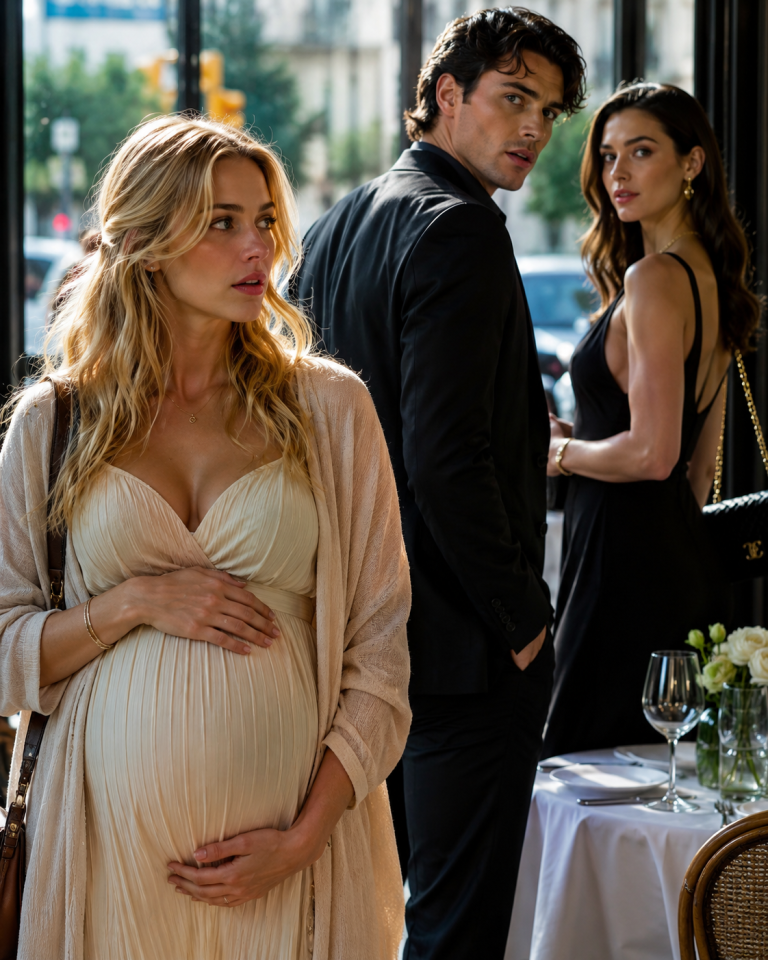
Inside was a photograph. My husband, one hand buried in the golden hair of a woman half my age, her back pressed against the island in my kitchen — the hand-cut Calacatta Viola marble I’d imported from Italy myself, where I’d once hosted senators and gallery owners and men powerful enough to ruin small countries before lunch. They were kissing like they wanted to be caught. Like the photograph itself had been sharpened into a blade and dipped in perfume before it was mailed.
I did nothing, for one full minute. I didn’t cry. I didn’t throw the frame. I simply looked.
The mistress had chosen a flattering angle for herself, of course. Her cheekbones caught the light. Grayson looked younger than his fifty-one years, which only made him look ridiculous — a man with a much older bank account and a much younger hunger, kissing scandal like it might make him immortal.
Then my eyes moved past the two of them entirely.
Not to his hand. Not to her mouth.
To the counter behind them, where a small brass key with a black enamel head lay beside his half-empty glass of scotch.
My safe key.
The same one Grayson had sworn had gone missing three weeks earlier — the same week my jewelry disappeared from that safe.
I leaned in until my breath fogged the glass.
She’d mailed me a photograph meant to break my heart.
Instead, she’d mailed me evidence.
—
By eight o’clock Grayson came down dressed for war, navy suit, the untroubled expression of a man who still believed charm counted as a legal defense. He stopped cold when he saw the frame propped against the roses on the breakfast table.
“Adrienne.” My name sounded inconvenient in his mouth.
“Good morning,” I said, buttering toast I had no intention of eating.
“Where did you get that?”
“It came by courier.”
“From whom?”
“You tell me.”
He’d been devastating once — gray at the temples even at forty-two, disciplined, the kind of face that made investors feel their money was safe even when it wasn’t. I’d mistaken his hunger for ambition back then. There’s a difference. Ambition builds a table. Hunger eats everyone seated at it.
“It isn’t what it looks like,” he said.
I laughed, once, softly. The sound startled even me. “It looks like your mouth on another woman’s, in my kitchen.”
“She’s emotional.”
Not *I’m sorry.* Not *I betrayed you.* Just — *she’s emotional* — as though Peyton Larkin, with her glossy hair and curated sadness, had simply drifted into our penthouse on a cloud of feeling and landed under his tongue by accident.
“Is that what we’re calling her,” I said.
“This is complicated.”
“No. Tax law is complicated. Kissing your mistress beside my lemons is vulgar. Not complicated.”
His jaw tightened. There it was — the man beneath the polish, the one who didn’t like being embarrassed because he was so used to being the one doing it.
“She’s a consultant,” he said. “She worked on the foundation gala.”
“She also worked on my kitchen.”
“Adrienne.” A warning, this time.
I looked back at the frame. “Did she pick it herself? Gold, this literal? It looks like something a villainess buys after maxing out a card at Bergdorf.”
He leaned forward, both palms on the table. “You need to listen to me carefully.”
Ah. Not the remorseful husband. The man who assumed every room was already his the moment he lowered his voice.
“This getting out would hurt both of us,” he said. “The foundation. Your mother’s name. You, publicly.”
“How interesting,” I said, “that the private version doesn’t seem to trouble you nearly as much.”
His mouth thinned. “I’ll handle Peyton.”
The name landed between us like perfume spilled over blood. Twenty-seven. A former pageant girl turned publicist with a gift for making wealthy men feel understood. I’d met her twice — once when she touched Grayson’s sleeve a beat too long, once when she called me “iconic” with the sincerity of a blade going in.
I didn’t hate her for being young. I’d once been underestimated by older women myself. Peyton simply hadn’t learned yet that youth is a currency, not a fortress — and like any currency, it can be spent foolishly.
“Nothing happened with the jewelry,” Grayson said abruptly.
My hand paused over my cup. I didn’t look at the key in the photograph. I didn’t let him see that he’d just told me exactly where to aim.
“What a strange thing to bring up,” I said.
“You’re thinking it.”
“I haven’t said a word.”
He pushed back from the table. “I filed the police report. The insurance claim. You know that.”
“Yes,” I said. “You were very helpful.”
For one second, something shifted in his face, and he saw me — not the wife, not the hostess, not the silence he’d mistaken for weakness. Me.
Then his phone buzzed, face up on the table between us.
PEYTON LARKIN. *Did she open it yet?*
He flipped it over. Too late.
“Tell her,” I said, “her composition is excellent.”
He left twenty minutes later without kissing my cheek. I watched his car slide into traffic from the window, and once he was gone, I walked to the kitchen and stood exactly where Peyton had stood in the photograph. The marble gleamed. The lemons were fresh. The air smelled of espresso, lilies, and something colder underneath both.
I opened the drawer beneath the wine fridge and peeled a small brass key from its underside — taped there since the week we moved in.
The real safe key. The one in the photograph was a duplicate. Grayson had never known there were two.
*Men admire trust,* my grandmother, Augusta Sterling, used to say, fastening diamonds at her throat with hands that had survived three husbands and one hostile takeover. *But they respect locks.*
I had trusted Grayson with a great deal.
Never the locks.
At nine, I called Adrian Voss. He answered on the second ring.
“How bad,” he said, before I’d finished a sentence.
I looked at the gold frame gleaming on the counter.
“Expensive,” I said. “And about to become public.”
## PART TWO
Adrian arrived without an entourage, which is how truly dangerous people enter a room — charcoal overcoat, black gloves, eyes the color of storm clouds over the river. He studied the photograph for a long moment, said nothing comforting, because he knew better than to offer a bandage to a woman bleeding internally.
“She mailed this?” he finally asked.
“By courier. There’s a note too.” I handed him the cream card.
*A woman deserves to know when she’s already been replaced,* it read, in Peyton’s careful hand.
“She forgot to dot the *i* in *replaced,*” I said. “Passion makes people careless.”
We reviewed the security footage together in the pantry, behind the mirrored panel where the server hid — pinhole cameras installed after a break-in the year before, cameras Grayson had signed off on without reading the invoice. Three weeks earlier, at 11:42 p.m., he’d entered the kitchen with Peyton, poured her my wine, opened the drawer beneath the wine fridge, and pocketed the duplicate key. Ten minutes later, elevator logs showed him accessing the private lower level where our safe room sat. He returned at 12:08 a.m. carrying a black velvet case.
My mother’s emerald parure. Four million dollars in stones and immeasurably more in memory.
Peyton had clapped like a child when he held the necklace to her throat.
I did not flinch, watching it. My voice stayed even. “He told me the key went missing four days after this. I noticed the jewelry gone the morning after that.”
“Insurance fraud,” Adrian said. “Theft, false reporting, possibly wire fraud depending on what he did with the pieces.”
“Find out.”
There was more. I brought him to my father’s old study and laid out eight months of irregular transfers — six hundred forty thousand dollars funneled from the foundation account into a vendor called Larkin Creative Strategies, a company formed ten months earlier, billing five times market rate.
“That’s charitable money,” Adrian said.
“Yes.”
By noon he had a plan that had nothing to do with tantrums. Preserve everything — photograph, packaging, footage, metadata. Trace the vendor. Review Grayson’s access to every trust and account. Get appraisals on the missing pieces. Determine whether he’d pledged, sold, or hidden them.
“And sixth,” I said.
He slid the frame into an evidence bag. “Let them think you’re ashamed.”
“That’ll be easy,” I said. “Everyone expects a humiliated wife to hide.”
“So hide beautifully.”
—
That night, my accountant Renata Cole called with a voice like a blade. “You need to come in.”
Her office had no flowers — she considered them emotional clutter — and by the time I arrived, Adrian was already there, which told me everything before she opened the file.
“Grayson is in debt,” she said. “Personally, around eighteen million. His fund has liquidity problems. He’s using new investor money to quiet old investors. Not technically a Ponzi scheme yet. But it’s wearing the perfume of one.”
“The jewelry?”
“Collateral. The emerald parure is pledged through a private lender in Miami. The diamond rivière is unaccounted for.” She paused. “The sapphire ring was sold in pieces.”
My father’s ring. The one he’d slipped onto my hand in Nantucket after graduation, saying, *for the days you forget you belong to yourself,* six months before his heart stopped in a hotel room in Chicago.
I let myself feel that for exactly as long as it took to close my hand into a fist, and then I set it aside. Grief is a room with many doors. I’d already opened too many that week.
“There’s one more thing,” Renata said. “He’s been moving assets — Delaware entities, a Wyoming LLC, some Cayman activity. But he made one real mistake. He used marital funds to service debt tied to assets he’d concealed before our postnuptial disclosures were updated.”
I smiled, slowly. Renata smiled back.
Adrian looked between us. “Explain.”
“Our postnup has a clawback clause,” I said. “If either of us concealed assets, diverted marital funds, or caused reputational harm to the foundation, the injured party gets accelerated separation terms, legal fees, and full recovery.”
Grayson had laughed when I first asked for that agreement, called it unromantic. I’d told him romance wasn’t injured by paperwork unless romance intended to commit fraud. He’d signed two weeks later, once my family trust declined to guarantee his credit facility without it.
Men like Grayson do not fear contracts. They fear women who actually read them.
“He didn’t just cheat,” Renata said. “He breached.”
I removed my wedding ring and slid it across her conference table. “Find every asset. Every transfer. Every lie.”
“And Grayson?” Adrian asked.
“Let him keep believing I’m heartbroken.”
—
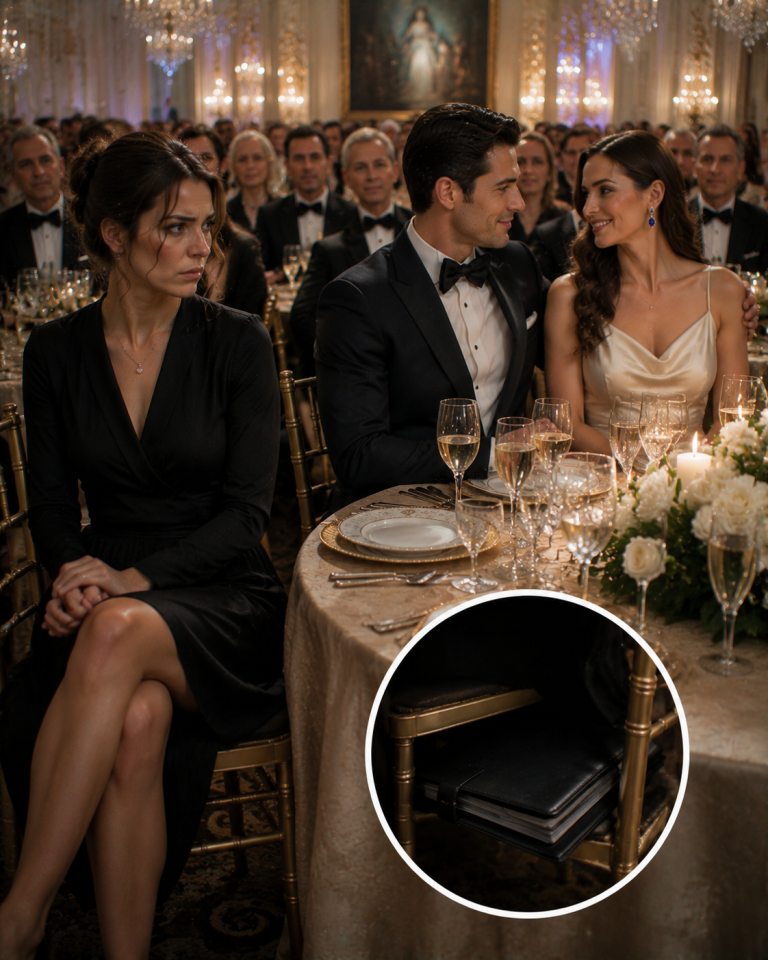
He chose the wrong battlefield two nights later — a ballroom, of all places, the Sterling Arts Foundation’s winter gala at The Continental, the one night a year my mother’s legacy filled a room with old money pretending to like new money for tax reasons.
Grayson thought scandal, handled with enough composure, could become theater. He arrived with Peyton on his arm, both of them dressed like a magazine spread, and the room inhaled the moment they crossed the threshold. She wore red. Diamonds at her throat that weren’t quite my mother’s emeralds — close enough to be a message.
I wore black velvet and my grandmother’s pearls. No diamonds, no emeralds. Pearls, the jewelry of women who know how to survive with their throats exposed.
Sympathy flowed toward Grayson all evening, which was the fascinating part — men clapping his shoulder, women touching his arm with theatrical concern, as though he were the wounded party. Peyton played reluctant love beautifully.
Then I gave my remarks from the podium, said something true about legacy and protecting what you inherit, and the applause came in slow, then thunderous waves.
Afterward, near the marble staircase, Peyton found me.
“I know you’re upset,” she said, loud enough for the room to catch it. “I never wanted to hurt you.”
“Then you should have chosen a smaller frame,” I said.
A ripple moved through the crowd. She should have stopped there. Instead, anger got the better of her.
“You think money makes you untouchable? Grayson chose me. Maybe because I don’t treat him like an accessory in my perfect little life.”
Phones appeared. Of course they did.
“My dear,” I said gently, gently enough to kill, “I don’t keep things that steal from me.”
Her face went from confusion to fear in under a second, because *yes* can be denied, but *not here* suggests a room already waiting elsewhere.
The clip was everywhere before the valet brought my car around.
## PART THREE
The lawsuit landed on a Monday morning, filed at 9:01 for maximum efficiency and minimum ambiguity — breach of postnuptial agreement, conversion of separate property, fraud, breach of fiduciary duty tied to foundation funds, and an emergency injunction freezing every asset Grayson might try to move, sell, or hide.
The evidence packet included one particularly useful line from a two a.m. email Grayson had sent Peyton: *A won’t notice until after Palm Beach. Wear the green set there. You deserve beautiful things.*
*A won’t notice.* That sentence became its own kind of weather.
Peyton’s deposition happened in a glass conference room above Midtown, and I watched it on a live feed from a separate office with Renata beside me. Adrian hunted the way he always did — gently, at first.
“Did you know the jewelry was separate property belonging to Mrs. Marsh?”
“I didn’t think—”
“Did you know?”
She cried then, without any beauty left in it. “Yes,” she whispered.
By the time three hours had passed, she’d admitted to the photograph, the key, the emeralds, the inflated invoices, all of it — trying, in turns, to blame Grayson, herself, stress, and finally something she kept calling love, though she clearly didn’t understand what the word was for.
Grayson settled the civil case within forty-eight hours, though *settled* was a gentle word for what actually happened: surrender in a custom suit. He returned what jewelry could be recovered, compensated the trust at treble value for what couldn’t, resigned every foundation role, and agreed not to contest the call of the note my family had quietly held on his fund since before my father died — the note that had been the spine of his empire the entire time, without him ever once thinking to check whose signature was actually on it.
His fund collapsed within the month. Not because I announced anything. Truth, once subpoenaed, has a habit of finding its own windows.
—
The emerald parure came back first, escorted by two attorneys and a security guard into Adrian’s office. I opened the case and lifted the necklace, furious to find the stones still beautiful — I’d wanted some visible mark on them, proof that betrayal had touched them and failed to be forgiven. But jewelry is cruel that way. It survives the necks of foolish women. It survives thieves. It survives grief better than flesh ever does.
“Never let a man make you feel expensive,” my mother used to tell me, fastening this same necklace before a benefit dinner. “Be expensive before he enters the room.”
Adrian stood by the window, giving me privacy without leaving it.
“Did you know the note was in my family’s trust?” I asked him.
“Since your father died.”
“You never told me.”
“It wasn’t mine to use. And you didn’t need it, then.”
That was the whole of Adrian Voss in one sentence — dangerous, but never because he grabbed for power. Because he could stand beside it and wait.
Three days before the final settlement, in the courthouse’s cold March light, Peyton approached me on the steps — no diamonds now, no red dress, just a navy coat and the stunned look of a woman discovering that consequences don’t care how pretty you are.
“I didn’t know he was using me like that,” she said.
“You knew enough,” I told her.
“I loved him.”
“No,” I said. “You loved winning.”
That landed. She looked down, and then, quietly, said something that stopped my breath entirely.
“I’m sorry about the ring. The sapphire — he didn’t sell all of it. He kept one stone. Said it was bad luck to lose everything.” She glanced toward the courthouse. “He put it in the frame.”
“The photograph,” she said, when I didn’t move. “The backing. He thought it was funny. Like a trophy. I thought he only meant the picture.”
By that afternoon Adrian had a court order. By evening, two attorneys and a clerk watched a technician open the gold frame’s backing under camera. Taped beneath the velvet lining was a small folded square of black silk, and inside it, loose, deep blue, entirely alive, sat the center stone from my father’s ring.
I reached for the table. Adrian’s hand covered mine before I asked for it, warm and steady, and neither of us spoke while the stone caught the fluorescent light.
*For the days you forget you belong to yourself,* my father had said.
I had forgotten. In small, polished ways, over years, I’d confused endurance with devotion, silence with grace, being chosen with being loved. But the one thing that could bring me back to myself had survived, hidden inside the very object Grayson had built to humiliate me. That was the actual twist, in the end. Not the affair. Not the theft. Not even the debt.
The twist was that his arrogance had accidentally preserved the one thing worth keeping.
—
I took my name back before lunch on the day the divorce was finalized in June. Adrienne Sterling. Never Marsh again.
Grayson accepted a plea deal that summer for crimes larger than anyone had expected, though not larger than his own certainty had always promised. Peyton avoided prison by cooperating, moved to Arizona, deleted every account she had. I didn’t follow what became of her after that. Hatred is still a kind of attention, and I’d already spent enough of mine.
The foundation didn’t just survive the scandal — it thrived past it. Donations doubled. At the first student exhibition afterward, a twelve-year-old girl from Queens painted a woman in pearls holding a sword made of light and titled it *The Wife Who Looked Closer.* I bought it anonymously. It hangs now in my mother’s old townhouse, restored, sheets removed, windows finally open, a stubborn magnolia blooming too early in the garden as if it had somewhere to be.
Adrian came to see me there one evening in September, no flowers, because he knew me better than that. He brought a small box from a jeweler who specialized in antique restoration instead. Inside was a new ring — platinum, simple, the recovered sapphire set plainly at its center, no replacement diamonds, just a thin engraved border I had to lift close to read.
*You belong to yourself.*
“It’s not a proposal,” he said quickly, and I laughed, because on him that particular awkwardness was rare enough to be worth noticing.
“I know,” I said.
I slid it onto my right hand. It fit perfectly, of course it did, and we stood there a long moment in the lamplight — two people old enough to understand that healing isn’t a montage or a kiss in the rain, but the far quieter work of walking back into rooms that once hurt you and simply opening the windows.
“Are you still only permitted one answer?” I asked him, the way I had once before, in a different room, at a different edge of ruin.
“I’ve had enough of watching men underestimate you,” he said. “I’d rather not join them.”
So I kissed him — not to replace anything, not to prove I could still be wanted, just because the house was warm, my father’s stone was back on my hand, and for the first time in years, wanting something felt like a door I’d opened myself.
Outside, the city went on being loud and careless the way it always does. Somewhere, someone else was mailing a photograph meant to wound, believing cruelty made them powerful.
Let them.
I know now that survival has more than one dialect. Some women scream. Some break plates. Mine turned out to be quieter — it wore black velvet to the gala, preserved the metadata, called the note, and turned a mistress’s petty little performance into a chain of custody.
She mailed me a kiss dressed up as a warning.
I zoomed in, and found my own name waiting in the background the entire time.