No One Could Save the Dying Mafia Boss—Until a Brave Single Mom Healed Him Instantly

## PART 1
She was thinking about the permission slip.
Not the man bleeding out on the gurney. Not the nine armed men who had just turned her emergency room into something that was not a hospital anymore. Not the gun aimed at the ceiling, or the order that had come from the man holding it — *nobody moves, nobody calls anyone* — or the terrible silence that followed.
She was thinking about the permission slip for Marcus’s field trip that she had left on the kitchen counter, unsigned, because she had been late for her shift and she had promised herself she would do it tonight and now tonight had become this.
That was how fear worked for Sera Kim, apparently.
Not in dramatic waves. In small, irrelevant details that the mind grabbed at to avoid the shape of what was actually happening.
She set down the form she had been filling out.
There were eight men in the emergency room now that she could count. A ninth stood at the sliding doors in a way that meant the doors were not sliding for anyone. They were not hiding the guns. That was intentional. Fear required visibility.
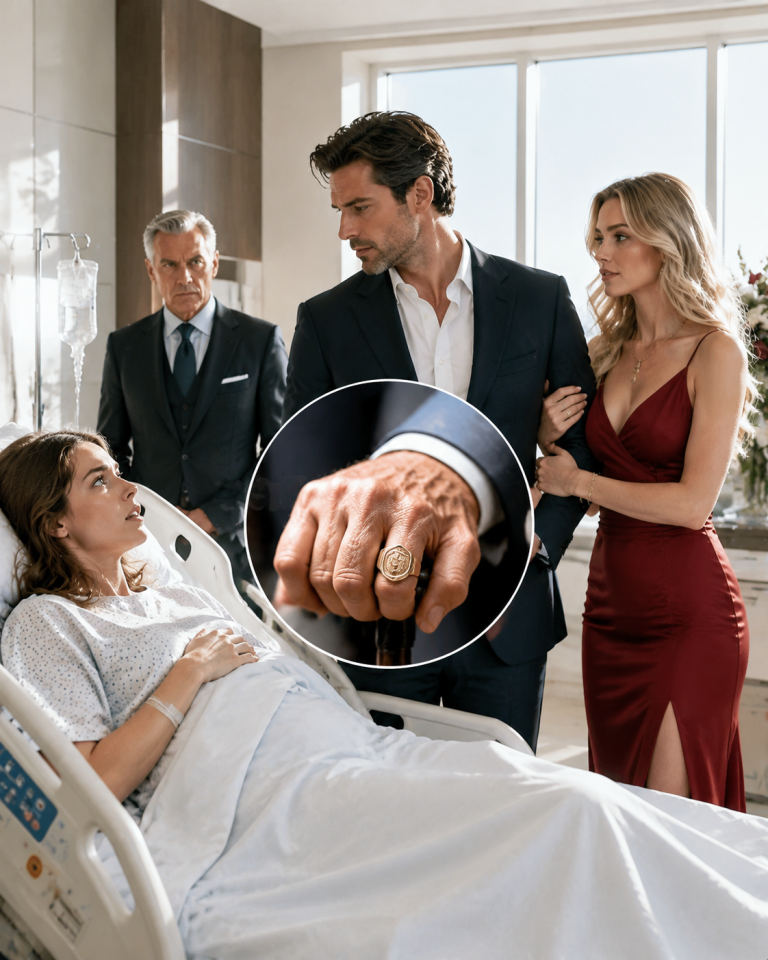
Between two of them hung a man who was actively dying.
She could see it from thirty feet away.
The gray around his mouth. The uneven rise of his chest. The way his weight had become something his legs were no longer managing. His suit was expensive, which meant the blood soaking through it looked wrong in the way expensive things always looked wrong when they were ruined.
Dr. Wexler, the trauma attending, stepped forward.
“We need to—”
“Back up.”
The man who said it had a scar that ran from his left eyebrow to the corner of his jaw and eyes that had made the ER silent through no loudness at all. His voice was calibrated precisely below the threshold of shouting, which made it worse.
“Your best trauma surgeon. Right now.”
“That’s me,” Wexler said.
The scarred man’s gaze moved over him with the efficiency of someone sorting objects by usefulness.
“He’s been losing blood for twenty-three minutes,” he said. “Three wounds. Chest, side, shoulder. If he dies in the next two minutes because you wasted time, everyone here is responsible for that. Starting with you.”
Wexler moved to the patient.
Sera watched Wexler’s hands on the first assessment.
She watched them the way she had learned to watch hands in places where hands told you more than faces did. Afghanistan had taught her that. Mosul had reinforced it. Three years in combat medicine, then a year at Walter Reed, then Marcus and the divorce and this hospital and this life — all of it had made her fluent in the language of what hands did when the brain was somewhere else.
Wexler’s hands were trembling.
Not badly. Not enough for most people to see.
She saw it.
She also saw the patient’s breathing.
She did not think. The part of her that had learned not to think — the part the Army had trained into the muscle and bone of her — moved before the part that held the permission slip and the fear and the exhaustion had a chance to raise objections.
She pushed past Wexler.
“Chest tube kit. Open thoracotomy tray. Crash cart. I need them in thirty seconds.”
Wexler turned. “Sera, what—”
“His lung is down and his pericardium is filling. If we don’t open him in the next ninety seconds we lose him permanently.”
She did not look at the scarred man. She did not ask permission. She looked at the patient because the patient was the only thing in the room that mattered.
Then she said, without turning her head: “I need everyone to stay back and stay quiet. And whoever is holding the lightest, hold it here.”
She meant the lamp above the gurney.
The youngest man in the room — barely twenty-two, wearing a suit that still had the careful crease of someone who had just learned how to wear one — moved the lamp.
His hands shook once.
Then they didn’t.
“Jenny, glove me,” Sera said. “Wexler, maintain airway. Keep oxygen moving. Don’t let it drop.”
She made the incision.
The room inhaled.
Blood came faster than she wanted. She controlled it. Her hands moved the way they had moved in dust and heat and noise that made the ER’s fluorescent hum sound like silence — with the precision that was not born from talent but from repetition, from the particular education of cutting into people under conditions that did not permit mistakes.
She found the collapsed lung.
She found the tamponade.
She opened the pericardium.
Blood.
Then the heart moved.
Wrong rhythm. Wrong strength. But moving.
The monitor stopped screaming and started beeping.
Jenny said something under her breath that was probably not appropriate for a hospital setting.
Sera clamped what needed clamping, controlled what needed controlling, and called for what was needed next in the specific order that would give this man a chance at an operating room.
When she stepped back, her scrubs were not the color they had been.
The scarred man was watching her.
He lowered the gun.
Not dramatically. Just returned it to wherever it had come from, with the same economy he had applied to everything else.
“What’s your name?”
“Sera Kim.”
“Mine’s Dante,” he said. “You just saved Luca Mancini.”
She did not recognize the name.
Every nurse in the room did.
Their faces told her exactly what she needed to know.
She had just pulled the head of the Mancini crime family back from the edge of a death he had been aimed toward by someone who clearly understood his schedule very well.
And now she was standing in the middle of it, covered in his blood, with no clear path back to the side of the room where things were still ordinary.
—
## PART 2
By three in the morning, the ICU’s West Wing had been turned into a private fortress with terrible lighting.
Every room on the floor had been cleared through explanations that nobody questioned because the questions had been discouraged. Armed men occupied the elevators and stairwells and the nurses’ station with the focused stillness of people who had done this before. Sera had completed her operative notes, changed into the clean scrubs the charge nurse had retrieved from the supply closet, and was attempting to finish a set of charts that had been waiting since before the world changed.
Dante appeared beside her desk in the way he appeared everywhere — without any sound that announced him.
“Army,” he said.
“Yes.”
“Combat medic.”
“Trauma specialist, technically. Two rotations in country, one in a forward surgical unit.”
“How many emergency thoracotomies?”
“Fourteen. Three in austere conditions.”
Dante considered this.
“Why did you leave?”
Sera looked at her chart.
“My son was born,” she said. “He needed a mother who came home.”
“How old?”
“Eight.”
Dante’s gaze sharpened in the way she had seen it sharpen before — not warming, but focusing.
“Where is he now?”
“With his father.” She set down her pen. “What is this? A background check?”
“Someone knew Luca’s route tonight,” Dante said. “Someone with access to his security schedule. We are identifying the source.”
“I didn’t know who he was before you said his name.”
“That doesn’t eliminate you.”
“It absolutely eliminates me. If I were involved in shooting someone, I would not then perform emergency surgery on them for forty minutes.”
Dante’s jaw moved.
“That logic is more compelling than it should be.”
“Because it’s correct.”
Before he could respond, Dr. Hartwell appeared. Behind him, two administrators in suits that should not have been in a hospital at this hour.
“Nurse Kim,” Hartwell said. “Richard Sousa, hospital director. We need to discuss what happened in the ER tonight.”
“The patient survived.”
“You performed an unauthorized procedure.”
“The alternative was a death in our emergency room. I chose the other option.”
Sousa’s mouth tightened. “The liability implications of—”
The monitor alarm from Room 12 cut through the conversation.
Sera moved.
Inside, Luca Mancini had surfaced from under the sedation and was trying to reconstruct where he was. His hand had found the bandaging across his chest and his eyes were doing the rapid assessment of a man who had woken in unfamiliar places before.
“Stay down,” Sera said.
His gaze found her and stopped there.
She returned it without apology. Eight years in medicine had cured her of being nervous about powerful people’s eye contact. Bodies were bodies. Consciousness was consciousness. He was a patient who had nearly died and was now looking at the person who had decided he would not.
“You,” he said. His voice was rough from intubation.
“Me. And if you sit up, you’ll tear two sutures, compromise the chest tube, and undo approximately forty minutes of work I would rather not repeat.”
Something passed through his expression.
Then Dante was behind her.
“Sir. We need to move you.”
“No.”
Luca’s eyes were still on Sera.
“Her name,” he said.
“Sera Kim.”
“Sera Kim.” He said it the way you said something you intended to remember. “She’s protected. Anything that happens to her is answered by me personally. Everyone in this building hears that.”
Dante nodded.
“Understood.”
As the sedation pulled him back, Luca said: “She saved my life. In my world, that has weight.”
Sera stood in the doorway while the room resumed its machinery around her.
Hartwell and Sousa were behind her. She could hear Sousa already composing the language of consequence.
Dante brushed past her shoulder, close enough to speak only to her.
“Protection from him is real,” he said quietly. “But real means you are now known. Being known to the Mancini family is not the same as being safe.”
He was gone before she could answer.
She looked at her hands.
The scrubs were clean now.
But she was thinking about Marcus’s permission slip again, and about how the distance between her life two hours ago and her life right now was exactly the width of one man’s heartbeat under her fingers.
—
## PART 3
The morning came pale and cold.
Sera crossed the hospital parking lot at six-forty, keys in hand, breath clouding the November air. She was thinking about getting to Marcus before his father gave him sugared cereal again. She was thinking about the field trip form still on her counter. She was not thinking about the two people leaning against her car.
She stopped.
A woman in a charcoal blazer. A man in the kind of jacket that had been worn on surveillance long enough to lose its shape. Both of them wearing the unmistakable combination of visible badge and invisible tension that meant law enforcement doing something they weren’t entirely authorized to do at six-forty on a Thursday.
“Sera Kim,” the woman said. “Detective Andrea Crane. This is Detective James Rourke. We need to talk about what happened last night.”
Sera stayed where she was.
“I gave a statement to the responding officers at four a.m.”
“Not about the shooting,” Crane said. “About Luca Mancini.”
The morning felt colder than it had a moment ago.
“My patient survived. That’s the relevant part.”
Rourke took a half step forward with the rehearsed warmth of someone who had practiced it. “We’re not here to cause you problems. We’re actually here with an opportunity.”
“It’s been twelve hours since eight men with guns walked into my ER. I’m not interested in opportunities.”
Crane held up her phone. Security footage. Dante’s face. Luca’s hand. The room’s configuration. “He put you under personal protection. In Mancini’s organization, that means something real. It means you have access we’ve been trying to build for four years.”
Sera looked at the footage.
Then at Crane.
“You want me to report on my patient.”
“We want you to observe—”
“No.”
Crane blinked.
“I’m a nurse,” Sera said. “Everything that happens in that room is protected. Everything that is said to me in a medical context is protected. What you are describing is a violation of patient confidentiality, medical ethics, and the trust that makes it possible for anyone — including people you’re trying to prosecute — to receive care when they’re dying.”
Rourke’s jaw tightened.
“These men are dangerous,” Crane said.
“Everyone is dangerous when they’re bleeding.”
“You have a son.”
Sera’s face did not change.
“Do not,” she said quietly, “use my son as a mechanism.”
Crane had the grace to look briefly uncomfortable. “I only mean you have something to protect. These people—”
“These people are not my problem to solve. I’m not a spy. I’m not an informant. I saved a patient’s life and now I want to go home and sign a permission slip for a field trip about the water cycle.”
She walked to her car.
They did not stop her.
But as she pulled out of the lot, she could feel their eyes in the rearview mirror, and she understood something Dante had said in the doorway — being known was not the same as being safe, and the knowing had come from two directions now.
She was on the highway when her phone buzzed.
Unknown number.
She let it ring.
It rang again.
She pulled off at the next exit, parked in a gas station lot, and answered.
“Ms. Kim.” A man’s voice. Not Dante. Someone who had been trained in the particular discipline of sounding calm when they were not. “My name is Rafael Ruiz. I’m an attorney representing Luca Mancini. He’d like to meet with you.”
“He’s recovering from surgery.”
“He is aware of that. He’d like to meet with you at the hospital this afternoon, under whatever conditions you prefer.”
Sera looked through the windshield at a gas station attendant restocking windshield fluid who appeared to be having a considerably simpler morning than she was.
“What does he want?”
“To thank you. And to discuss something he believes you need to know.”
“I don’t need anything from him.”
“That,” Ruiz said carefully, “may not be entirely accurate.”
She said nothing.
“There is a reason Luca was shot last night,” Ruiz continued. “Someone inside his organization provided the information that made it possible. His security team believes the same person may have also provided information about you to the people who wanted him dead.”
Her hand tightened on the phone.
“What kind of information.”
“About your son.”
The gas station lot went very still.
The attendant was still restocking windshield fluid. The highway noise was still there. Everything was exactly as it had been fifteen seconds ago, and Sera’s whole body was somewhere completely different.
“What,” she said, and her voice had the particular flatness she remembered from the forward surgical unit, the voice that came when emotion became a structural liability.
“Marcus Kim. Eight years old. Enrolled at Fairview Elementary. His father is Daniel Yun, who resides—”
“Stop,” she said.
She knew.
She already knew where he lived. She knew Marcus’s schedule and routine and which corner he waited at for the school bus. The information Ruiz was reading from had been assembled by someone who wanted it available.
She thought about the two detectives in the parking lot.
She thought about Crane saying *you have a son* before she finished the sentence.
She thought about how that information could travel from a hospital security system to a police database to wherever else information went when it was being used as leverage.
“I’ll be there at two,” she said.
—
Luca Mancini looked better than anyone had a right to look fourteen hours after emergency thoracic surgery.
Not well. The color had not fully returned and he held himself with the conscious stillness of someone managing pain. But his eyes were the same — dark, attentive, the kind that filed details rather than performed interest.
Rafael Ruiz stood near the window. Dante by the door, arms folded.
Sera sat in the chair beside the bed with her hands in her lap, because she was a nurse visiting a patient, which was the only thing she allowed this to be.
“Thank you for coming,” Luca said.
“Your attorney mentioned my son.”
He accepted the directness without flinching.
“Yes.” He looked at Dante briefly. “Tell her.”
Dante pushed away from the wall.
“The shooter last night was hired through a contact we’ve been tracking for six months,” he said. “The contract included two pieces of information from inside sources. Luca’s security route — which came from someone in our own organization.” A pause. “And a secondary target. A nurse at the hospital, identified by name and home address, to be used if the primary contract failed.”
Sera kept her breathing even.
“Why a nurse.”
“Because the contract was placed by someone who understood that Luca survives most things,” Dante said. “The contingency was to have a leverage point afterward. Someone who mattered to him.”
“He didn’t know me before last night.”
“No. The person who placed the contract anticipated last night. They planned for you to save him.” Dante’s eyes were direct. “They expected you to become important. And they prepared accordingly.”
Sera sat with that for a moment.
She had been placed on a board she had not agreed to play on, in a game that had begun before she walked into work, by people who had made assumptions about her usefulness before she had made a single choice.
“Who placed the contract,” she said.
Dante looked at Luca.
Luca said, “That is what I need to discuss with you. Because the person who did this is not someone you would expect.”
He picked up a tablet from the bed beside him and turned it toward her.
Sera looked at the screen.
She recognized the face immediately.
It was not a man from Luca’s organization.
It was Detective James Rourke.
She thought about the parking lot that morning. The practiced warmth. The rehearsed step forward. The way he had said *you have a son* like the information was already inside him before he said it.
“He’s been running a parallel operation,” Dante said. “Using the Romano family to fund it while building federal cases that eliminate Romano’s competition. Luca’s network was next. Your ex-husband is connected to a real estate holding company that Rourke’s been using for fund movement.”
Sera went very still.
“Daniel.”
“We don’t believe he knew the full scope,” Dante said. “He appears to have been used as an unwilling mechanism. But his signature is on three transactions.”
“Does he know about Marcus.”
“We believe Rourke provided your son’s information without Yun’s knowledge. It was insurance, in the event the primary operation failed.”
She closed her eyes for two seconds.
Not from fear.
From the specific clarity that came when training and motherhood and everything that she was converged into a single, irrevocable decision about what happened next.
She opened her eyes.
“I need everything you have,” she said. “Documents, timelines, evidence. Not for your case. For mine.”
Luca looked at her.
“Rafael handles documentation,” he said. “He works for you now, for as long as you need him. No conditions.”
“I’m not asking for your resources.”
“I know.” His voice was quiet. “I’m offering them. Freely. Because you reached into my chest and chose to care when you didn’t have to, and that is the only kind of debt I know how to carry.”
Sera looked at him.
She thought about the word protection, and Dante’s warning about what it meant, and the difference between being used and being given something without conditions.
She thought about Fallujah. About the men she had sat with in the dark when the surgery was finished and the noise was less and they were just people who had been through something terrible and needed someone to stay.
She had always been the person who stayed.
“Three conditions,” she said.
Luca waited.
“Marcus is never mentioned again in any document connected to your organization. His father is protected from prosecution if he cooperates. And I keep my job and my license intact.”
“Done,” Luca said. “Dante?”
“Done,” Dante said, with less enthusiasm but equal finality.
Sera stood.
“I need Rafael this afternoon.”
“He’ll meet you at four.”
She picked up her bag.
At the door, she turned.
“The young man who held the lamp last night,” she said. “In your organization.”
Luca’s expression shifted slightly.
“Marco. My nephew.”
“He was frightened and he held steady,” she said. “That’s worth noticing.”
She left before Luca could respond, but she heard him say, quietly, to Dante: “She’s remarkable.”
And Dante say, equally quietly: “She knows.”
—
What followed was not cinematic.
It was paperwork, recorded calls, forensic accounting, a federal whistleblower attorney, and the particular patience of a woman who had learned in a forward surgical unit that precision outlasted speed every single time.
Rourke had been building his operation for four years, using a corrupt department liaison and two shell companies to fund a protection racket disguised as organized crime cooperation. He had positioned Detective Crane as an unwitting partner — Crane, Sera learned, had been genuinely running a legitimate investigation and had no knowledge of what Rourke had been doing beneath it.
Crane called her the day before Rourke’s arrest.
“I owe you an apology,” she said.
“For this morning, or in general?”
“Both.” A pause. “I used your son as a pressure point. Even if I believed it was for the right reason, that was wrong.”
“It was,” Sera said.
“I’m sorry.”
“I know.”
Daniel was interviewed by federal investigators for eleven hours and turned over the transaction records he had not understood the significance of. His lawyer — not the public defender he’d expected, but a sharp-edged woman named Carmen who billed through Rafael’s firm at Luca’s specific instruction — navigated him through cooperation immunity with the efficiency of someone who had done it before.
He called Sera the night after his interview.
“I didn’t know,” he said.
“I know.”
“About Marcus. That they had—” His voice broke. “I’m sorry.”
“What matters,” she said, “is that he’s safe and you’re going to stay clean.”
“How did you know what to do?”
She thought about it.
“I’ve been navigating situations where the official channels are compromised since I was twenty-four years old,” she said. “You learn to find the person who wants the same outcome for different reasons, and you work from there.”
Daniel was quiet for a moment.
“The Mancini attorney told me not to worry about legal fees.”
“I know.”
“That’s not—”
“Daniel. Go be Marcus’s father. That’s all.”
He was quiet.
“Yeah,” he said. “Okay.”
—
Rourke was arrested on a Tuesday morning, with the specific bureaucratic lack of spectacle that federal arrests tended to have when the evidence was very good and the lawyers on both sides had been thorough.
Crane was cited in the accompanying press release as an investigative partner whose separation from Rourke’s operation had been documented and verified.
Sera read the release on her phone in the break room at Chicago Memorial, between a fractured collarbone and a toddler who had swallowed a Lego.
Her phone buzzed.
An unknown number.
She answered.
“It’s done,” Dante said. “Thought you should hear it directly.”
“Thank you.”
“The nephew. Marco.”
“Yes?”
“He’s been asking about trauma medicine. Whether there are programs for people from his background.”
Sera looked out the break room window at the gray November sky.
“There are programs,” she said. “Send him my contact.”
Dante paused.
“You’d do that.”
“He held steady when it counted. That’s what medicine looks for.”
Another pause.
“You are a strange person to have saved a man like Luca.”
“He was bleeding,” she said. “That’s not strange. That’s the job.”
—
Three months later, on the first Saturday in February, Sera and Marcus took the bus to the Science Museum for the field trip the permission slip had eventually been about.
He had graduated to the one that required three signatures and a liability waiver, because that was apparently what field trips became once you turned eight and a half.
She signed all three.
On the bus, Marcus fell asleep against her arm with the complete trust of a child who did not know that his mother had spent part of a November night deciding which kind of world she was willing to fight to keep him in.
She looked out the window at Chicago passing.
She thought about the things the night had cost her — sleep, innocence, the particular luxury of believing her life was fully contained — and the things it had not taken, which were the things she had built, slowly and deliberately, from the materials that were available.
A son who drew suns in the corners of his worksheets.
A job she was good at.
Hands that knew what to do when the room went quiet.
She thought about Luca’s words: *she saved my life. That means something.*
She did not particularly want it to mean something. She had not saved him because she wanted weight in his world. She had saved him because he was a person who was going to die and she knew how to stop that, and the people around him had not been able to move fast enough.
But the weight had arrived anyway, and she had learned — in Afghanistan, in the divorce, in the particular education of raising a child alone while working nights — that weight was only dangerous if you pretended it wasn’t there.
She had not pretended.
She had looked at it directly, named its shape, and decided what to do with it.
That was all she had ever known how to do.
Marcus stirred.
“Mom.”
“Mm.”
“Did you bring snacks.”
“Of course I brought snacks.”
He settled back against her arm.
She let her head rest against the window, watched the city move, and thought: *this. This is what I was protecting.*
Not a theory. Not a principle. Not a complicated calculation of right and wrong in a world that was neither.
Just this.
A kid who needed snacks on a February bus.
A permission slip she had finally signed.
A morning that belonged only to them, in a city that was still complicated and still dangerous and still full of people who were going to need someone who moved toward them when everything said to stay back.
She would move.
She always had.
She was good at it.
That was enough.