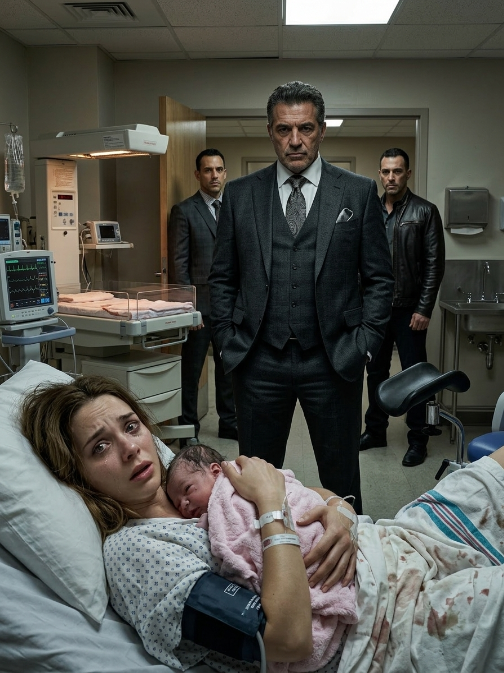
The Mafia Boss Let Them Torture Her—Until She Whispered His Name and Everything Changed

## PART 1
The last thing Elena Marsh thought before the interrogation lamp blinded her was that the numbers had been right all along.
Not the warehouse. Not the cold, which was the specific cold of industrial spaces that had absorbed decades of disuse and now breathed it back like punishment. Not the rope at her wrists or the ice water that had been thrown on her twice to keep her focused. Not Pavel Sorin across from her, who wore a suit that cost more than her car and spoke in the careful, reasonable cadence of a man who believed that courtesy made cruelty sophisticated.
The numbers.
She had been a senior auditor at Deloitte Marlow for six years. Her world was clean: fluorescent light, risk matrices, client meetings where the most dangerous thing in the room was a partner’s passive-aggressive feedback on formatting. Numbers had always been simpler than people. More honest. Less interested in how they were perceived.
And one month ago, the numbers had told her something nobody wanted her to know.
A commercial property group. Seven clients, diversified, legitimate on every surface. But underneath — shell vendors with no physical address, invoice flows that cycled through three offshore entities before returning to a Chicago account classified as a management fee, consulting payments to incorporated names that resolved to a registered agent and nothing else.
She had spent four weeks building the map before she understood whose territory she was mapping.
The Sorin Organization.
She had copied everything: ledger files, routing chains, vendor authorizations, the internal approval trail that went all the way up to a managing director who had signed off on twelve months of red-flag transactions without flagging a single one.
She had been three days from the FBI.
Then they took her.
Pavel stepped closer now. He was a large man, precise in the way of someone trained to read rooms and adjust his volume accordingly. “Miss Marsh,” he said. “The password. That is all.”
“I don’t remember it,” she said.
This was a lie and they both knew it.
Pavel sighed with the performative regret of a teacher disappointed by a capable student.
“Your memory is excellent,” he said. “I have read your performance reviews.”
He had been thorough. That was the thing that separated men like Pavel from ordinary violence — the research. They arrived having read everything, which was its own kind of violation.
The lamp burned.
Her wrists ached.
Elena kept her gaze on the floor.
There was a man in the room she had been trying not to look at since they dragged her in.
He was seated near the back wall in a straight-backed chair, positioned outside the light, dressed in a dark suit that was tailored in the way of things that did not announce themselves. His posture was relaxed in the careful way of someone who had trained their body to look relaxed. One hand held a glass of whiskey he had not touched. His face was angular, controlled, shadowed by the warehouse dark.
Adriano Costa.
Elena knew the name from financial filings, court documents, city council meeting agendas, law firm client lists, and every other place money moved in this city while pretending not to be. The head of the Italian Syndicate. A man who had made himself into something the city negotiated around rather than with.
She knew another name.
Sandro.
Seven months earlier, on a wet October evening at the Hideout bar while she was nursing a terrible week over a glass of Barolo, a man had sat down beside her and asked her what she thought about whether balance sheets could be beautiful.
She had looked at him and said, “Only if you know what you’re looking at.”
He had smiled.
They had spent the next three months together in the margins of her ordinary life. Saturday mornings at a coffee shop on Milwaukee Avenue where he was always already there reading. A weekend in Madison where they drove to the Arboretum and he held her hand like he was trying to memorize the geometry of it. The way he looked at her when she said something that surprised him — not surprised that she was smart, but surprised that she could reach him.
He said he was a private equity consultant.
She had known it wasn’t true by the second month.
The men near doors. The phone calls he took outside at all hours. The way a restaurant’s energy shifted when he entered, subtly but reliably. The weight under his jacket.
When she asked him, he told her the shape of it without naming it.
“I’m not someone you should know,” he said. They were standing outside her apartment building at midnight, and he was already positioned for a goodbye she hadn’t given him permission for. “My world — what I do in it — it doesn’t stay contained, Elena. If it reaches you—”
“It won’t,” she had said.
He had shaken his head.
“I love you,” he said. “Which is why I am not allowed to say that where you can hear it.”
He left.
She had told herself it was grief for a few weeks, and then she had gone back to work and let the numbers fill the space.
And now she was in a warehouse on the south side, and the man who had stood outside her apartment and ended things to keep her safe was twenty feet away, watching Pavel Sorin prepare to break her hand.
Adriano had not spoken.
His expression had not moved.
He sat in the bored, careful way of a man attending a business meeting that was running long.
Pavel glanced toward the shadows. “Signor Costa, your patience is admirable. What would you suggest for our stubborn auditor?”
Adriano’s voice, when it came, was entirely level.
“I would suggest you brought me here to discuss port licensing, not to demonstrate how much trouble you attract when a single accountant reads your footnotes carefully.”
Pavel’s eyebrows rose slightly.
“She copied proprietary files.”
“She copied numbers,” Adriano said. “Numbers that exist because your people were careless. If the documentation embarrasses you, the weakness predates her.”
A pause.
This was not mercy. Elena understood that even through the haze of cold and pain. Adriano was doing what dangerous men did when they needed to delay something — making the room discuss itself.
Pavel smiled thinly and gestured to one of his men.
Elena’s breath shortened.
The man moved toward her.
Adriano checked his watch. The gesture was casual, elegant, the movement of a man managing an impatient meeting.
But she saw it.
The jaw.
One muscle, held.
Eight seconds of something real inside a face built for nothing else.
Elena’s vision had been blurring for twenty minutes. The lamp above her made everything a flat, white erasure at the edges. She could feel herself slipping — not toward sleep, but toward the cold place where the body stopped performing survival and simply waited.
Her eyes found him.
The man who had stood outside her building and said he loved her like it was a private verdict rather than a confession.
“Sandro,” she said.
Just that.
It was barely audible.
In the concrete space of that warehouse, it was enormous.
Pavel froze.
He turned slowly.
“What did she say?”
Adriano did not move.
But something broke.
Not fully. Not visibly to everyone. But Elena had spent months learning the specific grammar of this face, the way it held things, and she had just watched one word undo something he had spent years building.
She raised her head. A tear cut through blood and concrete dust on her cheek.
“Adriano,” she said. “Please.”
Then the room went dark.
The silence after her name landed in the warehouse was the kind that preceded consequence.
Pavel looked between the woman losing consciousness in the chair and the man who had gone still in his seat with the particular quality of a person deciding which version of themselves they were going to be in the next twenty seconds.
He understood it too late.
Adriano Costa stood.
—
## PART 2
She woke to a ceiling she did not recognize.
Painted. Old. Plaster figures arranged in fading pastoral scenes, nothing like hospital tile or hotel white. Warm light came from somewhere to her left. A fire, she realized, and cedar underneath it, and the clean antiseptic smell of someone who had treated injuries in this room before.
Her body itemized itself: ribs, shoulders, wrists, the split corner of her mouth.
She tried to sit up.
“Don’t.”
The voice came from near the window.
Adriano stepped into the light.
He was not wearing his suit. Dark trousers, a black sweater, the sleeves pushed to his forearms. He looked like the person he had been on Saturday mornings at the coffee shop, which was somehow the more difficult version to look at.
“Where am I?”
“My home. Outside the city.”
He brought water from a small table near the fireplace and set it in her reach without touching her.
“Your people got me out,” she said.
“Yes.”
“The flash drive.”
“Safe.” He sat in a chair near the bed, not on the edge of it. Distance that acknowledged things. “You hid it in the lining of your laptop bag.”
“The exterior seam. Did they get the password?”
“No.”
“Good.”
He looked at her with a quality she remembered from the Arboretum in October, when she had said something about the way trees communicated through root systems and he had gone quiet in the way of someone filing something carefully.
“Six hours,” he said.
“I wasn’t counting.”
“I was.”
Elena looked away.
“You were right there,” she said.
“Yes.”
“The entire time.”
“Yes.”
“And you—”
“I was trying to assess whether I could get you out without making you more valuable to him.” He paused. “I failed at the assessment. Your name made it irrelevant.”
She laughed once, jagged and short.
“My name,” she said. “Not even my name. A nickname I gave you because you looked like someone who needed one.”
He accepted the sentence without defending himself from it.
“What are you going to do with me now?” she asked.
“Whatever you decide.”
She stared at him.
“That is not how you operate.”
“It is how I intend to operate with you.” He held her gaze. “The evidence you built is intact. The FBI can receive it through a clean chain. Your firm’s internal logs show the managing director’s approvals. The partner who signed off on twelve months of flagged transactions without reporting them is documented.”
“Who gave that access to Sorin?”
Adriano’s face went still.
“Tell me,” she said.
He stood and walked toward the fireplace.
“Elena.”
“Don’t manage me. Tell me.”
He looked into the fire for a moment.
“Your supervising partner,” he said. “Martin Kovacs. He accessed your restricted audit files through an executive credentials override and sold your routing, your schedule, your private notes. To Sorin.”
Martin Kovacs.
Martin, who had hired her out of her master’s program and told her she had the kind of methodical intelligence that accounting needed more of. Martin, who sent her edits on her client reports with detailed notes rather than vague corrections. Martin, who had recommended her for a leadership track last spring and taken her to lunch to celebrate.
Martin, who apparently had a gambling problem that predated her by four years and had turned her life into a ledger entry on someone else’s balance sheet.
“How much?” she asked.
“Enough to cover what he owed,” Adriano said. “Not enough to change his life. Just enough to buy himself a year.”
The cruelty of it was not in the number. It was in the scale.
She had been worth an extension.
“Where is he now?”
“Contained.” A pause. “In this house.”
Elena looked at him.
“You detained him.”
“Yes.”
“That is illegal.”
“Yes.”
“You are holding my professional mentor in a basement.”
“A secure room on the ground floor. He has not been harmed.”
“Adriano.”
“He sold you to a man who was going to break your hands and drown you in the Calumet River.”
The sentence was stated without affect. That made it worse.
Elena looked at the fire.
Here was the impossible thing: the man who had lied to her and kept her at arm’s length to protect her had walked into a warehouse and was the only reason she was alive, and the man who had mentored her and told her she was the future of forensic accounting had sold her for a year’s grace on a debt.
“What are you going to do to him?” she asked.
“Whatever you decide.”
“You keep saying that.”
“I keep meaning it.”
“You could send him to federal investigators. With full documentation.”
“Yes.”
“You could expose him publicly first.”
“Yes.”
“You could—”
“Elena.” His voice softened just enough. “Tell me the version of this that lets you become someone you can live with. I will make it happen. But I am not choosing for you.”
Her throat tightened.
“And Sorin?”
Adriano’s expression changed in the way of something briefly surfacing.
“That is the harder conversation.”
“Tell me anyway.”
“Sorin will spend the rest of his life understanding that he chose the wrong leverage point. That is a certainty.” He turned from the fire. “The question is whether you want him in a federal cell or in a condition that is more immediate.”
“I want him in a federal cell,” she said. “Where lawyers have to stand in front of cameras and say his name in daylight.”
Adriano looked at her.
“That is,” he said carefully, “more difficult for me to arrange than the alternative.”
“I know.”
“You are asking me to put a man I have wanted dead for two years into the hands of people who might let him negotiate.”
“I am asking you to choose the version of this that lets *you* live with it too.”
The sentence landed.
He was quiet for a moment.
Then: “Done.”
One word. Heavy with everything it cost him.
Elena exhaled.
In the quiet that followed, she thought about the flash drive, the ledger, the routing chains she had spent four weeks building, all of it waiting in the lining of a laptop bag for the right moment.
The right moment had arrived in the wrong way.
But it had arrived.
“I need a laptop,” she said. “Secure internet access. The drive. A forensic chain-of-custody framework. And someone who can confirm Deloitte Marlow’s file retention schedule for client workpapers.”
Adriano stared at her.
“You were tortured ten hours ago.”
“I know.”
“You have two cracked ribs.”
“I know that too.” She met his eyes. “This is how I fight back. Let me fight back.”
He stared at her for another moment.
Then he left the room.
He came back in eight minutes with a laptop.
—
## PART 3
Martin Kovacs was arrested on a Tuesday.
No theater. No late-night raid. He was taken from the lobby of the Deloitte Marlow building during the morning security check-in, which meant thirty-seven people saw it happen including the associate he had been mentoring for six months. The associate later told investigators that Martin had said “it’s a mistake” while being led out, and that he had said it looking at the floor rather than at anyone present.
Elena read the arrest report from the kitchen table of the Lake Shore house where she had been staying for three weeks, her ribs taped, her wrists no longer bandaged, a half-eaten croissant beside her laptop.
The federal complaint named Martin Kovacs, two managing directors, and the global head of client risk management who had personally approved suppressing two separate escalation reports in eighteen months.
It also named Pavel Sorin.
Elena read the count three times.
Wire fraud. Obstruction. Conspiracy to defraud regulatory bodies. Unauthorized access to protected financial documents. Payment received in exchange for identifying and endangering a federal whistleblower.
Federal whistleblower.
She was, technically, now that.
Adriano came in from the balcony with coffee and set a cup near her without comment.
“The complaint uses that word,” she said. “Whistleblower.”
“Yes.”
“It makes it sound like I was doing something extraordinary.”
“You were.”
“I was doing my job.”
“Most people do their job and stop before the part where it becomes dangerous,” he said. “You did not stop.”
She looked at him.
“You want me to feel heroic.”
“I want you to feel accurate.”
“Those aren’t the same.”
“No.” He sat across from her. “But accurate is better.”
The investigation opened into something larger than any of them had anticipated. The Sorin Organization’s laundering network had used eleven different institutional partners over six years. Property firms, law offices, import companies, three charitable foundations. The forensic trail Elena had built from her own audit work became the spine of a case that consumed two federal divisions for months.
Deloitte Marlow issued a statement. It used many words carefully selected to avoid meaning anything. Elena circled every passive construction until Adriano came in and asked if she was assigning grades.
“C-minus,” she said.
“I think it was a solid D-minus.”
“I’m being generous.”
The firm placed Martin Kovacs on administrative leave, then terminated him, then terminated two additional partners before the board called an emergency session and issued a second statement that was slightly more direct but still primarily concerned with its own survival. Several clients requested independent reviews. A Senate commerce subcommittee opened an inquiry. The SEC formally requested the firm’s internal escalation records for the past three years.
Elena drafted her testimony while Adriano’s team ran security perimeter checks she pretended not to notice.
“You are protecting my autonomy,” she told him one evening, “by ensuring that every person who approaches this house is screened by three men I can’t see.”
“Security and autonomy are not inherently in conflict,” he said.
“They are when one of them wasn’t discussed.”
He looked at her.
“Discuss it now,” he said.
They did.
For two hours.
He wanted visible security only at public events. She agreed.
She wanted full notification before any surveillance measures were applied to her communications. He agreed, with the specific caveat that surveillance already in place before their agreement existed would be disclosed within forty-eight hours.
She found that specific caveat suspicious.
He disclosed the surveillance within forty-eight hours.
There was less of it than she had assumed, and it had been aimed at identifying threats to her rather than monitoring her movements, which she had to sit with for a while before deciding how to process.
She processed it by drafting terms.
No unauthorized communications access. No security measures implemented without prior disclosure. No information about her movements shared with third parties without consent. Complete transparency about any threat assessments related to her situation.
He read the document twice.
“Point four,” he said. “Complete transparency is a high standard.”
“Yes.”
“I operate in environments where complete transparency creates operational risk.”
“I am aware. Point four applies to my situation specifically. Not your operations generally.”
He looked at her.
“You wrote this like a contract.”
“I am a forensic accountant. I communicate in documents.”
His mouth moved.
“Fine,” he said.
“Do you agree to all four points?”
“Yes.”
“In writing?”
A pause.
“Yes.”
She drafted a second document.
He signed it.
That was how the conversation about terms happened, which was different from how it had happened in every film she had ever seen about people in circumstances like these, and she found that she preferred the difference.
The first federal hearing happened four weeks after her extraction from the warehouse.
She wore charcoal gray because she had decided she was not going to look fragile for men who expected women who had been through something to dress in accordance with their suffering. Her wrists were still faintly discolored under her cuffs. The split at the corner of her mouth had healed into a small, permanent mark.
Adriano did not enter the building with her.
“Your presence changes the narrative,” she told him in the car.
“I know.”
“Every story about what I documented becomes a story about who drove me here.”
“I know that too.”
“I need it to be my story.”
He looked at her.
“It is your story,” he said. “I drove you to a building where you’ll tell it. That is not the same as telling it for you.”
She believed him.
He pressed her hand once, quickly, without possession.
“Tell the truth,” he said.
“I always do.”
The hearing room smelled of institutional carpet and old ambition. Lawyers filled the tables, all of them in suits calibrated for different registers of authority. Federal investigators moved through binders. A Deloitte Marlow representative sat with the resigned expression of someone who had been told to look cooperative. Martin Kovacs sat three tables away and did not look at her.
When Elena took her seat, the room went quiet.
She answered questions for three hours.
She was asked about her audit scope. The irregularities she found. The files she copied. The internal escalation she attempted. Martin’s access to her restricted folders. The managing director approvals she had documented. The partner-level sign-offs that predated her by eighteen months.
She answered in dates, file paths, access timestamps, and dollar amounts.
At one point a Deloitte Marlow attorney suggested she had exceeded standard audit procedures by copying protected files.
Elena looked at him.
“Protected from whom?” she said.
The attorney paused.
“From competitive misuse—”
“From regulators? From the clients who were defrauded? From the public whose institutions were used as laundering infrastructure?” She looked at the investigative panel. “I copied documentation that evidenced financial crimes because I had reasonable grounds to believe the internal escalation path had been compromised. The Federal Whistleblower Protection Act anticipates exactly this circumstance.”
Silence.
An investigator asked her to elaborate on the compromised escalation path.
She elaborated for fourteen minutes.
With authorization chains, timestamps, system access logs, and the specific email in which a managing director had described a suspicious transaction report as “commercially premature” and recommended it be held pending “client relationship review.”
The attorney did not question her again.
The headline that evening read: *Deloitte Marlow Auditor Details Internal Failure Chain In Federal Hearing.*
Adriano read it aloud in the car.
“Systematic,” he said. “That is the word they keep using.”
“It was systematic,” Elena said. “That’s accurate.”
“They are not using it as praise.”
“I know. But accurate is more useful than praise.”
He looked at her.
“You were magnificent,” he said.
Elena kept her face toward the window so he would not see how completely the word reached her.
*Magnificent.* Not collateral. Not a problem that had survived itself. Magnificent.
Martin Kovacs pleaded guilty eight weeks later.
His cooperation produced two additional indictments: one partner, one managing director, and the revelation that a senior engagement manager had been actively suppressing audit flags for thirty months across four clients.
Pavel Sorin spent two years in federal custody before his cooperation became insufficient to sustain his leverage. He was convicted on eleven counts, sentenced to twenty-seven years, and spent the first year attempting to negotiate through channels that no longer existed for him.
Deloitte Marlow paid a regulatory settlement that entered the financial press under the headline *Record Fine For Firm’s Systematic Whistleblower Suppression*. The board established an independent external reporting channel for audit staff, overseen by regulatory counsel, funded at a level that suggested they were more afraid of what came next than what had already happened.
Elena read the relevant clause three times.
“External counsel,” she said.
Adriano looked up from his own reading.
“Good?”
“It has actual enforcement teeth.” She set the document down. “It’s not enough. Nothing is enough. But it exists.”
“That is more than most outcomes.”
“It’s a beginning.”
She did not return to Deloitte Marlow.
They offered reinstatement, back pay, a statement praising her courage, and a managing director title that she was reasonably certain had been created in the forty-eight hours preceding the offer.
She declined, politely, and attached a twelve-point memo recommending structural protections for junior audit staff facing potential retaliation.
She copied the board, the SEC oversight division, and the Senate subcommittee that had requested documents.
Because some habits were worth keeping.
Two months later, she registered Marsh Forensic Integrity. A small firm, initially — three rooms in a building on North State Street, two forensic accountants she had known from previous engagements, and a junior analyst who had called her the day after the federal hearing to ask whether the firm she’d seen discussed in the news was hiring.
“I don’t have a firm yet,” Elena had told her.
“When you do,” the young woman said, “I would like to apply.”
Elena had said: “I’ll call you when the firm exists.”
She called her seven weeks later.
The new hire cried during the first team meeting when Elena said: “We do not punish people here for noticing things.”
Adriano invested nothing.
At her specific request.
He sent flowers twice before she told him that flowers were not a professional communication strategy.
He stopped.
He began having good coffee delivered to the office on Monday mornings instead, through a supplier she had never authorized, with no note.
She did not tell him to stop.
—
Trust did not return quickly.
It came the way most things came after something like this: in irregular increments, without announcement.
For weeks, she woke from dreams with her wrists aching in a room that was quiet and warm, and the aching was not the result of anything happening in the room but of something that had happened in a different room, and her body had not yet learned to distinguish between the two. She flinched when doors opened suddenly. She sat with her back to walls in restaurants, which she had never done before.
The first time it happened with Adriano in the room — the flinch, the going-still — horror crossed his face.
“I’m sorry,” she said automatically.
“No.” His voice was sharp. Then softer. “Do not apologize for what that room taught your body to do.”
He sat on the floor beside the bed that night, giving her the space she needed, until she reached for his hand.
That was how they navigated the months that followed. Not with vows or grand resolutions. With the specific, unglamorous work of two people deciding that the thing between them was worth the difficulty of being honest about it.
She asked him to tell her when he was managing her instead of talking to her.
He asked her to tell him when the security arrangements were making her feel contained rather than protected.
They disagreed about both of these distinctions constantly.
They had dinner at a restaurant on North Clark where he arrived first and sat with his back to the wall, and she arrived and sat across from him with her back to the room, and they both noticed what the other had done and neither said anything about it for approximately three minutes.
Then she said: “You’re watching the door.”
“You’re watching the room.”
“We are both watching everything.”
“Yes.”
“This is going to be very tiring.”
“Probably.” His mouth moved. “But at least we’re watching the same room.”
She smiled.
Which was not the same as forgiveness and was not trying to be.
—
Five months after the warehouse, Elena returned to the jazz bar in Wicker Park where she had been sitting with a glass of Barolo the night a man asked her what she thought about balance sheets.
It was raining, the same as it had been.
She wore a dark green coat and a ring on her right hand that she had bought herself the day her firm incorporated, and the scar at the corner of her mouth had faded to a faint crescent.
Adriano was at the bar.
He stood when he saw her.
“You came,” he said.
“I almost didn’t.”
“That is honest.”
“I thought about what I would say if I did come.” She stopped two feet from him. “I thought about what I would say if I didn’t.”
“And?”
“The things I wanted to say required being here.”
He was quiet.
The band started something slow and complicated, a trumpet finding its way through a chord progression that kept revising itself.
“You told me your world would destroy me,” she said.
“Yes.”
“You were wrong.”
He looked at her.
“It cost me things,” she said. “Real things. Things I will not get back, and things I will work the rest of my career to make harder for other people to lose. But it did not destroy me.” She held his gaze. “I need you to understand the difference.”
“I understand the difference,” he said.
She believed him.
That surprised her less than it used to.
“I need to ask you something,” he said.
“All right.”
“I am not going to do this at a restaurant. Or somewhere theatrical.”
“Good.”
“I have thought about this carefully.”
“I can tell.”
“I wrote terms.”
She stared at him.
He reached into his coat and produced a folded document. Single page. Two columns.
She unfolded it.
It was, in fact, a document. Formal structure, numbered clauses, the specific kind of clear language she had spent years demanding from people who preferred ambiguity.
*Clause 1: I am asking you to be my equal, not my accomplice.*
*Clause 2: I will not make decisions about your safety without consulting you first, except in emergency circumstances which I will define as narrowly as possible and account for afterward.*
*Clause 3: Your work is yours. Your name is yours. Your firm is yours.*
*Clause 4: I will tell you the truth. When I fail to tell you the truth, I will tell you that I failed and we will address it.*
*Clause 5: I would like to spend the rest of my life learning to be someone you chose rather than someone you survived.*
Elena read it twice.
Her throat was doing something she had to manage carefully.
“This is a contract,” she said.
“It is a proposal,” he said. “If those are the same thing to you, I accept that.”
“You wrote it in forensic language.”
“I communicate better in documents.”
She looked at him.
“You are quoting me,” she said.
“You were right when you said it.”
She folded the paper and put it in her coat pocket.
He watched her do it.
“Yes?” he said.
“The terms are fair,” she said. “But I want to negotiate Clause 2.”
“Acceptable.”
“And I want an addendum about the Monday morning coffee.”
He looked confused for a moment. Then: “The coffee from the supplier.”
“I want it on record that I know about it and have decided not to object.”
Something moved in his face.
“That can be an addendum.”
“Then yes,” she said.
He took her hand.
Not claiming. Not pulling her anywhere.
Just holding.
The trumpet found the resolution it had been looking for and the room opened slightly around it, that particular quality of a jazz bar in the rain when the music finds something true.
—
Their wedding was small.
The security team disliked this and said so to Adriano repeatedly. Adriano told them that small events were more defensible, which was true and also convenient.
Elena wore cream.
Her team from Marsh Forensic Integrity sat in the third and fourth rows and argued quietly about whether the venue had adequate emergency egress, which was not a romantic way to spend a wedding but made her feel more at home than anything else could have.
Adriano’s hands shook during the vows.
He did not acknowledge this.
She held them steadier and did not mention it.
“I lied to you about who I was,” he said. “I told myself it was to protect you. The truth was that I was afraid you would leave if you knew, and I chose a version of myself you could keep for a while instead of the version you deserved to decide about. I was wrong.” He looked at her. “You taught me that protection without honesty is just a different kind of control. I am still learning the difference. I would like to learn it for the rest of my life.”
“The first time you looked at me in that warehouse,” she said, “I thought you were doing nothing. Then I saw your jaw. One muscle. I knew that was the only honest thing in the room, and I held onto it for six hours.” She stopped. “I am a forensic accountant. I am trained to find the truth inside things designed to hide it. I found you inside what you built to survive. I’m not letting go of that.”
Later, someone asked Adriano how it felt to marry a woman who had taken down his rivals with a spreadsheet.
He said: “Like winning something I did not deserve, with a discipline I intend to match.”
Elena, overhearing, said: “That is a very good answer.”
He said: “I had a long time to prepare it.”
—
Two years after the warehouse, Elena drove past the address on the southeast side.
The building had been demolished during the federal forfeiture proceedings. In its place: a construction site, a large signage board, and the words *Tri-County Financial Literacy and Legal Aid Center — Community Funding Coalition.*
She knew whose money was in the coalition.
Adriano had not told her.
She had found it in a filing.
Because she was a forensic accountant, and she found things in filings.
She stood outside the fence while winter moved off the river.
He waited near the car, giving her whatever this moment required.
She came back when she was ready.
He opened the door but did not touch her until she reached for his hand.
“You’re quiet,” he said.
“I was thinking about something I told you in the hearing room.” She looked back once at the construction sign. “I said I was a witness. I said I was proof.”
“Yes.”
“I’ve been thinking about what comes after proof.”
“What does?”
She looked at him.
“The building,” she said. “You use what you found to build something that outlasts the finding.”
He lifted her hand and pressed his mouth to her knuckles.
Chicago moved around them, cold and bright and containing all its compromises.
Elena leaned back in the seat.
Not healed entirely. Not safe from everything. Not naive about what the world permitted powerful men to keep hidden.
But the woman who had been taken from her audit desk and interrogated in a warehouse had gone to court, opened a firm, written terms, testified in public, and refused every invitation to disappear quietly.
Those were facts.
Facts were evidence.
And evidence, built carefully and documented properly and shared with the people who needed it, was the most durable thing she knew how to make.
She looked out at the city and thought about the junior analyst who had called her the morning after the hearing. The client they had taken last month — a hospital system concerned about vendor fraud. The woman on the ethics committee at a regional firm who had emailed to say that a policy update Marsh Forensic Integrity had recommended had just been adopted.
Numbers told stories.
You had to know what you were looking at.
Elena looked at the construction site in the side mirror until it disappeared behind them.
She was still looking.
—
*THE END*