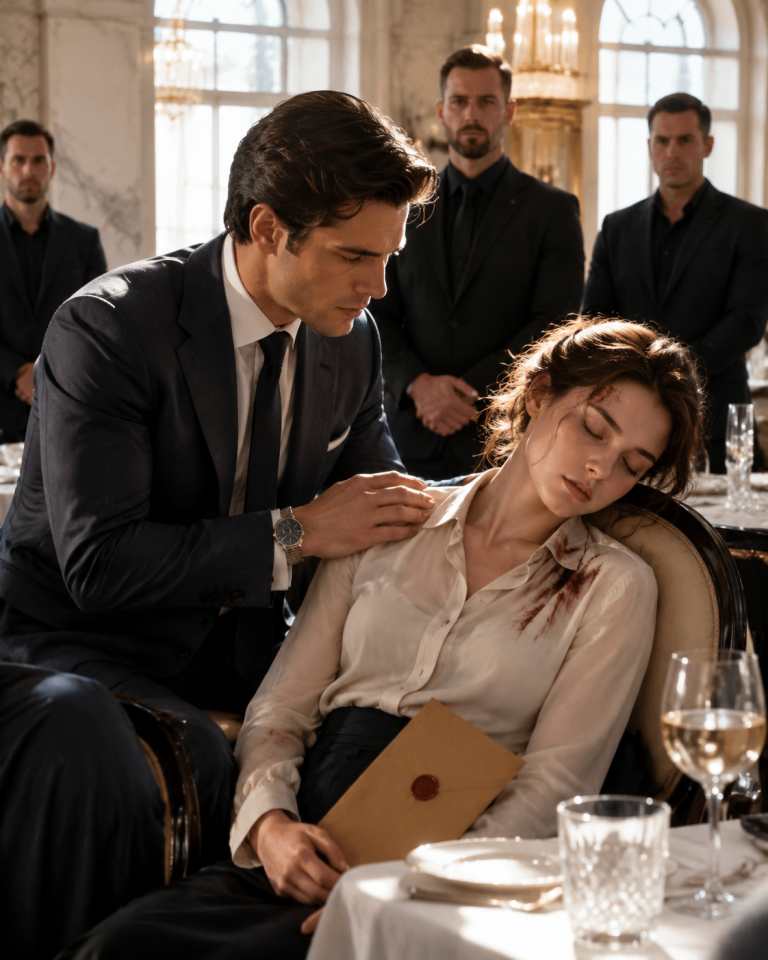
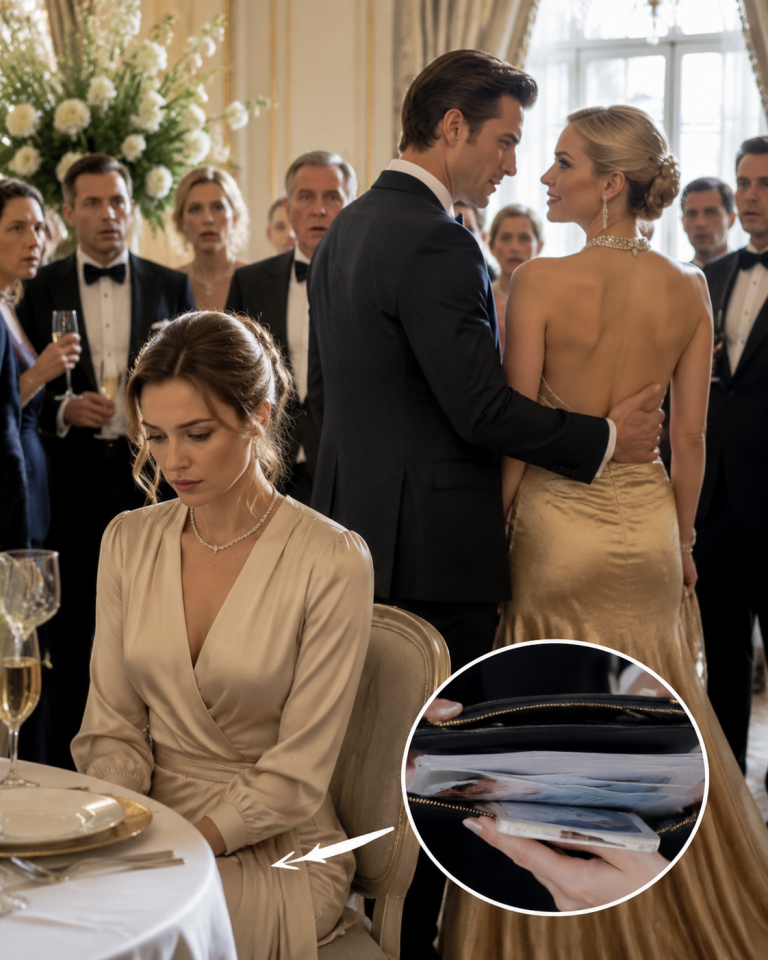
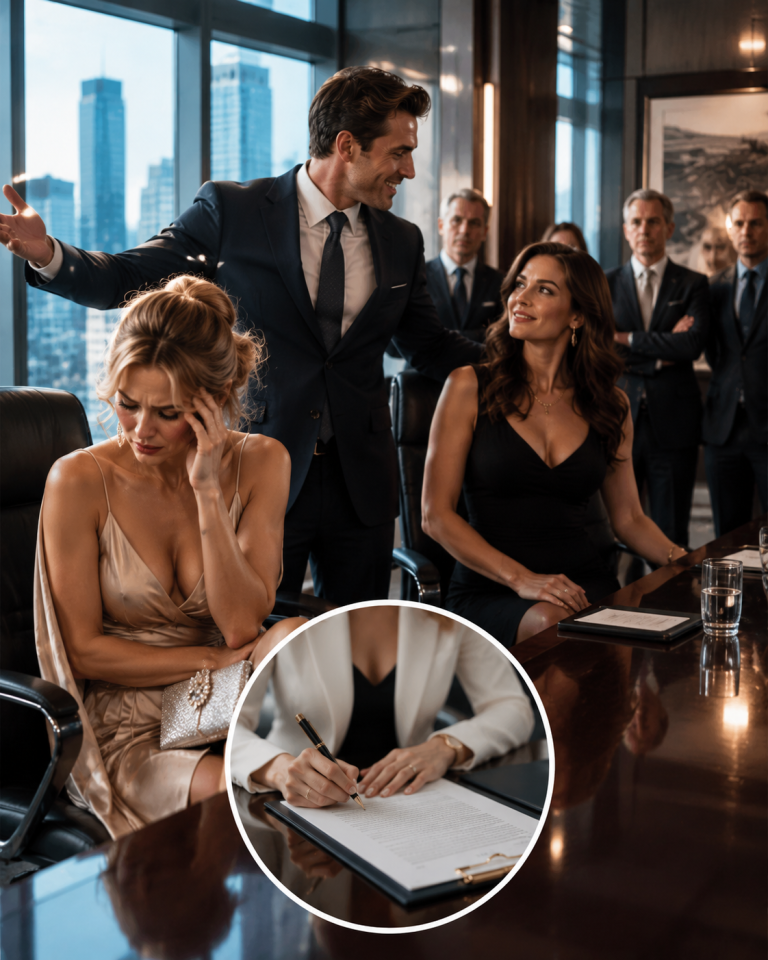
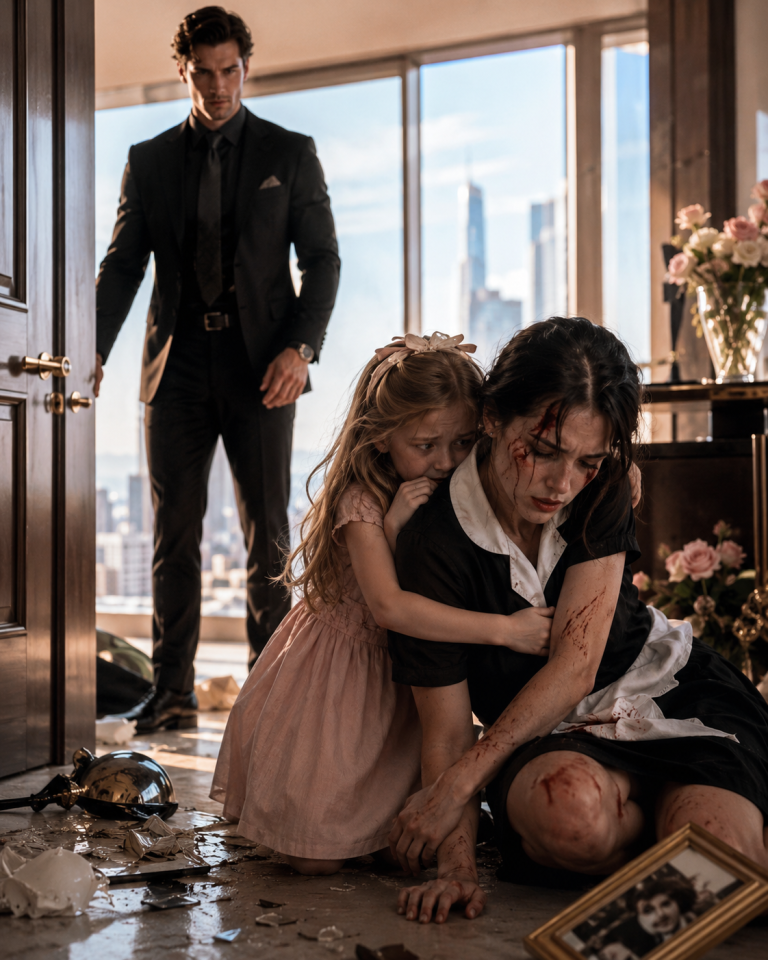
On Her 21st Birthday, She Woke in the Mafia Boss’s Bed—Then He Declared, “You’re My Wife”

## PART 1
The first thing I noticed was the ring.
Not the ceiling — though the ceiling was made of something that cost more than my rent. Not the sheets — though they were the kind of fabric that made you understand, viscerally, that there was a category of material you had never encountered before. Not the headache, which arrived approximately one second after consciousness and felt like something industrial.
The ring.
Gold, simple, worn on the left hand I was staring at because my hand was pressed against a pillow that smelled like expensive soap and something older underneath it. I stared at the ring for a full three seconds before I processed that it was on my finger. Another two seconds to understand that it had not been there yesterday.
My name is Nina Calloway. I am twenty-one years old. I waited tables at Marcy’s on Eighth for three years to save enough for a studio apartment in a neighborhood where no one asked too many questions, and I had spent the last six months believing that the worst thing in my life was the size of my bank account.
I was wrong about that.
The room I was in was enormous and dark, the curtains drawn against whatever time it was outside. The walls were paneled in something expensive. The furniture had the quality of things that were built to last through inconvenience and violence both. My clothes — jeans, sweater, the same ones I had been wearing to Aunt Diana’s dinner — were still on my body, which was the first fact that reduced the immediate terror from devastating to merely catastrophic.
I remembered the dinner.
Diana calling, sweet as she never was, on the specific birthday I had been dreading — twenty-one, the last arbitrary milestone, the one that made it official that I was an adult entirely on my own. *Come for dinner*, she had said. *Just us. Your parents would have wanted me to do something.*
My parents had been dead for nine years and Diana had never once in those nine years done anything they would have wanted.
But I had wanted to believe her.
That was the mistake. Not the only one, but the first.
The dinner. The wine Diana pushed on me twice before I reached for it myself. The way the wine tasted slightly wrong and I had not trusted that observation enough to stop. Diana talking and talking about nothing while her eyes kept flicking toward the door.
Then: nothing.
Then: this ceiling, this ring, this specific and absolute certainty that something had happened to me while I was unconscious that I did not have words for yet.
I got up too fast. The room tilted and my skull registered its objection loudly. I stood still until the vertigo settled, then looked around.
Shoes: gone.
Jacket: gone.
Phone, keys, the twenty dollars I kept folded in my back pocket for emergencies: gone.
On the nightstand sat a glass of water and two white tablets.
I backed away from them.
The door opened.
A woman entered. She was in her sixties, silver-haired, wearing a dark suit with the particular calm of someone who had learned to be still in rooms where other people panicked. She looked at me with an expression that contained nothing I could read.
“Ms. Calloway,” she said. “You’re awake.”
“Where am I?”
“A dress has been left in the wardrobe. You have twelve minutes.”
“I asked where I am.”
“And I told you about the dress. Eleven minutes now.”
She left.
I stood very still.
Then I opened the wardrobe.
The wardrobe was the size of a room. The dress that had been positioned in the center of it was black, short-sleeved, exactly my size in a way that required specific knowledge of my measurements. There were shoes beneath it. Also exactly my size.
I hated putting it on.
Putting it on felt like consent to something I did not understand yet.
But I had grown up in other people’s houses after my parents died, and one of the lessons that experience teaches — not gently — is that you dress for the room you are in, not the room you wish you were in. You gather information before you attempt escape. You do not let the people who have power over you see you shaking.
I put on the dress.
In the mirror, I looked like someone else. Same face, same dark hair. But the girl in the reflection had the specific expression I had not worn in years — the one from the worst weeks in the worst foster placements, when I understood that I was not safe and that no one was coming for me.
Cornered.
Cornered things either made themselves smaller or learned to stop being the thing people wanted to corner.
I had learned that lesson twice already.
I walked out.
—
The house was all marble and dark wood and guarded silence. I followed the sound of voices down a staircase into a room full of people holding drinks they seemed to have forgotten about, because the moment I appeared at the doorway, every conversation stopped.
At the far end of the room stood a man who had not looked at me yet, which should have seemed polite and instead seemed deliberate — the choice not to look at the thing that had entered your space, because you had already decided it was yours.
Mid-thirties. Dark hair, tailored jacket, the specific stillness of a man who did not need to assert his presence because his presence had already been established by the time he entered rooms.
He turned.
His eyes were very dark and they moved over me with an assessment so thorough and so controlled it felt like being catalogued.
“There she is,” he said.
His voice was the kind that rooms remembered.
Someone near me whispered his name.
I knew the name. Everyone in this city knew the name, even the people who had only ever looked at it in print, the way you learned the names of weather systems and natural disasters — not because you expected to encounter them, but because it seemed important to have the vocabulary available.
Caruso.
Vincent Caruso.
He walked toward me with a piece of paper.
“This won’t be necessary,” I said, before he reached me.
“I haven’t said anything yet.”
“You were going to show me a document.”
He stopped.
For a moment, the controlled expression shifted into something that might have been interest.
Then he held it out.
A marriage certificate. My name, his name, a signature at the bottom that looked exactly like mine and had absolutely not been written by me.
“I didn’t sign this,” I said.
“The state of New York says otherwise.”
“I didn’t sign this,” I said again, louder, and I was aware of the room’s attention sharpening around me, the specific attention of people watching something that might become dangerous.
“Your aunt—”
“What did my aunt tell you?”
“That the arrangement had been explained to you.”
“What arrangement?”
Vincent looked at me steadily.
“Your aunt came to me three weeks ago. She owed a significant amount of money to a man who does not accept installment plans.”
“How significant.”
“Enough that the alternative was considerably more than inconvenient.”
“And she offered me.”
He said nothing.
“She offered me,” I said again. “And you accepted.”
“I changed the terms.”
The specific absurdity of that sentence arrived with a clarity that almost made me laugh.
“Tell me,” I said. “What makes you different from the man she was afraid of?”
Something moved behind his eyes. Not guilt, exactly. Something more like the expression of a man who had asked himself the same question and arrived at an answer he was not entirely satisfied with.
“The man she owed money to is named Sandro Ferretti,” he said. “He had already been watching you for six weeks.”
The words landed differently from the others.
Six weeks.
I thought about late shifts at Marcy’s. The walk to the subway at two in the morning. The man who had been at the corner table three nights in a row and always left when I did. The black car I had thought was a coincidence.
“He would have taken you,” Vincent said. “Not married you.”
I looked at the ring on my finger.
“So you bought me instead,” I said. “To send him a message.”
“I protected you.”
“Same thing. Different price.”
He did not deny it.
I set the marriage certificate down on the nearest surface.
“I want it undone,” I said.
“I understand.”
“Can you?”
“Legally? Yes.”
“Then—”
“Not yet.”
I looked at him.
“Ferretti saw the ceremony. If I dissolve the marriage today, he reads it as an invitation.”
“And I’m supposed to stay married to you until you decide otherwise.”
“You’re supposed to stay alive until you have enough information to make decisions for yourself.”
I looked around the room. The guests had returned to their drinks, their conversations, the performance of normalcy. Most of them were not looking at me. The ones who were had the particular expression of people watching something they expected to become useful.
“What do you want from this?” I asked.
He was quiet for a moment.
“I want my enemies to believe I have something to protect,” he said. “Which means you need to appear protected. Publicly. Convincingly.”
“And in return?”
“You are protected. Publicly. Convincingly.”
“That’s circular.”
“Most useful arrangements are.”
I looked at the ring.
“I want my own room,” I said. “With a lock I choose.”
“Yes.”
“And I want my phone.”
“Your phone is in my desk. It was in your aunt’s bag when my people found it.”
That told me something I had not wanted to confirm yet.
“She took it deliberately,” I said.
He said nothing, which was also an answer.
“She took it so I couldn’t call anyone,” I said. “Before, during, after. She planned this carefully.”
Vincent was quiet.
“Where is she now?”
He looked toward the woman in the dark suit, who had appeared again near the doorway.
Something passed between them — a look that contained information I was not yet cleared to receive.
“Clarissa,” he said.
The woman came forward.
“We have a situation,” he said.
Clarissa produced a photograph from somewhere and set it on the table between us.
I looked at it.
Diana. Sitting in a chair with her hands tied. Behind her stood a man I did not recognize, and behind him was a date. Today’s date. On a newspaper I could see clearly enough to confirm was real.
Written across the bottom of the photograph in black marker were five words.
*A TRADE CAN BE REOPENED.*
I looked at the photograph for a long time.
I hated Diana. I had hated her for years with the specific, exhausted hatred of someone who had needed a person to be better and watched them fail repeatedly. She had taken me in after my parents died and spent nine years making me understand I was a burden. She had drugged me on my twenty-first birthday and signed my name to a contract she had no right to sign.
But she was also the only family I had left, and the person in that photograph looked terrified in a way that made me feel things I did not want to feel.
“Who took this?” I asked.
“Ferretti,” Vincent said.
“He has her.”
“Yes.”
“Since when?”
“Since this morning.”
I looked at the ring.
Then at Vincent.
Then at the door behind which, somewhere in this house, the city continued its business without any knowledge that my life had fractured at its foundation overnight.
“What happens to her if we don’t respond?” I asked.
Vincent was quiet for exactly long enough to answer the question without answering it.
I understood.
“And if we respond?”
“That depends,” he said, “on what we respond with.”
Before I could ask what that meant, the room’s temperature changed.
A man came in through a side door without knocking.
He was younger than Vincent — my age, or close to it — with the kind of easy confidence that either came from being loved exactly right or from never having been told no long enough to believe it. He looked at me with bright, immediate curiosity.
“I heard she was awake,” he said.
Vincent’s expression did something specific. Not anger. Something quieter.
“Stefan,” he said.
“Cousin,” the young man replied, cheerfully. “Your wife looks like she’s deciding how to escape.”
“She’s deciding whether to trust me,” Vincent said.
Stefan looked between us with the expression of someone watching the opening of something interesting.
“Same thing,” he said. “In this house.”
And then he pulled an envelope from his jacket pocket and tossed it lightly onto the table, where it landed beside the photograph of Diana.
“Ferretti sent a second message,” Stefan said. “While you were all standing around looking at the first one.”
Vincent opened the envelope.
He read it.
His face did not change.
He held it out to me.
I read it.
The message was short: *Midnight. Bring her. Or I send pieces.*
I set the note down.
Clarissa was watching me.
Stefan was watching me.
Vincent was watching the window.
I looked at the wedding ring on my finger — this symbol I had not chosen, in this life I had not chosen, in this room full of people I had not chosen — and I thought about Diana sitting in that chair. I thought about nine years of being a burden, and one night of being a commodity, and the specific question of whether either of those things meant she deserved what was happening to her.
I had grown up in other people’s houses.
I knew what it felt like when the people who were supposed to protect you decided you were less important than their own needs.
I also knew what it felt like to stop waiting for someone else to make the decision.
I looked at Vincent.
“You said you want your enemies to believe you have something to protect,” I said.
“Yes.”
“Then let me be worth protecting.”
He looked at me.
“What do you mean?”
“I mean stop moving me around the board,” I said. “I mean let me understand the game. I mean if Ferretti wants to use me as a pressure point, then teach me enough to be pressure back.”
Stefan made a sound that was not quite a laugh.
Clarissa’s expression did something it had not done since I met her.
It opened.
Just slightly.
Vincent was very still.
“You understand,” he said carefully, “what you’d be asking for.”
“I’m asking for information,” I said. “I’m asking to stop being the one person in this situation who doesn’t know what’s happening.”
“That is not a small ask in my world.”
“In your world,” I said, “everyone seems to agree that I’m already in it. So stop protecting me from it and let me learn to stand in it.”
The room was quiet.
Outside, somewhere, traffic moved and the city breathed and no one knew anything had changed.
Inside, Vincent Caruso looked at the girl he had married without her permission and seemed to be recalculating something he had previously believed was settled.
He nodded once.
“Clarissa,” he said.
“I heard,” she said.
And that was when I understood that Clarissa was not a housekeeper or an assistant.
She was something considerably more specific.
And she was going to teach me what that was.
—
## PART 2
The first thing Clarissa taught me was not a rule or a strategy.
It was a room.
She walked me through the house — the parts I would be expected to know — and explained which doors required key cards, which windows were alarmed, and where the security staff rotated at night. She did this in the tone of someone describing building maintenance, and I understood that was intentional.
“The faster you stop seeing the security as restriction,” she said, “the faster it becomes information.”
“And information is?”
“The only currency that never loses value.”
We sat in a smaller room off the main corridor — dark wood again, maps on the wall I was not close enough to read yet, a table with two chairs positioned like a conversation rather than an interrogation.
“Ferretti,” I said.
“Yes.”
“Tell me what he actually wants.”
Clarissa set her phone on the table, and on the screen was a photograph. Not Diana this time — a building. Old brick, warehouse-style, near the waterfront.
“Ferretti has been trying to move a specific operation through a port structure that the Caruso family controls,” she said. “Vincent has been blocking it for eight months.”
“What kind of operation?”
“The kind that requires significant infrastructure and plausible legitimacy,” Clarissa said. “And the kind that the Caruso name would provide.”
I looked at the building on the screen.
“So this is actually about business.”
“Everything is about business.”
“And Diana was—”
“Diana owed Ferretti money she had borrowed from people she should not have borrowed from, to pay debts she had accumulated through a specific combination of poor decisions and deliberate theft from a fund she was supposed to manage for a client.”
I processed this.
“She stole money. From criminals.”
“From a man connected to Ferretti, yes.”
“And she decided to pay it back by selling me.”
“She decided you were her most valuable asset.”
The specific ugliness of that sentence was extraordinary.
“How did she know about Vincent?”
“She approached three different men with a similar proposition before the Caruso offer.”
“Three.”
“Yes.”
“And the other two?”
Clarissa’s expression told me not to finish that question.
I looked at my hands.
“Vincent knew what he was buying,” I said.
“Vincent knew what he was acquiring,” she said. “He believed your aunt had informed you. He had documentation suggesting consent.”
“Forged.”
“Yes. We know that now.”
“Did he know it then?”
A pause.
“He suspected the documentation was incomplete,” Clarissa said carefully. “He made the decision to proceed.”
I sat with that.
“Why?”
“Because Ferretti’s men had already been observed near your workplace twice in the preceding week. And because the terms Vincent offered your aunt were different from what Ferretti would have offered.”
“Different how?”
“You are alive, unharmed, and in a house with locks on your door,” Clarissa said. “That is the difference.”
I looked at her.
“You’re asking me to accept that as sufficient.”
“I’m asking you to understand it as context,” she said. “What you accept is your own decision.”
That was, I realized, the first time in twenty-four hours anyone had said anything that acknowledged decisions were mine to make.
“What do you know about Stefan?” I asked.
Clarissa’s expression changed very slightly.
“Why?”
“Because he walked in with Ferretti’s second message and he delivered it like it was news, but he had it in his jacket pocket when he came in, which means he had it before he came in, which means he either had it from Ferretti directly or he was holding it for a reason.”
A pause.
“You noticed that quickly,” Clarissa said.
“I’ve been noticing things quickly my whole life,” I said. “It’s how I survived.”
Clarissa looked at me for a long moment.
Then she said: “Stefan Caruso has been in contact with Ferretti’s financial officer for approximately four months. We believe the contact began as a business negotiation that shifted into something less straightforward.”
“Vincent doesn’t know.”
“Vincent suspects. He does not have confirmation.”
“And you’re telling me.”
“Because you asked.”
“Because I might be useful,” I said. “In confirming it.”
Clarissa was quiet.
“Because you might be useful,” she agreed.
I looked at the building on the phone screen.
“The midnight meeting,” I said. “Ferretti wants me there.”
“Yes.”
“Because he thinks I’m leverage over Vincent.”
“Because he believes you are.”
“And am I?”
Clarissa looked at me directly for the first time.
“Possibly more than either of you yet understands,” she said.
Before I could ask what that meant, the door opened.
Stefan walked in.
He looked at me. Then at Clarissa.
His easy smile did not change.
But something behind it did.
“Family meeting,” he said. “Vincent wants everyone.”
Clarissa stood.
I stood.
Stefan looked at me with the specific expression of someone recalculating.
“You two have become friendly,” he said.
“She was showing me the house,” I said.
“Which parts?”
“The parts I should know.”
His eyes moved to the maps on the wall.
“Industrious,” he said.
He held the door.
I walked past him.
His hand moved, reflexively, toward my arm — not quite touching, the motion of someone accustomed to guiding people who were expected to be guided.
I turned to look at him before he made contact.
He withdrew the hand.
Smiled.
“After you,” he said.
I walked toward the main hall.
Behind me, Clarissa fell into step beside me.
Neither of us spoke.
But she had positioned herself between me and Stefan.
I understood that this was intentional.
I understood that I had been moved from one category into another in the last forty minutes.
And I understood that by the time we reached the room where Vincent was waiting, something had shifted in the architecture of the situation in a way that no one had yet named.
Stefan was ahead of us by the time we entered the hall.
Which meant he did not see the way Clarissa turned to me and said, very quietly: “At the meeting. Watch his hands.”
“Whose hands?”
“Stefan’s,” she said. “When Ferretti’s name is mentioned.”
I filed that away.
We walked toward the light.
—
## PART 3
The room Vincent had chosen for the family meeting was the kind of room that made the word *family* feel like something different from what it usually meant.
Maps. Documents. A table that held coffee cups and the architecture of a problem being worked. Four men I did not know stood near the walls. Clarissa took a position near the door. Stefan settled beside the window with the ease of a man comfortable in any room.
Vincent stood at the head of the table.
He looked at me when I entered, and the look contained something new — not the cataloguing assessment from the dining room, but a question. The specific, restrained question of a man who has made a decision and is watching its consequences arrive.
“The midnight meeting,” I said, before he could establish whatever order he had planned for the conversation. “You’re going to say no.”
“Yes,” he said.
“Because you believe it’s a trap.”
“Yes.”
“And Diana dies.”
The room absorbed the directness of that.
“That is Ferretti’s intention,” Vincent said.
“His intention, or his promise?”
“In my experience, they are frequently the same thing.”
I looked at the map on the wall. I had not seen it clearly from Clarissa’s room, but from here I could see the waterfront marked in two colors — one for what the Caruso family controlled, and one for what Ferretti was attempting to claim.
“He wants the port structure,” I said.
Several people in the room shifted.
Vincent’s eyes moved to Clarissa.
“Yes,” he said carefully.
“And he believes that if he can demonstrate he has leverage over you through me, you’ll negotiate a different position on the port.”
“That is the theory.”
“Does he know about Stefan?”
The room went extremely still.
Stefan turned from the window.
His easy expression was still present, but underneath it, something had changed.
“What about Stefan?” he said lightly.
I looked at him.
“Four months,” I said. “Ferretti’s financial officer. You’ve been in contact long enough to develop a position.”
Stefan looked at Vincent.
“She’s guessing,” he said.
“I’m not,” I said. “But I’d like to know why.”
A silence that had a specific quality — the silence of a room waiting for someone to choose who they were.
Stefan’s smile faded.
“You knew,” he said to Vincent. Flat.
“I suspected,” Vincent said. “For three months.”
“And you kept me close.”
“You’re family.”
“I’m a liability you were managing.”
“You’re someone I hoped would make a different choice before I had to make one for you.”
Stefan looked at the window.
His hands, I noticed, were perfectly still. Which was, I was beginning to understand, its own kind of tell — the stillness of someone who had been trained to manage their reactions and was currently managing one very carefully.
“Ferretti promised access to the Caruso infrastructure,” Stefan said finally. “Not your infrastructure. The old routes. The ones your father built that you’ve been trying to dismantle.”
“I know.”
“He said you’d dismantle them completely within five years. That there’d be nothing left.”
“Probably true.”
“Those routes are my inheritance.”
“They’re also the reason three people I trusted are dead,” Vincent said. The flatness in his voice was different from coldness. More like grief that had been lived with long enough to become architecture. “I’m not preserving them for anyone.”
Stefan looked at him for a long moment.
“So what happens now?” he asked.
“That depends,” Vincent said, “on what you’ve already told him.”
Stefan’s jaw tightened.
“The midnight meeting,” he said. “He asked me to confirm you wouldn’t attend. That you’d reject the trade.”
“And you told him?”
“I told him you always rejected the predictable move.”
“Which means?”
“Which means he’s expecting you to show up anyway. On your terms.”
I looked at the map.
Then at Vincent.
“He’s expecting *you*,” I said. “He doesn’t know about Clarissa. He doesn’t know what she’s been teaching me today. And he certainly doesn’t know that the conversation you had this morning with me changed what I understand.”
Vincent looked at me.
“What are you proposing?”
“I’m proposing that when Ferretti sent that midnight message, he sent it because he believes I’m the variable he can control. That I’m afraid, disoriented, desperate to help my aunt, and willing to do whatever gets her home.”
“And?”
“And I am all of those things,” I said. “But not in the way he thinks.”
Clarissa moved away from the door.
“The port structure,” I said. “The documentation that would allow him to operate through it — where does it live?”
A pause.
“In a filing system that requires two authorizations,” Vincent said carefully. “Mine and the family attorney’s.”
“Not the attorney’s signature. A family member’s.” I looked at him. “A wife’s would count.”
Very still room.
“How do you know that?” Clarissa said.
“Because the waterfront documentation in the map uses the family registration structure from 1987, and that structure was set up to protect assets through legitimate family connections in the event of federal interference. Which means the definition of ‘family member’ is specifically broad.”
Several people in the room were looking at each other.
“She read the maps,” one of the men near the wall said.
“Quickly,” another said.
I looked at Vincent.
“What Ferretti wants isn’t me,” I said. “It’s the authorization. If I go to that meeting and offer it to him, he gets what he actually wants and Diana comes home.”
“And you hand him control of a port structure he’ll use—”
“I don’t hand him anything,” I said. “I offer it. Pending review. With documentation that requires a forty-eight-hour processing window.”
“Which doesn’t exist.”
“Which Ferretti doesn’t know doesn’t exist.” I held his gaze. “He wants to believe he’s won. Let him believe it long enough to release Diana and reveal his full position. Then let the forty-eight hours expire however forty-eight hours expire in your world.”
Vincent looked at me for a long time.
“You’ve been in this house for six hours,” he said.
“I’ve been watching powerful people make decisions about me for nine years,” I said. “I’ve had a lot of time to learn how the game works.”
Stefan, near the window, made a sound. Not a laugh. Not quite.
“She’s right,” he said. He sounded surprised, and underneath the surprise was something more honest — the specific recognition of someone who has been outmaneuvered before they understood the game had started. “Ferretti will take the offer. He thinks she’s desperate. He thinks you’d never let her go to that meeting.”
“Would you?” I asked Vincent directly.
The question landed with more weight than I intended.
He looked at me — not the cataloguing look from this morning, not the cold assessment of someone calculating variables. Something more like the expression of a person encountering an argument they had already started making to themselves.
“No,” he said. “I wouldn’t let you walk into that meeting unprepared.”
“Then prepare me.”
—
The meeting was set for midnight at a location Ferretti’s people specified two hours before — a restaurant in midtown, private room, ostensibly neutral territory.
It was not neutral.
But neutrality was not the point.
Clarissa spent the time between then and midnight teaching me things that had no names but were still lessons: how to read a room before sitting down in it, how to let someone believe they are controlling a conversation while you locate its edges, how to present something valuable without presenting the thing itself.
I wore the black dress from that morning. The ring. The shoes.
Stefan was not in the car with us.
Vincent had made that decision quietly, in the hour after the meeting, in a conversation I was not present for. Whatever passed between them resulted in Stefan remaining at the house with two of Clarissa’s people and the specific, subdued manner of a man who has been reminded of something he would prefer to forget.
In the car, Vincent sat beside me.
“The forty-eight-hour window,” he said.
“Yes.”
“You understand it’s not real.”
“I understand it’s real enough for tonight.”
“And after tonight?”
“After tonight,” I said, “Diana comes home and Ferretti understands that whatever pressure point he thought he had no longer functions the way he believed.”
“And you?”
I looked out the window.
“And I,” I said, “would like to understand what I’m actually owed in exchange for this.”
He was quiet.
“An annulment,” I said. “Eventually. When the situation is stable enough that it doesn’t create the problem you described.”
“Yes.”
“And before that—” I paused. “I want to keep learning.”
Vincent turned to look at me.
“What does that mean?”
“It means Clarissa started teaching me things today that no one has ever offered to teach me,” I said. “And I would like to continue.”
“Why?”
I thought about Diana’s apartment, where I had felt like an inconvenience from the moment I arrived and for every year after. I thought about my parents’ faces in photographs I had moved from placement to placement for nine years. I thought about the ring on my finger and the twenty-one years of decisions made around me, about me, without me.
“Because I am done,” I said, “being the person other people move around.”
Vincent looked at me for a long moment.
“That,” he said, “is the most honestly dangerous thing anyone has ever said in my car.”
“Is that a yes?”
“It’s a beginning.”
The restaurant appeared through the windshield. Lit windows, private entrance, two men standing outside with the specific posture of people whose actual job has nothing to do with the restaurant.
“One more thing,” I said.
“Yes?”
“Diana.” I looked at him directly. “I don’t want her harmed. Not by Ferretti, not by—” I stopped.
“Not by me,” he said.
“Yes.”
“She sold you.”
“I know.”
“She drugged you, forged your signature, and delivered you to a stranger’s house unconscious.”
“I know.”
“That usually has consequences.”
“I know that too,” I said. “I’m not asking for her to be forgiven. I’m asking for her to be alive so she can spend a long time living with what she did.”
Vincent was quiet.
“That,” he said softly, “is colder than forgiveness.”
“Yes,” I said. “It is.”
He nodded once.
The car stopped.
—
Sandro Ferretti was exactly what I had expected from the voice that had come through that telephone speaker — polished surface over something that had decided a long time ago that other people were problems to solve rather than people to encounter.
He sat at the head of the private table with three men and a woman I did not know, and he looked at me with the specific satisfaction of someone who had arranged the room to confirm a theory.
Diana was not there.
I had expected that.
“Mrs. Caruso,” he said. Not Mrs. Romano — he had done his research, or thought he had.
“Mr. Ferretti,” I said.
He looked at Vincent.
“I asked for her alone.”
“You asked for her,” Vincent said. “I brought her.”
“That wasn’t the arrangement.”
“Arrangements change when they become inconvenient,” I said.
Ferretti looked at me.
I held the look.
“My aunt,” I said. “Where is she?”
“Close.”
“Produce her.”
A pause.
Ferretti made a small gesture. One of his men stepped away.
Three minutes later, Diana was brought in from a side door.
She looked terrible. Hair unwashed, mascara from days ago still visible beneath her eyes, the specific diminishment of someone who had been frightened for long enough to forget themselves. She saw me and her face did something complicated — relief and shame in equal measure, the expression of someone who understood, perhaps for the first time, the full weight of what they had done.
I did not go to her.
I looked at Ferretti.
“The authorization,” I said. “For the port structure.”
His expression sharpened.
“You have it?”
“I have the ability to sign it,” I said. “Pending the standard processing window. Forty-eight hours.”
He studied me.
“Vincent agreed to this.”
“Vincent agreed to let me make my own decisions,” I said. “I’ve decided this is what I want.”
The room had the quality of a held breath.
Ferretti leaned back.
“What do you want in return?”
“My aunt. Unhurt. Released tonight.”
He smiled.
“That’s all?”
“That’s all.”
He looked at Vincent.
Then at me.
Then, slowly, he nodded.
“Forty-eight hours,” he said. “The documents arrive in forty-eight hours, or I revisit the terms.”
“The documents arrive through proper channel,” I said. “You’ll have confirmation within the window.”
He extended his hand.
I shook it.
His palm was cold.
Diana was released to Clarissa’s care at the door.
As we were leaving, Ferretti’s voice came from behind me.
“You’re not what I expected,” he said.
I turned.
“I know,” I said. “That’s the point.”
—
In the car, on the way back, Diana sat across from me with her hands in her lap.
I looked out the window for a long time without speaking.
She said my name once, very quietly.
I let it sit.
Then she said: “I’m sorry.”
I turned to look at her.
She looked exactly like what she was — a woman who had made catastrophic decisions and was now living in the specific silence that followed them. Not reformed, not transformed. Just smaller.
“I know,” I said.
“The money—”
“I don’t care about the money.”
“I didn’t think—”
“I know,” I said again. “You didn’t think I was real enough to consider.”
She didn’t deny it.
Outside, the city moved past in the way it always did — indifferent and continuous, full of people who had no idea what had happened in the last sixteen hours to one girl from Queens who had woken up in a strange bed with a ring she didn’t choose.
“You’re staying somewhere safe tonight,” I said. “Clarissa will arrange it.”
Diana looked at Clarissa.
Clarissa looked at her the way you looked at problems that had been addressed but not resolved.
“And after that?” Diana asked.
“After that,” I said, “is your problem to figure out.”
She nodded.
Nothing else was said.
—
Back at the house, in the hour before dawn when everything felt like the space between one life and another, I stood in the room that had been given to me — my own lock now, as promised — and I looked at the ring.
I had worn it through a meeting where it meant something, in a room full of people who treated it as information. I had used it as a tool and it had functioned as one.
That was not what rings were supposed to be.
But nothing about the last twenty-four hours had been what it was supposed to be.
There was a knock at the door.
Not demanding. The knock of someone who understood that this door required permission.
I opened it.
Vincent.
He looked at me with the expression I had first seen in the car — the one that was not cataloguing.
“The forty-eight-hour window,” he said.
“Expires,” I said.
“Yes.”
“And Ferretti’s position.”
“Will be significantly less comfortable than he believes.”
“Good.”
He was quiet for a moment.
“Clarissa says you read a full map in forty minutes and extracted the relevant documentation structure from it.”
“The maps were labeled clearly.”
“They were labeled in shorthand that takes most of my people two weeks to decode.”
I said nothing.
He looked at me.
“You asked to keep learning,” he said.
“Yes.”
“Clarissa has agreed to continue,” he said. “For as long as you want.”
I looked at the ring.
“I want the annulment paperwork drawn up,” I said. “Even if we don’t file it yet.”
“I’ll have it done by tomorrow.”
“And I want to understand exactly what the processing window is supposed to contain,” I said. “Not because I plan to use it. Because I want to know what I offered him.”
He nodded.
“And one more thing,” I said.
“Yes?”
“I want to be in the room,” I said, “when the forty-eight hours expire. Whatever that looks like.”
He looked at me for a long moment.
“That,” he said, “is the kind of room I’m not sure you’re ready for.”
“Then teach me until I am.”
A pause.
Something in his expression moved — the careful, controlled surface of it shifting just slightly, the way winter light shifted when something warmer came through.
“You’ve been in this house for less than a day,” he said. “You’ve already changed the position of every piece on the board.”
“I’ve been watching other people move pieces around me for twenty-one years,” I said. “I had a lot of time to think about how it worked.”
He was quiet.
“Get some sleep,” he said finally.
“Is that an order?”
“It’s a recommendation from someone who knows what tomorrow looks like.”
I leaned against the doorframe.
“Vincent.”
He looked at me.
“The reason you changed the terms with Diana,” I said. “The reason you bought a marriage instead of whatever Ferretti would have arranged. I want the actual reason.”
His expression went through something.
“What makes you think there was one beyond what I told you?”
“Because you’ve been honest about everything else in a way that tells me you’re not a man who’s comfortable with dishonesty,” I said. “And the story you told me was accurate but it wasn’t complete.”
He was very still.
“My mother grew up poor,” he said finally. “She came into this family without understanding what she was entering. She spent twenty years inside it without anyone explaining what the rules were or why they existed.”
“And?”
“And she died believing that was her fault,” he said. “That she had failed to understand something she had never been taught.”
I held his gaze.
“I told your aunt,” he said quietly, “that whatever girl she was bringing me, I was not interested in the version of this arrangement she was used to seeing.”
“What version were you interested in?”
“The version,” he said, “where the person understood what they were entering. Where they had information and choice.”
“But you proceeded when she had neither.”
“I proceeded because the alternative was worse,” he said. “And I have spent today trying to decide whether that distinction matters.”
“Does it?”
He looked at me.
“I think,” he said, “that’s for you to determine.”
I looked at the ring.
“Then let me have enough information to determine it,” I said.
“Yes,” he said.
He stepped back.
“Sleep,” he said.
He left.
I closed the door.
I stood for a moment in the room — my own lock, my own walls, my own specific terrible freedom — and I thought about the twenty-one years that had led here and the twenty-four hours that had changed their meaning.
The ring caught the light from the window.
Tomorrow was going to require everything I had.
That was fine.
I had spent my whole life preparing for exactly that.
I sat down on the bed.
And for the first time in a very long time, I slept without waiting for someone else to decide what happened next.
—
**THE END**