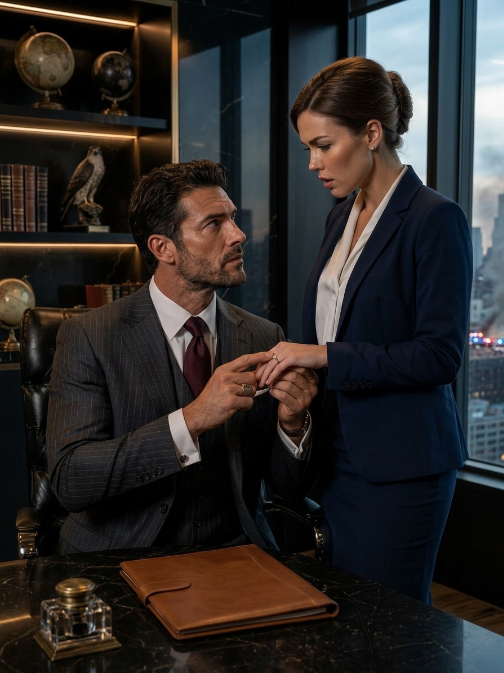
At a Glamorous Gala, a Merciless Mafia Boss Cut a Waitress’s Hair—Then Her Brother Walked In and Shook New York’s Elite

PART 1
The scissors were still in Julian Harwick’s hand when the doors flew open.
That was the image Nora would carry long after everything else faded — not the cold marble beneath her knees, not the laughter curling through the ballroom like smoke, not even the wet sting across her scalp where a fistful of her hair had been. Just the doors. The way they hit the wall. The sudden silence that followed, so complete it felt like the room had forgotten how to breathe.
She had been on her feet a moment ago. Now she wasn’t sure how she’d gotten to the floor.
It had started with a glass.
That was all. A single flute of champagne, barely touched, slipping from her fingers when a passing guest caught her elbow — and the gold-colored wine arcing through the air in what felt, in retrospect, like slow motion, before finding its landing spot on the front of Julian Harwick’s cream dinner jacket.
The jacket that cost more than her rent.
She knew who he was. Everyone in the room knew who he was. Julian Harwick, forty-two, founder of the Harwick Group, twice featured on the covers of financial magazines, a man who collected power the way other people collected art — not for the beauty of it, but for the fact of ownership.
“I’m so sorry,” she had said immediately, reaching for a napkin, already apologizing before the words were fully formed. “Please, let me—”
“Let you what?” His voice was pleasant. That was the first warning — the pleasantness of it. “Ruin something else?”
The room had slowed around them.
She tried to step back. His hand closed around her wrist.
What happened next took less than four minutes, but she would not be able to reconstruct the exact sequence for weeks. She remembered the snap of the scissors — where had he gotten scissors at a gala? — and the sound of her own voice, lower than she expected, saying no, please, no, and the particular quality of laughter in a room full of people who had decided, collectively, that what was happening was entertainment rather than something else.
She remembered the scatter of auburn across the marble. Her hair. Her own hair.
When Julian finally stepped back, satisfied, she was still standing — barely. She had not collapsed. She was choosing to count that as something.
“Consider it a lesson in gravity,” he said, to the room more than to her. Someone applauded.
Then the doors opened.
No knock. No announcement. The massive double doors at the far end of the ballroom simply burst wide, and the noise of the city briefly flooded in — traffic, wind, the ambient pulse of Chicago at ten p.m. — before the figure in the doorway absorbed all of it.
He was tall. That was the first thing. Tall, and dressed wrong for the occasion, wearing a dark overcoat instead of eveningwear, as if he’d come from somewhere else entirely and hadn’t bothered to change. He stood perfectly still while every other person in the room flinched or turned or shifted instinctively toward the walls.
His gaze moved once across the room and stopped.
On her.
Nora’s legs almost went out from under her.
No. The word formed in her chest before it reached her mouth. No, it can’t be—
But it was.
Callum Vega. Her brother. Three years gone, and now standing in the doorway of the Ashworth Grand Ballroom with his hands in his coat pockets and an expression on his face she had never seen before — not in childhood, not in the years before he vanished, not in any of the thousand moments she had replayed trying to understand why he left.
Absolute, controlled fury.
Julian Harwick had gone still.
The applause died.
Callum stepped into the room.
PART 2
He crossed the ballroom without hurrying.
That was what made people afraid of him, Nora realized dimly — not the size of him, not the expression, but the pace. A man in a hurry is still reacting. A man who moves like he has all the time in the world has already decided how things end.
He stopped six feet from Julian. He didn’t look at the scissors. He didn’t look at the hair on the floor. He looked at Julian’s face with the focused patience of someone waiting for a number to be called.
“Harwick,” he said.
Julian’s composure was extraordinary, under the circumstances. “Vega.” A thin smile. “I wasn’t aware they’d lifted your travel restrictions.”
“They didn’t.” Callum reached into his coat and produced an envelope. He didn’t hand it to Julian. He handed it to the small, pale man standing slightly behind Julian’s left shoulder — a man Nora hadn’t noticed until now, holding a glass of scotch he hadn’t touched. “Federal civil complaint. Filed this morning, amended tonight with new evidence. Richard, I’d read page seven before your client says anything else in front of witnesses.”
Richard — whoever he was — opened the envelope with steady hands. Read. Did not look up.
“Theater,” Julian said. “At a dinner party. You haven’t changed.”
“Neither have you.” Callum’s gaze moved, finally, to the floor. To the auburn hair scattered across the marble. Something shifted in his face — just slightly, just for a second. Then it was gone. “That was my sister.”
The room held its breath.
Nora stood among the wreckage of the evening and watched her brother look at what Julian Harwick had done, and understood, in the particular way you understand things that have been true for a long time before you name them, that tonight had not been an accident.
The glass.
The elbow that had knocked it from her hand.
The scissors, appearing so quickly, as if someone had placed them nearby.
He knew who I was, she realized. The thought moved through her like cold water. Before any of this started — he already knew.
Richard closed the envelope.
He looked at Julian.
And in that look, Nora saw everything she needed to know about what was on page seven.
Callum turned to her, and his voice dropped a register, losing the precision he’d used with Julian, becoming something older and quieter. “Nora. Come here.”
She crossed the room to him.
He took off his coat without ceremony and put it around her shoulders. It was warm from his body. It smelled like cedar and cold air and something underneath she couldn’t name — something that felt like the apartment they’d grown up in, on the third floor of a building that no longer existed.
She wanted to say something. She couldn’t find the words.
“We’re leaving,” he said.
He didn’t look at Julian again. He didn’t need to.
As they walked toward the doors, a woman stepped forward — silver-haired, pearls at her throat, the kind of old money that wore itself quietly. Nora recognized her: Eleanor Ashcroft. One of the people who had laughed.
Eleanor didn’t speak. She reached out and briefly, gently, touched Nora’s arm.
Then she looked away.
Outside, a black car waited at the curb. Callum held the door. Nora got in. The door closed behind them, and the Ashworth Grand disappeared into the rain, and Nora pressed her back against the seat and tried to remember how to breathe.
“He recognized me,” she said. Not a question.
“Yes,” Callum said.
“Before tonight.”
“Months before tonight.”
The car moved through the wet city streets. Nora watched the streetlights blurring across the window and thought about the hand on her elbow, the glass falling, the scissors appearing out of nowhere, the laughter that followed so easily, so fast.
“Callum.” Her voice came out steadier than she expected. “What did you do?”
He was quiet for a long moment.
“I’ll explain everything,” he said. “But there are things you need to understand first. About what I’ve been doing. About why he targeted you.”
She turned to look at him in the dark of the car.
“It wasn’t random cruelty, was it,” she said.
“No.”
“It was a message.”
“Yes.” He met her eyes. “For me.”
The rain thickened against the glass. The city moved around them. And somewhere behind them, in the grand ballroom of the Ashworth Hotel, Nora imagined Richard still standing with the envelope, reading page seven, and Julian Harwick beginning to understand what it meant when a man spent three years building something in silence before he walked through the door.
PART 3
The apartment was on the eighteenth floor of a building in Streeterville, overlooking the lake.
It wasn’t his — she could tell that immediately. The rooms had the careful blankness of a place that was being used rather than lived in: no photographs, no accumulated mail, no worn cushions or coffee rings. The kitchen was stocked but impersonal, the bedroom door closed, the bookshelves holding a few volumes arranged with the deliberate tidiness of staging rather than habit.
“Safe house?” she said.
“I’ve been moving around.”
He made tea, and she sat at the island and watched him, and tried to reconcile the man before her — precise, contained, entirely at ease in an unfamiliar kitchen — with the brother she’d known for twenty-eight years. The one who always lost his keys. Who burned rice. Who had called her from a pay phone on a rainy Tuesday and told her, without preamble, that he needed to go somewhere for a while and that she should trust him and that he was sorry.
That had been the last time she heard his voice. Until tonight.
She wrapped both hands around the mug he set in front of her.
“Tell me,” she said.
He told her.
It came out in a single continuous thread — no pauses for her reaction, no careful editing, no strategic framing. He told her about the Harwick Group’s pension manipulation: a series of fund restructurings spanning four years that had quietly hollowed out retirement accounts belonging to hundreds of families in the Chicago and Portland areas. He told her about their own relatives — Aunt Celeste and her husband, who had lost a significant portion of their savings without understanding why. He told her about the three years he had spent building the case, gathering documentation, tracing the paper trail through shell companies and overseas accounts, learning the shape of Julian Harwick’s fraud the way you learn the shape of a building you intend to enter.
He told her why he’d disappeared.
The leak was in the financial crimes division of the city attorney’s office. Someone with access to case filings and active investigations, someone who had fed information to Harwick’s legal team on at least three documented occasions, resulting in evidence going missing and witnesses becoming suddenly unavailable. When Callum identified the leak, he had two choices: surface and risk the case collapsing, or vanish and build from outside.
He chose to vanish.
“You could have told me,” Nora said. Her voice was level. She’d worked hard on that.
“If I had come to you, you would have become leverage. Which is what eventually happened anyway — but that was a failure of my own. I trusted an intermediary who turned out to be playing two sides.” His jaw tightened. “Harwick’s people had a photograph of you and me together. From eighteen months ago, at a meeting I should never have attended in person. By the time I found out, it was too late to warn you about the gala.”
“How long have you been back in the city?”
“Seven weeks.”
She let that land. Seven weeks. She had walked to work seven weeks of mornings while he was somewhere in this same city, watching, preparing, not calling.
“I know,” he said, before she could say it. “I know what I’m asking you to accept. I’m not going to dress it up as something it isn’t.”
“Aunt Celeste’s funeral was in October.”
Silence.
“You weren’t there.” She heard the catch in her own voice and let it stay. “I stood at the grave alone, Callum. The whole service.”
He didn’t offer explanations. He didn’t tell her she couldn’t understand the complexity of the situation, or that the sacrifices were necessary, or any of the other things a different person might have said. He just sat with it.
“I know,” he said finally. “I’m sorry. That’s all I have.”
She nodded. Once. Not absolution — just receipt.
She reached up and touched the ragged ends of her hair. The places where Julian Harwick’s scissors had worked. The texture of it was wrong; she kept expecting to find the smooth weight of the chignon she’d pinned up that morning, and kept finding the blunt, uneven reality of what was left.
“The case,” she said.
“Federal prosecutors. Meeting tomorrow at seven a.m.” He looked at her steadily. “Three years of documentation. Financial fraud, obstruction, pension theft. And tonight—” A pause. “Tonight he committed battery in front of a hundred witnesses and seven camera angles, against the sister of the primary investigator, at an event he himself organized. He handed us the assault charge in a room full of people with their phones out.”
Nora was quiet for a moment.
“He didn’t know it was me,” she said slowly. “When he grabbed me. He thought I was staff.”
“Yes.”
“He thought he was humiliating a server.”
“Yes.”
“And instead he filmed himself assaulting me.”
“Seven cameras,” Callum said. “Including the one mounted above the east service door that his security team logged as inactive.”
She looked at her brother across the kitchen island. Something in her chest — the tight, knotted thing that had been there since the ballroom, maybe longer, maybe since October, maybe since the Tuesday afternoon phone call three years ago — loosened fractionally.
“He walked into a ballroom with scissors,” she said, “to give a speech, and left having committed a federal crime.”
“He provided the theater.” The ghost of something crossed Callum’s face. “I provided the audience.”
She exhaled. It came out wrong — not quite a laugh, too sharp for relief, but real.
“I’m still furious with you,” she said.
“I know.”
“Not just about tonight. About all of it.”
“I know.”
“You have three years of catching up to do.” She looked at the mug in her hands. “And I am not going to make it easy.”
“I’m not asking for easy.”
She looked at him for a long moment — this person who had been her brother their whole lives, who had vanished and come back and sat at a stranger’s kitchen island at midnight telling her the truth. She thought about the coat still around her shoulders, warm and cedar-scented. The way he had crossed the ballroom without hurrying.
“Show me the case,” she said.
He went to the bedroom. Returned with a briefcase, which he set on the island between them and opened without preamble.
Inside: three years. Folder after folder, index tabs, copies of financial records she would need hours to understand, photographs, transcripts. The physical evidence of a life lived in secret, in service of something that had cost everyone who loved him.
“It’s a lot,” he said.
“I’m not going anywhere.”
The filing happened at 7:18 the next morning.
Nora was still in the safe house when he called — she had slept four hours on the couch, which turned out to be softer than it looked, and woken to pale winter light off the lake and the distant sound of the city resuming its business. She was on her second cup of coffee when her phone rang.
“Done,” was all he said.
She let out a breath she’d been holding since midnight.
At 8:52, a statement appeared on the Harwick Group’s website calling the charges a political attack. At 9:11, the statement was removed.
At 10:47, Julian Harwick was arrested at his home in Lincoln Park. The news footage was brief and quiet: a gray stone house, dark suits at the door, no drama. Just the machinery of consequence, finally catching up.
She went to a salon three days later.
Not anywhere she’d normally go — a small place in Andersonville, above a florist, with a hand-painted sign and the smell of coffee and product coming through the door. The stylist was a woman named Priya, silver streaks in her dark hair, who looked at the state of Nora’s cut the way a carpenter looks at a badly done repair: not with judgment, but with the professional assessment of someone who knows what she’s working with.
“Someone did this deliberately,” Priya said.
“Yes.”
Priya nodded, the kind of nod that closes a door. “I can even it out. Shorter than you’re used to — probably close to your jaw. But clean lines.”
“Clean is what I need.”
While Priya worked, Nora watched herself in the mirror. The tension she’d been carrying in her shoulders since the ballroom — maybe longer, if she was honest; maybe since the October funeral, maybe since a Tuesday phone call three years back — had begun, incrementally, to release. Not resolved. Not gone. But no longer held so tightly.
When Priya finished and turned the chair, Nora looked at herself.
Not someone who had survived something. Not a woman defined by what had been done to her in a ballroom in front of a hundred people who had laughed.
Just herself. Slightly different. Still here.
Callum came by that evening with food from a Vietnamese place on Lawrence Avenue — the kind of place with no decor and perfect broth — and they ate at the small table by the window in the quiet that exists between people who have known each other long enough to not need to fill it.
He looked at her hair.
“Good,” he said.
She pointed her fork at him. “You have years to make up for.”
“I know.”
“Holidays. Birthdays. Aunt Celeste’s service.”
“All of them.”
“I had a terrible New Year’s. I watched the midnight countdown from my couch and the power went out at 11:58.”
“I’ll replace every bad New Year’s.”
“With what?”
“Whatever you want.”
She looked at him across the takeout containers — her brother, who had been an absence so long she’d almost stopped feeling its shape, and was now, improbably, present again. She felt the irreducible weight of it: loving someone who had chosen something over you and not stopped being worth loving because of it. The complicated arithmetic of that. The way it didn’t resolve cleanly.
Outside, Chicago hummed its ordinary winter music — traffic, a neighbor’s television, wind off the lake rattling the window frame.
“Aunt Celeste’s savings,” she said. “Can any of it be recovered?”
“The Harwick assets are frozen. Recovery will happen in phases. Probably fourteen to eighteen months before families see anything.”
She thought about the phone calls she’d had with Aunt Celeste over the years — the particular pride in her voice when she talked about that savings account. Her safety net. Her independence. A thing she had built slowly, carefully, over decades, and which had been quietly taken from her without her ever knowing who took it.
“Okay,” Nora said. “Then we wait.”
Callum heard the full meaning of that. She knew by the way he looked at her.
“Yeah,” he said. “We wait.”
The lake was invisible in the winter dark, but she could feel it out there — that enormous cold patience, the thing the city had been built beside and had never entirely tamed. She thought it suited the moment.
Nora cleared the containers, washed her hands at the sink, stood for a moment looking at nothing in particular. Her reflection in the dark window showed her the new length of her hair, the clean line of it.
She turned around.
“Same time tomorrow?” she said.
Something shifted in Callum’s face. Brief, careful, quickly contained. The expression of a man who had spent three years not having anything to return to and was still learning how to hold the fact that he did.
“Same time tomorrow,” he said.
She nodded.
And the city hummed on outside the window, and the night was quiet, and that was enough.
THE END