Sold at Eighteen to a Lonely Rancher—Then His Twin Children Claimed Her as Their Mother Before He Ever Did

PART 1
The sign above Danner’s General Store had been missing two letters since last winter — Dan_ers, faded and unfixed — and Eliza Hartwell fixed her eyes on it because looking at anything else meant admitting this was real.
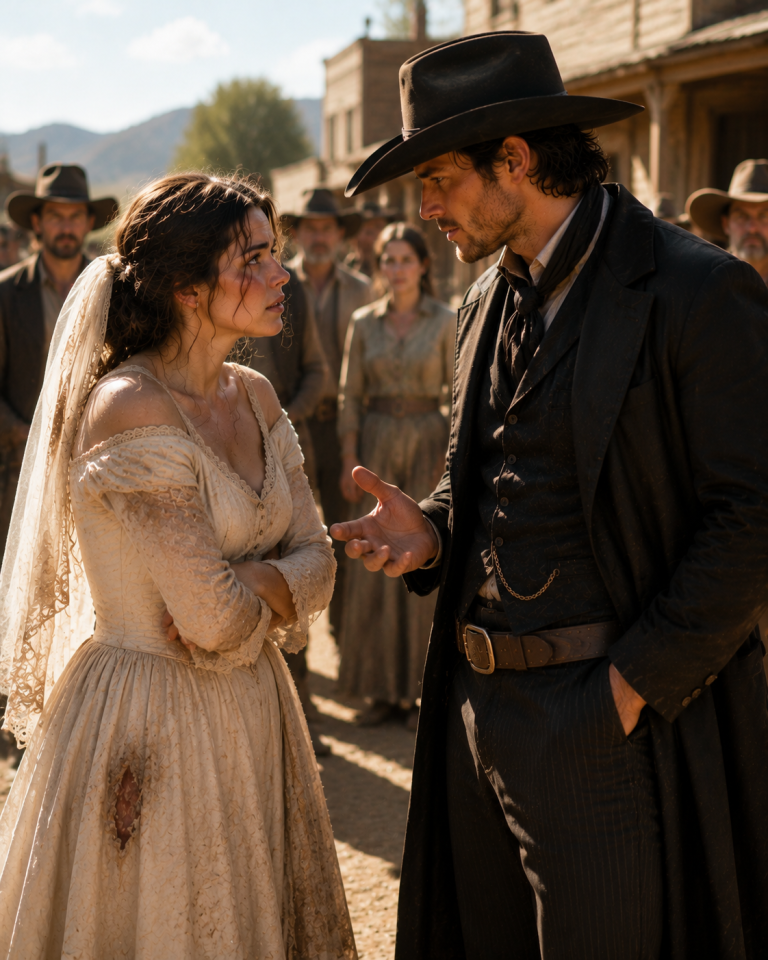
Caldwell Creek, Wyoming, autumn of 1887. A town that had stopped caring about its own appearance a long time ago. She’d been standing on the wooden platform for six minutes. She knew because she’d counted every second since Sheriff Roy Dunar had put a hand on her shoulder and guided her up the three steps with the kind of firm, apologetic pressure that told her she didn’t really have a choice.
She was wearing her best dress — blue cotton her mother had sewn the year before she died. That was the worst part.
“Forty-seven dollars owed to Callaway Grain,” Dunar read from the ledger, not looking up. “Sixteen-twenty to the savings and loan. Eighty-two to Raymond Peek for use of his bull.” He paused. “Total outstanding debt, four hundred and eleven dollars. Thomas Hartwell has no remaining assets of value. His daughter, Eliza Anne Hartwell, age eighteen, has agreed to serve as indentured labor to settle the balance.”
She hadn’t agreed, not exactly. She’d signed because the alternative was her father in prison — a broken man who coughed through the night and couldn’t lift a hay bale without stopping to rest.
“Starting bid is one hundred,” Dunar said. “Terms are two years of domestic service.”
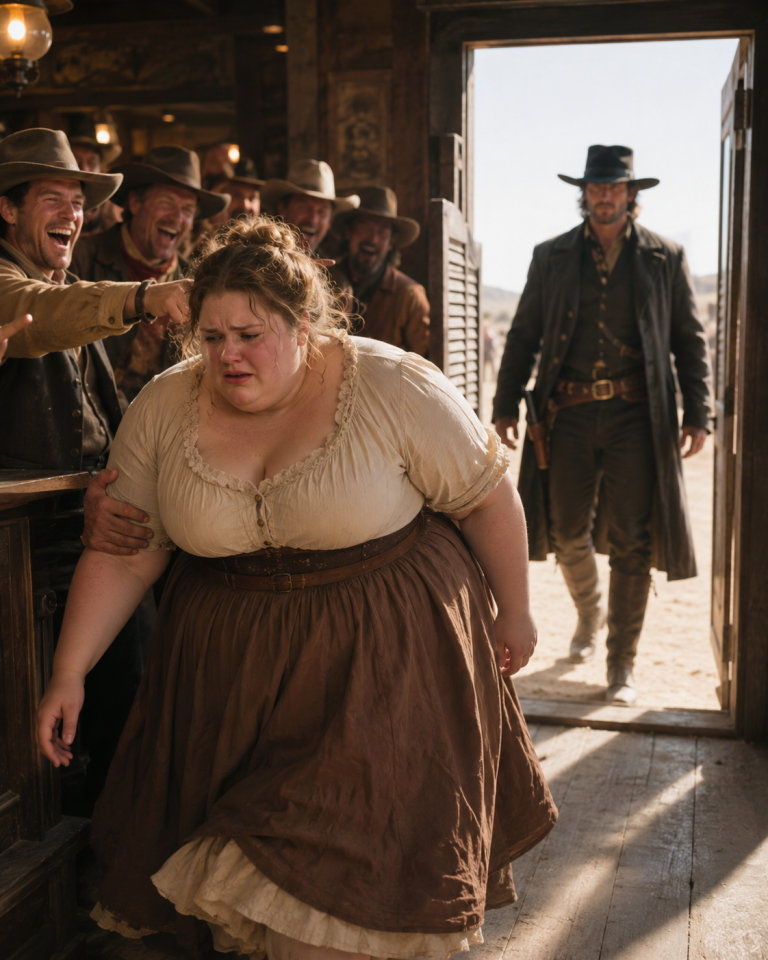
“A hundred,” said Clem Whitaker, before Dunar had even finished the sentence. He owned the saloon and three other buildings on Main Street, and he’d been one of her father’s creditors. Short, thick-necked, pale-eyed, watching her in a way that made her skin feel wrong.
“A hundred and twenty,” said Pete Norris from the livery, grinning with very few teeth.
“A hundred and forty,” said a voice she didn’t recognize.
The numbers climbed with an almost casual cruelty, men raising the pot without thinking too hard about what they were buying. She had a plan — a bad one, but the only one she had. Do the work. Save every penny. Be gone before two years were finished, one way or another.
Whitaker bid again at a hundred and seventy-five, low and certain, like a man who’d already decided the outcome. Her stomach turned.
“Two hundred.”
The number hit the crowd like something thrown. Several conversations stopped at once. Whitaker, fishing a coin from his vest, went still.
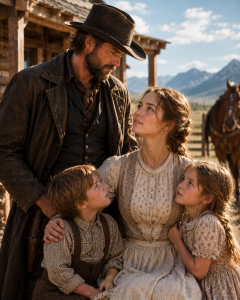
The man standing at the back of the crowd was tall — not unusually so, but he stood like someone who’d spent his life outdoors and never learned to make himself smaller for a room. Brown work coat, hat worn the color of weather. Dark beard going gray at the jaw. He wasn’t looking at her. He was looking at Whitaker, and his face gave away nothing.
“Wade Mercer,” someone said near the front, and the name moved through the crowd in a particular way — not fear, exactly, but recalculation.
“Two ten,” Whitaker said.
“Two fifty,” Mercer answered, unmoved.
“Mr. Mercer —” Dunar began.
“I heard the amount owed,” Mercer said, voice quiet but carrying clean across the street. “Four hundred and eleven. I’ll pay the full sum and you can close the ledger and send the girl home to say goodbye to her father.”
Dead silence. Even the wind seemed to pause.
“The terms are for two years of —”
“I know what the terms are.” Mercer’s jaw tightened, just slightly. “Do you have any other takers willing to pay the full debt?”
Whitaker was doing the math behind his eyes. Four hundred and eleven was real money — more than he wanted to spend on something he’d expected to get at a discount. He pressed his lips together and looked away.
“Going once,” Dunar said. “Going twice. Sold — to Wade Mercer, for four hundred and eleven dollars. Miss Hartwell, you may step down.”
She had forty minutes to pack and say goodbye to her father. He held her a long time at the door of the house that would now belong to the bank, and she could feel how thin he’d gotten through his shirt.
“You don’t know this man,” he said, hands tight on her arms.
“That’s enough for right now,” she told him, and it wasn’t a real answer, and they both knew it.
When Mercer’s wagon appeared — solid, well-kept, pulled by two dark horses that looked genuinely cared for — her father stood very straight and watched it come. Mercer climbed down without hurry and offered his hand.
“Mr. Hartwell. Your daughter will be treated fairly. She’ll have her own room, fair wages above what the debt requires, and she can write to you whenever she likes.”
Her father studied him with the eyes of a man who’d trusted the wrong people too many times. “You bought her like a piece of furniture,” he said quietly. “I want to know why.”
Something moved across Mercer’s face. Not a flinch. More like recognition.
“Because I have two children and no help,” he said. “And I needed to solve a problem before winter. And because I didn’t like the alternative.”
He didn’t say which alternative he meant. From the shift in her father’s expression, Eliza thought he understood well enough.
The ride out was long, the grassland gone the color of dry straw. Nearly a mile passed before Mercer spoke.
“You can ask whatever you’re thinking.”
“Why did you really do it?”
“I told you. I need help.”
“You could have hired someone.”
“Tried three times this year. None of them stayed.” He was quiet a moment. “My children,” he said finally, something underneath the flatness now. “They’re six. Twins. They’ve been through a lot, and they’re not easy to be around right now.”
“How not easy?”
“The last woman I hired quit after nine days. Left a note saying they were agents of the devil.”
Mercer Ranch rose out of the flat grassland as the light started to fail — solid rather than impressive, dark timber, wide porches, a barn built for serious livestock, and cattle stretching in every direction. Bess Coulter, broad and practical, met them at the door with her coat already on.
“They know you’re coming,” Mercer warned before they went in. “Ethan said he’d been nice to the last one and it hadn’t worked, so he wasn’t going to bother this time. Clara didn’t say anything.”
“Which one is more trouble?”
“Clara,” he said, without hesitation. “Without question.”
Two children appeared in the doorway — dark-haired, beautiful in the particular painful way of children who look like both parents combined into something neither could have been alone. Ethan stared at the floor. Clara looked directly at Eliza, dark eyes entirely unimpressed.
“This is Miss Hartwell,” Mercer said. “She’s going to be helping out for a while.”
“Like the others,” Clara said. Not a question.
Eliza crouched down, which put her below eye level and was not comfortable in her dress, but seemed important. “Your father’s right that the others had names too,” she said. “I’m not planning to be like them. You have no reason to believe that yet. That’s fine.”
Something flickered in Clara’s face. Not quite a smile.
Mercer showed her to a room at the end of the hall — small, clean, a narrow bed, a chest of drawers someone had dusted recently and carefully, including the corners. It had been prepared, she realized, before he’d even known what she would be like.
“Kitchen starts at five-thirty,” he said from the doorway. “I need breakfast before the hands arrive at six. The children eat at seven, and Clara —” He stopped. “Clara sometimes won’t eat what’s put in front of her. She’s not being difficult. She just has particular things she will and won’t eat.”
“What does she like?”
He looked faintly surprised by the question. “Eggs. Not beans. Not stew with carrots.” He paused. “I don’t know why I know all that.”
“Because you pay attention to her,” Eliza said. “That’s why.”
Something moved across his face that she didn’t have a word for yet. He nodded once, said he’d be up before five, and was gone — leaving her alone in a small, clean room, in a house that wasn’t hers, on land she’d never seen before today, wondering exactly what kind of man had just paid four hundred and eleven dollars for a stranger and dusted her furniture before he knew her name.
PART 2
She was up at five-fifteen, before Mercer, on purpose. The kitchen was stocked practically, without waste — flour, lard, dried beans, a crock of apple butter, six eggs. She made biscuits, because it was the one thing she knew how to do without having to think, and not thinking was valuable at five in the morning in a stranger’s house.
Mercer stopped in the doorway at five-forty and looked at the biscuits cooling on the rack with an expression she couldn’t read.
“You didn’t have to do that.”
“I know.”
He wasn’t a man who needed to fill silence, she was discovering. He drank his coffee and watched the gray morning through the window, and when he finally spoke, it wasn’t small talk.
“The hands won’t say anything about where you came from. I’ll make sure of that.”
“And people in town?”
“They’ll say what they want to say. Probably that I’ve got another one who won’t last.”
“And what do you think?”
He considered it with the same care he gave everything. “I think you’re someone who’s had a bad run of trouble through no fault of your own, and that you’re tougher than you look, and I don’t know yet whether that’s enough.” He broke a biscuit open, steam rising. “These are good,” he said, which she understood wasn’t really about the biscuits.
The first weeks were not easy. Clara watched her with the particular vigilance of a child who’d been disappointed too many times to waste energy on direct attack, cataloguing every difference from how things used to be done. Ethan disappeared into corners and barns, not hiding exactly, just becoming invisible. She found him once sitting in the hay with his knees pulled up, and sat beside him without a word until, eventually, he told her about the stones he kept in a box under his bed — smooth creek stones, each one with a name.
Slowly, without either of them marking the day it happened, small things changed. Her boots ended up on the porch beside the children’s. Clara let her braid her hair one morning without being asked. The account books, when Eliza finally saw them, told her everything the house wouldn’t say out loud — the ranch wasn’t failing, but it was one bad season from difficult decisions, and there was a hole in Ethan’s boot that had gone unnoticed for three weeks because nobody had had the time to ride to town.
So on a Friday, she drove the children into Caldwell Creek herself to fix what she could. Donahue’s general store smelled like leather and dried herbs. Ethan got new boots, both feet this time. Clara argued with him, comfortably, about who’d seen the hawk over the grass first.
Then the bell above the door rang, and she heard Clem Whitaker’s voice before she turned around.
“Well,” he said. “Mercer’s girl.”
He looked exactly as she remembered — pale eyes, a smile with no warmth in it at all — and he took his time pulling off his gloves, finger by finger, unhurried.
“Didn’t think you’d last this long,” he said, conversationally, like they were discussing the weather. “What is it, six weeks? Seven?” His eyes moved to the children, and Ethan shifted slightly behind her, small and instinctive. “Kids look well enough. Considering.” He looked back at Eliza. “You know, if the situation out there gets uncomfortable, the offer I made in October still stands. Room and work at the saloon. Better than being stuck on a ranch in the middle of nowhere with two wild kids and a man who —”
“Thank you,” she said, voice level. “No.”
“You sure?”
She turned back to the counter without answering him again, and asked Donahue for thread and salt, and felt the tension in the room drop maybe three degrees, but not disappear. On the wagon bench outside, Clara sat very close to her on the left and Ethan on the right, and neither child spoke until they were past the edge of town.
Then Ethan said, “I don’t like him.”
“You don’t have to,” Eliza said.
“Papa doesn’t like him either,” Clara said. “He told Cal that Whitaker is the kind of man who smiles at things that shouldn’t be smiled at.”
That evening, she told Mercer what had happened in the store, plainly, while the children slept upstairs. He listened without interrupting. When she finished, his jaw had gone tight in the particular way she was learning meant he was managing something he didn’t want to say out loud.
“He’s going to keep doing that,” he said finally.
And underneath the flat, careful way he said it, Eliza understood something she hadn’t let herself think clearly until that moment — that whatever Clem Whitaker wanted from this, he wasn’t finished asking for it. And whatever Wade Mercer was carrying under that stillness of his, she was only just beginning to see the edges of it.
PART 3
Mercer didn’t say much else that night, but two days later she heard from Cal that he’d ridden into town and had a short, quiet word with Whitaker at the saloon — the kind of word that left Whitaker’s smile a little thinner the next time she saw him across a street she made a point of not walking down anymore.
For a while, that was the end of it. November deepened into the committed cold of a Wyoming winter that had made up its mind. Mercer was out from first light to dark most days, and Eliza kept something warm on the back of the stove for whenever he came in. The parlor, once a room nobody entered because it meant remembering someone who used to sit there, slowly became the room where all four of them ended up in the evenings — not planned, just the way people in a cold house with one good fire gravitate toward warmth. She started reading aloud after supper, and Ethan appeared in the doorway one night in his socks, drawn by the sound of her voice, and sat near her feet without a word. Clara followed the next evening, positioned at the far end of the settee with two feet of deliberate space between them. Within a week it was simply a thing that happened.
Clara thawed slowly and incompletely, the way a general studies terrain before committing to a position. She still had her armored mornings. But she’d stopped watching Eliza for signs of departure, and one afternoon she sat across from her at the kitchen table with a drawing notebook, working in silence, seeking nothing but company — the particular comfort of being near someone who required nothing of you for an hour.
It started with Ethan, and she almost missed it, which frightened her afterward more than anything else. He’d been quiet at supper, eaten only half his plate, gone to bed without argument. She checked on both children at nine, the way she always did, and found them sleeping.
She woke at two in the morning to a sound she couldn’t immediately name — a low, continuous murmur through the wall. She was in the hallway with her lamp lit before she was fully awake.
He was burning. That was the only word for it. His skin was dry and scorching, his eyes half open but tracking something on the ceiling that wasn’t there.
“Ethan. I’m here.” He didn’t respond.
She checked Clara in the same bed — cool, normal — then made herself think instead of panic. Water, cool not cold. Keep him from chilling while bringing the fever down. Get Mercer.
He answered his door already dressed, which meant he’d been either a light sleeper or already awake, and his eyes went sharp the instant she said the word *fever*. She watched him cross the hall, press his hand to his son’s face, and watched the recognition move through him — the specific fear of a man who had seen this before and knew what it could mean.
“I’ll ride for Doc Hennessy,” he said. “In the dark, the horses can manage the road. I know it well enough.”
“That’s two hours round trip if everything goes right,” she said. “I need to know what you want me to do while you’re gone. And I need to know if you’ve seen this before in him.”
He stopped. She could see the older fear stacked underneath the fresh one.
“His mother,” he said, flat. “It started with a fever.”
“I know.”
“It’s not the same thing,” he said, and it wasn’t comfort — it was a fact he needed to say out loud before he could ride away from it. “Don’t let it go above —” He stopped, swallowed. “If he starts shaking, real shaking, put him on his side.”
“I will.”
He was gone within minutes, hoofbeats fading into the dark. She sat on the edge of Ethan’s bed, dipping the cloth, talking to him in a quiet, steady voice about nothing in particular — the horses, the hawk, the stones in the box under his bed — because silence felt like giving ground to something.
Clara woke at four, came away cleanly from sleep the way she always did, looked at her brother and then at Eliza, her face going through several things before settling into stillness.
“Is he dying?”
“No. He has a fever, and your father’s gone for the doctor. Come here.”
Clara climbed over without hesitation — itself a measure of how frightened she was — and pressed into Eliza’s side.
“His eyes look wrong.”
“His body’s working hard, and it’s using most of what he has. That’s why he looks like that.” Eliza kept the cloth moving. “Talk to him.”
“He can’t hear me.”
“Maybe not. Talk to him anyway.”
Clara leaned forward, voice about half its usual size. “Ethan, you have to stop being sick, because you still owe me from the lemon candy argument, and you can’t be right if you’re sick. It doesn’t count.” It wasn’t what Eliza had expected. It was Clara, exactly.
“Keep going,” Eliza said, and Clara kept going — about the stones, the hawk, the brown boots that finally fit right, a secret plan for the creek to the south of the property she hadn’t told anyone — her voice low and unsteady but continuous while the fever raged and the dark pressed against the window.
Mercer came back at a quarter to five with Doc Hennessy, gray-haired and unhurried, who examined Ethan with the efficiency of a man who’d seen the full range of what frontier illness could do. He took Eliza aside afterward.
“You did right,” he said. “Keeping him cool, keeping him on his side when it got worse.”
“It got worse while you were coming,” she told Mercer. “Around four-thirty he started shaking. I did what you said.”
“How bad?”
“Bad enough. It stopped after about ten minutes.”
Hennessy looked between them. “Fever’s starting to break. He’s not out of it yet, but the direction’s right.” He looked at Mercer. “He’s going to be all right, Wade. It’s not — it’s not what happened to Anne. Different kind of thing.”
Mercer said nothing for a long moment. “Thank you, Tom.”
By midmorning, Ethan woke with the fever diminished, his eyes actually seeing her. “I remember you talking,” he said, voice like gravel. “You talked about my stones. The dark red one. You said it was the color of the sky before a storm.”
“I did.”
“That’s still exactly what I thought.”
Three days later, at breakfast, healthy color back in his face, he announced with great seriousness that he wanted her to have the dark red stone — the one he loved most.
“That’s why,” he said simply, when Clara pointed out he loved that one.
The kitchen went very quiet. Eliza didn’t trust her voice enough to answer right away. Mercer studied his coffee cup with the focused attention of a man who has found something interesting in the middle distance and has decided to look at it very carefully instead of at anyone’s face.
That morning in the hallway, before he left for the cattle, Mercer stopped and turned back to her, working at words that clearly didn’t come easily to him.
“I should have told you sooner,” he said, “that you were doing more than I’d asked for. More than I had any right to expect from — from the arrangement.”
“The arrangement,” she repeated, and heard the word land on him.
“That’s not — I don’t mean it the way it sounds.” He pressed his lips together. “I mean that what you’ve given this house is more than any arrangement could require, and I don’t know how to account for that. I’m trying to say thank you.”
“You’re welcome,” she said simply.
The trouble with Whitaker came back in the second week of January, this time through Cal, who wasn’t a man who brought problems indoors unless they were past solving on his own. Mercer came in from the yard with his hat in his hands, turning it slowly, the way he did when deciding something difficult.
“Whitaker’s been talking in town,” he said. “That you won’t last the winter. That you’ve been looking for a way out and considering his offer.” He paused. “Also that the reason I paid what I did at the auction wasn’t what I said it was.”
The kitchen went very quiet except for the stove.
“He’s implying something about the arrangement,” she said.
“Yes. And people are listening. Not Donahue. Not Hennessy. But some will believe it, because it’s more interesting than the truth and costs them nothing to believe.” He met her eyes. “I don’t give a damn what Whitaker says. But I give a damn that you’re hearing it from me instead of from the town.”
“Thank you,” she said, and meant it precisely.
He went to see Whitaker that afternoon and came back three hours later saying only that Whitaker had been informed further comments would have consequences, and that he believed the message had been received. She didn’t ask for specifics. The way he said it was enough.
That night, in the parlor, with the Whitaker business sitting between them like a piece of furniture that hadn’t been there before, he asked her the question underneath all of it.
“Is it a choice?” he said, watching the fire instead of her. “You’ve been here three months. I know you’ve stayed because of the agreement, but I haven’t asked what you’d choose if the agreement weren’t the thing deciding it.”
“I don’t know yet,” she said honestly. “I know I’m not staying because I have to. I know that stopped being the reason somewhere around November.”
“That’s not the same as knowing what you’d choose.”
“No,” she agreed. “It’s not.”
“I’m not going to ask you to decide before you’re ready,” he said. “But I want you to know — what you’ve done here, what you are here, it’s not nothing to me. You saved my children last month. You’ve given them something back I didn’t know how to give them, and I didn’t know anyone else could. And you’ve made this house something I want to come back to. I hadn’t felt that in a while.”
“Wade,” she said.
He looked at her.
“I know,” she said. It wasn’t a decision and it wasn’t a declaration, but he seemed to understand all of it anyway, because he nodded once, slowly, and let the fire finish the conversation for the night.
She thought about it for weeks after — about her mother’s old line, that a choice made under duress wasn’t a choice, and a choice made because you had nowhere else to go wasn’t a choice either. A real choice required options, chosen from with full knowledge. She had options now that she hadn’t had in October — wages saved, a reputation built with Hennessy and Donahue and Bess Coulter that would carry her somewhere else if she needed it to. She was not standing on a platform anymore. Which meant that if she stayed, it would be real.
February brought a storm that pinned all four of them inside for four days straight — the kind of blizzard that was less weather than an argument the land was having with the sky. On the third day, Clara asked, with the precision of someone who’d been holding the question a long time, “Are you going to stay?”
“What makes you ask that now?”
“Because we’re stuck inside and I’ve been thinking.” Clara’s voice stayed carefully flat. “Ethan says yes. But Ethan thinks everyone he likes is going to stay. He thought Mrs. Fowler was going to stay, and she left in four days.”
“I don’t want to tell you something I’m not certain of,” Eliza said. “You deserve better than that. I know that I’m not planning to leave. I know that every week I’ve been here, I’ve wanted to leave less. I know that you and your brother matter to me in a way that’s real. Not arrangement. Real.”
“Mrs. Adler said she cared about us too. On the first day.”
“You didn’t say it on the first day,” Clara said. “You said it now. On the ninety-third day.”
Eliza stared at her. “You’ve been counting.”
“I count things.” Clara said it with simple dignity. “Ethan has his stones. I count things.” She picked up her notebook. “I think you’ll stay,” she said, and went back to her drawing, leaving Eliza sitting with her mending in her lap and the unexpected weight of being known settling gently on her chest.
That evening, when the children were asleep and the storm had dropped to a steady moan against the windows, she told Mercer about it, and about the choice she was still circling.
“What is moving you toward staying?” he asked, when she said she was closer than she’d been.
“The stone on the windowsill,” she said, thinking it through carefully because he deserved careful. “The fact that you dust things for people before you know them. The way you said *both of them, whatever state they’re in.* The way you rode to town in the dark.” She looked at him. “You’re a good man. I don’t say that the way people say it when they don’t mean much by it.”
He was quiet a long time. “I have thought about very little else since October except how to be fair to you,” he said finally. “How not to make what happened to you into another kind of trap. And I have failed at that, in the sense that I do want something. I want you here. Not because I need help with the children or the house. Because the house is different when you’re in it. Because I’m different.” He met her eyes. “And you’re still technically —”
“The agreement is a piece of paper,” she said. “It is not the thing that is happening in this house.”
“No,” he said. “It is not.”
She reached across the table and put her hand over his. He went very still, and looked at her hand and then her face, and his expression was one she’d never fully seen before — not guarded, not managed, just entirely present and entirely undefended.
“I’m not deciding tonight,” she said. “But I want you to know what direction I’m facing.”
His hand turned under hers and held it. “All right,” he said.
The storm broke in the night. By morning the sky was clear and absolutely blue, the kind of blue that only happens in Wyoming winter, and the dark red stone on the windowsill caught the first direct sun and glowed exactly the color it had been named for.
She made her decision on an ordinary Thursday in early March — no crisis, no dramatic weather, just laundry in the cold morning air while Ethan chased a barn cat and Clara told the horses things in a low private voice at the fence line. She looked at the two children, the horses, the timber house, the land running flat in every direction, and the decision was simply there, the way a thing is there once you finally stop looking around it.
She found Mercer at the kitchen table with a letter from a cattle buyer.
“I’ve decided,” she said. He put the letter down. “I want to stay. Not under the agreement. Not as hired help. As someone who chose to be here. If that’s still something you want.”
He was quiet long enough that she felt the first edge of doubt.
“I’ve wanted that since November,” he said.
“You could have said something.”
“You needed to get there on your own.”
He asked her to marry him that same afternoon, in the barn of all places, while checking on a mare favoring her left foreleg. No long speech.
“I want you to have the actual thing,” he said. “Not the arrangement version of it. Will you marry me?”
“Yes,” she said. “But I have conditions. I’m not going to stop telling you when I think the account books are wrong.”
“You’ve never stopped.”
“And I’m not going to become a different person because we’re married.”
“I’m not asking you to be anyone else,” he said, with a slight edge that told her he was offended she’d felt the need to say it — which she found reassuring.
That evening he told the children plainly — no decoration, just the facts laid out and trusted to be enough. Ethan burst into tears immediately, insisting loudly that something was in his eye even as it ran freely down his face, and then recovered in ninety seconds flat.
“I knew you were going to stay,” he said. “I told Clara.”
Clara, who would never cry at a kitchen table in front of people, considered the announcement with her hands flat on the table, then asked, “Will you still be Eliza?”
“I’ll still be Eliza. I’ll just also be a Mercer on paper.”
Clara tried the sound of it. “Eliza Mercer. That’s all right.” A pause, very deliberate. “You can call me Clara. Not Miss Mercer. Just Clara” — which, from Clara, was roughly equivalent to another child throwing their arms around your neck.
The wedding was in April, organized mostly by Bess Coulter, who managed things by nature whether or not she’d been asked to. Her father came — well enough to travel now, Patterson driving him out as a personal favor, thinner than he should have been but with his back straighter and his eyes clear. He stood at the bottom of the wagon steps and looked at her the way a person looks at something they’d feared was damaged beyond repair, and found mostly intact.
“You kept your word,” he told Mercer, after they shook hands in the yard.
“I tried to.”
“More than tried. I can see it.”
Clara studied Thomas Hartwell for a full day before approaching him on the porch. “Did you teach her how to stay?” she asked. “When things are hard, she stays. Did you teach her that?”
He considered it honestly. “I think her mother taught her that,” he said. “I mostly taught her what not to do, the last few years. Which might have been its own kind of lesson.” He looked at this six-year-old who had been measuring people for reliability since before she could say why. “You’ve been staying too, through things that would have broken a lot of people. I’d say you have it.”
The ceremony was short, held in the yard behind the house under a sky so deep and blue it looked painted, apologizing for everything else Wyoming put you through. She wore the blue cotton dress her mother had made — the one she’d worn on the auction platform, the one she’d worn her first morning cooking breakfast in this kitchen. She’d thought about wearing something else, and then understood this was exactly right, because she’d survived in it, and everything since had grown out of that survival.
Justice Alderman said the words plainly. She said yes when it was her turn. Mercer said yes when it was his, and his face did the thing that had taken ninety-three days to produce the first time, and now came more easily — not easily, exactly; he was still not built for easy expression. Willingly.
Ethan threw himself at both of them at once, nearly knocking Mercer sideways. Clara stood in the circle of her father’s arm, face tilted to the sky for one unguarded second, then reached over and simply took Eliza’s hand and held it, and said nothing, which needed nothing said.
Bess had laid out a meal in the barn that smelled like a barn but was warm with people and food, and her father sat beside Ethan looking, for the first time in years, like a man not carrying something too heavy for his frame.
Standing in that barn, cold coffee in hand, mother’s dress on her back, twenty people who had made room for her in their understanding of what this family was, Eliza understood something she wouldn’t have understood in October. Survival was not a small thing — it was sometimes the only honest response to what the world put in front of you, and there was no shame in holding on with both hands until it was enough. But she was not surviving anymore. Belonging hadn’t arrived like weather, sudden and total. It had been built the way the ranch was built — slowly, under difficulty, out of ordinary days. Ninety-three counted days. A stone on a windowsill. Soup left warm on a stove. Two in the morning with a burning child. Four days of a storm that showed you exactly who people were when performance wasn’t an option.
That evening, after her father’s wagon had disappeared east toward Caldwell Creek, she walked back across the yard where Mercer stood waiting on the porch, the children’s voices carrying from inside — an argument, resolving, as they always did, into laughter. The lamps were lit. Smoke rose from the chimney. The sky was going gold in the west, the exact color Clara’s mother used to call a gift.
He held the door for her without ceremony, and she went inside, into a house that was warm and loud and entirely hers, and the dark red stone caught the last of the day’s light on the windowsill, glowing the color of the sky before a storm — the color, she thought, of something that had finally, fully arrived.
THE END