“Nobody Wants You,” Her Sister Sneered—Then the Mafia Boss Crossed the Ballroom for Her

## PART 1
She had already decided she would not cry.
That was the only promise she made herself before she walked through the gold doors of the Lennox Foundation Gala — the only one she trusted herself to keep. Not *be brave.* Not *enjoy it.* Not *prove something.* Just: *don’t let them see you break.*
Her name was Ivy Mercer. Twenty-four years old. Owner of a small bookshop café on a quiet street, a rented room in a house that technically belonged to her by inheritance and practically belonged to the two women who had spent two years making her feel otherwise. She wore a dusty blue dress borrowed from her best friend Dana, pinned at the shoulder because it was half a size too large and neither of them had owned a garment bag in recent memory.
“You look like a painting,” Dana had said while fixing her hair.
“I look like someone who borrowed a dress,” Ivy replied.
“Same thing. Go. Be magnificent. Text me if anyone commits a crime.”
The invitation had arrived not as invitation but as instruction. Her stepmother, Renata, delivered it in the doorway of the kitchen with the same tone she used for grocery lists: *You’re coming tonight. Sophia needs someone in case her hem shifts.* Just like that. Not daughter-of-the-house. Not guest. Hem adjuster. Living furniture. A body to be present and peripheral and grateful for the permission to be either.
That was how Ivy had learned to read the language of her own diminishing. Two years of it, since her father died on an early November morning between one heartbeat and the next — her funny, bookish, careful father who had left her the shop and thought that was enough armor, not understanding that the women he’d married and brought with him into the house would know exactly how to make even that feel like insufficient ground to stand on.
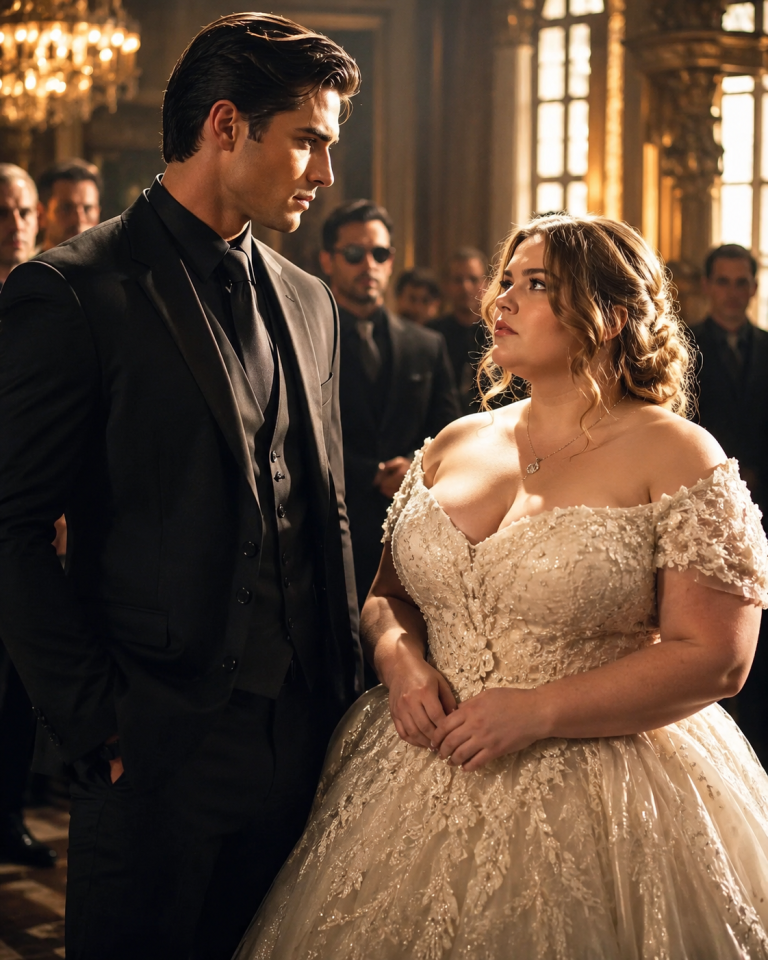
The gala was held in a hotel that had been built to make wealth feel like righteousness. Marble and crystal and white flowers in quantities that suggested abundance as ideology. Ivy spent the first hour three steps behind Sophia, who worked the room in a gown the color of a deep bruise — beautiful, expensive, and desperate in the particular way of a woman whose confidence requires an audience to function.
The man Sophia had targeted that night was named Luca Fiorente.
Everyone in the room knew that name, even the people pretending they didn’t. He ran the Fiorente Group: ports, logistics, development, the kinds of deals that don’t make the business press because the men involved prefer their arrangements to exist only where handshakes travel. Power with impeccable tailoring and a reputation that made certain categories of powerful people speak more carefully when his name was nearby.
He stood talking near the far end of the room with two men in dark suits, and the way the space organized itself around him — the unconscious drift of other bodies either toward or respectfully away — told you everything about the kind of gravity he carried.
Sophia had made three passes near him.
He had not noticed once.
That should have been the end of it.
It wasn’t, because Sophia without an audience was manageable and Sophia humiliated needed a softer target immediately.
She turned to Ivy with the expression Ivy had memorized in the way you memorize a weather pattern that reliably precedes damage.
It started as observation. Ivy’s shoes. The borrowed dress. The hair that kept escaping its pin on one side. Small cuts, the kind that require no raised voice — just the right tone, the right volume, the right witness.
Then it sharpened.
“At least when I fail, it’s a competition worth entering,” Sophia said, pitched precisely for the nearest cluster of guests to absorb. “You’re not even in the category.”
Ivy kept her face still.
“No one has ever wanted you, Ivy,” Sophia continued. Her voice was almost kind, which was the most practiced cruelty of all. “Not really. They tolerated you because your father felt guilty. That’s not the same thing.”
Renata stood to her left with a champagne flute and a faint smile that said: *I agree, and I’m glad someone finally said it aloud.*
Those words — *no one has ever wanted you* — did not arrive as new information. That was the worst part. They arrived as confirmation of something Ivy had been fighting not to believe for two years. Her father’s death had made a wound. These two women had spent every day since then pressing on it from the inside.
The tears came before she could stop them.
She turned. Reflex. The old animal instinct to hide the damage before those causing it could enjoy it fully.
And in turning, she looked directly across the ballroom.
At a man who had stopped watching the room and started watching her.
He had been in conversation — clearly important, clearly not finished — but his attention had moved the way attention moves when something has genuinely interrupted the hierarchy of priorities. He was watching Sophia. Then Renata. Then Ivy’s face.
Not the dress.
Not the borrowed shoes.
Her face.
And then he did something no one in the room predicted.
He handed his glass to the man beside him and started walking.
The ballroom shifted the way rooms shift when the person who owns the temperature of the space puts themselves in motion. Conversations stuttered. Shoulders straightened. The crowd parted with the instinctive courtesy people extend when power moves with purpose, not performance.
Sophia saw him coming.
Her face opened completely — relief, triumph, the full-body brightness of a woman convinced the universe had finally corrected an injustice done to her.
He walked past her.
Stopped in front of Ivy.
Extended his hand.
“Dance with me.”
The room was so quiet around them that Ivy could hear her own heartbeat.
She stared at his hand for two full seconds. Looked at his face. Looked back at his hand. There was no mockery in it. No theater. No performance of rescue designed to make him look good while she remained the object of the gesture.
Just a direct request.
From a man who appeared, improbably, to mean it.
She looked over his shoulder just once.
Sophia’s expression had turned to something past shock. Past fury. Past the ordinary vocabulary of social embarrassment.
Some small, battered, exhausted part of Ivy that had been lying face-down on the floor for two years quietly rose to its feet.
“Yes,” she said.
Her voice didn’t shake.
She hadn’t known it was going to do that.
He took her hand and walked her to the center of the floor. His grip was warm and unhurried. Not possessive. Not performative. Just present.
She was trembling. She hated it.
He noticed.
“You’re shaking,” he said.
“I wasn’t expecting this.”
“What were you expecting?”
She made a sound that was almost a laugh. “To leave early and unnoticed.”
Something moved through his expression.
“Who are they to you?”
“Stepmother. Stepsister.”
He said nothing for a moment. Just looked at her.
Then: “What’s your name?”
“Ivy Mercer.”
His gaze shifted by a fraction. “Mercer as in Thomas Mercer?”
“He was my father.”
A pause. Small and full.
“I’m sorry,” he said. “I knew of him.”
“Everyone in your world knows everyone.”
That pulled a short, unexpected laugh from him. Low. Real. The kind that didn’t seem like something he offered often.
“Are you afraid of me?” he asked.
Ivy considered lying. Decided against it.
“Slightly.”
“Good,” he said. “It means you’re paying attention.”
“That’s not reassuring.”
“No. I suppose not.”
They danced in silence that felt less like awkwardness than like two people giving each other room to think. When the music drew toward its close, he didn’t release her immediately.
“Coffee,” he said.
She blinked. “I’m sorry?”
“Tomorrow. Coffee with me.”
“I work.”
“Where?”
A pause. “Mercer Books & Coffee. On Aldwych Street.”
Something in his face changed — interest deepening from observation to intention.
“Then I’ll find it.”
“Why are you doing this?”
He looked at her with the steadiness of a man who has decided honesty is cheaper than performance.
“Because in a room full of people pretending to be more than they are, you were the only person trying simply to survive it. That interested me.”
He brought her hand to his lips. Kissed it once. Unhurried.
“Tomorrow, Ivy.”
Then he walked back into the room, and every eye in the ballroom followed him, and in his wake, every eye that returned to Ivy Mercer found someone standing considerably taller than she had been an hour before.
That night, Dana’s reaction required Ivy to hold the phone eighteen inches from her ear.
But in the quiet after the call, in the narrow room with the chipped skirting board and the one window that faced the garden wall, the old fear crept back with its oldest question:
*What if it was performance? What if tomorrow he isn’t there?*
She lay in the dark and tried to be practical.
She failed.
Because something in his face when he said *I’ll find it* had not looked like a man making a polite exit gesture.
It had looked like a man making a decision.
—
## PART 2
He came.
Ten-fifteen the next morning, Mercer Books & Coffee had exactly seven customers and Dana behind the pastry case doing what she claimed was inventory and was clearly surveillance. Ivy was grinding beans with the particular focus of someone using manual tasks as an anxiety management strategy when the bell above the door rang.
She looked up.
Luca Fiorente in daylight was somehow worse.
Dark jeans, white shirt, sleeves already pushed to his forearms, the kind of unstudied ease that belonged to men who had stopped needing to dress for approval decades ago. He removed his sunglasses as he came through the door. Found her immediately.
The seven other customers noticed.
Dana’s pastry cloth went completely still.
“You found it,” Ivy said.
“I told you I would.”
He looked at the shop the way she hadn’t expected — attentively, genuinely. The shelves her father had stripped and refinished by hand. The chalkboard menu in her handwriting. The photographs above the register: her father with his sleeves rolled up on the day the shop first opened, laughing at something just outside the frame.
“This was his,” Luca said.
“He built most of it himself. The shelves, the counters. Said good coffee deserved furniture made with intention.” She paused. “He was very serious about both.”
“It shows.”
He sat at the corner table and asked her to choose for him. She made a pour-over, single origin, the kind that rewarded attention. He took one careful sip, set the cup down, and said, “That’s extraordinary.”
“You don’t have to—”
“I’m not being polite. I don’t do polite when honest is available.”
Dana made a sound near the croissants that she immediately converted to a cough.
They talked for ninety minutes.
He asked about her father and listened without filling the silences. He asked about the shop’s future — not as small talk, but as though the answer mattered to whatever he was calculating. He asked about Renata, and when she answered, his jaw tightened in a way that he didn’t attempt to conceal.
Then he asked the question no one had asked her in two years.
“What do you actually want? Not next week. Your life, if you were designing it.”
Ivy put her coffee down.
“My own place,” she said quietly. “To grow this shop. A second one, maybe, one day. To stop feeling like my life is something I’m only allowed to hold very carefully in case someone decides to take it back.”
He looked at her across the table with an expression that was neither pity nor calculation but something that sat between the two and belonged to neither.
“What if I helped you leave?”
“No.”
The word was out before she had time to construct caution around it.
“I don’t need rescuing.”
“I didn’t offer rescue,” he said. “I offered a door.”
And the difference, she realized with a feeling like cold water and dawn arriving at the same time, was everything.
—
## PART 3
She said no to the apartment that day.
She said yes three days later, after the article appeared.
It ran in one of those glossy digital outlets that has mastered the grammar of social cruelty — headline measured for maximum reach, photos selected from the most unflattering angles available, “sources close to the family” weaponized into surgical accuracy. The piece described Ivy as calculating, opportunistic, a woman who had spent years using a failing bookshop to attract wealthy benefactors. It mentioned her father’s estate dispute with the sort of selective framing that made the victim read like the aggressor.
She read it at the register at seven in the morning and had to sit down on the stool Dana kept behind the counter for emergencies.
Dana arrived forty minutes later, read it over Ivy’s shoulder, and said something so imaginatively profane that a customer three tables away looked up with what appeared to be genuine admiration.
“Renata,” Ivy said.
There was no question mark.
Then her phone lit up.
Luca’s name.
She answered and said, voice just above breaking, “It isn’t true—”
“I know.” No hesitation. None. “I looked into you before I ever walked through your door. I know exactly who you are and what was done to your father’s estate.”
The relief was so sharp it was briefly indistinguishable from pain.
“You investigated me.”
“I investigate everything that matters to me.”
A beat.
“So you know they’re lying.”
“Yes. And I’m going to ensure the people behind it understand what it costs to aim something like this at you.”
“I don’t want anyone hurt.”
A pause that had weight and texture.
“No violence,” he said, and it cost him something to say it, she could hear that clearly. “I promise you.”
That was the moment she agreed to the apartment.
Not because of the article. Not even because of the fear. But because a man who would spend his own discipline on a promise made to her was something she had not known she was allowed to ask for.
—
The apartment was on the third floor of a building that smelled like old bricks and something faintly like cedar. High ceilings. Tall windows. A small balcony that looked over a row of plane trees just beginning to bud. Not grand. Not performed. Just right in the specific way of things chosen with actual knowledge of the person they’re for.
The lease was in her name.
He had arranged it so that it couldn’t be touched.
He met her there the first afternoon with the keys and a document she could read herself that confirmed every legal protection she had.
“First three months are covered so you can stabilize,” he said. “After that, market rate, your payment, your place. I have no claim on it.”
“Why?”
He looked at her steadily.
“Because you’ve been given things that came with conditions your whole life. I wanted to give you something that didn’t.”
Ivy looked around the apartment — the light falling in long rectangles across the bare floor, the empty shelves waiting for her books, the silence that belonged to no one else — and felt something enormous and quiet move through her.
She laughed.
Cried immediately after.
“It’s small,” he said, watching her with an expression she was only beginning to learn to read.
“It’s mine,” she said.
He stepped toward her. She turned toward him. And whatever had been building between them since the ballroom — that specific tension of two people circling something real and neither of them certain of the permission to reach for it — arrived at the only conclusion available to it.
He kissed her the way he did everything: without hesitation, with complete attention, as though she were the only thing in the room worth thinking about.
She kissed him back the same way.
When they finally separated, both of them breathing unsteadily in an empty apartment full of possibility, he rested his forehead against hers and said, “I am considerably past casual with you. I want you to know that.”
She laughed, which was the right response and also the only one she trusted herself to produce without saying too much.
“Good,” she managed. “Because I’m not far behind.”
—
Moving out of the Mercer house required four boxes.
That fact sat in her for days afterward. Four boxes to hold everything from a life in a house that should have been hers. Books. Photographs. Her father’s coffee-stained recipe notebook. The small things that mattered precisely because no one else had assigned them value.
When Luca’s people came to help, Renata watched from the living room doorway with the expression of someone witnessing something they had been certain would never happen. Sophia stood on the stairs in a robe, face arranged into contempt that didn’t quite disguise the thing underneath it.
“He’s doing this out of pity,” Sophia said.
Ivy picked up her box and looked at her stepsister directly.
“Maybe,” she said. “But I’d still rather leave with help than stay here and disappear for free.”
Renata’s face did something Ivy had never seen it do before.
It went uncertain.
The gate of the Mercer house closed behind her. She looked back once, through the window of Luca’s car. Then she turned forward and didn’t look back again.
—
Renata made her call to Viktor Solin six days later.
Solin was Luca’s sharpest rival — a man whose name altered the posture of people who heard it in the wrong context. Renata did not make the call from panic. She made it from strategy, calmly, the way she made every decision she thought would protect Sophia’s position. She offered information. She offered access. She framed it as business intelligence.
She had no idea that she had just handed a weapon to someone who would point it in a direction she hadn’t calculated.
Ivy was closing the shop on a Tuesday evening when it happened.
Dana had left twenty minutes earlier. The register was counted. The lights were going off in sequence. She was pulling her coat on and thinking about whether to pick up food on the way home when the back door, which she had locked, burst open in a way that turned the ordinary world sideways in the space of a single second.
Three men.
Fast.
Purposeful in the way of people who have done this before and know exactly what order the events go in.
She fought. Of course she fought — grabbed the nearest thing, kicked, twisted, used every piece of herself she had. It didn’t matter. They were larger, prepared, and operating from a plan she hadn’t known existed until it was already in motion.
She was in the van before she had time to scream for anyone.
“Solin sends his regards,” one of them said, and the accent and the name arrived together like a key turning in a lock she had never known was there.
Dana came back.
She had forgotten her phone charger on the shelf below the register — a detail so small it probably saved Ivy’s life. She came through the front door and found the back one swinging. Found the side door to the alley standing open. Called Ivy’s phone and listened to it ring from somewhere inside the shop.
Then she called Luca.
Her hands were shaking badly enough that she dropped the phone twice before the call connected.
He picked up on the second ring.
She said: *They took her. Right out of the shop. A black van, I saw it turning onto Crane Street.*
The room around Luca did not matter anymore after that sentence.
What happened to his expression in the moment after those words was not something his associates described easily, later. Not because they couldn’t find words. Because the words that came to mind were frightening.
He left the room without explaining.
Made two calls before he reached the car.
And the city, the port, the systems he had built over fifteen years — all of it converted, in those minutes, into a single instrument aimed at one objective.
Find Ivy Mercer.
Nothing else existed until that was done.
—
The warehouse smelled like rust and salt water and the particular cold of industrial buildings where heat is a functional consideration rather than a comfort. Ivy sat in a chair — zip-tied, not chains, which was probably meant to feel less theatrical and managed instead to feel more calculated — while Viktor Solin explained, with the patient courtesy of someone who considered this professional rather than personal, that Luca’s attachment to her had created a useful pressure point.
“He’ll come,” Solin said.
“Yes,” Ivy said. “He will.”
She said it flatly.
Not bravely.
Not with performance.
Just as fact, because it was fact, and the only comfort available to her in that room was the knowledge that she had not misjudged him.
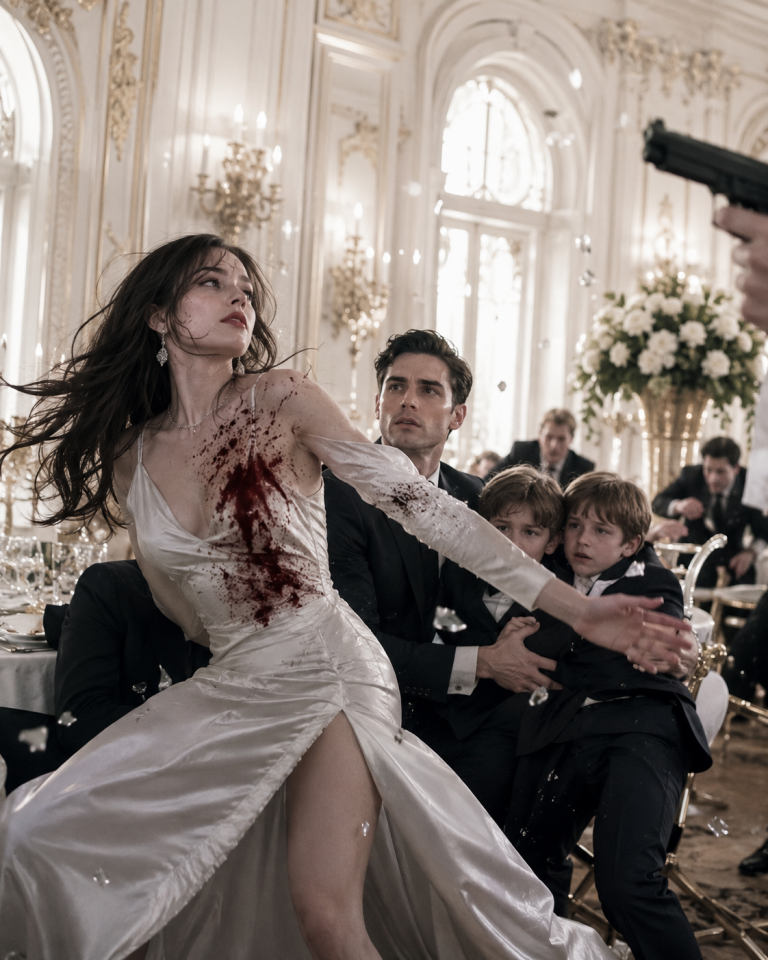
Three hours and forty minutes later, the door came in.
What followed was not the way it looks in films — clean and choreographed, beauty preserved throughout. It was loud, fast, ugly, and efficient in the way of people operating from training and necessity rather than narrative satisfaction. She could hear it more than see it from her position in the inner room: commands, impact, the specific sound of men who know what they’re doing working quickly through a structure they had mapped before they arrived.
Then the inner door.
Then Luca.
Gun down. Moving to her. Face carrying something she had not seen on it before — not the controlled blankness of the ballroom or the focused attention of the coffee shop. Something rawer.
He cut the zip tie and his hands came up to her face and for a second he just looked at her, checking, cataloging, making sure she was real and present and unharmed in the ways that couldn’t be seen immediately.
“I found you,” he said.
Just that.
She pressed her forehead to his shoulder and shook — all of it finally arriving, the fear that had been too sharp and fast to process during the event itself now arriving in the aftermath where the body finally had room to understand what had happened.
He held her without speaking.
No commentary. No immediate strategy. Just arms around her in the way of someone who had arrived with one objective and was now doing exactly what that objective had always actually been.
Solin tried something from across the room.
He ran out of opportunity before he got far enough for it to matter.
In the car, Ivy told him it was Renata.
She watched his face absorb it.
“You’re sure.”
“Who else knew exactly which things to hand to someone who would use them this way?”
A silence.
He looked out the window at the city moving past, and something in his expression went to a place she didn’t try to follow. Then he turned back to her.
“What do you want me to do?”
The question surprised her.
“I want it to stop. I don’t want anyone hurt.”
He nodded.
One single nod.
The kind that means: *this costs me something. I’m giving you it anyway.*
—
He went to the house the next morning.
Ivy did not come. She had asked him not to hurt them, and she trusted him to keep that, but she also knew there were things her presence would complicate and things that needed to happen with her absent for them to land correctly.
He came alone. Knocked.
Renata answered in a robe. Saw him. Lost three shades of color.
He stepped inside.
He did not raise his voice. That, his associates always said, was the most frightening thing about him — the absence of performance when the anger was real. He laid out what she had done. What it had nearly cost. What Solin had done with the information she had provided. He described it precisely and without editorializing.
Then he described what would happen if she ever used Ivy’s name again, in any direction, for any purpose.
He did not need to specify.
Renata was a strategic woman. She understood the shape of consequences when they arrived in this particular tone.
When he left, she was sitting on the stairs with her hands in her lap and Sophia somewhere above her, silent.
Ivy heard about it secondhand and said only: “Leave it there. Let it be done.”
He looked at her for a long time.
“For you,” he said finally.
And let it be.
—
Peace arrived the way good things often do after bad ones — not dramatically, but steadily. Like a room airing out after too long with the windows closed.
Luca came to the shop every day. At first for the coffee, which he genuinely loved. Then for the conversations that started over the counter and moved to the corner table and ran too long in the best possible way. He met Dana, who subjected him to a level of scrutiny she described as “thorough vetting” and he described as “unexpectedly rigorous.” He passed on both counts. He helped source a second espresso machine when Ivy’s old one finally gave up entirely. He had opinions about the new menu board font that were more considered than she expected and better than her own instinct, which she refused to admit aloud but he noticed.
He learned her life in increments.
She learned his — not the parts that moved through port logistics and private arrangements and rooms where the consequences of decisions lingered, but the parts that existed outside all that. The way he read. The way he cooked when given a kitchen and a reason to use it. The way he looked at things he found beautiful with an attention that treated beauty as something that deserved its full duration of regard.
He was dangerous.
She knew that.
She had never required otherwise.
What she had required was that the danger not be turned inward. That the power not be used against her. That whatever he was in the rooms she would never fully see, he remained, in the rooms she occupied, someone she could trust with the parts of herself she had been taught were inconvenient.
He gave her that.
Not as a gift. Not as a transaction.
As a decision he made daily.
The proposal came on an evening in late October — which mattered to Ivy privately because late October was when her father had died, and she had not known until that year that the same season could hold both loss and this.
They were on the terrace of his apartment with the city below them and a sky that had finally decided to go full autumn — deep blue, stars arriving early, the air that smells like something ending and something else gathering.
He turned to her.
“You made my life larger,” he said. “Not louder. Not more complicated. Larger. There’s more of it now than there was before you.”
He paused.
“Marry me, Ivy.”
He produced a ring from somewhere — she genuinely could not explain later where it had come from, it seemed simply to exist when the moment required it — and it was exactly right. Not ostentatious. A single deep-set stone, elegant in the way of something designed to last rather than impress.
She cried first.
Then laughed at herself for crying.
Then said yes. Twice, for emphasis.
Then kissed him before either of them could produce another word, which was probably the right decision.
—
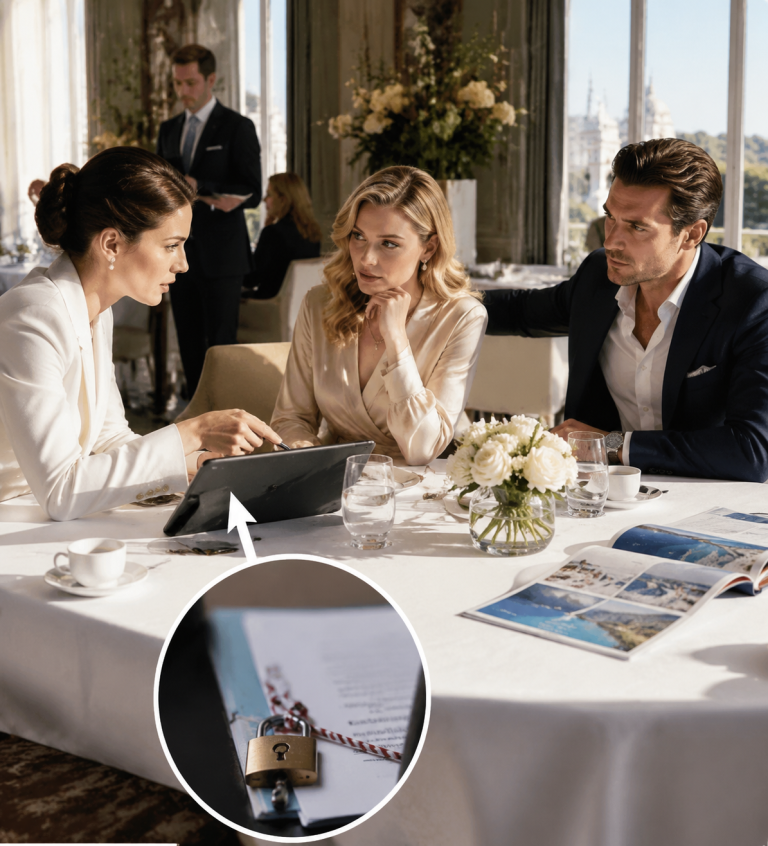
Wedding planning confirmed several things Ivy had already suspected.
That Dana took maid-of-honor logistics as seriously as most people take employment. That Marco, Luca’s closest friend and right hand, approached groomsman coordination with the same systematic energy he applied to everything else and had strong feelings about pocket squares that no one had previously known about. That Luca, who moved through billion-dollar negotiations without visible effort, developed opinions about ceremony music that required three separate conversations to resolve. That Ivy wanted something that felt like them — not like a statement, not like an event the city would photograph and file, but like a day that belonged to the people inside it.
They compromised.
Small venue. Old stone building with tall windows. Garden reception. Fairy lights in the trees. A guest list short enough that everyone present was genuinely glad to be there.
When the engagement became public — photographs of Ivy outside the shop with the ring catching the light — the reaction was exactly what she expected. Society pages. Speculation. Several articles that framed her variously as Cinderella, social climber, and mystery depending on which editorial angle the piece required.
She stopped reading them after the third.
Then Renata called.
The apology came with structure — careful, not quite convincing, strategically softened around the hard edges. She had changed. She was sorry. She only wanted peace. Could she come to the wedding?
Ivy sat with the phone and with the question for two days.
The part of her that had grown up wanting a mother — any version, even a bad one who occasionally remembered to try — still existed inside the adult who had been systematically diminished by the woman on the other end of this call. That part had not fully dissolved. Perhaps it never would.
She said yes.
One chance. No more.
Luca looked at her when she told him.
“You’re too generous,” he said.
“Maybe. Or maybe I’m just done letting her have anything I haven’t chosen to give.”
He considered that.
Nodded.
“Yes,” he said. “That.”
—
The wedding day arrived cold and bright.
October again — but this October full of light. The church was old and smelled of candle wax and cut flowers and the particular cold of stone buildings that hold centuries inside their walls. Ivy stood in the entrance in ivory silk while Dana made final adjustments with the focused energy of a woman for whom any task, properly undertaken, becomes sacred.
“You look—” Dana started.
“Don’t,” Ivy said, because she was already close to tears and they had not begun yet.
“—completely terrifying,” Dana finished. “In the best way.”
She walked herself down the aisle.
Her father was not there to give her away, and she had decided early that she would not replace him with a substitute gesture. She walked herself, alone, with her flowers and her borrowed courage and the knowledge that this was what a life looked like when you had survived the people who tried to reduce it to nothing and arrived on the other side still in possession of yourself.
Luca saw her from the front of the church.
And whatever composure he had prepared for the occasion briefly left him.
Marco said something. Luca didn’t answer. He watched Ivy walk toward him with an expression so unguarded that people in the front rows looked away, feeling they had been given access to something private.
His vows were quiet.
He told her she had taught him that real power — not influence, not leverage, not the fear in other men’s faces, but actual power — was the kind that made something grow. He promised her presence, honesty, protection that remembered it was for her benefit rather than his control. He promised to keep choosing her.
*Not once. Not for the occasion. Daily.*
Her vows were shorter.
She thanked him for walking past the red dress. She thanked him for seeing her face instead of her circumstances. She told him she had spent two years believing that survival was the ceiling of what was available to her, and he had shown her, without ever meaning to, that the ceiling was much higher than that.
They were married.
At the reception, under the lights strung through trees and the warm sounds of people genuinely happy to be in the same room, Sophia found her.
Not the Sophia of the ballroom. Not the one in the bruise-colored dress performing contempt for an audience.
Just Sophia.
Smaller than usual. Uncertain.
She apologized.
Not beautifully. Not completely. With the halting, imperfect honesty of someone who has arrived late to an accounting she should have started years ago.
“I was jealous of you,” she said. “Not because of him. Before him. Your father looked at you like you were worth looking at. I wanted that. I took it out on the wrong person.”
Ivy listened.
The forgiveness did not arrive that evening. Some things require more than one honest sentence to heal. But the truth did arrive — the fact of it, finally said — and that was its own form of relief.
“I’m not there yet,” Ivy told her. “But I’m not closed.”
Sophia nodded.
That was enough.
For now.
—
The honeymoon was in Italy.
Luca’s birthplace — a town on a cliff above the sea that looked exactly the way places look in the imagination of people who have only seen them in photographs and are then stunned to discover the photographs were underachieving. He showed her streets he had run as a boy, introduced her to family who fed her more than she thought physically possible with a warmth that seemed to operate independently of language, took her to a church with a floor worn smooth by centuries of the same stone and the same light.
On their last night, on a terrace with the Mediterranean below them like folded silk and the sky doing the thing it does over water when the stars decide to be taken seriously, Ivy said, “Do you realize all of this started because someone told me no one wanted me?”
He turned to look at her.
She watched him consider how to answer — not perform it, actually consider it.
“They were describing their own failure,” he said finally. “Not you.”
She leaned her head against his shoulder.
“Poetic,” she said.
“True,” he replied.
“Same thing.”
He laughed.
She laughed too.
Below them the sea moved in its old, unhurried way, indifferent to timelines and unmoved by cruelty, doing only what it had always done: continuing, returning, finding the shore again and again regardless of how many times the wind tried to redirect it.
That was the story.
Not the ballroom — though the ballroom was the beginning. Not the dance — though the dance changed things in ways neither of them had fully predicted.
The real story was everything that came after: the coffee shop conversations, the four boxes, the apartment with tall windows, the promise made at the cost of his instincts, the ring in October light, the aisle she walked alone because she had learned, finally, that some thresholds are yours to cross yourself.
Nobody had wanted her.
He had.
Then he had kept proving it, not in the ballroom, but in every ordinary and extraordinary day that followed, until wanted became the wrong word entirely for what she was to him — too small, too conditional, too easily revoked.
What she was to him was necessary.
What she was to him was home.
And that — not the gesture, not the rescue, not the feared man who walked past the red dress — was the truth that changed everything.
—