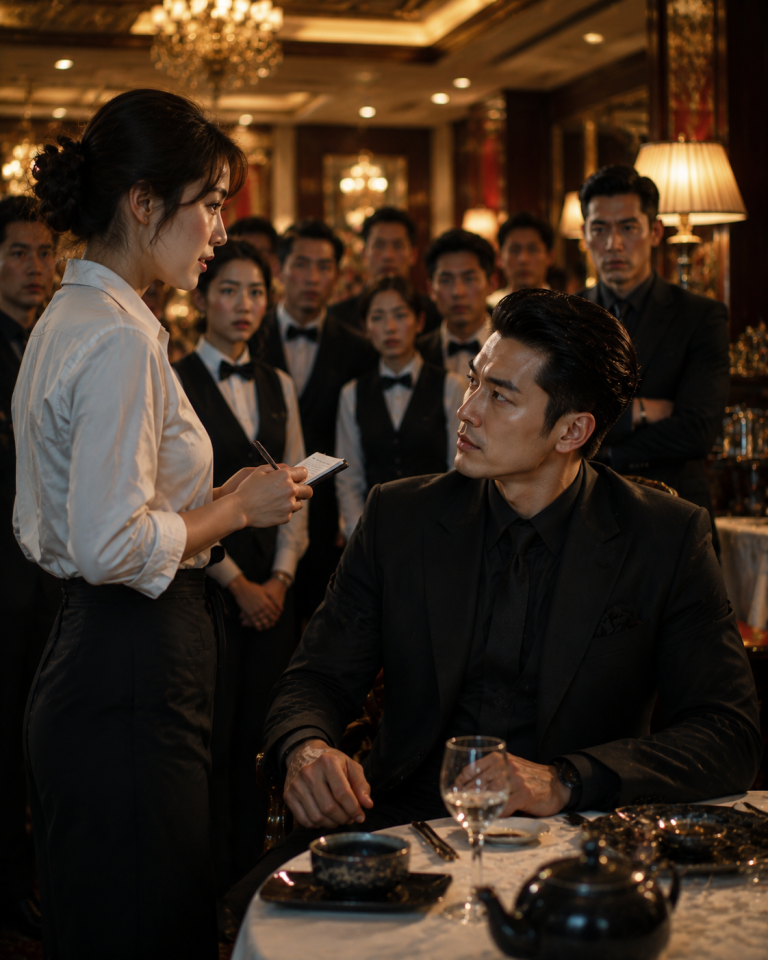
Serving Dessert to His Son—The Mafia Boss Declared My Old Life Was Over

## PART 1
I have never been afraid of the right things.
I was afraid of late rent. Of phone calls from the hospital. Of my brother’s face when the bus was too loud and no one moved to help him. I was afraid of the quiet way exhaustion can hollow a person out until she forgets what she looked like before she became useful to everyone except herself.
But a dangerous man in a silk suit?
That I walked toward.
It started with a dessert I invented on the spot and a little boy nobody in that restaurant would look at.
The shift at Marcello’s had been grinding me down since four in the afternoon. My feet had stopped hurting two hours ago, which meant they had crossed into the territory where pain becomes background noise — always present, no longer worth acknowledging. My section that night was the one near the service corridor, the one that caught the kitchen draft and the slamming of the utility door, the one that Gregorio the floor manager gave to servers he considered temporary. He had been giving it to me for three years.
I was not temporary.
I simply had nowhere else to go.
Marcello’s was all warm amber light and white linen from the dining room side. From the kitchen side, it was steam and shouting and the constant arithmetic of survival. Servers who smiled at the right people moved up. Servers who showed up reliably and kept their heads down got the corridor section. I had made peace with that the same way I had made peace with most things — not because it was fair, but because fighting it cost more energy than I had left.
My name is Clara Voss. I am twenty-eight years old. My father has stage four lung cancer. My younger brother Theo is autistic and seventeen. My twin sisters are in their last year of secondary school. My mother left when I was eleven, which was not a tragedy so much as an adjustment that restructured everything downstream.
I was the straw holding the shape of the straw.
The restaurant changed at 8:22 that Thursday evening.
I know the exact time because I had just checked the clock above the bar and was quietly counting how many minutes remained until I could take off my shoes. The front door opened. Cold October air moved across the dining room like a tide pulling back before something arrives. The noise did not stop. It contracted. Tables lowered their voices. Couples leaned in. People looked quickly away.
Four men entered first — broad-shouldered, still-faced, with the contained alertness of people whose profession was reading rooms for exits and threats. Behind them came the one they were protecting.
He was younger than power usually looked. Early thirties. A black suit that said nothing aloud and everything beneath the surface. Dark hair. A jaw with a faint scar disappearing into his collar. And eyes that did not assess the room so much as receive it — as though the room had already agreed to be examined.
Beside him walked a boy.
Small. Eight years old, perhaps. Dark hair like his father’s, but his face softer, not yet armored. He wore a pale blue shirt buttoned to the throat and small polished shoes that looked uncomfortable. His gaze stayed low. His fingers moved in a private rhythm against his thigh — tap, pause, align, tap — the kind of movement that is not distraction but anchor.
I had seen that movement before.
Theo had done the same thing at the grocery store when the fluorescent lights buzzed too loud. In church when the organ came without warning. On the bus when a stranger sat too close. It was not nervousness. It was the body finding its own ground when the world offered none.
Gregorio appeared from nowhere with a smile wide enough to dislocate something.
“Mr. Ferretti. Your table is ready.”
The name hit the air and spread outward.
Nico Ferretti. My colleague Daria reached me in three steps, eyes bright with the particular mix of fascination and dread that only certain names produce.
“That is Nicolò Ferretti,” she breathed. “Head of the Ferretti family.”
I arranged silverware and said nothing.
“Sofia, don’t even think about it.”
My name is Clara. She sometimes called me Sofia when she was agitated.
“You have the look,” she said.
“What look.”
“The one you get before you do something that can’t be undone.”
She was not wrong. But she was also not watching the boy.
The assigned server was a man named Federico — experienced, competent, deeply concerned with staying employed. He approached the table, took drink orders from the adults, and did not once speak to the child. Did not offer a menu. Did not bend down. Did not acknowledge him except as an accessory to a powerful man.
The boy’s name, Daria told me, was Marco. His mother had died in childbirth. His father brought him everywhere because he trusted no one with him.
Marco had begun arranging his cutlery. Fork parallel to knife. Knife parallel to spoon. Napkin refolded into thirds. Glass turned until the etched crest faced him at a precise angle. His shoulders were rising. His breathing had become visible from across the room.
I had watched Theo reach that same edge a hundred times.
I had also watched every adult in every room decide that whatever else was happening was more important.
Daria grabbed my wrist. “Clara.”
“He needs help.”
“He is not your table.”
“He’s a child.”
“He is Ferretti’s child.”
I heard her. I understood what she meant. A man like Nicolò Ferretti did not welcome unsolicited attention. He did not forgive clumsy kindness from strangers who had nothing to offer him except the wrong kind of compassion.
I looked at Marco’s hands.
I thought of Theo in the cereal aisle at nine years old, curled between the shelving and the freezer case, covering both ears while strangers stepped around him like a display misplaced from another section.
I thought of my father kneeling on that floor without looking up, only putting one hand on Theo’s back, only saying: *I’m here. It’s loud. It will stop.*
I thought of everyone who had ever muttered that someone should do something.
I picked up a dessert menu.
And I walked toward the most dangerous table in the restaurant.
The guards saw me before I was halfway there. One shifted. Another’s hand moved beneath his jacket. The third placed himself between me and the table without appearing to move at all.
Nicolò Ferretti turned his head.
And looked at me.
The world went briefly airless. Not because he was beautiful — though he was, in the way a blade is beautiful when the light catches it right. But because his attention was complete. Not the lazy inventory men sometimes offered women they found decorative. Not the quick dismissal reserved for service staff. He looked at me the way you look at something you are deciding whether to keep.
I crouched slightly. Not close. Hands visible. Voice low.
“Hi, Marco. My name is Clara. Would you like to see what we have for dessert?”
His rocking slowed by a fraction. His eyes moved to me — not direct, not the way adults expected, but sideways and careful, the way trust approaches when it hasn’t been rewarded often enough.
Then Nicolò spoke.
“Marco doesn’t eat dessert.” His voice was low, precise, and carried the specific chill of a man accustomed to ending conversations. “And this is not your section.”
Every server in the restaurant heard it.
So did Gregorio, who had gone the color of fresh pasta.
My face burned. My job balanced on the edge of a single second.
And then I heard myself say: “We have something not on the menu yet. Vanilla gelato with dark chocolate pieces shaped like puzzle fragments. They can be arranged before eating.”
Ferretti’s eyes narrowed.
I kept mine on Marco.
“Sometimes when everything feels too loud, having something to arrange first helps.”
One of the guards exhaled almost silently.
Daria, near the bar, had stopped breathing entirely.
Then Marco said, very quietly: “Puzzle pieces.”
The two words landed in the silence like something precious being set down carefully.
Nicolò looked at his son.
And in the carved severity of his face, something shifted — so small that only a person watching for it would have caught it. A fracture in the stone. The particular unguarding of a father whose attention has been caught by something that matters to the child he would burn the world for.
“Bring it,” he said.
Not please. Not thank you. An order.
I stood, walked back to the kitchen with my spine straight, and did not let my knees shake until the doors closed behind me.
Chef Benno stared at me. “What did you do.”
“I need vanilla gelato and chocolate cut into puzzle shapes.”
He put down his knife. Looked through the pass toward table twelve. Then picked the knife back up and moved faster than I had ever seen him. If we were going to die for this, at least the plate would be professional.
Four minutes later, a chilled white bowl. A scoop of vanilla bean. Dark chocolate pieces cut into rough interlocking shapes. A thin drizzle of sauce.
I carried it back myself.
The dining room watched.
Marco’s face when I set it in front of him was not greed. It was recognition — the exact expression Theo made when the train schedule finally made sense.
He reached for the chocolate with precise fingers. He did not eat. He arranged. Piece by piece, a pattern formed. His breathing slowed. His shoulders came down. The small sound he had been making — barely audible, the kind only someone listening for it would notice — faded into the ordinary noise of the restaurant.
I was turning to leave when the voice found me again.
“Thank you.”
Barely above a murmur. I turned.
Nicolò Ferretti was looking at me. The earlier assessment was gone. In its place was something I did not have a name for — focused, unblinking, the expression of a man who has just found something he didn’t know he was looking for.
“Your name.”
“Clara Voss.”
He repeated it the way people repeat things they intend to keep.
“You know something about children like my son.”
“My younger brother is similar. I helped raise him.”
His gaze traveled over me — not slowly, not with any pleasure in the surface of things, but with the thorough attention of a man cataloguing information. My uniform. My hands. The cheap shoes. The corridor section I’d been assigned for three years.
“Section by the service entrance tonight,” he said.
“Yes.”
Something cold moved through his face.
“That section is beneath your abilities.”
No one at Marcello’s had ever said anything like that to me. Not in three years.
He looked away. The dismissal was clear.
I returned to my tables with my pulse hammering, carrying the unsettling feeling of having just stepped onto a surface that had not yet decided whether to hold.
They left after ten.
Just before the exit, Marco held up the last chocolate piece — showing his father the shape he had made. Nicolò bent down and looked at it with complete attention. Not performing. Listening.
I busied myself with napkins.
Then a shadow fell across my station.
One of the guards. Young. Face like a closed door.
“Mr. Ferretti would like to speak with you outside.”
Gregorio gave me the small, pale nod of a man stepping out of the way of something he couldn’t stop.
I untied my apron.
Outside, October reached through my thin blouse. The black car at the curb had windows dark enough to seem painted on. The guard opened the rear door.
I slid inside.
Warm leather. Cedar and something darker beneath it. The silence of money so established it no longer needed to announce itself.
Marco sat across from me, turning a small metal puzzle in his hands, calm in the way children become calm after the overwhelming thing has passed.
Beside him: Nicolò Ferretti.
The door shut. The city went muffled.
“You made an impression on my son.”
I folded my hands so he wouldn’t see them shake. “I’m glad he enjoyed the dessert.”
“Do you know who I am.”
“Yes.”
“And still you came to the table.”
I looked at Marco. “I saw someone who needed help. That’s what I would do for anyone.”
Something changed in his expression. “My son is not anyone.” Absolute. Quiet. “He is everything.”
The car began to move.
Panic hit hard. “Where are we going. I need to finish my shift—”
“Your shift is finished.”
“Mr. Ferretti, I need that job. My father is sick—”
“Stage four lung cancer. Mercy Regional. Treatment interrupted due to outstanding balance.” He continued without pausing. “Your mother left when you were eleven. Your brother Theo is autistic, seventeen, currently on his third school placement. Hartwell Court, apartment 2F. Eleven weeks behind on rent.”
I forgot how to breathe.
“You learned my name twenty minutes ago.”
He didn’t answer that.
“What do you want from me.”
“Marco needs someone who understands him. Someone who doesn’t treat his needs as inconveniences to be managed.” A pause. “Fifteen thousand a month. Room and board. Your father’s medical balance cleared. You start tomorrow.”
The number expanded inside me like water filling all the dry cracks at once — every unpaid bill, every interrupted treatment, every morning I had woken up already behind.
Fifteen thousand. A month.
“This is not a request,” he said.
There it was. Velvet over steel.
“You can’t take people out of their lives because they were kind to your son.”
The faintest curve touched his mouth.
“I believe I just did.”
Marco looked directly at me. “Will you make more puzzle desserts?”
A child asking for sweetness in the middle of a negotiation he couldn’t understand. A father willing to move law and wealth for him. And me, caught between the need pulling me backward and the danger sitting inches away.
“If you want me to,” I told Marco. “I would.”
Nicolò watched the exchange.
Then: “It’s settled.”
“Nothing is settled,” I said.
The car slowed. Outside: my building. Cracked steps. Broken mailbox. The city I had always lived in, looking suddenly like something I was already leaving.
Nicolò leaned forward. “Your father’s treatment resumes tomorrow. Your family’s rent is covered. All you have to do is say yes.”
He handed me a card. Heavy cream stock. One gold number.
“Until eight o’clock tomorrow morning.”
The door opened.
I stepped onto the sidewalk still wearing my server name tag. Clara. Black letters on cheap plastic. As if I still belonged entirely to the old version of myself.
“Why me,” I said before I could stop it. “There must be people with qualifications.”
Nicolò looked at me through the open door.
“Because my son smiled at you.”
His face darkened with something I didn’t have a word for yet.
“Do you understand how rare that is.”
The door closed.
The car disappeared.
I stood alone with the card in my hand and the faint, unshakeable feeling that the ground under my feet had just shifted — and that it would not shift back.
—
## PART 2
My apartment smelled like radiator heat and lemon cleaner and the specific silence of a home where too many people used to live.
I climbed the stairs. Mrs. Pereira from the floor below asked if the restaurant had any bread left. I told her not tonight. She accepted this with the patience of someone who had made peace with disappointing answers long ago.
Inside 2F, silence waited.
My siblings had scattered across the city the way families scatter when the space is too small and the need too large. Theo stayed with our aunt when his routine held. The twins rotated between relatives. I stayed in the apartment we’d all once shared, surrounded by mail that wasn’t mine anymore and the particular loneliness of being the one nobody worried about because she was doing the worrying.
I set the cream card on the kitchen table beside the rent notice.
It looked wrong there. Too precise for that surface.
I made instant noodles and could not eat them. I called the hospital. My father was stable — that word I had started to hate, stable meaning not falling, not meaning standing.
I called Nora at eleven. I did not tell her about the car. I did not tell her about Nicolò Ferretti or the number he had said like it was ordinary or the way he had looked at me like something he was deciding whether to keep.
I asked if Theo had slept.
“Not really. He keeps asking when Dad is coming home.”
“What do you tell him?”
“That the doctors are working on it.” A pause. “Clara. Are they?”
I looked at the card.
“They’re trying.”
After we hung up, I sat at the table until the city outside shifted from black to gray. A pipe knocked in the wall. A siren passed somewhere far off and did not return.
At 7:29, my phone was in my hand.
At 7:30, I dialed.
The woman answered before the second ring.
“Miss Voss.” She said my name with the certainty of someone who had never expected otherwise. “The car will arrive in thirty minutes.”
I should have demanded a contract. I should have called someone, though I could not have named who.
Instead, I packed a bag. Two pairs of jeans. Three shirts. Toiletries. My father’s old cardigan. A photograph of all five of us taken at a street fair the summer before his diagnosis — Theo with both hands over his ears because the music was too loud, my father’s arm around his shoulders, all of us leaning slightly toward each other.
The car arrived at 8:02.
Black and silent as a held breath.
I got in.
And the city I had spent my entire life navigating began — quietly, without announcement — to fall away behind me.
—
## PART 3
The estate appeared from behind iron gates and a long drive lined with cypress trees. Pale stone. Terra cotta roofs. Balconies in black iron. Fountains catching the early light. The kind of architecture that had learned to look beautiful while remaining defensible.
A woman waited on the front steps — slender, charcoal gray suit, dark hair engineered into a precise knot. Elena Savin, Mr. Ferretti’s personal assistant. Her handshake was brief and exact.
“Your primary responsibility is Marco,” she told me as we moved through marble corridors. “His routine is documented. Deviations are to be avoided. You’ll have the suite adjoining his rooms. Mr. Ferretti prefers his son’s caretaker continuously available.”
“One day off per week. Sundays.”
She stopped before a heavy wooden door. “The previous three caretakers didn’t last.”
“What happened to them.”
“They are no longer employed.”
Not an answer. A perimeter.
She knocked and opened the door.
Marco’s rooms were a world. A reading corner under deep shelving. A large worktable with puzzles at various stages. A mineral cabinet with labeled drawers. An art station. A sensory corner with weighted blankets and soft lighting. Maps on one wall — transit systems, topographic surveys, geological charts. Everything placed with money. Most of it placed with thought.
Marco sat on the rug organizing colored tiles. He did not look up.
I set my bag down quietly and knelt several feet away.
“Hi, Marco. It’s Clara. From the restaurant.”
His hands stilled.
I opened my bag and produced a small white box. I had returned to Marcello’s before dawn, knocked on the service entrance, and asked Benno to cut more chocolate into puzzle shapes. He had looked at me for one long moment before moving without a single question, which told me he had understood more than I’d said.
“I brought something. For after lunch, if you want.”
Marco looked at the box. Then at my face.
“Dessert comes after lunch. That is the rule.”
“That’s right.”
“Rules matter.”
“They do.”
He returned to his tiles. But the small tension that had been in his brows — a child bracing for disruption — had loosened by one degree.
Elena, from behind me: “Perhaps Mr. Ferretti’s confidence isn’t entirely misplaced.”
She left without explaining what she meant.
—
That evening, I read Marco’s documentation while he worked beside me. The notes from the most recent caretaker were methodical and cold. *Subject refuses transition. Subject fixated on routines. Subject manipulates through distress.* Observations without a child inside them.
Marco looked up. “You made the angry face.”
“Did I.”
“Two lines, here.” He touched the space between his own brows. “Miss Petra made that face too. But at me.”
“I’m not angry at you.”
“Then why.”
“I don’t like when people describe children as impossible.”
He considered this carefully.
“Miss Petra yelled. On the scratchy sweater day. My skin didn’t like it.” He returned to his tiles. “Papa made her leave.”
*Made her leave.* The phrase sat in the room with all its implications intact.
—
Nicolò arrived at seven.
He did not announce himself. Marco felt him before the door opened — his head came up, his body realigned, and the specific tension that lived in him during his father’s absence dissolved in an instant.
“Papa.”
Nicolò crossed to his son and crouched beside him with the focused presence of a man who had made a practice of being entirely there when it mattered.
“Piccolo. Tell me your day.”
“Clara brought chocolate puzzles. She found the seamless socks. And she didn’t make the angry face at me.”
Nicolò glanced at me. “Seamless socks.”
“The gray pair has a seam across the toe. I found one without in the second drawer.”
“You noticed that on the first day.”
“My brother Theo screamed when socks hurt. People called it dramatic.” I kept my voice level. “It wasn’t.”
He studied me. Then turned back to Marco. “Mrs. Ricci will take you to wash for dinner. I need to speak with Clara.”
An older woman materialized from the sitting room doorway with the silence of someone long practiced at being present without intruding. Marco went with her, but paused at the threshold and looked back at me once — checking that the good thing would still be there when he returned.
When the door closed, Nicolò gestured to the sofa.
I sat.
“His mother’s family called him damaged,” he said, without preamble. The word dropped like something he had carried for years. “They wanted him placed in a facility after Lucia died. Said a child like him required management, not love.”
“He’s not damaged.”
“No.” The contempt in his voice had edges. “He is not.”
“What did you do?”
The question escaped before I could catch it.
His mouth curved slightly. “What do you imagine.”
I remembered Daria’s whispered warnings. I looked away first.
“Your father has been transferred to the private oncology wing at St. Aurelius Medical Center,” Nicolò said. “Treatment begins tomorrow morning.”
The room tilted.
“You already—”
“Of course.”
“I haven’t agreed to anything in writing.”
“You came.” His voice was even. “That was close enough. For now.”
I should have been furious. I was furious. But beneath it, rising like something that had been held back for months, was relief so enormous it threatened my composure entirely.
Dad was getting the treatment. Dad had a chance.
Nicolò saw the tears before I could stop them. Something moved through his face — not warmth, but a discomfort with emotion he couldn’t direct.
“Don’t thank me,” he said. “Do your job. Keep my son well. Everything else follows.”
—
Dinner felt like an examination with good food.
Three place settings at one end of a long mahogany table. Marco cutting his food into careful squares. Nicolò watching his son with one eye and me with the other — a divided attention that somehow lost nothing in the division.
The clothes Elena had arranged were hanging in my closet when I’d returned to the suite. I had chosen the simplest dress because my jeans suddenly felt like a statement I wasn’t ready to make.
“Marco tells me you found the seamless socks,” Nicolò said.
“Miss Petra said I was being difficult,” Marco said, lifting his fork. “Because the socks felt like feet made of scratchy noise.”
Nicolò turned to him. “Is that how it feels?”
“Yes. Clara understands. Because of Theo.”
“Your brother,” Nicolò said to me.
“He’s seventeen. He loves bus timetables, old weather data, and transit maps of cities he’s never visited.”
Marco’s fork paused. “Old weather data.”
“He can tell you the exact temperature on his birthday for every year since he was born.”
Marco absorbed this completely. Then: “That is genuinely useful information.”
I smiled. “He thinks so too.”
For a while, the dinner became something else. Marco asked questions. I answered. Nicolò followed his son’s winding thoughts with the patience of a man who had learned to value paths that didn’t go straight.
After Marco left to show Mrs. Ricci something from his mineral collection, Nicolò poured wine into my untouched glass.
“Tell me about your family.”
“Five of us. I’m the middle. Dad worked two jobs. Then he got sick. I became the one who covered the distance between what we needed and what we had.”
“Without being asked.”
“Someone had to.”
His eyes moved over my face. “No one ever asks the responsible one if she chose it.”
The accuracy of that landed somewhere unprotected.
He watched me absorb it.
“Your siblings have been relocated,” he said.
My head lifted.
“The housing application your family had been waiting on was expedited. Three-bedroom flat. Better schools. Quiet street. Twelve months of rent arranged.”
I stood. The chair scraped. “You cannot keep rearranging my life without asking me.”
He didn’t stand. He didn’t need to.
“You needed it. I arranged it.”
“You bought leverage.”
“Don’t pretend those are different things in this world.”
“They don’t know where the money came from.”
“They believe it’s a housing subsidy. It is. Subsidized by me.”
A laugh almost escaped — inappropriate, startled, the kind that arrives when absurdity and anger reach the same room at once.
“Why,” I said. “Why any of this.”
He rose then, and I understood for the first time how much space he occupied in a room — not physically, but in the quality of the air.
“Because you are useful.” A pause. He saw me flinch. “And because Marco slept this afternoon without asking for me. That has not happened during daylight in eleven months.”
He stepped closer. “You think I don’t know the difference between purchasing service and recognizing value.”
“Do you?”
The boldness of the question surprised us both.
“There she is,” he said quietly.
“Who.”
“The woman who crossed my dining room because a child needed her. Not the server. Not the exhausted daughter. You.”
My heartbeat was doing something I chose not to examine.
He turned at the door. “The east wing.”
I waited.
“Never. Not you. Not Marco. Ever.”
“What’s there.”
“My offices. Security operations. Business that doesn’t involve you.”
The way he said *business* made the room cooler.
“Understood.”
He left.
I lay in sheets softer than anything I had owned and stared at the ceiling until the dark became familiar. I should have felt saved. My father had treatment. My siblings had a home. Theo would have a room of his own.
Instead, I felt the distinct sensation of a door closing quietly behind me.
At 2 a.m., Marco’s voice — high and frightened — came through the adjoining wall.
I knocked once and entered.
He was tangled in blankets, eyes open, unfocused with the terror of a child mid-nightmare.
“It’s Clara. You’re in your room. The blue lamp is on. The mineral chart is on the wall.”
Facts. Solid ground. A ladder back from wherever fear had taken him.
“Bad men,” he whispered.
I sat on the floor beside the bed. Not touching. Only near.
“Can you name five things you see?”
He counted. Lamp, wall, book, the rug pattern, the door. His breathing slowed.
After a while: “They tried to take me before.”
“Who did?”
“Papa says I don’t need to remember.” He closed his eyes. “So I try not to.”
I stayed until he slept.
When I came back to the sitting room, Nicolò stood in the doorway to the hall.
“How long have you been there.”
“Long enough.”
“The cameras.”
“Yes.”
“That’s invasive.”
“That’s security.” He said it without apology. “What Marco told you — men tried to take him. Three years ago.”
He moved toward the window. The garden was dark. The city below scattered like broken light.
“Lucia was born into another family. Old money. Old grudges. When she died, her family decided Marco belonged with them. When I refused, they found a judge. When that failed, they found other methods.”
“The kidnapping.”
“He was six. His aide was paid. The car was stopped two blocks from his school.”
I didn’t ask what happened after the car was stopped.
“He’s been homeschooled since. Rarely leaves the estate. Everyone near him is checked.” He paused. “Including you.”
“Why tell me this.”
He turned. In the low light his face was harder to read, which made it somehow easier to watch.
“Because Marco trusts you. That makes you matter. It also makes you a risk — to him, if you leave without warning. To me, if you become something someone else can use.”
“I would never hurt him.”
“See that you don’t.” He crossed the sitting room slowly. “I protect what is mine. With everything I have.”
“I’m not yours.”
A pause.
“Not yet.”
I should have moved. I didn’t.
He looked at me for a long moment — not with the inventory from the restaurant, but with something closer to uncertainty, which on his face was more frightening than certainty.
Then he stepped back.
“Good night, Clara.”
After he left I stood in the dark sitting room for a long time, listening to the garden fountains and thinking about the phrase *not yet*, and how it sat in the room after him like something he had placed there deliberately.
—
The days built themselves into structure.
Medication at 7:45. Breakfast. Math with his tutor. Reading. Movement break. Minerals. Lunch. Dessert on Tuesdays and Fridays. Art. Swimming at five. Dinner when Nicolò was home. Bath. Reading. Blue lamp. Sleep.
I learned the specific topography of Marco’s needs. Which foods he could manage when anxious. That he could hear forks scraping plates from across the room. That he remembered the exact date his father had brought home each mineral in his collection. That he whispered the word *Mama* sometimes in half-sleep, quietly, like a word kept in a room he only visited in the dark.
I learned the estate’s rhythms too. Elena knew everything and said only what was useful. The kitchen staff respected me because Nicolò had chosen me, not because they trusted me. And Renato Greco, the head of security — older, silver-templed, with scarred hands and a voice that never changed register regardless of what was happening — had a quality the other guards lacked. Whatever Renato said, people believed.
On my sixth day, he found me in the corridor outside Marco’s classroom.
“Mr. Ferretti has asked that you be briefed on emergency movement procedures.”
My stomach tightened. “Is he expecting something.”
“He is always expecting something. That is different from expecting it now.”
Renato showed me the concealed stairwell behind the library panel. The reinforced door behind the pantry. The safe room beneath the north corridor. The wardrobe passage from Marco’s suite. A small device in the base of Marco’s bedside lamp.
“If activated, it alerts me and Mr. Ferretti. Marco knows it exists. He knows the word.”
“What word.”
“Magnolia.”
I filed it carefully.
“If Marco uses that word outside its normal context, you call me. If you cannot reach me, you move him to the nearest secured point. If you are intercepted, you keep him calm and you buy time.”
“With what.”
He looked at me steadily. “Whatever you have.”
No drama. No false reassurance. Just the plain arithmetic of a world where certain emergencies did not come with warning.
—
On my first Sunday off, I visited my father.
St. Aurelius’s private wing was a different kind of place than Mercy Regional had been. No crowded hallways. No families sleeping upright in chairs not built for waiting. Quieter. More expensive in the way that shows itself in surfaces.
Dad was sitting up near a window. Thinner than I’d remembered, but something had returned to his color.
“My Clara,” he said — which he hadn’t called me in months, because serious illness makes people careful with sweetness, as if it might cost something.
Nora was there with Theo, who stood in the doorway until I showed him the noise-canceling headphones I had bought with my first advance payment. My salary. My money. My choice.
Theo put them on, pressed both palms over the ear cups, and looked at me.
“These are correct.”
Highest praise.
I cried in the bathroom before leaving. The bathroom was private and the right size for that particular kind of grief.
On the drive back, I watched the city change from ordinary streets to old trees to gated roads, and I thought about how two months ago I would have described my life as stuck — not tragic, just insufficient. A candle trying to fill a room.
Now the room was full.
The flame was not one I had lit myself.
That was the part I hadn’t figured out how to hold yet.
—
The first time Nicolò touched my face, it was after a thunderstorm that had sent Marco under his weighted blanket for forty minutes.
I had sat with him through the whole of it — talking, counting, naming the sounds until they became ordinary. When he finally slept I slipped out to the garden. I needed open air and the smell of wet stone.
Nicolò appeared from the house with two glasses of something amber.
“You managed him well.”
“He was terrified. He needed to know the storm would end.”
Nicolò looked toward the city glittering below the hill.
“Lucia loved storms.” The sentence came out quietly, like something he hadn’t decided to say until it was already said. “She would open every window and tell me thunder was only the sky moving furniture.”
“That’s ridiculous.”
“It made her laugh.” He paused. “Marco was born during a storm. She died before morning.”
The garden went still around us.
“I’m sorry.”
“Pity is useless.”
“I didn’t offer pity. I offered the thing people say when they don’t have a better word.”
Something changed in his expression — the look of a man not often corrected, deciding what to do with it.
Then he reached out and caught a strand of hair the damp wind had blown across my cheek. His fingers brushed my face as he tucked it back.
The gesture was gentle. That was the problem. I had braced for authority. Gentleness from him undid me in a way commands never could have.
“You see too much,” he said.
I stepped back. “Not nearly enough.”
His eyes darkened. “No. Not yet.”
After he left I stood in the garden alone and admitted to myself that I was in trouble — not the kind with locked doors and armed guards, though that kind was also present, but the quieter kind. The kind where the dangerous thing stops feeling like danger and starts feeling like warmth.
—
Three weeks in, I passed the east wing door at the wrong moment.
1 a.m. I couldn’t sleep. Moving toward the kitchen, I heard Nicolò’s voice behind the oak door.
Low. Precise.
*No witnesses.*
I walked to the kitchen. Made tea I didn’t drink. Went back to my room and lay down.
*No witnesses.*
I turned the words over until they became something I could not unfeel.
This was what I had known. What I had allowed myself to partly forget in the ease of routines and puzzle desserts and a child who had started leaving his door open slightly, just enough to hear me in the next room.
I was inside something real.
—
Nicolò left on a Tuesday.
Business travel. Three days, possibly four. Elena delivered a brief note: *Normal routine for Marco. Return expected Thursday. N.*
Not Nicolò. Not a word about anything else.
I told myself I was relieved.
For two days I focused entirely on Marco. Math. Minerals. Swimming. Stories. The bedtime routine that had become as familiar as breathing. He missed his father but managed it with the same precision he managed everything — not by pretending the absence wasn’t real, but by organizing around it.
“Papa says danger happens whether you plan or not,” Marco told me on the second evening, arranging quartz specimens by size. “Planning only decides who is surprised.”
“He’s right,” I said.
“Are you scared when he’s away?”
I looked at the stones.
“Sometimes.”
“Me too.” He placed the last specimen. “But you’re here.”
I stayed until his light was adjusted and his breathing had slowed into sleep. Then I sat in my room and tried to read and couldn’t, and finally admitted that three days had felt different since Nicolò left, and that admitting it was the most honest thing I had done all week.
Then came the night of the east wing.
—
Sunday. My day off. I was in the garden on a video call with Nora, watching her hold the phone so I could see my father’s color, when Marco appeared at the garden entrance with a guard behind him and his fingers fluttering in the way that meant something had interrupted his internal order.
“Miss Clara.”
I ended the call. “What is it.”
“Papa wants you.” His voice dropped. “In the east wing.”
The east wing.
“Did he say why?”
Marco shook his head. “He was on the phone. His voice went quiet. Bad quiet.”
I crouched in front of him. “I’ll go see. You’re safe here. Renato is on the grounds.”
He caught my wrist briefly. “Be careful.”
“I will.”
The guard led me through corridors I hadn’t walked before. The east wing was everything the rest of the villa was not — sleek, modern, stripped of warmth. Glass walls revealing rooms full of monitors and maps and men in quiet conversation. Security infrastructure. Communication stations. The machinery of something large and hidden running beneath the house’s beautiful face.
Nicolò’s office overlooked the city. Floor to ceiling windows. A desk wide enough to be a border. He stood with his back to me, phone to his ear.
“Find him,” he said. Low. Controlled. “Use whatever methods are necessary.” A pause. “No witnesses.”
There were those words.
He ended the call and turned.
For a moment I saw both versions of him at once — the man who had bent down to look at chocolate puzzle shapes his son had made, and the man who had just ordered something I didn’t want to define clearly. Both real. Both him.
“Sit down.”
I sat.
“I need to leave again. Tomorrow. Longer this time — a week, possibly more.” He sat across from me. “Certain people believe my absence creates an opening.”
“For what.”
“For taking what I value.”
He produced a sealed envelope from the desk.
“Emergency protocols. Contact numbers. Access codes. Fallback routes. If I become unreachable, you take Marco and you follow these exactly.”
I took the envelope. Heavier than it looked. “You have Renato. Elena. People who know this world.”
“People who can be anticipated.” He held my gaze. “You are new. You are attached to Marco. He trusts you. And your reasons for staying are simple enough that no one would think to complicate them.”
That stung. He saw it.
“That came out colder than I meant.”
“Did it.”
“Yes.” He leaned forward. “What I actually see, when I look at you — do you want to know?”
I said nothing, which was its own kind of answer.
“A woman who has spent her entire life standing between her family and the thing that could break them. Someone who became invisible because visibility only brought more to carry.” His voice was even. “The person who crossed my dining room because a child needed her.”
My throat tightened.
He rose from his chair and crossed the room slowly enough that I could have moved.
I didn’t.
His hand touched my face — the same gesture from the garden, one thumb light against my cheekbone.
“What do you feel?” he said. “When you’re honest.”
“Confusion. Fear.” I looked at him. “Something I don’t know what to do with.”
“More honest than most people are with me.”
“Maybe most people are smarter.”
“No. Most people want to survive me. You keep insisting on seeing me clearly.”
Then he kissed me.
Not soft. Restrained — which was different. I felt the force behind it being held back, waiting for an answer I had to choose to give.
My hands found his chest. I had meant to push. They didn’t.
I kissed him back.
The world simplified: warmth, cedar, the edge of the desk against my hip, his hand at the back of my neck, the specific recklessness of wanting something I couldn’t properly justify to myself.
His phone buzzed on the desk.
He pulled back. Exhaled. Looked at the screen.
“My people are waiting.”
“Of course they are.”
He rested his forehead briefly against mine. The gesture was so unguarded it frightened me more than the kiss had.
“This isn’t finished.”
He handed me the envelope and left.
—
I read the emergency instructions that night — not as carefully as I should have. That failure would cost me later.
At the bottom, beneath the routes and codes and contacts, Nicolò had written one sentence by hand:
*If you save him, you save what remains of me.*
I folded it. Put it back. Touched my lips like a fool.
Nicolò left before breakfast without coming to my room. Elena delivered a note. *Normal routine for Marco. Return expected in five days. N.*
Signed with an initial. Business memo style.
I told myself I was relieved.
For three days, I held the routine together and didn’t examine what I felt when the estate’s nighttime silence pressed in around me.
On the third evening, his return was delayed.
*Mr. Ferretti’s travel extended. Arrival revised to Saturday.* Elena’s text arrived at 7:30.
That night, after Marco was settled, I couldn’t sleep.
I put on a cardigan and walked down to the jasmine pergola in the garden. The night was cool. The city below the hill shimmered. I sat on the bench where Nicolò had told me about Lucia and storms and let myself be still for a moment.
I should have stayed inside.
A sound beyond the garden lights. A branch, or something designed to sound like one.
I went still. “Hello?”
A man stepped from the shadow near the wall. Tall. Pale. A long scar down one cheek. Not estate security. Not lost. His posture was the posture of someone who had already evaluated the distances between himself and everything else.
“Your guards are unavailable,” he said. Eastern European accent. Almost pleasant. “There was a disruption during the shift change.”
Two more figures emerged from the dark behind him.
My body went very cold.
“What do you want.”
He looked toward the villa.
“The boy.”
—
Marco’s uncle. Lucia’s brother. Mateo Deluca had been waiting for an opening. Tonight, he had decided, was it.
I ran.
Surprise gave me two seconds. Gravel cut through my slippers. I hit the side door, fumbled the key card, heard the lock turn green, shoved through into the dark kitchen.
Three steps to the alarm panel.
Two.
A hand closed over my mouth. An arm locked around my ribs. The scar-faced man’s breath was hot at my ear.
“Foolish girl.”
Something struck my temple.
The kitchen disappeared.
—
I woke on cold stone.
Wine cellar. A single bare bulb. Rows of bottles disappearing into dark. My wrists bound behind me.
Marco sat in the corner with his knees drawn to his chest, both hands over his ears, rocking hard.
Rage arrived before fear did.
They had taken him from his bed.
The scar-faced man spoke into a phone in a language I couldn’t follow. Two others guarded the stairs. Weapons visible. No more pretending.
I shifted. Marco heard it.
“Clara.”
His voice broke on my name.
“I’m here.”
“Papa will be angry.”
The certainty in his voice — that his father would come, that his father’s anger was something reliable — steadied me more than I expected.
The scar-faced man ended his call. Looked at us. “We move in fifteen minutes.”
“Then let me help him,” I said. My voice was steadier than it had any right to be. “You want to move a child through this house quietly. You cannot drag a screaming boy across marble floors. Let me calm him first.”
He weighed this.
Nodded.
My wrists were cut free. I crawled to Marco slowly, palms visible, and sat beside him without touching.
“In through the nose,” I said softly. “Hold. Out slowly.”
He tried. Hitched. Tried again.
A guard went upstairs to retrieve Marco’s anxiety medication — a delay I had created deliberately.
While he was gone, Marco leaned close to my ear.
“Magnolia,” he whispered.
The emergency word.
He was telling me he knew. He was telling me the threat was real. He was telling me he remembered everything Renato had taught him.
“Magnolia,” I whispered back. “I understand.”
The guard returned with the medication and water. I helped Marco take it. We waited. I counted every second.
A crash above us. Everyone froze.
Then gunfire.
Marco screamed and folded inward. I covered him with my body and held on while bottles shattered around us and wine ran dark across the stone floor.
Then silence.
Bootsteps on the stairs.
“Miss Voss.”
Renato. Helmet in hand. Face grim.
“Are you hurt.”
“No.”
“Marco. Can you tell me your full name.”
Marco’s voice shook. “Marco Nicolò Ferretti.”
Something in Renato’s expression softened by one degree. He spoke into his radio.
“Secure. Package alive. Caretaker alive. Mr. Ferretti inbound. Six minutes.”
—
Renato moved us upstairs. I kept Marco turned toward my shoulder as we passed through the damage the villa had taken — broken glass, bullet marks, a smear on the marble I turned him away from.
“Count my steps,” I told him.
He counted all the way to twenty-seven.
Then the front doors opened.
Nicolò entered the way weather enters — all at once, and everywhere at the same time.
Coat open. Hair disordered. There was blood on one cuff, and I chose not to know whose. His face had abandoned every layer of control.
He crossed the foyer in three strides.
“Piccolo mio.”
Marco threw himself into his father’s arms. Nicolò held him with the specific ferocity of someone who understands exactly what he almost lost — not grasping, but complete. Both arms, complete attention, his lips pressed to the top of Marco’s head.
“I remembered magnolia,” Marco said, crying now. “But they came too fast.”
“You did perfectly.” Nicolò’s voice fractured on the last word. One small crack, quickly sealed. “Perfectly.”
Then he looked at me.
It was the first time Nicolò Ferretti had looked at me without any of the calculation present. No inventory. No assessment of usefulness or loyalty or what I might be worth to someone else.
Just the raw aftermath of fear, standing in the light of relief.
“Clara.”
“I’m all right.”
He crossed the remaining distance and pulled me into his arm — the one not holding Marco — and I felt him exhale against my hair once, sharp, like a man releasing something he’d been carrying since his phone told him the estate was compromised.
“I should not have left.”
“You couldn’t have known—”
“It is my house.” He paused. “My son.” Another pause. “And you.”
The three of us stood in the foyer while Renato spoke into his radio and Elena appeared in a robe and the faint smell of smoke drifted from somewhere in the east wing.
“What happens now?” I asked.
He drew back. The control had returned — not all of it, and not in the same shape as before, but enough.
“Now Mateo Deluca learns there are things blood does not entitle him to.”
I did not ask what that meant. I already understood.
“And us?” The question left me before I could stop it.
Nicolò looked at Marco, who had turned to me with red eyes and a direct question on his face.
“Are you leaving, Miss Clara?”
The foyer waited.
All my old exits were there — I could feel them, the reasonable ones, the sane ones. The ones that led back to a smaller life with less danger and less of everything else too.
I crouched in front of Marco.
“I can’t promise *forever*,” I said. “Adults should be careful with that word.”
He frowned. “Then what can you promise?”
“That I’m staying.”
He nodded once, accepting the precision.
“Staying is a good word.”
When I stood, Nicolò reached out and tucked a loose strand of hair behind my ear.
The gesture had once made me step back.
This time, I stayed.
“You walked into my world by accident,” he said.
“No.” I looked at the glass scattered across the foyer floor — beautiful, before tonight. “I walked in because your son needed someone and everyone else decided to look away.” I met his eyes. “The difference matters.”
His mouth curved slowly.
“Yes,” he said. “It does.”
—
Outside, dawn was beginning to gray the windows.
The night had removed the last comfortable illusion. Nicolò Ferretti was dangerous. His enemies were more dangerous. His love — for his son, possibly for other things — was the kind that moved the world to accommodate itself. His world had hidden rooms and emergency codes and men who said *no witnesses* in quiet voices at 1 a.m.
But it also held a boy who needed patience and found it. A father who would dismantle anything that threatened his son. A family of my own finally breathing because a dangerous man had done something unexpectedly merciful.
Some people find their lives in safe places.
I found mine when I crossed a room full of people who had all decided not to see a child.
Kindness opened the door.
Danger closed it behind me.
And something I still didn’t have the right word for made me stay.
—
—