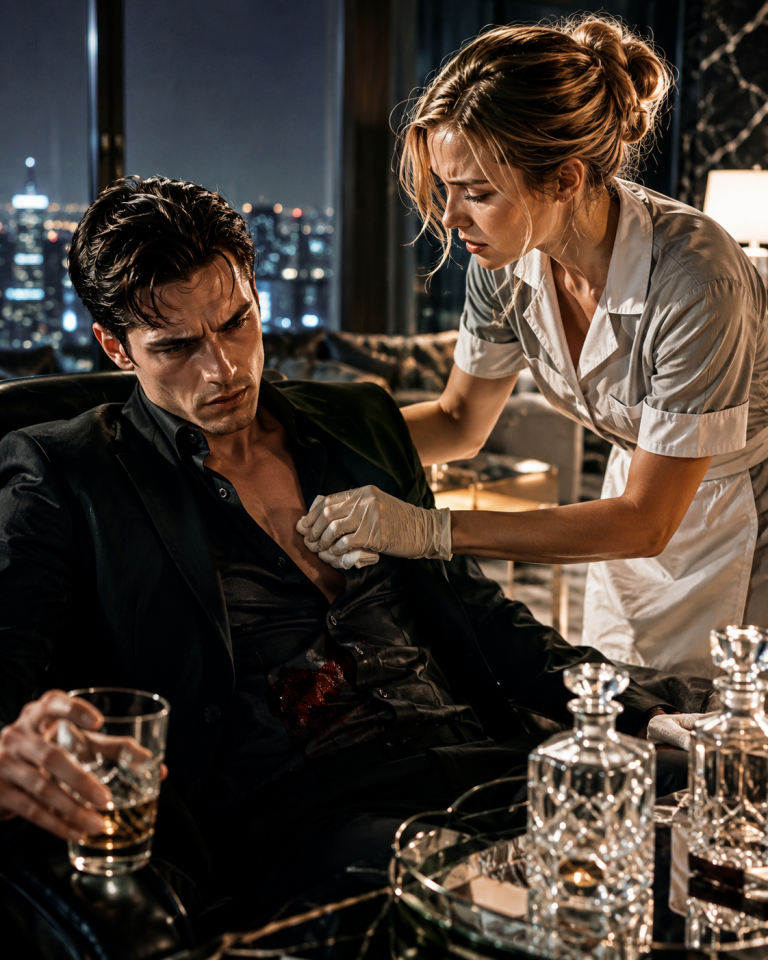
I Told the Mafia Boss His Crying Son Needed a Mom—Then His Dead Wife’s Secret Drew Me In

## PART 1
She recognized the boy’s eyes before she recognized the danger.
That was the order of it. The eyes first — green, wide, thick with tears, turned toward her across a restaurant full of people too afraid to breathe — and then the men with their hands near their jackets, and then the understanding that she had just seen something she was not supposed to survive seeing.
The boy was screaming.
Not from fear of strangers. From the specific, exhausted desperation of a child who had been crying so long that the sound had worn through to something rawer, something closer to the bone.
And the most feared man in the city sat beside him and could not make it stop.
—
Mira had spent four years practicing disappearance.
She wore dull clothes to work. Kept her brown hair flat against her head. Walked to the side of pavements rather than their centers. Paid her rent in cash to a landlord who preferred not to know his tenants. Used a name that was not the one on her birth certificate.
Invisibility was not a philosophy. It was a survival strategy.
She had learned it from her sister.
Her sister, who had loved a man the whole city lowered its voice to discuss. Who had sent Mira a letter that ended *please hate me if it keeps you alive*, and then had died in a car crash that every newspaper called tragic and that Mira had known, from the first headline, was neither accidental nor natural.
Elena had known what she was marrying. She had done it anyway. And she had tried, in the only way available to her, to wall Mira outside the blast radius.
Mira had honored that wall for four years.
Then the boy had looked at her.
His eyes were Elena’s.
The same shade, the same shape, the same slight tilt at the outer corners that their mother had called *the old country*. Mira had not seen those eyes in four years. She had spent four years not seeing them in mirrors, in photographs, in the faces of strangers she avoided.
Now they were looking at her from a booth in the most expensive restaurant in the city, above cheeks wet with crying, below lashes that were too dark for his age.
The man beside him — Caden Voss — was trying to manage the scene through a nanny who was visibly failing, two guards who had no idea what to do with a crying child, and the particular glacial control of a man who did not permit himself to show fear, even when he was terrified.
Mira had been watching from the service station.
Her thumb was pressed against a cut from the coffee machine.
She was bleeding slightly onto a clean cloth.
The boy cried and cried and cried.
And something in Mira that had been under lock and key for four years recognized its name in those green eyes.
She put down the cloth.
She took a small plate of toast from the warming shelf.
She walked toward the corner booth.
The first guard moved to intercept her with the unhurried confidence of a man accustomed to stopping people who had not been stopped before. He was enormous in the specific way of men whose jobs required them to be enormous.
Mira looked at him.
“The child is in distress,” she said. “And you are making it worse.”
The guard blinked.
The dining room went very, very still.
Caden Voss raised one finger.
The guard stepped aside.
Mira reached the table.
She was close to him now. Close to Caden Voss, the man whose name people used as shorthand for consequences, whose black cars made pedestrians find other streets, whose involvement with city officials and police departments was a matter of common knowledge, common silence, and uncommon fear.
He looked like a man made from the cold parts of winter. Dark hair, grey eyes, jaw that held everything in check. His suit was immaculate. His hands were not — they were the hands of someone who had, at some earlier point in his life, done work that the suit was now trying to forget.
He was looking at her with the eyes of a man trying to decide whether she was a threat.
Mira ignored him.
She set the plate on the table with a crack of porcelain against wood and knelt beside the booth.
The boy’s hands were balled into fists. His face was red and wet and furious with the specific fury of a child who has been trying to communicate something for a long time and cannot find anyone who speaks the language.
Mira’s memory opened before she could stop it.
Her sister, seven years old, crying in exactly this posture because their mother had worked a double shift and forgotten to call.
Mira had not known what to say then either.
She had sung instead.
An old song from their grandmother, low and strange, about a wolf sleeping under winter trees and a moon that remembered all the names of the dark.
The song came out of her without permission.
It entered the dining room like something physical — a smell or a warmth or a change in the air pressure. The crying boy’s fists loosened. His ragged breathing hiccuped.
She kept singing.
Leo — the boy — leaned toward her.
He pressed his wet cheek against her apron.
The restaurant watched.
Mira wrapped one arm around him and sang to the child of the man she had spent four years fleeing, and felt something split open inside her that had no business being there.
Caden Voss had not moved.
When she finally looked at him, his face had gone the color of a man who has seen something impossible.
“Where did you learn that song?” he asked.
The question arrived quietly.
It was the most dangerous thing he had said all evening.
“My grandmother,” Mira said.
The lie was smooth from use.
Caden’s expression did not change.
“Elena used to sing it,” he said.
“That was what she told me it was. An old family song.”
Mira kept her face still.
“Old songs travel,” she said.
“She told me it was unknown.”
“People say that about the songs they love.”
She began to stand.
His hand closed around her wrist.
Not violently.
With the specific certainty of a man who did not let go of things that mattered.
“You are not going anywhere,” he said.
—
## PART 2
The nanny was fired before she finished stammering.
Mira watched her flee with the particular combination of relief and dread of someone who has just watched a worse outcome escape while understanding it has been replaced by a different, more personal danger.
Caden placed a considerable sum of money on the table.
“You work for me now,” he said.
Mira looked at the money.
“No.”
The dining room seemed to hold its breath.
“No?” he repeated.
“I have a life.”
“A small, well-hidden one,” he said. “But yes.”
He was not smiling.
He was not threatening in the conventional sense.
He was stating facts in the manner of a man who found facts sufficient.
Mira looked at the boy still pressed against her apron.
Leo. Her nephew. Elena’s son.
The child she had abandoned because her sister’s last act of love had been to make Mira disappear.
Leo’s hand tightened in the fabric.
Such a small grip.
Such an enormous sentence.
“He has not slept through the night since his mother died,” Caden said.
The words came out with no softening. He did not say since she passed or since the accident. Died. A fact.
“That is not my responsibility,” Mira said.
“You made it your concern when you walked toward this table.”
Part 2 Cliffhanger: Mira looked at the money. At the boy. At the green eyes that were her sister’s eyes.
Running had kept her alive.
Staying had kept Elena alive, until it hadn’t.
But Leo’s hand was still in her apron, and his breathing had gone slow and even, and Mira understood with horrible clarity that every wall she had built to protect herself had just developed a gap shaped exactly like a three-year-old boy.
“I am going to need to know,” she said carefully, “whether you killed her.”
The room went so silent she could hear rain beginning against the tall windows.
Caden looked at her.
In his face was something she had not expected: grief, old and unsoftened, which had no business being there if he had done what she’d believed for four years.
“No,” he said.
He said it the way people said things they had needed to say for a very long time.
“I have been trying to find out who did.”
—
## PART 3
The estate sat behind walls that had never been meant to be welcoming.
Mira arrived with nothing except the clothes she had worn to her shift, a fear she had been managing since childhood, and a nephew who had fallen asleep against her shoulder in the armored car before they reached the first gate.
The house was exactly what she had imagined and worse.
Marble floors. Tall windows. Art that had been chosen to impress rather than comfort. The specific quality of silence that large houses manufactured to suggest permanence.
No sign anywhere that a child lived there.
The guard who showed Mira to Leo’s room moved with the efficient wariness of someone who had been briefed about her without being told what to do about her. His name was Keran. He had a scar that ran from his ear down his neck and eyes that stayed in constant small motion.
“What happened to the last nanny?” Mira asked on the stairs.
“She left,” he said.
“She looked terrified.”
“She was unhappy in the position.”
“That is a careful sentence.”
He glanced at her.
“She was not capable of managing the boy’s needs.”
“How many before her?”
He did not answer.
Leo’s room was large and cold and contained the saddest collection of toys Mira had ever seen.
They were expensive. They were abundant. They had been purchased by someone who understood the concept of play and had not successfully translated it into practice. Everything was arranged with the neatness of a room that was rarely used for its intended purpose.
No crayon marks on the walls.
No worn patches in the carpet from a preferred path.
Nothing showed the evidence of a child’s inhabiting.
Mira laid Leo in the carved bed and tucked the blanket up.
He stirred.
She hummed the first note of the wolf song.
He settled.
Keran watched from the doorway.
“You’re very good at that,” he said.
“I had a sister who was difficult to settle.”
“Past tense?”
Mira kept her eyes on Leo.
“Yes.”
“I’m sorry.”
The genuine quality of the words surprised her.
“Careful with your sympathy,” she said. “You do not know what I am yet.”
Keran’s expression flattened.
“I will know by morning.”
“I assumed.”
“You do not look frightened by that.”
Mira turned to face him.
“I have spent four years being frightened. I have decided to try something else.”
Keran looked at her for a long moment.
“You should know,” he said, “that the boss is not a man who is deceived comfortably.”
“I am not here to deceive him.”
“You arrived with a forged identity.”
“I arrived because a child needed help and your employer required someone willing to provide it.” She held his gaze. “The forged identity is four years of survival. It is not a weapon against this house.”
Keran absorbed that.
“The boss will want to speak with you tomorrow.”
“I will be ready.”
He left.
The door closed.
Mira sat on the edge of the bed beside Leo’s sleeping weight and let herself feel, briefly, the full terror and the full strange relief of the impossible position she had chosen.
She had stepped into the wolf’s house.
She had done it for Elena’s son.
She had done it because running, as she had told Keran, was something she was done with.
She had also done it because Caden Voss did not sound, in that restaurant, like a man who had ordered his wife’s death.
He sounded like a man who was still looking for the person who had.
—
The household revealed itself in layers.
Mira had grown up learning to read houses the way some children learned to read books — as the primary text of the people inside them. This house was written in fear and in genuine love, the two scrawled over each other so thoroughly it was sometimes difficult to separate them.
The kitchen staff moved with perfect efficiency and kept their eyes down in corridors when Caden passed. The guards walked with the practiced alertness of men who had been given precise responsibilities and preferred them to ambiguity. The housekeeper, Mrs. Tull, ran the domestic machinery of the estate with the controlled precision of someone who had decided that emotional investment was a liability.
The library was enormous and used only by one person.
The piano in the west room was kept tuned but never played.
Leo’s nursery had a small bed wedged against the wall where whichever nanny was current slept close enough to respond to the night terrors that came with the regularity of tides.
Mira changed the room.
Not dramatically. She moved furniture away from the center. She requested materials.
Mrs. Tull looked at the list.
“Crayons,” she said.
“And paper. And fingerpaint. And blocks.”
“The master is particular about the rooms.”
“The master hired me to care for his son,” Mira said. “Children require mess.”
Mrs. Tull looked at her over the reading glasses she wore for emphasis rather than vision.
“You are remarkably confident for someone with a fabricated file.”
Mira had been told, that morning, that Keran had run her documentation.
“I am remarkably determined,” she said. “The confidence may follow.”
The materials arrived.
Leo touched the crayons with the tentative wonder of a child who had been given toys as objects rather than toys as permission.
“Mine?” he said.
“Yours,” Mira said.
He picked the green one.
She looked away before the grief could reach her face.
He drew a line. Then another. Then he looked up, waiting.
She looked at his marks.
“That is a very ambitious river,” she said.
“It is a dragon.”
“I apologize to the dragon.”
He laughed.
Small. Surprised by itself. A sound that had not been used enough recently.
Mira turned toward the window.
Outside, the grounds were immaculate and empty.
She was not running.
She was terrified.
She was also, for the first time in four years, in the same room as the child who contained the last living evidence of her sister.
—
Caden began watching.
Not the watching of surveillance, which she also endured — she saw the cameras, counted the guards, noted the new ones that appeared at different angles after her arrival. This was the watching of a man learning something he had not expected to learn.
He appeared in doorways.
Always doorways.
He stood at the threshold of the playroom with a face that contained the particular helplessness of someone who loved a thing they did not know how to reach.
Mira let him watch.
Then, one afternoon, she offered him a block.
Leo was building something ambitious. The structure leaned with the optimistic instability of a child’s engineering. Caden stood at the door. Mira held out a yellow block without turning her head.
“He will not break if you sit down,” she said.
“I know that.”
“You stand there like it costs you to enter.”
A pause.
“It does.”
She looked at him then.
The honesty of the admission surprised her.
He stepped inside and sat with the stiff caution of someone entering unfamiliar country.
Leo watched from beneath his lashes.
Caden took the block.
He placed it with enormous care.
The tower swayed. Held.
Leo’s face opened.
“Daddy did it,” he said.
Something happened to Caden’s face that Mira did not want to see and could not look away from. The iron composure cracked by a single line. A warmth arrived that made him look briefly like a different person — younger, less armored, closer to the man who had once appeared in a photograph with Elena, squinting into light and looking like a man who could not believe his own luck.
“Elena used to build them deliberately too tall,” he said.
The name in the room.
Like a candle in a cold place.
“She would act surprised when they fell,” he continued. “Every time.”
Mira kept her hands steady on her own block.
“She sounds like someone who understood theater,” she said carefully.
“She understood joy.” Caden looked at the tower. “Which was harder to find in this house before her.”
Leo knocked the tower over.
The crash scattered blocks across the rug.
Caden’s hand moved instinctively toward his waistband.
He caught himself.
He looked at his own hand as though it had betrayed him.
Shame crossed his face so fast most people would have missed it.
Mira did not miss it.
She filed it carefully.
“The papers said it was an accident,” she said.
Caden’s eyes sharpened.
“The papers printed what they were given.”
“And what were they given?”
“A story.”
“What do you believe?”
He looked at her steadily.
“The brake line was cut clean. Professional work. Nothing left to find that wasn’t meant to stay hidden.”
His voice was flat with the practiced control of someone who had said these words to himself many times.
“Someone inside this house,” he said, “or someone who had access to it.”
—
The locked room was on the third floor.
Every large house had one. Mira had learned, in four years of service work, that locked rooms communicated more than open ones — they announced the particular category of pain that required permanent closure.
This one smelled faintly of lavender and was located at the end of a corridor the staff cleaned quickly and left quickly.
The carving on the door — vines and small birds — looked like something Elena might have chosen.
The housekeeper confirmed, reluctantly, that it had been Elena’s private sitting room.
That no one entered it.
That Mr. Voss especially did not enter it.
That the key was kept in a specific locked drawer in the study and had not been moved in four years.
Mira memorized that information.
—
Keran had been watching her since she arrived.
Not with the obvious surveillance of the cameras — with the specific attention of a man conducting a personal investigation, running each answer she gave against a list of expected answers and noting the divergences.
He sent questions through other people.
A driver asked where she had grown up. A cook asked about her schooling. A guard by the east garden inquired, with studied casualness, whether she had any family in the city.
Mira answered each question with the life she had practiced for four years.
Keran’s eyes, each time, told her he was not satisfied.
On a Tuesday when Caden had left the estate with an escort of eight cars and Keran with them, Mira fed Leo breakfast, read him three picture books, hummed the wolf song over his midday sleep, and waited thirty-five minutes after the last car disappeared through the gates.
Then she went to the study.
The drawer was locked, but the lock was old and the bobby pin Mira had been carrying since her third day was sufficient.
Their grandmother had taught this skill to both girls. Elena had called it the most useful thing their grandmother ever showed them. Their grandmother had called it the most honest thing — every girl should know how to get out of somewhere she should not be.
The key was exactly where Mrs. Tull had said.
—
Elena’s room had been preserved like an argument against time.
The scent of her came first. Lavender and the specific clean-warm smell that Mira had associated with her sister since childhood. It arrived before the light did, and Mira stood in the doorway with her hand on the switch and breathed her sister for a moment before the room became visible.
Then she turned on the light.
Elena’s dresses hung in the wardrobe. Her brushes sat on the vanity beside perfume bottles in amber and rose. Books were stacked on the nightstand. A scarf lay draped over an armchair.
The room looked like someone who had stepped out for an errand and had not come back.
Mira walked to the vanity.
A photograph stood in a silver frame. Elena holding a newborn Leo, head tilted toward the baby with the specific concentrated love of new mothers. Caden beside her, looking at both of them with an expression that was the most unguarded thing Mira had ever seen in a photograph of him.
She had spent four years being certain he had done it.
That expression made her certainty crack.
There was a leather journal beside the lamp.
She opened it.
The handwriting was achingly familiar.
*Keran has been watching me again today. He says he is doing a security check. He stood in the nursery doorway for too long.*
Mira’s hands tightened.
*I found a small device behind the bookshelf. Recording. I do not know how long it has been there. I have not told Caden because he is already stretched to breaking and I do not know what he will do if he believes the house has turned.*
Another entry.
*I am taking Leo to the safe house tomorrow. Something is wrong here. The walls are listening and I do not know who is on the other side.*
The date.
The day before Elena died.
The floor seemed to tilt.
A sound outside the door.
Metal against metal. A key.
Not the key she had used.
The door opened.
Keran stepped into the room.
In the lamplight, his scar looked dark as a river. His pistol was already drawn.
“I was wondering when you would find your way here,” he said.
Mira did not move from the vanity.
“I was looking for blankets,” she said.
“There are no blankets in here.”
“I made a mistake.”
“Yes,” Keran said, stepping inside and closing the door behind him. “You did.”
The suppressor at the end of his pistol was the particular shape of a problem without a clean solution.
“Your file is too clean,” he said.
“It is called a careful life.”
“Real people leave traces.”
“Real people afraid of being found do not.”
He raised the gun.
“Who sent you?”
Mira looked at the journal in her hands.
She looked at the date on the last page.
She looked at the man who had stood in the nursery doorway too long.
“You killed her,” she said.
The words came out before she had decided to say them.
Keran went still.
The stillness lasted less than a second.
But it was its own confession.
“You put the listening device in the nursery,” Mira said.
“You cut her brake line.”
“You brilliant,” he said softly, “stupid girl.”
The gun pressed cold against her forehead.
“Who told you to come here?”
Mira’s hand found the heavy crystal bottle on the vanity behind her.
“No one sent me,” she said.
“You are alone?”
“Completely.”
She brought the bottle across his face as hard as she could.
The sound was terrible.
Keran’s gun hand flew wide.
The shot punched through the mirror behind her.
Glass rained down across her shoulders, hot fragments, the cold in the room suddenly sharper.
Mira dropped to her knees.
Keran cursed.
His hand came back with the gun.
She kicked hard at the back of his knee.
He buckled, but his arm swung. The grip connected with her cheekbone and the floor came up fast.
She tasted blood.
Keran stood over her with crystal cuts opening along his cheekbone and fury replacing the professional calm.
“Dead girl,” he said.
The door exploded inward.
Caden filled the frame.
His shirt was dark with rain. His eyes went from Keran to Mira to the broken mirror to the gun.
“What,” he said, and the word was below freezing, “is happening?”
—
Keran’s explanation moved fast.
Intruder. Snooping. Dangerous. False identity.
Caden listened to all of it with his eyes on Mira’s face and the particular quality of attention of someone who was not hearing the intended narrative.
“Lower the weapon,” Caden said.
“Boss, she is a plant—”
“Now.”
Keran lowered it.
Caden looked at Mira.
“Stand.”
She stood.
Her jaw was swelling. One shoulder burned with a cut from the mirror. Her knees were steady by sheer stubbornness.
Caden looked at the journal.
Then at Keran.
“My study. Both of you.”
—
The study was the room where the house revealed its true architecture.
Books Caden actually read. Two unfinished glasses of whiskey that had been standing long enough to warm to room temperature. A photograph of Leo at approximately eighteen months that had been positioned with the specific carelessness of someone who kept it for reasons that were not decorative.
No photograph of Elena.
Mira noticed that too.
Keran explained himself smoothly. Intruder. False documentation. Suspicious behavior. He was efficient and convincing and watching Mira the whole time.
Caden listened without expression.
“Her name is forged,” Keran said.
Caden looked at Mira.
“Yes,” she said.
“You came here with false papers.”
“I came here because a child needed help. You brought me. The papers were four years of staying alive.”
“Four years hiding from whom?”
The room balanced on a knife point.
Keran spoke before she could.
“We don’t know yet. Could be Moretti. Could be press. Could be internal.”
Caden’s eyes stayed on Mira.
“Go to the perimeter,” he said to Keran.
Keran stiffened.
“The Moretti situation—”
“Go.”
Something moved behind Keran’s control. A calculation. Then he left.
Caden poured whiskey and handed one glass to Mira.
“I don’t trust you,” he said.
“I noticed.”
“Don’t mistake my patience for credulity.”
“I am not here to make that mistake.”
His eyes were on her jaw.
“Did he do that?”
“After I hit him with a perfume bottle.”
“Why?”
“He was pointing a gun at me.”
“Before that.”
Mira set down the glass.
“He killed her,” she said.
Caden went very still.
“What?”
“Elena. The journal — she wrote about a listening device in the nursery. She wrote about Keran watching her. The entry before her death says she was taking Leo to the safe house because she felt watched. Because the house felt wrong.”
The room seemed to constrict.
“The last entry is dated the day before,” Mira said.
Caden’s face.
She had not known what she expected.
She had feared calculation. She had feared denial.
What she saw was a man being hit by the specific unbearable pain of a suspicion that had lived in him, unconfirmed, for four years, finally being given a name and a face and a date.
“He has been at my side,” Caden said.
“Yes.”
“Since before Elena.”
“Yes.”
The glass in his hand cracked.
He set it down.
“Because she made you human,” Mira said.
“What?”
“The journal. She wrote that Keran hated her. That he thought she was making you soft.” She held his gaze. “He didn’t kill her because she was an enemy. He killed her because she was changing you.”
The silence that followed was the most complicated silence Mira had ever sat in.
Caden turned toward the window.
Rain moved down the glass in silver lines.
“I need you to stay here tonight,” he said.
“With Leo.”
“Yes.”
“And Keran?”
His voice was very quiet.
“He is going to find out what I know, whether he goes to the perimeter or not.”
“I thought he already suspected.”
“Suspicion is different from certainty.” He turned. “Tonight will be complicated.”
“How complicated?”
“The kind that requires a child to be behind a reinforced door.”
Mira looked at his face.
The wolf, she thought, preparing to deal with the betrayal inside the walls before dealing with whatever waited outside them.
“Take me to Leo,” she said.
—
The safe room was beneath the main house.
Mira sat in it with Leo asleep on the cot — sedated lightly at Caden’s insistence, for which she argued and which she ultimately accepted because Leo’s presence in the room could not be announced by a nightmare — and listened to the house become something it had not been meant to be.
The lights went out first.
Then the sounds.
Boots on stone. Voices running short commands in the dark. The particular percussion of a house at war with itself.
Mira sat beside the door with the fire extinguisher from the wall bracket in both hands and waited.
She had found no weapon.
She had found no second exit.
She had found that the room’s override key was held by Caden and by one other person, which Caden had told her before he left, which meant she now knew exactly who to expect if the person who came through the door was not Caden.
The locks disengaged.
The door opened.
Keran.
His face was cut from the crystal bottle and bleeding fresh from the fight above. His pistol was drawn and pointed at her before the door finished moving.
“Move away from the cot,” he said.
Mira did not move.
“The boy first,” he said. “Then whatever conversation you want.”
“You are not going near him.”
Keran looked past her to Leo sleeping.
“He is his mother’s mistake,” he said. “She thought a child would anchor Caden to her world.”
“She was right.”
“She is dead.” Keran’s gun raised. “And the mistake—”
Mira threw the fire extinguisher.
Not aimed with precision. Aimed with mass. The thing was heavy and she was not trained and it spun rather than flew but it connected solidly with his forearm.
The gun went sideways.
The shot hit the ceiling.
Leo did not wake.
Keran’s forearm was broken — she heard it, the specific sound that did not belong in civilian life. He shouted, swore, turned toward her with the pistol still in his less injured hand.
She was already moving.
She had no training.
She had four years of fear and a fire extinguisher already on the floor and the fact that she was standing between him and Elena’s child.
The second shot missed.
The third was aimed.
The door came off its hinges.
Caden entered the safe room with the velocity of someone who had been fighting his way down through his own house and had not stopped moving since the lights went out.
He took in the room in one sweep.
Keran. The gun. Mira standing between Keran and the cot.
The rifle in Caden’s hands spoke once.
Keran fell.
—
The silence afterward had the quality of things that had been built too long on false foundations and had finally come down.
Caden was bleeding from his side.
Mira was bleeding from her shoulder.
Leo slept through all of it on the cot, and this, she thought, was either the most fortunate or the most heartbreaking detail of the night, that Elena’s son was asleep while the man who had killed his mother was finally answered for.
Mira knelt beside Caden.
He looked at her with the specific expression of a man who had been about to lose the last thing that mattered.
“You stayed,” he said.
“I was not going to leave.”
“Most people would have.”
“I am not most people.”
“Who are you?”
The question finally had nowhere to hide.
“My name is Mira,” she said. “My real name.”
She pressed gauze against his wound.
“Mira Rossi.”
He stopped breathing.
“Elena was my sister.”
He looked at her for a long time.
She watched him recalculate four years of certainty.
“She told me she had no family.”
“She was protecting me.”
“She lied to me.”
“She loved you,” Mira said. “The lie and the love were the same gesture.”
Caden closed his eyes.
When he opened them, Leo was stirring on the cot.
“Daddy?” the boy said, blinking into the red emergency light.
Caden reached for his son with his good arm.
“I’m here,” he said.
His voice was wrecked.
“I’m here, little one.”
Leo tucked himself against his father.
“You smell like rain,” Leo said.
“There was a storm,” Caden said.
“Is it gone?”
Caden looked at Mira over the boy’s head.
She looked back.
“Yes,” Caden said.
“It is gone.”
—
The months after the safe room were the months of accounting.
Caden spent the first two weeks horizontal with wound care, lawyers, and the specific demands of an organization reorganizing around an absence. Keran had been, Mira learned, the fulcrum of the operation’s darker arrangements — his removal created a cascade of complications, realignments, and territorial negotiations that required Caden’s attention even when he was not physically capable of providing it.
Mira did not leave.
She had said she would not, and she had meant it.
She cared for Leo, who did not fully understand what had happened and asked every few days whether the storm would come back. She managed the household machinery with a competence that surprised Mrs. Tull and a directness that surprised everyone else. She read Elena’s journal from cover to cover and sat with what she found there — the love, the fear, the specific lonely brave life of a woman who had loved a dangerous man and tried to protect her sister from him simultaneously.
She was angry at Elena.
She was also, more and more, grateful.
They had a conversation, she and Caden, in the third week when he was well enough to be in his study and she brought him tea and he looked at it for too long and she sat down without being asked.
“She hid you from me deliberately,” he said.
“Yes.”
“She thought I was a danger to you.”
“She was right.”
He absorbed that.
“She was also wrong,” Mira said. “About you specifically. But she made the best calculation she could.”
“She told me she grew up alone.”
“She grew up with me.”
“Did you know about me?”
“I knew she had married someone the city was frightened of.” Mira wrapped her hands around her own cup. “I did not know much else.”
“What did she tell you?”
“That she loved you.” Mira looked at the window. “She wrote that in the letter she sent before she disappeared. That she loved you. That she was cutting contact to protect me.”
Caden was very still.
“She never told me she wrote to you.”
“She was good at protecting people,” Mira said. “Even from each other.”
They sat in something that was not quite silence.
Outside, Leo shouted from the garden where he was chasing something with the gardener’s help.
“I want to find his grave,” Mira said.
Caden nodded.
“I will take you.”
“The files about Keran—”
“My lawyers have everything Elena wrote. The journal. The formal record of his termination.” He looked at her. “The investigation is ongoing.”
“And the docks?”
He met her eyes.
“The docks are a different conversation.”
“I am having it now.”
The corner of his mouth moved.
“You are remarkably direct.”
“Elena was too.” Mira looked at him steadily. “She wrote about it. Schools. Hospitals. Legitimate income. She believed you could build something else.”
“She told you that?”
“She wrote it.”
Caden looked at his hands — the marked, heavy, complicated hands that were entirely wrong for the careful gestures he had been making around his son.
“She was always further ahead than I was,” he said.
“She needed you to catch up.”
He looked at Mira.
“And now?”
“Now you have a son who is three years old and looking at you every morning to learn what the world is.” She leaned forward. “What do you want him to learn?”
The question stayed in the room for a long time.
—
Elena’s grave was in a private section of a cemetery on the edge of the city.
White marble. Her full name. The year she was born and the year she died. A carved lily at the base.
Mira stood before it with Leo’s hand in hers.
She had not been here before.
She had been afraid to locate it. Afraid that finding the place would make the death real in a way that all the newspapers and all the headlines had not managed to make it.
It was real.
She stood in front of it and it was real and Leo held her hand and hummed the wolf song, very quietly, because she had taught it to him and he hummed it now when he felt something too large for words.
Caden stood a step behind.
“She always said she wanted lilies,” he said.
“She liked how they smelled in autumn.”
“I did not know that.”
Mira looked at him.
“There are many things you did not know,” she said. Not cruelly. As fact.
“She protected too much.”
“She loved too much, and there was too little time, and someone cut it shorter.”
Caden’s jaw worked.
Leo let go of Mira’s hand and took his father’s instead.
“Does Mommy live here?” Leo asked.
Caden crouched down.
“Her body lives here,” he said. “The rest of her—” He stopped. Tried again. “You remember when you see the moon and you think of the wolf song?”
Leo nodded.
“She lives there.”
Leo looked at the stone.
“And in Auntie Mira,” he said, with the specific confidence of a child who had worked this out and was reporting findings.
“Because they look the same.”
Mira pressed her fingers over her mouth.
Caden looked at her.
In his face was something she had not been expecting: relief, vast and complicated and long overdue.
“Yes,” he said to Leo.
“Exactly that.”
—
The third floor room opened one afternoon in November.
Not because anyone decided it should be opened.
Because Leo asked to see where Mommy kept her books.
Mira stood with the key in the lock and waited.
Caden appeared at the top of the stairs.
She had not told him she was going.
He had come anyway.
This, she had learned, was how Caden Voss operated: he appeared when things were happening and would not pretend he had not noticed.
He looked at the door.
He looked at her.
She did not apologize for being there.
He did not ask her to.
She turned the key.
The room smelled of lavender, time, and the specific grief of things that had been waiting to be seen.
Leo went immediately to the wardrobe.
He found a green dress and pressed his face into the fabric and said nothing.
Mira looked at the vanity.
Caden looked at the photograph in the silver frame.
For a long time, neither of them spoke.
Then Leo emerged from the wardrobe with something in his hand.
A length of green ribbon.
He brought it to Mira.
“For you,” he said.
She took it.
Her hand shook.
“She had lots of ribbons,” Leo announced. “I saw them.”
“She did like ribbons,” Mira said.
“You can have all of them.”
“That is a generous offer.”
“She would want you to.” He said this with the absolute certainty of a child who had no access to doubt. “She told me.”
Mira looked at Caden.
He shook his head slightly.
Leo told him things.
Leo had been telling him things for months.
She supposed that was what happened when a dead woman’s eyes lived in a living child.
They didn’t leave.
They kept speaking.
—
The room did not stay locked after that.
They stripped it slowly, over weeks. Elena’s clothes were stored with care. Her books were distributed between the library and the room they had decided to build for Leo — a proper child’s room with shelves he could reach and a reading corner he would grow into. Her brushes stayed on the vanity until Leo claimed them for his art projects, which Caden allowed without comment.
The room became the library.
Mira chose the books.
She chose them the way Elena had chosen things — with the specific attention of someone who believed that what surrounded a child shaped them, and that the world contained enough darkness already without bringing it inside unnecessarily.
Picture books first.
Then adventure.
Then the books that asked questions.
Then the books about wolves.
Leo called it Mommy’s library.
Caden called it the library.
He came there sometimes to read in the evening, sitting in the armchair Elena had kept by the window.
Mira found him there one night after Leo was asleep and sat across from him with her own book.
They did not speak.
They did not need to.
This was the strange intimacy they had arrived at: the shared silence of two people who had been shaped by the same loss from different angles and had found, unexpectedly, that the loss connected them rather than dividing them.
It was not romance.
It was not nothing.
It was the specific thing that grows in the space grief leaves behind when two people decide to build rather than evacuate.
—
One evening, late, Caden brought her something.
He arrived in the library with a small box and set it on the table beside her.
Mira looked at it.
Inside was a silver pendant. Small. Round. Engraved on one face with a crescent moon and a sleeping wolf, the image so detailed it must have been custom, must have been made specifically.
“Elena was designing it,” Caden said. “I found the sketch in her journal. I commissioned it.”
Mira held the pendant in both hands.
“She was going to give it to you,” he said. “When she decided it was safe to contact you again.”
The pendant was warm from his pocket.
Mira pressed it to her mouth.
She did not cry immediately.
She sat with it, the small weight of her sister’s intention, the piece of love that had waited four years to arrive.
Then the tears came.
Caden did not leave the room.
He moved to the adjacent chair and sat close enough that she was not alone with it.
He did not touch her. He did not offer words.
He was simply there.
The way people were there for each other when there was nothing else adequate.
When she could speak again, she said: “You are changing the business.”
“I am.”
“Elena wanted that.”
“I know.”
“Leo will grow up knowing you tried.”
Caden looked at the pendant.
“I want him to grow up knowing she was right,” he said. “About what was possible.”
Mira turned the pendant in her fingers.
“She was right about most things,” she said.
“About me?”
“She wrote that you were afraid of your own capacity for goodness.” Mira looked at him. “She wrote that you needed someone to keep expecting it of you.”
He was quiet for a long time.
“Are you going to do that?” he asked.
“Someone has to.”
“You could leave now.”
“You keep saying that.”
“You keep not leaving.”
“Yes,” Mira said.
She fastened the pendant around her neck.
The crescent moon and the sleeping wolf rested against her throat.
“I keep not leaving.”
—
Leo’s fourth birthday was the first birthday Mira attended as herself.
Not as the waitress who had walked across a restaurant with toast.
Not as the woman with false papers and a survival name.
As Leo’s aunt.
As Mira Rossi, who had grown up on fire escapes and emergency exits and the songs their grandmother sang about moons and sleeping wolves, and who had run for four years from the grief of a sister she had not been permitted to mourn.
The party was too large, because Leo had made friends at the small school Caden had enrolled him in, and small children at a birthday party multiplied in a way that seemed to defy physics.
The cake was enormous and wrong in two different ways before Mrs. Tull stepped in.
There were ribbons in Leo’s hair because he had asked for them.
There was a telescope wrapped in paper beside the cake because he had recently decided that finding the moon before dark was a serious occupation.
Caden stood on the terrace as the afternoon softened toward evening.
He looked like a man who had been somewhere very cold for a long time and had finally decided to come inside.
“Elena would have hated this party,” he said.
“She would have loved it,” Mira said.
“It is too chaotic.”
“She would have made it more chaotic and then felt guilty about the mess.”
He was quiet.
“That sounds accurate,” he said.
Across the lawn, Leo had organized five of his school friends into some kind of hunt that appeared to require everyone to run in different directions. The gardener watched with the expression of a man accepting his garden as collateral damage.
“You are staying,” Caden said.
It was not a question.
Mira looked at the pendant at her throat.
At the house behind them, which was less fortress than it had been.
At the library where Elena’s books were teaching a small boy who his mother had been.
At the child who had cracked open four years of silence with a single set of familiar eyes.
“Yes,” she said.
“I am staying.”
—