They Mocked the Childless Woman as “Useless” — Then a Widowed Cowboy With Five Children Asked Her to Be Their Mother

—
## PART 1
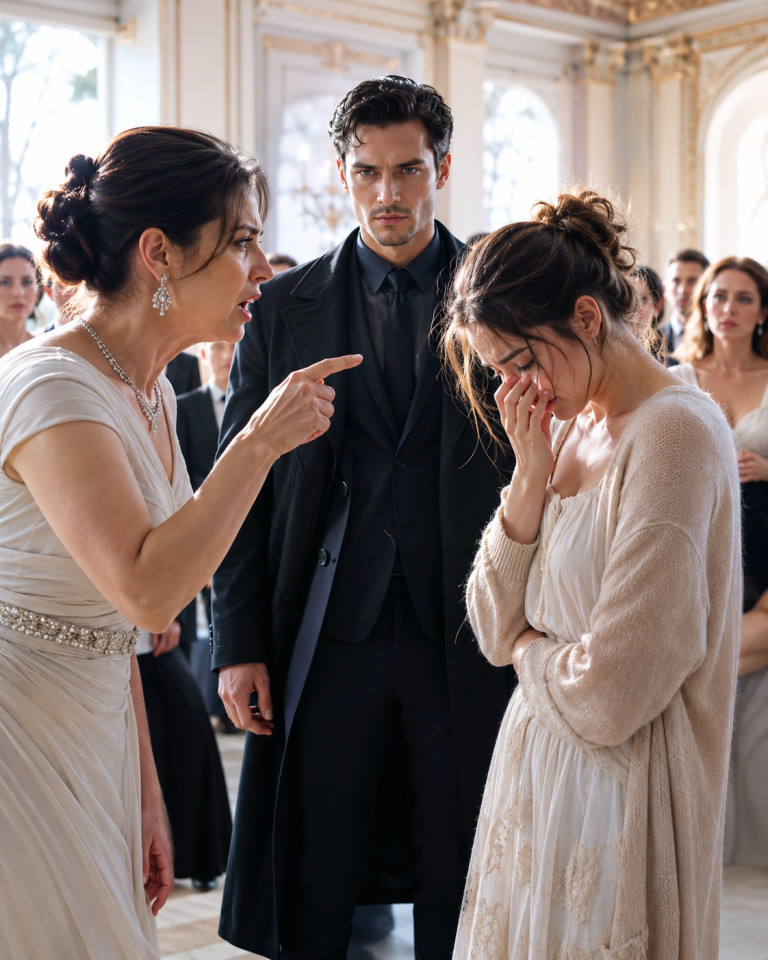
The spring sun beat down mercilessly on Ash Ridge’s town square, baking the packed dirt into a griddle. Eliza Morland stood on the same wooden platform used twice a year for livestock auctions. The irony wasn’t lost on anyone, least of all her. Her father, Gerald Morland, a former horse trader with a slight tremor beneath his bravado, worked the crowd like he’d worked a thousand sales before.
“Before you stands a woman of twenty-two years, educated by the Sisters of Mercy, skilled in all domestic arts,” Gerald boomed. “She knows her place, which is to keep her mouth shut and her hands busy.”
Eliza kept her eyes fixed above the horizon, the way her mother had once taught her. *Look to where they can’t follow.* But her mother’s wisdom felt hollow now. Nothing could protect her from this.
“My daughter was married three years to Harold Peton, God rest his soul,” Gerald continued, arranging his face into practiced sorrow. “The Lord did not see fit to bless their union with children. The midwives confirmed it. She’s barren as the Salt Flats, gentlemen. Can’t bear children, never will.” He raised a hand against the murmuring crowd. “But she’s healthy, young enough yet, and she’s got skills that would make any household run smooth as clockwork. I’m asking fifty dollars. Who will start the bidding?”
Silence fell like a burial shroud. It stretched and stretched. “Come now,” Gerald said, desperation cracking his voice. “Forty. Forty dollars, gentlemen.” More silence. Eliza’s mother stood at the edge of the crowd, face carved from stone, refusing to meet her eyes. “Thirty. That’s less than a decent horse.”
“Does she know how to handle children?”
The voice came from the back, deep and rough as creek gravel. The crowd parted for a tall man in worn but clean clothes, a wide-brimmed hat shadowing a strong jaw, eyes a startling winter-sky blue-gray.
“Yes!” Gerald seized on the question. “She’s wonderful with children.”
“I asked her,” the man said quietly, eyes shifting to Eliza. “Not you.” The square went silent — no one spoke to Gerald Morland that way, not in public. But Gerald shut his mouth.
“Miss,” the man said, gentle but with steel underneath. “How old were the children you’ve cared for?”
Eliza’s throat was dry. “My brother Thomas. I helped raise him from birth. He’s sixteen now. I helped at the church, too. Father Martinez would bring children from struggling families. I’d watch them, keep them fed.”
“She can’t have children,” Gerald interjected, worried the buyer was losing interest. “I want that clear.”
“I have sons,” the man said simply. “Five children total. Their mother died sixteen months ago. Influenza.”
Gerald’s eyes lit up. “Well then, sir, you’re looking at exactly what you need. Thirty dollars and she’s yours.”
The man’s jaw tightened at that, but he ignored Gerald, focused on Eliza. “What’s your name?”
“Eliza, sir. Eliza Morland.” She’d reclaimed her maiden name after Harold’s death.
He reached into his coat, pulled out a small leather pouch, extracted a single silver dollar, and placed it on the edge of the platform with a soft clink.
The crowd gasped. Gerald’s face went purple. “Now see here, I said thirty dollars—”
“That’s all she’s worth in this town,” the man interrupted, quiet but edged now, “because in this town she’s been judged and found wanting through no fault of her own. She’s been called barren, useless, a burden. You’re selling her because you’re ashamed of her, and every person in this square knows it.” He turned to the crowd. “If any man here valued her for her skills, her character, her humanity, you’d have bid already. But you haven’t, because all you see is a woman who can’t bear children, and in your eyes that makes her worthless. So I’m offering one dollar — one dollar more than anyone else values her at. And when she leaves here with me, she won’t be judged anymore. Not in my house. Not by my children. Not by me.”
The square was so quiet Eliza could hear her own heartbeat. “That’s robbery,” Gerald finally sputtered.
“The sheriff’s standing right over there,” the man said, nodding toward a portly figure at the crowd’s edge, “and he can confirm this is a legal transaction. You set the terms yourself. Unless,” he added, turning back to Gerald, “you’d like to call off the sale entirely and take your daughter home with the dignity she deserves.”
Gerald Morland had never chosen dignity over profit. His hand shot out and snatched the silver dollar. “She’s yours. And good riddance.”
The man nodded once, turned to Eliza. “I’m Bo Thatcher. I have a ranch eight miles northeast near the canyon rim. I need help with my children. They’re hurting, and I can’t reach them the way their mother could. I can offer you a room of your own, three meals a day, and a dollar a week. In exchange, I need you to care for the house and the children. Just that. Nothing else.” The way he emphasized those last two words made his meaning clear.
Tension Eliza hadn’t known she was carrying released from her shoulders. “I understand, Mr. Thatcher,” she said softly.
—
## PART 2
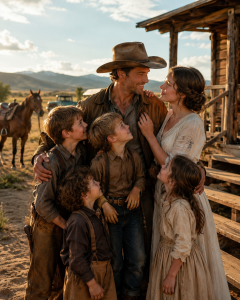
They left Ash Ridge without ceremony, riding in silence through scrub brush and red rock. As twilight deepened, Bo finally spoke. “The children,” he said, rough. “James is twelve, thinks he’s the man of the house. Matthew’s nine and he’s angry — at me, at God, at the world for spinning on when his stopped. Levi’s seven, quietest child you’ll ever meet. Hasn’t said a dozen words since the funeral. The twins are five, Nathaniel and Meera. Meera keeps asking when her mama’s coming home.” His hands tightened on the reins. “My wife, Catherine, was the heart of everything. When she died, it was like someone ripped the center out of our world.”
“I’m sorry. That’s a terrible loss.”
“I need to be clear about something, Miss Morland. I didn’t bring you here to replace Catherine. No one could. And I didn’t bring you to be my wife. I’m not ready for that. Never may be. I brought you because my children are drowning in grief, and I can’t reach them. Can you just be there? A steady presence? Can you do that?”
Eliza thought about it, really thought about it — a year of being measured against a standard she could never meet, found wanting every time. “Yes,” she said, surprised by her own steadiness. “Yes, I can do that.”
—
The ranch house glowed with lantern light against the dark, but signs of sixteen months without a woman’s hand showed everywhere — peeling paint, a loose shutter, weeds through the porch steps. The front door burst open and five children spilled out, staring at the wagon with expressions ranging from curiosity to hostility.
“Who’s that?” James, twelve, dark-haired, suspicious.
“This is Miss Eliza Morland,” Bo said. “She’s going to be staying with us.”
“We don’t need looking after,” James said flatly.
“You burned the biscuits again this morning,” piped up one of the twins.
“Is she going to be our new ma?” Meera asked, small.
“No,” Bo said firmly. “Your ma is your ma. Always will be. Miss Eliza is here to help. That’s all.”
James snatched Eliza’s carpet bag with barely contained hostility and led her upstairs. “My ma’s things are in the attic. You’re not to touch them. You’re not to go in their bedroom. And you’re not to think you can just walk in here and take her place, because you can’t.” Each word landed like a thrown stone. But Eliza had been hurt by experts — Harold’s mother, her own parents, the whole town of Ash Ridge. A twelve-year-old’s grief, however sharp, couldn’t touch her the way their judgment had.
“I’m not here to take anyone’s place, James,” she said quietly. “I’m here to help. That’s all.”
“We’ll see.”
Alone that night, Eliza pulled her mother’s locket from beneath her collar, looked at the tiny portrait, and let herself cry — for her marriage, her parents’ love, the children her body would never create. And somewhere in that grief, she found the smallest spark of something else. Not hope exactly. Not yet. Possibility. The possibility that in this broken house, with these broken children and this broken man, being broken might finally be enough — though whether five grieving children and one guarded widower would ever let her prove it was still very much an open question.
—
## PART 3
Dawn broke with a rooster’s crow and the thunder of children’s feet. The kitchen was a disaster of smoking pans and scattered flour when Eliza came down. James manned the stove with a spatula like a weapon; Matthew sat scowling, arms crossed; Levi watched from the window with enormous silent eyes; the twins scattered forks across the floor trying to set the table.
“Paw’s already out with the cattle,” James said, a warning in his tone.
Eliza took over the stove without asking twice, assigning small tasks — Nathaniel and Meera to gather forks, Matthew to fetch water. Matthew refused, testing her. “Get it yourself.”
“All right,” Eliza said mildly, turning back to the eggs. “Though I have to say your father struck me as the kind of man who raises children with better manners than that.” Matthew’s chair scraped back. “Fine,” he muttered, storming out for the bucket. A small victory.
When Meera let slip happy memories of her mother singing over the stove, James snapped, “Don’t,” and Meera fled crying. “You’ll leave her alone,” James told Eliza. “You don’t know anything about us.”
“You’re right, I don’t,” Eliza agreed. “But I know what it’s like to hurt. And I know that taking that hurt out on your little sister isn’t going to make it better.” She found Meera curled on a bunk bed, clutching a rag doll.
“Are you grieving too?” Meera asked, with a child’s blunt honesty. “Is that why you’re here?”
“In a way,” Eliza admitted. “I lost something too. Not a person, but a life I thought I was supposed to have.” She offered what she could actually give: not a replacement mother, but a steady hand — help with breakfast, a hand to hold, someone to notice when the missing got too big. Meera, considering this with startling gravity, agreed it would help.
By evening, the house had its first real meal in months — Catherine’s own stew, made from her recipe box with Meera’s careful direction, her mother’s favorite wooden spoon stirring it. James, tasting it, offered the first thing approaching approval he’d given: “Ma wouldn’t want all her recipes just sitting there gathering dust.” That night, silent Levi appeared at Eliza’s elbow and pressed his mother’s old tin cup — scratched with a crude daisy Bo had carved for Catherine years before — into her hands. “For you. Mama’s cup. She’d want you to have it.” It was the first thing he’d said unprompted since the funeral.
“You’re doing exactly what I hoped you’d do,” Bo told her later, finding her in tears over the cup. “That means you’re enough.”
—
Three weeks in, everything changed. Meera woke with a sore throat and fever that spiked by noon into something serious — delirium, burning skin, ragged breathing. Doc Morrison, fetched at a desperate gallop by Matthew, delivered the grim diagnosis: scarlet fever. “This could kill her if it gets any higher,” he warned Eliza. “You need to stay with her.”
She did. She didn’t leave Meera’s side for nearly twenty-four hours — cool cloths, willow bark extract, whispered lullabies and stories about brave girls who fought dragons and won. Around three in the morning, the fever spiked worse, Meera thrashing in delirium. Eliza’s composure cracked into something fierce.
“You can’t have her,” she said to the empty room, to whatever decided who lived and died. “I don’t care what you took from me. I don’t care that my body couldn’t give life. I’m giving it now. I’m choosing this child. And you can’t have her.”
As dawn broke, the fever finally turned. Meera’s eyes fluttered open. “Thirsty,” she whispered — the most beautiful word Eliza had ever heard.
When Meera, still confused, murmured “Mama,” Eliza’s heart clenched. “No, sweetheart. It’s Miss Eliza. Your mama is still with God. But I’m here. I’m right here and I’m not going anywhere.” Then, unplanned, the truth slipped out: “I love you. I’m so very glad you decided to stay with us.”
Doc Morrison confirmed the fever had broken for good. “She saved your daughter’s life, Mr. Thatcher,” he told Bo. “No question.” Downstairs, the boys — even Matthew — waited with new eyes. “You really meant it,” Matthew said quietly. “When you said you’d fight for her.”
“Yes,” Eliza said. “And I mean it about all of you. You’re my children now, whether you like it or not.”
A week later, at the first family dinner since Meera’s illness, the little girl asked in front of everyone: “When I was sick, you said you loved me. Did you mean it?”
“Yes,” Eliza said, steady despite the emotion threatening to swamp her. “I love you, Meera. I love all of you.”
James, flushing, cleared his throat. “We talked about it while you were taking care of her. We wanted to know — can we call you Mama?” Meera blurted the rest before he could finish: “Not instead of our first mama. Like a second mama. The mama who’s here now.”
“Yes,” Eliza managed, voice breaking. “Yes, you can call me Mama. I’d be honored.”
That night, tucking five children into bed for the first time as their mother, her heart was fuller than it had ever been.
—
Six weeks after the auction, a supply run to Ash Ridge forced a reckoning. Matthew and Nathaniel came along, fiercely protective, and at Henderson’s General Store, Harold’s mother, Mrs. Agnes Peton, swept in.
“You,” she spat at Eliza, venom thick in her voice. “That barren ghost who killed my son with her deficiency.”
“Don’t you dare talk to our mama that way,” Matthew shot back, and James stepped bodily between his brother and the older woman. “She’s worth ten of anyone in this town, including you.”
“I’ve maintained my dignity,” Mrs. Peton sneered. “I haven’t sold myself to the first man who’d have me for the price of a drink.”
Eliza drew herself up. “You’re right about one thing. Bo Thatcher bought me for one dollar in a public square. Do you know why he only paid a dollar? Because no one else bid. Because every person in this town had already decided I was worthless based on something I couldn’t control. But Bo Thatcher saw someone who could love his children, keep his home, show up every day and do the work that matters. And I have. Every day for six weeks, I’ve proven my worth has nothing to do with my womb and everything to do with my heart.” She stepped closer, and the older woman actually backed up. “Those boys behind me call me Mama. Their sister, who’s home resting because I fought through a night of fever to save her life, calls me Mama too. Their father calls me the best decision he ever made. So I’ll ask you, Mrs. Peton — what do people call you? Because all I see is a bitter woman wearing her grief like a badge, tearing down anyone who found a way to be happy despite their losses.”
Mrs. Peton stormed out, the bell chiming violently behind her. Mrs. Henderson, shaken, apologized quietly for the town’s judgment. Outside, Eliza reunited with her younger brother Thomas, who begged forgiveness for not standing up for her the day of the sale, and asked to visit the ranch. She agreed — glad, for the first time in years, to have family that wasn’t ashamed of her.
—
That evening, back at the ranch, Bo tried — and failed twice — to say something important to her, interrupted first by Levi’s sudden burst into speech (“I wanted to say thank you for staying when Mama Meer was sick… you’re a good mama, and I’m glad Pa brought you home”) and then by the arrival of a far fancier wagon than usually traveled ranch roads.
Two territorial family court officials, escorted by lawyer Samuel Hutchkins, had come in response to a formal complaint — filed by Agnes Peton — questioning the legality of Eliza’s position in the household. No adoption papers. No marriage certificate. A woman “purchased in a public auction” installed with five children, unsupervised.
The inspection that followed was exacting and humiliating — every room searched, every child interviewed separately. But the verdict, when it came, was unambiguous: the home was exceptionally well-maintained, the children clean, fed, thriving under Eliza’s care.
“However,” the lead official continued, “the legal irregularity remains concerning. Miss Morland has no formal standing as these children’s guardian. If something happened to you, Mr. Thatcher, she’d have no legal claim to them.”
“Then tell me what to do to fix it,” Bo said urgently.
“The simplest solution would be marriage.”
“Then we’ll marry,” Bo said without hesitation.
“Bo, no,” Eliza protested. “You said you weren’t ready. I won’t trap you in a loveless marriage because of a spiteful complaint.”
“Who said anything about loveless?” Bo asked quietly. And there, in front of two officials and a lawyer, he told her what he’d been trying to say for weeks — that he’d always love Catherine, his first love, the mother of his children and the woman who built this home, but that somewhere in the last four months he’d come to love Eliza too, differently, steadier, “like coffee on a cold morning. Like a tomato that shouldn’t grow, but does anyway.”
“I love you too,” Eliza said, the words spilling out before she could stop them. “I didn’t mean to. I wasn’t supposed to. But I do.”
“Then marry me,” Bo said. “Not because the law requires it. Because I choose you every single day, and I want the world to know it.”
“Yes,” Eliza breathed. “Of course, yes.”
James rode hard to Ash Ridge to fetch Thomas as a witness. By sunset, the whole family gathered in front of the house as the sky painted itself gold and purple, and the officials themselves performed a hasty, heartfelt ceremony. “I do,” Bo said, eyes never leaving her face. “I do,” Eliza whispered back, voice thick with tears.
“By the authority granted to me by the territory of New Mexico, I now pronounce you husband and wife.”
Five children swarmed them the moment the kiss broke, demanding hugs and reassurance that Mama was theirs forever now, that no one could ever take her away.
—
Years passed on the ranch, the way years do — droughts and good harvests, children’s triumphs and heartbreaks, the slow mellowing of age. Eliza’s garden, coaxed back to life from Catherine’s dying beds through sheer stubborn refusal to give up, eventually thrived enough to feed the family and sell surplus in town — one single tomato, against all odds, having taken root in that first impossible drought and become the family’s private symbol for everything they’d survived together.
Matthew, his anger transformed into a passion for justice, went on to study law. James took over more and more of the ranch, steady as his father. Levi found his voice fully and, with it, a gift for storytelling that filled long winter evenings. The twins grew up inseparable and joyful.
Travelers who passed the Thatcher Ranch in later years would slow their wagons to read the hand-carved sign by the fence: *Not For Sale.* The locals knew the story — how Bo Thatcher had bought his second wife for a single dollar at a public auction, how she’d arrived broken and left whole, how she’d taken a dying garden and a grief-stricken family and loved them back to life through sheer stubborn refusal to give up.
On summer evenings, long after the children had grown and started families of their own, Eliza and Bo could still be found on the back porch, gray-haired and weathered, sharing coffee from two old tin cups — Catherine’s, with its scratched flower, and Eliza’s, the one Levi had given her that first week.
“What are you thinking about?” Bo would ask, catching that distant look in her eyes.
“Just grateful,” Eliza would reply, taking his hand. “Grateful for the man who saw value where others saw only deficiency. Grateful for the children who taught me love multiplies instead of divides. Grateful for a single tomato that reminded me that not everything worth keeping comes easy.”
“But it does come,” Bo would finish, squeezing her hand.
“Yes,” Eliza would agree, watching the sun set over the land they’d built a life on together. “Eventually, it comes.”
And in the garden, where Catherine’s hands had first broken ground and Eliza’s had coaxed it back to life, tomatoes grew wild and bright long past the season when such things should have withered — because that was what love did, in the end. It made impossible things possible. It turned one silver dollar into riches beyond measure.
**THE END**