THEY DUMPED A PARALYZED MOUNTAIN MAN ON HER PORCH AS A CRUEL JOKE — THEN HE STOOD UP AND ENDED THEIR EMPIRE

PART 1
The laughter reached Clara Whitfield before the wagon did.
It rolled up her dirt road loud and careless, the kind of sound men make when they’ve already decided the joke has landed. Dust boiled around the wheels in the hard Colorado light. Flour dusted her forearms. Six months of grief and grit had worn her down to something harder than either, and she stood on her porch watching Silas Draven’s black gelding pick its way toward her like he owned the road beneath it — which, in every way that mattered on paper, he very nearly did.
Behind her, the Ironback peaks shouldered against the sky, blue-gray and indifferent to everything happening below them.
Her husband, Daniel, had been dead six months. Found face-down in the shallow water at Miller’s Crossing, according to Sheriff Tate, who delivered the story in that flat voice lawmen used when they wanted grief folded neatly into paperwork. Slipped, struck his head, drowned. Clara had never believed a word of it. Men didn’t drown in ankle-deep water without help.
What Daniel had left her wasn’t comfort. It was debt — sprawling, impossible debt that multiplied every time she opened a ledger, debt Silas Draven had bought up within weeks and turned into a leash. He’d cut her credit at the mercantile, poisoned the town against her with careful whispers, and made no secret that he wanted her land and meant to have it, particularly the northern ridge he claimed was worthless except for its springs.
Clara didn’t believe that either. Belief had never mattered much against a man with Draven’s kind of power.
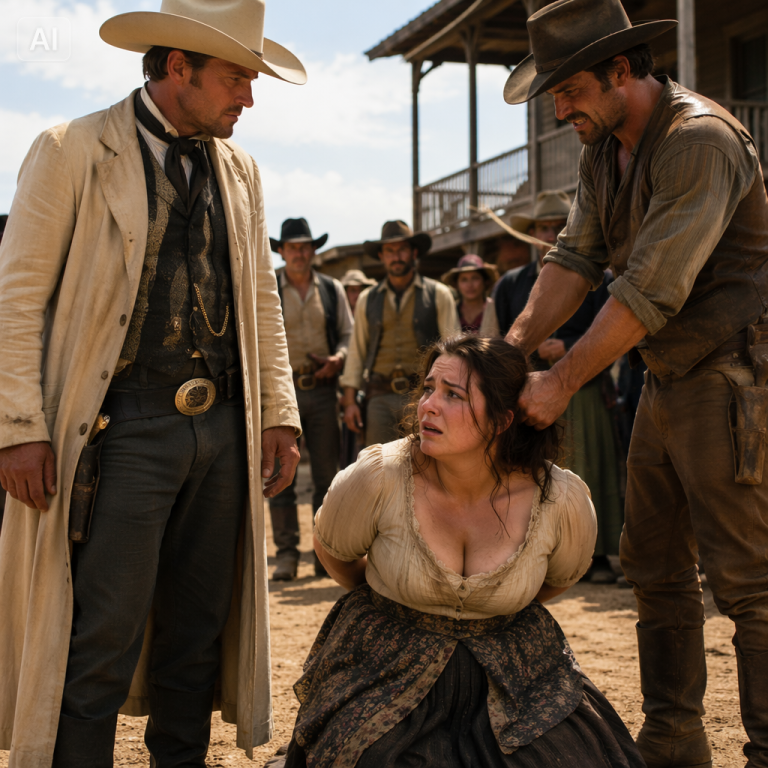
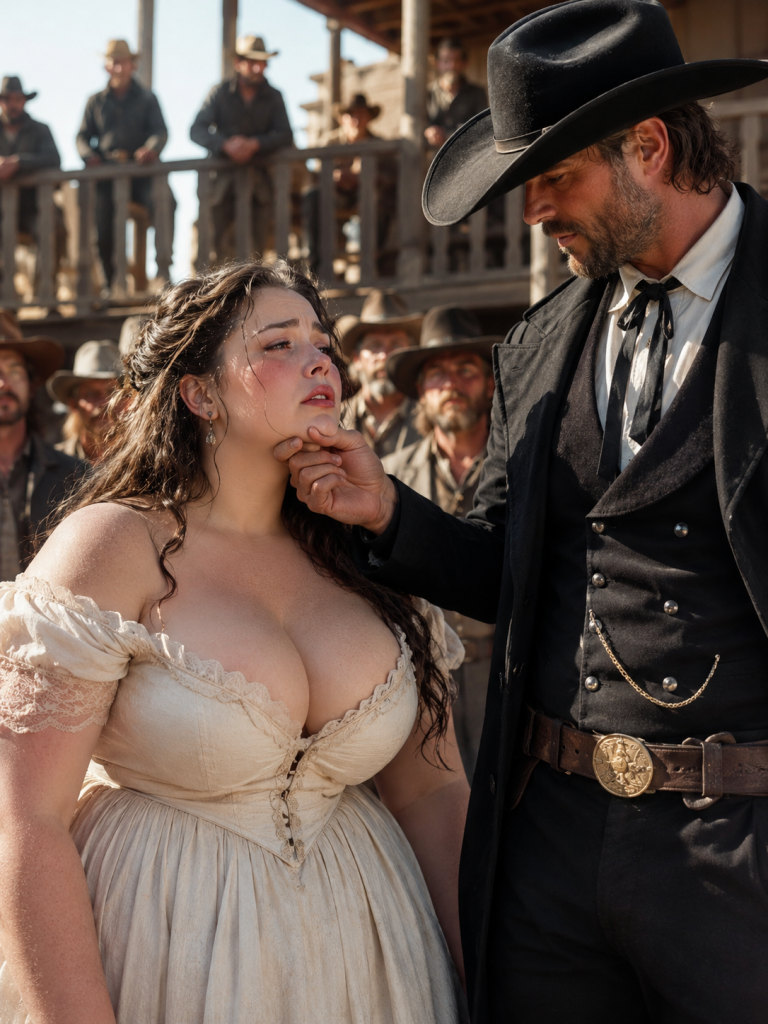
“Afternoon, Widow Whitfield,” Draven called, tipping his hat with a smile that stopped well short of his eyes. “Brought you a housewarming gift. Or maybe I should say a husband.”
“I’m not selling,” Clara said. “I’m not marrying you. Get off my land.”
Draven laughed, dry as old leather. “Ain’t offering myself. Town took up a collection instead. Found you the strongest man in the territory. Leastways, he used to be.”
Two ranch hands dropped the tailgate and dragged a canvas-wrapped shape into the dirt. It hit hard. A low groan rose from inside the bundle, and the whole yard went still around the sound.
Clara went down the steps fast, heart slamming, and tore back the canvas.
The man beneath it was massive even curled in pain — matted hair, a wild beard, a face bruised and weathered raw. His shoulders looked built for hauling mountains. But it was his legs that stopped her cold. They lay wrong beneath him, slack and motionless in a way that told her everything before Draven ever opened his mouth.
“Reuben Hale,” Draven said. “Best timber man north of Denver, till a redwood laid him flat at the logging camp. Doc says he’s paralyzed waist-down. Company dumped him in town rather than feed a cripple.”
The men laughed again.
Draven leaned over his saddle horn, savoring it. “Law says an unmarried woman can’t hold a deed in this county if a qualified buyer steps forward. Married woman’s protected, though. Town council wed you two by proxy this morning. You’ve got your husband, Clara. Feed him, wash him, watch him die — or sign the deed over right now, and I’ll have him carted to the poorhouse and you put on a train east.”
It was a trap built with real care. Humiliation dressed up as law.
Reuben Hale opened his eyes. Gray, storm-heavy, bright with a pain that looked almost like hatred — not for her, she understood at once, but for the men standing over him, for a body that no longer answered him, for knowing exactly what part he’d been made to play.
Clara turned to Sheriff Tate. “Is this legal? Is he truly my husband?”
Tate shifted his weight. “Yes, ma’am. Mayor signed it himself, under provisions of—”
“Save it.” She faced Draven again. “Thank you for the delivery, Silas. You’ve just secured my claim to this land. Now get off my property before I fetch my shotgun and start shooting for trespassing.”
The smile dropped off his face like it had never been there at all.
“You’re a fool. You can’t run a ranch and nurse a cripple both. He’ll drag you under before the first snow.”
“Get off my land.” Softer that time. More dangerous. Draven heard the difference. He spat in the dirt, wheeled his horse, and rode out with his men laughing behind him until distance finally swallowed the sound.
The silence after felt enormous.
“Why didn’t you let them take me?” Reuben rasped from the ground, voice barely strong enough to carry.
Clara knelt and slid her arms beneath his shoulders. “Because I don’t like Silas Draven, and I don’t believe in dead weight. Grit your teeth, Mr. Hale. We’ve a long way to that porch.”
It took nearly an hour. She ended up dragging an old barn door from the shed to use as a sled, levering him onto it inch by inch, stopping every few feet to breathe through the burn in her arms. By the time she’d wrestled him onto Daniel’s old bed, her palms had split open and her back screamed with every movement.
She had no idea yet that she’d just dragged the answer to everything up her own front steps.
PART 2
The first three weeks were bad enough that neither of them, later, ever tried dressing them up as anything gentler than what they were.
Reuben Hale had spent his life in timber camps and high country winters where weakness got buried fast. To be washed, fed, and turned in bed by the sheer mechanics of paralysis was a humiliation he couldn’t outrun, and in a proud man, humiliation curdled into rage. He snapped at her constantly. One evening he hurled a plate of beans against the wall hard enough to shatter it, bellowing that he’d sooner starve than be fed like an infant.
Clara bent, gathered the pieces, and set a rag and pail beside him.
“Then starve,” she said evenly. “But you’ll clean the wall first. Your arms still work, don’t they?”
He stared at her like she’d struck him. It was the first thing that taught him Clara Whitfield wasn’t a fragile widow clinging to ruin. She was made of something considerably harder.
She built a routine because routine was the only wall against desperation — livestock before dawn, then dressings and liniment and his cursing, which she learned to ignore entirely.
“Doc Mercer said your spine is crushed,” she told him one morning, rubbing camphor between her palms. “He didn’t say your legs should be abandoned.”
“He said they’re gone.”
“He isn’t God.” She dug both hands into the dead muscle of his calf and began working it like she meant to wrestle life back into it by force. “Push against me.”
“It’s useless.”
“Push.”
He strained until sweat ran into his beard, and nothing happened. He collapsed back, shaking with frustration.
“Again tomorrow,” she said. And the day after. And the day after that.
It was the ledgers that changed things between them. He caught her squinting at columns of figures by lantern light one night and told her, gruffly, to bring them over. He read for two days straight.
“Your husband was a fool with numbers,” he finally said. “Not this big a fool.”
Clara looked up from her sewing. “What do you mean?”
“These debts to Draven are forged.” He tapped the page with a scarred finger. “Dates don’t match the Denver bank. Interest compounds impossible. Signatures are shaking, wrong.”
The room went very still.
“He drowned at Miller’s Crossing,” Clara said slowly. “Tate said he slipped.”
Reuben’s eyes darkened. “Crossing runs ankle-deep in October. Man doesn’t drown in ankle-deep water unless somebody holds him under.”
The truth arrived all at once — not as revelation, but as alignment. Draven’s pressure. Daniel’s death. The manufactured debt. The sudden hunger for a ridge he swore was only good for springs.
Murder.
“Why that land,” Reuben muttered. “Water rights don’t buy this much cruelty.”
“There’s an old silver dig on Raven’s Ridge,” Clara said. “Daniel called it a bust.”
Reuben’s gaze sharpened into something new — no longer a broken man waiting to die in a borrowed bed, but a strategist already three moves into a war neither of them had chosen.
“Maybe,” he said, “he was looking for the wrong metal entirely.”
PART 3
By August, Reuben’s upper body had begun remaking itself through sheer necessity — chest broadened, shoulders thickened from hauling himself in and out of the rebuilt wheelchair frame he and Clara had reinforced with wagon wheels and bear-hide padding.
They rode up to Raven’s Ridge with him lashed into the flatbed, block-and-tackle rigging groaning against the ruts. What remained of Daniel’s old prospect sat half-collapsed into the hillside, forgotten by everyone except the man who’d died chasing it. Reuben dragged himself across the ground on two iron-shod canes, tapping stone, tasting dust off his thumb, silent in the particular way that meant his mind was working its sharpest.
Finally he sat back and tossed a heavy, dark chunk of rock into her hands.
“Daniel was looking for silver. Found a trace. Didn’t know what it meant.” He nodded at the stone. “Tellurium. And where you find tellurium in this country, you often find gold sitting right underneath it. A deep vein. A fortune.”
The mountain air seemed to change around them.
Draven hadn’t wanted springs. He’d wanted the ridge, and Daniel Whitfield had died for getting close enough to notice.
That evening, grief finally cracked something loose in Clara over the cookpot. Reuben wheeled himself over and closed one huge hand gently around her wrist.
“He took my husband. He took my life. Then he sent you here to humiliate us both,” she whispered. “I’m so tired, Reuben.”
“Look at me, Clara.” She did. There was no pity in his eyes, only a steady, unwavering respect. “Draven thought he was handing you a corpse to bury. He handed you a soldier instead. And he sure as hell didn’t know what kind of woman he was crossing.”
He took the liniment into his own huge hands that night and worked the knots from her shoulders with a gentleness that undid her more than kind words ever could have. When she knelt to return the favor, pressing her thumbs hard into his calf, something happened that neither of them expected.
A twitch. Small. Deliberate. Real.
Doc Mercer had called the damage complete. But the spine, it turned out, wasn’t dead — only crushed, compressed, wrong but not entirely finished. Hope entered that cabin like a third living thing.
By December, Draven had traded legal pressure for outright siege — bribing the mercantile to refuse Clara’s coin, cutting her fences, scattering her herd into the storm country, meaning to starve them into surrender. What he didn’t understand was that he was no longer laying siege to a grieving widow and a broken man rotting in bed. He was laying siege to a fortress designed by a mountain survivor.
Reuben dug a stake trench beneath the porch snow and rigged an overhead harness of ropes and pulleys through the rafters, letting him swing room to room without the chair. He cut Daniel’s shotgun down for close quarters and mounted the Sharps rifle on a swivel at the front window.
The attack came on the coldest night of the year, wind howling hard enough to shudder the walls. Reuben woke instantly.
“Abby — Clara. Up. Now.”
Five figures moved toward the barn with torches. Griggs kicked the door open and raised his light — and the snowbank beneath him collapsed, driving him waist-deep into the stake trench, a sharpened point punching clean through his boot. His scream tore through the storm as the others stumbled back, confused.
The cabin door flew open. Reuben swung out on the rope harness with a Colt in one hand and a braided rawhide whip in the other, cracking it across the dark like lightning, looping it around a man’s neck and yanking him into the mud. The Colt boomed twice more. Clara answered from the side window with both barrels of the sawed-off shotgun, buckshot chewing snow around the attackers’ boots until they fled, dragging a bleeding Griggs behind them.
“Tell Draven the rent just went up,” Reuben roared into the wind. “Next time you come on this land, you don’t leave.”
By dawn the homestead still stood. Reuben sat wrapped in a blanket, pale and shaking, but alive in a way Clara had never seen in him before.
“We held them,” he said.
“We did. But we can’t keep doing this forever. Draven owns the sheriff.”
Reuben stared out over the white fields a long while. “Judge Everett Holt. Federal circuit judge, due in Denver come spring. Get him the forged ledgers and the ore, and Draven hangs legal.”
Clara looked down at his right leg, at toes that had moved, faintly but undeniably, every day that week. “Then we’ve got until spring to get you strong enough to ride there.”
The months that followed were punishing rather than miraculous. A blacksmith named Tobias Renn forged heavy hinged braces, which Clara lined herself with sheepskin so the iron wouldn’t skin him raw. The first time they strapped them on, Reuben bit through his own lip before the attempt was finished. He hauled himself upright by pure force, tried a step, collapsed. Tried again. Collapsed again. By April he could manage one step with the braces and two canes. By May, he crossed the porch without falling — not walking the way healthy men walked, but something stranger and fiercer, a man dragging himself upright on iron, leather, and rage.
Clara sent the forged ledgers and an ore sample east through a drifter she trusted, addressed to a man named Marcus Kellerman of the Pinkerton National Detective Agency. Then they waited.
On the morning of May the fourteenth, they drove straight into Cedar Bluff. No stealth to it — the buckboard rolled through deep spring mud while every shuttered storefront watched from behind curtains. Reuben rode in the back beneath a buffalo hide, the Sharps hidden under it.
They made it as far as the saloon before the road closed. Draven waited on his gelding with Griggs beside him, still favoring the foot the trap had ruined, and ten armed hands fanned out behind them.
“Going somewhere, Mrs. Hale?” Draven called. “Roads are closed to anyone carrying stolen ore off my ridge.”
“It isn’t your ridge,” Clara said. “And you’re going to hang for what you did to Daniel.”
“Who’s going to hang me? You? Or your paralyzed pet in the wagon?”
The buffalo hide shifted. “Griggs,” Reuben said from beneath it, low and terrible. “I told you last winter. The rent went up.”
He threw the hide aside, gripped the sideboard, and hauled himself upward with a roar that seemed to pull straight from the mountains. The iron braces clanged against the floorboards. He rose to his full towering height and stepped off the wagon into the mud.
Thud. Clank. He did not fall.
He took another step toward Griggs, and the psychological weight of it landed on Draven’s men harder than any bullet could have — they’d been told for a year the man was a corpse propped up in a chair. Now the corpse was walking straight at them.
“Shoot him!” Draven screamed.
A rifle cracked from the far end of the street before Griggs’s shaking hand could fire, blasting the revolver clean out of his grip. A hard-driving stagecoach thundered in, flanked by riders with shotguns, and a sharp-faced man in a city suit stepped down holding a smoking Winchester and a silver badge.
“Marcus Kellerman, Pinkerton Agency,” he called. “Acting under authority of Governor Alden Whitmore and Judge Everett Holt. Silas Draven, I have a warrant for the murder of Daniel Whitfield, fraud, and claim jumping.”
Draven’s face went slack. He spurred for the alley.
Reuben was faster. He swung a hickory cane with both hands and caught Draven square in the chest, ripping him from the saddle into the mud, then stepped in and drove an iron-shod boot down onto his wrist before he could reach for his gun.
“Looks like I’m not the dead weight anymore, Silas.”
The street erupted — Pinkertons moving in, hands throwing down weapons, Sheriff Tate rushing forward to clap irons on the man he’d protected for a year, already mumbling excuses to whichever authority might still save him.
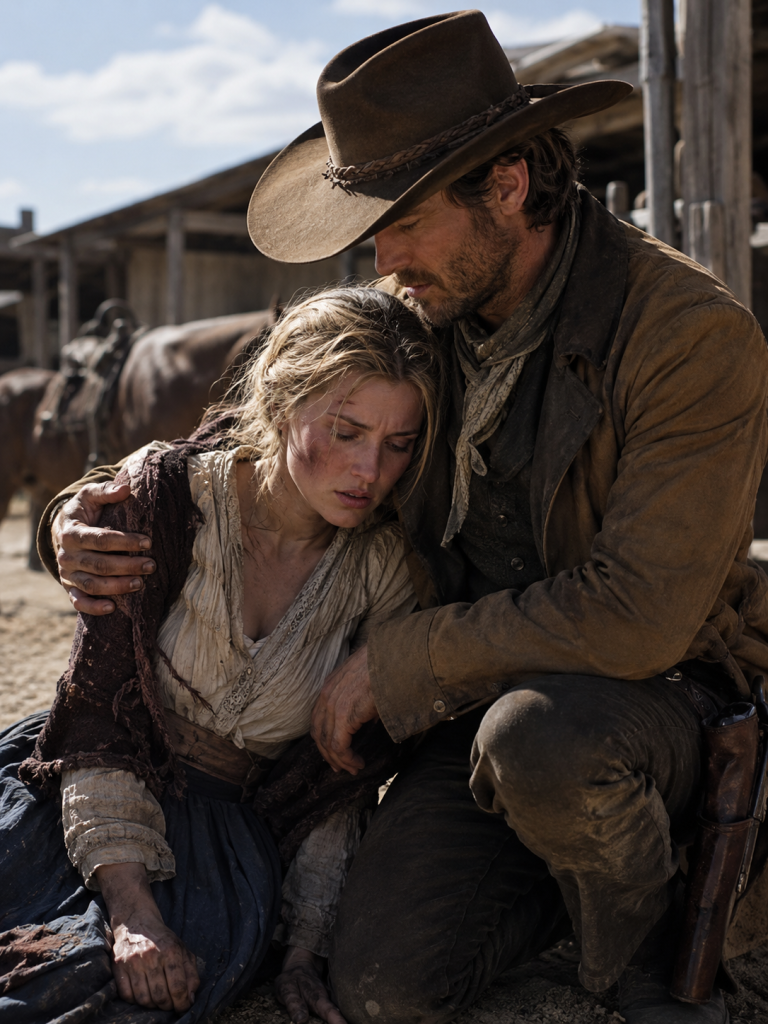
Clara went straight to Reuben, mud on her hems, wind in her hair, and something inside her finally gave way all at once. He caught her the moment she reached him, his hands closing around her like there’d never been any question he could.
“You stood up,” she whispered against his vest. “You stood up for us.”
“I told you, Clara. I just needed a reason to walk again. You gave me the whole world.”
Kellerman approached, hat tipped respectfully. “Mrs. Hale. Mr. Hale. The assayer in Denver confirmed the ore. You’re sitting on the richest tellurium-gold vein in the territory.”
It wasn’t over quickly — there was testimony, paperwork, the slow unraveling of a network built on fear. Draven died in territorial prison two years later, his empire collapsed into lawsuits and abandoned claims. Tate lost his badge before summer’s end. Griggs rode west and was never heard from again.
But the larger change belonged to Clara and Reuben.
They built — not just wealth, but a life. They developed the mine carefully rather than stripping it, expanded the ranch because cattle held steadier than ore when markets turned, and by the decade’s end their combined operation was the largest in that part of Colorado. Reuben never recovered the easy grace he’d once had in his body, never again climbed a mountain the way he used to, but he walked — stiffly, painfully, on iron and oak and pure stubbornness — all the way to the ridge some evenings, just to look down over the land Draven had tried to steal.
Every step stayed deliberate. Every step stayed a victory.
Clara changed too, though not by vanishing into comfort. She grew sharper, steadier, less willing to let any man explain the world to her. She ran contracts and payroll and legal correspondence with the same iron patience that had once dragged a giant up a porch on a barn door and refused, from that very first hour, to pity him for it.
Years later, when she was very old and a young reporter from Denver asked whether she believed in fate, she thought about it a long while before answering.
“No,” she said. “I believe in choices. Some are made by cruel men who think they’re ending your life. Some are made by desperate women who decide not to bend. Some are made by broken men who stand anyway.” She smiled. “And sometimes, if God’s in a merciful mood, those choices make a life.”
Their children grew up on that ridge hearing the story told a dozen different ways by a dozen different neighbors, but the truest version was always the simplest one — that Silas Draven had sent a dying man to break a grieving widow, and instead had handed her the one partner strong enough, in every sense that eventually mattered, to help her build an empire out of a cruel man’s worst joke.
No one in Cedar Bluff ever laughed about that porch again. They’d learned, the hard way, that an anchor doesn’t only drag a person down. Sometimes it holds a house steady through the worst storm anyone’s ever seen — and sometimes, in the right hands, it becomes the very thing that keeps a life from being swept away entirely.
THE END