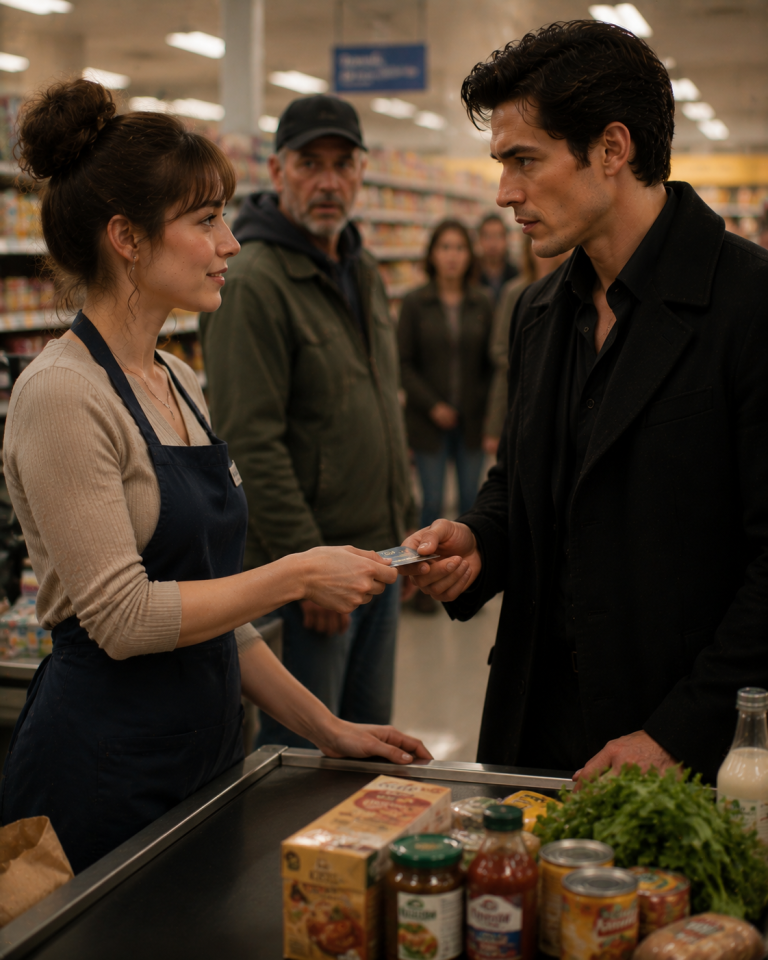
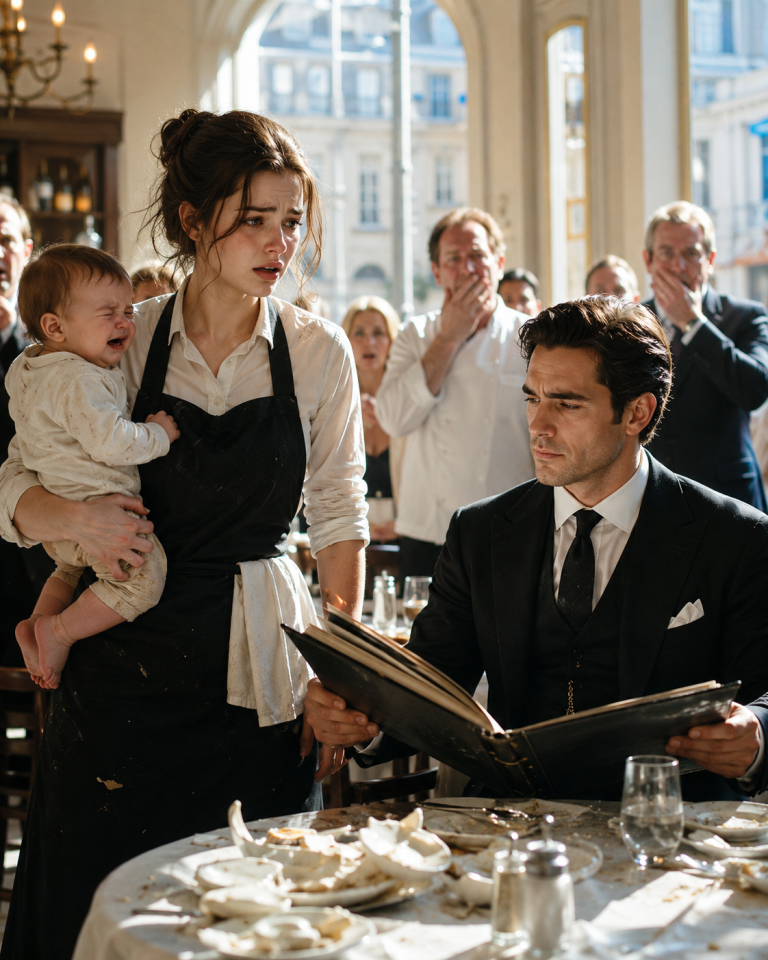
She Sold Her Phone for Her Son’s Medicine—The Mafia Boss Watching Broke Down Before Taking Revenge

## PART 1
The thing about real poverty is that it doesn’t announce itself.
It shows up in the small, private negotiations — the ones made in the back of a Tuesday afternoon when no one is watching, when you’ve already done the calculation three times and the answer keeps coming back the same. Not enough. Not by one hundred and forty dollars.
Rosa Delgado stood at the counter of a pawn shop on Harmon Street and waited.
She had already thought through every other option. She was good at this — at the specific, exhausting arithmetic of survival. She had a list in her head, and she had moved through it the way you moved through every list: systematically, without sentiment. The neighbor who might lend cash was three weeks past the last time Rosa had asked. The credit card was at its limit since the ER visit in March. The emergency fund she had built over eighteen months had covered the rent when the landlord changed the late fee policy without notice.
That left the phone.
A three-year-old model with a cracked screen from the time she dropped it running for the bus. The blue case was peeling at one corner where Tommy had picked at it during long waits at the clinic. She had 4,847 photographs on it, and three years of text messages, and the school’s number in her favorites, and her own mother’s voice in a voicemail she had never deleted because she was not ready.
The man behind the counter turned it over twice.
“Screen’s cracked,” he said.
“I know.”
“Older model.”
“I know.”
“I can do one-sixty.”
“The model was two-eighty when I bought it.”
“That was three years ago.”
Rosa pressed her hands flat on the counter. “One-eighty.”
He looked at her for a moment — not unkindly, the way people in pawn shops learned to look at the people in front of them. Not curious. Not moved. Just noting.
“One-eighty,” he agreed.
She counted the bills twice.
Sixty. One hundred. One-twenty. One-forty. One-sixty. One-eighty.
She folded them into her coat pocket, tucked the receipt beside them, and walked out.
The inhaler cost three hundred and twenty dollars without insurance.
She was still one hundred and forty short.
—
She did not know someone had watched her from the back office.
She did not know that the man in the charcoal coat had arrived forty minutes earlier to speak with his property manager about a cracked facade, a tax reassessment, and the kind of administrative friction that accrued when you owned too much of one neighborhood. She did not know he had owned this block for four years or that he had, just before she walked in, been thinking about whether to sell it.
She did not know his name.
Rafael Estrada. Forty-four years old. Son of an immigrant laborer from Guadalajara who had died with nothing but worked every day of his life as if that were a choice he had made rather than a condition he had been assigned. Rafael had taken the empire he inherited from his adoptive father at thirty-one and expanded it into something his father would not have recognized: real estate, restaurant chains, logistics contracts, a few things that did not appear on any publicly available document and had made him the kind of man who could enter a room and feel the temperature change.
He had not meant to watch her.
He had been standing in the back office doorway, listening to his property manager explain a plumbing problem, when the bell above the front door chimed and the woman in the gray coat came in with the phone.
Everything about her was tired except her jaw.
That jaw was set like she had set it ten thousand times before and intended to set it ten thousand more.
Rafael watched her negotiate one-eighty out of a counter that had been prepared to offer one-sixty. He watched her count the bills with the focused attention of someone performing a ritual. He watched her fold them into her pocket and walk out.
He did not move for three seconds.
Then he said, “The receipt she just signed.”
The clerk behind the counter looked up.
“Let me see it.”
“Mr. Estrada—”
“Please.”
The clerk passed it over.
Rosa Delgado. An address on Callander Street. And in the description field, in the bored handwriting of a man who had filled out ten thousand of these forms: *Prescription inhaler. Son.*
Rafael looked at those three words for a long time.
Then: “What did she get for it?”
“One-eighty.”
“What’s the resale?”
“Two-fifty, maybe. Screen’s cracked—”
“Full retail value. What it cost new.”
The clerk blinked.
Rafael laid his card on the counter.
Four minutes later, he was in his car with Rosa Delgado’s phone in a paper sleeve and her receipt on the seat beside him. He searched the medication on his phone. Three hundred and twenty dollars, cash price, closest pharmacy two blocks east.
He sat for a moment with his hands on the wheel and the rain beginning against the windshield.
One hundred and forty dollars.
Between a child breathing and a mother failing.
Rafael put the car in drive.
—
He bought three inhalers.
The pharmacist looked at him with the specific hesitation of someone who understood that a man in this kind of coat did not usually come in for a child’s prescription without a prescription.
“Is this for a patient currently in your care?” she asked.
“It’s for a child named Tommy Delgado,” Rafael said. “Who is not with me. His mother sold her phone to come up short of the cash price. I’d like to make up the difference.”
The pharmacist was quiet for a moment.
“I can’t sell this to you without the prescription.”
“Then I’ll call the clinic.”
She looked at him.
“Wait here,” she said.
It took eleven minutes. He stood in the middle of the pharmacy while a woman argued with someone on her phone near the greeting cards and a toddler knocked over a display of vitamin gummies. He stood and waited the way he had taught himself to wait: without visible impatience, every available resource already calculating the next contingency.
The pharmacist came back with three inhalers in a brown bag.
“The clinic has the prescription on file,” she said. “I reached the prescribing doctor. She confirmed the name.” She looked at him steadily. “The mother came in two weeks ago asking about payment plans.”
Rafael took the bag.
“Thank you,” he said.
He carried it out carefully, the way you carried something that mattered.
Outside, his phone had been buzzing.
He checked the screen.
A message from a number he didn’t recognize, forwarded from his building manager: *Tommy says mom’s phone went to the store. Mr. Ruiz is at our door again. He says we have to leave by tonight.*
Rafael stared at the message.
Then, beneath it: *Mama please come home.*
He looked at Rosa Delgado’s phone in the paper sleeve on the passenger seat.
The message had arrived on her phone because she no longer had her phone.
Her son was texting her from someone else’s device to a phone she had just sold, and the message had arrived to Rafael Estrada instead.
He pulled up the address on Callander Street.
He pulled the car out into traffic.
—
The building was the kind that had once been solid and had been allowed to become something else. The paint around the window frames was peeling in long strips. One fire escape had a lean to it that did not look structural. A man named Ruiz, according to the building directory, was the property manager — which Rafael already knew, because he knew the building.
He had been considering buying it for eight months.
He had not pulled the trigger because the current owner, a man named Donovan Wells, kept adjusting his ask in response to Rafael’s interest, and Rafael had decided to wait him out.
Donovan Wells had apparently grown tired of waiting.
From outside, Rafael could hear someone shouting.
He went in.
Second floor.
The door to apartment 2B was open.
Inside: a woman in a gray coat standing between a man and her son.
The man was Ruiz. Rafael recognized him from the management files. He was holding a folder and talking about what happened to people who failed to respond to notices.
The boy — Tommy, seven, eight, slight the way underfed children were slight, one hand pressed to his chest — was making a sound that Rafael had not heard in thirty years.
Not crying.
Breathing.
Wrong breathing.
The kind from his sister’s chest, in a cold apartment, before the ambulance reached them.
Rosa was trying to get between Tommy and Ruiz and manage Tommy’s breathing simultaneously and not cry in front of either of them, and her hands were shaking.
“Ruiz,” Rafael said.
Everyone turned.
Rafael looked at the boy first.
He walked past Ruiz and held out the brown bag.
“I have his medication,” he said to Rosa. “Three inhalers. From Waverly Street Pharmacy. The prescription is confirmed with Dr. Chen’s office.”
Rosa stared at him.
“I don’t understand,” she said.
“Later,” he said. “This first.”
She took one inhaler from the bag with hands that were not quite steady, removed the cap, shook it once, and crouched in front of her son.
“Tommy. Slow breath. Look at me. Good. Again.”
Rafael stood behind her and waited.
The room waited.
Ruiz opened his mouth twice and closed it both times.
Tommy inhaled. Exhaled. Inhaled again.
The terrible sound faded.
It did not disappear immediately. It came back in stages, reluctantly, like something returning from a distance. But the specific panic of it eased, and Rosa pressed her forehead against her son’s and breathed with him, and for thirty seconds the room contained nothing except those two people.
Then Tommy said, quietly, “Mom. There’s a man.”
Rosa looked up.
Her eyes found Rafael. They held there.
He saw several things pass through them in quick succession: gratitude, suspicion, fear, and something underneath all three that was too tired and too complicated to name.
“Who are you?” she asked.
Rafael looked at Ruiz.
“Step outside,” he said.
Ruiz shifted his weight. “This is a building management matter—”
“Step outside,” Rafael said again, and this time the quality of it changed.
Ruiz stepped outside.
—
## PART 2
The door closed.
Tommy had settled against the sofa cushion with the careful relief of a body learning to trust air again. His eyes were watching Rafael with the open assessment of a child who had learned early that strangers came in two kinds, and he was not yet certain which kind this was.
Rosa stood with her arms crossed, the pharmacy bag in her hand, the brown coat still on.
“You were at the pawn shop,” she said.
“Yes.”
“You saw me.”
“Yes.”
“You bought my phone.”
He confirmed that without speaking.
Her jaw moved. “I don’t accept charity.”
“I know you don’t.”
“You don’t know anything about me.”
“I know you negotiated one-eighty out of a counter that opened at one-sixty,” he said. “I know you counted it twice and put the receipt in your pocket. I know you walked out and didn’t look back.”
The precision of it seemed to unsettle her more than generosity would have.
“That doesn’t give you the right—”
“No,” he agreed. “It doesn’t.”
She stared at him.
“Then why?”
Rafael thought about the honest answer. He thought about it for long enough that she looked at him the way people looked at men who were slow to speak because they were choosing carefully.
“Once,” he said, “no one came in time.”
A silence.
Tommy had fallen asleep in the way that children fell asleep after medical crises — sudden, complete, exhausted. His chest rose and fell with a steadiness that made Rafael’s chest loosen.
“His medication costs more than I had,” Rosa said. Not to Rafael. Just saying it out loud to hear it stop being a secret.
“I know.”
“Without it, he can’t go to school. Without school, I lose the childcare voucher. Without the voucher, I can’t work the morning shift—”
“I know,” Rafael said again.
“And the building manager—”
“Is not going to remove you tonight,” Rafael said. “Or this week.”
Rosa looked at him.
“You can’t promise that.”
He held her gaze.
“I own the block,” he said. “I own this building. I have for four years. And I’m going to own it for four more.”
The color left her face. “You’re the landlord?”
“I’m the owner. Ruiz is the manager.”
“Ruiz is who’s been—”
“I know what Ruiz has been doing,” Rafael said, which was not exactly true, but he knew enough to know there was more he did not know yet. “We’ll have that conversation. Not tonight.”
Rosa sat down on the arm of the sofa. She sat down the way people sat down when their legs made the decision without permission.
Tommy’s hand found hers in his sleep.
She looked at her son.
Then at the brown bag in her lap.
Then at the phone that Rafael held out toward her.
She did not take it.
“What do you want?” she asked. The question was not hostile. It was the question of someone who had learned that very few things arrived without a ledger.
Rafael looked at her.
The honest answer was still forming.
Then his phone buzzed.
He checked it.
A message from his building manager: *Estrada. You need to see this. Ruiz has been adding fees. Eleven tenants in the last eight months. All low-income, all in buildings you haven’t been hands-on in. I’m sending you the documentation.*
Rafael felt the specific, cold weight of understanding a thing you should have known.
He looked at Rosa.
“How much are you behind?” he asked.
She told him.
He typed a number into his calculator and showed her the screen.
Her eyes narrowed.
“That’s more than what I told you.”
“The additional fees,” he said. “Were they on the original lease?”
“No.”
“Did you sign anything after move-in that referenced them?”
“Ruiz said I had to sign or—”
“Show me.”
She retrieved a folder from a cabinet by the kitchen. The folder was organized in the specific way of a woman who kept her documents because she knew she might need them. Rafael went through every page.
He found six charges that had no contractual basis.
He found two forms signed under what appeared to be extreme pressure with language that no standard tenant would understand.
He found, in the back of the folder, a notice of sale.
The building had been sold.
Not to Rafael.
To a company he did not recognize.
The sale date was two weeks from now.
Rafael looked at this for a moment.
Then he looked at Rosa, who was watching him read with the expression of someone waiting to find out how bad the news was.
“Ruiz has been clearing units,” he said.
“What does that mean?”
“Someone wants to buy this building empty,” he said. “Ruiz has been helping them get there.”
Rosa’s hand tightened around her son’s.
“Who?”
Rafael flipped to the back page.
The purchasing entity was listed as Meridian Residential Capital.
He searched the name on his phone.
What came back made the cold return.
Meridian Residential Capital was a shell company he recognized.
Not because he had done business with it.
Because he had spent eighteen months in a legal dispute with the family behind it.
The Kowalski Group.
His biggest competitors in the city.
And the men who had, three years ago, used a similar operation to displace four hundred families from a building on the South Side — using a property manager who falsified maintenance requests and added illegal fees until people left or were pushed out.
Rafael looked at Rosa.
“I’m going to need you to trust me,” he said. “For approximately forty-eight hours.”
She looked at him steadily.
“I don’t know you,” she said.
“No.”
“I don’t know what you are.”
“Some of what I am is not good,” he said.
That honesty appeared to surprise her.
“But this,” he said, gesturing to the folder, to the building around them, to Tommy asleep with his hand in his mother’s, “is something I can fix.”
Rosa was quiet.
Then Ruiz knocked on the closed door.
“Mr. Estrada,” he said, his voice different now. Careful. “There’s someone downstairs who says they’re from the Kowalski Group.”
Rafael looked at Rosa.
Rosa looked at Rafael.
“Forty-eight hours,” she said.
He nodded.
“What do I do?” she asked.
“Lock this door behind me,” he said. “Don’t open it for anyone except me or a police officer. I’m sending someone up within the hour.”
He moved toward the door.
“Rafael.”
He stopped.
She was holding out the brown pharmacy bag.
“Thank you,” she said. “For Tommy.”
He looked at the bag. At her face. At Tommy asleep in the soft light.
“He breathes first,” he said.
And then he went out to deal with what was downstairs.
—
## PART 3
The man from the Kowalski Group was waiting in the building’s narrow lobby, flanked by two others and carrying the kind of leather portfolio that existed to communicate legitimacy.
His name was Harlow. He had the pleasant affect of a man accustomed to being the one in the room with the paper.
“Mr. Estrada,” Harlow said. “We weren’t expecting you personally.”
“I wasn’t expecting you at all,” Rafael said.
“The sale is contractual. Signed by your manager under a power of attorney that—”
“My manager doesn’t have power of attorney over my holdings.”
Harlow’s expression shifted minimally.
“The documentation we received—”
“Was forged,” Rafael said. “Or he exceeded his authority without my knowledge. Either way, the sale is invalid.”
“That’s a position, not a fact,” Harlow said.
“My attorney is currently on the phone with your attorney,” Rafael said. “By nine a.m. tomorrow, it will be both.”
Harlow looked at him.
“The Kowalski Group has significant interests in this neighborhood, Mr. Estrada. We’re prepared to settle this quietly.”
“I appreciate that,” Rafael said. “I’m not.”
Harlow’s expression became less pleasant.
“There are eleven families in this building,” Rafael said. “I’ve reviewed the additional charges your operation added through Ruiz. I’ve reviewed the manufactured eviction proceedings. I’ve reviewed the falsified maintenance records used to justify unit condemnation.” He looked at the portfolio. “I’ve also contacted the tenant rights organization that handled your South Side project three years ago. They were interested to hear the Kowalski Group had returned.”
Harlow was very still.
“You can leave the building,” Rafael said. “Now.”
They left.
Ruiz had been very quiet during this exchange. He was still quiet when Rafael turned to him.
“You’re terminated,” Rafael said. “Tonight. The documentation on the fee irregularities and the false notices goes to the city housing authority tomorrow morning. Whether you cooperate with that process or not is your decision.”
Ruiz said nothing.
He left.
Rafael stood in the empty lobby.
Then he went to work.
—
It took three weeks to fully unwind what Ruiz had built.
Rafael’s attorney handled the contractual side. The housing authority handled the regulatory side. Mila Chen, a tenant rights attorney Rafael had known for years, handled the side that required someone who was good at sitting with frightened families and explaining that the law actually applied to them too.
Rafael handled the rest.
He was present in a way he had not been present for those buildings in years. He walked through units and listened to what people told him — about the mold in the corner of apartment 1A, the heat that went off at eleven every night in 3B, the front door lock that had not worked properly since March. He took notes. He did not make promises he did not intend to keep.
Rosa had watched all of this with the specific wariness of a woman who had learned not to update her expectations too quickly.
“You’re fixing things,” she said one evening, two weeks in, when he passed her in the hallway.
“Yes.”
“Because of the lawsuit exposure.”
“Partly.”
“What’s the other part?”
He looked at her.
“Because when I was eight years old,” he said, “my sister couldn’t breathe in a building where nothing worked and no one came to fix it.”
Rosa was quiet.
“Did she recover?”
“No.”
A pause.
“I’m sorry,” she said.
“She was five,” he said. “Her name was Pilar.”
Rosa looked at him with the expression of someone who understood what it meant to carry a name.
“That’s why you came upstairs with the inhalers,” she said.
“I came upstairs because your son texted your phone while it was still in my car,” he said. “But yes. That’s why I ran the red light to get there.”
She almost smiled.
Almost.
“I’d like to give you the phone back,” he said.
“I don’t need—”
“It’s yours.”
She looked at him.
Then she said, “I’d like to pay you back for the inhalers.”
“You don’t have to.”
“I know I don’t have to,” she said. “I want to.”
He nodded.
That, somehow, was the moment the wariness changed.
—
The thing about Rafael Estrada was not that he was powerful.
Rosa had been around powerful men before, and what she had learned was that power tended to make men smaller in certain specific ways — less curious, less patient, less willing to be wrong. Power was clarifying in the worst sense: it clarified what you could get away with.
What was strange about Rafael was that he seemed to be using power to undo rather than acquire.
He hired contractors. He fixed the heat. He had the mold tested and remediated. He replaced the front door lock. He reduced the rent across the building to the pre-Ruiz figures and wrote off the illegal fees and asked nothing in return except that people stay.
He also, in the third week, asked Rosa if she would be willing to speak with Mila Chen.
“About what?”
“About the other buildings,” he said. “Ruiz managed four. We believe the Kowalski Group was running the same operation in all of them.”
Rosa looked at him.
“You need me to testify.”
“I need you to decide whether you want to,” he said. “I’m not going to ask you to do something that costs you more than you’ve already paid.”
She looked at Tommy, who was doing homework at the kitchen table with a second inhaler now on the shelf beside his school bag, within reach, the way things you needed should always be.
“What does it cost?” she asked.
“Time,” he said. “Some of it unpleasant. A deposition. Possibly a hearing.”
“And the benefit?”
“The other families,” he said. “And potentially enough in recovered fees to keep Mila’s organization funded for two years.”
She thought about this.
“The benefit isn’t for me,” she said.
“No,” he admitted. “Not directly.”
“But you’re asking anyway.”
“Yes.”
She looked at him.
“You’re the strangest man I’ve ever met,” she said.
His mouth shifted. “I’ve heard that.”
“Did anyone say it as a compliment?”
“Not usually.”
She laughed.
He had not heard that laugh yet. It was not large or careful. It came out the way something came out that had been kept inside for a while and had slightly forgotten the shape of the exit.
He looked at her.
She noticed him looking and stopped.
“I’ll talk to Mila,” she said. “But you should know I’m going to say everything, including the parts that don’t make your company look good.”
“I’d expect nothing less,” he said.
—
She did.
The deposition was five hours. Rosa was thorough and specific and did not soften anything.
Mila called Rafael afterward.
“Your witness,” she said, “is remarkable.”
“She is,” he said.
“She also said several things about the state of your property management oversight that I’m going to have to include in the complaint.”
“I know.”
“That will cost you.”
“It should,” he said.
Mila was quiet.
“Rafael,” she said.
“Yes.”
“Are you okay?”
“I’m solving something,” he said. “That’s different from okay.”
“Fair,” she said.
—
The Kowalski Group settled in month two.
The settlement included returned fees for all affected tenants, a monitoring agreement with the city housing authority, and a provision that the Kowalski Group would not acquire residential property in the district for ten years.
It was not enough.
Rosa said so, when Mila explained it.
“Ten years,” Rosa said. “And then they come back.”
“Yes,” Mila said. “The law only goes so far.”
Rosa looked at the settlement document.
“What would go further?”
Mila and Rafael exchanged a look.
“There’s a tenant coalition,” Mila said carefully. “It’s been trying to get organized for three years. What it’s been missing is someone who understands the administrative side and isn’t afraid of making enemies.”
Rosa looked at the document again.
Then at Tommy, who was explaining something to Rafael about his science project involving the atmospheric conditions required for different kinds of clouds.
“The fees they took from us,” Rosa said. “How much total, across the four buildings?”
Mila ran the number.
Rosa listened.
“That’s enough to fund a tenant advocacy organization for four years,” she said.
“Approximately.”
“Then that’s what it should do.”
Mila wrote it down.
Rafael watched Rosa, and what he saw was the thing he had seen in the pawn shop: not the exhaustion, not the worn coat, not the cracked phone or the short money. What he saw was the jaw, set the way it had been set every single time, and the intelligence underneath it that had always been there but had not, until now, been given a room large enough to use.
—
Three months after that, on a Tuesday morning, Rosa Delgado walked into a meeting with the city housing director, accompanied by Mila Chen and six other tenants from buildings across the district.
She brought documentation.
She brought testimony.
She brought the specific quality of attention that came from having counted every dollar in every transaction for every year and never once stopped paying attention to where the numbers went wrong.
The housing director listened for four hours.
New regulations followed.
New oversight requirements.
A monitoring system that Mila’s organization would help to administer, funded by the Kowalski settlement and matched by two other foundations that came in once they understood what was being built.
Rosa did not take a salary from the organization.
Rafael argued with her about this.
“You’re working full-time on it,” he said.
“I have a job.”
“You’re working two jobs.”
“Tommy’s older now. He helps.”
“That’s not—”
“Rafael.”
He stopped.
She looked at him the way she had started looking at him six months ago — not with suspicion or wariness, but with the direct, undecorated attention of someone who had decided to see a person clearly and was in the process of doing it.
“I know what I’m doing,” she said.
“I know you do,” he said. “That’s why I’m arguing about it.”
She almost smiled again. “Because I’m not asking for enough?”
“Because you never do.”
She looked at him.
He looked at her.
They were in the renovated lobby of the Callander Street building, which had new light fixtures and a working intercom and a small bulletin board where Mila’s organization had posted resources for tenants in the district.
Tommy appeared from the elevator.
“Are you two arguing about money again?” he asked.
“Yes,” Rafael said.
“Mom always wins,” Tommy said, without breaking stride. “Mr. Rafael usually brings pastries when he knows he’s going to lose. Did he bring pastries?”
Rosa looked at Rafael.
Rafael, who had in fact brought a box from the bakery on Harmon Street that was sitting in his car, said nothing.
Tommy looked between them.
“Pastries,” he said. “I’ll get them.”
He went back to the elevator.
Rosa put her face in her hands for a moment, the way she did when she was trying not to laugh at her own son.
Then she dropped her hands.
“You should have just said thank you,” she said. “Instead of buying things.”
“I say thank you.”
“You say it by buying things.”
“That’s how I know how to say it.”
She looked at him.
“You could learn a different way,” she said.
He held her gaze.
“I think I’m already learning,” he said.
She was quiet.
Outside, the city moved in its usual way — indifferent, enormous, full of the small private negotiations of a thousand lives happening simultaneously, each one invisible to the others, each one carrying its own weight in the specific and particular way that weight was always carried.
And in a lobby on Callander Street, a woman who had counted pawn shop bills with shaking hands stood next to a man who had built himself into something dangerous in order to survive what the world had done to people he loved, and they both looked at a bulletin board that had not existed six months ago.
On it was a flyer for a tenant rights workshop.
And beside the flyer was a photograph: Tommy, grinning, holding an inhaler in one hand and a science fair ribbon in the second place.
Above the photograph, in Rosa’s handwriting: *He breathes first.*
Rafael read it.
Rosa said, “I stole that from you.”
“I know,” he said.
“It was worth stealing.”
He looked at it for another moment.
Then Tommy returned from outside with the pastry box, and the three of them sat on the lobby bench and ate almond croissants at ten in the morning while the city went about its business outside, and it was, in all the ways that mattered, a good morning.
Not the end.
The beginning of what came after.
—
**THE END**