She Saved His Daughter From Drowning—Then the Mafia Boss Became Terrifyingly Calm

## PART 1
She had learned, somewhere between her father’s hospital and her mother’s second job, that rich people did not actually see the hands that moved through their lives.
Not the hands that carried trays, or restocked ice, or folded linen into angles. Not the hands that held doors open half a second longer than necessary or quietly removed a glass before it became a stain. Hands like that were furniture. Hands like that belonged to the architecture of a wealthy afternoon, not to people with specific names and specific reasons for being tired.
Mara Reyes understood this the way you understood the smell of a place you had grown up in — not consciously, just completely. She was twenty-three, a nursing student working catering shifts to cover the gap between her scholarship and her rent, and she had learned to make herself peripheral in rooms that would have paid five thousand dollars a seat to pretend they cared about the world.
Today’s event was a water-safety charity fundraiser at the Harborside Club on the Connecticut shore.
The irony was too expensive to feel.
Her supervisor, Diane, had run through the rules before the guests arrived. Do not interrupt. Do not make eye contact unless spoken to. Do not enter the pool area. Do not interact with children without a parent’s explicit invitation. Do not tell anyone you’re in nursing school — it made guests feel like they owed medical opinions.
“You’re background,” Diane said. Not meanly. As a fact.
Mara nodded because the job paid eleven dollars more per hour than the hospital cafeteria.
By noon, she had her read of the party: women in white linen discussing private schools, men in blazers discussing real estate, a string quartet playing pop songs at a volume meant to feel expensive. A banner above the terrace read *Every Child Deserves Water Safety* in navy script. Around the pool, at least four toddlers were unattended by adults too busy being photographed.
Mara tracked all of it. Three years of lifeguard certification before financial aid ran out had hardwired certain responses in her. She did not stop noticing water just because she was carrying crab cakes.
She was watching when Marco Ferrara arrived with his daughter.
She noticed him first because the party rearranged itself around him. Not dramatically — just the small, reflexive adjustments of people processing the presence of someone whose name meant something specific in a register most of them preferred not to examine too directly. Conversations thinned. A few men straightened.
Ferrara was thirty-five, dark-haired, wearing a suit at a poolside party with the nonchalance of someone who had decided his own comfort mattered less than being impossible to read. He had the kind of face that had been handsome before it became serious, and a scar at his jaw that old news stories described with the careful language of not quite saying what it implied.
His daughter was impossible not to love.
Sofia was six years old, in a yellow swimsuit with tiny white flowers, carrying a stuffed rabbit with the authority of someone transporting a colleague. She held her father’s hand with both of hers and looked at everything with the kind of curiosity that had not yet learned to perform itself.
“Daddy, is that a real boat?” she said, pointing at a decorative piece in the garden.
“No,” he said. “It’s rich people’s idea of a boat.”
Sofia considered this. “It’s too pretty.”
“Yes.”
A woman in cream silk moved toward them before they reached the terrace — smooth blond hair, diamond earrings, a smile that had been applied with the precision of someone who knew exactly what cameras were in the room.
Viola Crane.
Mara had seen her in the party briefing photos: longtime foundation donor, current companion to Marco Ferrara, recently photographed at three events where her hand appeared on his arm in ways that suggested proximity was a project she was managing.
“You made it,” Viola said, with the warmth of someone claiming territory.
Ferrara looked at her hand on his sleeve. She removed it.
“I told you Sofia might not want a crowd today,” he said.
“Nonsense.” Viola bent toward Sofia with the brightness of someone performing affection. “You love parties, don’t you, sweetheart?”
Sofia tucked herself slightly behind her father’s leg.
Ferrara’s eyes moved to his daughter. Then to Viola. Then to a fixed point somewhere past her shoulder.
Mara moved through with her tray. Sofia’s eyes tracked the glasses of sparkling lemonade.
“Are those for kids?”
Mara looked down and stopped before she could think about Diane’s rules. “They can be. This one has extra strawberries.”
Sofia reached. Viola intercepted the glass first.
“Staff don’t hand things directly to children,” Viola said, with the pleasant authority of someone accustomed to not being contradicted. “It encourages begging.”
The word landed.
Sofia’s expression contracted into itself.
Mara held completely still.
Ferrara reached across and took the glass from Viola’s hand. He gave it to Sofia without looking at Viola at all.
“What do you say?” he asked his daughter.
Sofia said, quietly, “Thank you.”
Mara said, “You’re welcome,” to the top of Sofia’s head, and moved on before Diane found her standing at a distance that could be interpreted as interested.
She was three tables away when Diane appeared at her elbow.
“Kitchen. Now.”
In the service corridor, Diane delivered a speech about appropriate distance and the particular word she had chosen to use.
Mara listened. Said yes in the right places. Looked through the glass door.
Sofia was standing near the shallow end of the pool. Her father had been intercepted by two men near the garden. Viola stood behind Sofia with something small and silver between two fingers.
Something in the quality of Viola’s posture — the angle of her body, the direction of her attention — registered before Mara’s conscious mind caught up.
“Mara. Are you listening?”
“Yes,” Mara said.
She was watching.
Viola bent close to Sofia and spoke. Sofia shook her head once. Viola pointed toward the pool. The silver thing caught the sunlight.
Then it dropped.
Into the deep end.
Sofia leaned forward.
Her foot found the wet tile at the pool’s edge.
“No,” Mara said.
She was already moving before the word finished.
The tray hit the stone. Glasses shattered. Someone gasped at the sound.
Mara had already cleared two tables and the pool coping and hit the water.
The cold swallowed everything.
She had three summers of lifeguard training in her body and almost none of it was verbal. It was physical. It was the knowledge of where a small body went in a pool, how it moved, the specific angle of descent. She found Sofia before her eyes fully adjusted.
The girl had not lost consciousness.
She was reaching upward, toward light that was not as close as it looked.
Mara grabbed her.
They broke the surface together.
The party found its voice.
Call 911. Someone do something. Is she breathing.
Mara got Sofia over the ledge. Got herself over. Her hands found the child’s chest and began the assessment with the specific efficiency of training overlapping terror.
The crowd formed a ring at what it judged a safe distance from responsibility.
Then a man pushed through it.
Marco Ferrara dropped to his knees on the pool stone three feet from Mara without asking permission and without speaking. He did not touch his daughter yet. He watched Mara’s hands with the complete focus of a man who understood that the person doing the work should not be interrupted.
Mara breathed into Sofia’s mouth.
Again.
The child’s chest rose.
Water came first. Then a cough that was violent and small and the best sound Mara had ever heard.
Sofia turned onto her side and cried.
Mara held her head and said, “That’s it. Keep going.”
Ferrara’s hand covered his eyes for exactly three seconds.
Then he reached for his daughter.
He looked at Mara first.
“Can I?” he asked.
The question was so unusual it registered as its own kind of information.
Mara nodded.
He gathered Sofia against his chest and stayed low on the stone, not standing, not performing the moment for the crowd. Just on his knees in his soaked suit, holding his daughter.
“Rabbit,” Sofia said, into his collar.
“Forget the rabbit.”
“Viola said it wanted to swim—”
Viola’s voice came from the umbrella tables, perfectly modulated for the crowd.
“She must have slipped. I said the tiles were wet this morning. I told Richard they needed to be redone.”
Mara sat back on her heels. Her hands were bleeding where she had scraped the pool coping.
The club manager, a compact man named Harlow, arrived with Diane at his side and the expression of someone whose first instinct was damage control.
“Thank God,” Harlow said. “Mr. Ferrara, we are so relieved. Obviously we’ll be reviewing how a staff member came to be in this part of the pool area. Miss—” He glanced at Mara’s name tag. “Miss Reyes had no authorization—”
“She saved my daughter,” Ferrara said.
Harlow’s sentence stopped.
Ferrara did not raise his voice. “She saved my daughter while two hundred people decided whether it was their problem.”
Harlow said, carefully: “We are of course grateful. But there are protocols—”
“Tell me why she was the only one who moved.”
Nobody answered.
Then Viola spoke again, and her voice had something new in it — not warmth, not performance, but the harder texture of a person who had made a calculation.
“I’m shaken,” she said. “We all are. But I noticed that girl speaking to Sofia earlier. Without permission. Standing too close, watching her. It felt wrong.”
The air shifted.
Harlow looked at Mara.
That look was a sentence.
Mara was still sitting on wet stone in a catering uniform, blood on her hands, water coming out of her hair.
Then a server named Owen, who had been working the east tables, walked over and picked up a piece of wet cloth near the broken tray.
He went still.
“Mr. Harlow,” he said.
There was something under a crab cake near the tray’s edge, glinting in the afternoon light.
A diamond tennis bracelet.
Viola gasped with perfect timing.
“My bracelet,” she said.
And Mara understood, with the cold clarity of someone who had been watching without being seen, that the next hour was going to try to bury her under the thing she had just done.
—
## PART 2
By the time the paramedics arrived and the police followed, the story had already been shaped.
Not loudly. Not with any single lie big enough to call a lie. Just the accumulated weight of who was believed when certain kinds of people spoke and certain other kinds stood there in wet uniforms.
Mara sat in the staff changing room wrapped in a towel that smelled like pool chemicals while an officer asked whether she had any financial difficulties at the moment.
“Yes,” she said. “I’m putting myself through nursing school.”
He wrote something down.
She looked at her scraped hands.
Sofia was in an ambulance with an oxygen mask and her father.
The bracelet was in an evidence bag.
By the time Mara was escorted out through the service entrance, three things had happened: she had been fired, the club’s management had put out a preliminary statement about unauthorized staff behavior, and someone had already uploaded a seven-second video with a caption that turned watching into evidence.
The parking lot light was orange and sodium-bright.
Her nursing program called the next morning.
“We’re not making any judgments,” the dean said, in the voice of someone who had already made them. “But given the seriousness of the questions being raised—”
“I saved a child,” Mara said.
A pause.
“We think a brief pause from clinical placement, pending review, is appropriate.”
She hung up.
Her bank balance read four hundred and twelve dollars.
At six in the evening, someone knocked on her door.
Mara looked through the peephole and saw a woman in a dark coat, copper hair pulled back, with the specific expression of someone who had spent a career watching powerful people try to make truth inconvenient.
“Mara Reyes?” the woman said. “My name is Elaine Basso. I’m Marco Ferrara’s attorney. I’m alone.”
Mara kept the chain on.
Elaine raised both hands.
“Sofia is awake,” she said. “Mild aspiration pneumonia. She’s asking whether the server found her rabbit.”
Mara leaned against the door.
The relief was so physical it felt like something giving way.
“She’s all right?”
“She will be.”
Mara unlatched the chain.
Elaine came in without examining the apartment, which Mara appreciated more than she expected to. She placed a folder on the table and opened it directly.
Three photographs.
The first: the viral clip with metadata attached. The second: the pool deck from the club’s event photography website. The third: a still from a backup cloud upload made by the private photographer — blurry, taken from the terrace angle, showing Viola standing behind Sofia with her hand extended, something silver between her fingers.
“The photographer’s official card was wiped before he left,” Elaine said. “He shoots backup to cloud as a habit. He didn’t understand what he had until he reviewed it at home.”
Mara stared at Viola’s frozen image.
“I saw that,” she said. “From across the room. I didn’t understand what I was seeing in time.”
“There’s audio too,” Elaine said. “The event team’s lapel mic was left running near the cabana. A staff member found the receiver and made a copy before turning it in.”
Mara looked up.
“What’s on it?”
Elaine looked at her steadily.
“Everything.”
Then Mara’s phone buzzed.
An unknown number.
A text. One line, and a photo of her building’s exterior.
*Stop talking before we stop you.*
Mara set the phone down.
“Mr. Ferrara needs to know about this,” she said.
Elaine was already on her phone.
—
## PART 3
Marco Ferrara called forty minutes later.
Mara answered.
“I didn’t ask for guards,” she said, looking at the black car that had materialized across the street.
“No,” he said. “I put them there.”
“I don’t want protection from people in your line of work.”
When he spoke again, his voice was quieter, with something in it that was neither anger nor performance.
“Sofia is alive because you moved when no one else would. The people at that party had every resource a person could want and they stood still. If what I have can protect something worth protecting, I will use it for that.”
Mara looked at the car.
“The bracelet wasn’t mine,” she said.
“I know.”
“Do you actually know, or are you being polite?”
“I know. I saw Viola’s face when they found it. That reaction was prepared in advance.”
“Why did she do it?”
“I ended things with her the morning of the party,” he said. “She asked me to wait until after the event. She decided not to wait.”
“She almost killed your daughter.”
“Yes.” The flattest word she had ever heard.
“She didn’t think Sofia would actually fall.”
“No. She thought Sofia would panic near the edge, I would rush to her, and in that moment Viola would be the one beside me.” He paused. “Instead the pool camera that was supposed to be down was only partially down. Instead the lapel mic no one planned for caught everything. Instead you were there.”
Mara thought about watching Sofia from across the terrace. Filing the wrongness of Viola’s posture before she understood why.
“When Sofia was on the stone,” she said. “You didn’t interrupt. You just watched my hands.”
“Because you were doing it correctly. And because I have spent fifteen years learning the cost of powerful men doing the wrong things because they can’t tolerate doing nothing.”
“Elaine told you to let the process handle it.”
“She always does.”
“You’re listening.”
“Tonight, yes.”
“Because I asked.”
“Because you asked.”
Mara looked at the ceiling.
“Your wife,” she said. “I read about her.”
“What was published.”
“What wasn’t?”
A long pause.
“That she asked me for three years to become the kind of man Sofia would be proud of. That I told her I was working on it. That I wasn’t working quickly enough.” His voice did not break, but it thinned at the edge. “After the funeral, Sofia asked me whether I was going to go away too.”
Mara’s throat tightened.
“What did you tell her?”
“That I was going to stay and become someone she could bring to school without explaining.”
“That’s specific.”
“She is a specific person.”
They were quiet together.
“The audio,” Mara said. “What’s on it exactly?”
“Two voices. Viola and Harlow, the club manager. Forty minutes before Sofia fell. A conversation about the pool camera and what would happen if a child panicked near the water. And a conversation about you.”
“About me.”
“About the particular usefulness of a catering worker who was already being noticed near the child. About how easy it would be to redirect attention.”
Mara pressed her hand flat against the floor.
“I want to testify,” she said.
“You don’t have to.”
“I know. I want people to know what actually happened. Not just to clear my name — yes, obviously I want that. But Sofia went into the water because someone decided a child’s fear was an available instrument.” Her voice steadied. “People should know that’s what happened.”
He was quiet.
“All right,” he said. “Then let’s make the truth the loudest thing in the room.”
—
The foundation board meeting was three days later.
Mara wore her one good blazer and her one pair of good flats and had her hands almost fully healed. Sofia met her in the hallway outside the boardroom.
She was in a soft green cardigan, her rabbit tucked under one arm, her color back.
She ran the last three steps.
Mara knelt and held her carefully.
“You scared me,” Mara said.
“I scared me too.” Sofia considered this. “Elaine says I was very brave.”
“Elaine is right.”
“She also said I’m not allowed in the meeting but Daddy said the hallway counts.”
Mara laughed.
Ferrara came up behind his daughter looking, she thought, exactly as tired as she felt, which was the most human impression she had formed of him.
“Ready?” he said.
“They’ll try to make me emotional,” she said.
“Yes.”
“That’s not a weakness.”
He looked at her. “No,” he said. “It isn’t.”
—
The boardroom smelled like cedar and old certainty.
Portraits of men who had never cleared a table. The pool glittered through the windows, roped off with tasteful navy barriers.
Harlow. Diane. Four board members. Foundation attorneys. Viola Drake in a cream blazer with a diamond tennis bracelet on her wrist.
The same bracelet.
Mara looked at it.
Viola looked back with the specific expression of a person who had decided that boldness and certainty were interchangeable.
The club’s attorney stood immediately. “Miss Reyes is here to clarify certain matters and sign the non-disparagement agreement—”
“She won’t be signing anything,” Elaine said.
Harlow’s expression hardened. “That complicates her situation.”
“Her situation,” Elaine said, “is that she pulled a child out of the bottom of a pool while your employees were calculating liability.”
Ferrara entered behind Mara with Sofia.
Sofia walked with the gravity of a six-year-old who had been informed she was important to this moment.
Viola sighed.
“Must we?” she said. “A child had an accident. A staff member acted. The internet overcorrected. Can we please—”
Elaine tapped the tablet.
The viral clip appeared. Mara circled in red. Dramatic zoom.
Several board members did not look at Mara.
Elaine paused it.
“This version was amplified through three accounts connected to a communications firm your club retains. We have the IP logs.”
The club attorney made a sound that was not quite an objection.
Elaine changed the screen.
The photographer’s backup footage played.
Sofia by the pool. Viola behind her. The silver charm between Viola’s fingers. The drop. Sofia leaning.
Then Mara, moving before anyone else turned.
One board member put her hand over her mouth.
When Sofia came up limp and Mara began compressions, Diane Caldwell began crying with no apparent decision to do so.
When the child coughed, the boardroom was entirely silent.
Elaine stopped it.
“That is what actually happened.”
Viola’s hands tightened on her water glass.
“I dropped a toy,” she said. “I never thought she would actually—”
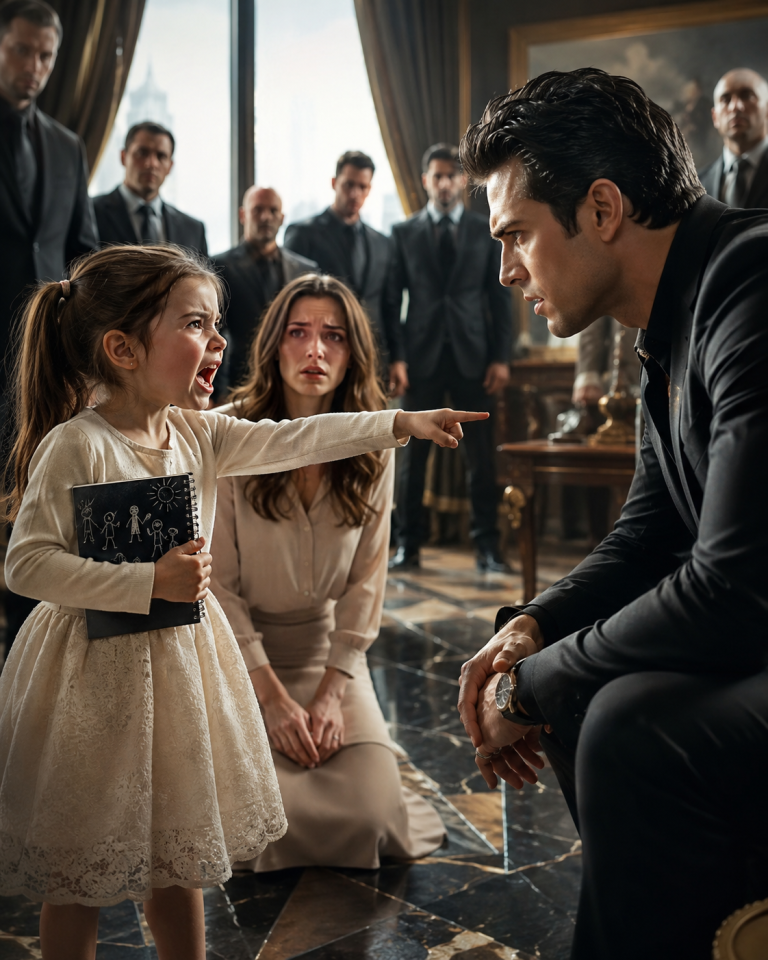
“You told me Bunny wanted to swim,” Sofia said.
Sofia’s voice was small but it belonged entirely to the room.
Viola looked at the child.
For one visible second, the performance stopped.
Irritation crossed her face. Then fear.
“Sweetheart,” Viola said, “you were confused.”
“Daddy broke up with you,” Sofia said. “You said if I was brave, he would look at you again.”
Ferrara closed his eyes.
Mara felt the weight of that sentence: the instructions given to a child, the calculation that had decided a six-year-old’s fear was available as a lever.
Elaine said: “The board may want to hear this.”
She played the audio.
Viola’s voice filled the boardroom.
*”If the girl panics, someone will pull her out.”*
Harlow: *”Your plan, not mine.”*
*”She won’t die. She’ll just be scared. He’ll forget the breakup and remember who belongs beside him.”*
A pause. Then:
*”And the server?”*
*”She’s already watching the child like she’s hoping for a reward. Poor, working two jobs, exactly the kind of person people believe when they want a story. If something goes wrong, they’ll decide she staged it.”*
*”By tomorrow, she’ll be the story.”*
The recording ended.
Harlow’s coffee cup touched the table too hard.
Nobody moved to clean it.
Viola stood.
“That is illegal. That’s a private—”
“One-party consent state,” Elaine said pleasantly. “Event team authorization covered the equipment. But please, continue. The district attorney’s office appreciates confidence.”
The boardroom door opened.
Two detectives entered with the unhurried patience of people who had been waiting in the hallway.
Mara looked at Viola.
She thought about the things she had been called while still wet from the pool. Suspicious. Unauthorized. A cautionary note about watching children too closely.
She thought about her father’s hospital room. About her mother’s hands, rough from years of cleaning houses like this one.
“You chose me,” Mara said.
Everyone looked at her.
“You looked at the room and chose me. Not because I was suspicious. Because I was visible enough to use and invisible enough to discard. Because poor and working-class meant people would believe the story you gave them.” She looked at Harlow. “You put out a statement about unauthorized staff behavior while I was still bleeding on the driveway.”
Harlow’s face did something complicated.
“And you.” To Viola. “You told a six-year-old to go to the edge of the pool because her father wasn’t looking. You planned for a child’s panic and you planned for someone like me to be the explanation.”
Viola’s attorney put a hand on her arm.
“I am not a prop,” Mara said. “I am someone who ran CPR on your—” Her voice broke once, and she let it break. “I wanted nothing from that pool except for her to breathe. That’s it. That’s everything.”
The room was still.
Sofia’s voice came from down the table.
“She said thank you.”
Everyone turned.
Sofia was looking at Mara.
“When I woke up. I said thank you.”
“You did,” Mara said.
“And you said you’re welcome.”
“Yes.”
Sofia considered this.
“People who want rewards don’t say you’re welcome first,” she said.
It was a six-year-old’s logic. It was entirely irrefutable.
One of the detectives cleared his throat.
“Ms. Drake. Mr. Harlow. We need you to come with us.”
Viola looked at Ferrara.
For a moment she seemed to believe something was still possible — that fifteen months of a relationship would matter more than a recording.
He looked at his daughter.
That was his answer.
Viola and Harlow were escorted out.
Diane Caldwell sat at the table with her hands clasped.
“I told you to be invisible,” she said to Mara.
“Yes.”
“I was wrong about who needed protecting.”
It was not enough. It could not be enough. But Mara looked at the woman who had been afraid of the wrong things for twenty years and understood that apologies from that place were not performances.
“Say it where you said the rest,” Mara said. “In front of the right people.”
Diane nodded.
“I will.”
And she did.
—
The investigation ran four months.
Viola Drake was charged with endangering the welfare of a child and conspiracy to commit fraud through false witness. The charges took eight months to work through the courts.
Harlow resigned and was subsequently charged separately with evidence tampering.
Diane gave a recorded statement and cooperated fully.
The foundation severed ties with the club. Two board members stepped down. A third announced a donation to a child water-safety nonprofit run by families who had lost children in preventable drownings.
Mara’s nursing program sent an apology letter. Not the dean. Her actual professor, who called first and said the program statement tomorrow would be what it should have been the first day, and she wanted Mara to know before it went out.
It was not the apology it should have been.
It was still a beginning.
—
Mara returned to clinical placement in October.
She stood in front of the locker room mirror and read her badge.
*Mara Reyes, Student Nurse.*
She thought about the pool. About the cold and the specific angle of descent. About her hands finding Sofia in the blue dark.
She clipped the badge to her chest and walked in.
—
Ferrara appeared outside the hospital one Wednesday afternoon in November with two coffees and the uncertain expression of a man attempting something he was not sure he was good at.
“This is borderline loitering,” she said.
“I have coffee.”
“So it’s a social call.”
“I am attempting one.”
“You look uncertain.”
“It is very uncertain.”
She took the coffee.
They walked without a destination through the November street while the city moved around them with complete indifference to anything that had happened in the previous four months.
“How is Sofia?” Mara asked.
“In swimming lessons.”
“Seriously?”
“She wanted to go. She said she didn’t want the water to win.”
Mara smiled. “That sounds like her.”
“She also told the instructor that Bunny has emotional trauma and needs special accommodations.”
Mara laughed.
He watched her laugh with the expression of someone confirming something.
“What would you have done?” she asked. “At the pool. If you’d been there.”
“I got there when it was over,” he said. “I was twenty feet away when it happened and I arrived when it was over.” He said it without softening. “I think about that every day.”
“You got there.”
“You got there first.”
“That’s not a competition.”
“No,” he said. “It’s a fact.”
They stopped near a park. Children on a jungle gym. Parents watching.
He said: “I wanted to ask you something.”
“If it’s about a hospital, the answer is no.”
“It’s not a hospital.”
“Good.”
“A smaller proposal. The foundation has been restructuring. As part of their remediation, they’ve committed to funding a water-safety education program. Teaching parents what drowning actually looks like. What to do in the minutes before emergency services arrive.”
Mara looked at him.
“There’s a very short list of people qualified to build and run something like that,” he said. “And a shorter list of people who would make sure it prioritized families who can’t afford private club memberships.”
“What do I know about running a program?”
“You know what drowning looks like. You know what it feels like to jump when no one else does. You know what families who can’t afford five-thousand-dollar-a-plate galas actually need from water safety education.” A pause. “I know some things about funding. I’m offering to apply them to something you’d build.”
Mara looked at the park.
At a parent who glanced at their phone for one second, then looked back at their child.
She thought about her father’s hospital room. About her mother’s second job. About the word *unauthorized* applied to pulling a child out of a pool.
“What would it be called?” she asked.
He reached into his pocket and handed her a folded piece of paper.
She opened it.
*SECOND BREATH PROJECT*
*Free water-safety education for families in all income brackets. Because every child deserves the same chance.*
She read it twice.
“That’s good,” she said.
“You can change it.”
“I might.”
“That’s also fine.”
She folded the paper.
“I’ll think about it.”
“No pressure?” she said.
“None.”
“No enormous donation in my name before I respond?”
He was quiet one second too long.
“Elaine has some preliminary—”
“Ferrara.”
“— she can pause.”
Mara shook her head.
They had walked back near the hospital entrance.
“Thursday,” she said. “If there’s actual food.”
“Real food.”
“Not real food requiring a chef.”
“Regular kitchen. Six-year-old sous chef who insists on grating cheese.”
Mara thought about Sofia declaring that Bunny had emotional needs.
“Thursday,” she said.
She walked back toward the hospital.
—
She said yes to the program in December.
Not to Ferrara. She said yes to the proposal at a meeting with Elaine and a foundation liaison and her clinical placement advisor, all three of whom she had made sign the same disclosure agreement first.
The program launched in February.
First session: twelve families. A borrowed pool at a community center. Mara in a polo shirt with the program logo and the voice she had developed from three summers of lifeguard certification — not loud, but certain.
She taught them what drowning looked like.
Not the movie version. The real version: quiet, head tilted back, no thrashing. The version that looked like floating.
She taught them the two minutes between a child going under and the moments that would define everything after.
She taught them to move without permission.
In the back row, Sofia sat next to Marco Ferrara.
He was not in a suit.
He was wearing a gray sweater on a folding chair the same as everyone else, watching Mara teach with the expression of a man who had been present for many important things in his life and had learned to recognize which ones he should stay quiet for.
At the end of the session, a man in the third row raised his hand.
“My daughter’s school doesn’t have these resources,” he said. “Can we bring this there?”
Mara looked at him.
“Yes,” she said. “That’s why this exists.”
—
Sofia’s drawing was still on Mara’s refrigerator.
A pool. Three people. A tall woman with brown hair, a small girl with yellow curls, a tall man with dark hair standing to the side. Above the drawing, in careful letters:
*THANK YOU FOR JUMPING*
Some evenings when Mara came home from the hospital she stood in front of the refrigerator and looked at it.
Not at the drawing, exactly. At the instruction inside it.
*Thank you for jumping.*
Not for knowing the right protocol. Not for performing heroism on demand. Not for being brave in a way that could be printed on a banner.
For the moment when the floor was wet and the crowd was still and a child was under the water and there was a single decision available to a person standing close enough to act.
She had acted.
That was the whole story.
The rest of it — the investigation, the program, the dinners on Thursdays when Sofia told her about school and Ferrara cooked badly on purpose and was caught doing it — all of that was what life had made from a single moment.
But the moment itself was simple.
She had seen what was happening.
She had decided it was her problem.
She had moved.
—
*THE END*