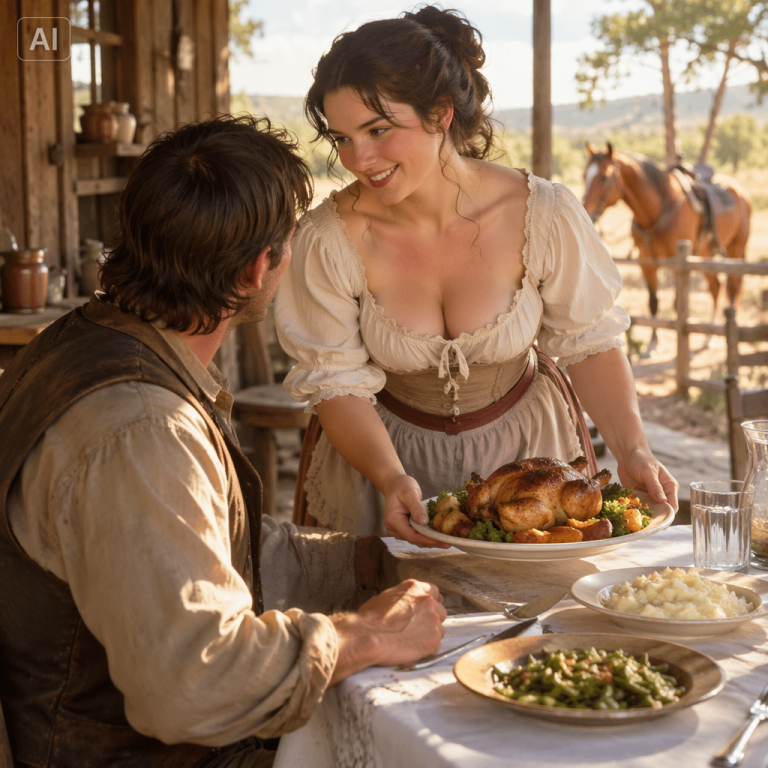
SHE MARRIED A STRANGER WITH SIX BOYS AND A DYING RANCH — SHE HAD NO IDEA A FOUR-YEAR-OLD WAS ALREADY TRYING TO COOK THEIR SUPPER

—
PART 1
The letter was seventeen words long. That’s all it took to reshape a life.
*Mrs. Callaway, your arrangement with Mr. Harlan Greer is confirmed. Stage arrives Sorrow Creek the 14th. Someone will meet you. — Reverend Morris.*
The stagecoach lurched over another rut, and Norah Callaway’s head cracked against the wooden frame hard enough to blur her vision. She didn’t complain. Complaining required energy she’d stopped wasting three states ago.
Across from her, a cattle merchant snored with his mouth open. Beside him, a woman in an expensive traveling coat held a perfumed handkerchief to her nose and stared out the window with practiced indifference. Norah had learned that skill too, though not by choice.
She pressed her palm against the leather satchel on her lap — everything she owned in the world, condensed into a bag that weighed less than hope and more than pride. Three dresses. A sewing kit. Her mother’s silver thimble. And the letter.
“You’re the mail order bride?” the woman with the handkerchief said, not looking at her. It wasn’t a question.
“I’m traveling to meet my husband,” Norah said.
“Harlan Greer’s place. I heard about his situation. Six boys and a failing ranch. You must be desperate.”
“I’m neither desperate nor stupid,” Norah said, her voice level. “I’m practical.”
“Is that what you call marrying a man you’ve never met? Moving to the edge of nowhere to raise someone else’s children?”
“I call it survival,” Norah said quietly. “Same as anything else.”
The truth was more complicated, but these strangers didn’t deserve it. They didn’t need to know about the factory fire in St. Louis that had taken her first husband and left her drowning in debts she couldn’t pay. They didn’t need to know about the landlord who’d suggested alternative arrangements for rent. The choice hadn’t been between marriage and freedom. It had been between marriage and the streets.
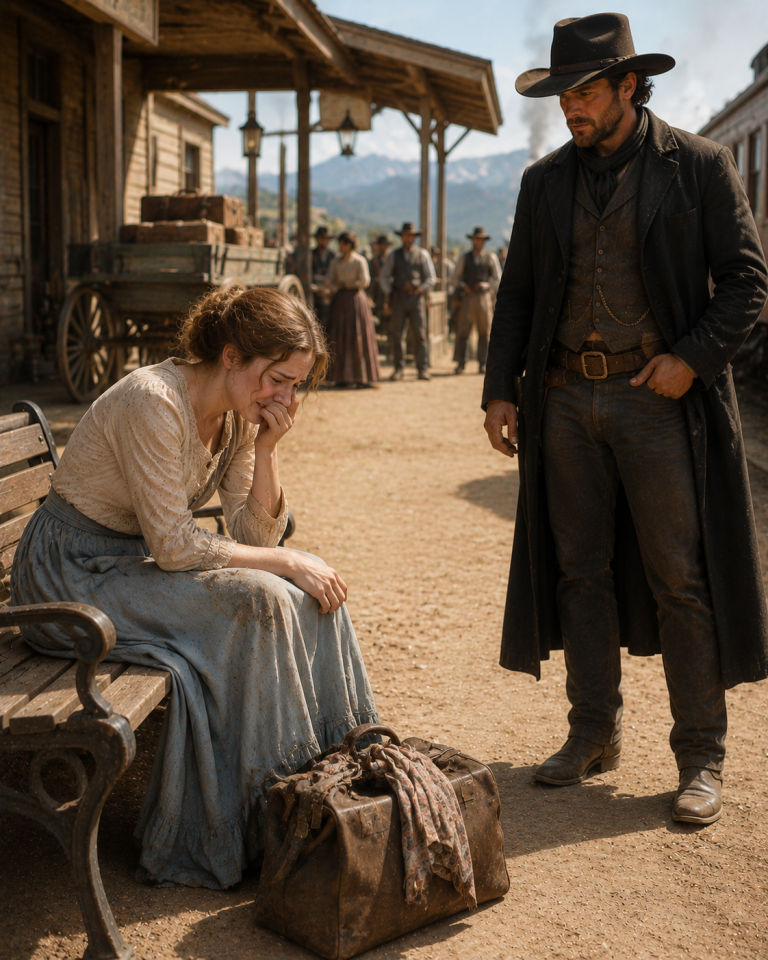
The stage crested a hill, and Sorrow Creek came into view — buildings leaning against each other like drunks trying to stay upright, a main street more suggestion than road. “Welcome to paradise,” the cattle merchant muttered.
A boy of maybe sixteen was waiting by the general store, tall and lean, his hat set at an angle that might have looked careless if his posture weren’t anything but. “You Mrs. Greer?” he asked.
“Norah Callaway,” she said. “Soon to be Mrs. Greer, I suppose.”
“Thomas. I’m supposed to bring you to the ranch.” He picked up her bag, testing its weight with a slight frown. “This all you got?”
“I travel light.”
“Good. Ranch ain’t got room for extra.”
The wagon ride was six miles of silence broken only by hoofbeats and wind. “Your father,” Norah finally said. “What should I know about him?”
“He works hard. Expects the same from everyone else.” Thomas’s tone flattened. “That’s about it.”
“And your mother?”
His hands tightened on the reins. “She died two years back. Fever.” He glanced at her, his eyes hard. “Don’t expect us to call you Ma. That ain’t happening.”
“I wouldn’t ask you to.”
“Good.”
When the rough patch of road finally smoothed out, Thomas spoke again, softer. “Why’d you agree to this?”
Norah considered lying. Instead: “Because staying where I was would have killed me. Maybe not right away. But eventually.”
Thomas nodded slowly, like that made sense to him. “Ranch might kill you faster.”
“Maybe. But at least I’ll have tried something different first.”
The Greer Ranch rose from the landscape like something that had grown there by accident — the house patched with planks over planks, the roof sagging, a barn missing half its doors. “Home,” Thomas said without inflection.
Five boys spilled from the house — not six, though Thomas didn’t seem to notice the gap. The tallest after Thomas — Eli — crossed his arms, suspicious. Beside him, a sharp-eyed boy sized her up like she might steal something.
“This is her?” the sharp-eyed one asked.
“Cade,” Thomas warned.
“We don’t need hope,” Cade interrupted. “We need someone who can cook and clean without making things worse. Last woman who came out here lasted three days.”
“That was a housekeeper,” Eli said.
“Same difference.” Cade’s eyes stayed on Norah. “You know how to cook? For eight people?”
“Yes. And I can sew — I worked in a dress shop for six years.”
Cade studied her, then shrugged. “We’ll see.”
“That’s five,” Norah said, counting faces. “I was told there were six of you.”
“Silas is up at the north pasture with the herd,” Thomas said. “Somebody’s got to watch the cattle or we lose what’s left of them to wolves. He’ll be down by dark.”
“Alone? How old is he?”
“Thirteen. Old enough.” Thomas said it like a fact he’d stopped arguing with a long time ago.
“Where’s the youngest?” Norah asked.
The boys exchanged glances. “Probably in the kitchen,” Thomas sighed. “He’s always in there around supper time. He tries to cook.”
“Usually makes a mess,” Eli said, “but at least he tries. Paw’s been out since before sunup trying to save what’s left of the herd. Somebody’s got to start supper.”
Norah’s chest tightened. A four-year-old, trying to cook because the men of the house were fighting to keep the family from losing everything, and there simply wasn’t anyone left over.
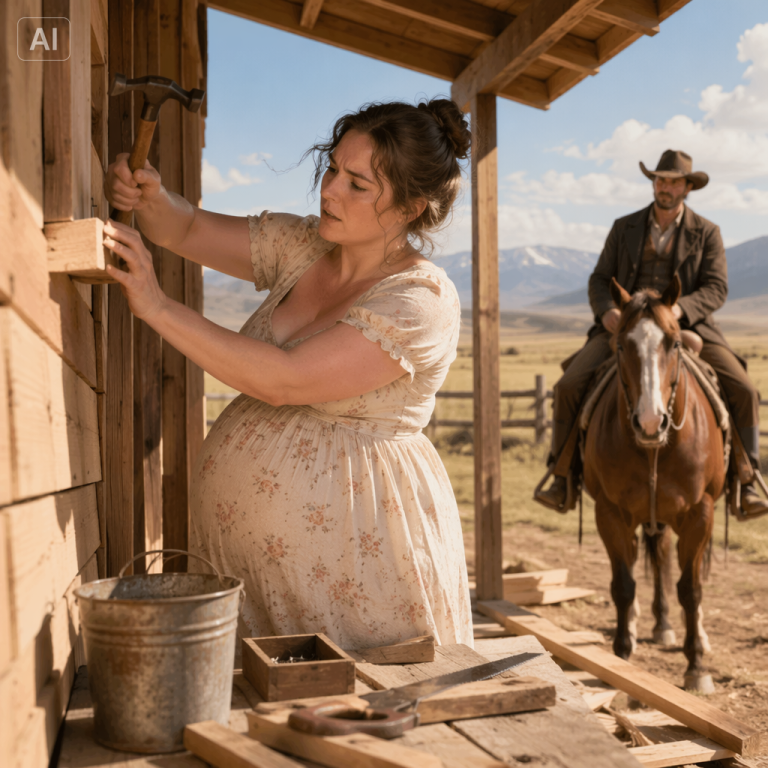
Inside, standing on a stool dragged to the stove, was the smallest boy Norah had ever seen trying to cook. His face was red with heat and concentration, sleeves rolled past his elbows, stirring beans that had cooked without enough water and were starting to burn.
He looked up. Not fear. Not curiosity. Resignation — the expression of a child who’d already learned that adults rarely helped when you needed them most.
“Hi,” he said softly. “Are you the new Ma?”
“I’m Norah. What’s your name?”
“I’m Ruel. Everyone calls me Ru.” He said it carefully, like he’d corrected people on it before. “What are you making — I mean, what am *I* making. Beans. They’re supposed to be soft, but I don’t think I did it right.”
“May I?” she asked gently.
She added water, adjusted the heat, saved what she could. “You did well getting them started. But beans need more water and lower heat, or they turn into rocks.”
“I didn’t know.”
“Now you do.”
“Have you eaten today?” Ru shook his head. “None of you have eaten.” She turned to the older boys in the doorway. “Paw left bread this morning,” Thomas said, and there was no defensiveness in it now, only exhaustion. “One meal for six growing boys, because he was out the door before sunrise trying to keep the last of the herd alive. He hasn’t slept right in weeks. None of us have.”
“That’s not enough food,” Norah said.
“It’s what we had time for.”
“It’s what you *had*,” Norah corrected, rolling up her sleeves. “Now you have me.”
By sunset, the smell of real food filled the house for the first time in months — salt pork, vegetables bulking out the beans, biscuits hot from the oven. A wiry, sunburned boy of thirteen came in last, smelling of horse and cold air, and took his place at the table without a word, too tired to be curious about the stranger serving supper.
When Harlan Greer walked through the door — tall, stooped, weathered like the land he worked, dark circles carved so deep under his eyes they looked bruised — he stopped at the sight of everyone at the table, eating.
“What’s this?” he asked.
“Supper,” Thomas said.
Harlan sat in the chair at the head, more worn than the others. He picked up his fork, took a bite, chewed slowly. The room held its breath.
“This is the best meal I’ve had in a long time,” he said.
It wasn’t flowery. But coming from this man who looked like exhaustion had worn the kindness right out of his voice — not the kindness itself, just the ability to show it — it landed with weight. And Norah understood, sitting in the fading light of her first evening at Sorrow Creek, that she hadn’t married a man who’d stopped trying. She’d married a man who’d been trying alone for far too long, and had nothing left to try with.
And Norah Callaway had never been good at walking away from people who needed her. Especially when she should.
—
PART 2
Morning came too early and too cold. Norah surveyed the pantry and bit back a curse — flour nearly gone, cornmeal for a few more days, dried beans, some salt pork that had seen better months. This wasn’t a pantry. It was a countdown to starvation.
“Sick cattle,” Thomas mentioned over breakfast, and Norah’s hands paused. “Started two weeks ago. Lost three already. That’s why Silas is up with the herd day and night — Paw’s afraid if we leave them alone for more than an hour, we lose more.”
“Has your father tried to treat them?”
“Tried everything he knows. Boiled willow bark for the fever. Separated the sick ones. Sat up two nights straight with a heifer that died anyway.” Thomas’s jaw worked. “He’s not lazy, if that’s what you’re thinking. He’s just one man who hasn’t slept since Ma died, doing the work of two, and losing anyway.”
That’s when shouting erupted in the yard. Thomas and Eli, about to throw punches, Harlan standing between them looking more tired than angry. “You want to give up?” Thomas shouted. “Just quit like Ma did?”
The air went electric. “Ma didn’t quit,” Thomas said, dangerously quiet. “She died. There’s a difference.”
“Feels the same from where I’m standing.”
They went down grappling. Norah threw a bucket of water over both of them.
“Are you finished?” she asked calmly, and made them explain. Eli wanted to leave for town work — one less mouth, one more wage coming in. Thomas thought that was betrayal, another person walking out the door. Cade, it turned out, had been secretly trading ranch supplies in town to help buy food — convinced everyone would call it stealing if they knew, so he’d carried the shame alone rather than ask.
Norah caught Harlan’s eye across the yard and made a decision that, in hindsight, she’d wish she’d made differently.
“You should have known about this,” she said to him, in front of the boys. “All of it. The trading, the fighting, Eli wanting to leave. A father should know his own sons are drowning.”
Harlan’s face closed like a door. He didn’t answer. He turned and walked toward the barn, and didn’t come back until after dark, and when he did, he didn’t look at her.
It took Norah half the night, lying awake, to understand what she’d done — she’d meant to push him toward his children, and instead she’d shoved him further away, cornered him in front of the boys he already felt he was failing. Being right hadn’t made it kind.
“Tonight,” she said instead, the following evening, finding him alone at the fence line first. “Not in front of them. Just you and me. Tell me what you’re most afraid of.”
He was quiet a long moment. “That I already lost them. That I’ve been so busy trying to keep the land under our feet, I let go of the boys standing on it.”
“Then don’t tell them you were wrong,” Norah said. “Tell them you love them. The rest follows.”
That night, around the table, the truth came out in pieces — Eli’s exhaustion, Thomas’s fear of abandonment, Cade’s secret trading, and finally Harlan himself, cornered not by accusation this time, but by his own sons’ honesty, met with something softer than Norah had offered him the day before.
“I made you boys grow up before you were ready,” Harlan said, voice cracking, looking at each of them in turn. “I was so afraid of losing the ranch, I didn’t see I was losing you instead. That stops now.”
“What would you have us do?” Eli asked, quieter than before.
“Ask for help,” Norah said. “You’re not the only family struggling. You’re just the only one too proud to admit it out loud — and I said that to you the wrong way yesterday, and I’m sorry for it.”
Harlan looked at her for the first time since the barn. Something in his shoulders came down half an inch. “Wasn’t wrong. Just early.”
Three days later, Harlan rode into town — not to drink or avoid his family, but to talk to other ranchers. Three days after that, Willis Mercer showed up with lumber and two sons. “Heard you could use a hand.”
“I didn’t ask for charity.”
“Good. I’m not offering any. You help me with my harvest next month. We’re even.”
It was the first crack in years of isolation — and the first sign that something much larger than a leaking roof was about to be tested.
Because three nights after that, the sound came that changed everything — horses approaching fast, voices rough and unfamiliar. Three armed men on the porch, the leader with a scar from eye to jaw, asking for shelter in a voice that made every hair on Norah’s arms rise.
“We don’t take in strangers,” Harlan said.
“Everyone’s a stranger until they’re not.”
“I’m not your friend. My hospitality doesn’t extend to armed men showing up after dark.”
They left. But Harlan’s face, watching them ride off, told Norah this wasn’t the last she’d see of them — and what he said next confirmed it.
“Black Hollow Gang,” he said grimly. “Or scouts for them.”
—
PART 3
“Black Hollow,” Norah repeated. “I’ve heard the name in town. Nobody says much.”
“Nobody says much because nobody who’s crossed them is still around to talk about it,” Harlan said. He rubbed his face with both hands. “They burned a family thirty miles north two winters back. Killed the husband. Been working this valley ever since — one ranch at a time, always the isolated ones, always at night. They don’t hit towns. Towns have too many guns close together. They hit families like us. Alone, spread out, easy to scare.”
“Then why hasn’t anyone stopped them?”
“Because there’s no law out here worth the name. Sheriff’s forty miles east and answers to the railroad, not to ranchers. And every family that’s been hit has been hit alone — nobody talking to their neighbor, nobody knowing the next ranch over got the same visit the week before. By the time word travels, the gang’s three valleys away.” Harlan’s voice was flat, the voice of a man reciting a fact he’d made peace with. “They’re not braver than us. They’re just smarter about picking us off one at a time.”
That single sentence stayed with Norah long after he’d gone inside. *Smarter about picking us off one at a time.* It was, she realized, the exact shape of the problem — and, maybe, the exact shape of the answer.
Morning came bright and hard-edged, the kind of cold that made breath visible and thought clear. Norah found Thomas at the woodpile.
“If Black Hollow only hits isolated places,” she said, “what happens the day they’re not isolated anymore?”
Thomas set down the axe. “You’re not thinking of fighting them.”
“I’m thinking they’ve never had to fight anyone who wasn’t alone.”
Harlan left at first light two days later, riding through fresh snow toward the Webb ranch, then Mercer’s, then every family within reach who might listen. Thomas watched from the window, jaw tight.
“He’ll be fine,” Norah said, though she wasn’t sure who she was trying to convince.
“He’s riding alone through territory where Black Hollow operates. Fine seems optimistic.”
“Your father’s survived worse.”
“Has he? Or has he just been lucky until now?”
Norah didn’t have an answer for that. The day crawled past with the weight of waiting. Reeve — seven years old, silent since his mother’s death — disappeared into the root cellar and emerged with every tool that could be used as a weapon.
“What are you doing?” Norah asked him.
“Getting ready.” His voice was flat, matter-of-fact. “For when they come back.”
“You’re seven. You shouldn’t have to think about things like this.”
“Ma died when I was five. Paw stopped being Paw when I was six — not because he wanted to, I know that now. Because he was drowning and nobody threw him a rope.” He picked up a hatchet, testing its weight. “I’ve been thinking about bad things for a while now. Thinking doesn’t make them happen. Not thinking doesn’t make them stop.”
Harlan returned late afternoon with Willis Mercer, Charlotte Webb, and three other ranchers Norah didn’t know, along with grim news. Black Hollow had hit the Morrison place two nights before — burned the barn, stole what livestock they could move, left a message painted on the wreckage: *Pay or burn.*
“They’ve been doing this for years,” Charlotte said, her voice hard. “Picking off isolated ranches, terrorizing families until they either pay or leave. Nobody talks to their neighbor about it. Shame keeps people quiet. My own place got a visit last spring. I never told a soul until just now.”
A murmur went around the room — three more ranchers admitting, quietly, that they’d had their own visits. Their own silence.
“That’s exactly how they’ve stayed in business,” Norah said, moving to the map spread across the table. “Not because they’re strong. Because we’ve all been too proud, or too scared, to say out loud that we’d been hit. Every one of you thought you were the only ones. That’s not an army beating us. That’s silence beating us.”
“You’re asking us to trust our lives to a woman who’s been here a month,” one rancher said dismissively.
“I’m asking you to trust your lives to someone who’s kept this family alive through winter when everyone expected them to fail,” Charlotte cut in. “Gender doesn’t enter into it. Competence does.”
“Then let me be plain about what I’m proposing,” Norah said, “because it isn’t bravado. Black Hollow has never once fought a family that wasn’t alone. They’ve never had to. If we consolidate — move families and livestock to one location, put eyes on every road in, share what each of us knows — we’re not offering them a bigger target. We’re taking away the only advantage they’ve ever needed.”
One by one, the ranchers agreed — not because they thought it would work, but because every other option led to certain destruction.
The next three days were chaos. Families arrived with whatever they could carry. Livestock filled the pastures. The house became a refugee camp. Norah organized it with efficiency born from years of managing impossible situations — sleeping spaces, rationed supplies, cooking for thirty people with provisions meant for eight.
“You’ve done this before,” Charlotte observed, sorting blankets. “Managed chaos.”
“Different chaos. Same principles.”
Reeve worked alongside the men, his small hands competent with tools. No one questioned it. Out here, childhood ended when necessity demanded — though Norah made a private vow, watching him, that it would end sooner than that once this was over.
On the fourth day, smoke appeared on the horizon. The Morrison place, burning again. No one spoke. The message was clear. Black Hollow was coming — and this time, for the first time, they were coming toward a ranch that wasn’t alone.
That night, thirty people crowded into the main room. “They’re coming,” Harlan said without preamble. “Probably tomorrow, maybe the day after, but soon.” He paused. “This isn’t going to be clean. People are going to get hurt. Some of us might die. If anyone wants to leave, now’s the time. No one will judge you. There’s a difference between courage and suicide.”
No one moved.
“All right, then. We stand together. We fight together. And if we’re lucky, if we’re smart and brave and lucky, we survive together.”
“What if they offer terms?” Thomas asked. “What if they say we can avoid bloodshed by just paying?”
“We don’t pay,” Charlotte said flatly. “The moment you pay extortion, you’re a victim forever.”
Norah stepped forward. “There’s something else you should know. This isn’t just about Black Hollow. It’s about what comes after. Right now, this valley is dying. Families are isolated. Trust is gone. That’s why Black Hollow operates here — not because they’re stronger than us, but because we’ve let them convince us we’re each alone. But if we hold, if we prove this valley can unite and fight, everything changes. We stop being victims and become something else. A community that protects its own.”
That night, women and children were assigned to the root cellar. Ru clung to Norah at the entrance. “I don’t want to go down there,” he whispered.
“I know, honey, but you have to.”
“What if you don’t come back?”
Norah crouched, holding his small face in her hands. “I will come back. I promise.”
“Ma promised she’d get better. She didn’t.”
The words hit like a punch. “You’re right,” Norah said finally. “I can’t promise nothing bad will happen. But I can promise I’ll try my hardest to come back. That’s all any of us can do.”
Dawn came too fast and too cold. Twenty riders appeared from the north, spreading out to flank the ranch on three sides. Their leader — the same scarred man from the porch — rode forward alone.
“You’ve got maybe thirty people, half of them women and children,” he called out. “We’ve got twenty men who do this for a living. You do the math.”
“Math says you die if you attack,” Harlan said. “Some of us, sure. But all of you.”
The outlaw smiled. “Here’s my offer. You pay us what the Morrisons would have paid, plus a little extra for the inconvenience. Everyone walks away alive.”
Before Harlan could answer, Norah stood up. “No.”
The leader turned his attention to her. “And who are you?”
“Nobody important. Just someone who’s tired of men like you deciding who gets to survive.” Her voice didn’t waver despite her hands shaking on the rifle. “You’ve built your whole reputation on ranches too proud or too scared to tell their neighbors you’d been there before them. That’s over. Every family behind me knows now. You’re not the terror of this valley anymore. You’re just twenty men a long way from home.”
“Touching speech won’t stop bullets.”
“No. But it might make you wonder whether this particular ranch is worth dying for, when every other one you’ve hit was alone and this one isn’t. Are we worth that risk?”
The leader’s smile faded. He turned his horse. “This isn’t over.”
“Yes, it is,” Norah replied. “You just don’t know it yet.”
The outlaws withdrew to confer. Minutes stretched into eternity. Then gunfire erupted — but not from Black Hollow. Riders poured over the ridge, ranchers from farther north, drawn by the smoke from the Morrison fire and by word Harlan had carried to them himself two days before, armed and tired of paying silent tribute to men who’d never once faced a united valley.
Caught between two forces, Black Hollow’s leader made the smart choice and signaled retreat.
“Did we win?” someone asked uncertainly.
“For today,” Harlan said. “For today, we won. And tomorrow they’ll ride into some other valley looking for a ranch that’s still alone — and find out this one’s spreading word too.”
—
**THE KEY**
The families stayed another week before slowly returning to their own ranches, carrying with them the knowledge that they didn’t have to face the frontier alone. Charlotte left last.
“You did good,” she said, embracing Norah.
“We all did. I got it wrong at least once along the way — pushed Harlan when I should have listened. Community doesn’t mean I stopped being able to make a mess of things.”
“Nobody who’s actually doing anything gets it right every time,” Charlotte said. “That’s not a flaw. That’s proof you’re really in it.”
That evening, Norah found Harlan at the fence line, staring out at land that had nearly been taken from him.
“I almost lost everything,” he said. “I almost got my boys killed because I was too proud to ask for help sooner.” He turned to her. “Thank you for pushing me. Even the day you did it badly. Even that.”
“I’m sorry for that day,” Norah said. “I said what was true in a way that wasn’t kind.”
“You said what nobody else would say to my face. I needed both — someone honest, and then someone patient. Turned out to be the same person.” He reached into his pocket and pulled out the rusted iron key she’d used that first night. “You unlocked more than a door when you came here. You unlocked a family that had locked itself away from living.” He handed it to her. “This place is yours. We’re yours. If you want to leave, I’d understand.”
“I’m not leaving,” Norah said. “This is home now.”
He nodded, emotion crossing his weathered face too quickly to identify, and then he hugged her — brief, awkward, but real. “She would have liked you,” he said quietly. “My wife. She would have liked you a lot.”
Later that same week, Harlan gathered the boys in the yard — all six of them, Silas included, down from the north pasture for the first time in days now that the herd had settled and the danger had passed.
“I owe you boys something I should’ve said a long time ago,” he said, hat in his hands like a man at a funeral, though nobody had died. “I made you grow up before you were ready. Silas, watching cattle alone at thirteen. Thomas, running this house like a man twice your age. Cade, carrying a secret because you thought I couldn’t handle the truth. Eli, ready to leave because staying felt like drowning. Reeve, learning to arm yourself at seven instead of learning to play.” His voice caught. “And Ru, standing on a stool trying to feed five brothers because I wasn’t here to do it myself. That’s on me. Not on your mother for dying. On me, for letting grief make me useless to the ones who needed me most. I’m sorry. All of you. I’m sorry.”
Nobody said anything for a long moment. Then Thomas crossed the yard and put his arms around his father, and one by one, the rest followed, until Harlan Greer stood in the middle of his sons, absorbing an apology’s answer that no words could have said better.
Life didn’t become easy after that. Winter still had teeth. But something fundamental had shifted. Thomas smiled more. Eli stopped talking about leaving. Cade’s anger mellowed into determination. Silas started coming down from the pasture for supper instead of eating alone by the fire he built himself. Reeve remained quiet but less haunted. And Ru finally started acting like a four-year-old instead of a miniature adult.
Spring came late but fierce. On the first truly warm day, Norah worked in her garden with Ru at her side, planting seeds.
“Norah?” he said after a while — he’d stopped calling her by the wrong name months ago, though she’d never once corrected him harshly for it. “Are you my ma now?”
The question stopped her hands. “I don’t know. What do you think?”
He considered seriously. “I think Ma was Ma, but you’re something too. Something good.”
“What am I?”
“You’re Norah.” He said it like that explained everything.
“Yeah,” she whispered, pulling him close. “That’s enough.”
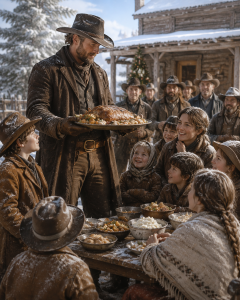
That evening, the whole family gathered for a real meal, not rationed portions — eight chairs full for the first time since Norah had arrived. Thomas stood up awkwardly. “I just wanted to say something. About this family. About how we almost didn’t make it. About how everything changed when someone showed up who refused to let us fail, and who wasn’t afraid to tell Paw the truth even when it cost her something. Thank you for staying, for fighting, for being exactly what we needed.”
Harlan raised his coffee cup. “To family. The one we’re born into and the one we choose.”
“To family,” they echoed.
Norah looked around the table at faces that had been strangers months ago, that had become something more important than she’d known she needed — these flawed, stubborn, broken people who’d fought and struggled and survived together.
The lesson wasn’t complicated. It wasn’t poetic. Sometimes survival isn’t about being strong enough to stand alone. It’s about being brave enough to admit you can’t. It’s about building connections instead of walls. Choosing to fight for something bigger than yourself, even when every logical part of your brain says you should run.
Norah had arrived at this ranch with nothing but a rusted iron key and a resolve worn thin by too many losses. She would leave it, if she ever left it, with something far more valuable — a family, a home, a purpose, and the knowledge that she’d taken something broken and helped make it whole again.
Not perfect. Never perfect. But whole enough to keep growing.
Years later, travelers passing through Sorrow Creek would ask about the woman who’d stood down Black Hollow, and the old ranchers would smile and point toward the Greer land. “That ranch survived when everyone expected it to fail,” they’d say. “And the woman who made it happen — she started with nothing but a key and a stubborn refusal to quit. Taught a whole valley how to stop hiding from each other, and how to fight for what mattered.”
And if you visited the Greer Ranch on a spring evening when the wildflowers were blooming, you’d find Norah in her garden, dirt under her fingernails and peace in her expression — because that’s what she did. She planted seeds. She nurtured growth. She refused to let things die that could be saved.
And somewhere along the way, in the process of saving a broken family on a failing frontier ranch, she’d saved herself, too. Not from poverty or hardship or danger. From loneliness. From purposelessness. From the slow death of surviving without living.
The rusted iron key sat on her dresser still — a reminder of the door she’d opened that first night. But she rarely looked at it anymore.
She didn’t need to. The life she’d built was reminder enough.
THE END