“Nobody Wants You,” Her Sister Sneered—Then the Mafia Boss Came for Her

## PART 1
She had been standing at the edge of the ballroom for forty minutes holding a bag that wasn’t hers when the most feared man in the city looked at her.
Not at Serena.
At her.
Iris Vane had spent those forty minutes perfecting the art of being present without being visible. She knew the skill well. She had been practicing it for three years inside the Vane house, ever since her father Arthur died and Miriam began the quiet, patient work of reducing Iris to a function rather than a person. Not cruelly, not loudly — that was the genius of it. Just incrementally. Iris’s bedroom moved to the east wing. Iris’s name disappeared from the household accounts. Iris was needed at events not as a guest but as an extra pair of hands, a shadow in gray while Serena glittered in whatever color she’d decided owned the room.
Tonight it was red.
It suited her. Serena had always understood how to announce herself.
Iris stood in borrowed charcoal silk and held the small jeweled bag Miriam had pressed into her hands outside the car with the phrase *”be useful”* and a look that made it sound like mercy.
She was not thinking about the bag anymore.
She was watching Raffael Saros.
Everyone watched Raffael Saros, which meant most people didn’t, because watching him directly felt like the kind of presumption you paid for later. He stood near the far wall in a black suit, listening to two men who both looked like they had money and were careful about it, and he had the quality of stillness that certain people had — not absence, but concentration. The whole room arranged itself slightly around where he was standing without understanding why.
Serena had noticed him the moment they arrived.
She had spent an hour recalibrating herself toward him the way plants recalibrated toward light: the laugh adjusted louder, the turn of her body opening in his direction, the smile deployed with the precision of someone who understood that beauty was a language and she was fluent.
He had not looked at her once.
That was when Serena looked at Iris.
“Nobody wants you,” she said, conversationally, reaching to adjust a bracelet, not even bothering to lower her voice. “You understand that, don’t you?”
The women beside her — two daughters of the city’s charitable circuit, both in gowns that cost more than Iris’s rent — made the small, pleased sounds of people watching someone else’s pain and being grateful for the distance.
Miriam laughed.
Iris had heard that laugh at seventeen, standing at her father’s wake while Miriam received condolences. She had heard it at nineteen, when the east bedroom was declared “more practical.” She had heard it at twenty, when the gallery job Iris had found independently was quietly dismantled by a phone call Miriam made and never acknowledged.
The laugh had history in it.
Iris turned away before they could see her face.
She had one rule in the Vane house: do not let them see it land. The moment they saw it land, the wound became a weapon they would use again.
She turned and walked three steps toward the wall and stopped, because there was a man in front of her.
Raffael Saros had not been there a second ago.
He was there now.
Tall. Dark suit. The kind of face that had been described, Iris was certain, in newspaper articles using words like *alleged* and *reputed* and *despite no formal charges*. He was looking at her with the specific attention of someone who had decided, before approaching, exactly what they meant to say.
He held out his hand.
“Dance with me.”
Iris stared at it.
Her mind ran through explanations: mistaken identity, some obligation she didn’t understand, a game at her expense. None of them left his expression unmoved, because his expression wasn’t waiting for her to catch up. It was simply there.
“I’m sorry?” she said.
“Dance with me,” he repeated. “I asked once. This is twice.”
Behind him, across the twenty feet of ballroom floor that separated them from Serena and Miriam, something was happening to Serena’s face that Iris could see even from here. The red silk was perfectly arranged. The smile remained. But beneath it, something had cracked.
Miriam’s expression was harder to read. It had gone very still.
Iris looked back at the hand in front of her.
Then she said, “Yes.”
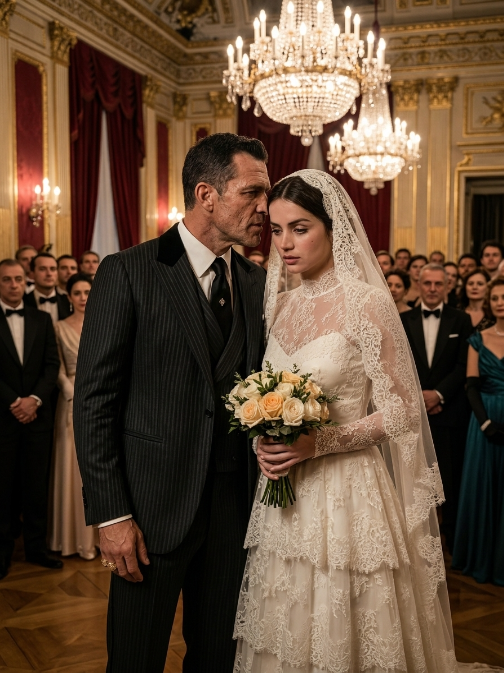
He led her to the center of the floor and turned, and his hand settled at her waist with a precision that did not claim her — it just steadied her, the way you steadied a door you didn’t intend to close. The orchestra was playing something with too much string in it for the occasion, beautiful and slightly anguished.
“You’re shaking,” he said.
“I didn’t expect this.”
“I know.” He turned her, angling her away from the watching crowd with the effortlessness of someone who had long ago learned to use bodies in space as tools. “I’ve been meaning to speak with you for some time.”
Iris looked up. “You don’t know me.”
“Iris Vane,” he said. “Daughter of Arthur Vane. You studied art restoration at Whitmore College before your stepmother withdrew the tuition payment and told the registrar you’d declined. You worked six months at the Veyron Gallery under a modified reference because Miriam Vane had told three people you were unreliable.” He paused. “You repair paintings better than the people who were hired to teach you.”
Iris’s feet nearly stopped.
He adjusted without breaking rhythm.
Her voice came out low and careful. “How do you know that?”
“I know many things about you.”
“That isn’t an explanation.”
“No,” he agreed, “it isn’t.”
She looked at him directly for the first time. “What do you want?”
“To tell you something your father should have told you himself.” His voice was quiet enough that no one three feet away could have heard it. “He saved my life.”
The orchestra swelled.
Iris heard neither.
“My father was an art restorer,” she said.
“He was many things.”
“He died of a heart attack three years ago.”
Raffael’s jaw shifted, almost imperceptibly. “That is what you were told.”
The floor became unstable.
Iris gripped his shoulder without deciding to. “What does that mean?”
“It means that what is convenient and what is true are different things. And that your father was careful enough to understand the difference.”
Across the room, Serena was moving toward them with the practiced grace of someone who had decided a mistake was occurring and she was the correction. Miriam was with her.
Raffael turned Iris in a slow arc that placed his back to them.
“There is a cabinet at your house,” he said. “Black wood, brass handles, tall. Your father showed it to me once.”
Iris’s throat tightened. “What about it?”
“I believe something is still inside it.”
“Miriam uses it for porcelain.”
“On one side.” His eyes met hers. “Your father had a second room behind the first. He showed me when I was twenty-three and desperate and had just made three serious mistakes. He said, *some doors only open for people who already know they exist.*”
Iris stared at him.
Her father used to say that.
She had heard it at seven, at ten, at twelve, standing in his study while he pointed at the hidden space behind the tall cabinet and explained that secrets should be kept somewhere safe and trusted and not in the same place as the things you showed everyone.
*My lucky compartment,* he’d call it.
She had thought it was a game.
The music ended.
Polite applause moved through the ballroom. Raffael released her hand, but slowly, and bent over it in the way of a different century — no contact, just proximity, and somehow more intimate than touching.
He straightened.
Behind him, Serena arrived with champagne and a smile assembled from pure discipline.
“Mr. Saros,” she said. “What a surprise.”
His gaze moved to her with the attentiveness of someone turning to look at weather.
“Your sister,” he said, “seems to have been told, publicly, that no one wants her.”
Serena’s smile held by sheer architecture. “Oh, we tease each other terribly. Old family habit.”
“I see.” He was quiet for one moment. “She doesn’t tease back. That’s not a habit. That’s a structure.”
Serena’s champagne tilted slightly.
Miriam moved in. “Raffael—”
“Mrs. Vane,” he said, looking at her without warmth. “I know your father.”
The sentence landed without explanation.
It didn’t need one.
Miriam’s smile thinned to something structural.
Raffael offered Iris his arm.
She took it.
As they walked toward the balcony doors, Serena’s voice followed them, thinned with something that sounded like panic wearing the costume of contempt.
“Iris, don’t be absurd—”
Iris stopped.
Three years of training said: *turn around, smooth it over, make yourself smaller, protect the equilibrium.*
She turned around.
Not to comply.
Just long enough to say: “You can carry your own bag.”
She set Serena’s jeweled purse on the nearest table.
And walked out.
Behind her, someone in the crowd made the specific sound of people who have just witnessed something they will discuss for months.
Raffael’s arm did not move.
She held it and kept walking.
—
## PART 2
The balcony overlooked a winter garden, frost silver on the hedges, lanterns hung in bare branches. The city beyond the estate walls looked patient and enormous.
Raffael did not speak immediately.
Iris pulled in one long breath of cold air and let it reach the parts of her chest that had been held tight all evening.
“How did he save your life?” she asked.
Below them, something moved near the hedges. One of Raffael’s men, probably. She was beginning to understand that the world was much more populated with watchers than she had previously assumed.
“I was twenty-three,” Raffael said. “Young and stupid in the specific way of young men who inherit dangerous situations and believe confidence is the same thing as preparation.” He looked out at the city. “A meeting had been arranged. I was told it would settle a dispute. It was actually a trap. I arrived early. Your father was inside, restoring a painting for the man who had arranged it.”
“He recognized the danger?”
“He heard enough. He found me in the anteroom before anyone arrived and told me which door led out. He gave me his coat so the guards at the back would see a figure they expected and not examine it.”
“What happened to him?”
Raffael was quiet for a moment.
“They hit him. Broke two ribs. He told me later he’d claimed to be a delivery man who had gone to the wrong door.” The corner of his mouth moved without warmth. “He told you he fell down some stairs.”
Iris looked at her hands.
She was nine that October. Her father had come home from his trip pale and coughing, with bruises across his ribs he dismissed as nothing. She had believed him. Children believed the people they loved because the alternative was more than nine-year-old minds could accommodate.
“Why didn’t you come to him afterward?”
“I did. Many times.” Raffael turned from the railing. “He asked for nothing except one promise: that whatever I owed him, I would not collect near you.”
“He knew what you were.”
“Yes.”
“And he helped you anyway.”
“He said a young man shouldn’t have to die because old men were cruel to each other.”
Iris’s eyes filled, which she refused to allow. She breathed through it.
“When he died,” Raffael continued, “I stayed away as I had promised. But I had people watch from a distance. Not close enough.”
“No,” she said. “Not close enough.”
He accepted that without defense.
“The cabinet,” she said. “You think there’s evidence inside.”
“I think your father was methodical, and I think he understood that Miriam would look for everything she could find, and I think he trusted you with hidden things because you were the only person in that house he trusted at all.”
Iris looked toward the mansion’s lit windows.
Inside, Miriam was certainly watching the balcony.
“He told me,” Iris said slowly, “that the compartment opened only for people who knew it existed. I assumed he meant I was the only person who knew. But he gave you his coat. He trusted you.”
Raffael met her gaze. “I had never been back to the house.”
“He left something for you?”
“For you. About me.” A pause. “There is something in your father’s evidence concerning my world and how he came to possess it. He wanted you to have the truth before I asked for the ledger.”
“What ledger?”
“Documents he gathered over years. Names of men who profit from crime while prosecuting it publicly.” Raffael’s voice was level. “Your father restored art for powerful people. Powerful people speak in front of the invisible.”
Before Iris could answer, the balcony doors opened.
Miriam stepped out.
Not Serena. Miriam alone, which was worse.
She looked at Raffael first. Then at Iris. Then at the photograph she had seen Raffael hand over — she had been watching that long.
“Iris.” Her voice was perfectly calibrated. “Serena needs you.”
Iris looked at her.
Three years of *Iris needs to understand.* Three years of *Iris should be grateful.* Three years of being managed like a door that kept opening onto the wrong room.
“No,” Iris said.
Miriam’s expression did not shatter. It reconfigured.
“Don’t be theatrical, darling.”
“I’m not.”
“You have no money, no position, no support beyond this family—”
“That,” Iris said, “is the lie you’ve been telling me for three years.”
Miriam’s hand moved.
Raffael caught her wrist before it reached Iris’s face.
He did not squeeze. He simply held it, and looked at Miriam with the expression of a man communicating a boundary that he would only explain once.
“She’s right,” Miriam said, voice dropping to something stripped of performance. “You don’t know what your father found. You don’t know who’s involved.”
“Tell me,” Iris said.
Miriam smiled.
It was the worst smile Iris had ever seen from her, because it was real.
“Daniel thought keeping secrets made him clever,” Miriam said. “He didn’t understand that powerful men don’t fear dead doctors. They fear living witnesses.”
A sound came from inside the ballroom.
Glass breaking.
A woman’s scream.
Then another.
Raffael turned toward the doors.
Iris went with him.
In the center of the ballroom floor, Serena lay in her red dress with champagne spilled beside her, one hand near her throat, eyes open and terrified. The crowd had formed a useless circle. A doctor was already kneeling.
“She’s breathing,” he said. “Barely. Call an ambulance.”
Miriam rushed forward with beautiful precision. “My daughter! Serena!”
But Iris watched Miriam’s eyes.
They went first to the broken glass.
Then to a waiter near the east wall.
Then to Raffael.
Raffael saw it too.
His voice cut across the room. “Nobody leaves.”
Serena’s fingers moved against the marble.
Iris knelt.
Her stepsister’s eyes found hers with difficulty. The cruelty was gone. What remained looked horribly young.
Serena’s lips moved. No sound.
Iris bent close.
“Cabinet,” Serena rasped. “Not… yours.”
Then her eyes rolled back.
The doctor called for space. The room erupted.
Raffael pulled Iris upright.
“She said it,” Iris whispered.
“I heard.”
Iris looked across the room.
The waiter Miriam had glanced at was gone.
And Miriam, weeping beautifully into her hands, had eyes that were completely dry.
—
## PART 3
**The Letter That Changed the Shape of Everything**
Her father’s house was dark when they arrived except for the morning room, whose light fell into the hallway in a long gold strip.
The front gate had been left open.
It was never left open.
Raffael’s grip on her arm tightened once as they entered. His men moved through the house silently while he and Iris followed the light.
The morning room door was ajar.
Inside, porcelain lay smashed across the carpet. The tall black cabinet stood against the far wall with its doors open and its false back torn out — not carefully, not like someone who knew the trick, but violently, like someone who had guessed and been wrong.
On the floor in front of it sat a small wooden box.
Iris recognized it immediately.
Her father had carved it when she was twelve — a keepsake box with a compass rose burned into the lid. She had spent three years believing Miriam had sold it or discarded it or hidden it somewhere she’d never find.
It was here.
Unlocked.
An envelope inside with her name in her father’s handwriting.
*Iris.*
The sight of it was so specific that she sat down on the floor without deciding to.
Raffael crouched beside her.
“Take your time,” he said.
She opened it.
One sheet of paper, dense with her father’s careful script.
*My dear Iris,*
*If you are reading this, then I failed to come home to you in time.*
*Do not accept the story of my death without asking questions. Miriam is capable of many things I did not fully understand until it was too late. I am sorry for that.*
*There is a vault. There is proof. There is also a truth about your mother that has been buried longer than I should have allowed.*
*Trust Raffael Saros only if he comes to you openly, knowing the cost. He owes me his life, but more than that, he knows what it means to pay a debt honestly.*
*You were never unwanted, Iris.*
*You were everything I was most afraid to lose.*
*With all of it, Dad.*
Iris pressed her hand flat against the paper as if she could absorb it through her palm.
Raffael said nothing.
That was the right thing to do.
She breathed through the worst of it, and when she lifted her head, the room had settled back into focus.
Two documents had been folded beneath the letter.
A trust agreement.
A property deed.
The house — the house she had been permitted to remain in as a courtesy, the house she had watched stripped of her father’s presence room by room — was hers.
Had been hers since the day he died.
Iris looked at the page for a long time.
“She knew,” Iris said.
“Yes.”
“Every time she talked about the house being her responsibility — every time she implied I was a burden—”
“She knew,” Raffael said again. Quiet. Clear.
Iris’s grief moved through her and came out the other side as something harder and more useful.
“The vault,” she said. “Where?”
He told her.
—
**What the Church Held**
The stone church on the east side of the city smelled of candle wax and cold stone and the particular stillness of a building that had been trusted with things.
An elderly priest met them near the side door. He had the eyes of a man who had known Arthur Vane and had been waiting a long time for this errand to conclude.
“Miss Vane,” he said.
“You knew my father.”
“He asked me to keep something safe until it was needed. He said his daughter would understand the key when she found it.”
The key from the envelope fit a vault set into the stone beneath the crypt stairs.
Inside: a metal box. Files, photographs, a flash drive, and a sealed bracelet.
The bracelet was engraved.
*Clara Marlowe-Vane.*
Iris’s mother.
She had been told her mother died in childbirth. She had carried that belief for twenty-four years like a weight she had accepted as permanent.
She opened the folder beneath the bracelet.
Hospital records. A death certificate with a date six years after Iris’s birth. A handwritten note from her father, one paragraph:
*Clara lived until Iris was six. Miriam’s family threatened her into silence about what she had seen. She agreed to disappear to protect Iris. She died in 2007 of pneumonia, alone, because I failed to find her in time. I have never forgiven myself. The photograph in the vault is the last one taken before she disappeared.*
The photograph showed a young woman with Iris’s eyes, fierce and unguarded, holding a small girl on her hip in a garden full of late summer light.
Iris didn’t recognize the garden.
She recognized her own face in the woman’s.
“She loved me,” Iris said.
The priest’s voice was gentle. “Very much. Your father said she asked about you every time they could communicate.”
Raffael crouched beside the box and lifted the flash drive.
“This,” he said, “is the evidence your father spent fifteen years building. Financial records, communications, names.” He looked at her. “Enough to dismantle Miriam’s brother’s organization and everyone connected to it.”
“How do we use it safely?”
“I have a contact. Federal, not local. The local infrastructure has been compromised for years.”
His phone rang.
He answered. His expression didn’t change, but his eyes went sharp.
“What?” Iris asked.
He lowered the phone.
“Serena is gone. My men saw Miriam leave the hospital with her. Their car disappeared twenty minutes ago.”
Iris’s stomach moved.
Despite everything, Serena was still her sister. The blood kind, not the chosen kind, but blood nonetheless.
His phone buzzed again with a video.
Serena on a chair in what looked like a warehouse. Tied. Mascara gone. Looking exactly her age in a way she never allowed in public.
A man’s voice, off-camera: *Bring the girl and the drive, Saros. Or the pretty one answers for it.*
Iris looked at Raffael.
“I’m going,” she said.
He said, “No,” with the conviction of someone who had already decided and was now simply waiting for reality to confirm it.
She said, “She’s frightened. She doesn’t understand what her mother is.”
“That doesn’t require your body in a warehouse.”
“No,” Iris said. “But I have a different plan.”
He looked at her.
She held his gaze.
“My father understood,” she said, “that the only way to protect something was to make the person coming for it reach for the wrong thing.” She held up the flash drive. “This is the real one. Give me something that looks like it.”
—
**The Warehouse and the Decoy**
Raffael argued for eleven minutes.
Iris counted them.
She won.
By dawn, they arrived at the textile warehouse on the edge of the harbor district. Raffael beside her, not in front — she had been specific about that.
Serena sat in a chair in the center of the floor, wrists bound, dress torn. She looked up when they entered.
Patricia was standing behind her, free, composed, utterly unsurprised.
Iris understood immediately.
Serena hadn’t been kidnapped.
She had been used.
Serena’s eyes went to Iris. In them, for one unguarded second: shame.
From a speaker overhead, a man’s voice filled the warehouse. Victor Marlowe. Patricia’s brother. The name from her father’s file, the man who had ordered a doctor’s heart attack and called it natural causes.
“The drive,” Victor’s voice said. “And you leave with your sister.”
Iris lifted the drive.
Miriam’s eyes fixed on it.
“Is this what you want?” Iris asked.
“Give it to me,” Miriam said.
Iris looked at Serena.
Her stepsister’s mouth was shaking.
Iris thought about the years. The borrowed dress. The purse. The laughter. The twenty-three years of being whittled down to someone who apologized for existing.
She also thought about a woman in a photograph, holding a small girl in a summer garden, fierce and fierce and fierce.
Her mother had loved her.
Her father had left her the truth.
Serena looked at her with an expression Iris had never seen from her before.
*I didn’t know.*
“No,” Iris said.
She threw the drive into a metal trough of standing water.
Miriam screamed.
The gunman came forward.
Everything happened at once — Raffael’s men from the catwalks, smoke across the floor, Serena tipping sideways in her chair, Iris cutting across the space toward her with a piece of broken bracket she had pocketed in the car.
She cut the rope.
Sliced her palm.
Blood ran down her wrist.
Serena stared at it.
“You came,” she said.
“Unfortunately, yes.”
Serena made a sound that was not quite a laugh and completely was one.
A shadow behind them.
Miriam with a gun and the specific emptiness of a woman who had been performing kindness for so long she had run out of the performance entirely.
Serena moved before Iris could.
She stepped between them.
The shot went into the roof when Raffael closed his hand around Miriam’s wrist from behind.
“No,” he said. Once. Quietly.
Miriam let the gun go.
From outside, sirens.
Raffael looked at Iris.
Iris held up her uninjured hand.
In it was the real drive — the one she had transferred to her palm during the drive, small enough to disappear in her fist.
The decoy had been a cheap drive from the car’s center console, wiped clean.
“Your father,” Raffael said.
“Would have been insufferable about it,” Iris said. “Yes.”
The federal agents came through the warehouse doors in two waves. Victor Marlowe was dragged from an upper office. Miriam stood with cold precision until the handcuffs went on, and then looked at Iris with the expression of a woman who had underestimated someone for the last time.
“You were nothing,” Miriam said.
Iris looked at her stepmother — really looked, the way she had been afraid to look for three years.
“I was the evidence you forgot to erase,” she said.
—
**The House That Finally Remembered**
Spring arrived early that year.
The Hayes — Vane — house lost its gray feeling within the first week of Iris’s actual ownership. It was less dramatic than she had imagined: she simply stopped apologizing for moving through it, stopped hesitating on the threshold of rooms she had treated as borrowed space for three years, started leaving windows open in the morning.
The first thing she hung in the front hall was a photograph of her parents together, taken before her birth, her mother fierce-eyed and laughing at something outside the frame, her father smiling at Clara as though she had just said the most reasonable thing in the world.
She cried standing in front of it for a while.
Then she went and made coffee.
Miriam and Victor’s arrests unwound a great deal of the city’s comfortable arrangements. Judges resigned. Accounts were frozen. Men who had attended her father’s funeral and expressed sorrow with one side of their mouths had the other side reserved for the prosecutors.
Serena testified.
That surprised most people. It did not surprise Iris, because she had seen Serena’s face in the warehouse and understood that some people simply needed someone to show them the door.
The first time Serena came to the house after, she brought a box.
Not roses, not a speech.
A cardboard box of things that had been in Miriam’s storage: drawings from Iris’s childhood, a music box with a cracked lid, a silver bracelet engraved with Iris’s name.
Her father had given it to her.
“I didn’t know she had these,” Serena said.
Iris believed her.
“I know,” she said.
“I’m not asking for forgiveness.”
“Good. That would be too soon.”
Serena exhaled. “I’m just saying I didn’t know.”
“I believe you.” Iris paused. “Come in.”
Serena came in.
They were not healed. That was not the word. But they were in the same room together without armor, which was a start.
Raffael came less often than the papers suggested and more often than he admitted.
He never brought flowers. He brought things that were useful: a contact in the county records office who could expedite the title transfer. A lock specialist for the basement vault Iris had decided to repurpose as a studio. Three boxes of her father’s professional files recovered from an evidence archive, arranged in order of date.
Iris opened the door when the boxes arrived and stared at them.
“You found these.”
“They were sitting in a warehouse.”
“You sent someone to a warehouse.”
“The drive’s prosecutor contacts were thorough.”
She looked at him. “You are the worst at doing nice things in ways that are recognizably nice.”
Something moved in his expression.
“I’m aware,” he said.
“You could just say you did it because you wanted to.”
“I did it because you needed them.”
“Those are the same thing.”
He was quiet.
She laughed and let him in.
That was how it went.
Not rescue. Not possession. A gradual and mutual arrival. He had come to her because of a debt owed to her father; he stayed because she had thrown a flash drive into a trough of water and gone to rescue her sister with a piece of broken metal and a plan she’d assembled in forty minutes in a church basement.
She stayed because he had crossed a ballroom.
Because he had caught a wrist before it reached her face.
Because he said her father’s name with reverence.
Because when she asked him what he wanted, he told her the truth instead of something easier.
In October, on the evening they reopened Arthur Vane’s clinic — free, public-funded, named for Arthur and Clara, staffed with people Iris had spent six months recruiting — Raffael arrived alone.
He carried a small bunch of wildflowers, the imperfect market-stall kind that didn’t know they were supposed to be a gesture.
Iris met him at the door.
“You brought flowers.”
“You said I was bad at being recognizably nice.”
“These are very recognizably nice.”
He handed them to her.
Inside the bouquet was a card.
She opened it.
Six words.
*You were worth crossing rooms for.*
Iris looked up at him.
Behind her, the clinic hummed with people — nurses carrying files, a child in a waiting-room chair kicking her feet, an older man in the front hall looking at the photograph of Arthur and Clara and staying there a moment longer than a stranger would.
Serena appeared in the doorway holding three cups of coffee and complaining about the parking.
“Are you two doing that thing where you’re emotionally significant at each other in the doorway again?”
“Yes,” Iris said.
“Can you be emotionally significant inside? It’s cold.”
Raffael’s mouth curved.
Iris stepped back to let him through.
It was not the end of anything complicated. The federal cases would take years. Serena’s particular brand of apology would continue to be uncomfortable and imperfect and real. The clinic would be difficult to run and constantly underfunded and worth it. The house would need work. The truth about her mother would take more time to absorb than time currently allowed.
But her father’s portrait was on the wall.
Her mother’s photograph was beside it.
Her name was on the deed.
And the man who had crossed the ballroom was standing in the clinic her father had dreamed of, holding a paper cup of coffee, watching her with the same expression he’d had in the moment before he first extended his hand.
Like she was the only honest thing in the room.
She reached for her own coffee.
The evening settled around them.
And Iris Vane, who had been told for three years that no one wanted her, discovered that the hardest part of being seen was not learning to believe it.
It was learning to stop waiting for it to be taken away.
She stopped waiting.
**THE END**
—
—