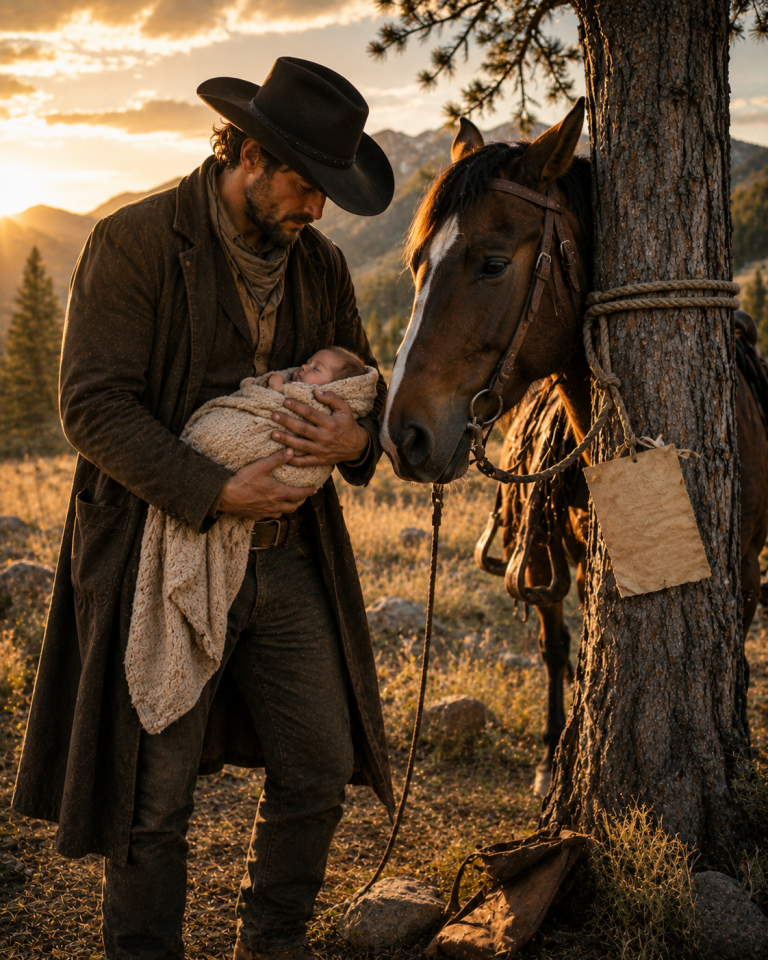
“JUST LET US STAY THE WINTER” — THE RANCHER TOOK IN A RUNAWAY WIFE AND HER THREE FRIGHTENED CHILDREN, NOT KNOWING WHO WAS STILL HUNTING THEM

PART 1
Cora’s hands shook so badly she nearly tore the paper in two pulling it free of the frozen post.
The notice had been nailed crookedly to the weathered board outside a feed store on the edge of town, stiff with ice, half buried under a drift of windblown snow. Its corners had curled in the cold, the ink run slightly where sleet must have caught it earlier in the week. She read it once, then again, then a third time, as though repeating the words might turn them into something more solid than hope.
*Wanted: cook for winter. Room, board, and honest wages. Marcus Reed. Broken Spur Ranch.*
*Honest wages.*
That phrase hit her harder than the rest. So much in her life had been bought, threatened, bartered, or simply taken that the word *honest* felt less like an employment term and more like a promise from a world she’d stopped believing still existed. She kept staring at the name and the place beneath it while the wind cut under her shawl and needled through the thin layers she’d managed to salvage before running. Behind her, in the broken wagon, her children huddled under blankets too worn and too few to keep out a Colorado winter already sharpening toward cruelty.
Their breath rose in pale little clouds.
Eli, ten years old and already carrying himself like someone twice that age, sat upright near the wagon’s rear board, watching the road both directions with eyes that had learned too early that danger often arrived looking perfectly ordinary. Lucy, seven, sat beside him with Charlie curled against her side. She hadn’t spoken in days. Charlie, only four, slept fitfully, one hand tucked under his cheek, the fading bruise on his temple still visible despite how Cora had tried to shield it under his cap and the folds of a blanket.
That bruise was the reason they’d run.
Once it had been purple and livid, shocking against the softness of his skin. Now it had gone yellow at the edges, which only made it worse somehow. Bruises on children should come from climbing fences too fast, falling out of trees, chasing chickens through muddy yards and misjudging a rut in the ground. They shouldn’t come from a father’s hand. A father’s temper. A father’s drunken rage.
Three nights earlier, Judd had thrown their son against a wall.
Cora had heard the sound before she understood what had happened — the hard, sickening crack of a small body against plaster — and in that instant something in her stopped enduring and started acting. She hadn’t paused to think about supplies, or money, or winter, or whether the mule could survive the road. She’d simply moved. Waited until Judd passed out in his chair, whiskey still on his breath and half a bottle still in his hand, then packed what she could carry, lifted Charlie while he whimpered in his sleep, woke Eli and Lucy without lighting a lantern, and left before dawn.
She hadn’t stopped moving in three days.
Now she stood in the wind with the notice in her hand, trying hard not to imagine what would happen if the job was already taken, or the rancher had changed his mind, or Marcus Reed took one look at a tired woman and three frightened children and decided they were too much burden for any winter wage to justify.
“Mama?”
Eli’s voice, from behind her. He never sounded like a little boy anymore, not really. Even before Judd nearly killed Charlie, Eli had spent too many years reading rooms the way other children read storybooks — learning from tone and posture when to stay silent, when to move his brother out of the way, when to stand between Lucy and whatever mood had walked into the house in their father’s boots. Fear had aged him in ways no child should have to bear.
“Is someone coming?”
Cora folded the paper carefully and tucked it inside her coat like it was less a notice than a document of survival. “No, baby,” she said, lying as gently as she knew how. “Not yet.” She lifted her chin toward the road disappearing into the pines and the drifts. “Get your sister and brother. We’re going to find this ranch.”
The road to Broken Spur Ranch took four hours through snow and bitter wind. The mule stumbled more than once, and each time Cora’s breath caught until the old animal found its footing and leaned back into the traces with renewed misery. The wagon wheels complained at every rut. The sky stayed low and colorless, a hard white ceiling pressing down over the land. Pine crowded the road in dark ranks, branches heavy with old snow, and every so often the wind shook loose a glittering cascade that hissed against the frozen ground.
Cora focused on the next mile. Then the next turn. Then the next shallow rise. She didn’t let herself think beyond those increments — the future had become too dangerous to hold all at once. The blankets were too thin. The provisions too low. The weather too strong. If she let herself think in days instead of minutes, she was afraid panic would take her legs out from under her and strand all four of them in the road.
Lucy sat unnaturally still the whole way. Her silence had become its own kind of injury. She’d once been a talkative child, forever asking about birds and recipes and whether summer would come sooner if she wished hard enough. Since the night Judd threw Charlie, she hadn’t spoken a single word — answered only with nods or shakes of the head, sometimes just stared. Cora knew silence could be fear turned inward. She knew it because she’d lived that way herself, in the early years of her marriage, mistaking quiet for peace until the quiet became habit and the habit became a cage.
Charlie slept, woke crying, slept again. Eli didn’t sleep at all.
When the ranch finally came into view, the sun was already sinking. Smoke rose from the chimney first, a thin gray line against the white. Then the house itself — solid, unadorned, built low and broad against the winter with the kind of practical strength that said a man had built it to outlast storms rather than impress neighbors. A barn stood not far off, red boards darkened by weather, corrals fenced clean and well-kept. There was order there. Usefulness. Warmth. Life that still believed in itself.
Cora pulled the mule to a stop at the gate and sat a moment with both hands wrapped around the frozen reins. This, she knew, was the point past which pride became a luxury she couldn’t afford. She could not leave without asking.
The barn door opened. A man stepped out — tall, broad-shouldered, moving with the grounded economy of someone used to work that punished waste. Heavy canvas coat lined with shearling. Snow clinging to his boots and trouser hems. His face looked like years of wind had carved it a little harsher than it might otherwise have turned out, but the hardness didn’t read as meanness. It read as endurance. His eyes were sharp, gray-blue maybe, though the fading light made the exact color impossible to name, and there was something in them — old fatigue, some buried grief — that kept him from seeming merely formidable.
He came toward the wagon slowly. “Ma’am,” he said, reaching the gate. “You lost?”
His voice was deep and even. Not warm exactly. Not hostile either.
Cora held his gaze, because lowering her eyes now felt too much like surrender. “No, sir. I saw your notice in town. You’re looking for a cook.”
PART 2
The rancher studied her. Then the wagon. Then the children. His eyes stopped on Charlie’s bruised temple. He said nothing for several long seconds.
“Name’s Marcus Reed.”
“Cora Bennett.”
He nodded once. “You came alone?”
“With my children.”
“Family nearby?”
“No.”
“A husband?”
Her throat tightened. “Yes.”
Marcus’s expression didn’t change. “Where’s he.”
She looked him dead in the eye. “I hope far enough behind us.”
Silence settled between them. The wind pushed snow across the yard. Marcus opened the gate. “Come inside before your little one freezes.”
The ranch house was warm — not luxurious, just honest. Woodsmoke. Fresh bread. Coffee. Everything smelled like survival. Cora stood awkwardly near the doorway.
“We can sleep in the barn if that’s easier.”
Marcus looked at her like she’d spoken another language. “Why would you sleep in my barn?”
“So we don’t trouble you.”
“You’re already here.”
She blinked. “I… don’t understand.”
“You answered my notice.”
“Yes.”
“I needed a cook.”
“Yes.”
“So you’ll sleep in the spare room.”
Cora stared. “There’s… one?”
“There’s three.”
She couldn’t stop herself. “Three?”
“My parents built this place.” His voice softened, almost imperceptibly. “They expected grandchildren.”
The words hung in the room. There weren’t any. She understood enough not to ask why.
Dinner was quiet. Eli barely touched his food until Marcus picked up his own fork; only then did the boy start eating, watching, measuring, always watching. Lucy stayed silent. Charlie fell asleep with mashed potatoes still on his spoon. Marcus noticed everything — including Cora cutting her own portion smaller each time the children asked for more. When everyone finished, only one biscuit remained. She quietly slid it toward Eli.
Marcus stopped her. “Aren’t you eating?”
“I’m not hungry.”
The lie was gentle. Practiced. He broke the biscuit in half, handed one piece to Eli, the other to Cora. “You’re too thin for someone who says she’s not hungry.”
She almost laughed. *Too thin.* No one had ever said those words to her before — not because she was actually thin, but because for the first time in years, somebody had looked past exhaustion and seen hunger there instead of just appearance.
That night Marcus checked the barn before bed and found Eli outside in the snow, holding an old shovel.
“What are you doing?”
The boy jumped. “Making sure.”
“Making sure of what?”
“No one’s coming.”
Marcus looked toward the dark road. “You expecting someone?”
Eli hesitated, then said quietly, “My father.”
The answer landed heavy. Marcus crouched until they were eye level. “Your mother says he doesn’t know where you are.”
“He always finds us.”
Marcus understood then. The boy wasn’t afraid of wolves. Or winter. He was afraid of one man.
“Not here.”
Eli searched his face. “You don’t know him.”
“No.”
“He’s bigger than you.”
Marcus almost smiled. “There aren’t many men bigger than me.”
The corner of Eli’s mouth twitched. Tiny. But real.
Three days passed. Cora cooked, cleaned, mended shirts, organized the pantry without being asked — worked like someone trying to earn permission to exist. Marcus found her scrubbing an already-clean floor.
“You’ve done enough.”
She didn’t stop. “I can do more.”
“You don’t have to.”
“Yes.”
“No.”
She finally looked up. “If I stop working—” her voice cracked “—people send us away.”
Something twisted painfully in Marcus’s chest. “No one is sending you anywhere.”
Lucy still hadn’t spoken. One afternoon Marcus found her in the stable brushing an old mare.
“You like horses?”
She nodded.
“They like you.”
Another nod. He reached into a storage chest and pulled out a tiny wooden horse. “Carved that years back.”
She stared at it, then carefully accepted it. Then, the smallest whisper: “Thank you.”
Marcus froze. Her first words. He smiled. “You’re welcome.”
PART 3
Winter deepened. Snow buried the fences. The ranch became its own small world. Eli learned to split kindling. Lucy helped bake bread. Charlie followed Marcus everywhere, asking impossible questions.
“Mister Marcus?”
“Yes?”
“Can cows get lonely?”
He thought about it. “Yes.”
“So can people?”
Marcus glanced toward the house, where Cora laughed quietly over rising dough. “Yes.”
“So that’s why Mama smiles here?”
Marcus couldn’t answer. The child had already answered it himself.
One bitter January morning, hoofbeats thundered across the yard. Cora saw the rider first, and everything drained out of her face.
Judd.
He dismounted laughing. “There you are.”
Charlie hid instantly. Lucy stopped breathing. Eli stepped in front of both of them.
Judd smiled. “You belong to me.”
Marcus walked onto the porch. “No.”
Judd looked him over. “And who’re you.”
“Marcus Reed.”
“The rancher.”
“Yes.”
Judd sneered. “She’s my wife.”
Cora finally spoke. “You lost that right.”
He ignored her. “She’s coming home.”
“No,” Marcus said.
Judd laughed. “You planning to stop me?”
Marcus stepped down into the snow. “No.” Another step. “I already have.”
Judd swung first. He never landed the punch. Marcus caught his fist, twisted, and dropped him into the snow with frightening ease. Judd reached for a revolver; Marcus kicked it away.
The sheriff, already riding up the lane with two deputies, watched the whole thing.
Cora stared. “The sheriff?”
Marcus nodded. “Sent for him the day Eli told me your husband always found you.”
Judd was in irons before sunset. Multiple warrants followed — debt fraud, domestic assault, horse theft. The law had been hunting him a good deal longer than Cora had ever realized.
Spring arrived with melting snow and green grass. One evening Cora stood on the porch watching the children chase calves through the pasture. Marcus joined her.
“Your contract ends tomorrow.”
She nodded. “Yes.”
Silence. Then she forced herself to ask, “We’ll leave at sunrise.”
Marcus frowned. “Why?”
“Because the job’s finished.”
He looked genuinely confused. “Wasn’t talking about the job.”
She stared. He cleared his throat. “Was wondering—” for perhaps the first time in his life, Marcus Reed looked nervous “—if maybe you’d stay.”
Cora’s eyes filled. “As cook?”
He shook his head. “No.” A pause. “As family.”
She covered her mouth, tears spilling freely. “The children?”
“All four of you.” He smiled toward the yard. “Gotten rather attached.”
Charlie ran over at that exact moment. “Attached means forever?”
Marcus laughed. “If your mama agrees.”
Charlie turned to Cora. “Well?”
She couldn’t speak. So she nodded, and the children erupted with joy. Eli hugged Marcus so hard he nearly lost his footing. Lucy cried openly. Charlie announced to every cow within hearing distance that they weren’t leaving.
They married beneath the cottonwoods that summer. Simple vows. Simple rings. Extraordinary peace.
Years later, people around town still remembered the widow who’d arrived begging for only one winter. What they never forgot was what Marcus Reed told her the day she apologized for taking up space in his home. He took both her hands and said, “You asked me for one winter.” He smiled. “I’ve been hoping for the rest of our lives.”
Sometimes a broken family doesn’t need saving.
Sometimes they only need one good man willing to open a gate and say, *come inside before your little one freezes.*
And that is how four frightened souls found home at Broken Spur Ranch.
THE END