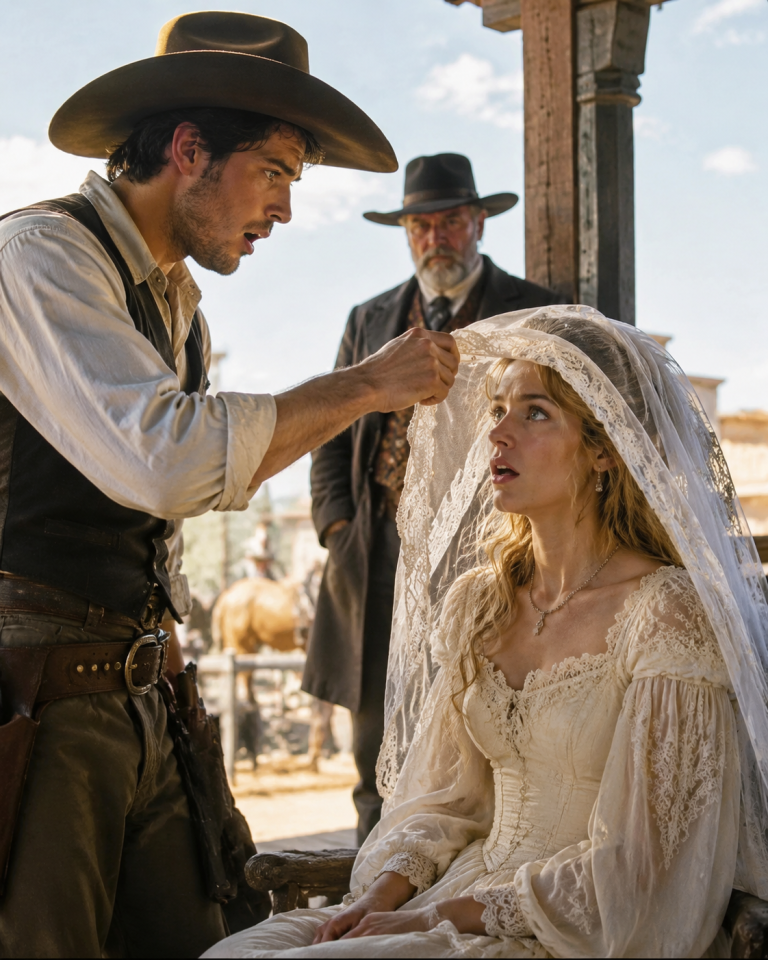
Her Father Chained Her Inside a Barn for Eleven Days — Then a Passing Rancher Heard Her Breathing

—
PART 1The smell reached him before the sound did — heat-baked wood, old sweat, something sour underneath that he recognized from field hospitals and didn’t want to name. Nate Brooks had no business being on Hail land. He’d only followed his mare’s skittish ears toward the leaning barn because something about the silence coming from it wasn’t the ordinary silence of an empty building. Empty buildings didn’t breathe.
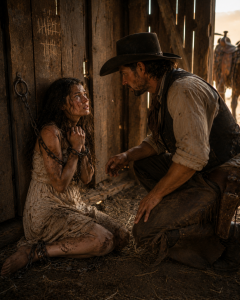
He pried the warped door wide enough to let the morning in, and the light fell across her like something accusing.
She was maybe nineteen, barefoot, her wrists raw where an iron ring held a chain bolted into the wall. Flies moved along a split in her lip that had scabbed and reopened more than once. She didn’t flinch from the sunlight. She didn’t flinch from him either. She simply looked up, the way a person looks up when they’ve run out of reasons to expect anything good.
“My father,” she said, before he’d asked a single question. “Three times a day.”
Nate had buried men in Tennessee mud. He thought he understood what fear looked like. This was something older than fear — a body that had learned exactly how much space it was allowed and had stopped testing the edges of it.
He crouched. The chain was short — too short for her to reach the door, long enough to let her curl up and sleep. Someone had measured that distance on purpose. Cruelty like that didn’t happen in a fit of temper. It happened slowly, with a ruler.
“What’s your name?”
“Rebecca. Rebecca Hail.”
He drew his knife and worked the blade under the bolt, prying until the old wood groaned and gave.
“How long?”
“Eleven days.” She said it flatly, like a number she’d recited so often it had stopped belonging to her. “My father carves marks in the wood. So I know when he’s coming.” She tipped her chin toward the post behind her. Three fresh scratches, cut clean and deliberate. “He’ll be back before noon. He always comes before noon.”
The chain dropped into the dirt with a sound far too small for what it meant.
“Can you walk?”
“I think so.”
He offered his hand. She didn’t take it. She pushed herself up on her own, knees buckling once before she caught the wall and steadied herself, chin lifting the way a person lifts their chin when they’ve decided that falling in front of a stranger is one indignity too many.
They made it six steps into the yard before a voice stopped them cold.
“That’s my daughter.”
Caleb Hail stood at the fence, thin and sharp-boned, whiskey riding off him even in the morning heat. His eyes did the fast, ugly arithmetic of a man calculating how much trouble was standing in his yard.
“Your daughter was chained to a wall,” Nate said.
“She’s unstable. You don’t know what she does.”
“I know what a chain does.”
Caleb lunged for her wrist. Nate caught his arm and twisted just enough to make him let go, dust rising around their boots while cicadas screamed in the trees like the whole prairie was watching and refusing to look away. Then Rebecca did something neither man expected — she scooped a fistful of dirt and threw it straight into her father’s eyes.
Caleb staggered back, cursing, clawing at his face.
“Run,” she whispered.
Nate didn’t wait to be told twice. He lifted her onto his horse and they rode, the Hail property shrinking behind them into a smear of heat and dust, until there was nothing left to look back at.
They didn’t speak again until his ranch came into view — sixty dry acres, a house, a stable, a well. Nothing grand. Quiet, though. Quiet had value he hadn’t known how to price until just now.
“He won’t let this go,” she said against his back. “He’ll tell the sheriff you kidnapped me.”
“Probably.”
“You should have left me.”
Nate stared down the long road ahead. “I spent three years telling myself other people’s terrible things weren’t my business,” he said. “I ain’t doing that again.”
He gave her the spare room, clean water in a basin, one of his shirts since her dress had torn beyond wearing. Over salt pork and silence, she finally asked him why he’d stopped at that barn at all.
“I heard breathing,” he said. “Most people hear it and keep walking.”
“Then most people are cowards.”
He asked her about the forty acres of river land her mother had left her — asked if that was what her father had really wanted.
She went very still. “He made me sign it over. On the eighth day. If I fight him in court, I lose the land to the bank anyway. There’s a lien. Six hundred dollars. My father buys it back cheap through another man once the bank forecloses.”
Rebecca looked at him across the table, and for the first time her voice cracked just slightly at the edges.
“My father counts the days,” she said. “Three marks every morning. So I know it’s starting again.”
“Then we stop the counting,” Nate said.
Neither of them saw it yet — but far down the road, past the treeline, a thin column of dust had already begun to rise into the morning air. And by the time it reached his doorstep, both of them would understand that walking away from that barn had not ended anything.
It had only just begun.
—
PART 2
The dust cloud reached the gate at sunrise. Sheriff Owen McGrath rode in on a gray horse, wearing the tired, unhurried face of a lawman who’d learned that arriving slow gave everyone time to see him coming and compose themselves. Rebecca stood on the porch beside Nate. She didn’t hide behind him.
“Morning,” McGrath said.
“Morning.”
“Got a complaint filed. Caleb Hail says you took his daughter off his land by force. Says you struck him.”
“She was chained to a barn wall for eleven days.”
McGrath’s eyes flicked to Rebecca’s wrists, where the bruising had already turned an old, yellow-green. “Miss Hail. Your father claims you’re unwell. Says he was keeping you safe.”
“He chained me,” she said, and her voice didn’t shake. “He carved marks in the wood so I’d know when he was coming back.”
McGrath shifted in his saddle. He played cards with Caleb’s brother-in-law twice a month. Everyone in that yard understood exactly what that meant, and no one said it out loud.
“I’ll ride out to the Hail place,” he said finally. “I’ll look at the barn.”
“He’ll clean it,” Rebecca said.
“Maybe. But I’ll look.”
He tipped his hat and turned back toward town. Rebecca watched him go with the flat certainty of someone who’d already learned what kind of help this county offered.
“He won’t help.”
“Maybe not,” Nate said. “But someone will.”
That afternoon they rode to the small shack behind the Hail property, where Tom Avery — Caleb’s stable hand, mid-fifties, the kind of quiet man who survived by never asking questions — went pale at the sight of her.
“You heard me,” Rebecca said. “Every night. You brought water once. Slid it under the door.”
Tom’s shoulders sagged. “I was scared.”
“I know.”
“We need you,” Nate said. “For the truth.”
“Caleb will kill me if I speak.”
“He can’t kill you from a cell.”
Tom stared at the bruises on her wrists a long moment before something in him gave the same way the barn bolt had. “I’ll come,” he said quietly.
The next morning they filed papers at the county clerk’s office — a counter-petition, the deed transfer entered under duress. The clerk hesitated before he stamped it. “Your father filed for guardianship yesterday,” he said.
Rebecca’s jaw tightened. “I am nineteen. I am of sound mind. And I was chained to a wall.”
The stamp came down louder than it should have.
Outside, Caleb was already waiting with two men flanking him — Dex Rollins and Pete Sutter, drifters with hard eyes and quicker tempers, the kind of men who worked for whoever paid first and asked questions never.
“My own daughter,” Caleb said, “filing papers against her own blood.”
“You let my mother die,” Rebecca said. The street went dead quiet. “You stopped me from riding for the doctor. You said she didn’t need him.”
“You don’t know what you’re saying.”
“I know exactly what I’m saying.”
Rollins stepped closer and Nate moved between them without a word. “That’s close enough.”
Caleb’s eyes went hard and flat. “This ain’t over.”
“No,” Rebecca said. “It isn’t.”
They rode home beneath a sky that felt too heavy for daylight, and neither of them spoke of what everyone in that street already understood — that a man who measured chain length to the inch was not a man who accepted losing quietly. Something was coming, and neither of them yet knew it would arrive that same night, with the smell of smoke.
—
PART 3
Just before midnight, the smell of smoke reached the porch where Nate sat with a rifle across his knees, and he was on his feet before conscious thought had caught up with instinct. Orange light flickered against the underside of the low clouds to the west. The stable was burning.
He was across the yard before he’d finished pulling on his boots, the night air already thick with the smell of scorched pitch and hay. Flame climbed the dry wood like it had been waiting all day for permission. Inside, the horses were screaming — a sound that never left a man who’d once heard it, high and human in a way animals shouldn’t be capable of.
Tom was already there, beating uselessly at the flames with a wet blanket, his face lit orange, sweat cutting tracks through soot. “Started at the far wall,” he shouted over the roar. “Someone poured something first — I could smell it before it caught.”
Nate kicked the door open and went through smoke thick as cloth, eyes streaming, throat closing around each breath. He found the first stall by touch more than sight, fingers finding the latch, hauling it wide. The gelding inside bolted past him into the dark, and Nate had no time to be grateful before he was moving to the next.
Rebecca appeared beside him without shoes, without hesitation, a scrap of her nightdress pressed over her mouth. She grabbed a halter off the wall peg and went straight for the mare in the corner stall, the most frightened animal in the barn, rearing hard enough to splinter the low rail in front of her.
“Rebecca — get out—”
“I’ve got her.” Her voice didn’t waver, not even as a burning strip of roof timber cracked and fell six feet from where she stood. She talked the mare down the way she must once have talked herself down through eleven nights of counted scratches — low, steady, relentless — until the animal’s ears came forward and she let herself be led.
They got the horses out. Every one of them. The roof came down behind the three of them in a collapse that sent sparks pluming into the black sky like something almost beautiful, if beauty were a thing anyone could afford to notice in that moment.
When the flames finally guttered low into a smoking, blackened frame, Tom found a paper nailed to the fence post near the road, half-scorched at one corner where someone had held a torch too close while pinning it. Five words, cut into the paper in a hand pressed hard enough to tear the fibers.
*Give back what’s his.*
Rebecca stared at the ruin, soot streaked across her cheekbones, her hands finally beginning to shake now that there was nothing left to save. “He burned your stable.”
Nate crouched and picked up an empty kerosene can lying half-buried near the fence line, turning it once in his hands before setting it back down like it was evidence in a trial that hadn’t started yet. “He’s desperate.”
“Rollins and Sutter were asking about this place in town today,” Tom said. “Before the fire. I should’ve said something.”
“You’re saying it now,” Rebecca told him, and something in the way she said it made the old man stand a little straighter.
She looked toward the treeline, where the road toward town disappeared into darkness. “He won’t stop.”
“No,” Nate said. “He won’t.”
She turned to him then, and there was something in her eyes brighter and harder than he’d seen there yet — the particular clarity of someone who has run out of patience for waiting to be saved. “Then we don’t wait for the circuit judge.”
Judge Amos Crane wasn’t due in Ellsworth for eight more days.
“Eight days is too long,” she said. “We ride to him.”
Nate studied her for a long moment in the dying orange light. The girl who’d been chained to a wall was gone. In her place stood someone who had already decided, with a clarity that frightened him a little, that she would not be hunted twice.
“We leave before dawn,” he said.
They didn’t sleep. There wasn’t time, and neither of them pretended otherwise. Nate spent what remained of the night moving what stock he could into the near pasture, checking the well cover, loading the wagon with what little they’d need for two hard days on the road. Rebecca sat at the kitchen table with the letters spread in front of her, reading them again and again by lamplight, not because she’d forgotten what they said but because rereading them was the only thing keeping her hands from shaking.
Near four in the morning, Tom found her there. He didn’t say anything at first — just set a cup of coffee in front of her and stood a moment, turning his hat the way he always did when he had something to say and no good way to start saying it.
“I should’ve come to you sooner,” he finally said. “First night I heard that chain drag across the floor, I should’ve come.”
“You came when it counted,” Rebecca said, not looking up from the letters.
“That’s a kindness. I don’t know that I’ve earned it.”
“Maybe not,” she said. “Doesn’t mean I can’t give it anyway.”
He nodded slowly, like that was an answer he hadn’t expected and didn’t quite know what to do with, and went back out to help Nate with the wagon.
—
They rode two days north through country that grew flatter and harder the further they went — dry creek beds, fence lines strung between fewer and fewer houses, the horizon a straight, merciless line broken only by the occasional windmill turning slow against a white sky. They slept in short shifts, taking turns keeping watch, saying little, both of them aware that every hour on the road was an hour Caleb spent free to try something worse than a burned stable.
On the second night, camped in a shallow draw with the horses hobbled nearby, Rebecca sat close enough to the low fire that Nate could see the marks on her wrists catching the light.
“Why’d you really stop that first morning?” she asked, not looking at him. “Most men would’ve kept riding. Told themselves it wasn’t their land, wasn’t their trouble.”
He was quiet a moment, turning a stick over in the coals. “There was a boy in my company. Tennessee. Everyone knew his sergeant beat him half to death some nights, and everyone found a reason not to see it. I told myself it wasn’t my place.” He looked up. “He didn’t come home. I’ve spent three years deciding I wasn’t going to be the man who told himself that twice.”
Rebecca didn’t answer right away. When she did, her voice was quieter than he’d heard it since the barn. “I used to think if I was quiet enough, careful enough, he’d stop needing to prove I was his to control. I know now that was never going to be true. Nothing I did was ever going to be enough, because it was never about me being good or bad. It was about him needing something to own.”
“You know that now.”
“I know that now,” she agreed, and for the first time since he’d known her, she let herself look tired instead of braced.
They reached Newton the following afternoon and found Judge Amos Crane in a boarding house near the rail depot — a spare, unhurried man with reading glasses pushed low on his nose, halfway through his supper when the landlady showed them in. He didn’t rise, didn’t offer pleasantries. He simply set down his fork and said, “Sit. Tell me why two people who look like they haven’t slept in two days rode this far to find me instead of waiting eight.”
Rebecca told him. All of it — the barn, the chain, the marks on the wood, the deed signed on the eighth day, the fire. She laid the letters on the table between them: correspondence between Caleb Hail and a land speculator named Lucius Ward in St. Louis, letters that spoke plainly of debt, of a forced transfer, of buying the land cheap at auction once the bank foreclosed on it. She laid down last a medical statement her mother, Margaret Hail, had filed months before her death — a statement expressing fear that her husband intended to alter or invalidate her will.
Judge Crane read every page twice. He asked no questions until he’d finished, and when he finally spoke, his voice had none of the weariness it had carried a moment before.
“I’ve read a great many petitions in this territory,” he said. “Most of them are men arguing over cattle and fence lines. This is not that.” He folded the papers with the same precise, unhurried care he seemed to bring to everything. “I’m moving my court session up. Two days. Tell Sheriff McGrath to secure the Hail property. Tell Caleb Hail to be in Ellsworth.”
On the ride home, Rebecca felt something she hadn’t felt in weeks — not safety yet, but momentum, which was its own kind of relief, distinct and hard-earned. They reached the ranch after dark. Nate checked every window and every lock twice before he’d let himself sit down. Rebecca stood in the kitchen holding her petition in both hands like it might still dissolve if she loosened her grip.
“My father counts the days,” she said quietly. “Three marks every morning. So I know it’s starting again.”
Nate met her eyes. “Then let’s make sure the next mark he carves is inside a cell.”
—
The Ellsworth courthouse was already full when Rebecca stepped through the door two days later. Word had traveled faster than dust on a summer road — farmers, ranchers, widows, storekeepers, all of them come to watch a story they’d only heard secondhand finally arrive in the same room as the people living it.
She wore a plain blue dress borrowed from Widow Milikin, simple fabric, but she held herself straight in it — no chains, no bowed head, nothing left of the girl who’d once measured her whole existence by three carved marks on a post. Nate followed a step behind her, quiet and steady, the way a person stands when they’ve decided their job today is to be a wall someone else can lean on if they need it, and otherwise to stay out of the way. Tom Avery came last, hat turning slowly in both hands, a man who had spent eleven nights being afraid and had finally run out of patience with his own fear.
Caleb sat at the front beside a lawyer brought in from St. Louis, his shirt clean, his boots polished, his whole bearing that of a man who still believed this was a story he controlled the ending of.
Judge Amos Crane entered without ceremony and without a single glance toward either side of the room. He opened the file.
“Rebecca Hail contests the deed transfer of forty acres along the Simmeron Fork,” he said. “She alleges unlawful confinement and coercion. Caleb Hail petitions for guardianship and accuses Nathaniel Brooks of kidnapping. We will hear testimony.”
Rebecca stood. The room’s noise fell away until there was nothing left but her voice.
“My father chained me in a barn for eleven days,” she said. “On the eighth day, he forced me to sign over my land. I signed because I believed I would never leave that barn alive.”
Doc Harland testified next, describing the marks on her wrists, the pattern of bruising consistent with sustained restraint — a clinical accounting that somehow landed harder in the silent courtroom than any raised voice could have. He spoke plainly, without flourish, the way a man speaks when he has decided that the facts themselves are damning enough and need no embellishing. Somewhere behind Rebecca, a woman she didn’t recognize began quietly crying, and no one asked her to stop.
Tom Avery stepped forward after him, hat still turning in his hands. “I heard her every night,” he said. “I saw the chain through the crack in the door. I was scared, and I did nothing for eleven days. That shame is mine to carry. But what I saw was real, and I won’t carry a lie on top of it.”
Caleb’s lawyer rose, smooth and unbothered. “My client restrained his daughter for her own safety. She has a history of instability.”
Judge Crane looked over the top of his glasses. “Where is that documented?”
The lawyer hesitated a beat too long. “It is the father’s testimony.”
“That is not documentation,” the judge said, and something in the room exhaled.
The lawyer tried a different angle, turning toward Rebecca with the practiced, careful sympathy of a man paid to sound reasonable. “Miss Hail. Isn’t it true that you and Mr. Brooks left the property together, alone, before any authority had reviewed the circumstances? That you didn’t wait for the sheriff, or for a magistrate, before removing yourself from your father’s household?”
“I didn’t wait,” Rebecca said, “because I had counted eleven mornings of marks on a post, and I did not intend to count a twelfth.”
A ripple of quiet movement went through the gallery — not quite laughter, but something close to it, the sound of a room siding with her before the judge had said another word. The lawyer sat back down without finishing whatever he’d meant to ask next.
Rebecca reached into her satchel and laid six letters on the bench — the correspondence between her father and Lucius Ward, spelling out in her father’s own handwriting a debt, a forced transfer, a plan to buy the land cheap through auction if the deed couldn’t be gotten any cleaner way. Judge Crane read them slowly, then lifted a second document.
“This is a medical statement filed months ago by Margaret Hail,” he said. “In it, she expresses concern that her husband may attempt to alter or invalidate her will.”
The color drained out of Caleb’s face. “She was sick,” he said. “She didn’t know what she was saying.”
Doc Harland rose a second time. “She was of sound mind. I wrote that statement myself.”
The silence that followed had a weight to it, the kind that settles into a room when everyone present understands, at the same moment, which way the truth has finally tipped.
Judge Crane folded his hands. “Caleb Hail. Did you restrain your daughter?”
Caleb looked at Rebecca, and for one unguarded second something like confusion crossed his face, as if he genuinely could not account for how this moment had arrived — as if in his own accounting, none of this had ever been meant to cost him anything.
“She was mine,” he said quietly. “The land. The house. The girl. It was all mine.”
Rebecca stood taller. “I am not property.”
Judge Crane nodded once, the small, final nod of a man who had heard enough. “The deed transfer is null and void,” he announced. “It was obtained under duress. The land reverts to Rebecca Hail immediately.”
A murmur swept the courtroom.
“The guardianship petition is denied. There is no evidence of mental incapacity.” He turned a page. “The kidnapping charge against Nathaniel Brooks is dismissed. Mr. Brooks removed Miss Hail from unlawful confinement.”
The gavel came down.
“Sheriff McGrath — arrest Caleb Hail for unlawful confinement, assault, and coercion.”
McGrath stepped forward. Caleb didn’t fight him. As he passed Rebecca, he stopped, close enough that she could still smell the whiskey under the courtroom’s stale heat.
“You’ll regret this,” he said.
She met his eyes without flinching, for what she understood, standing there, might be the last time she’d ever have to. “No,” she said. “I won’t.”
—
The courtroom emptied out into a Kansas sun that felt somehow different than it had that morning. Rebecca stood on the courthouse steps and breathed it in — no ticking clock, no carved marks counted against her, nothing overhead but open sky.
Behind her, townspeople she’d never spoken to touched her arm as they passed, murmured things she only half heard. Widow Milikin pressed her hand and said nothing at all, which somehow said more than words could have. Somewhere down the steps, McGrath was loading Caleb into a wagon bound for the county jail, and Rebecca made herself watch it happen — not out of cruelty, she realized, but because some part of her needed to see it with her own eyes before she’d believe it was real.
Nate stood beside her without touching her, giving her the same quiet room he’d given her that first night at the ranch.
“What now?” he asked.
“Now I go home,” she said. “To my mother’s land.”
“You want company on the ride?”
“I want you there,” she said. “That’s different from wanting company.” It was the closest she’d come, in all the weeks since the barn, to telling him plainly what he’d become to her — not a rescuer she owed a debt to, but someone she’d chosen to keep close.
They rode east together, Tom going on ahead to open the house. When Rebecca stepped through the doorway of the place her mother had left her, she paused on the threshold long enough to press her palm flat against the frame, feeling the grain of the wood under her fingers. This house had once been the thing her father tried to take by breaking her. Now it was hers, plainly and legally and without a single chain attached to it.
That first week, ranchers began riding up the road to ask about water rights along the Simmeron Fork — worth real money to men whose cattle needed it in the dry months. Nate suggested leasing access instead of selling any part of the land outright: five dollars a head, per season, paid up front. Within a month Rebecca had enough contracts signed to clear the bank lien in full. The debt that had once been sharp enough to drive her father to lock her in a barn was paid off clean, in daylight, with her own name on every paper.
But something else began happening too, something neither of them had planned for. A young widow rode up one afternoon with nowhere else to go. Then a woman with two children close behind her. Then a girl no older than sixteen with everything she owned tied behind her saddle. They had all heard about the trial — about the girl who’d been chained in a barn and had ridden two days to find a judge rather than wait to be saved.
Rebecca looked at her mother’s house — four rooms, a wide porch, walls strong enough to hold more than one story — and two weeks later nailed a hand-lettered sign above the gate.
*Open Door.*
Women came and went after that. Some stayed a single night. Some stayed a season. A few never left at all. Sarah kept the books, careful with every dollar the way someone is careful who has once had nothing. Charlotte baked bread that filled the whole house with a warmth that had nothing to do with the stove. Tom repaired fences and fixed broken wheels without ever being asked twice, quietly working off a debt only he still believed he owed.
Rebecca made a rule for the house early on, and she never broke it: no one who came through that gate was asked to explain herself twice. She had spent eleven days being asked, by silence and by chain, to justify her own existence, and she would not build a place that did the same to anyone else. What she offered instead was simpler — a bed, a door that locked from the inside only, and time. Time enough for a woman to decide, on her own terms and in her own hour, what came next.
The house that had once been built to hold a family had become, instead, a place that held whoever needed holding.
One evening months later, Nate stood beside Rebecca on that porch, watching lamplight move behind the windows of a house full of women who were no longer anyone’s property.
“Marry me,” he said, simply, the way he said most things.
She shook her head. “Not yet.”
“All right.”
He didn’t push. That, more than anything he could have said, was the answer that mattered to her.
Winter came and went. The water leases held. The boarding house grew stronger, its reputation traveling the same dusty roads that had once carried word of Rebecca’s trial. In spring, Nate asked again.
“Marry me.”
She studied him a long moment, the way she’d once studied the length of a chain to see exactly how far it would let her go. “If I say yes,” she said, “it won’t be because I need saving. It’ll be because I choose you.”
“I understand.”
She smiled then — fully, for the first time since the morning he’d pried open that barn door and found her breathing in the dark.
“Yes.”
They married in Ellsworth with Judge Crane in attendance, standing at the back of the small church with the same unhurried patience he’d once brought to a courtroom full of letters and evidence. The land stayed in Rebecca’s name, exactly as she’d insisted it would. The sign stayed above the gate.
Years later, people in that part of Kansas still told the story, though it had worn smooth and changed shape the way stories do when they’re told often enough around enough different tables. They didn’t tell it as a rescue story anymore. They told it as the story of a girl who had counted scratches on a wooden post and then, one morning, simply stopped counting. They told of a rancher who heard breathing behind a barn door and didn’t walk on past it. They told of a stable hand who found his courage a little late, but not too late to matter when it counted.
And they told, always, of a house standing at the end of a dusty road with four rooms and a wide porch and a sign nailed above the gate that never came down, not once, not in all the years after —
*Open Door.*
Because once Rebecca Hail walked out of that barn, no one would ever lock her behind a wall again.
THE END