A Waitress Brings Her Child to Work—Then the Mafia Boss Is Found Cradling Her Baby

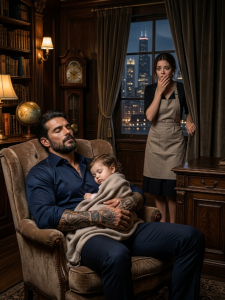
## PART 1
The baby was asleep in a produce crate lined with a folded apron, and Dante Sears found her at 11:40 p.m. on a Thursday.
He had come down to the kitchen because he couldn’t sleep, which was itself unusual — Dante slept the way men slept who had made enough decisions to be at peace with all of them. But something had been wrong with the air all night, that particular density that preceded bad news, and rather than lie in it he had come downstairs.
The kitchen at the back of Sear’s — his restaurant, the one that was also not a restaurant — was empty except for a prep cook finishing stock and the produce crate sitting in the corner of the walk-in passage.
The baby inside it had dark hair and a very serious expression even in sleep.
She had her small fist pressed to her cheek like she was thinking over a problem.
Dante stood looking at her for longer than made sense.
Then he went to find the prep cook.
The prep cook, whose name was Tomás and who had worked for Dante for six years and possessed the self-preservation instinct to never lie to him, said: “She belongs to Clara. The waitress. Her neighbor got hurt. She didn’t have anywhere—” He stopped. Reconsidered. “She was going to leave the minute her section was covered.”
Dante looked at him.
“She’s still on the floor?”
“She tried to — yes. She didn’t want to lose the shift.”
Dante turned and walked back through the kitchen.
At the pass, he found Clara Webb in the middle of carrying a tray of desserts that would have fed a family for three days. She was twenty-four or twenty-five, auburn-haired, wearing the focused expression of someone doing three calculations simultaneously — table position, her section timing, and whether the sleeping child two rooms away was still sleeping.
She had been invisible to him until this moment, which was what she had intended.
He waited until she set the tray down, then said, “Come to my office.”
She turned.
He watched her do the math. Boss. Office. Baby in the kitchen. Shift she needed. All of it in approximately one second.
“I’ll just get my—”
“Now,” he said.
She came.
In the office, which was clean and dark and smelled of old paper, she stood with her hands at her sides and her chin at the precise angle of someone who was not going to apologize for anything.
“I know it was wrong,” she said. “I’m sorry. It won’t happen again.”
Dante looked at her.
“Sit down,” he said.
She sat with the particular careful speed of someone who had not eaten since noon and was trying not to show it.
He poured water from the carafe on his desk and set it in front of her.
She stared at it.
“Your neighbor,” he said.
“Mrs. Garza. She slipped on the steps this morning. Her knee.” Clara wrapped both hands around the glass. “I’ll find a solution before tomorrow. I wasn’t going to make it a habit.”
“I didn’t ask.”
“You were—”
“I was getting to it,” Dante said.
She was quiet.
He looked at her the way he looked at most things in this room — not with judgment, but with the specific attention of a man cataloguing the shape of a problem.
“Who watches her usually?”
“Mrs. Garza.”
“The father?”
Clara’s jaw adjusted fractionally. “Not in the picture.”
Dante heard the answer she was actually giving and accepted it.
“Her name?”
“Ava.”
“Age?”
“Fourteen months.”
He leaned back. Looked at his desk. Looked at the rain on the window.
“You’re keeping your shift,” he said. “One of my people will stay with her.”
Clara stared at him. “I’m not leaving my daughter with a stranger.”
“Tomás’s wife is upstairs. She has four grandchildren.”
Clara opened her mouth.
Closed it.
“Why?” she said.
Dante had been asked that question enough times to recognize the specific weight it carried when a person had been failed too often to accept help without looking for the trap.
He looked toward the window.
“I had a younger brother,” he said. “He used to sleep with his fist against his cheek. Like he had something to figure out.” He was quiet for a moment. “He’s been missing for sixteen months.”
Clara said nothing.
He looked back at her.
“His name was Jesse.”
The quality of Clara’s silence changed.
It became different — not quieter, but denser. The silence of someone holding still because movement would give something away.
Dante noticed it immediately.
He always noticed small things. It was why he had survived this long.
“That name means something to you,” he said.
She shook her head.
“Clara.”
“It’s a common name.”
“Not the way you heard it.”
She looked at the glass of water.
Dante said, very quietly: “Ava’s father.”
Clara stood up so fast the chair scraped backward.
“I’m going to get my daughter—”
“Sit down.”
“I’m not—”
“I am not going to hurt you,” Dante said. “I am not going to hurt her. If Jesse was her father and he was my brother, that makes her my niece, and I have never in my life harmed family.”
Clara stood at the edge of the desk, trembling in a way she was trying to conceal.
“He told me he was a mechanic,” she said.
“He was. For a while.”
“He never mentioned a brother.”
“He wouldn’t have.”
“Why?”
Dante looked at her steadily. “Because my name carries weight. He wanted to be ordinary. He let you think he was.”
Clara’s throat moved.
“He left before she was born.”
“I know.”
“You knew?”
“I knew he disappeared. I didn’t know why.” Dante paused. “Until now I thought it was because of something he stole from me.”
“He stole from you?”
“A ledger. Names. Accounts. Records that could burn half this city.” He held her gaze. “I thought it was greed or cowardice. Now I wonder if it was something else.”
Clara sat back down slowly.
Ava was still asleep two rooms away. The restaurant hummed distantly around them. The rain had thickened against the glass.
“He left a note,” Clara said.
Dante waited.
“It said: don’t look for me, keep her safe, I’m sorry.” Her voice was controlled and very tired. “I hated him for sixteen months because of that note.”
Dante said nothing for a moment.
Then his office phone rang.
He answered, listened for twelve seconds, and his expression changed in the specific way that faces changed when information arrived that confirmed the worst version of a question you’d been afraid to ask.
“Tell me,” Clara said.
Dante set the phone down.
He turned his laptop toward her.
On screen was a photograph. Recent date stamp. A man she recognized — thinner, bearded, bruised — stepping into a black car outside a motel.
Clara’s hand went flat on the desk.
“He’s alive,” she said.
“Yes.”
“That’s Marcus Duval’s car.”
Dante looked at her sharply.
“You know that name?”
“Jesse used to turn off the radio when it came on.” She looked up. “He was scared of him.”
Dante stood.
Before he could speak, Clara’s phone buzzed.
She looked at the screen.
The message was from an unknown number.
*Jesse says hello.*
The blood left her face.
Dante took the phone, read it, and set it down.
“We need to move,” he said.
“To where?”
“Somewhere they won’t expect.” He crossed to the door, opened it. “Bring Ava.”
Clara rose.
“Who sent that?”
Dante’s voice was flat. “Men who want to know if you’re leverage.”
He looked at her.
“Are you?”
Clara thought of Ava asleep in a produce crate with a folded apron for a mattress, fist against her cheek, trusting the world to hold still while she figured things out.
“Yes,” Clara said.
“Then we move.”
—
## PART 2
The building above the restaurant was not the building anyone’s paperwork described.
The paperwork described storage. The reality was three secured floors with coded doors, clean rooms, and the kind of quiet that came from very good construction and very deliberate planning.
Clara sat on a couch on the second floor with Ava warm and drowsy against her chest, watching Dante’s second-in-command, a composed woman named Nadia, make phone calls across the room with the efficiency of someone who had done this before.
Dante stood by the window.
He had not spoken for six minutes.
Clara was counting because silence from powerful men had a texture she had learned to read.
“Tell me about the note he left,” Dante said.
“I already—”
“The exact words.”
Clara looked at her daughter’s sleeping face. “Don’t look for me. Keep her safe. I’m sorry.”
“Not — I love you.”
“No.”
“Not — wait for me.”
“No.”
Dante turned from the window. “That’s not how Jesse wrote to people he loved. He was specific. He would have said what he meant.”
Clara understood what he was saying.
“You think it was instructions.”
“I think *keep her safe* was the only line that mattered. The rest was cover.” Dante crossed to the desk, opened a drawer, and produced a photograph. He set it on the table.
A younger Jesse. Laughing. Beside a taller man with dark eyes and the posture of someone who had been told from childhood to take up space.
Clara picked it up.
“That’s you,” she said.
“Three years ago.”
“He looks—” She stopped.
“Happy?” Dante said. “He was, then.”
Clara set the photograph down.
“What did he steal?” she asked. “The ledger. What’s in it.”
Dante studied her.
“Names of men who run this city from positions where they’re supposed to be preventing exactly that. Judges. A deputy commissioner. Three aldermen. A federal prosecutor.”
Clara went still. “A federal—”
“Agent Marsh,” Dante said. “Who appeared at my bar tonight and was not there for me.”
“He was there for me?”
“Your name was in a sealed file that was opened this morning.” Dante sat across from her. “Either Jesse was working with Marsh, or Marsh found out about you through someone who was watching Jesse.”
Nadia’s voice came from across the room. “Or both.”
Clara looked at her.
Nadia set her phone down. “The man who sent that message from Moretti’s crew — we pulled the booth camera. He was at the bar with Marsh for twelve minutes before he sat down.”
Dante’s expression flattened.
“Then Marsh knows where Jesse is,” Clara said.
“Yes.”
“And Marsh is—”
“Crooked. Or compromised. Or both.” Dante’s jaw worked. “I’ve known Marsh for seven years. He’s been a thorn in my side for six of them.”
“And the seventh?”
Dante was quiet.
“He helped me once,” he said. “With something that had nothing to do with the law.”
“Something personal.”
“Something about Jesse.”
Nadia crossed to the desk and set down her phone, screen up.
On it was a text from an unknown number.
A video.
Dante played it.
Jesse appeared, lit by a bare bulb. Bruised. Bearded. But his voice when it came was the same voice Clara had heard in a kitchen when he cried into his hands over an ultrasound photo.
*Dante. If you’re watching this, you found her.*
He swallowed.
*Don’t trust Marsh. Don’t trust Duval. And don’t trust the woman you call Nadia.*
The video ended.
Every person in the room turned toward Nadia at the same moment.
Nadia looked at the phone.
Her expression did not change.
Dante’s voice was very quiet. “How long?”
Nadia said: “Longer than you’re comfortable with. For reasons you won’t like.”
“Tell me anyway.”
“Not yet.” She looked at Clara. “First, you need to know they have a second plan.”
Clara asked, “What plan?”
Nadia met her eyes.
“They know where Ava was tonight. And they know she’s here now.”
Clara looked down at her daughter.
Ava shifted in her sleep.
“They want the ledger,” Nadia said. “They’ll trade Jesse for it.”
“I don’t have the ledger,” Dante said.
“They don’t know that.” Nadia picked up her coat. “Or they don’t care.”
Then the building alarm went silent.
Not triggered.
Cut.
Clara felt it the way you felt a held breath.
Dante was already moving.
He reached the door and opened it on empty hallway.
No guards.
“Nadia,” he said.
Nadia was gone.
On the floor where she had been standing, Ava’s silver rattle — the one that had belonged to Jesse, that Dante had kept in his desk for sixteen months — lay on the carpet.
And Ava was still in Clara’s arms.
Clara’s pulse slammed.
Not because the rattle was there.
Because it hadn’t been there a minute ago.
“She left it,” Clara said.
Dante looked at the rattle.
“Yes.”
“Why would she—”
His phone lit up.
Unknown number.
A message: *The child for the ledger. St. Cecilia’s, midnight. Come alone.*
Then another: *Or we bring the old man to her.*
Clara looked at Dante.
“Who is the old man?”
Dante sat down.
He looked like a man who had just been handed back a piece of himself he had buried deliberately.
“My father,” he said. “Who died in prison.”
He looked at the message again.
“Or didn’t.”
—
## PART 3
**What Owen Sears Had Actually Built**
Clara did not ask permission.
She left Ava with Tomás’s wife on the floor above, kissed her daughter’s head seven times, and was back downstairs before Dante had finished arming himself.
He looked at her.
“She knows my voice,” Clara said. “If she’s frightened.”
“This isn’t negotiable—”
“No,” Clara said. “It isn’t.”
He studied her for one more second.
“Behind me,” he said.
“No promises.”
They went out through the kitchen.
—
St. Cecilia’s was a neighborhood church on the South Side that smelled of old candles and the particular cold of stone buildings in winter. The pews were empty. The stained glass fractured the streetlight into colored strips across the marble floor.
A man sat in the front row.
Clara knew him before she reached him, the way you knew someone whose absence had shaped you — from the angle of his shoulders, the way he held his hands in his lap.
Jesse.
He turned when he heard her steps.
The bruise along his jaw had yellowed. His beard was longer. His eyes, when they found her, broke open in a way that the rest of his face couldn’t contain.
“Clara,” he said.
She stopped.
She had imagined this moment approximately nine hundred times across sixteen months of feedings and bills and colic and the specific silence of an apartment with only one adult in it.
In most versions, she said something devastating.
What came out was: “You look terrible.”
Jesse laughed once, broken.
Dante said, from behind her: “Where’s our father?”
Jesse stood. “He’s coming.”
“You called him.”
“I needed time with you first.”
Dante crossed the distance between them in three strides and pulled his brother into an embrace that lasted four seconds and said everything neither of them was going to say out loud.
Jesse gripped the back of his jacket.
Then they separated.
Jesse looked at Clara.
“I found out what he was capable of,” he said. “Owen. I found a name in your medical file. Your prenatal clinic. He had people watching you before I’d even told anyone you were pregnant.”
Clara’s breath went shallow.
“He sent me a photograph,” Jesse continued. “You asleep. In our apartment. Then one of you at the pharmacy. Then one of Ava at your neighbor’s building — after she was born.”
“He knew about Ava.”
“He’d been watching from before. When I realized the ledger proved his connections to every corrupt institution in this city — not just Dante’s business, but Owen’s own network — he found out I knew. So I ran.” Jesse’s jaw tightened. “Not away from you. I thought I was running toward the only thing that could end it quickly enough to come back.”
“And instead?” Clara said.
“And instead it’s been sixteen months.”
“Yes.”
Jesse looked at his daughter’s absence — the empty space in Clara’s arms where Ava had been when he’d imagined this.
“Is she—”
“She’s safe. She’s not here.”
Something in him released.
“She has your eyes,” Clara said.
Jesse’s face broke again, just briefly.
“My fist,” Dante said.
Jesse looked at his brother.
“She sleeps like you did,” Dante said quietly. “Face serious. Like she’s working something out.”
Jesse looked down.
The church held its silence around them.
Then a door at the back opened.
—
Owen Sears had not died the way prisons usually killed men — slowly, by degree. He had simply left, which was apparently a thing he had arranged with the systematic patience of a man who had been planning it longer than anyone realized.
He was older than Clara had imagined from context. A big man, still broad despite age, with white hair and eyes the color of worn iron. He walked with a cane he probably didn’t need.
Nadia was with him.
And two of Duval’s men.
Owen stopped in the aisle and looked at his sons the way parents looked at things they had made and remained dissatisfied with.
“Both of you,” he said. “In the same room. I had to manufacture a crisis.”
Dante said: “Where is the ledger.”
“With me.”
“There is no ledger with you. I know where I keep things.”
Owen smiled faintly. “Nadia made a copy eighteen months ago.”
Dante looked at Nadia.
Nadia looked at him with the expression of someone who had made a choice they weren’t going to apologize for.
“You were getting close to the edge,” she said. “If Owen surfaced without leverage, you would have gone after him without thinking. I needed him to believe he had something to offer.”
Owen’s smile thinned. “Interesting interpretation.”
“It’s the accurate one,” Nadia said.
“She played both sides,” Owen said.
“I played the side that ends with you in custody rather than in a grave,” Nadia said. “Which is harder and less satisfying for everyone involved, but significantly more useful to Dante’s actual situation.”
A pause.
Owen looked at Jesse.
“You stole from your own family.”
“I stole evidence of what you did to people outside it.”
“I built everything you have.”
“You built it on men who are dead because of you.” Jesse didn’t raise his voice. “I’m not going to thank you for the inheritance.”
Owen’s face hardened.
He looked at Clara then, for the first time.
The look was assessor’s look — cataloguing, measuring.
“The waitress,” he said.
“Clara Webb,” Clara said.
“The child’s mother.”
“The child’s mother.”
“She isn’t here.”
“No.”
Owen tilted his head. “You would have brought her, to leverage you.”
“I know,” Clara said. “That’s why she isn’t here.”
He almost looked impressed.
“Smart woman.”
“Smarter than the men who assumed I’d do what they predicted.”
Owen looked at Dante.
“You always did find people who argued back.”
“It serves me well,” Dante said. “Give Nadia the copy.”
Owen looked at him.
“And if I don’t?”
Dante said nothing.
Owen waited.
Then from the vestibule came the sound of footsteps — careful, multiple, the disciplined rhythm of people who had been in position for some time.
Federal agents.
Agent Marsh appeared through the side door, which was when Clara understood the shape of what had actually happened tonight.
Marsh’s expression, when he saw Owen, was the expression of a man who had been building something for a very long time.
“Owen Sears,” Marsh said. “You’re under arrest.”
Owen looked at Dante.
“You called them.”
“Nadia did. Sixteen months ago, she came to me with a choice.” He paused. “I took longer to make it than I should have.”
Owen looked at each of his sons.
Something moved through his face that Clara could not immediately name — not guilt, not grief, something older. The look of a man who had reduced love to function for so long he had forgotten how to recognize it when it came back.
“I would have given you the empire,” he said to Dante.
“I didn’t want an empire,” Dante said. “I wanted my brother back.”
Owen was silent.
Marsh’s agents moved in.
Nadia handed the copy to Marsh before the first cuff clicked.
—
**What Came After**
Jesse turned himself in the following morning.
He did it voluntarily, with the specific clean-cut quality of a decision that had been made long ago and was simply finally being enacted. Nadia had arranged a cooperation agreement in advance. His testimony was the piece that made the case against Owen coherent — not just the ledger, but the timeline, the connections, the mechanics of how a man had run a shadow operation from federal custody for over a decade.
It was not a short sentence.
But it was finite.
Clara spent three days angry about that — not at the sentence, but at the sixteen months before it. She spent those days honestly, without performing forgiveness she didn’t feel yet, and Jesse received her anger without defense because he understood that receiving it was part of what he owed her.
On the fourth day, she brought Ava.
They met in a supervised room with gray walls and a table that had seen better years. Jesse sat across from her and Clara placed Ava on the table between them.
Ava looked at him.
She looked the way Ava looked at everything new — with complete seriousness, the small fist pressed to her cheek, working it out.
Then she said, “Da.”
Clara put her hand over her mouth.
Jesse stared at his daughter.
“I didn’t—” He looked at Clara. “Did you teach her that?”
“She figured it out from photographs.”
Jesse covered his face with both hands and cried.
Ava watched him with the fascinated concern of someone who did not yet understand adult emotion but found it deeply interesting.
Then she patted his wrist.
Clara sat with the broken and the intact parts of what had been between them and decided, not for the last time, that she did not need to resolve them all today.
—
Dante came to the bakery on a Saturday.
There was no bakery yet — Clara had only been thinking about it for three weeks, a half-formed thought about the lease on the corner shop she walked past every morning. She had mentioned it to Tomás’s wife, who had mentioned it to Tomás, who had apparently mentioned it to Dante.
He came in through the front door of the empty space with his hands in his pockets and looked around at the bare walls and the cold smell of vacancy.
“You’d need to gut the counter,” he said.
Clara turned from the window. “I’m aware.”
“And the electrical.”
“Also aware.”
He looked at the back room. “Good bones.”
“That’s what I thought.”
He was quiet for a moment.
“Jesse asked me to check on you,” he said.
“I know. You’ve been doing it twice a week for a month.”
He looked at her.
“You noticed.”
“I notice things,” Clara said. “It’s what I did to survive your restaurant for six months without anyone realizing I had a baby.”
Something almost lightened in his face.
“You were very good at it.”
“I was excellent at it.” She folded her arms. “You want to know something?”
“Yes.”
“The night I brought Ava in, I knew the produce crate was visible from the hallway. I knew you or someone else would find her eventually.” She looked at the window. “I was so tired. I had run out of options and I didn’t know who you were as a person yet, only who you were by reputation, and I brought her anyway because I needed someone to see that she existed.”
Dante was quiet.
“Someone to know that she mattered enough to be seen,” Clara said.
He looked at her.
“She does,” he said.
“I know that now.” She turned. “She has for a while.”
He reached into his jacket and set a key on the dusty counter.
Clara looked at it.
“This building is in a trust,” he said. “Held in Ava’s name, technically, which makes the paperwork unusual but legal.” He looked at the ceiling. “The lease is paid through the next three years. What you do with it is your decision.”
Clara stared at the key.
“Dante.”
“It’s not charity.”
“It looks like charity.”
“It’s a debt.” He picked up the key and held it out. “My family took something from you. Sixteen months that were not yours to carry alone. This doesn’t repay it. But it’s a start.”
Clara looked at his hand.
The key was small. Plain. Nothing like the enormous machinery that had surrounded her for the past weeks — the trials and the testimony and the city rearranging itself around a ledger that had always existed but had finally been read aloud.
She took the key.
“Ava calls you ‘Da,'” Clara said. “She does it for everyone tall and dark-haired. She also does it for a ceiling lamp in the kitchen.”
Dante looked at her.
“So I would not read too much into it.”
He almost smiled.
Almost.
“Understood,” he said.
“However,” Clara said, “she does recognize your face from the photograph I keep on the shelf. She points at it and says something that I think is meant to be your name but currently sounds like ‘Dah-tay.'”
Dante was quiet.
“She is fourteen months old,” Clara said. “She’ll get it.”
He looked at the photograph she was describing — the one from his office, the one of him and Jesse three years ago, which she had asked to borrow and he had given without asking why.
“Put the bakery wherever you want it,” he said.
“I intend to.”
He turned toward the door.
“Dante.”
He stopped.
“Thank you,” Clara said. “For the produce crate.”
He turned back.
“What?”
“For seeing her. That night. The way you came back and looked at her and didn’t immediately call someone to deal with the liability.” She held the key. “You came back and looked at her like she was a person.”
Dante’s expression shifted by the small amount it was capable of shifting.
“She reminded me of someone,” he said.
“I know,” Clara said.
He nodded once.
Then he left.
—
Three months later, the bakery opened.
The sign above the door read *AVA & COMPANY*, which had been Jesse’s suggestion, delivered via letter because that was how he communicated now — carefully, on paper, in handwriting that Clara kept in a box on the shelf next to the photograph.
The opening morning brought Tomás’s entire extended family, Agent Marsh (who appeared genuinely ashamed of being a customer at something good), and Nadia, who arrived precisely at nine with a wrapped gift and the composed expression of someone who had done difficult things for adequate reasons and had made peace with the ambiguity.
Clara met her at the door.
“The testimony helped,” Clara said.
“It was the right thing. Eventually.” Nadia held out the gift. “It’s a rattle. Jesse asked me to have it remade. The original was lost during everything.”
Clara unwrapped it.
Silver. Moon-shaped. The same as the one Dante had kept in his drawer for sixteen months.
“He kept it,” Clara said. “After Jesse disappeared. He kept it in his desk.”
“I know,” Nadia said. “I used to see him take it out when he thought he was alone.”
Clara held the rattle.
From the back room, Ava’s voice could be heard in conversation with the ceiling, which she had recently decided deserved commentary.
“Come in,” Clara said.
Dante arrived at eleven, without announcement, carrying nothing.
He stood in the doorway for a moment taking in the warm bread smell, the photographs on the wall, the chalk menu, the tables full of neighborhood people who had decided this was their place.
Ava saw him from the counter where Tomás’s wife was keeping her occupied with a bowl of raisins.
“Dah-tay,” Ava said.
Dante walked across the bakery floor and crouched to her eye level.
She offered him a raisin with the solemnity of a treaty negotiation.
He took it.
She clapped.
Clara watched from the counter with the silver rattle in her hand and thought about all the things that had come out of one produce crate, one note taped inside a cabinet, and one man who had looked at a sleeping baby with someone else’s face and recognized what she was before he recognized what she meant.
She thought about sixteen months of anger that had been, underneath, grief. About Jesse in his small room writing letters with the penmanship of a man practicing honesty. About Nadia making choices in the dark that nobody would understand until later.
She thought about Owen Sears in a courtroom, looking at his sons across a room that had the particular silence of consequences finally arrived.
She thought about Ava, who had not yet acquired enough language to understand any of it and whose current opinion on the matter was that raisins were good and the tall man crouching in front of her had a very interesting face.
Dante looked up.
Clara met his eyes.
He did not say anything.
Neither did she.
But later, when the bakery was closed and the tables were wiped down and Ava had been put to bed in the small apartment above, Clara found a message on her phone from an unknown number.
She almost didn’t open it.
Then she did.
It was one line, from a number she recognized as Nadia’s secondary phone.
*There was one more sealed file. Jesse asked me to wait until the opening.*
A photograph followed.
Dante, ten years old. A woman Clara didn’t recognize. A baby.
Then a second photograph. A document.
*SEARS, DANTE GABRIEL — BIOLOGICAL FATHER: UNKNOWN. ADOPTION FINALIZED.*
Clara sat down on the bakery floor.
She read it twice.
Then she put her phone face-down on the table and sat with the information for a while before she decided what it meant.
It meant that Owen had not been Dante’s father in any way that had ever done Dante any good, which she had already suspected.
It meant that the man who had spent sixteen months carrying his brother’s rattle in his desk drawer had been doing it without the biological claim he had believed in.
He had done it because Jesse was his brother.
Because that was enough.
Clara picked up her phone and typed a message.
*He already knows who he is. Don’t tell him unless he asks.*
Nadia wrote back: *That was my assessment.*
Clara set the phone on the counter.
Outside, the city moved through its ordinary late-night rhythms — traffic, voices, the distant river, the specific pulse of Chicago continuing its existence.
Above her, Ava slept with her fist pressed to her cheek.
Working out the problem.
Clara thought: *she’ll figure it out.*
She always did.
**THE END**
—
—