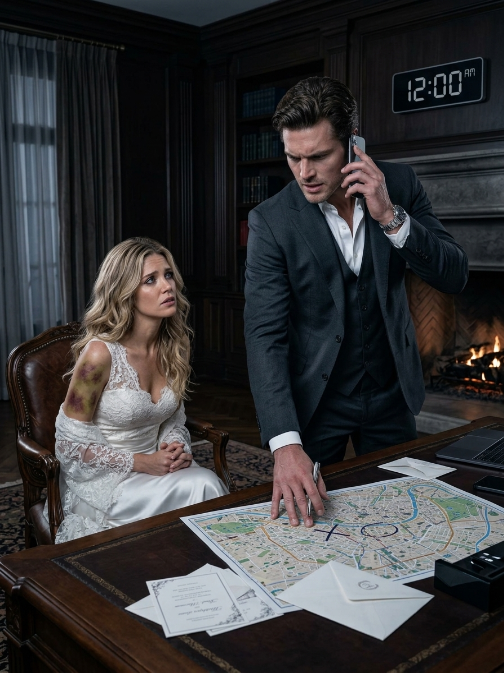
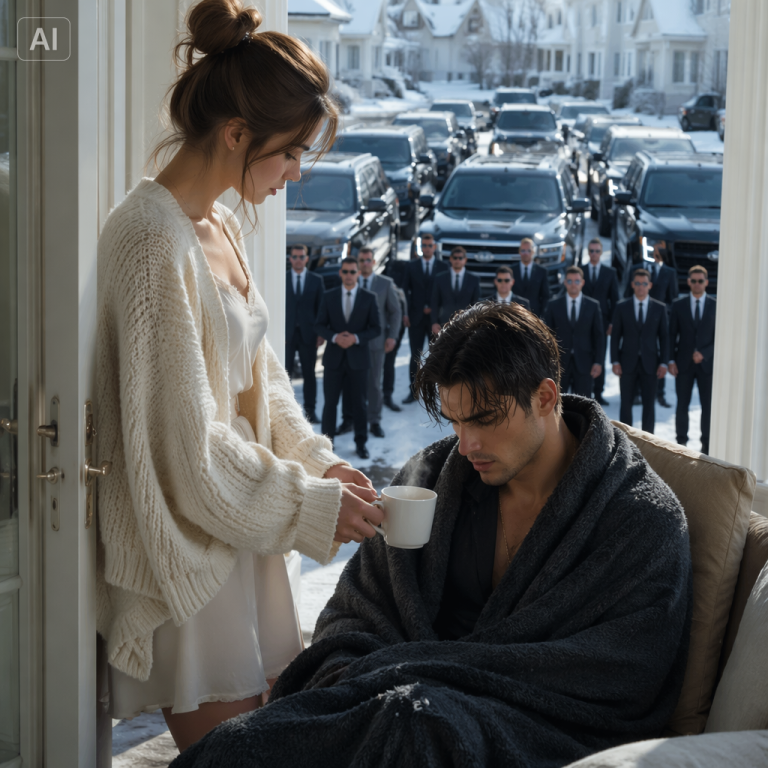
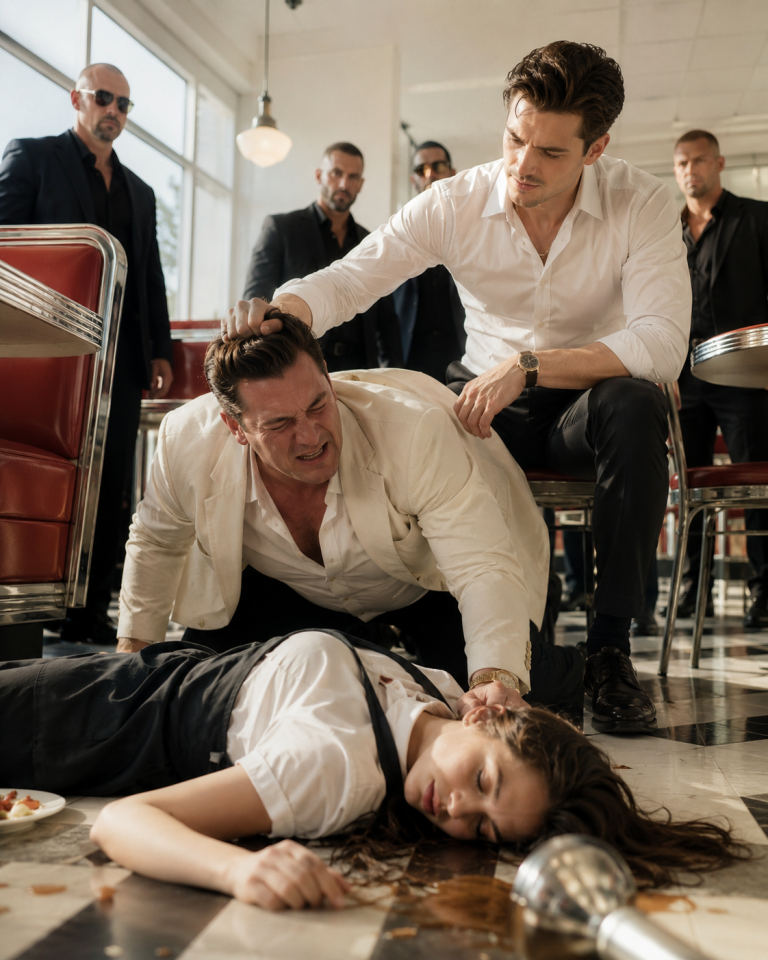
He Brought His Mistress to Their Anniversary Dinner — Then His Wife Threw Him Out of the Mansion Forever

PART 1
The ballroom of the Stratford Regency smelled of white lilies and something underneath them, something colder. Lakota Thorne stood at its center, framed by floor-to-ceiling windows fogged with Manhattan rain, and rotated a single crystal flute two degrees to the right until it sat perfectly on the head table.
“Mrs. Thorne.” Marcus Sterling crossed the empty hall toward her, tablet held against his chest like a shield. At fifty, silver-haired, impeccably dressed, he was the general manager of the hotel — and the only person alive who knew what today actually was. “The deed transfer finalized at four-forty-eight this afternoon. Halloway and Finch confirmed it in writing an hour ago. You’re the sole proprietor of the Stratford Regency and its sister properties in London, Paris, and Tokyo.”
“And Julian?”
“Still believes he secured this ballroom through a friend’s discount. Still thinks Vanguard Holdings owns the building. He has no idea the acquisition happened.”
“Good.” Lakota looked down at the street, where limousines were beginning to circle. Ten years of marriage to Julian Thorne, the architect who’d charmed New York’s investors and, more recently, a twenty-three-year-old design intern named Bella Sinclair. For six months Lakota had played the incurious wife — smiling at the perfume she never wore on his collar, nodding at the site visits that kept him out until three, signing whatever he slid across the breakfast table. He believed those signatures moved money into joint accounts for tax reasons. He didn’t know she’d read every page twice before signing, or that four months ago she’d hired a private investigator named Tobias Reed, who had quietly documented Julian’s affair — and a great deal else Julian didn’t know anyone was looking at.
“He wants Miss Sinclair seated at the main table,” Marcus said, checking the tablet. “Listed as executive assistant to the honoree.”
“The audacity is almost impressive.” Lakota’s laugh was dry, brittle. “He thinks I’m too polite to make a scene.”
“He’s not wrong. You’ve never made one.”
“I’m not going to make a scene, Marcus. I’m going to make an example.” She smoothed the velvet tablecloth. “When he orders the vintage, bring the 1996. All of it. Let the bill be memorable.”
By seven the guests were arriving, and Julian Thorne swept through the revolving doors like a man who believed the world was a film he was directing. Bella hung off his arm in aggressive red silk, eyes darting around the art deco lobby with a mixture of awe and entitlement.
“You rented the whole ballroom?” she breathed.
“For us,” Julian said, which was not the same as saying for my anniversary. His firm was hemorrhaging money, his debts were compounding, and he was leveraging assets he didn’t technically own — but nobody here knew that yet. “Remember,” he murmured, “up there you’re my executive assistant. Lakota’s fragile. We don’t want to upset her.”
“The boring wife gets the title, I get the fun,” Bella said, tracing a finger down his lapel. “When do you tell her?”
“After tonight. Once I lock in the investors, I’ll have the capital to buy her out.” He said it like he believed it. Believing his own lies was Julian’s one true talent.
At the top of the grand staircase, Marcus was waiting like a sentinel. “Mr. Thorne. Mrs. Thorne is already at the head table.” His gaze moved to Bella and didn’t blink. “I see you’ve brought additional staff.”
“My top assistant. Essential for networking.” Julian’s smile only faltered for half a second.
They entered. The room went quiet for one long heartbeat, then erupted into whispers — that’s not Lakota, is that the intern — and Julian ignored every one of them, steering toward his wife, who stood with her back to the rain-streaked window, city lights forming a kind of halo she hadn’t asked for.
“Darling.” He kissed her cheek. He smelled of scotch and audacity. “You look appropriate.”
Lakota let his lips graze cool skin, then let her eyes slide, unhurried, to Bella. “I see you brought work home with you.”
“Emergency briefing,” Julian said smoothly. “Bella has the files for the Skyline renderings.”
Bella extended a hand, nails lacquered the exact red of her dress. “Happy anniversary, Mrs. Thorne. Julian talks about you occasionally.”
Lakota looked at the hand. She picked up her water glass instead, took a slow sip, set it down. “You’re wearing red, Miss Sinclair. How brave. I usually reserve that shade for staff uniforms during the holidays.”
Bella’s face went pink. Julian hissed under his breath for his wife to be nice — she’s here to help secure our future — and Lakota, finally, smiled. It did not reach her eyes.
“Please, sit,” she said. “I wouldn’t want either of you to miss the show. I have a feeling tonight is going to be very educational.”
She gestured to the chairs. Husband, wife, and mistress, breaking bread in front of two hundred witnesses. A young waiter approached with a bottle of 1996 Dom Pérignon — the very private investigator Lakota had hired months ago, undercover tonight in a borrowed uniform, gathering the last of what he needed. Julian didn’t look at the label. He never did.
“Pour it,” he said. “We have a lot to celebrate.”
“We certainly do,” Lakota murmured, and across the room, Marcus’s eyes met hers for exactly one second. He touched his earpiece. The ballroom doors clicked shut and locked from the outside.
The trap wasn’t loud. It never needed to be. It was simply, finally, closed.
PART 2
The main course had barely been cleared when the sommelier refused to pour Julian’s chosen red, bowed instead to Lakota, and called her Madame with a respect that made the table go quiet. Julian’s ears went scarlet. He didn’t understand yet why the staff kept looking past him like he was furniture.
Then came dessert, and with it, the speeches.
Julian took the microphone first, gleaming, expansive, thanking Lakota for keeping the home fires burning while he conquered the world — and then, unprompted, thanking his executive assistant, Bella Sinclair, asking her to stand. The room went still in the particular way a room goes still right before something breaks.
Lakota didn’t wait for the applause to fade. She rose and walked to the microphone with a calm that felt, to anyone watching closely, less like grace and more like the final steps of a countdown.
“Julian spoke about building things,” she said, adjusting the stand he’d never once thought to lower for her. “About legacy. It got me thinking about construction. To build something that lasts, you need a solid foundation. If the foundation is rotten, the facade collapses no matter how beautiful it looks.” She reached into the podium and produced a small remote. “I prepared a retrospective. Ten years, in details Julian forgot to mention.”
She clicked it. The first image on the towering screen behind her wasn’t a wedding photo. It was a bank statement — the Thorne Architecture Group’s operating account, balance in red.
Julian was on his feet before the gasps finished rippling through the crowd. “Lakota — turn that off. Sit down.”
“We’re celebrating,” she said into the microphone, voice level, unhurried. “Part of celebrating is honesty.”
He lunged toward the stage. Two security guards stepped into his path without touching him — just present, immovable, a wall of black suits that hadn’t existed a moment ago.
“Marcus,” Julian shouted, panic cracking his voice for the first time all night. “Get these men off me. This is my party.”
Marcus stepped forward from the shadows near the wings, his expression unreadable. “Actually, Mr. Thorne. Per the venue contract, the microphone belongs to her.”
Julian froze mid-word.
Lakota clicked the remote again, and the screen changed to a credit card statement — a resort in Maui, a business trip that hadn’t been business at all. Bella’s hand flew to her mouth. Two hundred phones came out of two hundred pockets, and somewhere in the back of the room, Senator Harrison rose slowly to his feet, his face going the color of old thunder, because the charge on that screen wasn’t just an affair.
It was his constituents’ money.
And Lakota hadn’t even gotten to the part about the hotel yet.
PART 3
“You bugged my accounts,” Julian said, the words coming out strangled. “This is illegal. I’ll sue you for everything you have.”
“Sue me?” Lakota’s laugh was dark, almost amused. “With what money, Julian? You spent it.” She clicked the remote once more, and a legal document filled the screen — a deed of trust, dense with signatures. “You always told me not to worry my pretty head about finances. Told me to stay home and spend my inheritance.” She stepped down from the podium, crossing to the edge of the small stage so she loomed, however slightly, over her husband. “So I did. I bought Vanguard Holdings.”
Julian’s mouth opened and nothing came out for a full three seconds. “Vanguard owns—”
“This hotel. Which means I own it. I own the chairs you’re sitting in. I own the champagne you just drank. I own the security standing behind you.” Her voice didn’t rise, and that was somehow worse than if it had. “And I own the hundred and fifty thousand dollars your firm currently owes this venue in unpaid vendor invoices, which I’m calling due. Tonight.”
The color drained out of Julian’s face in a way Lakota had genuinely never seen on another human being — not gray, not white, something closer to the color of wet paper. He looked at Bella, sobbing quietly into a napkin. He looked at the investors watching him with the particular disgust reserved for men who’d been caught, not for what they’d done, but for how badly they’d miscalculated who they were dealing with.
“Now,” Lakota said, turning to the guards, “I believe Mr. Thorne and his assistant have a bill to settle before they’re escorted off the premises.”
“Wait.” Julian held up both hands. “Lot, baby, listen. It’s not what it looks like. We’re married. We can talk about this.”
“Are we?” Lakota looked toward the back doors. They swung open, and a woman in a sharp gray suit walked in carrying a briefcase with the unhurried confidence of someone who bills by the hour and has never once lost. “That’s my divorce attorney, Evelyn Price. She has paperwork for you. You can sign it here, in front of everyone, or you can sign it in a much less flattering room later. Your choice.”
Evelyn set the briefcase beside the untouched Château Margaux, snapped the latches, and the sound cracked through the silent ballroom like two small gunshots.
“Mr. Thorne,” she said. “I’d suggest you read these carefully, though I understand reading contracts isn’t historically your strength.”
Julian’s hands shook so badly he had to brace them on the table. He looked out at the crowd — his peers, his investors, men who’d shaken his hand at galas for a decade — and saw not pity but the specific, morbid interest of drivers slowing for a wreck.
“I’m not signing anything,” he said, dredging up one last scrap of bravado. “This is New York. Equitable distribution. Half of what’s mine is yours and half of what’s yours is mine. If you bought that hotel while we were married, it’s a marital asset. I own half this building.”
A murmur went through the room. Is he right? Does he own half?
Lakota poured herself another glass of wine with unhurried precision. “Evelyn. Educate my husband on the timeline.”
Evelyn pulled a single page from the stack. “Mr. Thorne. Do you recall the documents you had Mrs. Thorne sign three months ago — the ones you told her were for tax optimization on her family trust?”
“Yeah. So what.”
“That was a postnuptial agreement. In it, you waived any claim to assets Mrs. Thorne acquired using funds from the Vanderhoven family trust, in exchange for her waiving claims against the operating debts of Thorne Architecture Group — debts you told her didn’t exist. You also agreed that in the event of proven infidelity, you forfeit any claim to spousal support entirely.” Evelyn’s smile was thin and entirely without warmth. “You thought you were tricking a woman you assumed couldn’t read a contract. You signed away your claim to everything she was about to buy with that trust — including this hotel — three months before she bought it.”
Julian’s knees actually buckled. He caught the edge of the table.
Beside him, Bella made a small strangled sound and stood, purse clutched to her chest. “I — I have to go. This is too much.”
“Miss Sinclair.” Marcus’s voice carried across the room, and two guards stepped in front of the exit, arms folded. “I’m afraid there’s the matter of the bill first. Mr. Thorne’s card was declined ten minutes ago. As the event’s listed secondary contact, and given what’s been consumed tonight — three bottles of the ’96, the bisque, the filet — the total comes to twelve thousand four hundred dollars.”
“I’m an intern,” Bella said, voice climbing toward panic. “I don’t have that.”
“An intern in Louboutins,” Lakota observed mildly from the head table. “Perhaps Julian can help you. Oh — that’s right.”
Bella turned on Julian with an expression that had curdled entirely from adoration into fury. “You told me you were rich. You told me she was some boring housewife who didn’t know how to spend money.”
“Bella, it’s a temporary cash flow issue, I can fix this—”
“You’re a fraud.” She wrenched a diamond bracelet off her wrist and threw it at his chest. It clattered onto the parquet.
“That bracelet is real, for what it’s worth,” Lakota said. “He bought it with the seed money for the Riverside Orphanage renovation. Which, coincidentally, never broke ground.”
The room’s temperature seemed to actually drop. Senator Harrison, still standing, went rigid. “Julian. The Riverside funds were a municipal grant. Tell me that isn’t true.”
“Senator, listen — funds are fungible, it’s a liquidity cycle, it’s temporary—”
“You stole from an orphanage to buy your mistress jewelry.” Harrison’s voice shook, and not from age. “I’m pulling my endorsement. I’m calling the DA myself.”
“No — senator, wait—” Julian lunged toward him, and that was the mistake. Marcus said one word — restrain him — and within seconds Julian Thorne, a man who had believed himself a king twenty minutes earlier, was face-down on the table amid the ruins of his own lobster bisque.
Lakota walked over and looked down at him with something closer to mild distaste than triumph, the way one might look at a wine stain on carpet. “Get him up.”
The guards hauled him upright. His bow tie hung crooked, his suit was ruined, his composure entirely gone. “Lot,” he wheezed. “Please. I’m your husband.”
“You were my husband,” she said. “Now you’re a trespasser. Marcus — throw them both out.”
“Not yet,” said a voice from the side of the room.
It was the young waiter — Tobias — peeling off his white service jacket to reveal a badge clipped to his belt, and it wasn’t the badge of a private investigator. It was federal.
Julian’s knees went again. “FBI? For a divorce?”
“This isn’t about the divorce, Mr. Thorne.” Tobias stepped closer, unhurried. “I was hired four months ago to document an affair. What I found, doing that job properly, was a pattern of wire transfers from Thorne Architecture Group’s investor accounts into three shell companies registered in the Caymans — one of which received the entire Riverside Orphanage grant the week before ground was supposed to break. Once I saw that, I had a legal obligation to report it, whatever Mrs. Thorne wanted to do about her marriage. The Bureau’s been building this case independently for six weeks. Tonight just happened to be efficient.” He looked at Bella. “You’re listed as signatory on two of those shell companies. Sinclair Consulting.”
Bella went white. “I just signed what he told me to sign. He said it was for taxes. I didn’t know.”
“That’s an argument for a courtroom, not a ballroom.” Tobias unclipped a pair of handcuffs. “Julian Thorne, you’re under arrest for wire fraud, embezzlement, and money laundering.”
The click of the cuffs closing was very loud in a room that had gone almost entirely silent, and then not silent at all — phones out, flashes going, the whole thing already halfway to social media before Julian had finished being walked toward the doors.
“Lakota — help me,” he called back, voice cracking into something almost childlike. “We could’ve had kids. I’m still—”
“We didn’t,” she said, and for the first time all night there was something almost gentle underneath the ice. “And I’m grateful for that, considering where their father is about to live.”
“I’ll lose everything.”
“You already have.” She nodded to Marcus. “The music, please.”
The band, after a beat of confusion, struck up something upbeat, absurd, almost cruel in its cheerfulness, and Julian was walked out past Bella, the two of them screaming accusations at each other — you did this, no, you used me, I should have left you at the bar where I found you — until the doors swung shut and cut them off entirely.
Lakota stood alone at the head table for a moment, then picked the microphone back up.
“Ladies and gentlemen. I apologize for the interruption. Dessert will be out shortly — dark chocolate ganache, bitter orange glaze. Please, stay. Enjoy the hospitality of the Stratford Regency. Tonight the drinks are on the house. Consider it a celebration of new beginnings.”
Senator Harrison clapped first, slow and deliberate. His wife joined him. Within seconds the entire ballroom was on its feet.
Lakota didn’t bow. She nodded once, found Marcus’s eyes across the room, and walked off the stage through a side door.
*
She didn’t want the party noise or the empty penthouse yet, so she took the service corridor down to the kitchen instead. The staff went quiet when she entered — not out of fear exactly, but the particular respect people reserve for someone whose actual authority they’ve just watched used, rather than just heard about.
A young pastry chef was plating dessert. “It looks beautiful,” Lakota said. “What’s your name?”
“Leo, madame.”
“Leo. Make sure everyone gets a slice, and send a bottle of the ’82 Margaux to the staff break room. You all handled tonight impeccably under difficult circumstances.”
She took the freight elevator up to the roof instead of down to the lobby. She wasn’t ready for the empty house in the suburbs, the one Julian had insisted on for the school district that had never mattered, since they’d never had children to send there.
The rain had softened to a drizzle. Manhattan spread out below her in cranes and traffic and endless light. She took her wedding ring out of her clutch — an ostentatious diamond, exactly the kind Julian had wanted her to wear so people would know he’d succeeded — and studied it for a long moment.
She didn’t feel sad. She didn’t feel triumphant either, not really. Mostly she felt tired in a specific, bone-deep way that she suspected wouldn’t fully lift for months, no matter how the night had gone.
She didn’t throw it off the roof. That would have been the kind of gesture Julian made — loud, symbolic, ultimately pointless. She put it back in her clutch instead. She’d sell it. She’d give the money to the Riverside Orphanage — the real one, the one whose ground was still unbroken.
Her phone buzzed. A text from Evelyn: He’s in custody, bail denied, Bella’s talking to prosecutors for a deal. It’s over. You’re free.
Lakota typed back a single word — Thank you — and looked out at the skyline a while longer before the elevator chimed behind her.
It wasn’t a waiter. It wasn’t her lawyer. Marcus stood there in a trench coat, holding an umbrella he’d clearly brought up specifically for her.
“Did he suspect anything?” he asked. “About the ownership.”
“No.”
“About us?”
She let herself smile for the first time all night, the kind that actually reached her eyes. “Julian was so busy admiring himself he never noticed his wife and his general manager had been having coffee every Tuesday for two years.”
“Coffee and strategy,” Marcus said.
“Mostly strategy.” She stepped under the umbrella he held out. “Starting tomorrow, I think we can stop talking about Julian Thorne entirely.”
“Agreed.” He pressed the button for the lobby. “Where to, boss?”
“Home,” Lakota said. “I have a company to run in the morning.”
*
Three months later, the trial made the front page twice — once for the plea deal that sent Julian away for six years on the federal charges, and once, smaller, for the civil judgment that stripped what remained of Thorne Architecture Group to pay restitution to the Riverside project and the defrauded investors, Senator Harrison’s fund among them. Bella took a reduced sentence for cooperating, two years’ probation, and left New York for her parents’ house in Ohio before the ink on the plea was dry; nobody in the city ever mentioned her name again, which Lakota suspected was its own kind of sentence.
There was, Lakota would admit only to herself and once to Marcus, a strange week in the middle of it all where she’d almost pulled back. Evelyn had needed her testimony for the civil case, needed her to sit across a deposition table and describe the marriage in forensic detail, and for one evening Lakota had sat in her office long after the staff had gone home, staring at nothing, wondering if total victory over a man this small was actually worth what it cost to win it. Marcus had found her there and hadn’t said anything wise or reassuring. He’d just sat with her until she was ready to go home, which turned out to be the thing she’d actually needed.
She testified two days later. It went fine.
The Stratford Regency thrived under her ownership in a way it never had under the holding company’s — she cut costs Julian would have called beneath him and reinvested in staff wages he would never have thought to raise, and within a year occupancy across all four properties was up. Marcus stayed on as general manager, mostly because neither of them saw a reason to change something that already worked, in more ways than the professional one.
On a quiet Tuesday eighteen months after the anniversary that ended her marriage, Lakota sat in the small café two blocks from the hotel where she and Marcus had been meeting for exactly this reason for going on three and a half years now, and he set an ordinary paper coffee cup down in front of her — the same order she always got, the same table by the window.
“I have something for you,” he said, and for a man who’d spent thirty years running a five-star hotel without ever once looking flustered, he looked, just then, entirely out of his depth.
He didn’t produce a velvet box. He produced, instead, a set of keys — small, brass, unremarkable.
“What’s this?”
“The lake house upstate. I bought it last month. I want it to be ours, not mine. I want Tuesday coffee to eventually just be breakfast.” He turned the keys over once in his hand before setting them on the table between them. “I’m not asking you to marry me today, Lakota. God knows you’ve had enough of contracts and paperwork to last two lifetimes. I’m asking if you’d like somewhere quiet to figure out whether you want to, eventually, on your own time.”
Lakota looked at the keys, then at the man across from her — steady, patient, the only person who had ever seen exactly how much work went into her calm and had simply shown up to help carry it rather than being impressed or intimidated by it.
She picked up the keys.
“Tuesday coffee,” she said, “was never really about strategy, was it.”
“It started that way,” Marcus admitted. “It didn’t stay that way for very long.”
Outside the window, the city moved the way it always did — indifferent, glittering, entirely unconcerned with the small, quiet reconstruction happening at a corner table over two paper cups of coffee. Lakota Thorne — she’d go back to Vanderhoven eventually, when the paperwork caught up to the decision she’d already made — closed her hand around the keys and, for the first time in longer than she could easily remember, let herself simply want something without first calculating the cost of it.
THE END