A Cowboy Watched His Brother Publicly Reject a Mail-Order Bride—Then He Quietly Asked Her to Marry Him Instead

PART 1
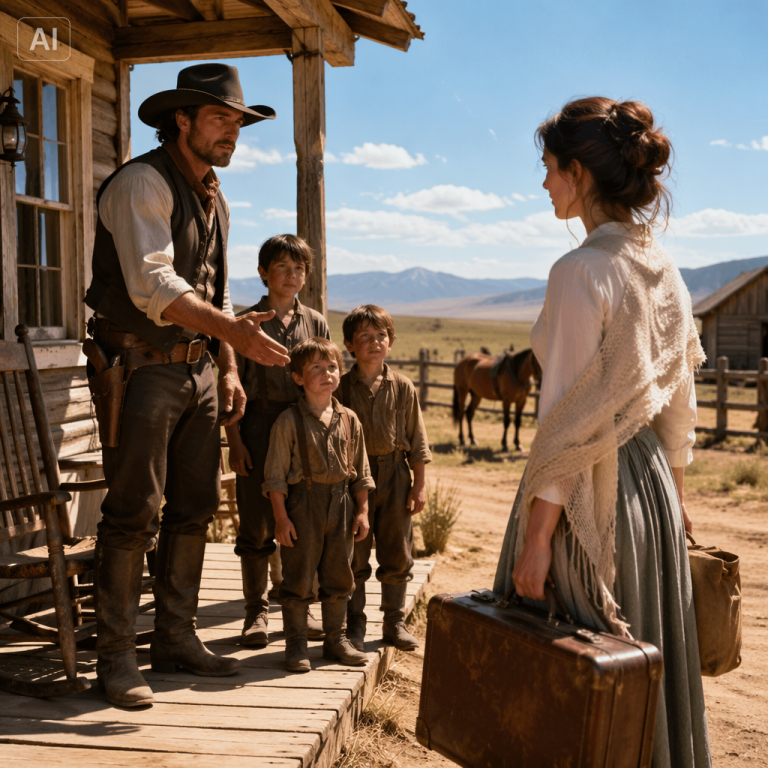
The stagecoach pulled into Delwater Creek just past noon, trailing a column of red dust that drifted slow over the rooftops before settling back into the street. Elena Marlo climbed down before the driver had fully secured the step, landing in the dirt with a small thud she absorbed through her knees without complaint. Her good dress — the dark green wool she’d saved specifically for this arrival — had acquired a film of road dust that six days of brushing hadn’t resolved. She had a trunk, a leather satchel, and the kind of hollow, careful calm that comes not from peace but from a woman who has already decided she will not let strangers see her unsteady.
She spotted him immediately. Tall, broad, dark hair going gray at the temples — Harlon Ashborne, exactly as described in the letters, standing at the edge of a small gathering with his arms folded, watching her descend with an expression she couldn’t yet read.
She walked toward him. Later, she would not be able to say exactly how she knew something was wrong before he opened his mouth. Maybe it was the way his folded arms stayed folded. The way he looked past her shoulder first, as if checking whether something better might be getting off the coach behind her.
She stopped three feet from him and extended her hand. “Mr. Ashborne. I’m Elena Marlo. It’s good to finally—”
“You’re older than the daguerreotype,” he said.
The words landed flat, matter-of-fact, the way a man might note a fence post was shorter than he’d ordered. Elena kept her hand out two full seconds, then lowered it.
“I’m thirty-one. That was in the letter.”
“The picture looked younger.”
“Pictures often do.”
He studied her the way a man evaluates livestock, and she let him. She had anticipated that the reality of her might not match whatever he’d assembled in his imagination over six months of correspondence. She had not anticipated he’d do this in front of eight people on a public street.
“I’m going to be straight with you,” he said. “I think you’d appreciate that. A practical woman — that’s what you called yourself.” He unfolded his arms, pushed his hat up half an inch. “I don’t think this is going to work.”
Somewhere behind her, a woman made a small involuntary sound.
“I see,” Elena said.
“It’s not personal.”
“It feels somewhat personal, Mr. Ashborne.”
He had the grace to look briefly uncomfortable, though it didn’t change his posture. “I sent for someone who could handle ranch work and keep house. You don’t look like you’ve done much of either.”
Elena Marlo had, in the previous four years, kept the books for her father’s failing print shop, nursed her mother through eighteen months of a wasting illness, negotiated a debt settlement with a bank that had planned to seize the building, and managed its sale after both her parents died within the same winter — all while sewing on the side to cover what the shop couldn’t earn. She had strong hands, a good eye for figures, and a back that hadn’t given her trouble once despite regular abuse. She said none of this on that street.
What she said was, “I traveled eight hundred miles, Mr. Ashborne.”
“I know it. I’m sorry for the inconvenience.” He nodded toward the saloon building. “Stage back to Caldwell leaves Saturday. I’ll cover the fare and the hotel till then.”
He turned as if the matter were concluded.
“Harlon.”
It was the younger man who spoke — the one who’d been standing back, jaw tight, silent through the whole exchange. Dark hair like his brother, but built differently, broader through the chest, with a stillness Harlon didn’t have. Just the one word, but something in the tone of it made Harlon stop.
“Stay out of it, Silas.”
“I’m not in it yet. I’m just saying your name.”
Harlon looked at him with the particular weariness of an older brother who has had this kind of exchange before. “Don’t.”
“Don’t what? I haven’t said anything.”
“I know what you’re thinking.”
“Then you know it’s not nothing.” Silas Ashborne looked at Elena — not the assessing sweep his brother had given her, but something more direct, like a man trying to see a person instead of an arrangement. “Miss Marlo. I apologize for the manner of this.”
“You have nothing to apologize for. It’s not your situation.”
“No,” he agreed. “It isn’t.” A pause. The crowd hadn’t dispersed. The stagecoach driver was making a show of checking the horse’s rigging while clearly listening to every word. “I’d like to ask you something. Are you in a hurry to get back on that coach?”
She looked at him carefully. “I don’t have anywhere to go back to,” she said, and it came out more honest than she’d intended.
“Then before you decide anything, would you have a conversation with me over a meal, if you haven’t eaten? Just a conversation. Nothing owed either way.”
Harlon made a sound that wasn’t quite a word.
“I’m buying lunch,” Silas said, without looking at his brother. “Come or don’t, Harlon.”
Elena studied Silas Ashborne for a moment. He wasn’t handsome in the conventional sense — his face too angular, weathered past his years, a scar along the jaw she couldn’t place the origin of. But there was something solid in his expression. Nothing performed about it.
“All right,” she said. “A conversation.”
PART 2
Mrs. Halverson’s lunch counter served three things — beef stew, cornbread, coffee — and served them well without ceremony. Elena sat across the plank table from Silas, wrapped both hands around a mug too hot to drink, and did not care.
“I want to ask you something,” he said, “and I’d like the truth, even if it’s not what I want to hear. Why did you answer the advertisement in the first place?”
She told him plainly — parents dead within the same season, a business that hadn’t survived them, no family left, a skill set with limited use in an eastern city for a woman her age. “The frontier is one of the few places left where what a person can do matters more than what she looks like,” she said. “That was the calculation.”
Silas turned his coffee mug a quarter turn. “Harlon’s advertisement mentioned a working ranch that needed a capable partner. Not someone decorative. He meant it when he wrote it. He just has a picture in his head of how things are supposed to go, and when reality doesn’t match it, he doesn’t always handle the gap well.”
“That’s a generous interpretation.”
“He’s my brother.” He looked at her steadily. “My ranch is in worse shape than I’d like to admit. I’ve kept it alive three years, but I haven’t made it thrive. I’m a better builder than bookkeeper. I think you’d find the errors in my accounts inside a week.” He paused. “I’m not Harlon. I won’t court you proper or write you poetry. But if I make an arrangement with a person, I keep it. I’m proposing an honest one — a legal marriage, because that’s the only arrangement that works out here — without pretending it’s something it isn’t. A partnership. If it turns into something else, that’d be—” He stopped himself. “I’m not making promises I can’t keep.”
Elena had been afraid on that stagecoach — not of the mountains or the pass, but of arriving to find nothing waiting, confirming what two years had quietly suggested: that she’d run out of road. She was still afraid of that. But she was looking at a man who’d just told her every hard thing about his situation without being asked, and who had not once looked past her shoulder.
“I have conditions,” she said.
“Tell me.”
“I want to see the books before anything’s decided. I need a room that’s my own, at least until we both know if this works. And if it doesn’t, I want an agreement in writing that you’ll cover my passage somewhere I choose.”
“I can do that,” he said. “In writing. I’ll have it drawn up at the land office tomorrow.”
Elena picked up her coffee, cooled enough now to drink, and looked out the small window at the slice of mountain above the roofline, snow sitting on the peaks like it had been there since the beginning of things.
“All right, Mr. Ashborne,” she said. “Show me the books.”
She had no way of knowing yet that those books — and the four hard, honest years that followed them — would teach her more about being seen than anything she’d left behind on the other side of eight hundred miles.
PART 3
The Ashborne property sat four miles east of town at the end of a rutted track, opening onto a broad, cold valley. The house was solid but unfinished in its edges — a porch sagging on the left, a loose shutter, a kitchen garden gone to frost-killed stalks. “It needs work,” Silas said simply, the way a man says it when he already knows and isn’t interested in pretending otherwise.
She spent forty minutes with his battered ledger and found what she suspected she would: a man who’d been paying twice for the same pasture lease without realizing it, who’d underreported his winter cattle losses because writing the true number down made it real. “The numbers don’t change because we don’t look at them,” she told him. He looked at her for a long moment, then said, “I meant what I said at the lunch counter.”
“I know you did,” she said. “I’ll stay.”
They were married three days later by the circuit judge in a ten-minute proceeding at the land office. Harlon did not attend.
The early days were not graceful. He rose at four-thirty; she took the kitchen without discussion. They ate breakfast in a silence that was careful rather than comfortable — two strangers making a reasonable effort. But Elena found her footing fast. On the fourth morning she walked the east field alone with a notebook and came back with six pages of notes and a theory about a stand of pines stealing the light from the northeast corner. Silas read through it without speaking, then looked up. “I was about to clear those pines anyway. Didn’t know the reason why.”
“You felt it right,” she said. “But clear all of them and you lose your windbreak. Four, carefully chosen, solves the shade problem without losing the protection.”
He read the marked section. “You’ve done this before.”
“Not cattle ranching. But I know how to read what land is doing. My grandfather had a farm in Ohio. I spent summers there. He kept records on everything — rainfall, yield, what worked and what didn’t. He let me keep them with him once I could write legibly.” She paused. “He died when I was fourteen. I kept his system in my head.”
It was the kind of exchange that became their rhythm — not warmth exactly, not yet, but a growing respect built one correction, one solved problem at a time. She found the account had been quietly bleeding money to a neighbor named Clyde Durant, who had circled the Ashborne east parcel for years, hoping financial trouble would eventually force a sale. “He’s waiting for a no that has a crack in it,” Elena told Silas after their first uncomfortable visit from Durant’s son. “Make sure your accounts reflect what that field is actually worth. When the ledger shows it, it’s harder to feel generous with it.”
Word moved through Delwater Creek the way water moves through cracked ground. By her second month, Elena had picked up freelance bookkeeping work in town — for Ruth Golton, whose husband’s mill accounts hadn’t been separated properly in years, and later for a grieving widow named Dorothia Marsh whose freight customers had quietly stopped paying what they owed after her husband died and no one caught it. Elena wrote them precise, unangry letters stating exactly what the numbers said. Two responded within the week. The third needed a firmer one.
Winter arrived hard and did not leave quietly. The water trough froze twice before Silas rigged a solution with an old iron pot and slow coal. Two chickens, dying of cold in the barn, ended up living in a crate in the kitchen corner — an arrangement neither of them discussed but both accepted, because it worked, and because Silas, after three days of silent disapproval, finally just asked, “Are those going to be there until spring?” and let it go.
They built a rhythm out of small accommodations neither of them announced. She learned to read a storm three hours out from the color of the cloud bank, the way he did. He learned to update his own accounts under her patient instruction, slow but accurate. One evening, after she burned the soup working through a feed-grain shortfall in her head, he simply put out cold ham and cornbread without comment, sat across from her, and said, “The cornbread was fine.” “That’s a generous interpretation of cold cornbread.” “It’s an honest one,” he said, meaning it completely, and she thought, not for the first time, that this was a strange situation she’d landed in — and not, on balance, a bad one.
Harlon came by in the third week, alone this time, hat in his hands. He looked at the porch they’d fixed together and said, quietly, “I behaved badly at the station.” Elena didn’t offer him the easy reassurance he was waiting for. “Yes,” she agreed. “I understand it. I don’t require you to explain it to me.” He rode off having gained nothing but the truth, which, over the following months, he came back for again and again — with a bushel of seed corn left wordlessly on the porch, with fence-line help, with the slow, unglamorous work of becoming someone worth trusting again.
By spring, the drainage channels Elena had designed for the east field — redesigned once, correctly, around a low point only Silas’s years of watching the land could have identified — were carrying water exactly where they’d planned. The harvest that August came in eight percent over projection, on a field he’d farmed six years and never once beaten his own estimates on. He looked at the number in the ledger for a long moment and said, “On a field I’ve been farming for six years.” It wasn’t really about the field.
That September, at the town’s harvest gathering, Clyde Durant tried his old approach one more time — pleasant weather talk sliding toward a comment about the east parcel’s value. Elena met him with a number: forty percent higher than three years ago, based on the yield data and drainage work, stated plainly, without heat. Durant left with the particular quiet of a man who has just been shown the full hand. He never tried that approach again.
The accident came in July of the second year, on a Wednesday she would remember by every ordinary detail surrounding it. A sharp crack from the barn roof, then nothing — the nothing was what sent her running. Silas on the ground, conscious, his shoulder wrong, his hip already darkening. She checked his legs, his spine, his breathing with a steadiness she didn’t fully feel, remembering a dislocation she’d watched her grandfather set once, years before. “It’s going to hurt,” she told him. “I know what a dislocation feels like,” he said. “Do it.” She did — slow, steady traction, not the violent jerk she half-remembered, and felt the joint seat back into place.
The doctor confirmed her work the next day, hip bruised but not broken, and told her, with the surprise of a man giving credit he hadn’t expected to give, that she’d done good work on the shoulder. “I had a good model,” she said.
For eleven days, Elena ran the ranch alone — the cattle rotation decoded from his shorthand journal, the barn water solved with his winter trick and one of her own, the east field checked twice daily. Harlon came and finished the roof himself, the two of them working in a silence that had nothing self-conscious left in it. One evening she heard Silas laugh from the downstairs room where he lay recovering — low, short, entirely real, a sound she hadn’t heard before and found she couldn’t stop thinking about.
When he was well enough to sit up and ask what he’d been avoiding since the fall, he told her: “When I fell, before I even understood how bad it was, I thought — she’ll know what to do.” Elena stood in the doorway with eleven days of held-together lists behind her and the particular fear she hadn’t let herself look at directly — that she’d find the limit of what she was capable of and discover it wasn’t enough. She hadn’t found that limit. “Thank you,” he said. Just that. It was, from a man who never said things he didn’t mean, everything.
The seasons folded into each other after that. A hard-won argument over a southfield rotation schedule that ended not in one of them winning but in a compromise neither had planned and both trusted. A creek-line section nobody had farmed in two decades, cleared and drained through four weeks of the hardest labor Elena had ever done, over a hidden clay layer that could have swallowed their reserve account if the risk hadn’t paid off — which, eventually, it did. A reputation in Delwater Creek that grew not through any single dramatic moment but the way light changes through a day, gradual and total: Berta Solace saving the good flour without being asked, Ruth Golton’s monthly finance consultations moving permanently to the Ashborne kitchen table, women driving miles to ask questions no one had ever answered for them honestly before.
Harlon, meanwhile, did the slower work of becoming a different man — showing up to supper once a month with the reliability of a decision made and never revisited, eventually writing a careful, honest letter to a schoolteacher in Caldwell named Margaret instead of another advertisement. “Tell her the real things,” Elena advised him, “including the parts that aren’t flattering. If she’s the right person, that’s what will matter.” He wrote the letter. Margaret wrote back within two weeks.
In the winter of the third year, mending a harness buckle by lamplight, Silas asked Elena if she’d thought about children. She had — more than she’d admitted even to her own notebook. “Yes,” she said. “I want it.” He nodded the way he received anything that mattered, without performance. “I want it too. I didn’t want to bring it up before the ranch was stable enough that it wasn’t just need talking.” It was stable now.
That same winter, standing at the kitchen window one evening with the lamp burning behind her, Elena finally told him about the letter she’d written before ever boarding the stagecoach — the one addressed, in her head, to whoever might actually read it and see what she was saying, never expecting anyone would. Silas had. Harlon had shown it to him over an accounts question he couldn’t answer, and Silas had read the whole thing.
“What did you think?” she asked.
“I thought whoever wrote that letter understood things most people don’t bother to understand,” he said, with the precision of a man reaching back for an exact memory. “And that Harlon was going to miss it.” He looked at her. “I was right about both.”
She thought about the woman who had climbed off that stagecoach four years earlier, holding herself together with both hands, certain she was arriving to be useful and nothing more. She had gotten the usefulness she’d planned for. What she hadn’t known to plan for was this — a man who read carefully, a valley that got into your blood over hard winters, the particular satisfaction of a drainage channel doing exactly what you’d calculated, the specific kind of knowing that only comes from showing up in the same difficult place every morning until the place becomes home.
“I should put out the lamp,” she said. “It’s late.”
“In a minute,” he said.
She left it burning. If you stood on the road east of town and looked toward the valley, you could see the Ashborne kitchen window glowing steady in the dark — a small, warm rectangle against the enormous quiet of the frontier, the mountains rising behind it into a sky full of cold, indifferent stars. The light itself was neither cold nor indifferent. It was just constant. Just present. Just someone home.
Years later, when Silas came in from a long day and saw that same window glowing from the road, he knew exactly what he was riding toward — not the ease he’d never had reason to expect from frontier life, not the version of things either of them had once imagined before life taught them the difference between imagining and knowing, but simply her. Simply the light she left burning. Simply a life built, one honest correction at a time, on what was actually true.
That, in the end, was everything.
THE END