The Cowboy Hid a Ruined Bride in His Barn — Then She Saved the Herd Everyone Said Was Doomed

PART 1
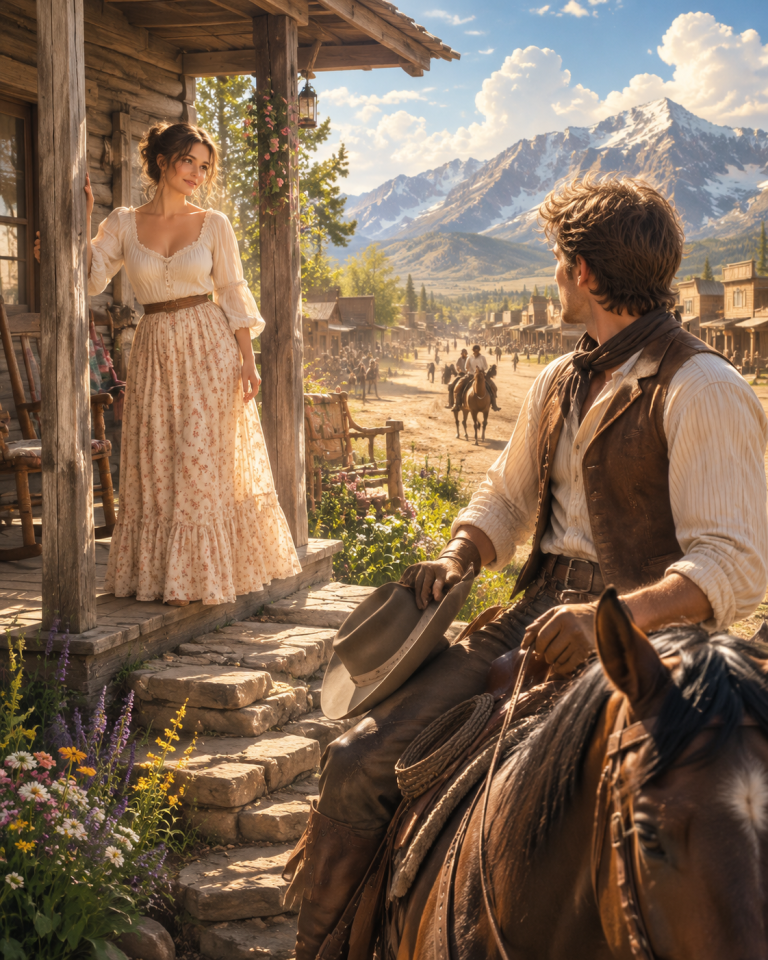
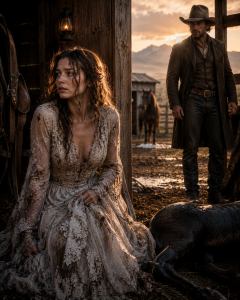
The wedding dress had been white once. Now it dragged through the dirt like something pulled from a grave, the hem black with mud, torn where Clara Whitmore had stumbled through sage and stone for three miles in the dark. She didn’t remember much about leaving town — only the murmuring voices behind her, the pitying stares that cut sharper than knives, someone’s laughter burned into her skull like a brand. So she’d walked. Away from the church, away from the boarding house where she’d been living on borrowed grace, away from everything familiar, until her feet bled through her ruined satin shoes and the night swallowed her whole.
The barn appeared just as gray touched the horizon — a dark shape hunched against the hills like something trying to hide. Clara didn’t care what it was. Shelter meant survival, and that was all that mattered now. She slipped inside and pulled the crooked door shut behind her, leaning against the rough wood while her heart hammered against her ribs.
The smell hit her immediately. Sickness — not the sharp tang of manure, but something deeper, something wrong. Clara had grown up around animals; her mother had kept goats and chickens behind their house in St. Louis before the fever took her, and she knew the scent of death creeping into living things. Her eyes adjusted to shapes moving weakly in the shadows. A horse nickered, the sound breathy and thin, like something drowning.
Her mother used to say she had a gift — not magic, nothing sinful, just an attentiveness to what ailed creatures who couldn’t speak for themselves. Clara approached the nearest stall, made the soft clicking sound her mother had taught her, and rested her palm against a trembling mare’s neck.
Fever. A wrongness radiating from deep in the animal’s belly — not colic, not founder, but something toxic burning through her system like slow poison. Clara let herself into the stall without thinking, running her hands along the mare’s flank, over her distended belly.
“What did they feed you?” she murmured. She closed her eyes and let herself feel — something sharp and chemical, burning through tissue it shouldn’t touch.
“It’s in the water,” Clara whispered, eyes snapping open.
A rifle cocked behind her.
She spun, heart lurching into her throat. A man stood in the barn doorway, silhouetted against the growing dawn — tall, broad-shouldered, the rifle leveled at her chest.
“Give me one reason,” he said, voice low and rough as gravel, “why I shouldn’t assume you’re here to finish stealing what your kind already took.”
Clara’s hands shot up. “I’m not — I didn’t take anything. I was just—”
“Trespassing in my barn at dawn. Wearing a wedding dress.” He stepped closer, and she could see him better now — dark hair, maybe ten years older than her, a face carved into hard lines by sun and work, eyes the color of creek stone that held no warmth at all. “Try again.”
“I needed shelter.” Her voice came out steadier than she expected. “That’s all. I’ll leave. I’m sorry.”
“You’ll leave when I say you can leave.” The rifle didn’t lower. “Who sent you?”
“Nobody sent me. I don’t even know where I am.”
His jaw tightened. “You expect me to believe you wandered onto my land in a wedding dress by accident?”
“I expect you to shoot me or let me go,” Clara said. “But I don’t expect you to believe anything.”
Something flickered across his face — surprise, maybe. His gaze moved from her ruined dress to her bleeding feet to the mare standing calm behind her.
“That horse was dying yesterday,” he said slowly. “Wouldn’t let anyone near her.”
Clara glanced back. The animal’s breathing had steadied even more. “Still sick. But no longer thrashing.”
“She’s poisoned,” Clara said. “They all are, aren’t they? The whole herd.”
The rifle lowered an inch. “What did you say?”
“It’s in the water. Something chemical — probably runoff from somewhere upstream. It’s burning through their systems.” She turned back to the mare, keeping her movements slow. “How long have they been sick?”
“Two weeks.” His voice had changed — still wary, but with an edge of desperation underneath it now. “Lost three already. Vet said there was nothing to be done.”
“Your vet’s an idiot.” Clara ran her hand along the mare’s neck again, the horse leaning into her touch. “They need clean water, fresh hay, and something to bind the toxins before they tear through what’s left of the tissue.”
The man stared at her, the rifle forgotten in his hands. “How do you know that?”
Clara met his eyes. “My mother taught me. Before she died.”
Silence stretched between them as dawn light crept further into the barn, illuminating dust motes hanging in the air. Somewhere outside, a rooster crowed. And the man standing in the doorway had a choice to make — one that would decide whether she left this ranch a stranger or something else entirely.
PART 2
The man finally lowered the rifle all the way.
“Cade Holloway,” he said. “This is my ranch.”
“Clara Whitmore.” She paused. “Or it was. I don’t know what my name is anymore.”
Cade’s eyes dropped to her ring finger — no band, no mark where one had been. “What happened to you?”
Clara’s throat tightened. “I made a mistake, and everyone I knew made sure I paid for it.”
She expected mockery, or pity. Instead, Cade just nodded once, like he understood something she hadn’t said out loud. “Can you really help them?” He gestured at the stalls. “The animals.”
“Maybe,” she said. “If you let me try.”
He was quiet a long time, weighing risk against desperation. Finally: “You can stay in the spare room in the main house. Work for room and board. If you save even one more horse, it’s worth it.”
“Why would you trust me?” she whispered.
“I don’t. But that mare hasn’t let anyone touch her in three days, and she’s standing calm as Sunday morning with your hand on her neck. So either you’re a witch or you know something nobody else does. Either way, I’m desperate enough not to care which.”
Two weeks later, Clara had learned to ride a gentle bay gelding named Copper, learned the brutal choreography of a cattle drive — dust and chaos and stubborn cows that refused to move — learned to earn grudging respect from four ranch hands who’d taken one look at her and assumed she was dead weight. Miguel, older and steady, whose father had died from the same mine that was poisoning Cade’s herd. Iris, sharp-tongued and skeptical, who’d handed over her own canteen when Clara nearly collapsed from exhaustion rather than let her fall. Together, riding drag through dust and heat, they’d driven two hundred head of sick cattle to clean water and lost only a dozen along the way — a number Miguel called a miracle.
That night, sitting by the fire with a tin cup of terrible coffee, Cade told her the truth about the ranch — that his wife Rachel had built it beside him ten years ago, that pneumonia had taken her in three days while he was in town buying supplies, that he hadn’t been there when it mattered most. Clara recognized the old, unhealed pain in his voice. She’d heard the same note in her own when she spoke of her mother.
“You’re not what I expected when I found you in my barn,” Cade admitted, days later, standing beside her at the ruined mine that was poisoning his land. “I expected someone broken.” He studied her face. “But you’re not broken. Just bent.”
For the first time in weeks, Clara let herself believe that might be true.
But that night, lying in her bedroll under the stars, she heard Iris say something across the dying campfire that made her blood run cold.
“You hear Eleanor Voss is back in town?”
Cade’s voice carried clear across the camp, tight in a way Clara had never heard from him. “I don’t care what Eleanor does. She’s not my concern anymore.”
“She’s making you her concern,” Iris said. “Word is she’s been asking questions about the ranch. About some woman you hired.”
Silence. Clara’s heart kicked hard against her ribs.
“Let her ask,” Cade said finally. “It’s none of her business.”
But Clara heard the tension underneath his words, and she understood, with the cold certainty of someone who’d already lost everything once, that trouble was coming. She just didn’t know yet how bad it would be.
PART 3
Eleanor Voss arrived three days later in a carriage that cost more than most men earned in a year, dressed in emerald silk, everything about her announcing money and breeding and a life lived far from places where animals died and work destroyed your hands. Clara watched from the barn doorway, covered in horse manure and hay, and felt Eleanor’s assessment land on her like a slap.
“That’s Clara Whitmore,” Cade said, jaw tight. “She’s the reason I still have a herd.”
“How industrious,” Eleanor said, smile sharpening. “You always did have a talent for finding strays, Cade.”
Miguel steered Clara away before her temper could catch fire, and later filled in what the ranch already whispered — Eleanor and Cade had been engaged once, five years back, before Rachel. Eleanor had gone east for finishing school promising to return in a year and stayed gone three; by the time she came back, Cade had already married. Her father owned half the territory — banking, railroads, mining — and Eleanor was used to getting exactly what she wanted.
“What does she want with Cade’s ranch?” Clara asked. “It’s barely profitable.”
Miguel’s look was shrewd. “Maybe it ain’t about the ranch.”
The campaign started quietly — tea with the mayor’s wife, concerned murmurs to the church ladies about propriety, about a ruined woman living alone with a widower. Within a week the whole town was talking, and Cade’s reputation, the thing that kept his credit good and his suppliers cooperative, was bleeding out in careful drops of gossip. Clara offered to leave. Cade refused outright.
“This ranch was supposed to be about building something good,” he told her, morning light cutting across his face. “A place where hard work mattered more than gossip or who your father was. If I compromise that to keep Eleanor happy, I might as well sell to hers and be done with it.”
He took Clara into town himself, introduced her at the general store, the feed supplier, the bank, daring anyone to say otherwise to his face. It bought them exactly one week of peace. Then three steers went missing from the south pasture, tracks leading toward the badlands — and when Cade led a small party to retrieve them, they rode straight into an ambush in a narrow canyon, bullets sparking off stone, no way forward and no way back.
“Leave the woman and ride out,” a voice called from the canyon rim. “She’s what this is about anyway.”
Clara understood then what Miguel already suspected — this had never been about stolen cattle. It was a message, and it was aimed at her. With the shooters reloading and the group pinned with no possible escape, Clara made the only choice that made sense to her: she stood, hands raised, and walked out into the open alone, drawing their fire so the others could reach the horses.
“We’re coming back for you,” Cade shouted after her, voice cracking with fury and fear. “You hear me, Clara? This isn’t over.”
They dragged her to an abandoned mining structure, hooded and bound, and gave her a choice: write a letter confessing to theft, claiming she’d robbed Cade and fled east, or die there in the dirt. Her hands were cut free so she could hold the pencil. Clara wrote — not the confession they wanted, but a message only Cade would understand: *The mare with the ash-colored coat is dying. Only one person can save her. The rest is lies.* When the scarred man reading it over her shoulder realized what she’d done, she drove the pencil into his leg and ran, straight into the sound of hoofbeats — Cade, Miguel, and Iris riding hard, having tracked her the whole way.
“I’ve got you,” Cade said roughly, catching her as her legs gave out. “I’ve got you.”
That night, in her small room off the kitchen, Cade sat on the edge of her bed and told her, voice raw, that if he’d lost her in that canyon he wouldn’t have been able to live with it — that somewhere in the past few weeks she’d become someone he couldn’t afford to lose. Clara didn’t know what to say to that. She only knew that when he left the room, warmth spread through her chest for the first time in longer than she could remember.
Eleanor’s second attack came faster and colder than the first. The next morning, in the sheriff’s office where Cade had gone to file charges over the ambush, Eleanor swept in with her own attorney and accused Clara of stealing three hundred dollars from her carriage the previous afternoon — an afternoon Clara had spent entirely at the ranch. Three paid witnesses said otherwise. Sheriff Porter, unwilling to cross the Voss family, arrested her anyway.
Clara spent three days in a jail cell counting cracks in the ceiling while Cade rode through the night to hire an attorney from Silverton — a sharp, unshakeable woman named Margaret Chen — and quietly dug for the truth. He found it in a saloon debt: one of Eleanor’s witnesses, a man named Robert Grimes, had been paid two hundred dollars by the Voss family’s business manager to lie under oath.
The preliminary hearing that followed tore the case apart in front of half the territory. Under cross-examination, one paid witness fled the stand rather than answer for perjury. Grimes broke down and confessed on the record. And Eleanor, cornered and furious, finally lost the composure she’d worn like armor for weeks.
“She’s nothing,” Eleanor said, voice rising, sharp and desperate in front of the packed courtroom. “A runaway bride who got exactly what she deserved. Cade should have thrown her out the day she showed up. But instead he—” She stopped, too late, hearing what she’d just admitted in front of a judge.
“Miss Voss,” Judge Harmon said slowly, “are you telling this court that this prosecution was personal rather than criminal in nature?”
Eleanor didn’t deny it. She couldn’t. Standing in the aisle, Cade rose before anyone could stop him.
“Miss Voss is right about one thing,” he said, voice carrying through the silent courtroom. “Clara Whitmore showed up at my ranch with nothing. She was broken and scared and had every reason to give up. But she didn’t. She saved my animals when nobody else could. She worked harder than any hand I’ve ever hired. She risked her life to protect people she barely knew. That’s not weakness, Eleanor. That’s strength you’ll never understand.” He turned, meeting Clara’s eyes across the room. “She’s not a charity case. She’s the woman I love. And I’m not letting you destroy her to satisfy your ego.”
The charges against Clara were dismissed within the hour. Eleanor and her attorney were ordered to remain in the territory pending a federal investigation into witness tampering and perjury.
Outside, in the autumn sun, Clara found herself unable to breathe properly. “You told the whole town you loved me,” she said. “That’s going to cause problems. Eleanor’s father will come after you now.”
“Probably,” Cade agreed. “But I meant every word.”
“I don’t know if I can love you back,” Clara admitted. “Jonathan broke something in me, and I don’t know if I’m capable of that anymore.”
“Then don’t,” Cade said simply. “Not yet. Maybe not ever. Just stay. Work the ranch. Save animals. Give yourself time to heal. And if you ever decide you want more, I’ll be here.”
She needed the time, so she took it — walked the road out of town far enough to feel the pull of leaving entirely, and then, without quite deciding to, turned back toward the ranch instead. She found Miguel in the barn that evening, and he told her about his father, a man who’d stayed quiet when a mine owner cheated him out of wages, who’d died broke and broken because staying quiet hadn’t helped anyone. “You fought,” Miguel told her. “That took guts.”
“It took desperation,” Clara said. “That’s different.”
“No,” Miguel said. “It’s not.”
When Cade found her at Ash’s stall — the mare she’d named for her coloring, the first animal she’d saved — he told her he wasn’t asking her to trust him because of words spoken in a courtroom. He was asking her to look at what he’d actually done: hired her when nobody else would, stood against Eleanor’s father when it would have been easier to let her go, ridden straight into an ambush without hesitating. “I don’t lie,” he said. “Ever. So when I tell you I love you, that’s not manipulation. That’s just truth.”
It took Clara two more months to say it back — two months of working the ranch side by side, of nightmares shared instead of hidden, of Miguel and Iris becoming real friends instead of coworkers, of watching Cade keep every promise he made without ever once demanding anything in return. When she finally told him, standing in the barn with the horses shifting in their stalls, her voice shook.
“I think I might love you, too,” she said. “I’ve only loved one other person, and that was my mother, so I don’t have much to compare it to. But when I think about leaving here, about not seeing you every day, it hurts. And when Eleanor tried to take you away from me, I wanted to burn her whole world down. So if that’s love, then yeah. I love you.”
They married six months after the trial, in the ranch yard instead of a church, Clara in a simple blue dress that had belonged to Rachel, Cade with his hair actually combed for once. Miguel stood witness. Iris cried and pretended she hadn’t. The same minister who would have married her to Jonathan Hayes officiated, and apologized, quietly, for ever believing the lies that had chased her out of St. Louis.
The years that followed weren’t easy — money was tight some seasons, nightmares came and went for both of them, and Cade’s stubbornness collided with Clara’s more than once. But the ranch grew into something Cade had never quite pictured when he built it with Rachel: not an empire, but a refuge. The Morrisons, burned out by a lightning strike, found work and a home in the bunk house and eventually land of their own nearby. Miguel married a widow from town. Iris became known across three territories for gentling horses nobody else could touch. And Clara — Clara became the person broken, frightened people were sent to when they had nowhere else to go, the way she herself had once wandered, ruined and desperate, into a stranger’s barn at dawn.
Two decades after that first morning, a nineteen-year-old girl appeared at the ranch gate — bruised, filthy, carrying the same hollow-eyed desperation Clara remembered feeling in her own bones. *Everyone says I’m ruined,* the girl told her. *That no decent person will ever want me now.*
“You’re not ruined,” Clara said, gripping the girl’s hand the way someone once should have gripped hers. “You’re surviving. And survival is the first step toward everything else.”
Later, standing at the paddock fence with Cade’s jacket around her shoulders and the sky burning gold over land she’d helped save twice — once from poison, once from a woman who’d tried to destroy her — Clara thought about the girl who’d stumbled through that barn door all those years ago, certain her story was already over.
It hadn’t been the ending. It had only ever been the beginning — the moment a rifle found her in the dark, and instead of firing, chose to wait and see what she was worth.
THE END