The Mountain Man Refused Every Bride They Offered Him — Then He Chose the One Nobody Believed Deserved a Husband

PART 1
The morning Eleanor Vale’s freedom died, the sky over Cedar Falls burned orange like infected flesh.
She stood in the cramped back room of St. Catherine’s Church, staring at her reflection in a cracked mirror. The dress they’d given her was cream cotton, cheap, the kind you buried people in. It hung loose — she’d lost weight these past three weeks, hadn’t kept food down since the banker’s men arrived with papers declaring her father’s debts now belonged to her. Twenty-three years old, never been kissed, about to be sold.
Three other women waited with her. Mary Hutchkins, sixteen, rocking in the corner, her father’s farm gambled away in a poker game Whitmore’s men had probably rigged. Catherine Chen, a widow whose husband had died in a mining “accident” witnesses swore was nothing of the kind. Rose Sullivan, forty, hard as the frontier had made her, chain-smoking cigarettes she’d bummed off the custodian.
“They’re filling up out there,” Rose said, blowing smoke at the ceiling. “Whitmore’s front row, naturally. Dressed like he’s attending an opera instead of a slave market.”
“Don’t call it that,” Mary whispered.
“What else would you call it, honey?”
Catherine finally turned from the window. “Does it matter what we call it? We’re here. They’re out there. In thirty minutes, we’ll belong to whoever pays our price.”
Three weeks ago, Eleanor had been planning her father’s funeral. Daniel Vale, town librarian, gentle man who’d taught her Latin and poetry, found dead at the bottom of the stairs, neck broken, whiskey bottle shattered beside him. The sheriff ruled it accidental — except her father hadn’t touched liquor in fifteen years. The very next morning, Harold Whitmore appeared at her door with documents showing debts she’d never heard of. “Sign over the house,” he’d said, standing in her doorway like he already owned it. “Or settle the debt another way.”
She’d understood what *another way* meant when the notice came about the bride auction.
Reverend Thomas opened the door, gray-haired and bent-backed. He wouldn’t meet their eyes. “It’s time, ladies.” Nobody moved. “Please,” he said quietly. “Don’t make this harder than it needs to be.”
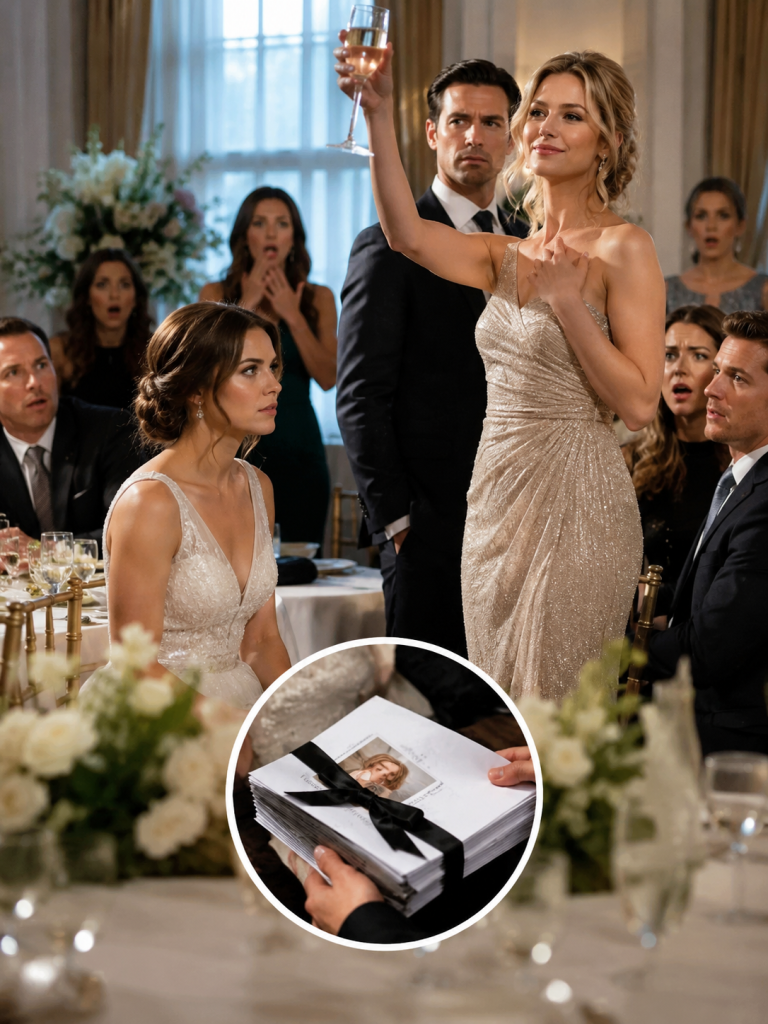
They filed into the packed chapel, men shoulder to shoulder in the pews, the air thick with sweat and tobacco. Harold Whitmore sat front row, charcoal suit, burgundy vest, a gold watch chain glinting across his stomach. He owned the bank, the hotel, half the businesses in town. When Eleanor walked past him, he smiled.
The auction moved fast and cruel. Mary went for twelve hundred dollars to a bearded rancher known for going through wives like firewood, stumbling forward like she’d been pushed. Catherine went for eight-fifty, walked to her buyer with her head high, face blank as paper. Rose fought — refused outright, spat at her buyer’s feet — and was dragged to the altar by two of Whitmore’s men anyway while the crowd hooted.
Then it was Eleanor’s turn.
“Miss Eleanor Vale,” the reverend announced, voice breaking on her name. He’d played chess with her father every Thursday for years. “Outstanding debt of three thousand dollars.”
“Bidding starts at five thousand,” Whitmore said. He didn’t stand, didn’t raise his voice. Just said it calm and clear, like ordering breakfast.
Silence crashed through the chapel. Eleanor stared at him, and he stared back, that same slight smile in place. This whole sick theater had been arranged just so he could sit there and buy her in front of everyone.
“Going once,” the reverend said weakly. Whitmore stood, smoothing his vest. “Going twice—”
The church doors exploded inward. Wood slammed against stone hard enough to shake the building. Every head turned.
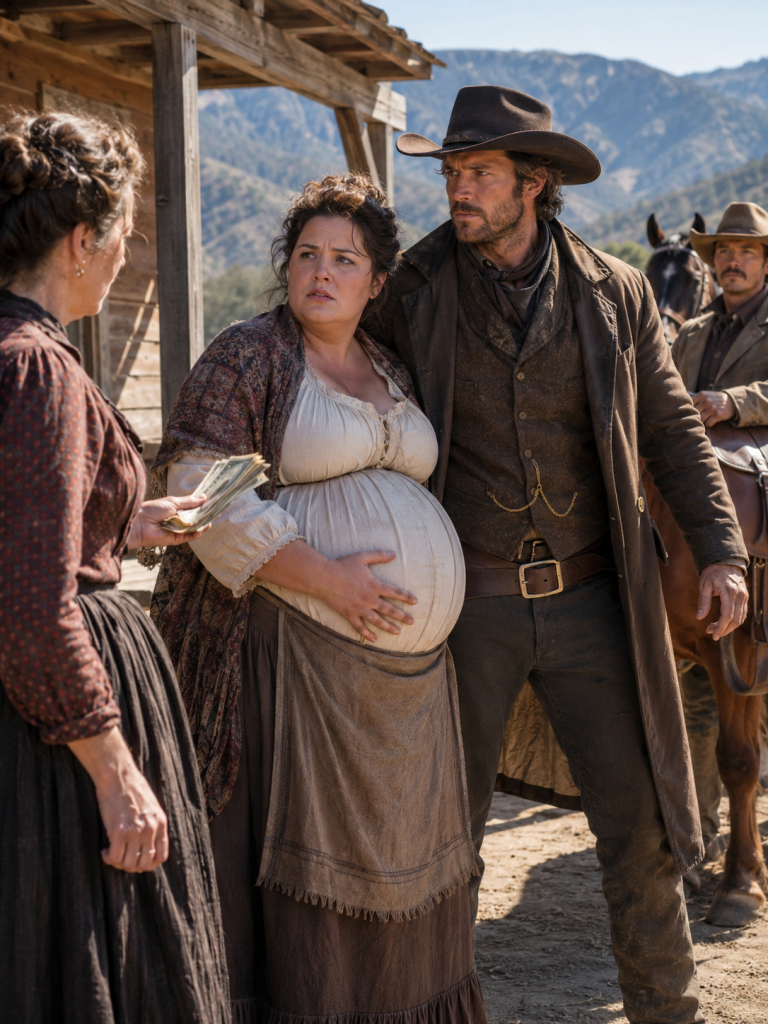
A man filled the doorway. Not walked through it — filled it. Six-foot-four at least, canvas pants, a battered leather coat, dark hair that needed cutting, days of beard over a face that might have been handsome except for the scar running from his temple to his jaw. His eyes swept the chapel like he was counting targets.
“Colt Mercer,” someone muttered, and the name hit the room like a thrown stone. The mountain devil. The land war killer. The outcast who’d murdered his neighbors over a water dispute and fled into the wilderness seven years ago.
Mercer didn’t stop walking until he stood directly in front of Eleanor. He looked at her for a long moment — really looked, like he was trying to read something in her face.
Then he kissed her. Right there, in front of everyone, his hand cupping the back of her head, gentle but certain. His mouth tasted like coffee and wood smoke and something wild she had no name for.
When he pulled back, the chapel had gone absolutely silent. Mercer turned to Whitmore, reached into his coat, and threw a leather sack onto the altar. Gold coins spilled out with a solid thunk.
“Six thousand,” Mercer said, voice rough like he didn’t use it often. “Cash.”
PART 2
“This auction is a legal proceeding,” Whitmore said, face going red. “You have no right—”
“I got every right. You set the rules. Highest bidder wins.” Mercer glanced at the reverend. “Count it.”
It took three shaking minutes. When Reverend Thomas straightened, he looked sick. “Six thousand two hundred.”
“Going once,” Mercer said, mocking the earlier words. “Going twice.” He looked at Whitmore. “Gone.” Whitmore’s hand drifted toward his coat, toward a pistol Eleanor knew he carried, but there were too many witnesses, and Mercer had positioned himself between them. “This isn’t over,” Whitmore said.
“Yeah, it is. Marry us.”
The ceremony took two minutes. Eleanor barely heard it. When the reverend said, “You may kiss the bride,” Mercer just looked at her. “Already did.” Then he took her hand and led her out, the crowd frozen behind them, even Whitmore not moving though his face promised murder.
Outside, a big gelding waited saddled in the street. Mercer helped her up, swung on behind her, arm around her waist. “Hold on.” Then Cedar Falls disappeared behind them in a cloud of dust and unanswered questions.
They rode hard for an hour before Eleanor found her voice. “We need to talk.”
“Later.”
“Now.” She twisted in the saddle. “You bought me like property, and now you’re dragging me into the mountains without telling me why.”
“Would you rather I’d left you there?”
“I’d rather have a choice.”
He slowed the horse to a walk, climbing now through dense pine. “I know you’re scared,” he said, quieter. “I know this doesn’t make sense. But I need you to trust me for about six more hours. Can you do that?”
Exhaustion won out over anger. She’d barely slept in weeks. “Six hours,” she said, slumping back against him.
“Six hours,” he agreed.
The cabin, when they finally reached it near dusk, was nothing like she expected — not a lean-to or a cave, but a real home, log walls three men couldn’t lift, glass windows, a stone chimney, shelves of books that included, she realized, some of her father’s own stock. “It’s not much,” Mercer said, watching her reaction. “It’s—” she couldn’t finish the sentence.
“There’s a bed in the back room,” he said. “We’ll figure out the rules tomorrow. I didn’t think past getting you out of that church.”
He didn’t have a plan. That, more than anything, loosened something in her chest.
“Why did you kiss me in the church?” she asked before she went to bed. “You could have just bid.”
“Had to make sure Whitmore knew you weren’t available,” Mercer said. “That if he wanted you, he’d go through me first.” He paused. “And that I wasn’t buying property. I was claiming my wife.”
The next morning, over coffee, he told her plainly: “That’s up to you. You want to leave, I’ll take you to Billings. There’s a train east. I didn’t buy you, Eleanor. I bought you out. There’s a difference.”
She thought of Whitmore’s connections everywhere, of her father dying with secrets still locked in his head, and made her decision before she’d fully admitted it to herself.
“I’m staying,” she said. “Can you teach me how to not die?”
PART 3
“Teach you what, exactly?” Mercer asked. “How to survive. How to shoot. How to live up here without depending on you for everything,” Eleanor said. Something shifted in his face — relief, maybe, or something deeper neither of them had a name for yet.
“It’s all right with me,” he said quietly.
The lessons started that hour. Mercer showed her how to hold a revolver, how to sight down the barrel, how to breathe out slow and fire between heartbeats. She missed everything her first morning, and most of the next. By the second week she could hit a can at twenty feet more often than not. He taught her to track, to start fires with flint and a bow drill, to read weather in the clouds, to move through dry leaves without a sound — though she’d never be as quiet as him. The man could walk through a forest and sound like wind.
Three weeks in, she asked him about the scars — the one through his eyebrow, another at his jaw, a third disappearing into his hairline. He set down the wolf he’d been carving and told her the truth in a flat voice that somehow made it worse. A ranch of his own. A wife, Sarah. A daughter, Emma, four years old. A water dispute with Whitmore over a creek that fed his land. Whitmore’s men had come at night, burned the barn, shot Sarah in the back as she ran for the treeline with Emma in her arms. “I killed three of them that night,” Mercer said. “Would have killed them all if I could have. That’s why I’m wanted. Not for defending my land — for shooting the men who murdered my family. Whitmore had witnesses who said different. Had a judge in his pocket.”
“Your father’s kindness meant something,” he added, quieter. “Nobody had treated me like a person in years, and then this old librarian sold me books and asked if I was eating right. When I heard what Whitmore was doing to you, I had to.”
“You saved me,” Eleanor said.
“Maybe. Or maybe I just needed to save someone. Couldn’t save Sarah. Couldn’t save Emma. But I could save you.”
She didn’t flinch from it, and something in him seemed to loosen at that — gratitude, or relief that she hadn’t run.
The attack came a week later. Eleanor was inside mending a shirt when the gelding screamed, and she ran out to find an eight-hundred-pound grizzly, ribs showing through patchy fur, testing the corral fence. Mercer’s first shot only wounded it, and it charged him at terrifying speed. Eleanor fired three rounds into its flank to pull its attention, and when it turned on her instead, closing the distance in seconds, she emptied her last three shots into its face. It dropped six feet from where she stood.
“That was the dumbest, bravest thing I’ve ever seen,” Mercer said, checking her for injuries with shaking hands.
“You’re welcome.”
That night she found a note on the table in his rough handwriting: *Proud of you.* She kept it in her father’s book of poems and went outside to practice until her hands stopped shaking.
Two months into her training, a woman appeared on an exhausted horse — Mary Hutchkins, having fled her husband, chased across two states by Whitmore’s men. She handed over a folded wanted poster: *Colt Mercer, wanted for kidnapping and murder, two thousand dollar reward.* “He’s telling everyone you were stolen from him,” Mary said. “That you need to be rescued.”
That poster changed the math. Whitmore had eyes and money enough to reach into Billings, and now bounty hunters from Denver were asking questions on the mountain trails. But it also told Eleanor something else — Whitmore was scared, and men that scared made mistakes.
Buried in a gap between the cabin’s logs, Eleanor had already found letters from a bank clerk named Thomas Morrison, dead in a convenient “accident” two months after documenting Whitmore’s fraud — fake loans, forged signatures, families ruined, and her father’s name mentioned as a collaborator. The real evidence, Morrison’s letters implied, was somewhere in Whitmore’s own house, in a study nobody was allowed to enter. Mary, who’d once worked there as a housekeeper’s daughter, drew them a map from memory — including the fact that every Wednesday evening, Whitmore left for three hours to meet the town council, leaving only two guards behind.
They trained for it for weeks — lockpicking, night movement, timing guard rotations. On a Wednesday in autumn, Eleanor and Mary slipped through the back door while Mercer watched from cover, made it up to the second-floor study, and found a false-bottomed drawer holding a leather portfolio: her father’s own handwriting, page after page documenting fifty-three ruined families, twelve suspicious deaths, forged property transfers, all of it pointing straight at Harold Whitmore.
“This is it,” Eleanor breathed. “This is everything.”
The floorboard creaked. Whitmore stood in the doorway, pistol raised, smiling like he’d already won. “I’ve been waiting for you,” he said pleasantly. He’d had them watched for two weeks — Mary’s trail to Billings hadn’t been as clean as she’d thought. He forced Mary to disarm Eleanor, laid out his offer: testify against Mercer, watch him hang for kidnapping, and everyone walks free. Marry Whitmore properly this time, start over. “I’d rather die,” Eleanor told him.
The window exploded inward. Mercer came through in a crash of glass and fury, rifle already on Whitmore’s head. “Drop it.” A standoff hung on a knife’s edge until heavy footsteps sounded on the stairs — Whitmore’s reinforcements, coming fast. Mercer fired, not at Whitmore, but at the oil lamp on the desk. It burst into flame that raced up the curtains and across the papers in seconds.
“Move!”
They ran through smoke and gunfire, out the back, into the treeline, Eleanor clutching the portfolio to her chest while Whitmore’s house burned orange against the night sky behind them.
They rode two miles to a hollow and studied what they’d stolen by starlight. It was worse than she’d imagined — fifty-three families, a dozen deaths, a territorial judge on Whitmore’s payroll. Worthless, though, unless it reached someone outside his reach. Mary had heard exactly the right name at the council meeting: a federal judge, Carson, staying at the Grand Hotel in Cedar Falls, doing circuit hearings.
“That’s suicide,” Mercer said, when Eleanor proposed going straight back into town. “They’ll be crawling with his men.”
“They’ll expect us to run,” Eleanor said. “Not walk back into the lion’s den. My father spent years building this case. I’m not wasting that.”
They rode down two nights later, avoided the main road entirely, and climbed a rose trellis to the second floor of the Grand Hotel under a thin crescent moon. Judge Carson — gray-bearded, sharp-eyed despite being roused from sleep — let them in once Eleanor said the word *evidence*, and read her father’s documents in silence, his expression darkening with every page.
Gunfire erupted outside before he could finish. Whitmore’s men had found them — a dozen or more, surrounding the hotel. Carson deputized all three of them on the spot, and they barricaded the door with furniture, firing low through the wood as men tried to force their way in. Mercer took a bullet in the arm and kept firing. Eleanor emptied a cylinder and reloaded with shaking hands more than once. When the barricade finally gave, three of Whitmore’s men lay dead in the doorway and the hallway beyond was empty — for a moment.
They fled to the roof. Carson fired a federal distress signal into the night air — three shots, three more — and told them he had U.S. marshals quartered just outside town. Eleanor stood at the roof’s edge and goaded Whitmore directly, drawing his attention and his men’s fire up instead of letting him organize a real siege, buying the minutes they needed.
The marshals hit Cedar Falls like thunder. By dawn, Harold Whitmore sat in chains in his own courthouse, his empire in ruins around him, and Judge Carson vacated Mercer’s seven-year-old murder warrant on the spot. “You’re not a criminal, Mr. Mercer,” Carson said. “You’re a victim.”
The trial lasted three weeks. Eleanor testified for two full days as the prosecution laid out fifty-three destroyed families and twelve deaths, evidence so overwhelming that even Whitmore’s expensive Denver lawyers couldn’t dismantle it. Witness after witness who’d been too frightened to speak before found their voice once Whitmore sat in chains in front of them. The jury deliberated forty-five minutes. Guilty on every count.
Two weeks later, in the town square, Whitmore dropped through the trap door and it was over — quick, cleaner than anything he’d ever given his victims.
“Let’s go home,” Mercer said.
They returned to the mountain with a strange, hard-won peace between them. That first night back, Eleanor finally asked him to stop pretending there was still distance between them, and he took her hand and didn’t argue. What followed were the happiest years Eleanor had ever known — not easy ones, mountain life was never easy, but full of the particular contentment of a life built entirely by choice.
Word of what had happened at Cedar Falls spread, and women began finding their way to the cabin — women running from forced marriages, from men who beat them, from towns where the whole community was complicit in keeping them trapped. Eleanor taught them to shoot, gave them money and a route out, told each one the same thing: *you’re never as trapped as they want you to believe.* Over the following years, seventeen women passed through that cabin. Not all of them made it — three went back, one died of injuries sustained before she arrived — but most walked away stronger, starting over somewhere Whitmore’s shadow could never reach.
Three years after the trial, Eleanor gave birth to a daughter they named Sarah Catherine Mercer — Sarah for the wife Mercer had lost, Catherine for the widow who’d burned down a mine office rather than accept being owned. More children followed: a son named Daniel after Eleanor’s father, another daughter, and finally twin boys who very nearly killed Eleanor coming into the world but arrived healthy and screaming anyway. The cabin grew room by room to hold them all.
On their fifteenth anniversary, Mercer took her back to the clearing where he’d first taught her to shoot. The tin cans were long gone, but the fallen log still stood, and Eleanor put five out of six shots into memory alone.
“I didn’t say yes in that church because I trusted you,” she admitted, when he asked her why she’d stayed. “I said yes because I was desperate and you looked less terrible than the alternative. But I stayed because I learned to trust you. Learned to love you. Learned that sometimes the best things in life come out of the worst circumstances.”
That night, after their children were finally asleep and the cabin had gone quiet, Eleanor stood on the porch and looked at the stars — impossibly vast up here, more light than she’d ever imagined existed before Cedar Falls, before the auction, before a mountain outlaw crashed through a church door and threw gold at the altar like a challenge to hell itself.
She hadn’t found safety up here. The wilderness was never safe. She’d found something better — the kind of freedom that comes from choosing your own impossible path, and finding out, one hard year at a time, exactly how strong you could become.
THE END