Jilted Bride Pulled a Wounded Stranger From the Mud — Then She Discovered He Owned the Ranch That Could Change Her Life

—
PART 1
They say pride and desperation make terrible traveling companions on the frontier, and Margaret Sullivan had both riding heavy on her shoulders as she stood on a muddy road outside Copper Valley, watching the wagon that brought her disappear back toward town.
Her trunk sat at her feet. Her whole life sat inside it — what little of it had survived the trip west.
She’d come two thousand miles to marry a man named William Garrett, a wealthy rancher whose letters had been formal but kind enough that she’d let herself hope. She’d sold her furniture, her mother’s dishes, nearly everything she owned back in Ohio, to buy passage toward a future that had lasted exactly as long as it took William Garrett to look at her face.
He hadn’t even pretended otherwise. One glance, and his expression had gone cold as the wind coming down off the ridge. He’d been expecting someone younger. Someone prettier. Someone who’d be an asset at his parties instead of standing beside him like an apology. He’d pressed fifty dollars into her hand — enough for a train ticket home, not enough to cover the shame — and climbed back into his fine wagon without a second look.
Margaret had cried into a boarding house pillow that night until there was nothing left to cry with. But grief, given enough hours, has a way of curdling into something more useful. By morning what was left in her chest wasn’t sorrow. It was anger — the clean, hot kind that burns off self-pity and leaves something harder standing in its place.
She wasn’t going back to Ohio to be pitied. She’d find work in Copper Valley if it killed her, and prove — to herself, if no one else — that she was worth more than the price William Garrett had put on her.
First, though, she had five miles to walk, because breakfast had taken the last of her fifty dollars and there was nothing left for the stage.
She’d been walking maybe an hour, her trunk bumping raw against her legs, when she heard it — a man’s voice, strained and desperate, calling for help.
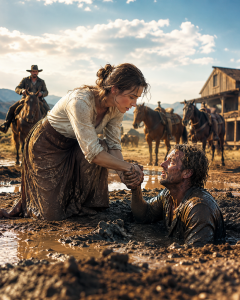
She found him thirty yards off the road, sunk to his chest in a mud pit the spring rains had opened up like a wound in the earth. He was fighting it, and every fight dragged him deeper, panic climbing fast behind his eyes.
Margaret dropped her trunk and ran.
“Stop struggling,” she called, already scanning the ground for anything solid. “You’re making it worse. Hold still and let me think.”
He looked up at her — mud-streaked, maybe thirty, dark hair plastered flat to his skull, and even half-drowned in filth she could see the fear in him hadn’t beaten the sense out of him yet. “Been stuck almost an hour,” he gasped. “Tried to cross what looked like solid ground. My horse ran off. Nobody knows I’m out here.”
She found a fallen branch thick enough to hold weight and dragged it to the edge of the pit, testing her own footing with every step. “I’m going to push this out to you. Grab hold, slow and steady. Don’t jerk. Understand?”
He nodded, and Margaret braced her boots in the mud and pulled with everything a lifetime of hauling water and chopping wood had put into her arms. Inch by agonizing inch, he came toward solid ground, until — nearly thirty minutes later — he dragged himself out onto the grass and lay there gasping, coated head to toe in mud that smelled of sulfur and rot.
Margaret sat down hard beside him, her arms shaking, and tried to remember how to breathe normally.
“Thank you,” he managed between breaths. “I thought I was done for. You saved my life.”
“Anyone would have done the same.”
“No.” He laughed, edged with leftover fear. “They wouldn’t. Most people keep walking so they don’t get stuck themselves. You didn’t even hesitate.” He tried to wipe his face clean with hands just as muddy, which only made it worse. “I’m James. James Garrett. I owe you a debt I’m not sure I can repay.”
Margaret felt the ground drop out from under her all over again.
“Garrett,” she said carefully, keeping her voice level even as her pulse wasn’t. “Are you related to William Garrett? Owns the Double G?”
Something shifted across James’s muddy face — complicated, unreadable. “He’s my older brother,” he said. “Why do you ask?”
—
PART 2
Heat rushed to Margaret’s face, and she looked away before he could read anything in it. “No particular reason,” she said. “Just heard the name in town.”
It was a terrible lie, and they both knew it. But James had the grace not to push, and they sat a moment in the kind of silence that comes after two strangers realize they’re standing closer to a secret than either of them planned.
James got to his feet first. “My place is about two miles north. Least I can do is offer you a meal and somewhere to sleep — you look like you’re new to the area, and maybe in need of a little hospitality.”
Pride told her to refuse. Practicality won instead. She had nowhere else to go, no money to get there, and this arrangement, at least, came with food. “All right,” she said. “Just a day or two, until I find work in town.”
He insisted on carrying her trunk himself, mud and exhaustion notwithstanding, and they walked the two miles through grassland dotted with wildflowers to a modest, well-kept ranch — smaller than anything William Garrett owned, but tended with a kind of care his brother’s spread had never shown Margaret in the five minutes she’d stood on it.
Over the next few days, Margaret found a rhythm she hadn’t expected. James’s house had gone neglected since his wife died two years before, and Margaret began cooking and cleaning without being asked — partly to earn her keep, partly because staying busy kept her from dwelling on the fifty dollars folded in her pocket like a verdict. James protested that she was a guest, not hired help. She insisted she needed to feel useful, and didn’t say the rest of what that meant.
Evenings, they sat on the porch and talked. He told her about Rebecca, gone in childbirth along with their son, and the grief that had nearly broken him before the ranch gave him something to survive toward. She told him about raising her siblings after her mother died, about being the capable one nobody thought to comfort. She still hadn’t told him about William. He didn’t ask questions that would force her to lie.
On the fifth day, the hired hand, Pete, rode up with news that turned James’s face dark. “Your brother’s talking around town. Says he’s buying out your water rights, forcing you to sell. Says a man can’t run a ranch without a wife to help, and you’ll cave eventually.”
James’s jaw went tight. “William’s wanted this land three years. Father left it to me instead of him, and he’s never forgiven that.” He looked at Margaret, something like apology already forming. “I should’ve told you sooner. My brother’s not a good man. Whatever brought you out here — whatever connection you’ve got to him — you’re safe on my property. He won’t touch you here.”
Margaret opened her mouth to finally tell him the truth.
That was when they heard horses in the yard — and when she saw the man riding in front, sitting his horse like a king surveying land he believed should already be his, the blood went straight out of her face.
William Garrett had found her. And from the look on his face as his eyes landed on her standing beside his brother, he already knew exactly what kind of story he was about to tell.
—
PART 3
“Well, well,” William said, and the smile he wore had no warmth in it at all. “The rejected mail-order bride found herself a consolation prize.” His eyes cut to Margaret with open cruelty. “Did you tell my little brother why you’re really here? Or are you playing the same game with him you tried with me?”
James stepped forward, his whole body gone tense with warning. “Whatever you’re talking about, William, say it plain and then get off my land. Margaret’s my guest, and you’ll treat her with respect.”
William laughed — short, ugly. “Respect for a woman who answered my advertisement claiming to be twenty-two and skilled in domestic arts, then showed up looking ten years older than her photograph with all the charm of a plow horse? I did her a favor rejecting her before she trapped me into a marriage I’d spend the rest of my life regretting.”
The words landed exactly where William intended, striking every place Margaret had spent years protecting. She hadn’t lied about her age. She’d sent an honest photograph. But truth had never mattered much to William Garrett, and he was rewriting the story in real time to leave her looking desperate and dishonest in front of the one person whose good opinion had started, in five short days, to matter.
Before she could find words to defend herself, James moved. Fast — faster than a man his size should have been able to move — and had William by the coat, dragged clean off his horse and slammed against the fence rail.
“You listen to me very carefully, brother.” James’s voice had dropped to something low and dangerous. “Margaret saved my life. I was stuck to my chest in that mud pit on the north road, and she pulled me out when she could have kept walking. She’s been nothing but honest and hardworking since. Whatever happened between the two of you is your business. But I know which one of you I trust — and it sure as hell isn’t the man who’s spent three years trying to steal my land.”
William shoved back, surprising strength in it. “You always were a fool, James. Can’t you see what she’s doing? Worming her way into your life to get what she couldn’t get from me — a ranch, security, a husband too stupid to notice how plain she is.”
The words hit Margaret like something physical, confirming every insecurity William had already carved into her the day he looked at her once and decided she wasn’t worth the trouble. She braced for James’s face to change — for the doubt to creep in the way it always had with every man who’d ever looked at her twice and then looked away.
Instead, James turned. Really looked at her. And what was in his eyes wasn’t doubt at all.
“You’re right about one thing, William,” he said, still holding his brother’s gaze. “Margaret is plain — if you’re too blind to see past the surface. But I’ve spent five days watching her work harder than any hired hand I’ve ever employed. Listening to her talk with more sense than most men I know. Being grateful every hour that she was brave enough to save my worthless life. She’s got more beauty in her little finger than you’ll ever recognize, because you’re too busy looking at faces to see souls.” His voice dropped lower still. “Now get off my property before I forget we share blood and shoot you for trespassing.”
William’s face went dark with fury, but he swung himself back onto his horse. “You’re making a mistake, James. This land should be mine, and everyone in the valley knows it. Enjoy it while you can — I’ll find a way to take it from you, and your plain little bride won’t be able to stop me.”
He rode out with his men behind him, and silence settled heavy over the yard once the dust cleared.
Margaret stood frozen, still trying to catch up to everything that had just happened — James defending her, calling her brave, calling her beautiful in a way no one ever had. Tears threatened, and she blinked hard against them.
“I’m sorry,” she said, voice thick. “I should have told you from the start. I did come here to marry William. I answered his advertisement, traveled all the way from Ohio, and when I arrived he took one look at me and decided I wasn’t good enough. He gave me fifty dollars and told me to go home because I was too plain and too old to be the wife he wanted. I was walking back to town when I found you in the mud. I didn’t know you were his brother. I didn’t know any of this.”
James crossed the yard in two long strides and pulled her into a hug that felt, for the first time in longer than she could remember, like safety instead of obligation.
“I’m the one who should apologize,” he said against her hair. “My brother’s a cruel man who measures worth in dollars and pretty faces. You came out here hoping for a fresh start, and he crushed it because he’s too shallow to see what’s standing in front of him. But I see it, Margaret. I see your strength in your kindness and your courage. I see someone who saved a stranger’s life and stayed to help him even when she had every reason to be bitter. If William’s too foolish to recognize what he had, then I’m grateful — because it means I got to know you instead.”
She pulled back to search his face for pity, for obligation, for anything that would make this easier to distrust. She found none of it. “James, I’m twenty-seven and plain, and I’ve got a stubborn streak that’s driven off every man who ever looked twice at me. I’m not the kind of woman men fight over. Your brother made that very clear.”
“William only knows one way to value things,” James said, shaking his head slowly. “By what other people think of them. He wanted a pretty wife he could show off, someone who’d make other men jealous. That was never about you, Margaret. That’s about him being hollow inside. Me — I want something different. I want someone who’ll pull me out of the mud when I’m stuck. Someone who cooks meals that taste like home and makes me laugh on the porch in the evenings. Someone real, and honest, and brave. If that’s you — and I think it is — then I don’t care what William or anyone else thinks.”
Something cracked open in Margaret’s chest, years of not-enough finally breaking loose. “What are you saying, James?”
He took her hands in his, callused and still faintly streaked with dried mud. “I’m saying I’ve been half alive since Rebecca died, going through the motions, keeping this ranch running out of pure stubbornness. Then you showed up and pulled me out of more than mud. You reminded me what it feels like to want to come in from the fields at the end of the day. I know it’s only been five days. I know you came here expecting to marry someone else. But if you’re willing to stay — if you’ll let me court you properly and see if this is real — I promise you every day proving you’re worth more than William Garrett could ever understand.”
Her tears finally broke free, hot down her cheeks. “I’m a mess, James. No money, no prospects, more baggage than any sane man would want. Are you sure you know what you’re asking for?”
He smiled, and it transformed his serious face into something warm. “I’m asking for a partner. Someone to help me run this ranch and fight off my greedy brother and build something worth leaving behind. Someone who saved my life because it was the right thing to do, not because of what I could give her in return. And yeah — I’m asking if maybe you feel even a fraction of what I’m starting to feel for you.”
Margaret thought of the woman who’d stood on that muddy road five days ago, certain her life had ended before it had properly begun. She thought of how wrong that woman had been — how the worst thing that had ever happened to her had turned out to be a door closing so a window could open somewhere she’d never thought to look.
“I feel it,” she whispered. “I’ve been trying not to, because it seemed too fast, too convenient — like I was just latching onto the first kind man I met. But it’s more than that. You make me feel seen in a way I never have before. Like I’m enough exactly as I am.”
He pulled her close again, and this time she let herself relax fully into it, let herself believe she might actually deserve this. They stood together as the sun went down over Copper Valley, painting the sky rose and gold, and somewhere in that light Margaret felt the broken pieces of her pride begin knitting themselves back together into something new.
The weeks that followed brought a different kind of fight. William tried to choke off James’s water rights through legal maneuvering, but Margaret had clerked for a lawyer back in Ohio and knew exactly where to find the weak seams in his paperwork. Together they filed counter-claims that stopped every scheme William threw at them, one after another, until even the men William hired to intimidate James stopped taking his calls.
The town that had watched Margaret’s rejection unfold in the street began to see her differently, too, as word spread of how she’d pulled James Garrett from a mud pit with her bare hands and then helped him stand against a brother twice as wealthy and half as decent. Respect grew where pity had been. Margaret walked through Copper Valley with her head level for the first time since she’d stepped off the stage.
Three months to the day after pulling a stranger from the mud, Margaret Sullivan became Margaret Garrett in a simple ceremony at the ranch, with Pete and a handful of neighboring families standing witness. She wore a dress she’d sewn herself — nothing fancy, but clean, and made with the same steady hands that had once hauled him out of the earth. When James looked at her that day, his eyes held everything William’s never had: love, respect, partnership, and the promise of building something together neither of them would have to build alone.
They chose each other not out of desperation or convenience, but because they’d seen each other at their worst and decided the best was worth fighting for.
Years later, with the ranch grown prosperous and three children between them who carried their mother’s courage and their father’s steady heart, Margaret would still tell the story of how they met. She never softened the part about William’s rejection, never pretended it hadn’t cut as deep as it had. But she’d learned, in the years since, that rejection is sometimes only redirection — that the doors slammed in your face have a way of pushing you toward windows you’d never have thought to look through otherwise.
James always added his own piece to the story — that Margaret had saved him twice. Once from the mud that would have swallowed him whole. And once from the slower, quieter drowning of a grief that had been killing him long before she ever set foot on that road.
William’s attempts to take the ranch failed, one after another, over the years that followed, because some things can’t be bought or stolen — only earned, through the kind of courage and kindness he’d never once bothered to understand.
On their tenth anniversary, James took Margaret back to the place where the mud pit had been. It had long since dried and filled in, marked now only by a patch of grass a slightly different shade of green than the rest. They stood there hand in hand, looking at ground that held no trace of what it had once nearly taken from both of them.
“Thank you,” Margaret said, smiling, “for getting stuck in the mud.”
James laughed and pulled her close. “Thank you for being brave enough to pull me out. And stubborn enough to stay, even when you had every reason to leave.”
They kissed there in the spring sunlight — two people who’d once been rejected and stuck and certain their lives were over, standing now on solid ground they’d built together, one honest day at a time.
THE END