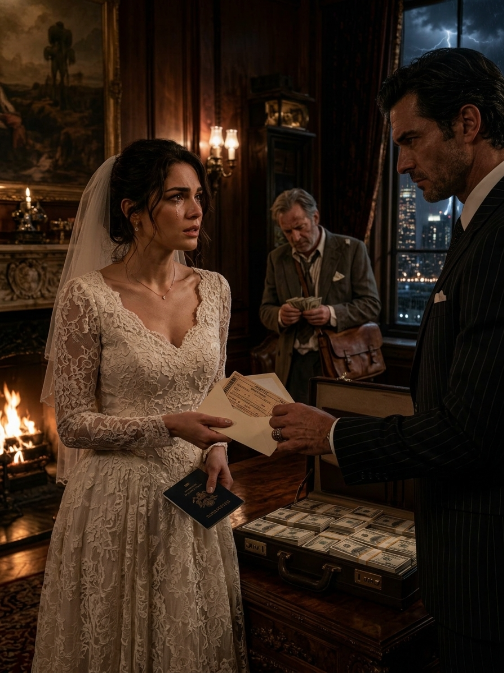
He Paraded His Mistress Into High Society—Then His Wife Exposed Who Truly Owned Every Door

PART 1
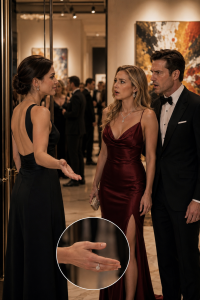
Julian stopped so suddenly that Serena Lockhart’s hand tightened around his arm. Her silver dress shimmered under the gallery lights, cut low at the back and high at the thigh — a dress designed to be noticed by men who thought discretion was old-fashioned.
She turned her head, honey-blonde hair sliding over one shoulder, smile still in place. “What is it?” she whispered.
Julian didn’t answer. He was staring at the woman behind the marble reception podium.
Lillian March looked exactly as he’d left her that morning — calm, elegant, unreadable, dark auburn hair pinned low at the nape of her neck, a black velvet dress with long sleeves, pearl earrings so simple they looked almost modest. Her gray-green eyes moved once to Serena’s fingers curled possessively around Julian’s arm, then returned to him. No tears. No trembling. No scene.
That was what frightened him first.
“Enjoy the exhibition,” Lillian said warmly — smooth enough to pass for politeness. Only Julian heard the blade beneath it.
Serena looked between them. “You know her?”
The entrance was crowded behind them — photographers flashing along the staircase, collectors in tailored coats handing over invitations, a string quartet playing somewhere inside while waiters moved through with champagne. Julian felt trapped in the open. He’d spent nine months constructing a lie clean enough to survive scrutiny: flights on company accounts, hotel suites through consulting retainers, dinner reservations booked under Serena’s name. He’d told Serena his marriage was dead. He’d told himself Lillian was too quiet to ever notice.
Now his wife stood three feet away, welcoming his mistress as Mrs. Vale.
“Julian.” Serena’s voice dropped lower. “Who is she?”
Lillian’s mouth curved, very slightly. Julian forced his voice to work. “My wife.”
Serena’s hand slipped from his arm — not dramatically, just enough for everyone nearby to see the space open between their bodies. “Your *wife*?”
Lillian handed a program to the next couple with perfect grace. “Welcome to Marlo House. The main reveal begins in ten minutes.”
Marlo House — the most private gallery in New York, the kind of place where invitations weren’t requested, they were granted. Julian had fought for tonight’s invitation because his firm was chasing an art trust partnership worth more than two hundred million dollars. He’d brought Serena because she loved rooms where rich people pretended not to stare at each other. He hadn’t brought his wife; he’d assumed she didn’t belong here.
That was the second mistake of the night. The first had been believing Lillian didn’t already know exactly where he was going and why.
“You told me she never went anywhere,” Serena hissed, her perfume sharp and sweet. “You told me she had no life outside that apartment.”
Julian swallowed. Across the foyer, Lillian stepped away from the podium as a tall, silver-haired woman in white kissed both her cheeks. Two men in Italian tuxedos waited behind with the nervous patience of people hoping to be remembered. Julian recognized one — Elliot Crane, director of the Westbridge Museum, a man who barely greeted donors, bowing his head slightly the moment Lillian turned to him.
Julian’s stomach tightened. “What exactly does your wife *do*?” Serena asked.
“She used to paint,” he said. The word *used to* sounded foolish the moment it left his mouth. He remembered their first apartment — sunlight on old wooden floors, canvases stacked against the walls, the smell of turpentine and coffee, Lillian painting barefoot in one of his shirts, color smeared along her wrist. Brilliant, then. Quietly brilliant.
Then he changed. He worked later. She painted less. He stopped asking about her work because he stopped wanting answers that required his attention. Eventually the canvases disappeared, and he told himself the dream had died. It never occurred to him she might have only stopped showing it to *him*.
A chime sounded through the foyer. The lights dimmed. Serena didn’t take his arm again — Julian barely noticed. His eyes were fixed on Lillian as she crossed the room toward a black curtain covering the largest wall, where a difficult, elegant man Julian recognized as Marcus Ren, Marlo House’s ruthless executive director, tapped the microphone.
“Good evening. Thank you for joining us for the private opening of *The Rooms We Leave Behind*.” The conversation softened. Julian felt cold beneath his collar. “For nearly a year, this collection has circulated only as rumor among a handful of private collectors. Tonight, for the first time, the artist has agreed to reveal her name.”
Serena glanced at Julian. He didn’t move. Some part of him already knew — his body understood before his mind surrendered.
Marcus turned toward Lillian. “Ladies and gentlemen, it is my honor to introduce the founder of the March Atelier Trust, the owner of Marlo House, and the artist behind this historic collection — Miss Lillian March.”
For one second, the room went silent. Then applause broke like thunder.
*Owner. Trust. Artist.*
Lillian stepped onto the stage under warm white light, calm as if she hadn’t just split her husband’s life open in public. Her eyes passed over Julian without stopping. That hurt more than if she’d stared.
“Thank you for being here,” she said. “This collection began with a question I was too proud to ask out loud. How long can a woman live beside someone who has already left her?”
The room stilled. Julian’s fingers curled around the program in his hand.
Lillian turned toward the black curtain. “The first answer was silence.”
The curtain fell.
PART 2
The painting behind it was enormous. A man sat alone in the backseat of a black car at night, his face blurred by the reflection of city lights on the window — but his hand was visible, resting near a woman’s silver-clad knee. The woman herself was mostly outside the frame. Only the curve of her thigh, the shine of her dress, and the bracelet at her wrist remained.
Serena looked down at her own bracelet. Silver diamonds, thin chain. Julian had given it to her two weeks earlier in a hotel suite overlooking the river. Her face changed.
The plaque beneath the painting read simply: *Passenger Seat.* No names, no accusation, no obvious scandal — which made it worse. “That restraint is extraordinary,” a museum director whispered. “It feels like being betrayed, before anyone says the word,” said someone else. Julian’s throat tightened. He remembered that exact night — the black car, Serena’s hand sliding over his wrist, his phone face down on the seat because Lillian had called twice and he’d told himself he’d say he was in a late meeting. He’d had no idea anyone was watching. How could she have watched?
“People imagine betrayal as a door slamming,” Lillian told the room. “But most betrayal arrives quietly. A delayed reply. A changed password. A chair left empty long enough that emptiness becomes part of the furniture.”
The second curtain dropped — a dining table set for two, one plate untouched, one glass filled, a phone glowing beside a folded napkin. Title: *Reservation for Two.* Their anniversary. Eight months earlier, Lillian had booked the small French place they used to love. Julian had remembered at five, then ignored it at seven because Serena surprised him at the office in a red coat with a suite waiting. He’d texted Lillian at nine: *Don’t wait. Work disaster.* Come home after midnight to find her still by the window in a navy dress, lipstick faded, one earring already removed. He’d kissed her forehead. *”You understand?”* he’d asked. *”Yes,”* she’d said. He’d thought that meant forgiveness. He understood now it had meant *record.*
The third curtain fell on a hotel suite at dawn — unmade bed, no bodies shown, a champagne bottle sweating beside a pair of heels and a man’s discarded jacket, Manhattan glowing pale blue through the window. Title: *Temporary Room.* Serena stepped back. Her silver dress, bold at the entrance an hour earlier, now looked like evidence.
“Whoever inspired this should leave before dessert,” a man nearby murmured to his wife. “No,” she answered. “He should stay and suffer.” A few people laughed softly. “You said she didn’t know,” Serena whispered. “I thought she didn’t.” He finally turned to look at her — twenty-eight, bright-eyed, ambitious, skilled at making wealthy men feel chosen, a woman who had only ever known the polished version of him and was only now, under his wife’s paintings, beginning to see the scaffolding holding it up.
By nine, three paintings had already sold — not reserved, *sold* — the numbers whispered behind him like something almost vulgar to say aloud. His phone buzzed without stopping. *Where are you. Crane wants to speak with you. Marlo House is tied to March Atelier — did you know? Call me immediately.*
Then Marcus Ren returned to the microphone with an announcement Julian hadn’t braced for at all — that *The Rooms We Leave Behind* wasn’t only an exhibition, but the opening program of a new residency fund, backed by fifty million dollars from Lillian’s own family holdings, for women artists rebuilding after financial or emotional coercion.
Julian felt the room tilt. He had always assumed the March family fortune had quietly faded to nothing but a name.
He had never once been more wrong, or more publicly, in his entire life.
PART 3
The March family had not disappeared. They had gone private — and Lillian had not been financially dependent on him for years. She’d simply let him believe otherwise, because a man who thought he was the provider revealed himself more honestly.
Julian had met Serena at a private banking reception where she worked in client relations — twenty-eight, bright-eyed, ambitious, skilled at making wealthy men feel chosen. She had complimented his speech, then his watch, then his loneliness, in that order, and he had liked her precisely because she admired him so easily. He had loved — if that was even the word — how she carried no memory of the version of him that once waited in line for cheap coffee with paint on his sleeve because Lillian’s canvases were drying across their kitchen floor. Serena had only ever known the polished Julian: managing partner, expensive suits, a driver on call, city memberships, his name recognized at restaurants. She had never once met the man Lillian had actually helped build, brick by unglamorous brick, in the years before any of it existed. Standing now beneath his wife’s paintings, even Serena was beginning to see the scaffolding holding the whole performance up.
The doors to the West Gallery opened at nine. Inside, the lighting dropped lower; each painting stood in its own pool of light, with enough space around it to make a viewer feel entirely alone.
The first canvas showed a woman seated on the floor beside a closed studio door, knees drawn up, hands stained with paint, light spilling from the keyhole while a man’s shadow passed outside without stopping. Title: *He Never Knocked.* Julian remembered the studio — the room at the end of their hallway Lillian used to call her weather room, because the light changed there all day. For the first year in the penthouse she’d invited him in constantly. *Come see this,* she’d say. He’d say *later.* Later became tomorrow. Tomorrow became next week. Eventually she stopped asking. He’d told himself she’d simply stopped painting. The truth had been kinder to him and far more damning: she’d stopped inviting him.
“It’s devastating,” a young curator said, “how the figure is locked outside her own gift.” Beside Julian, Serena’s face softened despite itself. “She loved you,” she said quietly. “I know,” he said. “No,” Serena replied. “You don’t. That’s why you’re standing here like a man surprised by a fire he lit.”
A collector Julian had pitched twice glanced at him, then at Serena, then across the room at Lillian — and the calculation was immediate and total. People in rooms like this didn’t need full explanations. They lived on implication, and a mistress in silver beside a husband watching his wife’s betrayal paintings sell for millions was more than enough.
His phone buzzed again, this time from his senior partner, Malcolm Reeve: *Need to know if there is a personal issue involving you and Lillian March. Our fund proposal may be compromised.* Julian’s palm went damp. His firm, Veil Reef Capital, had spent six months courting the March Atelier Trust. He’d led the pitch himself — cultural assets, ethical stewardship, legacy capital — never once realizing he was pitching his own wife. Or perhaps, worse, that she’d known exactly who was pitching her and let him walk into it anyway.
Serena read the message over his shoulder, her face going very still. “You said tonight was just networking.” “It is.” “The money belongs to your wife, Julian.” He said nothing. She stepped back from him as if he’d become physically unpleasant.
The second painting in the West Gallery showed a man adjusting his cufflinks before a mirror while, behind him, a woman sat blurred at a breakfast table. Title: *Polished.* “Cruel,” a critic near Julian murmured. “Accurate,” another answered. No painting had ever named him. No placard described an affair. Lillian had given the public no scandal, no gossip, no easy violence — and yet the collection had built a shape, and Julian found himself trapped entirely inside it. Every empty chair looked like him. Every delayed message sounded like him. Every reflected man wore his posture. She hadn’t exposed his secret by shouting it. She’d made his behavior recognizable to everyone who had ever been harmed by exactly that kind of man.
Serena found Lillian near the final painting before Julian could stop her — a woman standing on a rooftop at dawn, the city glowing gold behind her, black dress moving in the wind, her face calm, shoulders straight, hands empty. Not lonely. Released. Title: *After the Door Closed.*
“Lillian,” Serena said, chin lifted, wearing a smile that wasn’t her old sparkling one, but something tight and frightened. “I think you have the wrong idea about me.”
“Do I?”
“Julian told me your marriage was over.”
“That seems to be a favorite sentence among married men who want unmarried benefits.” A woman nearby heard and hid a smile.
“He said you barely spoke to him,” Serena pressed, flushing. “I stopped wasting language. He said you didn’t care where he went.” “I stopped asking questions he answered badly.” Something sharper surfaced in Serena’s jaw — the woman beneath the silk who had not merely been seduced, but had chosen ambition and called it love. “You know,” she said, “for months, I thought you were pathetic.” The air changed. Julian stepped forward — “Serena—” — and Lillian raised one hand, not to silence him, to dismiss him. It froze him in place.
“I thought you were one of those women who kept a ring because you had nothing else,” Serena went on, reckless now. “A quiet wife in a quiet apartment, waiting for a man who’d already chosen someone younger.” A few people had stopped pretending not to listen.
Lillian studied her a long moment — no hatred in her face, which was what made it lethal. “You thought youth was a victory,” she said, “because Julian sold you a race I was never running. You didn’t win my husband, Serena. You inherited his appetite. That’s not a prize. It’s a maintenance problem.” Someone coughed into a champagne glass. Then Lillian turned, at last, to Julian. “And you,” she said, “brought her into a room I own, wearing a bracelet purchased with a card attached to an account my auditors flagged six weeks ago.”
Serena looked down at her wrist. Julian’s stomach dropped. “You audited me?”
“You used joint household funds to buy jewelry for another woman, then submitted travel and meals under a cultural investment account tied to my trust proposal,” Lillian said, almost amused. “I didn’t need to audit you, Julian. You walked mud across a white floor.”
Serena unclasped the bracelet like it burned. “You told me that was from your personal account.” “It was complicated,” Julian said. “No,” Lillian said. “It was theft made small enough for you to pronounce comfortably.” Serena set the bracelet on a passing service tray, fingers shaking. “I didn’t know about the account.” Lillian’s expression softened, fractionally — not forgiveness, assessment. “I believe you didn’t know the accounting structure,” she said. “I don’t believe you didn’t know he was married.” Serena had no answer, because there wasn’t one.
Marcus Ren approached with a folded paper. “Lillian — Berlin confirmed. They want the rooftop piece for the fall retrospective.” Julian stared at the painting. His wife’s release was now a museum acquisition. That shouldn’t have hurt. It did. He thought, absurdly, of all the times he’d told colleagues that Lillian didn’t understand ambition — that she’d never wanted the things he wanted. He understood now that she had simply wanted different things, and had gone and gotten every one of them without asking his permission or his help.
“So this is what tonight is,” Serena said, a small broken laugh. “You destroy him and everyone applauds.” “No,” Lillian said. “Tonight is what happens when a woman stops hiding what nearly destroyed her.” Julian moved closer. “Can we speak privately?” “No.” The refusal was immediate; heads turned. “You don’t get privacy from me tonight,” Lillian said. “You used privacy to rot everything.” It cut deeper for being true — years of private calls, private rooms, private excuses, private pain imposed on her in public silence. Now she stood in public with the truth, and gave him nothing left to hide behind.
*
The formal announcement came at ten. Julian had just stepped into a side corridor to call Malcolm when Marcus returned to the microphone. “Before we close the evening, Ms. March has agreed to share one final note about the trust’s upcoming partnerships.”
Julian froze mid-call. Malcolm’s voice crackled through the line — *”Julian, are you there?”*
Lillian stepped onto the stage a final time to applause that was no longer merely introductory; it was warm, eager, almost protective. The room had chosen her, and Julian understood exactly why. She had given them pain with dignity, wealth with purpose, revenge without vulgarity — irresistible, to people who loved power but preferred it perfumed.
“The March Atelier Trust was created by my grandmother, Helena March,” Lillian said, “who believed art should never depend on the mercy of people who benefit from silence. In that spirit, the trust has concluded its review of potential financial partners.” Julian’s heart slammed once against his ribs. Malcolm was still on the line and heard it happen in real time. “We will not be proceeding with Veil Reef Capital.” A soft murmur passed through the crowd. “This decision follows a compliance review of expense handling, undisclosed conflicts of interest, and conduct inconsistent with the standards of stewardship required by this trust.” No names. No direct accusation. Enough for every serious person in the room to understand completely.
The collapse happened in layers. Malcolm hung up. Two investors near the bar glanced at Julian and turned away. Elliot Crane, who had once promised to take his call, met his eyes with cold recognition and crossed to the other side of the room. Serena stood near the entrance, coat over her arm, face pale — she had heard, and by morning, everyone would.
“Was that necessary?” Julian asked when Lillian stepped down from the stage, his voice lower than he meant it, rough with humiliation. “Was what necessary?” “Ruining my firm’s proposal in front of everyone.” “I did not ruin it,” she said. “Your records did. You could have handled this privately.” “You keep saying that as if privacy is a virtue. It isn’t. Sometimes privacy is where men put things they don’t want named.” “This is revenge.” “No,” Lillian said. “Revenge would have been easier. This is governance.” The word stunned him more than anger would have — not heartbreak, not jealousy, not punishment. A board decision. A risk review. A consequence. She had moved him, cleanly, from husband to liability. That was the real death of the marriage.
His phone buzzed once more: *You are suspended. Pending review. Do not contact clients.* Julian stared at it. He had spent years wearing control like his suits — full calendar, known restaurants, strategic friendships, Serena among them, proof he was still desired, still powerful, still moving upward. One evening had stripped all of it away at once.
“I am leaving,” Serena told him. “Not now.” “Exactly now. Do not make this worse.” “We can talk tomorrow.” “No,” she said. “Tomorrow you’ll be unemployed, publicly toxic, and trying to convince me this is all her fault.” Several people looked over. “Careful,” he warned. She laughed, no humor in it. “That’s the first honest thing you’ve said all night. You are not sorry. You are embarrassed.” He had nothing to answer with. “You told me she was dull,” Serena went on, her voice shaking now with fury at having been made a fool, not grief. “No ambition, no money of her own, no world outside you. You didn’t leave your wife because you were trapped. You stayed because she was useful. And you cheated because I was easy.” She pulled a small velvet box from her clutch and threw it lightly at his chest; he caught it by reflex — the pendant he’d given her the month before. “I don’t want gifts funded by another woman’s silence.” She walked out. Photographers outside caught her descending the gallery steps alone.
Julian stood under the lights with the box in his hand, watching the mistress he’d flaunted leave behind the wife he’d underestimated for a decade.
“Please make sure Miss Lockhart gets a car,” Lillian told Marcus.
“You’re helping her?” Julian asked, staring.
“I am not helping her,” Lillian said. “I am refusing to become you.”
*
By morning, the coverage had already outrun the gala itself. Arts writers who normally covered auction estimates and museum acquisitions found themselves writing about marriage, money, and power in the same paragraph, unable to separate the three even if they’d wanted to. One outlet ran the entire *Rooms We Leave Behind* series alongside a single line of text: *the quietest divorce filing in New York history was hung on a gallery wall months before anyone signed a single document.* Another simply printed Lillian’s line about governance beneath a photograph of the rooftop painting, no further commentary needed. Veil Reef Capital issued a brief statement confirming that Julian Vale had been placed on administrative leave “pending an internal compliance review,” language every reader in the industry understood to mean something closer to the end than a pause. Julian read every article once, in order, standing in his office at six in the morning before anyone else arrived, and then never searched his own name again.
Three weeks later, Julian returned to the penthouse to find half of it gone — not messy, not dramatic. Gone. Lillian’s reading chair by the east window, vanished. The wall where her small sketches used to hang, pale rectangles in the paint. Her books, missing from the shelves. The studio door at the end of the hall stood open on clean floors and a faint smell of linseed oil. Every absence was organized, which was what made it unbearable. She hadn’t stormed out. She had extracted herself.
On the marble kitchen counter sat a manila envelope and her wedding ring — small, plain gold, chosen once because he’d insisted large diamonds were vulgar, and she’d smiled and let him mistake his own preference for a principle. Inside the envelope: a petition for dissolution of marriage, an asset separation agreement, notice of a forensic accounting review, an affidavit concerning misuse of joint household funds. Every page prepared. Every signature placed. Every path closed. No note. Of course there was no note. She had written it across thirty paintings and sold it to museums instead.
Malcolm called for fifteen minutes to explain suspension, client concerns, reputational exposure, internal review, the need for distance — that particular word, *distance*, that powerful men reached for whenever they wanted someone else to carry the stain alone. “You’re pushing me out,” Julian said. “You pushed yourself out,” Malcolm said, “when you used a client-linked expense structure to impress your girlfriend inside your wife’s own institution. That’s not optics, Julian. That’s exactly what governance committees exist to catch.” *Governance,* Julian thought. He hated the word already, the way he’d once hated hearing Lillian ask if a canvas was too dark, back when he still had the option of simply answering her.
When the call ended he sat down on the kitchen floor, unable to say why — perhaps because the chairs felt too formal for collapse. Rain tapped the windows. The city glowed beyond the glass, indifferent and vast. He thought of Lillian in the early years, laughing as she painted a thin blue line across his wrist and called it accidental ownership, falling asleep on his shoulder in cheap theater seats, standing in a half-finished studio asking whether he thought a canvas was too dark while he answered emails and never once looked up long enough to remember what he’d said. That frightened him more than anything else that night — not that his memory had failed, but that his attention had, years before the memory ever got the chance to.
Two months later the divorce moved faster than he expected, because Lillian had protected everything long before he understood there was anything worth protecting. The penthouse belonged to a March family holding company. The art was trust property. Her liquid accounts had never once mixed with his; even the modest joint household account he’d misused was documented cleanly enough that his own attorney advised immediate settlement rather than a fight neither of them could afford to have in public a second time.
His attorney tried, once, to argue that seven years of marriage entitled him to a share of the trust’s appreciation — the March Atelier Trust had, after all, existed and grown throughout their marriage. Lillian’s counsel produced the trust’s founding documents within a day: established by Helena March two decades before Julian and Lillian ever met, structured with ironclad separate-property language that predated the wedding by years. Julian’s attorney read the paperwork once, set it down, and told him quietly that pursuing it further would only generate more headlines, none of them favorable. Julian dropped the claim the same afternoon.
Serena never returned his calls. She resigned from her banking role after the gala and moved to Los Angeles. Her final message arrived a week later: *I liked the man you pretended to be. That is not enough.* He read it three times, then deleted it. Months afterward, a mutual acquaintance mentioned, in the careless way people mention things they don’t realize will land like a blow, that Serena had started her own client advisory practice out west and was doing well — better, if the rumor was to be believed, than she’d ever done managing Julian’s calendar of borrowed importance.
His world narrowed by inches. Restaurants stopped having tables. Calls went unreturned. Invitations slowed, then stopped. Nobody accused him of anything — they simply became busy. One night in late winter, riding in a hired car after an interview with a smaller Midtown firm that once would have begged for him and now only offered *let’s circle back*, the car stopped at a red light near Madison Avenue, and he looked up.
Lillian March, thirty feet high on the side of a museum, black dress, pearl earrings, calm gray-green eyes. Behind her, the rooftop painting glowed gold. *Lillian March: The Rooms We Leave Behind — International Retrospective, opening this spring. Presented by the March Atelier Trust.*
“Beautiful, right?” the driver said. “My wife wants tickets. Sold out already.”
Julian stared at the billboard, his chest tightening so violently for a second he thought it might be pain. Then he understood it was only recognition, arriving far too late. He had once believed losing Lillian would look like a woman crying in an apartment he still controlled. Instead, losing her looked like an entire city looking up.
*
Lillian stood in the completed east wing of Marlo House on the morning of its public opening — no champagne yet, no cameras, no wealthy applause. Just pale sunlight across polished concrete and the faint smell of fresh paint. The wing had once been a storage warehouse belonging to her grandmother. Years earlier, Helena March had brought a young Lillian there and told her, “Buildings are like people. The ones everyone calls useless usually just need better light.” Lillian had remembered.
Now the building held studios, legal offices, counseling rooms, and a residency floor for women artists beginning again after marriages, contracts, families, or institutions had trained them to doubt their own names.
“The first residents arrive Monday,” Marcus said, walking beside her with a clipboard. “Four painters, one sculptor, two textile artists, a photographer from Detroit.” Lillian nodded. He studied her. “You seem quiet.” “I am often quiet,” she said, smiling faintly. “People keep misreading it.”
One of the painters had arrived a day early, unable to wait — a woman in her fifties named Ruth who had spent thirty years signing her canvases with her husband’s surname because a gallery owner once told her, decades ago, that a married woman’s work sold better with a man’s name quietly implied behind it. She found Lillian in the unfinished hallway, introduced herself, and then, unprompted, said the thing residents would say to her for years afterward in one form or another: “I saw the collection twice. I didn’t understand why I kept crying until the third painting. Then I understood I wasn’t crying for you. I was crying because I recognized the chair.” Lillian didn’t offer comfort or platitudes. She simply said, “Your studio is the one with the north light. Take whichever wall you want first.” It was, she had learned, usually enough.
They stopped before a blank wall near the entrance, a brass plaque waiting beneath a protective cloth. “Ready?” Lillian reached up and removed it. The plaque read: *The Helena March Studio Fund — for those who were told their silence was peace.*
She touched the brass with her fingertips, thinking, for a moment, of the gala — the silver dress, Julian’s pale face, Serena’s trembling hands, the applause, the sales, the strange public beauty of a private wound. People had called that night her revenge. They were wrong. Revenge would have kept Julian at the center of the story. This was the opposite — a life built so far beyond him that his betrayal became only one room she had walked through on her way to something larger.
When the public arrived that afternoon, a reporter asked whether she thought pain created great art. “No,” Lillian said. “Pain interrupts. Art is what happens when a person refuses to let the interruption be the final sentence.” Another asked what she hoped women would feel leaving the exhibition. She looked toward the new studio wing, sunlight falling across doors not yet opened. “Permission,” she said. “Not to suffer beautifully. To stop making themselves smaller for people who only love them when it’s convenient.”
By noon the museum steps were full — young artists with notebooks, older women standing in quiet pairs, a mother lifting her daughter to see Lillian’s portrait on the banner above the door. A group of art students from a local college had made signs, unprompted, quoting lines from her opening remarks; one simply read *permission, not performance.* Lillian watched from an upper window for a moment before stepping back. Her phone buzzed once, a message from an unknown number: *I finally understand. I am sorry.* No name. None was needed.
She looked at it, felt the old pain stir, and waited for it to turn into anger. It didn’t. It had become history instead. She deleted the message, then walked downstairs to open the doors herself.
Outside, the city was loud, impatient, alive. Inside, the rooms waited, filled with light. Lillian placed one hand on the brass handle and breathed in. For years she had believed silence was something that simply happened to her. Now she understood it could be a studio, a courtroom, a grave, or a beginning — depending entirely on what a woman chose to build inside it.
She opened the doors, and this time the world walked in on her terms.
THE END