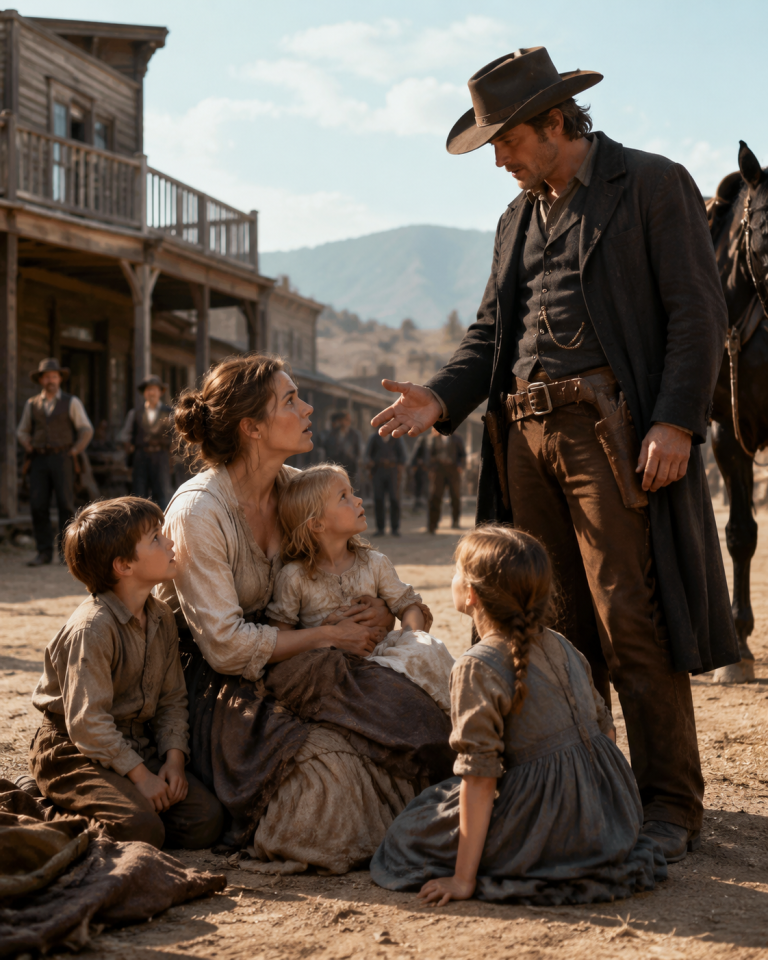
He Offered Ten Furs for One Night With a Lonely Widow — Then She Changed His Life Forever

—
## PART 1
The wind in the Montana high country did not whisper. It screamed like something hungry and alive, clawing at Clara Barrow’s cabin, tearing at loose fence posts like it meant to rip her last shelter clean off the earth. Clara fought it the way she’d fought everything since her husband died — alone, hands cracked and bleeding as she hammered a rail back into place, snow swallowing her boots with every step. She was only thirty-two, but grief and winter had carved hard lines into her face regardless. The land had taken her cattle. It had taken her savings. It had taken Amos. Now it was trying to take the last two chickens keeping her alive.
A sudden scream of feathers broke through the wind. Clara turned just in time to see a gaunt gray coyote dart from behind the coop with a hen in its jaws. She didn’t think. She grabbed the shotgun leaning by the cabin wall, the metal burning her hands with cold, and the blast split the white silence. When the smoke cleared, the coyote lay still in the snow. Clara stood there shaking — not from fear, from anger. Everything out here was starving, even her.
She carried the dead hen inside and barred the door tight. The cabin was small, rough wood, one cot, a narrow table, a stone hearth. The only place she felt safe.
Then came the pounding. Not a knock — a heavy, dull strike against the door. Clara froze. No one came this far in winter. The shotgun was already in her hands. “Who’s there?” she called.
“Shelter!” The voice came low and rough. She wiped frost from the small window and looked out. He was huge, wrapped in thick furs crusted with ice, leaning against the door frame like he might fall any second. Dark blood stained his shoulder.
“Go away,” she said flatly. “I’ve got nothing.”
“I’ll trade,” he rasped, dropping a heavy pack into the snow and pulling out a bundle of skins — thick, dark, perfect. “Ten,” he said. “Prime beaver. For the floor. One night.”
Clara stared at the pelts. Ten furs could buy flour, feed, powder. Ten furs could cover the better part of the debt Amos had left behind when a bad winter and worse decisions had put him three seasons behind on notes he’d never told her the full size of until after he was gone. She looked at the man again. He was dying.
Her stomach tightened. Amos had taught her what men could be — loud, cruel, taking. But this man was swaying on his feet, not reaching for anything but the door frame holding him up. “Just the floor,” she said sharply. “You try anything, I shoot you.”
He nodded once. She unbarred the door. The wind slammed it open, and he stumbled inside and collapsed near the hearth without so much as looking at her, curling toward the weak fire like it was the only thing left in the world worth reaching for.
Clara didn’t sleep that night. The stranger burned with fever, his breathing harsh and broken. Near midnight he began to mutter in his sleep. “Let him go,” he whispered. “Not again.” There was no anger in his voice. Only guilt.
Clara sat up on her cot with the shotgun in her lap. She knew the sound of a violent man — Amos had cursed and shouted plenty in his sleep too. This was different. This was a man haunted, not a man dangerous, though she understood well enough by now that the two weren’t always easy to tell apart from the outside.
By dawn his skin burned hotter still. Clara stood over him and pressed a hand to his forehead. The wound on his shoulder smelled wrong. Rotting. She could drag him outside and let the cold finish what the wound had started. Take the pelts. Survive.
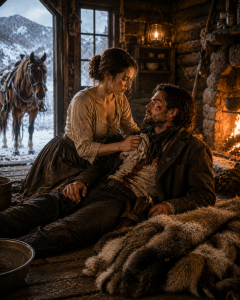
Instead she melted snow, heated water, pulled out her sewing needles and the last of Amos’s whiskey. “This will hurt,” she said, and he woke screaming when the hot cloth touched the wound, his hand clamping around her wrist like iron.
“You’re infected,” she said calmly. “Hold still, or lose the arm.” He stared at her through fevered gray eyes, then slowly let go. She poured whiskey into the wound. He roared but didn’t fight her. She dug the bullet out with a heated knife blade, her hands never once shaking. When she finished stitching him closed, she was the one trembling.
He lived. Two days later, he woke clear-eyed and pale. “You dug it out,” he said.
“It was festering.”
“Why?”
“You paid for one night,” she said. “The rest is interest.”
His name was Elias. He didn’t waste words. When he could stand, he began fixing her fence with one good arm, repaired the south corner of the roof before she’d even asked, chopped wood gently until he went gray with exhaustion. He never demanded, never bragged, never once reached for her. The silence in the cabin changed. It was no longer empty.
—
## PART 2
One evening she washed behind a hanging quilt for privacy and saw his shadow through the firelight — sitting still, watching, but never moving toward her. Later, by the fire, he reached out and gently tucked a loose strand of her hair behind her ear. The touch was soft, careful. Her breath caught. She hadn’t been touched like that in years.
Fear rose sharp and cold. She pulled away. “Don’t,” she whispered.
He nodded and stepped back without argument.
The next morning, she broke, telling him the truth about Amos, about the debt, about Silas Croft, who’d tried to claim her along with the land the same month Amos was buried, offering to settle her husband’s debt to the bank himself in exchange for a marriage neither the bank nor the county had any right pushing on a grieving widow. Elias listened without interrupting.
“They’ll come back,” he said quietly. “Men like that always do.”
For the first time in years, Clara didn’t feel entirely alone looking at the storm outside her cabin walls. But storms always pass, and when they do, the world comes knocking.
—
## PART 3
The storm didn’t last forever. When the snow finally stopped falling, the world outside Clara’s cabin looked clean and quiet. But the quiet felt false, like something was waiting on the other side of it.
Elias stood by the window most mornings now, rifle resting against his shoulder, his wound healing slow, though Clara could see the stiffness in his jaw when he worked and he never once complained of it.
“You should rest,” she told him one morning.
“I’ll rest when it’s done,” he answered, hammering a new board into the fence, the sound filling the valley — thud, thud, thud — different from the noise Amos used to bring home. This sound built something. It didn’t break it.
Days passed in a steady rhythm. Clara cooked what little food they had. Elias trapped rabbits along the tree line and patched the roof where wind had chewed through the wood. They spoke little, but the silence between them had stopped being heavy. It had become shared.
One evening, as the sun dipped low, Clara sat by the fire brushing out her hair. Elias watched the flames, though she could feel his eyes drift toward her now and then — not greedy, not cruel, just quiet.
“You ever plan to leave this place?” he asked.
“It’s mine. Why would I leave?”
He looked at her hands, rough and scarred from work. “Because men like Silas Croft don’t forget.”
The name made her stomach twist. Silas Croft owned half the town of Three Forks outright — ran the land office, the bank, the saloon, and, Clara had long suspected without proof enough to say so out loud, Sheriff Barlo’s badge besides, given how quick that man had always been to look elsewhere whenever Croft’s name came up in a complaint. Croft had tried to take her land after Amos died, tried to scare her into signing it over quiet, and hadn’t taken kindly to a widow who’d said no to both the land and the man in the same breath.
“He won’t scare me again,” she said. Elias didn’t answer. He just stared into the fire, and that same evening, without telling her directly why, he asked her for paper and a stub of pencil and wrote a short note to a name she didn’t recognize — Abner Potts, a rancher two valleys over Elias had done honest trapping business with the season before. “Man’s fair, and he keeps a dozen hands who’d ride if he asked them to,” Elias said, folding the note. “I’d sooner have somebody know where we stand before Croft decides where we stand for us.”
He rode it out himself the next clear morning, weak as he still was, and came back by dusk having left it with a boy at the trading post to carry the rest of the way.
The knock came three days later. Clara stiffened. Elias moved without a sound, stepping to the side of the door, rifle ready. “Who is it?” Clara called.
“Land office. Inspection.”
Clara’s blood ran cold. She opened the door just enough to see two men standing in the snow, thin coats, smirks that made her skin crawl. “We’re here on behalf of Mr. Croft,” the taller one said. “He’s filing abandonment papers. Says you ain’t been improving the land.”
Heat rose in Clara’s chest. “Look around. Fence is standing. Roof is fixed. Livestock’s alive.”
The shorter man stepped inside without invitation, boots dragging mud across her floor, eyes moving slow over the cabin. “Looks cozy,” he said. “Specially with company.” His gaze shifted toward Elias’s tools near the hearth. “You got a man staying here?” the tall one asked. “That against regulations, ma’am.”
“It’s none of your concern,” Clara said.
The tall man smiled. “Everything’s our concern.” He took a step toward her. Before she could react, the shotgun was in her hands, barrel pressed into his chest hard enough to bend his coat. “Get out,” she said, voice steady.
The men froze. Behind them, Elias stepped forward into the light, silent, rifle lowered but his gray eyes locked on them plain enough to finish the sentence Clara hadn’t needed to say. The tall man swallowed. “This ain’t over,” he muttered.
“It is for today,” Clara replied. They backed out into the snow and rode off fast.
Clara barred the door and leaned against it, hands steady though her heart pounded. Elias walked toward her slow. “You did good,” he said.
“I’m tired of being afraid.”
He reached out as if to touch her, then stopped halfway, and she saw the hesitation in it, and the respect underneath the hesitation. “You won’t have to face him alone,” he said quietly.
Before she could answer, another sound rolled across the valley — hooves, many of them. Elias moved to the window, jaw tightening.
“How many?” Clara whispered.
“Six, maybe seven.”
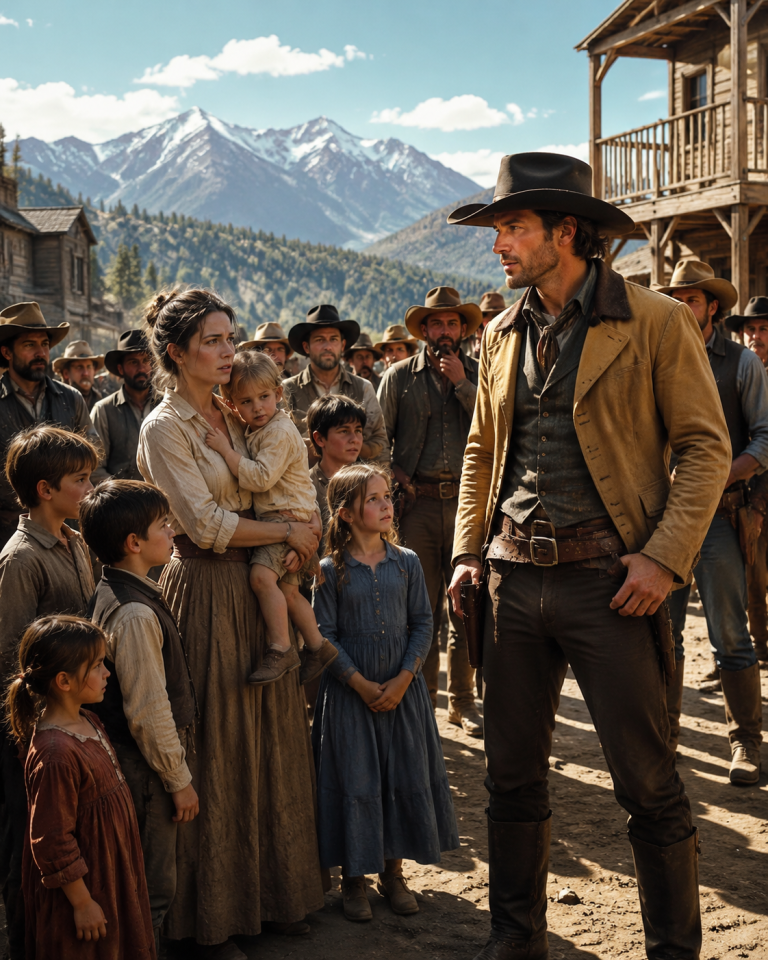
The riders came into view through the trees, a broad-shouldered man in a dark coat at their front. Even from a distance Clara recognized him. Silas Croft, and the men fanning out around the cabin like wolves circling a wounded deer.
Croft stopped his horse ten yards from the door. “Mrs. Barrow,” he called, smooth and loud. “You’ve been avoiding lawful business.”
Clara stepped forward, shotgun in hand. “This is my land.”
Croft smiled slow. “You owe three years of back taxes. Forty dollars. Pay today, or I take possession.”
Clara felt the truth of it like a knife. She didn’t have forty dollars, not with the pelt money already promised twice over to the bank note Amos had left behind. Elias stepped beside her, rifle lifted. Croft’s eyes narrowed.
“Well,” he said softly. “Now that’s interesting.” Recognition flickered across his face. “You’re harboring a wanted man, Mrs. Barrow. Wyoming sheriff’s put a price on his head.”
Clara’s heart slammed. She looked at Elias. He didn’t look at her — he looked at Croft. “You ride off my land,” he said calmly, “or I start shooting.”
The hired guns shifted nervous. Croft studied them both a long moment. “This ain’t finished,” he said finally. “You’ve got forty-eight hours.” He turned his horse, and the riders pulled away, snow kicking up behind them.
The silence after they left felt heavier than the storm. Clara lowered the shotgun slowly. “You’re wanted,” she said.
Elias nodded once. “For murder,” he added. She stared at him, and he met her eyes without flinching from it. “A man named Wexler ran a mining camp two winters back in the Bitterroots. Beat a boy near to death for skimming off his own wages, and when I stepped between them, Wexler came at me with a pick axe. I didn’t mean to kill him. Didn’t mean not to, either, once it started. His brother owns half the claims in that county now, and he’s the one put coin on my name rather than let it lie as the plain self-defense a fair court would’ve called it.” He let that sit a moment. “I’ve been running from a false charge for two winters, same as you’ve been running from a debt that was never rightly yours to carry alone. Figured that made us close enough to even.”
“They’ll come back,” he said. “And next time, they won’t talk.”
Clara tightened her grip on the shotgun. “Then we don’t run,” she answered. “We stand.”
The forty-eight hours passed slow. Clara didn’t sleep. Neither did Elias. They worked through the night, reinforcing the door with extra planks, dragging heavy logs against the weakest walls. Elias showed her how to reload faster, how to aim low in the snow, how to listen for movement beyond the wind.
“This cabin ain’t much,” he said quietly, checking the rifle one last time. “But it’ll hold long enough.”
“For what?” Clara asked.
“For them to regret coming. And for Abner’s note to reach somebody with enough hands to matter, if it comes to that.”
Dawn came gray and bitter cold. The riders returned just after sunrise, and this time they didn’t stop ten yards away. They spread wide across the open field, rifles in hand, Croft sitting tall in his saddle like he already owned the land beneath him.
“Last chance,” he shouted. “Forty dollars, or you’re out.”
Clara stepped onto the porch, shotgun resting against her shoulder. “You’ll have to drag me.”
Croft’s eyes hardened. “So be it.”
The first shot came from one of the hired guns, tearing through the side of the cabin inches from Clara’s head. Elias fired back instantly, the crack of his rifle splitting the morning air, and one of the riders dropped from his horse into the snow. The field exploded into chaos — gunfire tearing through the quiet valley, smoke rising in sharp bursts, horses screaming. Clara ducked back inside as bullets punched through the walls. Elias moved beside her, calm and deadly, firing through the shattered window.
“Reload!” he barked. She did, hands moving without thinking now, fear burned away, replaced by something harder. One of Croft’s men rushed the door with a torch. Clara stepped forward and fired — the blast threw him backward into the snow, the torch rolling uselessly away.
Croft shouted curses. Elias aimed again, then his body jerked, and Clara saw the blood bloom dark against his thigh.
“No!” she gasped. He staggered but didn’t fall.
“I’m fine,” he growled through clenched teeth, though the tremor in his voice said otherwise. “Keep shooting.” She dragged him behind the stone hearth as more bullets ripped through the wood, the cabin groaning under the assault, and for a moment, pressing her hand hard against the fresh wound in his leg while he fought to keep his rifle steady with a shoulder that had barely finished healing, she understood plain that this fight wasn’t going to be won on marksmanship alone. They were running low on both time and ammunition both.
“They’ll burn it,” Elias said, pressing his own hand against the bleeding.
Clara’s eyes moved quick. She remembered the shed behind the cabin — the dry hay, the old oil can. “I’ll smoke them out,” she whispered.
“Clara, no.” But she was already moving, slipping out the back pantry door and running low through the snow, bullets snapping past close enough to sting the air. She reached the shed, splashed oil over the hay, struck a match. The fire caught fast, thick black smoke rolling across the field on the rising wind, straight into Croft’s men. They coughed and shouted, blind in the haze.
Inside, Elias pushed himself back to the window and fired into the smoke. Another rider fell. The tall man from the land office visit stumbled forward, gun raised, and Elias steadied his aim and dropped him with one shot.
The hired guns broke first, two fleeing for the trees. Croft tried to rally what remained, but panic had already taken hold of the rest. Then new riders appeared from the east — hoofbeats Clara dared to look up and follow, and found Abner Potts riding at the front, rifle raised, his own ranch hands spread behind him in a clean, deliberate line, Elias’s note having found exactly the man it was meant to find with a full day to spare.
“That’s enough!” Abner roared, firing once into the air before leveling his rifle straight at Croft. The field fell silent. Croft looked around and understood, all at once, that the numbers had turned against him for good.
“You’ll pay for this!” he shouted at Clara.
Abner cocked his rifle. “Ride,” he said coldly. Croft hesitated only a second before turning his horse and fleeing, the last of his men following after. The valley grew still, smoke drifting up into a pale sky.
Clara ran back inside. Elias had collapsed against the hearth, blood soaking the floor. She dropped beside him, pressing both hands against the wound. “Stay with me,” she whispered. Abner came in behind her and knelt.
“He’ll live,” Abner said after a moment. “But we need to move fast.”
The hours that followed blurred together. They dug the bullet out, stitched the wound closed. Clara didn’t cry. She worked. Elias drifted in and out of fever through the night, and just before dawn his eyes opened, finding her like he was seeing her for the first time all over again.
“You stood,” he murmured.
“So did you,” she replied.
Weeks passed. A marshal rode down from Helena after Abner sent word of everything that had happened, and once the full account came out — the tax claim built on a debt Croft’s own bank had quietly let lapse into arrears on purpose, Sheriff Barlo’s warrant against Elias traced back to a bounty Wexler’s brother had posted rather than any court’s true finding, the land office men’s testimony crumbling apart the moment they were questioned separate from each other — Croft was arrested for fraud and attempted murder both. The hired guns scattered to whatever counties hadn’t heard the story yet. Barlo’s own badge was stripped inside the month once the territorial office finished asking its own questions about how long he’d been looking the other way for a price. The land deed was placed into Clara’s hands clean and final, the false abandonment claim struck from the county record for good.
She stood outside the cabin one evening as Elias leaned against the repaired fence, healing slow but steady. “You could leave now,” she said softly. “No one would chase you anymore, not with the truth of the Wexler business finally on record where a real court can see it plain.”
He looked at the mountains, then back at her. “I offered ten furs for one night,” he said.
She stepped closer. “And I gave you more.”
He nodded. “You gave me a reason to stop running.”
The wind moved gentle through the valley now — not screaming, not clawing, just moving, the way wind was supposed to move through country that had finally been left in peace. Elias reached for her hand. This time there was no hesitation in either direction. The land was still harsh. Winter would come again, same as it always had. But they would face it together — not as a widow and a stranger anymore, but as two people who had chosen, through fire and forty-eight hours and everything after, to stand their ground side by side rather than run from it alone.
**THE END**