He Publicly Replaced His Wife With His Mistress — Then Froze When Her New Husband Stole the Spotlight

—
## PART 1
Graham didn’t apologize. That was the first thing Evelyn understood clearly that night, the way you understand a fracture only after the bone has already set wrong.
He came through the front door shaking rain off his coat, one hand resting low on the back of a woman in red heels, and he introduced the moment like a scheduling conflict. *Evelyn, be civil.*
The word hung there, ordinary and obscene.
She stood on the staircase she had sanded herself the first year of their marriage, one palm against the oak railing, watching Laya Moore step onto the marble with an overnight bag and a small, careful smile. It was the earrings Evelyn saw first. Pearls. Not similar pearls — her mother’s pearls, the ones that had watched over the opening of the first Whitmore clinic, kept in a velvet case in the bedroom safe because they still smelled faintly of lavender drawer paper.
“I hope this doesn’t have to be uncomfortable,” Laya said, touching one pearl like it belonged to her.
Graham sighed — the sigh he used instead of an answer, the one that made every wound Evelyn named sound like extra paperwork. “Don’t make this dramatic.”
“You brought her into my home.”
“Hiding is childish. We’re adults. Laya will stay in the east guest room while her apartment gets handled.”
*Handled.* Evelyn almost laughed. The house had seven bedrooms, four fireplaces, a library built from walnut older than her grandfather. Of every room in the city, he’d chosen hers. Cruelty, for Graham, was never complete without a witness.
“I pay for this house,” he said, pulling off his gloves.
“No, you don’t.” She came down the last few steps slowly. “The mortgage was cleared by my family trust before we married. Your name is on the dinner invitations, Graham. Not the deed.”
Something shifted behind his eyes — quick, calculating, and gone. “This is exactly what I mean. You weaponize details instead of seeing the bigger picture.”
“The bigger picture is standing in my foyer wearing my earrings.”
“They’re earrings. You have boxes you never wear.”
For eight years she had translated his cruelty into gentler words — stress, ambition, pressure — wrapping his sharp edges so no one else would get cut. That night, with rain streaking the windows and Laya’s red heels beside her mother’s Florence umbrella stand, the translation simply failed to arrive.
“Take them off,” she told Laya.
“He gave them to me.”
“He had no right to.”
Graham stepped between them like a man protecting property. “Enough. You will not humiliate her.”
Evelyn looked at him — really looked, the way you look at a stranger’s face after someone tells you his name. Handsome in the maintained, expensive way. Wedding ring still catching the light. “You’re asking me to be civil,” she said, “while you bring your mistress into my home wearing my mother’s pearls.”
“I’m asking you to be mature.” To him, the distinction was obvious. His betrayal was complicated. Her pain was inconvenient.
She walked past both of them to the coat closet. Took down her camel coat. Her hands did not shake, which surprised her more than anything else that night.
“Where are you going?”
“Out.”
“Don’t be ridiculous. It’s raining.”
“Then I’ll get wet.”
“Graham,” Laya said, uncertain now.
He didn’t look at her. “If you leave tonight, don’t expect me to chase you.”
Evelyn paused at the door. Behind her: eight years of hosted dinners, missed fertility appointments, rewritten toasts, a thousand humiliations folded small enough to fit inside the word *civil.*
“That’s the first kind thing you’ve offered me in months,” she said, and stepped into the rain.
She didn’t call a friend. She called Norah Keen — seventy-one, silver-haired, general counsel to the Whitmore family office since before Evelyn was born. Norah arrived at the curb in nineteen minutes with a wool blanket and a thermos of coffee, and said only, “I assumed this night would come.”
“That’s less comforting than you think.”
“Comfort is rarely useful in the first hour.”
In the back seat, Evelyn finally let herself shake. “He brought her into the house. Wearing my mother’s pearls.”
Norah’s expression changed by exactly one degree — the kind of shift only someone who’d known her forty years would catch. “That was unwise.”
“Cruel.”
“The correction helps.” Norah took out her phone. “What do you want?”
Evelyn looked out at the blurred lights of the avenue, and for the first time in eight years, answered a question about her own life without first calculating what it would cost Graham to hear it.
“I want the house secured. Change the access codes. Pull the trust documents. And I want a full review of every gala sponsorship tied to Graham’s committee.”
Norah didn’t ask if she was certain. She simply began to type.
—
## PART 2
By morning, Graham was angry — not frightened. Fear required imagining Evelyn outside the role he’d built for her, and he lacked the imagination for that. Anger was simpler.
She hadn’t come home. Her phone went to voicemail. Laya, sleeping badly in the east guest room, came down to breakfast without the pearls.
“Where are they?”
“On the dresser. Because I’m not stupid.”
His phone buzzed before he could answer. A message from his assistant: *Mrs. West’s office canceled your interview with City Ledger. All future gala communications require direct approval from the Whitmore Trust Council.*
*Mrs. West’s office.* Evelyn didn’t have an office in his mind. She had lunches, guest lists, quiet obligations. An office implied staff. Authority. He didn’t like the shape of it.
A second message followed, from the museum director: *Norah requested removal of Laya Moore from the sponsor table, pending review.*
He called Evelyn sixteen times between nine and eleven. Nothing.
At eleven-thirty, a locksmith arrived with two security technicians and a woman from the property management office holding a tablet.
“What is this?”
“Access control update, authorized by the Whitmore Residential Preservation Trust.”
“This is my house.”
The woman glanced at her tablet, then chose her words with the caution of someone reading from a script her supervisor had written for her. “Your residency status was updated in our system eight months ago. You’re currently classified as a former resident spouse in transitional occupancy. That grants you thirty days. Guest access for non-family is being revoked immediately.”
Graham heard *former* and dismissed it as bureaucratic clumsiness — the kind of clerical error that came from Norah pulling levers too fast. He didn’t ask what “eight months ago” meant, because the question would have required him to imagine that something had already happened without his knowledge, and Graham could not yet imagine that.
Laya appeared at the top of the stairs in time to hear the rest of it. *Guest access.* The phrase moved through the foyer with surgical precision.
“I am family,” Graham said.
“You’re the spouse of a beneficiary,” the woman said, correcting herself back to the simpler phrase when he pushed. It was, at the time, close enough to true that no one in the room thought to argue with it.
It was a small correction. It would turn out to be the first thread of something much larger.
His phone rang — Victor Hail, a donor whose approval Graham had cultivated for years. “I’m hearing troubling things,” Victor said. “Is Laya Moore living in your wife’s house?”
“That’s private.”
“Not if she’s been included in sponsorship discussions while personally involved with the committee chair.”
“Laya has been essential to donor outreach.”
“So was Evelyn,” Victor said, “though I understand you forgot to mention that for several years.” The call ended before Graham could recover his footing.
He opened his inbox. A packet, sent to every trustee and senior sponsor. *Governance Review: Gala Sponsorship Conflicts and Access Controls.* No accusations — only dates. Consulting payments. Hotel suites booked under cultural trust codes. Donor introductions routed through his private account. And in the final paragraph, four words that rearranged the entire morning:
*Interim chair, Evelyn Whitmore West.*
He called her again and left a message, keeping his voice level by force. “Whatever you think I did, we handle this privately. Don’t punish the gala because you’re angry about Laya. Call me.”
In the study at Whitmore House, Evelyn listened to it once, then deleted it.
Norah looked up from a binder of trust documents. “He’ll try to frame this as jealousy.”
“I know.”
“Then we keep the record boring.” Boring records, Norah had always said, outlived dramatic men.
Evelyn turned the page — signatures, invoices, hotel records, and a single photograph: Laya wearing the pearls at a sponsor dinner two weeks before Graham had ever brought her home.
She stared at it longer than she needed to. Then wrote one line in the margin.
*Recover the earrings before the gala.*
—
## PART 3
The city loved a gala because a gala let wealth dress itself up as virtue. Evelyn had grown up behind the velvet ropes watching donors admire their own reflections in museum glass while nurses thanked them for checks their accountants had already recommended. Her mother had taught her not to despise the performance too much. *If vanity builds an operating room, let it. Just never let vanity become the mission.*
Graham had never understood that last part.
Three days before the Whitmore Civic Futures Gala, Evelyn sat at the head of a long table in the museum’s private archive room. Norah. Two auditors. The museum director. And a man whose presence would soon undo Graham more thoroughly than any spreadsheet — Malcolm Reed.
Malcolm was forty-two, a widower, founder of a legal aid network for children aging out of foster care. Evelyn had known him five years through the clinics, where his organization helped families navigate guardianship. Quiet face. Dark eyes. A habit of listening as though every sentence deserved somewhere to land.
He was also, as of eight months earlier, her legal husband.
Not an affair. Not revenge. Not a secret romance carried on behind a betrayed wife’s back — because by the time it began, the divorce was already final.
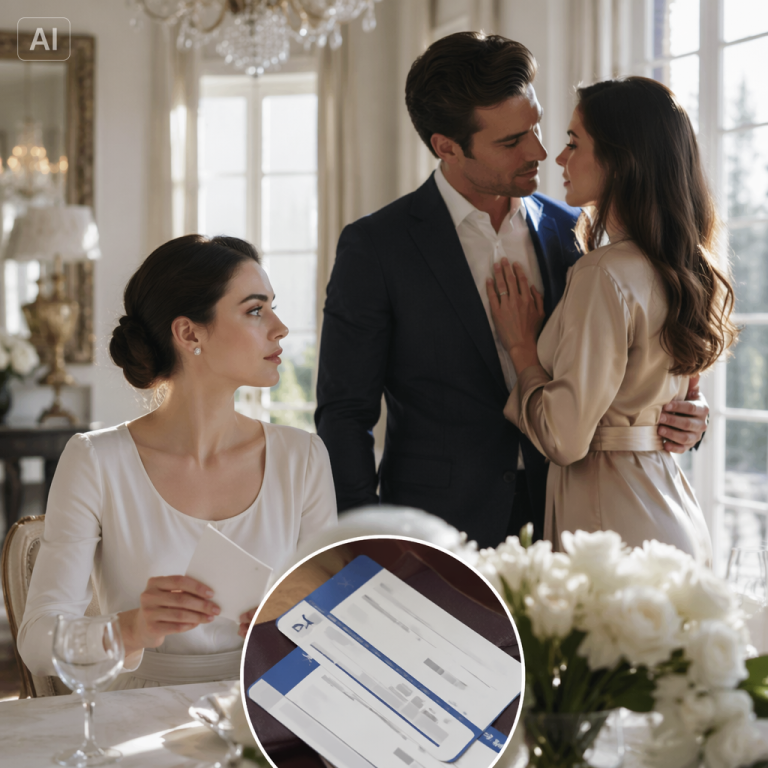
Two years earlier, after Graham missed the second fertility consultation and suggested, almost gently, that perhaps her body was “trying to tell them something,” Evelyn had stopped believing the marriage would ever correct itself. She and Norah had filed quietly, citing a full year of documented separation under the state’s no-fault statute — separate finances already, separate calendars, a marriage that existed mostly for cameras. Because Graham was simultaneously maneuvering his attorney to fold spousal advisory rights and future estate appointments into an unrelated tax restructuring, Norah had made sure the divorce petition, the waiver of marital property claims, and his acknowledgment of the restructuring all arrived in the same courier envelope, under the same signing appointment, twelve months later. Graham’s attorney, eager to close the tax matter before year-end, had walked him through it in nine minutes and told him it was routine. Graham had initialed every page without reading past the first paragraph of any of them.
The court entered the final decree the following week. Neither the finalization notice nor the case number had ever crossed Graham’s desk, because he had told his assistant, months earlier, to route anything from family court to his attorney directly — he found the correspondence “depressing.” He never asked what correspondence there might be.
Eight months after the decree, once the waiting period required for remarriage in that jurisdiction had passed, Evelyn and Malcolm married in a small civil ceremony with Norah as witness. Malcolm had offered himself first as a shield during the original filing — reviewing the settlement language, making sure nothing in it left her exposed. Then, slowly, as something else entirely.
He had never asked to be displayed. Never demanded proof that he mattered. That alone set him apart from Graham in every language Evelyn knew.
“This paragraph is too defensive,” Malcolm said now, sliding a donor statement toward her.
The auditor blinked. Few people edited Evelyn directly.
“It’s accurate,” she said.
“Accurate can still sound cornered.” His eyes held hers a beat too long. “Say the funds are protected. Say the programs continue. Say the chair has changed. You don’t owe anyone a poem about your pain.”
Something warm moved under her ribs — not triumph. Steadiness.
“Fine,” she said. “Cut the second paragraph.”
The meeting ran two hours: seating changes, press boundaries, security credentials, and the return of the pearls, which Laya had finally surrendered through Graham’s assistant after a formal demand letter. They sat now, locked, in Norah’s case. Evelyn hadn’t decided whether to wear them.
When the others left, rain had stopped outside, leaving the windows gray and reflective.
“You’re tired,” Malcolm said.
“I’m efficient. Those aren’t opposites.”
“Graham thinks I left because of Laya.”
“Partly you did.”
“I left because he brought her into my mother’s house and asked me to be civil.” She looked at the table. “But the leaving started before that. In pieces. At dinners. In hotel lobbies where he forgot I was standing beside him.”
“That doesn’t make you a coward,” Malcolm said. “It makes you someone who took time to stop calling survival loyalty.”
Evelyn had collected compliments from Graham for years — *elegant, patient, indispensable.* This wasn’t a compliment. It was more useful. It had a door in it.
“At the gala,” she said, “he’ll come.”
“I assume he’ll try to reclaim the room.”
“If he does — take my hand.”
“Then he sees me take your hand.” Malcolm’s voice softened without changing shape. “He’ll rage.”
“I know. You don’t have to stand in it.”
He reached across the table, palm open. She placed her hand in his.
“Evelyn. I didn’t marry you to stand nearby only when the rooms are kind.”
—
Graham arrived at the gala determined to look generous. Midnight tuxedo. Wedding ring still on — removing it would look guilty, keeping it looked wounded either way, but he chose the version that let him keep speaking in the first person. He’d rehearsed three statements in the car. All of them made Evelyn sound overwhelmed.
Laya wasn’t with him. After the governance packet reached donors, she’d texted that appearing together would be “professionally unwise” — two months after calling him the bravest man she knew. Now she sounded like a legal memo wearing perfume.
“Mr. West, will Mrs. West be joining you tonight?”
“Evelyn and I remain deeply committed to the mission,” he told the cameras, and it was a good answer, because it avoided the question and sounded like nobility.
Inside, the museum glowed — white branches strung with small gold lights like trapped stars, a string quartet near the Roman gallery, waiters moving through crowds of donors clustered beneath portraits of dead benefactors who had perfected the art of looking disappointed in advance. For a few minutes he recovered himself. People greeted him carefully, but they greeted him. Avoidance meant fear, not defeat. He could work with fear.
Then he opened the program.
*Evelyn Whitmore — Gala Chair.* Not Evelyn Whitmore West.
He turned the page. *Malcolm Reed — Keynote Honoree.*
He knew the name, of course. Reed’s legal aid network had received Whitmore support for years. Graham had filed him away as one of Evelyn’s earnest nonprofit men — useful for photographs with children, invisible everywhere that mattered. He had never considered him competition, because Graham did not categorize men by character. He categorized them by market value.
A donor approached him with something about a “complicated week.” Graham said, “Evelyn and I will resolve it,” and watched the man’s face shift with polite disbelief just as the lights near the staircase softened.
The room turned.
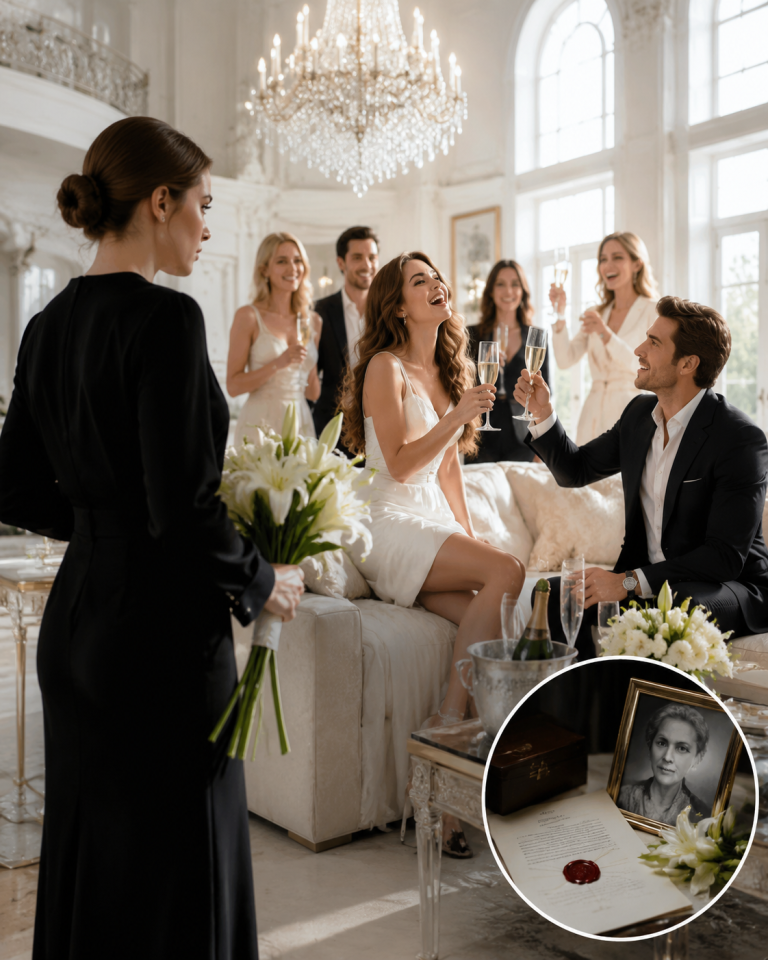
Evelyn appeared at the top of the stairs in a deep green gown, hair pinned back, and at her ears — the pearls. Not stolen proof, the way they’d looked on Laya. Inheritance, the way they’d always been meant to look.
For one bright, foolish second, Graham thought she had dressed for him.
Then Malcolm Reed stepped into place beside her.
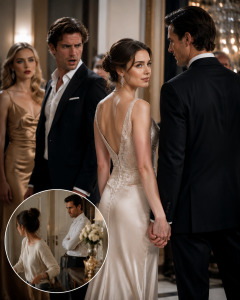
He didn’t touch her at first. That restraint made Graham dislike him instantly — men who waited for permission always looked virtuous to rooms that didn’t understand power. Evelyn paused on the landing, scanning the crowd with a calm Graham had mistaken for softness for eight years. Malcolm offered his hand. She took it — not as a hostess accepting help, but as a wife accepting the presence of her husband.
Graham felt the room notice before he understood why.
“Evelyn.” He crossed to her before his attorney, wisely stationed near the bar, could intercept him. “What exactly do you think you’re doing?”
“Hosting my mother’s gala,” she said. “With him.”
“Good evening, Mr. West,” Malcolm said.
Graham ignored him entirely. “You’re making a spectacle.”
Something crossed Evelyn’s face — not hurt, but a kind of sad recognition, the way you look at weather you’ve seen too many times to be surprised by. “You brought Laya into my home and asked me to be civil.”
Nearby conversation died mid-sentence.
“This isn’t the place,” Graham said, lower now.
“You chose the house. You chose the earrings. You chose the committee. You chose public rooms, every time, thinking they’d protect you.”
“Do not lecture me in front of my donors.”
“They’re not your donors.”
The sentence cut cleanly through the music. He smiled, and the smile had teeth in it now. “You think putting your maiden name on a program makes you powerful?”
Norah stepped forward, unhurried. “Mrs. Reed doesn’t need a program for that.”
Graham froze. Not at Norah’s tone — at the name.
*Mrs. Reed.*
A journalist near the museum’s Athena statue lifted her phone, then lowered it fast when security looked her way. Graham turned slowly to Evelyn. “What did she call you?”
“My legal name.”
“That’s impossible.”
“It’s documented,” Norah said.
He laughed once, short and disbelieving. “Documented? Evelyn, have you lost your mind?”
“Careful,” Malcolm said. Quiet. That made it worse.
“You don’t warn me in my own city.”
Evelyn stepped slightly ahead of Malcolm — not because he needed protection, but because this boundary was hers to draw. “You will not speak to my husband that way.”
*My husband.* The words visibly drained the color from Graham’s face, then flooded it back red. “Your husband? You are my wife.”
“I was your wife in every way that mattered until you made dignity impossible,” Evelyn said. “We divorced over a year ago. The petition was filed under the separation statute, and the court entered the final decree while you were signing your tax restructuring — the same week, the same courier, the same nine minutes your attorney gave you to read it. You initialed the acknowledgment on page fourteen without reading page one. Malcolm and I married eight months ago, once the decree was final and the waiting period had passed. There was nothing private about the court record, Graham. You simply never asked to see it.”
The gala had become a courtroom without benches.
“You tricked me.”
“No. I trusted you to read a document that affected my life. You trusted your arrogance instead.”
—
His rage didn’t arrive all at once. It gathered in layers — disbelief, calculation, public awareness — his eyes cataloging who had heard what, who might still be persuaded.
“This is fraud,” he said.
Norah produced a thin folder from her evening bag, looking as though she’d been born to serve documents under chandeliers. “There’s nothing to defraud. Case number, filing date, decree of dissolution, entered and stamped fourteen months ago. Your signature is on the acknowledgment your own attorney prepared. He labeled it estate planning because that’s the section he cared about.”
“I was told it was routine.”
“You were told what you wanted to hear so you’d sign quickly.” A few guests exchanged glances. Graham saw them, and hated them for witnessing his ignorance. He turned back to the only target left who still carried history. “You hid a divorce while playing victim in my house.”
“I hid nothing,” Evelyn said. “It was entered in public court. You simply never looked.”
“You married him to protect money.”
“She married me,” Malcolm said, “because you had already abandoned the marriage and started building pathways into assets you didn’t own. And I was helping clinics keep children housed during treatment. That’s where we met. Work, Graham. You may remember the word from your speeches.”
Someone behind them coughed to hide a laugh.
He stepped closer; security shifted; Evelyn lifted a hand slightly and they held position. She didn’t want him dragged out. Not yet. That would make him a victim too soon.
“You think this room will applaud you? A woman who replaces her husband in secret?”
She looked around the hall — donors, doctors, scholarship families, reporters pretending not to record with their eyes. “This room doesn’t need to applaud me. It needs to understand why the governance changed.”
The screen above the staircase lit. Not scandal. Not bedroom photographs — she’d refused anything that turned private humiliation into entertainment. Just a slide: *Protected Programs and Governance Updates.* Clinic funding secured. Scholarship endowment protected. Gala committee restructured. Then the facts, unadorned. Consulting approvals for Laya’s agency. Travel charged as outreach. Sponsor access sold through unofficial channels.
No adjectives. No fury. Just records.
“Turn it off,” Graham said.
“No.”
“Evelyn—”
“*No.*” The second one was quieter. It carried eight years of late arrivals and cold apologies and a woman walking out into rain.
Laya entered on the third slide, in black, no jewelry, the brittle composure of someone who’d spent three days talking to lawyers. She stopped when she saw the screen. Graham saw her too. “Why are you here?”
“I was invited to give a statement to the review committee.”
“You weren’t invited to the gala.”
“She was invited to the building,” Norah said. The distinction satisfied no one but was legally exact, which meant she enjoyed it.
Laya walked forward, the crowd parting with the particular fascination people reserve for a woman they’ve already decided how to judge. She glanced once at the pearls, gleaming and unreachable in Evelyn’s ears.
“I returned them.”
“You did,” Evelyn said.
“I shouldn’t have worn them.” Laya swallowed. “He said you knew. He said the marriage was already finished and you only stayed because the family image needed him.”
“Laya—” Graham warned.
“You told me the donor packages were standard. You told me the payments were approved. You told me Evelyn was too cold to care about anything but appearances.”
“Stop talking.”
“That’s what you say to women when they become inconvenient.”
The room went quiet in a new way. Evelyn didn’t soften toward her — Laya had made choices, had walked into another woman’s home wearing inherited pearls and called it uncomfortable. But accountability had layers, and Laya had finally reached one worth naming.
Graham’s control cracked at last. “You’re all very proud. But let’s be honest — this gala exists because *I* made it visible. I brought sponsors. I brought press.”
“My mother built clinics,” Evelyn said, almost gently, “before you learned how to pronounce philanthropy in front of cameras.”
His hand rose — not quite a strike, a jabbing, abrupt point too close to her face. Malcolm moved with calm speed, drawing her back half a step. Security closed in.
“Do not touch her,” Graham said, staring at their joined hands as though the sight itself had committed violence against him.
“She decides that,” Malcolm said.
He hadn’t raged, Evelyn understood then, because she’d betrayed him. He raged because someone had taken her hand without asking his permission — and she had allowed it. That was the wound he couldn’t survive.
—
The gala did not collapse. That, more than anything, was Evelyn’s victory. Security escorted Graham to a side room, not the street — Norah insisted on dignity, because chaos frightened donors and donors funded beds. Laya went with the auditor to give her statement. The quartet resumed after a pause so awkward the first note sounded like furniture being dragged in the dark.
Malcolm squeezed her hand once. “Breathe.”
She did. The air entered her like something she’d forgotten she was allowed to use.
Five minutes later she stood at the podium beneath her family’s portraits, her face on the side screens, looking — she noted with strange detachment — calm. Not untouched. Calm.
“Good evening. Many of you came tonight expecting a celebration of civic generosity. Some of you have instead witnessed an uncomfortable governance correction.” A ripple moved through the hall — not laughter, exactly. Relief recognizing intelligence. “My mother believed charity should never depend on the ego of the person holding the microphone. I’ve thought about that often this week.”
A few people laughed softly now.
“The Whitmore Civic Futures Gala funds pediatric trauma rooms, scholarships, legal navigation for vulnerable families, emergency housing through our clinics. Those programs are protected. They will continue. Committee access has been corrected. No patient, no student, no family will pay for a failure of judgment in this room, or any other.”
Her eyes found Malcolm near the first column, steady, not trying to own the moment.
“One thing about civility,” she said, and the word changed the room. “It isn’t silence in the face of disrespect. It isn’t a wife smiling while her home and her history get treated as props. Real civility starts with the truth, and sometimes the truth requires leaving a house in the rain.”
No one clapped yet. The room was too busy listening.
“This isn’t about revenge — that’s too small for what my mother built. It’s about making sure generosity never becomes a costume for vanity.” She paused. “Thank you for staying. Thank you for giving. And thank you, in advance, for reading the revised committee policies before you sign them.”
That broke the tension. Laughter, then applause — not wild, but sustained, the kind that doesn’t need to hide inside itself.
Dinner was served. A surgeon spoke about the trauma rooms. A scholarship recipient named Amara described night shifts spent finishing her nursing degree. Malcolm delivered his keynote without once mentioning Graham, speaking instead about children who aged out of systems and into paperwork no one had taught them to read. By the end, several donors had increased their commitments — which, more than Graham’s humiliation, nearly made Evelyn cry.
At eleven she slipped into the sculpture garden for air. The rain had washed the sky clean; the cold felt like something waking her up.
Malcolm found her by the bronze fountain. “You disappeared.”
“Relocated. Strategically. Emotionally.” He offered his coat; she accepted it, because accepting care was another thing she was learning not to treat as weakness. “You were magnificent,” he said.
“Careful. That sounds like a gala compliment.”
“Then I’ll be specific. You protected the work while telling the truth. That’s hard.” He looked at the small silk pouch in her hand, where she’d tucked the pearls after dinner. “When Laya wore those, did you think you’d feel better once you had them back?”
“Not exactly. They’re still just earrings. The insult was never really about the pearls. It was about him believing nothing of mine was sacred unless he decided it was valuable.”
“Yes,” Malcolm said, not pleased with his accuracy — just present with it.
“May I?” He held out his hand. The question, small as it was, nearly undid her. She placed her hand in his, and they walked back inside — not as a spectacle, not as a correction to Graham’s story, but as two people entering a room where she no longer had to stand alone to prove she was strong.
—
Six months later, the house opened again.
No ribbon, no cameras — Evelyn had refused any ceremony that made survival look decorative. Instead, on a cold March morning, the first family arrived: a grandmother named Ruth, her daughter Nenah, and Nenah’s six-year-old son Theo, who needed weekly treatment at the clinic and loved outer space. Theo chose the east guest room because the window faced the moon on clear nights.
Evelyn stood in the hallway while staff carried in donated furniture. The scent of lilies Graham always ordered, knowing she disliked their heaviness, was gone. The pearls were locked safely at Whitmore House, no longer needed as proof of anything. A small plaque near the staircase read only: *Family Residence and Legal Support Center.* No mention of Evelyn. No mention of Graham. That felt right.
Malcolm arrived late, a box of children’s books under one arm, legal intake forms under the other. Theo immediately asked if any of the books had rockets. Malcolm crouched and began sorting through the box with the seriousness of a man examining evidence.
Evelyn watched them from the foyer and thought about all the years she’d believed love announced itself through sacrifice — that if she hurt quietly enough, waited beautifully enough, forgave quickly enough, the marriage would eventually become worthy of what she’d invested. Love, she understood now, didn’t require a woman to disappear in installments. Love could be Malcolm asking before he touched her hand. It could be Norah telling the truth without decorating it. It could be a house remade so strangers had somewhere safe to sleep.
That afternoon, after the family settled, she walked into the garden. Early spring showed itself in small green points beneath the hedges. The fountain was still covered for winter; the air smelled like soil and rain.
Graham called as she reached the old stone bench. She almost let it go to voicemail. Then answered.
“Evelyn.” His voice sounded older — not broken; he would never give anyone that satisfaction — but thinner. “I heard what you did with the house. It opened today.”
“My father sent me the article.” A pause. “Was that meant to punish me?”
There it was — still the assumption that her choices orbited him. “No,” she said. “That’s why it will last.”
Silence, traffic on his end, maybe wind. For the first time, she didn’t try to picture where he was standing.
“I was cruel,” he said finally.
“Yes.”
“About Laya. About the house. About everything.”
“Yes.”
Another silence, longer this time. “Do you hate me?”
Once she would have softened the answer to spare him the weight of asking. Now she gave him something cleaner. “No. I’ve put you where you belong.”
“Where’s that?”
“In my past.”
He exhaled. “And him?”
She looked through the window toward the library, where Malcolm was helping Theo shelve a rocket book on the lowest rung. “He’s beside me.”
“You love him?”
“Yes.”
The silence that followed was the longest of the call. “I thought you needed me,” Graham said, so quietly she nearly missed it.
There was the whole story, folded into one sentence. Not *I thought you loved me.* Not *I thought I loved you.* *I thought you needed me.*
“I know,” she said. “You were wrong.”
She ended the call without anger. Inside, Theo laughed at something Malcolm said; Norah was probably in the front room correcting a volunteer’s filing system; Ruth was making tea, because some women restore themselves by feeding people. Life was filling the rooms with sounds that didn’t ask permission from memory.
Evelyn walked back to the foot of the staircase — the same staircase where Graham had once brought his mistress home, where he’d asked her to be civil, where she’d walked out and mistaken the cold for an ending. A child ran past her now in socks printed with planets, and the house did not echo with betrayal. It held new footsteps. New names. New reasons to keep the lights on.
Malcolm came to stand beside her. “You okay?”
She looked at his open hand. He never reached until she did. She took it.
“Yes,” she said. “I think this is what peace sounds like.”
He listened to the house a moment longer. “Good.”
She had not become powerful the night a roomful of donors discovered her documents. She had become powerful the night she stopped asking cruelty to call itself love — and from that height, she had built something no betrayal could ever enter again.
**THE END.**